Ao dai: Vietnam's national dress, tailored in a day
A fitted, ankle-length tunic worn over loose trousers — the symbol of Vietnamese grace. What the ao dai is, how the northern white version differs from the bright southern ones, where and for how much to get one tailored in Hoi An, how to choose the fabric, and where to do a photoshoot.

Below: what the ao dai is and where it came from, how the northern white ao dai differs from the bright southern ones, where and for how much to get one tailored in Hoi An, how to choose the fabric without overpaying, where to do a photoshoot, and whether a foreigner can wear it at all. If you're planning a shopping run, pair this with our Hoi An guide and our roundup of what to bring home from Vietnam.
What is the ao dai?

Áo dài is Vietnam's national dress: a long, fitted tunic with high side slits, worn over loose trousers. The name translates literally as "long shirt," but that plain phrase undersells it — the ao dai has long been a symbol of Vietnamese grace and national identity.
The silhouette is unmistakable: a mandarin collar, a fitted bodice, and two long panels — front and back — that flow to the ankles and split at the waist. Underneath are matching or contrasting trousers. The panels move beautifully in the wind, which is exactly why photographers love it: the dress "works" on a breeze, on a bicycle, in a temple doorway.
It's worn for holidays (Tet, weddings), as a school and office uniform, and increasingly by travellers who get one made as a keepsake or rent one for a photoshoot. There's a men's version too — more on that below.
History: from 1744 to the modern silhouette

The ao dai's story is usually traced to 1744, when Lord Nguyen Phuc Khoat of the southern realm ordered his court to wear a gown with trousers — the "five-part dress" (áo ngũ thân), the direct ancestor of today's garment. It was loose and layered, far from the fitted dress we know now.
The turning point came in the 1930s. The Hanoi artist Le Mur (Nguyen Cat Tuong) reworked the old dress: he stripped the layers, made the cut fitted, and extended the panels to the ankle. The new silhouette became fashionable and spread through the cities. So the modern ao dai is really a nearly-century-old modernist design, not an "ancient costume."
| When | What happened |
|---|---|
| 1744 | Lord Nguyen Phuc Khoat introduces the gown with trousers — áo ngũ thân |
| 1930s | Le Mur simplifies the cut, makes the silhouette fitted |
| Late 1930s | The new cut becomes fashionable and spreads |
| 20th–21st c. | The ao dai settles in as national dress and everyday uniform |
Regional styles: north, central, south

The ao dai isn't the same across the country. As with much in Vietnam, north, central and south pull it in different directions.
| Region | Character |
|---|---|
| North (Hanoi) | Restrained: soft colors, heavier fabric, modest patterns. White schoolgirl ao dai is the northern icon |
| Central (Hue) | Royal heritage: formal, rich colors, traditional motifs, heavy fabrics for ceremonies |
| South (HCMC) | Bright: bold colors, floral prints, light fabrics — for the heat, Tet and weddings |
The north likes minimalism — muted tones and fabric quality over a riot of color, epitomised by columns of schoolgirls in white ao dai. White symbolises youth and purity.
The centre, especially Hue, keeps an imperial aesthetic: darker, richer colors, heavy embroidery, often in silk or velvet. This is the ao dai for ceremonies and temples.
The south is the opposite of northern restraint. In Ho Chi Minh City the ao dai is bright, floral and light: the heat demands practicality and the festival culture loves color. At Tet the south dresses up in ao dai of every shade at once.
The modern ao dai — not just tradition

Young designers have long been reworking the classic. There are ao dai with a boat neckline instead of the mandarin collar, knee-length versions, and models with short sleeves that are easier to wear to the office and every day. Asymmetric hems, sheer layers, bold prints and metallic embroidery have all come into fashion.
There's also the "ao dai rental by the hour" — a whole industry around photoshoots: tourists and locals are handed a ready look, fitted on the spot and given accessories (conical hats nón lá, fans, parasols). So the ao dai today is both museum classic and living fashion that keeps evolving.
Fast Track — no queue at the border
5–10 minutes instead of an hour in the immigration queue
from$11per passenger
Where to get one made — Hoi An, the tailoring capital

If you want your own ao dai, go to Hoi An. This small colonial town in central Vietnam is rightly called the tailoring capital of the world: hundreds of shops, working fast and precisely. An ao dai can be made in 3–4 hours, though you should allow 2–3 days for a dress with fittings.
- A Dong Silk (A Đông Silk): One of the oldest tailors (since 1998) — Made-to-measure suits and shirts
- Yaly Couture (Yaly Couture): Classic + contemporary — Good fabrics, experienced tailors
- Bebe Tailors (Bebe Tailors): Several showrooms — Advice on fabrics and cuts
- MAYA Hoi An (MAYA Hội An): Ao dai rental + photoshoot — Fits any body type
Trusted shops:
- A Dong Silk — one of the oldest (since 1998), known for made-to-measure suits and shirts.
- Yaly Couture — holds a high standard, makes both traditional and modern ao dai.
- Bebe Tailors — several showrooms, good at advising on fabrics.
- MAYA Hoi An — if you don't want to have one made, they rent ao dai for photoshoots and fit them to you.
You can get one made in Hanoi or Ho Chi Minh City too, sometimes cheaper. But Hoi An's tailors have decades of experience cutting this tricky garment for foreigners.
How much it costs and choosing the fabric

Prices swing wildly — from pocket change to near-designer — depending on the fabric and shop. Rough guide for 2026:
| What | Price | Note |
|---|---|---|
| Ao dai tailoring (crepe / polyester) | from ~$55 (1,400,000 VND) | Simple, practical fabrics |
| Ao dai tailoring (silk + embroidery) | ~$120 (3,000,000 VND) | Silk blends, patterned |
| Photoshoot rental | ~$10–25 | Fitted to you |
On fabric: silk is the most striking — it flows and shimmers, but costs more and is fussier to care for. Crepe and polyester are the practical pick for the heat and everyday wear, cheaper and wrinkle-resistant. Velvet is used in central Vietnam for ceremonial ao dai.
And the golden rule of the market: haggle. In tourist shops you can knock the price down; how far depends on the place and the markup. Ask for the finished price including fabric, and compare a couple of shops.



An ao dai photoshoot

Even if you have no time to get one made, you can rent an ao dai for a couple of hours for a photoshoot — a small pleasure in itself. Rental spots like MAYA Hoi An and Hoai Phuong Ao Dai offer ready looks for any body type, fit them on the spot and add accessories: a conical hat, a fan, a parasol.
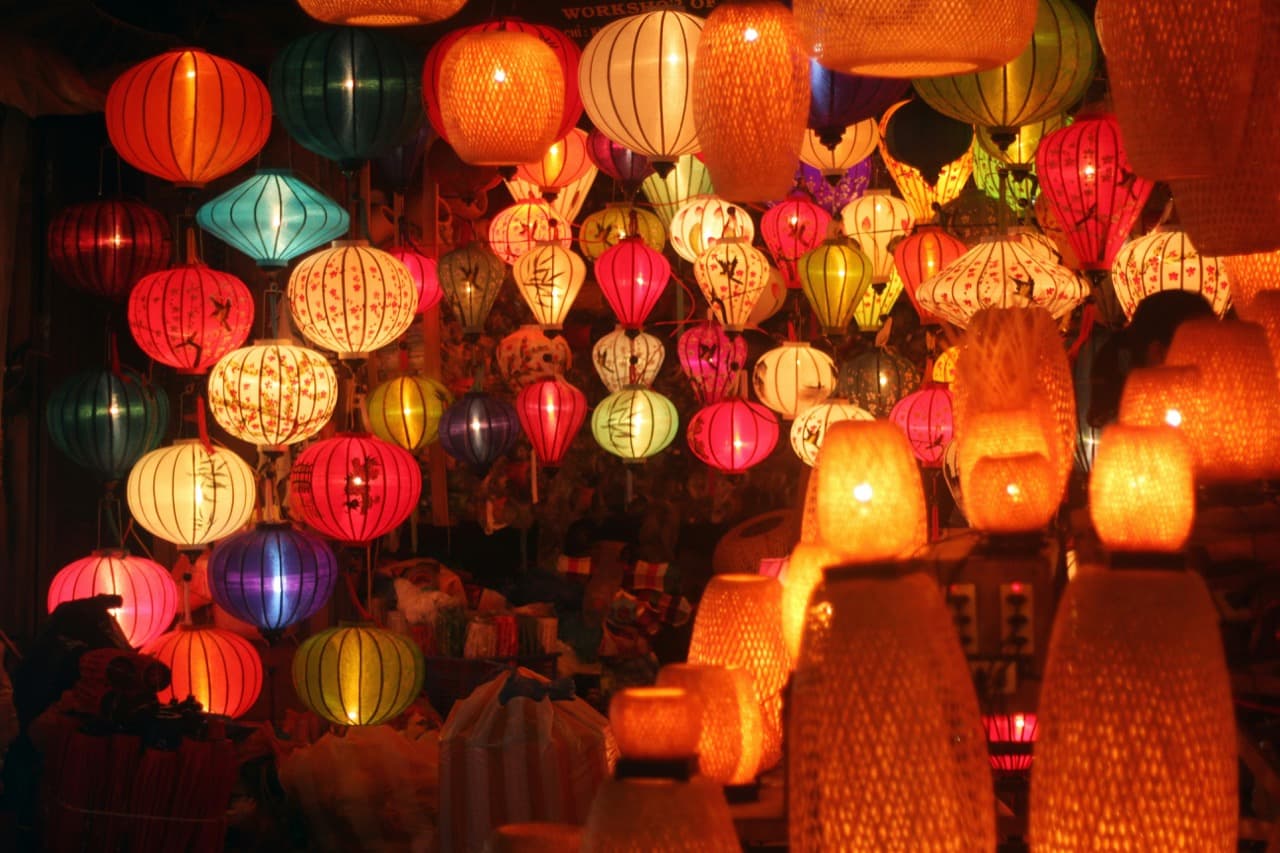
Where to shoot: in Hoi An, by the Japanese Bridge and in the yellow colonial lanes of the Old Town among the lanterns. In Hanoi, the Temple of Literature and blossom-lined streets in spring. In Hue, against the imperial citadel. Many photographers offer an "ao dai + shoot" package from $30–60. Best light is early morning, before the crowds and the heat.
Can foreigners wear it, and the men's version

A common worry: is it disrespectful for a foreigner to wear the national dress? The answer is a clear no — the opposite. Vietnamese people see it as a sign of interest and respect, happily photograph tourists in ao dai and compliment them. The only rule: in temples and pagodas, cover shoulders and knees, as with any clothing.
The men's ao dai (áo dài nam) is often forgotten but very much exists and looks sharp — looser than the women's, often in dark patterned silk, with a turban-style headpiece for formal ceremonies. Grooms often wear one at a traditional wedding, so a matching couple's look is a real option.
Quick phrases for the tailor
| Phrase | Vietnamese | Pronunciation |
|---|---|---|
| How much to make it? | May bao nhiêu tiền? | May bao nyeu tien? |
| In silk, thank you | Bằng lụa, cảm ơn | Bang lua, gam un |
| When will it be ready? | Khi nào xong? | Khee now song? |
| Can I try it on? | Cho tôi thử được không? | Cho toy thu duok khong? |
FAQ
The ao dai is Vietnam's national dress: a long, fitted tunic with side slits worn over loose trousers. It's a symbol of Vietnamese grace and identity, worn for holidays, weddings, and as a school and office uniform.
From ~$55 (1,400,000 VND) for a crepe dress to ~$120 (3,000,000 VND) for silk with embroidery. The city-wide range is wide, and you can usually haggle the price down.
Yes, and it's welcomed. Vietnamese people see a foreigner in an ao dai as a sign of respect, not appropriation. The only rule is to cover shoulders and knees in temples.
In Hoi An a simple ao dai can be ready in 3–4 hours. But with fittings and adjustments, allow 2–3 days, so order it early in your trip, not on the last evening.
Rent one (MAYA Hoi An, Hoai Phuong) with an on-the-spot fitting. Shoot in Hoi An by the Japanese Bridge and yellow lanes, in Hanoi at the Temple of Literature, in Hue at the citadel. A photographer package runs from $30–60.
Yes, áo dài nam — looser than the women's, often dark patterned silk, sometimes with a turban for ceremonies. Grooms wear one at traditional weddings, so a couple's set is possible.
- Shopping
Shopping in Cam Ranh: Markets, Souvenirs & Duty-Free
What to buy in Cam Ranh: local markets, resort-strip shops, souvenirs, airport duty-free and a Nha Trang shopping trip — with bargaining tips.Shopping in Cam Ranh: Markets, Souvenirs & Duty-Free - Shopping
Shopping in Vietnam: What to Buy & Where 2026
What to buy in Vietnam: coffee, silk, ao dai, lacquerware, spices and pearls — where to shop, how to bargain and what to know about customs.Shopping in Vietnam: What to Buy & Where 2026 - Shopping
Hanoi Shopping 2026: Markets, Silk and Craft Villages
Where to buy silk, ceramics and souvenirs in Hanoi: Dong Xuan market, Hang Gai street, Bat Trang and Van Phuc villages, malls. Prices, map, haggling rules.Hanoi Shopping 2026: Markets, Silk and Craft Villages