Bia hoi: Hanoi's freshest street beer
Bia hoi is Hanoi's fresh draft beer, brewed and drunk the same day, for a glass that costs less than your morning coffee. What it is, its history, where to drink it at the Ta Hien corner, the price, the etiquette and the snacks.

Below: what bia hoi is and why it's called "fresh," how a French brewery turned it into a people's drink, where to drink it in Hanoi, what it costs, how to toast properly, what to order as a snack, and whether street beer is safe. For the food side, see our guides to Hanoi food and Vietnamese street food.
What is bia hoi?
Bia hơi literally means "fresh beer." It's a light draft lager brewed in the morning, delivered to stalls in steel kegs by midday, and whatever isn't finished by night is simply poured away. No months in a warehouse: the beer lives one day, hence the name. In the glass it's a pale, lightly carbonated, refreshing lager of just 2–4%.
Because of the short cycle, bia hoi is considered a "living" beer. The taste is simple, faintly bready, nothing fancy — but that's not the point. Bia hoi is about the atmosphere: the sidewalk, the low plastic stools, the buzz of the street, and a glass that costs less than your morning coffee.
One more key detail: bia hoi is a northern, Hanoi phenomenon. In Ho Chi Minh City the beer culture is different — more bottled Bia Saigon and craft. For the real thing, go to Hanoi.
History: from a French brewery to a people's drink

Bia hoi's story starts with the colonisers. In the 1890s the French opened the country's first brewery in Hanoi, Hommel — tiny, about 150 litres a day, mostly for French officers. To locals this "strange bitter drink" was neither to their taste nor within their budget.
Everything changed after 1954, when the French left Hanoi. The brewery was renamed the Hanoi Brewery (later HABECO), but locals saw bottled beer as a luxury for the rich, and bottles were hard to transport. So the brewery switched to cheap draft beer — and bia hoi was born. It didn't catch on at once: Hanoians stuck to rice wine until the government clamped down on home-made spirits.
Since then bia hoi has been a symbol of the Hanoi street — and a remarkably egalitarian drink. Office workers, students, retirees and tourists share the same plastic stools. The beer puts everyone on the same level.
A 2020 piece on the Vietnam National Administration of Tourism site sums up the journey in its title: from bitter and expensive to Hanoi's favorite drink.
Where to drink it — the Ta Hien corner in Hanoi

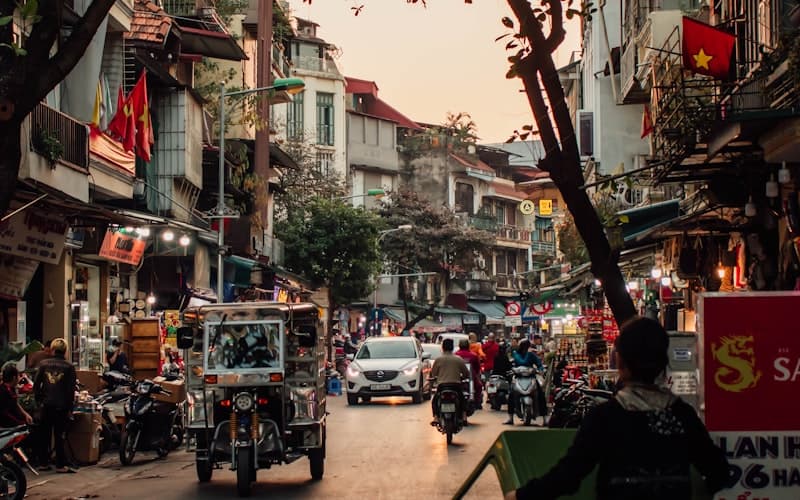
The main draw is Bia Hoi Junction, at the corner of Tạ Hiện and Lương Ngọc Quyến in Hanoi's Old Quarter. It's the heart of the nightlife: by evening the sidewalks fill with stools, tables and people, and dozens of stalls pour fresh bia hoi. The street comes alive around 5 PM and peaks 8–10 PM.
You don't need to hunt for a specific bar — just head to the corner and sit where the locals sit and a Bia hơi sign shows the price chalked up. A good sign is quick turnover: if the beer's moving, the keg is fresh.
Outside Hanoi, real bia hoi is rarer. In Ho Chi Minh City the scene leans toward bars and craft — more on that below.
Fast Track — no queue at the border
5–10 minutes instead of an hour in the immigration queue
from$11per passenger
How much it costs
Bia hoi is probably the cheapest line in your Vietnam budget. Guide for 2026:
- Glass of bia hoi5,000–20,000 VND ≈ $0.20–0.75
- Snacks (skewers, peanuts, salad)30,000–100,000 VND ≈ $1.20–4
- Evening for a group of 2–3150,000–300,000 VND ≈ $6–12
A single glass is literally 20–75 cents — cheaper at back-street stalls, closer to the top end at the touristy Ta Hien corner, but pennies either way. Even a solid evening of beer and snacks for a group rarely tops $12 for everyone. For comparison, a single craft pint back home costs as much as that whole Hanoi evening.
Etiquette and toasts
The rules of bia hoi are pleasantly simple: be social, don't block the whole sidewalk, and be ready to clink glasses. The one toast to learn is "Một, hai, ba, dzô!" ("one, two, three, cheers!"). It's shouted in unison as glasses go up, and in the first few rounds you're expected to clink with everyone at your table.
And it would be incomplete to enjoy bia hoi without the iconic mint green glass… The glass, with its surface dotted with bubbles, makes a satisfying 'clink' sound when toastingHoang Ngoc Sinh, a regular at a Hanoi subsidy-style beer stall, VnExpress International, 2024
Ordering is easy: hold up the number of glasses and they arrive. Tables at busy corners turn over fast, so don't be surprised if you're seated with strangers. That's normal and even encouraged — bia hoi is about company, not solitude.
Quick phrases for the corner
| Phrase | Vietnamese | Pronunciation |
|---|---|---|
| Two beers, please | Hai cốc bia, cảm ơn | Hai gok bia, gam un |
| Cheers! (toast) | Một, hai, ba, dzô! | Mot, hai, ba, yo! |
| How much do I owe? | Bao nhiêu tiền? | Bao nyeu tien? |
| Very good | Ngon quá | Ngon kwa |
What to order as a snack

Bia hoi is rarely drunk "dry" — there's a whole ecosystem of snacks around it. Worth trying:
- Roasted peanuts (lạc rang) — the classic, costs pennies.
- Grilled skewers — pork, chicken hearts, all on little sticks.
- Nem chua — sour fermented pork in a banana leaf.
- Nộm — a fresh green-papaya salad with peanuts.
- For the brave: trứng vịt lộn (balut, a boiled fertilised duck egg) and bánh tráng nướng, the "Vietnamese pizza" of crisp rice paper with egg and dried shrimp.
Order snacks from the same stall or passing vendors — just point. A full dinner of beer and snacks at the Ta Hien corner comes to less than a salad in a tourist café.

Is it safe, and practical tips

At busy stalls bia hoi is usually safe — it's brewed and drunk within a day, and the keg doesn't sit. A few sensible tips:
- Freshness is your friend. Go where it's crowded and the beer moves fast.
- Know your limit. It's light and goes down easily, but 3–4% is still alcohol and glasses come quickly. Count your rounds.
- Ice optional. Bia hoi is sometimes served with ice; if you worry about the water, ask for none (không đá).
- Don't block the sidewalk. Stools are packed tight; respect passers-by.
- Cash. Bia hoi is cash only, in small notes. No cards here.
North vs south and the craft wave
Bia hoi is Hanoi and the north. In Ho Chi Minh City the street-beer culture is weaker: bottled Bia Saigon and 333, rooftop bars and a growing craft scene rule instead. Where the north is about cheap fresh lager on the sidewalk, a beer evening in the south more often happens in a bar. The brands and prices are in our guide to alcohol in Vietnam.
Craft is creeping into Hanoi too, with local IPAs and porters sitting alongside the pennies-a-glass bia hoi. But bia hoi remains the authentic Hanoi experience — worth one evening on a plastic stool.
FAQ
Bia hoi is fresh draft beer brewed in the morning and drunk the same day. It's a light lager of 2–4%, served on low stools right on the street. It's a Hanoi phenomenon and a symbol of the city's street culture.
Around 2–4% — very light, weaker than most bottled lagers. That's why locals can enjoy a few glasses in the evening without feeling heavy.
- A glass5,000–20,000 VND~$0.20–0.75arguably the cheapest beer in the world
- Local stallscheaper
- The touristy Ta Hien cornersits at the topof that range
- Snacks30,000–100,000 VND
An evening for a group of two or three rarely tops $12
The classic spot is Bia Hoi Junction, at the corner of Ta Hien and Luong Ngoc Quyen in the Old Quarter. It comes alive around 5 PM and peaks 8–10 PM. Sit where the locals sit and a Bia hơi sign shows the price.
Usually, at busy stalls. It's brewed and drunk within a day, and high-turnover stalls keep the keg fresh. Pick busy spots, know your limit, and ask for no ice if you're cautious about the water.
Real bia hoi is a northern thing. In Ho Chi Minh City the street-beer culture is weaker, with more bottled beer, rooftop bars and craft. For the authentic version, go to Hanoi.
- Food
Mui Ne Food Guide 2026: Seafood, Street Food & Prices
Where to eat in Mui Ne in 2026: seafood by weight, the 6am fish market, Binh Thuan dishes and Bo Ke in Ham Tien. Prices in VND and USD, map of 9 spots.Mui Ne Food Guide 2026: Seafood, Street Food & Prices - Food
Hue Food Guide 2026: What to Eat and Where
What to eat in Hue in 2026: 12 dishes with addresses, bun bo Hue, imperial dinners from $20 to $60, vegan chay spots, Dong Ba market and real prices.Hue Food Guide 2026: What to Eat and Where - Food
Quy Nhon Food Guide 2026: Seafood, Banh Xeo, Prices
What to eat in Quy Nhon: banh xeo tom nhay, bun cha ca, imperial crab. Verified addresses, Cho Dam market, seafood prices in VND and USD, a one-day route.Quy Nhon Food Guide 2026: Seafood, Banh Xeo, Prices