SIM card & eSIM in Vietnam (2026)
A tourist SIM with generous daily data costs from about $2, and Vietnam's mobile network is one of the fastest in Southeast Asia — 4G reaches ~99% of the country and 5G is live in the big cities. This guide covers the two ways foreigners get online: an eSIM installed before you fly, or a physical SIM bought on arrival. Operators, real 2026 prices, the passport rule, and the mistakes that make people overpay.
You want mobile data from the minute you arrive. Grab (the local ride app), Google Maps, Google Translate and QR-code payments all lean on it, and the airport WiFi rarely stretches to the taxi rank. Two options do the job for foreigners: an eSIM you switch on the moment you land, or a physical SIM from an operator counter. This guide sticks to those — for café WiFi, home fibre and VPNs, see the separate internet in Vietnam guide.
eSIM or physical SIM? The quick answer
Both give you the same networks and the same speed. The choice comes down to how long you're staying and whether you need a Vietnamese phone number.
- Short trip, want data on landing: buy an eSIM before you fly. No counter, no queue, no passport step, and your home number stays live for bank codes.
- A month or more, cheapest data, a local number: pick up a physical Viettel or Vinaphone SIM at the airport. It's a few dollars for a month of daily data, and the number lets you use Grab, food delivery and bookings.
Mobile data speed and 5G
Per Ookla Speedtest (August 2026), Vietnam's median mobile download speed is about 220 Mbps, ninth in the world. 4G reaches ~99% of populated areas, and 5G is already live in Hanoi, Ho Chi Minh City, Da Nang, Nha Trang, Hai Phong and Can Tho. In practice you rarely think about the signal at all.
| Network | Speed | Coverage | SIM price |
|---|---|---|---|
| 4G LTE | 50–150 Mbps | ~99% of the country | from ~$2/week |
| 5G | 300–600 Mbps | Major cities | same SIM, no extra fee |
Out in the countryside and the mountains — Sa Pa, Ha Giang, the Mekong Delta — 4G still works, but the signal thins out and only Viettel holds steady off the main roads. If your trip goes genuinely remote, that alone is a reason to pick Viettel.
Mobile operators in Vietnam

There are four operators. All sell tourist SIMs with big data bundles; they differ in coverage, speed and price.
| Operator | Coverage | Best for |
|---|---|---|
| Viettel | Best in the country | Travelling nationwide |
| Vinaphone | Excellent in cities | Cities & beach resorts |
| Mobifone | Good in cities | Budget, tourist areas |
| Vietnamobile | Big cities only | Cheapest, single-city stay |
Viettel is the market leader and reaches even Sa Pa's mountains and remote islands — pick it if you're covering the whole country.
I got Viettel in Hanoi and travelled the whole of Vietnam, from Ban Gioc Waterfall in the north to Con Dao island in the south. The signal never dropped — even on the train there was coverage almost everywhereremboiv, Vinsky Forum, 2026, translated by VietnamSpot
Vinaphone is marginally faster in Hanoi and Ho Chi Minh City, 10–15% cheaper, and great for city breaks and the coast. Mobifone is fine in the main tourist zones. Vietnamobile is the cheapest but city-only — signal vanishes once you ride out of town.
Tourist SIM plans & prices
Every operator sells prepaid tourist bundles with big daily data caps. Prices below are current for 2026, in VND with an approximate USD conversion at ~26,000 VND to $1.
| Plan | Data | Validity | Price |
|---|---|---|---|
| Viettel | several GB/day | 7–30 days | 60,000–200,000 VND (~$2–8) |
| Vinaphone D | 2–4 GB/day | 7–30 days | 90,000–180,000 VND (~$3.5–7) |
A daily cap such as "3 GB/day" resets every morning — plenty for maps, calls, streaming and tethering a laptop. Plan names and allowances change often, so check the current list at the counter or in the My Viettel app. For a 2–4 week trip a 30-day plan is the sweet spot.
Mobifone plans
Mobifone counts data differently: its tourist bundles give you a total allowance for the whole period rather than a daily cap, so heavy streaming burns through them faster than the number suggests.
| Plan | Data | Validity | Price |
|---|---|---|---|
| HVN3 | 25 GB total | 3 days | 80,000 VND (~$3.10) |
| HVN7 | 50 GB total | 7 days | 120,000 VND (~$4.60) |
| HVN30 | 250 GB total | 30 days | 240,000 VND (~$9.20) |
These are sold through the Hi Vietnam app, which runs an eKYC check — a short video call against your passport. Fine if you have data already; awkward as your very first step off the plane.
Topping up
Four ways to add credit, in rough order of how often travellers use them:
- Scratch card. Sold in mini-markets, corner shops and petrol stations for 10,000–500,000 VND. Scratch off the panel and enter the code via USSD. No app, no card, no Vietnamese needed.
- Operator app. My Viettel, My VNPT or My MobiFone take Visa and Mastercard.
- Mini-market counter. Circle K, FamilyMart and GS25 will top up the number for you at the till.
- Vietnamese bank app. Only relevant if you've opened a local account — see the bank account guide.
USSD codes worth saving
These work on any handset, with no app and no signal-hungry data connection — useful when a bundle runs out at the worst moment.
| What you want | Viettel | Vinaphone | Mobifone |
|---|---|---|---|
| Check balance | *101# | *101# | *101# |
| Find your own number | *098# | *110# | *0# |
| Data left | *102# | *102# | *102# |
| Redeem a scratch card | *100*code# | *100*code# | *100*code# |
Prices are current as of July 2026. Check the operator's own site before you travel — bundles change often.
Fast Track — no queue at the border
5–10 minutes instead of an hour in the immigration queue
from$11per passenger
eSIM — get online before you land
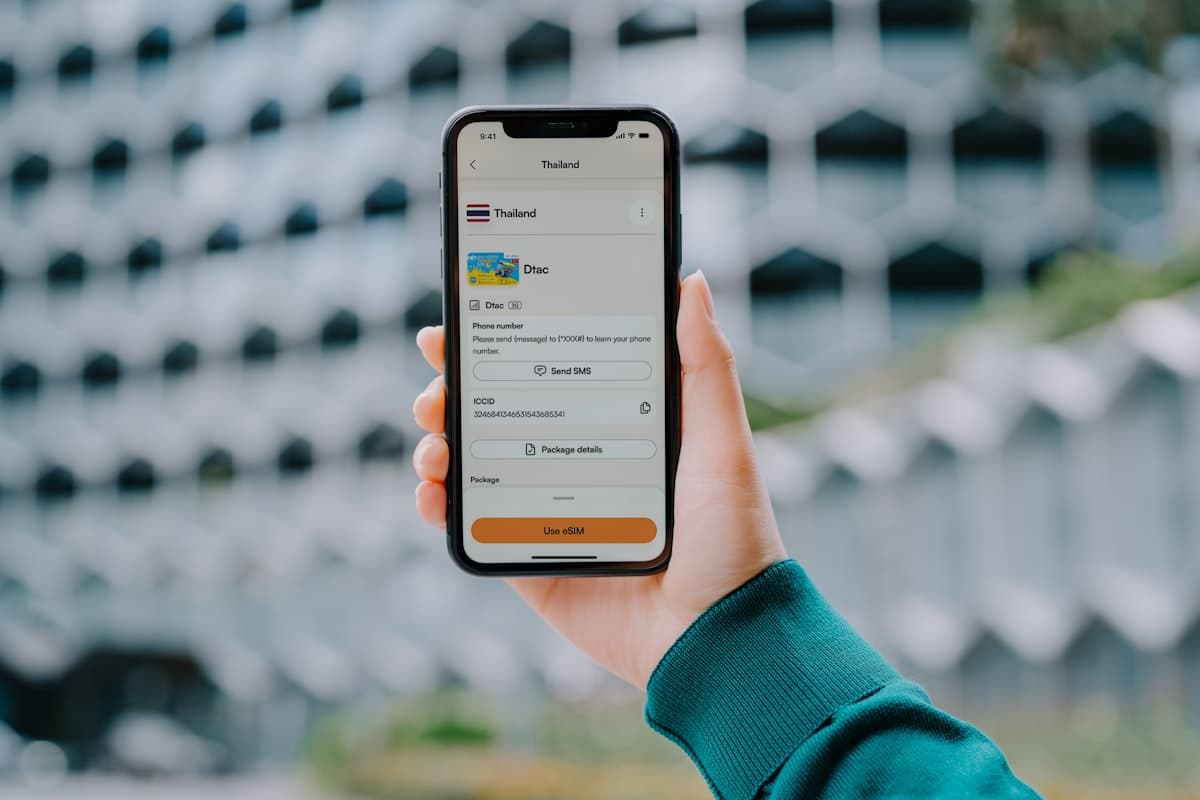
If your phone supports eSIM (most recent iPhones and flagship Androids do), this is the smoothest option: buy a Vietnam plan online, install it before departure and switch it on when you land. Providers like Airalo, Saily and Holafly run on Viettel or Vinaphone under the hood, so coverage matches a local SIM.
| Provider | Sample plan | Price | Network |
|---|---|---|---|
| Saily | 1 GB / 7 days | ~$4 | Viettel |
| Airalo | 10 GB / 30 days | ~$16 | Viettel / Vinaphone |
| Holafly | Unlimited / 7 days | ~$27 | All three |
To activate: buy the plan, get a QR code by email, then on your phone go to Settings → Cellular → Add eSIM and scan it. Set the new plan for data and keep your home SIM for calls and texts.
- Upside: data the second you land, home number stays active, and there's nothing to lose or forget at a counter.
- Downside: a bit pricier per GB than a local SIM, and most eSIMs are data-only — no Vietnamese number. Airalo's 10 GB month is ~$16, versus ~$8 for a month-long local SIM with several GB a day.





Where to buy a SIM (and the passport rule)
- Airport counters (fastest). Viettel, Vinaphone and Mobifone have staffed desks in the arrivals hall, usually open until the last flights. Staff register the SIM to your passport, set the data and check it works. The catch: prices run 20–30% above a city shop.
- Official operator stores. The cheapest prices and the full plan range, found in every town — handy if you want to top up or switch plans later.
I went round the operators' offices, having studied the plans in advance and taken screenshots from the website… The girl hands me a crooked printout with plans at 600–800, and supposedly they have no others. Fine, off to VinaphoneBulat_, Vinsky Forum, 2026, translated by VietnamSpot
- Skip unregistered street SIMs. They're often sold without your passport, registered to someone else, and can be cut off without warning.
Roaming from your home carrier
Home-carrier roaming works everywhere but is the most expensive way to get data by a wide margin — often 10–50 times the price of a local SIM or eSIM. Keep your home number switched on for one thing only: bank SMS and two-factor codes. For actual internet, use an eSIM or local SIM. If you must roam for the first hour, buy your carrier's travel day-pass rather than paying per megabyte.
Phone code & dialing (+84)
Vietnam's country code is +84. To call a Vietnamese mobile from abroad, dial +84 then the number without its leading zero (local 090 123 4567 becomes +84 90 123 4567). Local mobile numbers have 10 digits and start with 0. Emergency numbers: 113 police, 114 fire, 115 ambulance.
Number prefixes and operator hotlines
The first three digits tell you which network a Vietnamese number is on — handy when a driver or host gives you a number and you want to know whether calling them is on-net, or when you need to reach your own operator.
| Operator | Number prefixes | Hotline |
|---|---|---|
| Viettel | 032–039, 086, 096, 098 | 198 |
| Vinaphone | 081–085, 088, 091, 094 | 18001091 |
| Mobifone | 070, 076–079, 089, 090, 093 | 9090 |
| Vietnamobile | 052, 056, 058, 092 | 789 |
Common mistakes to avoid
- Leaving home roaming on by accident and coming home to a huge bill.
- Buying an unregistered street SIM that gets blocked days later.
- Overbuying data — a 3 GB/day plan is more than enough for most trips.
- Choosing Vietnamobile for a trip around the country; ride out of the city and the signal disappears.
- Expecting an international eSIM to give you a Vietnamese number (it won't).
- Skipping Zalo — it's how a lot of local businesses talk to you.
FAQ
Viettel for coverage; an eSIM before you fly for convenience. Viettel has the widest network, including mountains and islands, so it suits anyone travelling the whole country. If you just want data the moment you land and your phone supports eSIM, install an Airalo, Saily or Holafly plan before departure — no counter, no passport step.
If your phone supports eSIM, install one before you fly (Saily, Airalo or Holafly) so you have data on landing. For stays longer than a week or two, a local physical SIM from Viettel or Vinaphone is cheaper per GB and gives you a Vietnamese number for Grab and deliveries.
Yes. Vietnamese law (Decree 163/2024/ND-CP and Circular 08/2026/TT-BKHCN) requires every SIM to be registered to a passport, and since April 2026 shops also take a face photo. Airport counters and official operator stores do this for you. Skip unregistered street SIMs — they can be cut off without warning.
Viettel has the best nationwide coverage — mountains, islands, rural roads. Vinaphone is slightly faster in the big cities and beach resorts and a bit cheaper. Mobifone is a budget option that still works well in tourist areas.
A data-heavy tourist SIM runs roughly 60,000–200,000 VND (about $2–8) for 7–30 days, usually with 2–6 GB per day. Airport counters charge 20–30% more than a city shop. eSIMs from international apps cost a little more for the convenience.
Dial *101# for your balance and *102# for remaining data — the same codes work on Viettel, Vinaphone and Mobifone. To find out your own number, dial *098# on Viettel, *110# on Vinaphone or *0# on Mobifone.
Buy a scratch card at any mini-market or petrol station (10,000–500,000 VND), scratch off the code and enter it as *100*code#. You can also pay by Visa or Mastercard in the operator app — My Viettel, My VNPT or My MobiFone — or top up at the counter in Circle K, FamilyMart and GS25.
Usually, yes. Carriers were ordered to cut access from late May 2025. On 9 July that year Telegram became reachable again on most networks, though no official lifting of the block was announced. WhatsApp, Viber and the local app Zalo work without restrictions too.
- Preparation
Healthcare in Vietnam for Expats 2026: Insurance and Costs
What health costs an expat in Vietnam per year: BHYT at 4.5% of salary, private plans $200-1,500, check-ups from $100, evacuation up to $50,000.Healthcare in Vietnam for Expats 2026: Insurance and Costs - Preparation
Long Thanh Airport 2026: Opening Date, Flights, Transport
Long Thanh Airport, Ho Chi Minh City: ACV now targets 24 Dec 2026, which flights leave Tan Son Nhat by 2028, getting to the city, and what is still unknownLong Thanh Airport 2026: Opening Date, Flights, Transport - Preparation
Start a Company in Vietnam 2026: LLC, ERC and IRC Guide
How a foreigner registers an LLC in Vietnam in 2026: the new ERC-first rule and its catch, steps, $3-10k budgets, 20% CIT, the DICA account and work permits.Start a Company in Vietnam 2026: LLC, ERC and IRC Guide