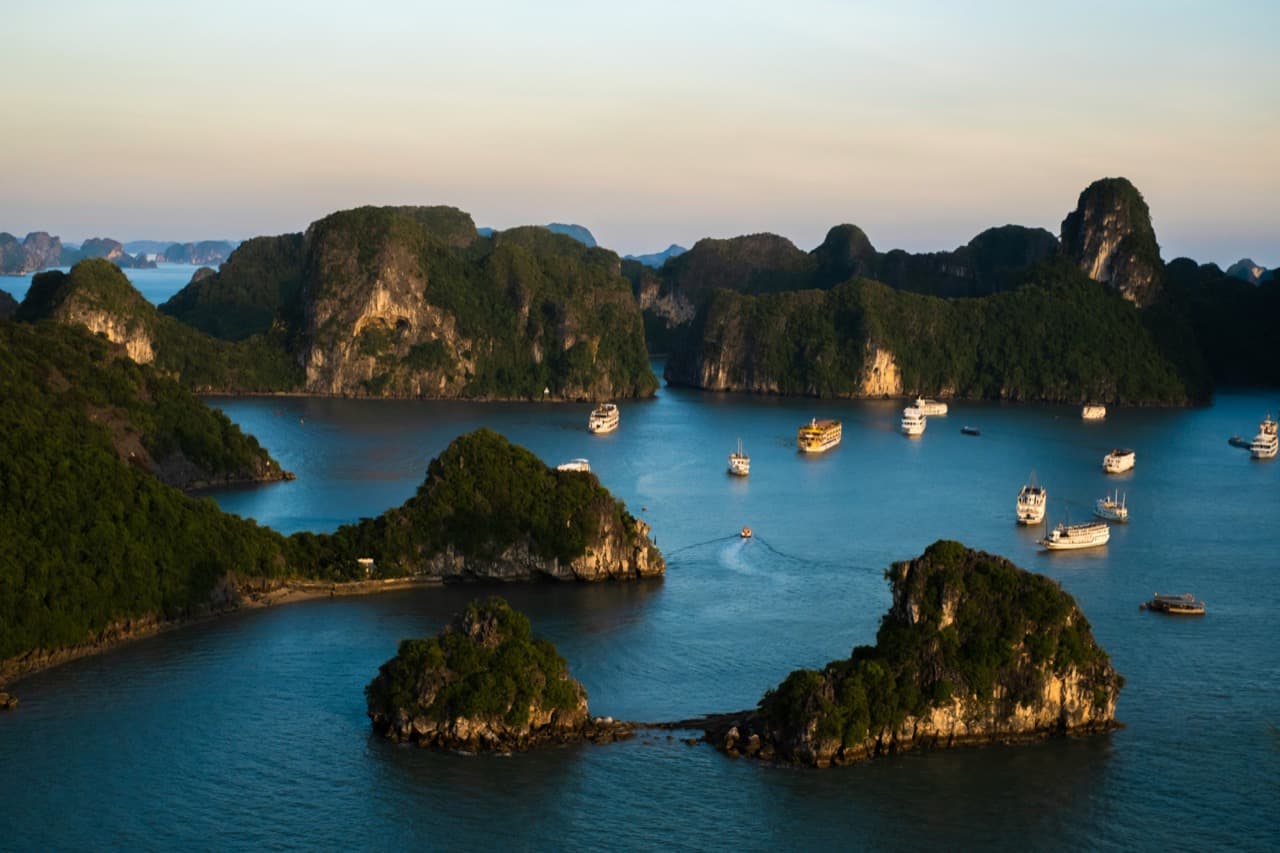
Halong Bay attractions in 2026: caves, islands, viewpoints
The headline sights of Halong Bay are Sung Sot Cave (10,000 m² across two echoing chambers), Ti Top Island with its 110-meter summit viewpoint, the Cua Van floating village with a real school on the water, and the Queen Cable Car at Sun World. All of it is scattered across 1,553 km² of bay and roughly two thousand limestone karsts — you will not see everything in one day. This guide helps you pick what belongs in your itinerary, with every price in VND and dollars.
How Halong Bay Is Laid Out — Zones and Sightseeing Routes
- Sung Sot Cave (Hang Sửng Sốt): 10,000 m², two chambers — Route No. 2 — 250,000 VND (~$10) — 8:00–18:00
- Thien Cung Cave (Hang Thiên Cung): Multi-level cave — Route No. 1 — 250,000 VND (~$10)
- Dau Go Cave (Hang Đầu Gỗ): 5,000 m², 300 m from Thien Cung — Included in route No. 1
- Luon Cave (Hang Luồn): Tunnel, kayak only — Macaques on the cliffs
- Ti Top Island (Đảo Ti Tốp): 400 steps, 110 m summit — Route No. 2
- Soi Sim (Đảo Soi Sim): Quiet beach near Ti Top — Route No. 2
- Tuan Chau (Đảo Tuần Châu): Main cruise marina — 3 km beach
- Cat Ba (Đảo Cát Bà): UNESCO since 2023 — National park 80,000 VND (~$3)
- Cua Van (Làng chài Cửa Vạn): Floating village, 300+ households — School on the water
- Vung Vieng (Làng chài Vung Viêng): Quiet village in Bai Tu Long — Kayaking, pearl farm
- Trong Mai Islets (Hòn Trống Mái): Bay symbol — Route No. 1
- Bai Tho Mountain (Núi Bài Thơ): 200 m viewpoint over the city — 15th-century royal poem
- Sun World Halong (Sun World Hạ Long): Queen Cable Car, park, water park — Combo 750,000 VND (~$29)
The bay sits in the Gulf of Tonkin in northeastern Vietnam, Quang Ninh province. Area: 1,553 km², 120 km of coastline, around two thousand islands. A UNESCO site since 1994; in 2023 the boundaries were extended into a single listing, "Ha Long Bay – Cat Ba Archipelago."
To avoid drowning in names, think of the bay as five zones:
- Central (Bo Hon) — nearly everything you have seen on Instagram: Sung Sot, Ti Top, Luon, Cua Van. The vast majority of cruises head here.
- North (Bai Chay, Dau Go) — closest to Halong City: Thien Cung and Dau Go caves, Bai Tho Mountain.
- Southwest (Tuan Chau) — the main marina where most tours depart. The island itself is a resort with a beach.
- Bai Tu Long — the northeast, roughly eight times fewer tourists, quiet lagoons, the Vung Vieng floating village.
- Lan Ha + Cat Ba — the south; technically a "different" bay within the same UNESCO site, logistically separate.
The bay's management board runs eight official sightseeing routes. These are not tours — they are bundles of sights covered by a single entrance ticket. You pay per route, not per cave or island. Day cruises from the port mostly use the first four:
| Route | Ticket price | What's included | Duration |
|---|---|---|---|
| No. 1 North | 250,000 VND (~$10) | Thien Cung, Dau Go, Dinh Huong, Trong Mai, Ba Hang | 4 h |
| No. 2 Central | 250,000 VND (~$10) | Soi Sim, Ti Top, Sung Sot, Luon, Bo Hon | 6 h |
| No. 3 Cua Van | 200,000 VND (~$8) | Cua Van, Tien Ong Cave, Ba Ham lagoon | — |
| No. 4 Bai Tu Long | 200,000 VND (~$8) | Thien Canh Son, Vung Vieng, Cong Do | 8 h |
The other four: No. 5 repeats No. 1 and continues to Gia Luan pier on Cat Ba (250,000 VND), No. 6 runs to the edge of Lan Ha Bay (150,000 VND), No. 7 combines routes 1–4 for exploration yachts (600,000 VND), and No. 8 follows the shore between piers (70,000 VND). Prices are from the bay management's fee page, updated 31 March 2025.
When you book a cruise, these tickets are baked into the price. You only pay separately if you charter a private boat — and almost nobody does. Most tours run routes No. 1 and No. 2: one in the morning, the other after lunch.
The bay is wide, and it is an hour's sailing between the northern and central routes. With one day, take No. 2 — that is where Sung Sot and Ti Top are. With two days and a taste for quiet, add No. 4 into Bai Tu Long.
Top 10 Halong Bay Attractions
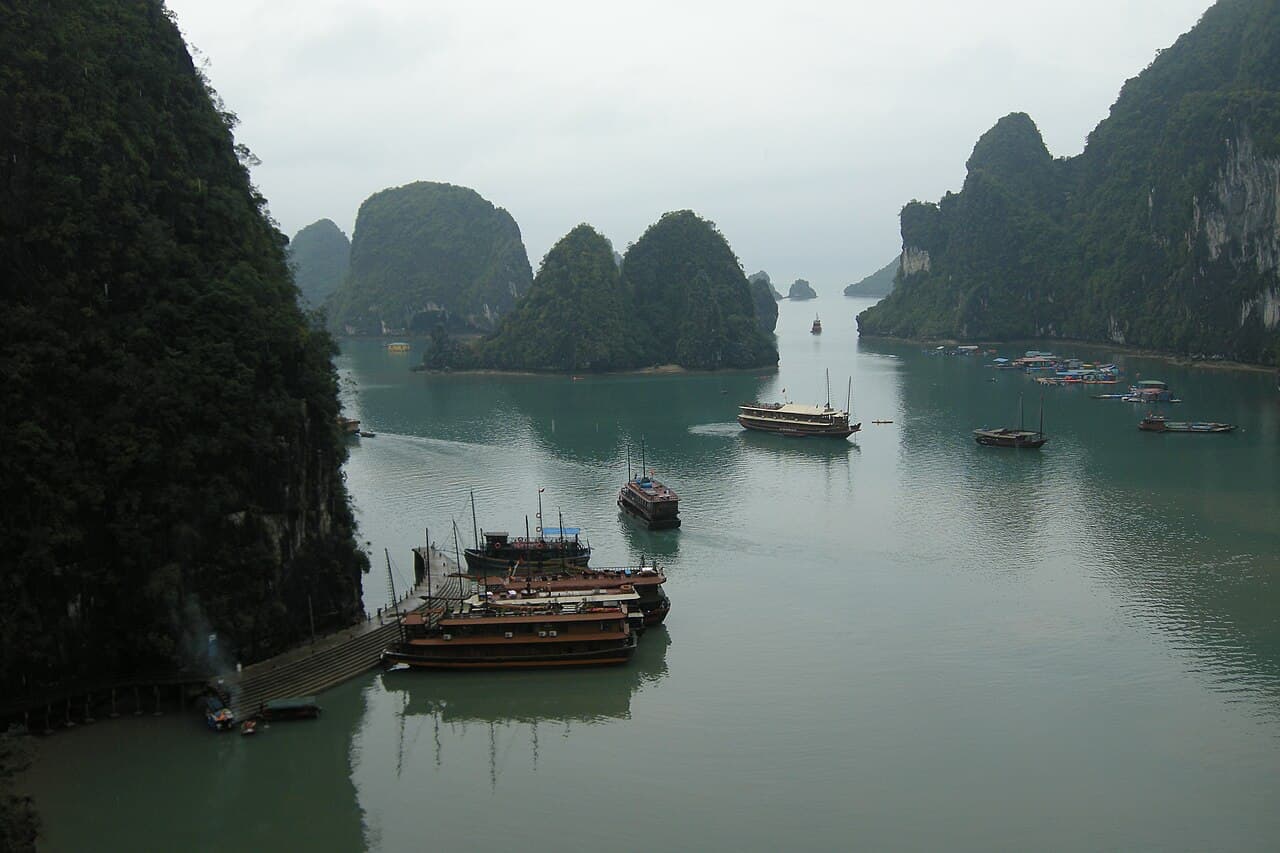
Ten sights in the bay justify the trip. The rest is a pleasant bonus. The list below is sorted by a blend of fame, actual impression, and value for time and money:
- Sung Sot Cave (Hang Sửng Sốt) — the bay's largest cave, 10,000 m², two soaring chambers. Time: 45 min. On route No. 2.
- Ti Top Island (Đảo Ti Tốp) — the 110-meter viewpoint, 400 steps, 360° over the karsts. On route No. 2.
- Thien Cung Cave (Hang Thiên Cung) — the "Heavenly Palace," a multi-level cave wrapped in a dragon legend. On route No. 1.
- Cua Van Village — floating houses and the bay's only floating school, plus a cultural center.
- Dau Go Cave (Hang Đầu Gỗ) — "Wooden Stakes Cave," 300 m from Thien Cung, massive columns and stalagmites.
- Luon Cave (Hang Luồn) — a low tunnel through the rock, kayak-only access, macaques on the walls.
- Trong Mai Islets — the "Fighting Cocks," the bay's emblem. On route No. 1.
- Bai Tho Mountain (Núi Bài Thơ) — the only viewpoint in Halong City proper, 200 m, 15th-century poems carved into the rock.
- Sun World Halong + Queen Cable Car — the urban counterweight: a cable car, theme park, and the Sun Wheel.
- Cat Ba Island — the archipelago's largest island with a national park and trekking; a separate 1–2 day story.
The rest of this article breaks these down: what is inside, how long the lines are, what to expect — and what not to.
The Caves — Sung Sot, Thien Cung, Dau Go, Luon
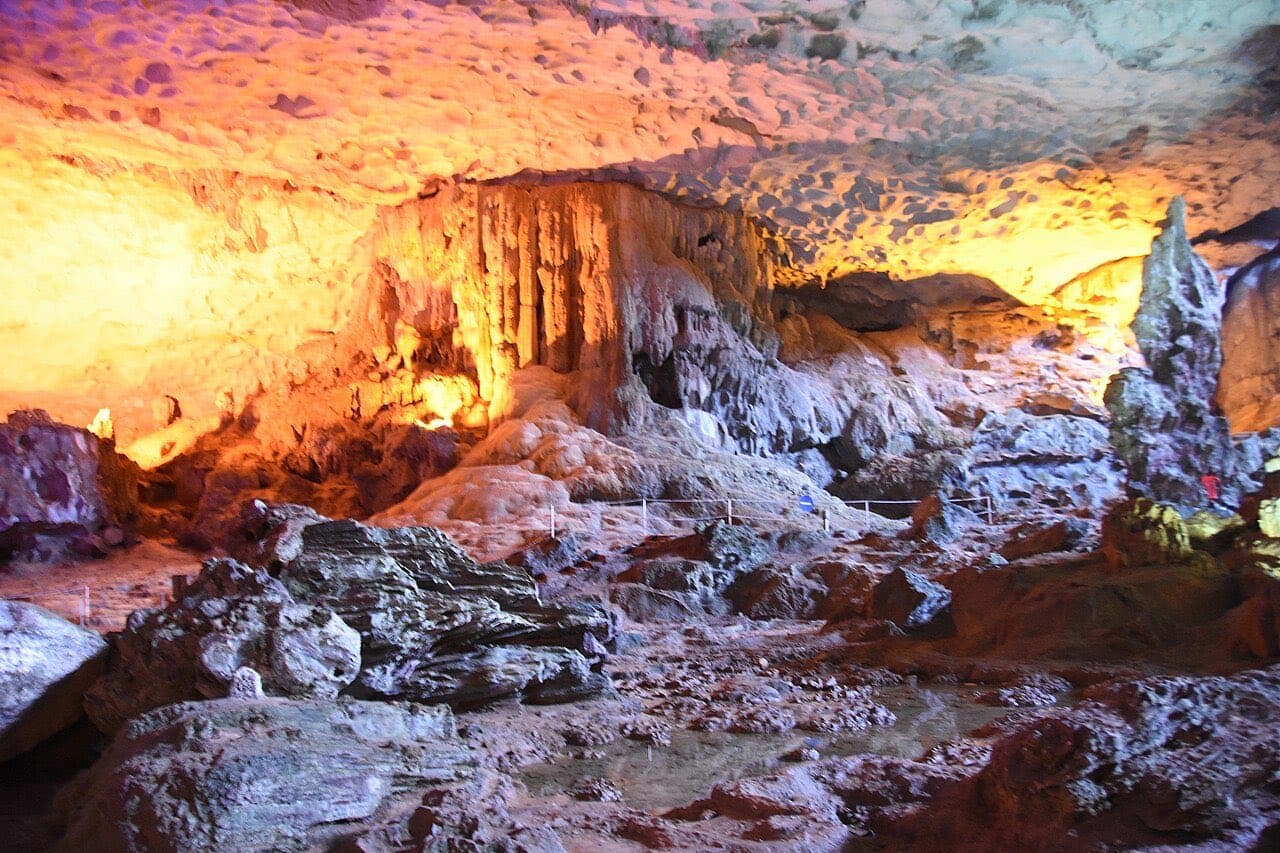
More than twenty caves in the bay have been surveyed, but four cover 90% of what visitors want. The limestone here is 500 million years old and the karst about 20 million, so the stalactites and columns have had time to grow several meters.
Sung Sot (Hang Sửng Sốt) — the Main Cave
The "Surprise Cave" was opened up by the French in the early 20th century, and the name earns itself twice: once for the size, once for the way the second chamber appears out of nowhere after a narrow passage. It covers about 10,000 m², sits 20 meters above the sea, and a 50-step staircase leads up to the mouth.
Inside are two chambers. The first feels theatrical — vaulted ceiling, stalactites hanging like a curtain. The second is a vast space that could hold a thousand people. Colored lighting, arrows on the floor: getting lost is not an option. The walk takes 40–50 minutes.
There is no separate fee for the cave: it is part of route No. 2 (250,000 VND, ~$10), and the route is part of the cruise price. Hours: 8:00–18:00 daily. Kids under 7 or below 1.2 m go free, ages 7–15 get 20% off.
Cruises drop their passengers here between 10:00 and 12:00 — that is peak. If you can land before 9 am (some early day cruises manage it), you get the chambers almost to yourself.
Thien Cung and Dau Go — the Northern Pair
These two caves stand 300 meters apart on Dau Go Island, four kilometers from Bai Chay port. They are shown together as route No. 1.
Thien Cung (Hang Thiên Cung, "Heavenly Palace") officially opened to tourists on May 1, 1998, five years after its discovery. Inside are several levels and chambers full of fantastical shapes: guides point out the "Dragon King's wedding procession," the "May dance figure," the "three elders."
Legend says the Dragon King held his wedding to the beauty May here, with genies, fairies and dragons among the guests. The stalactites are the guests, frozen mid-celebration.
Dau Go (Hang Đầu Gỗ, "Wooden Stakes Cave") — 5,000 m², 27 meters above the sea. The name goes back to the 13th century: one version says wooden stakes were stored here for the Battle of Bach Dang against the Mongol fleet. Inside: massive columns, deep echo, and a central chamber lined with sentry-like stalagmites.
Price: 250,000 VND (~$10), included in route No. 1. Hours: 8:00–17:00. Budget an hour for both caves including the walk between them.
Luon — the Kayaking Cave
Hang Luồn is not a cave in the usual sense but a tunnel straight through the rock. A regular boat cannot enter: at high tide the passage barely clears a kayak or a sampan (a flat rowing boat with a local "captain"). Thirty meters of tunnel later you emerge into a round, enclosed lagoon. Macaques often perch on the cliffs, supervising.
There is no separate entrance fee — you only need a bay ticket. A kayak on site runs 100,000–150,000 VND (~$4–6) per hour; a rowed sampan is 80,000 VND (~$3) per person.
Thien Canh Son — for Those Heading to Bai Tu Long
Hang Thiên Cảnh Sơn lies far to the northeast in the Bai Tu Long zone. In beauty it matches Sung Sot — without the crowd. Only route No. 4 cruises come here (200,000 VND / ~$8 bay ticket).
The Islands — Ti Top, Soi Sim, Cat Ba, Tuan Chau
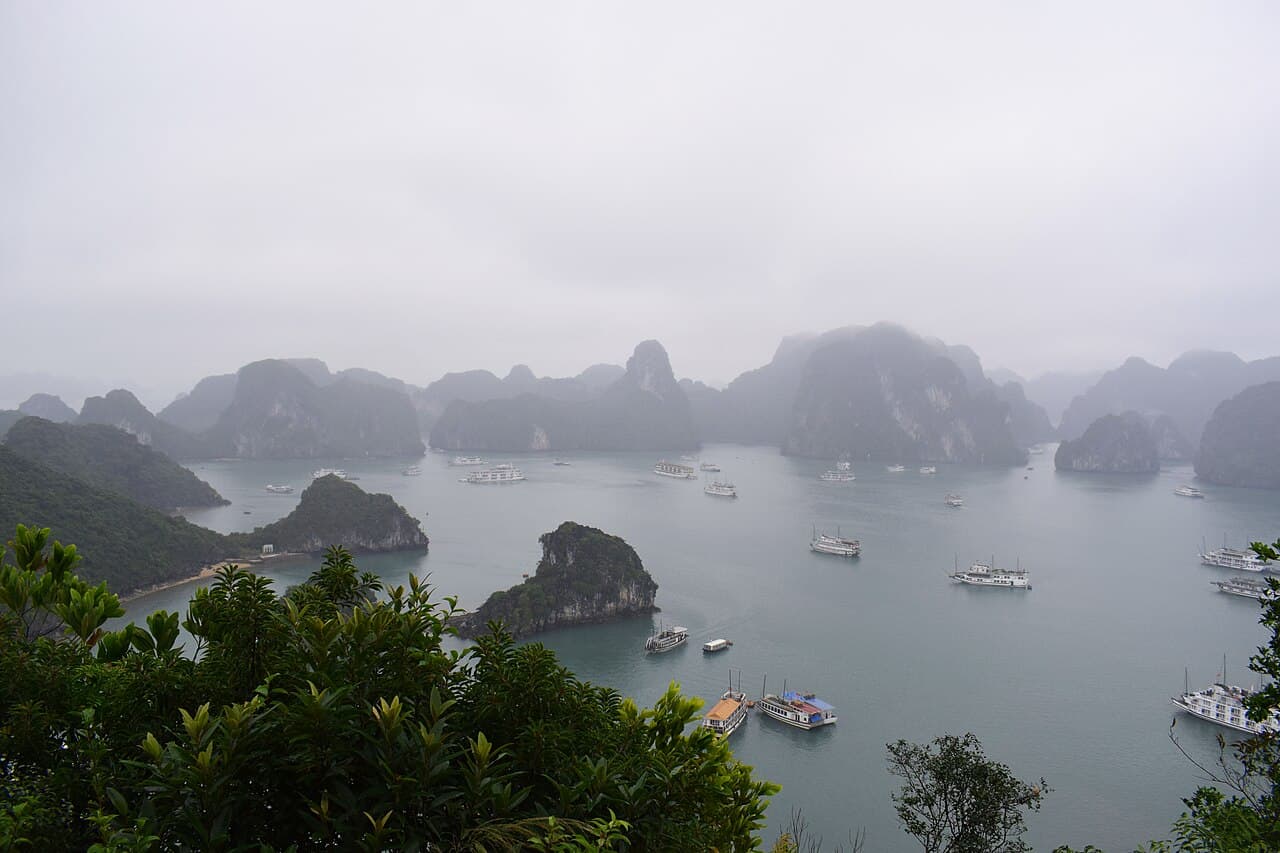
Of the bay's two thousand karst islands, tourists actually set foot on about five. The rest are uninhabited or closed to landings. Here are the accessible ones.
Ti Top Island — Viewpoint Number One
Đảo Ti Tốp got its name in 1962, when Soviet cosmonaut Gherman Titov visited with Ho Chi Minh. "Titov Island" has been the most visited in the bay ever since, despite covering just 3.7 hectares.
The point of the island is the climb. The summit stands at 110 meters, reached by a stone staircase of 400+ steps; an average visitor makes it up in 15–20 minutes without breaks, down in 10–15. From the top: a 360° panorama of concentric limestone ridges, narrow channels between them, junks dotted about. This is exactly the picture hanging on every tour operator's wall.
Below is a small crescent beach — fine sand, calm water. Swimming is fine, but crowded: by 11 am five to seven cruises unload at once.
| Detail | Value |
|---|---|
| Summit height | 110 m |
| Steps | 400+ |
| Climb time | 15–20 min |
| Ticket | in the route No. 2 ticket (250,000 VND, ~$10) |
| Hours | 7:00–17:00 |
| Included in cruise | Route No. 2 |
Soi Sim — the Quiet Alternative
Đảo Soi Sim lies 500 meters from Ti Top, but cruises call here far less often. Its own beach, a 15-minute trail to a lower viewpoint (90 m), few people. If you are on an overnight cruise and did Ti Top on day one, land here on day two — a similar impression without the crush. The island is on route No. 2, so there is nothing extra to pay.
Tuan Chau — the Main Marina and Resort
Đảo Tuần Châu is joined to the mainland by a 2-km causeway — de facto part of Halong City. It hosts the bay's biggest cruise port, Tuan Chau International Passenger Port; most day cruises and overnights leave from here.
The island itself has a beach about 3 km long, an amusement park, a water park and hotels. As a "supporting" attraction it fills a couple of hours before or after a cruise. Entry to the island is free.
Cat Ba — the UNESCO Archipelago
Đảo Cát Bà is the largest island in the archipelago. In 2023 the Cat Ba Archipelago was officially inscribed into the UNESCO listing together with Halong Bay.
Cat Ba is no longer "an island in the bay" but a destination of its own: Cat Ba Town (~12,000 residents), a national park with trekking routes, the hidden Cat Co 1–3 beaches, seafood restaurants. People come for a dedicated 2–3 days, not a half-day cruise stop. National park entry: 80,000 VND (~$3). Our full island guide: Cat Ba Island.
One more note on beaches: swimming is not the point of the bay. For a proper beach holiday head to Da Nang or Nha Trang — and if you specifically want Halong's beaches, we have a separate guide.
Floating Villages — Cua Van and Vung Vieng
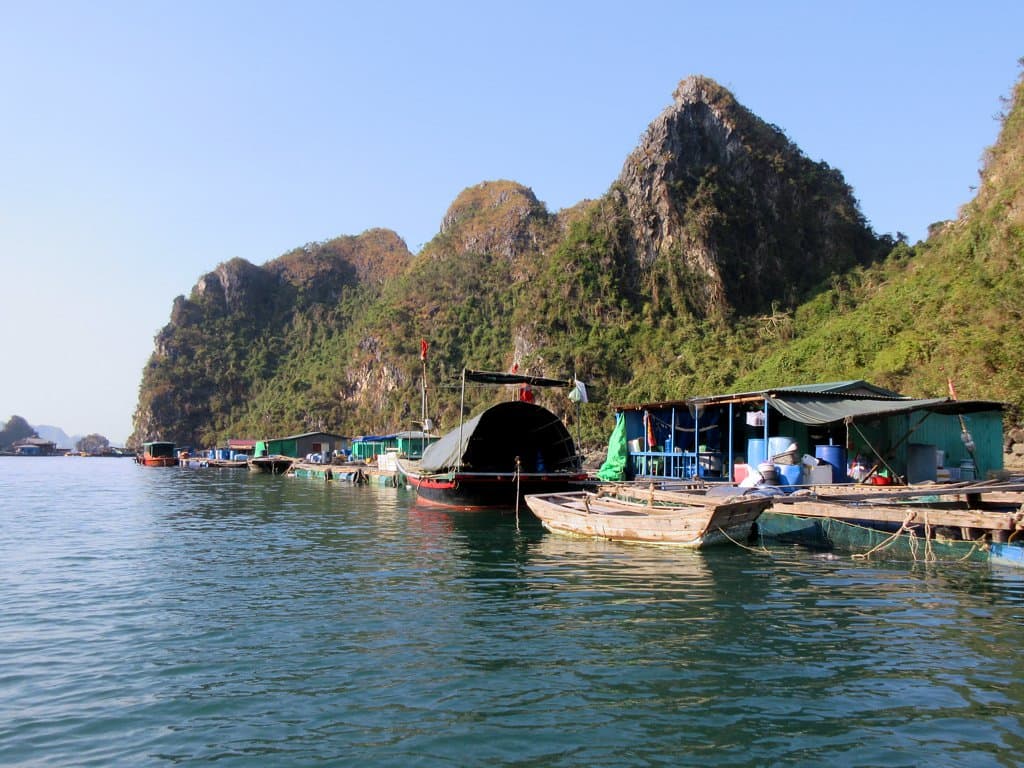
Until 2014 several thousand people lived directly on the water of Halong Bay in floating houses. The authorities resettled most villages over sanitation and UNESCO requirements, but kept two — Cua Van and Vung Vieng — as living heritage. That is where the boats take you now.
Cua Van — the Famous One
Làng chài Cửa Vạn sits 20 kilometers from Tuan Chau Pier. Per Paradise Vietnam, more than 300 households live here. The village is known for its floating school: fishermen's children genuinely study in it, and it is not a set piece for cameras.
Inside the village there is a Cultural Centre with an exhibition on the bay fishermen's traditions and workshops where nets are woven. Sampans shuttle between the houses — for 80,000 VND (~$3) per person a local woman will row you between the red-yellow-blue buildings for about 30 minutes.
The best window is November through April: calm water and clear skies. In summer rain and swell are common, and the sampans rock.
Vung Vieng — for the Bai Tu Long Crowd
Làng chài Vung Viêng is smaller (around 50 families), quieter and farther out. It sits in the Bai Tu Long zone, covered by route No. 4 and premium cruises. There is a working pearl farm (you can watch the seeding process), and kayaking between the houses goes almost unobstructed — no neighboring boats.
Choosing between the two: Cua Van gives you the picture and the context, Vung Vieng gives you solitude and authenticity.
Ba Hang — What Remains
Làng chài Ba Hang was resettled in 2014. Today it is simply the kayak launch point near Thien Cung — a few boat piers and empty stilts. Nobody presents it as a "village" anymore, but you will hear the name often.
Fast Track — no queue at the border
5–10 minutes instead of an hour in the immigration queue
from$11per passenger
Kayaking and SUP — Where It's Allowed and What It Costs
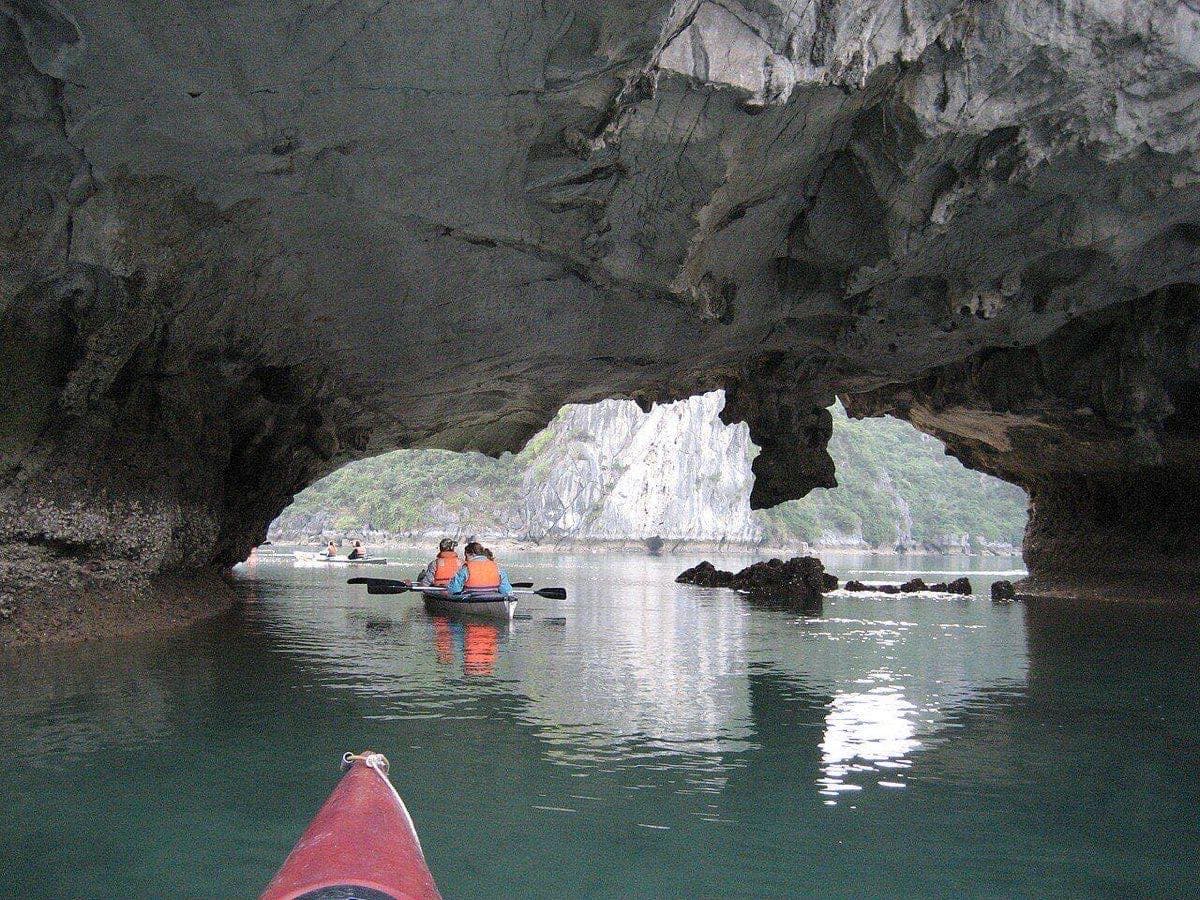
Kayaking in Halong Bay is legal only in eight government-approved zones. So when your cruise guide says "not here" — it is not a whim.
| Zone | Where | Type | In cruises? |
|---|---|---|---|
| Ba Hang | by Thien Cung | easy paddle to the former village | usually free |
| Luon Cave | central | kayak through the tunnel into the lagoon | almost always |
| Vung Vieng | Bai Tu Long | kayak among floating houses | premium cruises |
| Cua Van | south-central | kayak/sampan | often |
| Cong Do | Bai Tu Long | kayak through hidden lagoons | premium |
| Tung Sau Pearl Farm | central | kayak to the pearl farm | with farm tours |
| Hon Co | outer zone | kayak | rare, multi-day |
| Hang Trinh Nu | south | kayak | some |
Prices if you rent on your own: a kayak — 100,000–150,000 VND (~$4–6) per hour, a sampan with a rower — 80,000 VND (~$3) per person, SUP — 150,000–200,000 VND (~$6–8) per hour. Most day cruises and overnights include 30–60 minutes of kayaking in one of the zones. Premium lines (Paradise, Bhaya, Indochina Junk) let you paddle free several times per trip.
Of the eight zones, three stand out:
- Luon — for the atmosphere: you literally pass through the rock
- Cua Van — for the culture: you paddle among genuinely inhabited houses
- Vung Vieng — for the solitude: mirror-flat water, not a boat around
Gear-wise you need swimwear, a waterproof phone pouch and sunscreen. Life jackets are issued at the kayak and are mandatory in the bay — no exceptions.
The water is calm, currents are weak, capsizing takes effort. The real hazards are jellyfish in summer (May–September) and small motorboats passing by. Listen to your sampan rower or kayak guide — they know where not to go.
Sun World Halong and the Queen Cable Car
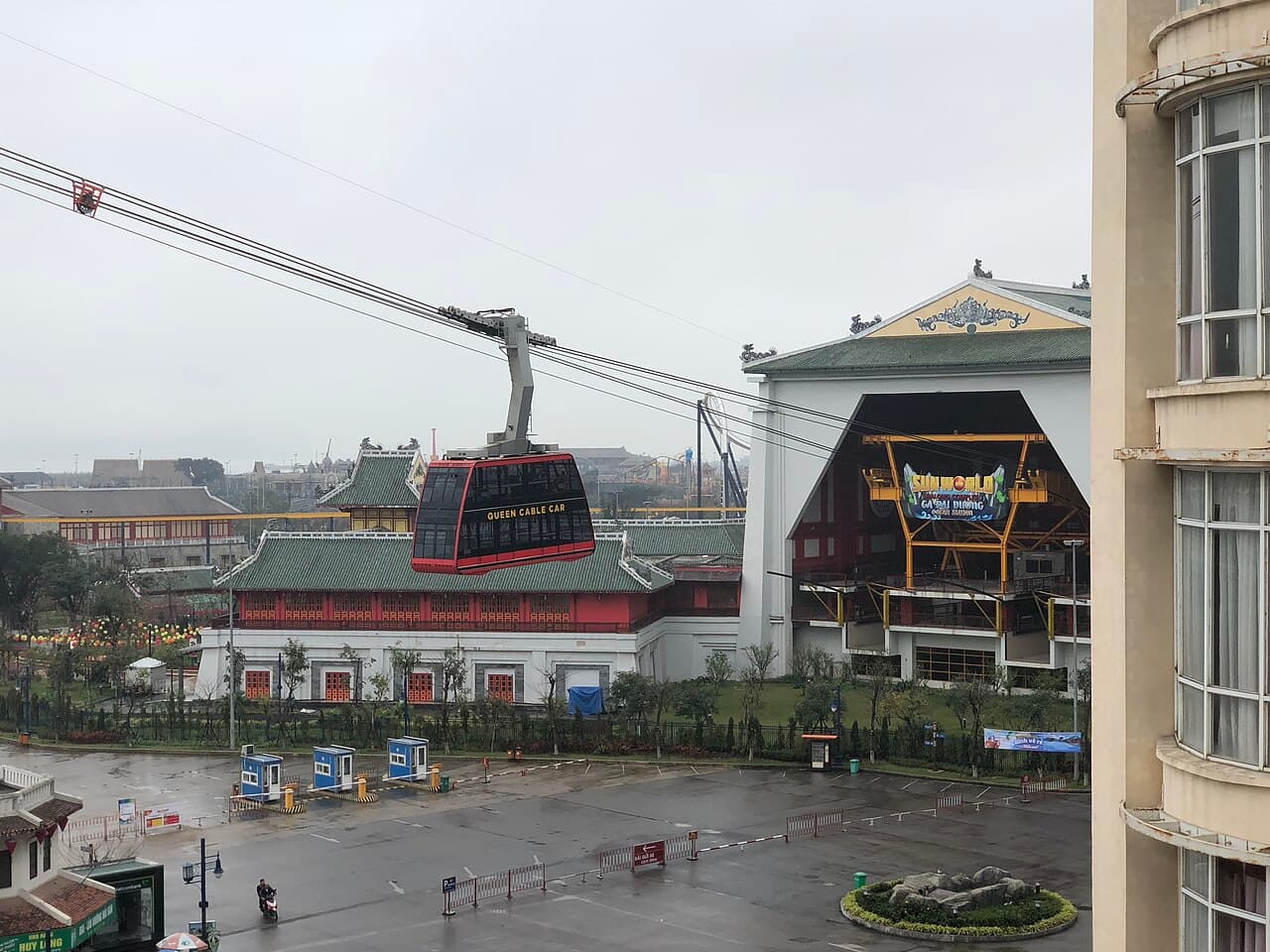
Sun World Halong is not nature — it is an amusement park on the hill above Bai Chay. It suits anyone visiting Halong with kids who senses that a second cave would be one cave too many.
| Zone | What's inside | Season |
|---|---|---|
| Queen Cable Car + Mystery Hill | Cable car across the strait, hilltop rides, the Sun Wheel | year-round |
| Dragon Park | Dragon's Flight coaster, water rides, kids' carousels | year-round |
| Typhoon Water Park | 30-slide water park | April–October |
Indicative prices as of 06/2026 (fares change with seasons and promotions; current ones are on sunworld.vn):
| Ticket | Adult VND / ~$ | Child (under 1.3 m) |
|---|---|---|
| One zone | 350,000 / ~$13.5 | 250,000 / ~$10 |
| Two zones (combo) | 500,000 / ~$19 | 400,000 / ~$15 |
| All three zones | 750,000 / ~$29 | 550,000 / ~$21 |
Kids under 1 meter go free. Weekend prices run 10–15% higher. The ticket office and gates take cards — one of the few attractions here where you do not need cash.
The Queen Cable Car is an attraction in its own right. Double-decker cabins cross the strait from Bai Chay station to Ba Deo hill. From the upper deck you see the entire central bay, Bai Chay Bridge and the silhouette of Bai Tho Mountain. You can ride it without a full park ticket: the cable car has its own fare, listed on sunworld.vn.
Hours: per sunworld.vn in September 2026, 9:00–20:00, but each zone has its own schedule: on weekdays the cable car opens at 14:00, Dragon Park is closed Monday to Thursday, and the water park runs until 17:30 in season. Check the site before you go. Address: Phường Bãi Cháy, Hạ Long. From most central hotels it is a 5-minute taxi ride or 15 minutes on foot along the promenade.
Overnight Cruise vs Day Trip — What Do You Actually See?
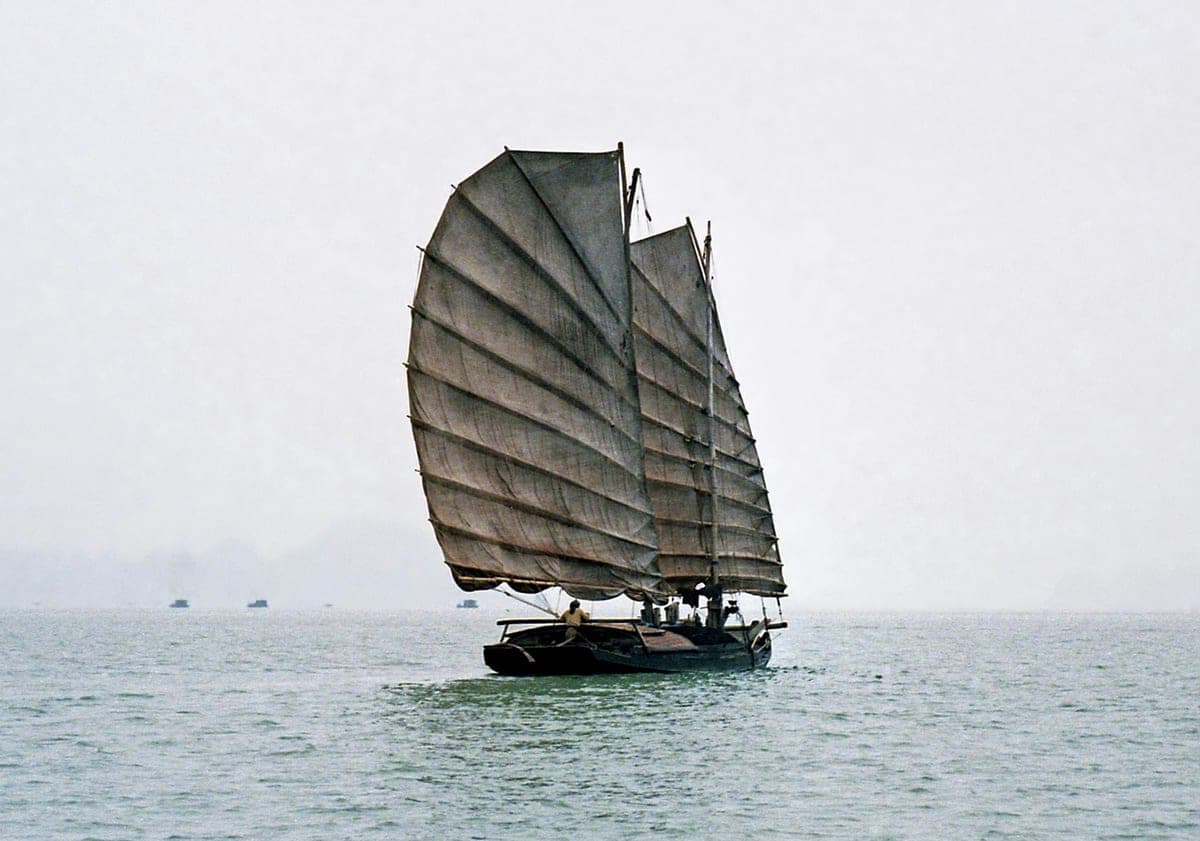
This question decides which attractions are even available to you. The bay is too big for one day, so day cruises and overnights show different things.
Day cruise (4–8 hours on the water):
- Route No. 1 or No. 2 (one of the two)
- 1 cave (usually Sung Sot)
- Landing on Ti Top with the summit climb
- Optional 30 minutes of kayaking
- Lunch on board
- Price: from ~$45 per person with Hanoi transfer
Overnight 2D1N (24 hours):
- Routes No. 1 + No. 2 in full, sometimes a Lan Ha detour
- 2–3 caves
- Cua Van or Vung Vieng
- Kayaking once or twice, 60 minutes each
- Sunrise in the bay from the top deck
- Vietnamese cooking class, night squid fishing, morning Tai Chi
- Price: from ~$120; premium from ~$250
Available only on an overnight: hidden lagoons and enclosed coves (day tours cannot reach them in time), sunrise surrounded by karsts, a proper run into Bai Tu Long, Cat Ba as an extra stop (only on some 3D2N itineraries).
Pointless on a day cruise: kayaking (30 minutes is "getting the paddles wet"), Cat Ba and Lan Ha (too far, no time).
The Best Viewpoints — Where That Photo Gets Taken
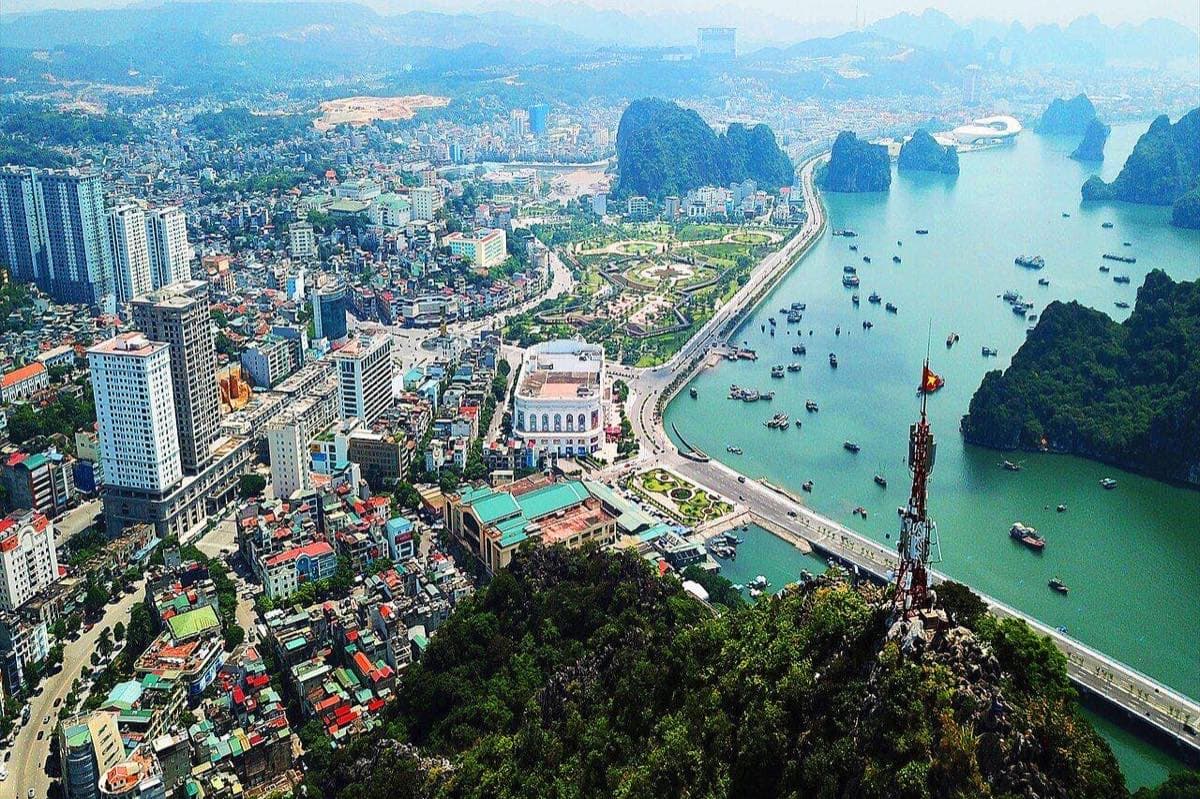
Four spots in the bay deliver the postcard panorama.
Ti Top Summit (110 m)
The classic. 400 steps, 15 minutes of sweat, and at the top — the shot you have seen a million times. Pros: it always works, the ticket is cheap. Cons: the crowd, especially 10:00–14:00, and in winter fog renders it useless.
Bai Tho Mountain / Poem Mountain (200 m)
Núi Bài Thơ is the only tall viewpoint inside Halong City itself. The cliffs still carry poems carved in the 15th century; the most famous was left by King Le Thanh Tong in 1468, and the mountain is named after it.
The summit gives a genuine 360°: the UNESCO bay and its islands to the south, the modern towers of Bai Chay to the west, and Bai Chay Bridge between them. Ti Top cannot show you this — from there it is only sea and rock.
You cannot climb it right now. The mountain was closed in 2017 after a forest fire and landslides, the trail is fenced off, and breaking the ban carries a fine of 150,000–300,000 VND per person (according to Sun World, 2024). No reopening date has been announced.
Queen Cable Car and Sun Wheel
The urban option: the cable car and the Ferris wheel overlook the western bay, Bai Chay Bridge and the port. It is not a "wilderness" view, but at sunset it competes with Ti Top just fine. Bonus: no stairs involved.
A Cruise Deck at Sunset
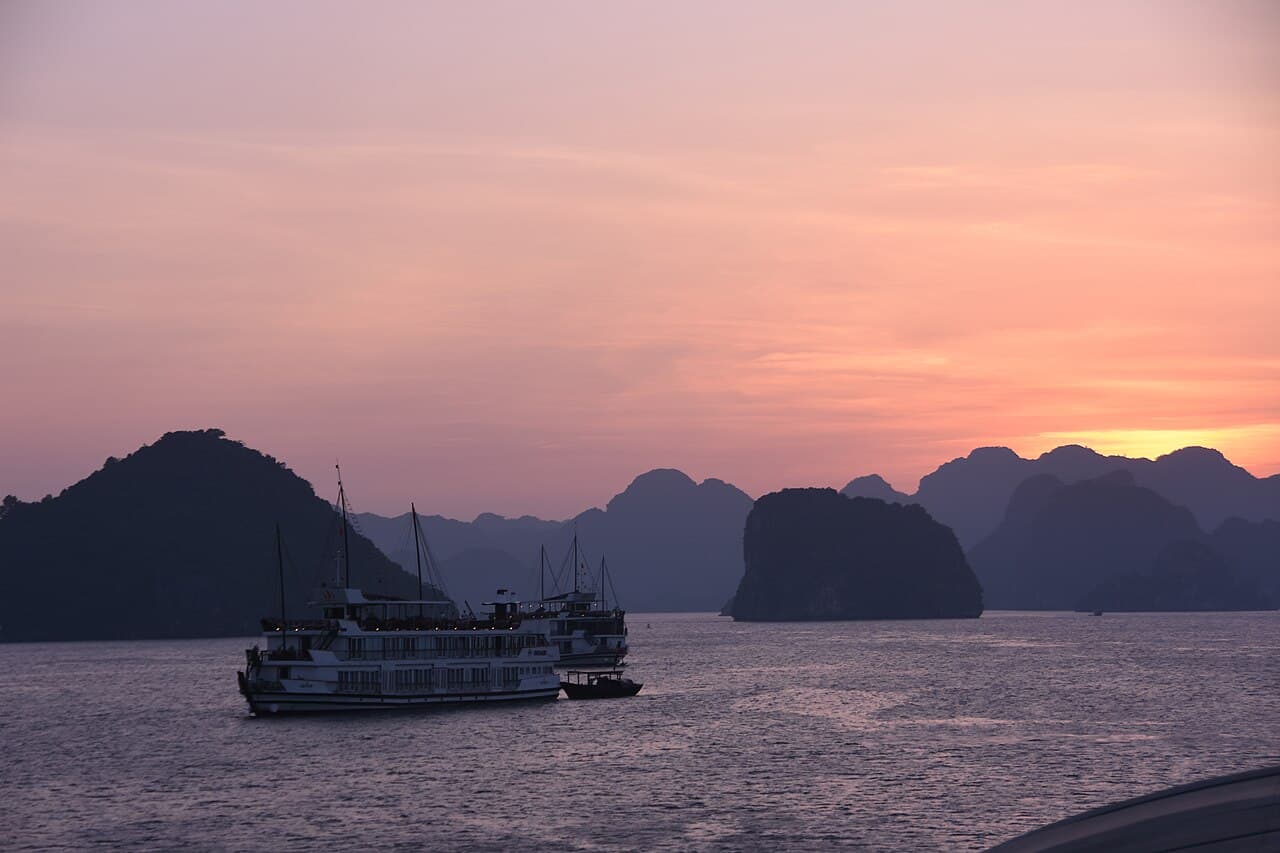
The most underrated angle. When the boats anchor for the night in Bai Tu Long or off Bo Hon, you are surrounded by dozens of junks, karsts between them, everything washed in pink and violet. This view cannot be taken from land. Getting your camera and sitting on the top deck is the one non-negotiable activity of an overnight cruise.
Off-Script Spots
For those allergic to the standard shot: the top of Soi Sim Island — a small 90 m viewpoint, 15 minutes on foot — and the ridge above Cong Do in Bai Tu Long: reach it by kayak, then 20 minutes up a trail.
When to Come for the Views
Seasons in Halong work differently than in Nha Trang or Phu Quoc. The deciding factor is not rain or heat — it is visibility. In fog season even perfect weather serves you a milky veil.
| Month | Air t° | Visibility | Worth going? |
|---|---|---|---|
| January | 13–18°C | fog, overcast | so-so |
| February | 14–19°C | dense fog | avoid |
| March | 17–22°C | fog + drizzle | so-so |
| April | 21–26°C | improving | good |
| May | 25–30°C | clear, humid | good |
| June | 28–33°C | clear, storms | so-so |
| July | 29–34°C | hot, rainy | avoid |
| August | 28–33°C | typhoons | cruises cancelled |
| September | 25–30°C | transitional | good |
| October | 24–28°C | clear, mild | ★ best |
| November | 19–24°C | crystal clear | ★ best |
| December | 14–20°C | cool, clear | ★ best |
The prime window is October, November, December: dry, cool, horizon visible. The second good wave is April–May — hotter, warmer sea.
A January–March trip is not pointless, but budget your expectations: there is a 50% chance you get milk instead of a panorama. Going in winter? Book a 2D1N so you get a second shot at a clear day. August is the official typhoon season — the bay's management regularly suspends cruise departures for 1–3 days.
Entrance Fees — 2026 Summary Table
All prices current as of June 2026. Rate used: ~26,000 VND = $1.
| Sight | VND | ~$ | Hours |
|---|---|---|---|
| Route No. 1 (Thien Cung + Dau Go + Trong Mai) | 250,000 | 10 | 7:30–17:00 |
| Route No. 2 (Sung Sot + Ti Top + Soi Sim + Luon) | 250,000 | 10 | 7:30–17:00 |
| Route No. 3 (Cua Van + Tien Ong + Ba Ham) | 200,000 | 8 | 7:30–17:00 |
| Route No. 4 (Bai Tu Long + Vung Vieng) | 200,000 | 8 | 7:30–17:00 |
| Sun World — 1 zone, adult | 350,000 | 13.5 | varies by day |
| Sun World — 3-zone combo, adult | 750,000 | 29 | varies by day |
| Cat Ba National Park | 80,000 | 3 | 8:00–17:00 |
| Queen Cable Car (standalone) | see sunworld.vn | — | varies by day |
Bay ticket discounts: kids under 7 or below 1.2 m go free, ages 7–15 get 20% off. The 50% senior discount applies only to Vietnamese citizens aged 60+.
If you are on a cruise, bay tickets (routes No. 1–4) are already inside the price. Paying separately only makes sense if you charter a private boat in Bai Chay or go to Sun World — it sits outside any cruise program.
Bai Tu Long as the Alternative
If your head holds the image of "perfect Halong Bay" but not the appetite for crowds, look at Bai Tu Long. Formally it is part of the same UNESCO site — with a different logic.
By the estimate of Jungle Boss Tours (a Bai Tu Long cruise operator), the main bay takes in 8,000–10,000 tourists a day, while Bai Tu Long gets around 1,000. Eight times fewer boats, shorter cave lines, wider channels between the islands. The downside: few cruises go there (a dozen operators versus a hundred in the main bay), and they cost $30–50 more.
What you see in Bai Tu Long and not in the main bay: Thien Canh Son Cave (Sung Sot-level beauty, minus the crowd), Vung Vieng floating village with its pearl farm, and the Cong Do and Cong Dam lagoons with top-tier kayaking.
What you won't see in Bai Tu Long: Sung Sot, Ti Top, Cua Van, Thien Cung.
The choice is simple: first time in Halong — take the main bay, for the picture and the box ticked. Second visit, or crowds are your nightmare — Bai Tu Long.
Alternatives to Halong — Ninh Binh and Lan Ha
If karsts start to blur together or your dates fall in the wrong season, two similar places are nearby.
Ninh Binh — "Halong on land": the same limestone towers, but rising from rice paddies, and you glide on a sampan along the Ngo Dong River instead of the sea. It is 100 km from Hanoi, doable as a day trip, no cruise required. More in our Ninh Binh boat tours guide.
Lan Ha — the neighboring bay, technically part of Cat Ba. Fewer cruises, the best beaches in the archipelago, excellent kayaking. Halong's route No. 6 only reaches its edge; tours from Cat Ba go inside.
VietnamSpot on InstagramTips, lifehacks and news for living in VietnamFollow



FAQ — Halong Bay Attractions
One day covers route No. 2 — Sung Sot Cave, Ti Top Island with the summit climb, and 30 minutes of kayaking at Luon or Ba Hang. Lunch on the boat is included. Cua Van, Bai Tu Long and Cat Ba do not fit into a single day — they need an overnight or a second trip.
- A day cruise with a Hanoi transferaround $45starts, including lunch, route No. 2 and a kayak session
- Overnight 2D1N at the budget endnear $120
- Mid-range$180-250
- Premium lines (Paradise, Bhaya)from $250
All bay entrance tickets, meals and onboard activities are already in the price
Sung Sot (Hang Sung Sot) is the largest cave at about 10,000 m². It sits 20 m above the sea and consists of two chambers, the second big enough for a thousand people. Hours 8:00-18:00. There is no separate fee for the cave: it is part of route No. 2 (250,000 VND, ~$10), and the route is part of the cruise price.
The stairs are open year-round and not slippery. The problem is different: from January to March the bay is frequently fogged in, and the viewpoint shows nothing. On a clear day — absolutely climb (15-20 minutes, 400 steps). If you cannot see the next island from the water, save your legs.
Cua Van and Vung Vieng are former fishing settlements on the water, preserved as living heritage. Cua Van houses more than 300 households, with a floating school and a cultural center. You cannot stay with locals — tourists get a daytime cruise stop or a sampan ride for 80,000 VND (~$3). For sleeping on the water, your option is Cat Ba homestays.
Bai Tu Long is the neighboring section of the same UNESCO site with roughly eight times fewer visitors: by the estimate of operator Jungle Boss Tours, about 1,000 a day versus 8,000-10,000 in the main bay. Its stars are Thien Canh Son Cave and Vung Vieng village. Few cruises go there and they run $30-50 dearer. Best for second-time visitors and crowd-haters.
Technically yes: in Bai Chay you can charter a private boat for 2,500,000-4,000,000 VND (~$95-155) per day, buying bay tickets separately at the pier plus a small port fee. In practice it costs more than a budget cruise and comes without lunch, guide or kayaks. It only adds up for a private group of 4+ that wants its own pace.
Not right now: the climb has been closed since 2017, when a forest fire and landslides led to the trail being fenced off. Breaking the ban carries a fine of 150,000–300,000 VND per person. No reopening date has been announced. You can see the mountain from the Queen Cable Car.
The Queen Cable Car, Mystery Hill and Dragon Park are not seasonal, but each zone keeps its own schedule: per sunworld.vn in September 2026 the park is open until 20:00, the cable car opens at 14:00 on weekdays, and Dragon Park is closed Monday to Thursday. Typhoon Water Park is seasonal — April through October. In winter the 3-zone combo makes no sense; take 2 zones for 500,000 VND (~$19) instead of 750,000 (~$29).
For the bay, children under 7 or shorter than 1.2 m go free, and ages 7-15 get 20% off. The 50% discount is only for Vietnamese citizens aged 60+, so foreign seniors pay full price. Carry the child's passport: the bay ticket office may ask for proof of age. At Sun World only children under 1 meter go free; from 1 to 1.3 m there is a child fare (250,000 VND / ~$10 per zone).
Sneakers or sandals with a heel strap (flip-flops fail — some steps are tall and uneven), a 0.5 L water bottle, sunscreen and a hat. In the dry season a cool wind can blow at the top — a light windbreaker helps. Skip the heavy backpack: 400 steps with weight turn into a workout.
Guides inside the caves come only with an organized cruise or group tour — and English is the default: effectively all day tours from Hanoi run with English-speaking guides. Book through the operator directly or via GetYourGuide, Klook or Viator. Mobile signal in the caves is weak — download offline translation and maps in advance.
One-Day Halong Checklist
What to pack:
- Sneakers or strapped sandals (for the Ti Top stairs and caves)
- Swimwear and a quick-dry towel (for the kayak)
- SPF 50+ sunscreen and a hat (junk decks have no shade)
- A light windbreaker (it is colder on the water than ashore)
- A waterproof phone pouch
- 500,000–1,000,000 VND (~$19–38) in cash — for souvenirs at Cua Van and the sampan; there are no card terminals on the water
- Motion sickness pills if that is your history
- A power bank (there will be many photos)
What not to do:
- Don't buy tours from street touts in Bai Chay — a 30% markup for the same product
- Don't run down the Ti Top stairs — ankle injuries are routine
- Don't land on uninhabited islands from a cruise — UNESCO fines are real
- Don't pay for kayaking separately if your cruise already includes it
- Don't climb Bai Tho — it has been closed since 2017 and breaking the ban means a fine
Classic planning mistakes:
- Booking February "because it's cheap" — high odds the fog eats your views
- A day tour with an eight-hour round-trip bus from Hanoi — you get 3 hours on the water out of 8
- Taking the cheapest cruise (from ~$35) — usually an overloaded junk with 60 tourists and a set menu
- Planning Halong as a beach holiday — that is what Da Nang and Nha Trang are for
- Guide
Ha Long Bay Cruises: How to Choose & What They Cost
Ha Long Bay cruises: 1, 2 and 3-day trips, boat classes, what's included, Bai Tu Long and Lan Ha — how to choose and book, with 2026 prices.Ha Long Bay Cruises: How to Choose & What They Cost - Guide
Cat Ba Island: National Park, Lan Ha Bay & Beaches
Cat Ba Island guide: the national park, Lan Ha Bay, beaches, how to get there from Hanoi or Ha Long, where to stay and what to do.Cat Ba Island: National Park, Lan Ha Bay & Beaches - Guide
Getting to Ha Long: From Hanoi, Airport & Around
How to reach Ha Long: the expressway from Hanoi, limousine buses and shuttles, the airport route, getting around town and island ferries.Getting to Ha Long: From Hanoi, Airport & Around