Where to live in Hanoi: Tay Ho, Old Quarter, Ba Dinh
Hanoi sprawls over 3,360 km² across the Red River delta — a dozen inner neighbourhoods and a ring of suburbs. As a traveller or long-stay expat you really only need seven zones: Tay Ho around West Lake (the expat hub), Hoan Kiem with the Old Quarter and colonial French Quarter, quiet Ba Dinh, techy Cau Giay, dense Hai Ba Trung and Dong Da, and budget Long Bien across the river. Here is what to rent, at what price in VND with ~$ conversion, plus who each district suits in 2026.

How Hanoi is laid out — the district map
Hanoi no longer has a district tier: Vietnam abolished quận and huyện on 1 July 2025 and moved to two levels, city and phường (ward; xã communes in the suburbs). The names survived the reform — Grab drivers, landlords and maps all still use them. In practice, for living and sightseeing, seven zones around the historic centre are what matter. Each has its own character: rice paddies 15 minutes from tower blocks in one, narrow colonial streets full of street food and motorbike noise in another.
The main landmark is Hồ Hoàn Kiếm lake in the heart of Hoan Kiem. Distances to everything else are measured from it — how the main sights spread out around it is on our Hanoi map guide. The further you get from the lake, the cheaper the rent and the quieter the nights.
- Tay Ho (Hồ Tây / Quang An): Expat district, West Lake — Rent: from $470–860/mo (1BR)
- Hoan Kiem (Old Quarter): Tourist heart of the city — Rent: from $310–510/mo (1BR)
- French Quarter (Pháp cũ): Colonial architecture, Opera House — Rent: from $500–900/mo (1BR)
- Ba Dinh (Ba Đình): Mausoleum, embassy quarter — Rent: from $350–590/mo (1BR)
- Cau Giay (Cầu Giấy): Tech, Metro Line 3, new builds — Rent: from $310–550/mo (1BR)
- Hai Ba Trung (Hai Bà Trưng): Local centre, Hom Market — Rent: from $310–510/mo (1BR)
- Dong Da (Đống Đa): Dense local district — Rent: from $275–470/mo (1BR)
- Long Bien (Long Biên): Across the river, the cheapest — Rent: from $235–390/mo (1BR)
| Zone | District (quận) | To centre | Best for |
|---|---|---|---|
| Tay Ho | Tây Hồ | ~5–7 km | Expats, families, remote workers |
| Hoan Kiem | Hoàn Kiếm | — | Tourists, short stays |
| Ba Dinh | Ba Đình | ~2 km | Diplomats, a quiet pace |
| Cau Giay | Cầu Giấy | ~7–10 km | Tech, students, budget |
| Hai Ba Trung | Hai Bà Trưng | ~2–3 km | Locals, budget expats |
| Dong Da | Đống Đa | ~3 km | Local Vietnamese life |
| Long Bien | Long Biên | ~5–8 km | Cheapest option, quiet outskirts |
What this means in practice: on new paperwork and at the post office an address now carries the ward and the city, with no district in between. It does not change the housing map — Tay Ho, Hoan Kiem and the other zones in this article are everyday names, and they are what people search on and what you will be understood by.
Tay Ho — Hanoi's expat heart
Tay Ho (Tây Hồ) is the expat district north-west of the centre. At its centre is West Lake (Hồ Tây), 525 hectares and the biggest lake in Hanoi. Around its rim: restaurants, cafes with European bakes, boutiques and embassies. This is where almost every foreigner who moves here long-term ends up.

Sub-areas of Tay Ho
- Quảng An — the premium end, on the peninsula. Villas and penthouses with a direct lake view, Indian and Korean schools, embassies. The priciest corner of Hanoi — a 2BR from $1,200/mo.
- Tứ Liên — French bistros, pottery villages, quiet lanes of three- and four-storey houses. A favourite with photographers and remote workers.
- Xuân La — closer to the Lotte Mall West Lake towers and Thu Le park. Modern complexes like Sunshine City and Tay Ho Westlake. Studios from $400/mo.
- Nhật Tân — the northern edge, with flower farms and seasonal peach-blossom plantations. Quiet, 20 minutes from the airport.
Tay Ho infrastructure
- Cafes and restaurants: Maison de Tet Decor
- Groceries: Annam Gourmet (imported food), L's Place, Veggie Castle (produce and organic), Lotte Mall West Lake — 232 shops under one roof
- Schools: none of these international schools is in Tay Ho itself. Hanoi International School (HIS) is in former Ba Đình district, Concordia International in former Đông Anh, about 13 km north, Korean International School in former Bắc Từ Liêm
- Healthcare: Raffles Medical; Family Medical Practice (298 Kim Mã) is in former Ba Đình district, outside Tay Ho
- Coworking: Toong Tay Ho, Dreamplex — desks from 100,000 VND/day (~$4)
Tay Ho: pros and cons
| Pros | Cons |
|---|---|
| Lake, parks, cycling paths | Prices 30–60% above the centre |
| Western food, schools, healthcare | Farther from the classic sights |
| Quieter and greener than the Old Quarter | Evening jams on Lạc Long Quân |
| Big expat community | 15–25 minutes to the Old Quarter by bike |
Best for: expats staying 6+ months, families with children (international schools), remote workers with a housing budget from $700/mo. The worst fit is a tourist here for 3–5 days — you'll have to commute to most of the sights.





Hoan Kiem — the Old Quarter and French Quarter
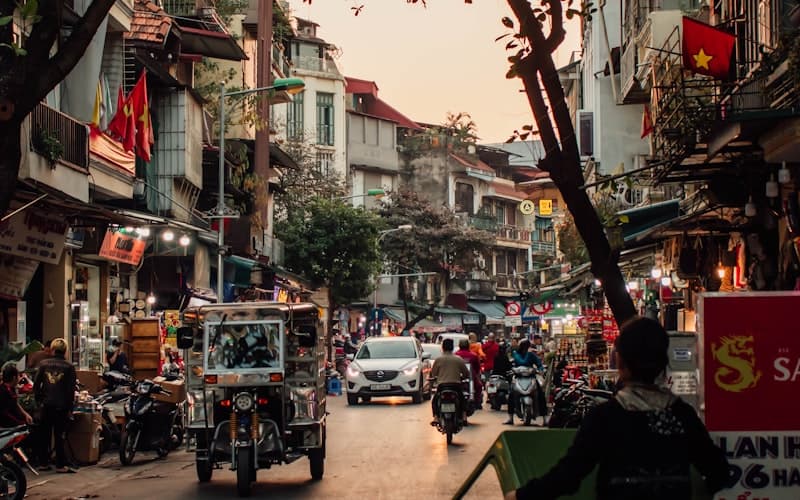
Hoan Kiem is the smallest district in Hanoi by area, but it is exactly where tourists head. Inside it are two different worlds: the chaotic Old Quarter with its 36 "guild" streets north of the lake, and the tidy French Quarter with boulevards and colonial villas to the south.

The Old Quarter — 36 guild streets
The Old Quarter is more than a thousand years old. The streets are named for what was traded here in the 19th century: Hàng Bạc for silver, Hàng Mã for paper lanterns and votive money, Hàng Đào for textiles, Hàng Thiếc for tin. Some streets still trade in their old specialty.
The houses are narrow and long — "tube houses" (nhà ống): a 3-metre frontage running 15–20 metres deep. The ground floor is a shop or cafe, living space above. Friday through Sunday the central streets are closed off for a night market that runs until midnight. The quarter's spas, with addresses and prices, are in our Hanoi spa guide.

The French Quarter — the other side of the lake
South of Hồ Hoàn Kiếm the French Quarter begins — a legacy of the colonial period, 1880–1954. Wide boulevards, plane trees, ochre villas, the 1911 Opera House (a copy of the Palais Garnier) and the Sofitel Legend Metropole hotel.

Rent in the French Quarter runs higher: a studio in a converted colonial house is $500–700/mo, an apartment with mouldings $900–1,500. But for that money you get high ceilings, a balcony over the plane trees and quiet after 9pm — a rarity in Hoan Kiem.

Hoan Kiem: pros and cons
| Pros | Cons |
|---|---|
| Everything on foot — temples, museums, markets | Noise until 11pm, especially at weekends |
| A dense cluster of food and cafes | Cramped, low-light "tube" houses |
| The atmosphere of the old town | Humidity, bugs and mould in the rains |
| Ideal for a 3–7 day visit | Food prices 1.5–2x the rest of the city |
If you're a light sleeper, prioritize hotels with good soundproofing, higher floors, and rooms not facing busy streets-especially in the Old Quarter.Geoff, Wandertooth, 2026
Best for: tourists here for 3–7 days and anyone who loves urban chaos. A good pick for a first-time visitor who wants to soak up the atmosphere. Hard for the long haul — the noise and cramped rooms wear you down. For what to see on foot from here, see the Hanoi attractions guide; for specific places to book by area, the Hanoi hotels guide. For the wider city, the Hanoi travel guide. Nightly and monthly rates per district are in the Hanoi price guide.
Fast Track — no queue at the border
5–10 minutes instead of an hour in the immigration queue
from$11per passenger
Ba Dinh — the quiet government quarter
Ba Dinh is the political centre of Vietnam. Here you'll find the Ho Chi Minh Mausoleum, the Presidential Palace, the One Pillar Pagoda (Một Cột), the Thang Long Citadel (a UNESCO site) and most of the embassies. Wide avenues, parks, pavements clear of motorbikes.

What defines the district
- Greenery: the Botanical Garden (Bách Thảo), and the lake and park at Thủ Lệ
- Embassies: China, Japan, Germany and many more
- Housing: serviced apartments like Somerset West Point and Pan Pacific Residences — for diplomats and senior managers
- Quiet: after 10pm the district is nearly empty, a rarity for central Hanoi
Rent in Ba Dinh is about 10–15% below Hoan Kiem and 20–30% below Tay Ho. A studio is $250–400/mo, a 1BR $350–590, a 2BR $550–980. Serviced apartments start at $1,500/mo.
Ba Dinh: pros and cons
| Pros | Cons |
|---|---|
| Green, quiet, safe | Nearly empty after 10pm |
| Museums, parks, historic sites | Few cafes and bars |
| 10–15% cheaper than Hoan Kiem | Monday road closures near the Mausoleum |
Best for: expats working at embassies or international organisations, families without teenagers, morning runners. A tourist might base here for 1–2 days to see the mausoleum and museums.
Cau Giay — the tech and metro district
Cau Giay (Cầu Giấy) is a relatively young district west of the centre. Into the 2000s it was rice fields. Now it is the main tech cluster in northern Vietnam: the offices of VinGroup, FPT, Samsung R&D and Viettel. In the evenings the streets fill with young developers in company jackets.

Apartment complexes and infrastructure
- Vinhomes Skylake — four towers, pool, gym, private park. Studios from 8m VND, 1BR from 12m
- Discovery Complex, Indochina Plaza — modern apartment complexes with 24/7 management
- Vincom Mega Mall, AEON Mall Ha Dong (in neighbouring Ha Dong) — big malls with international brands
- Universities in and near the area: National University, Foreign Trade University, Academy of Finance — the area teems with students and cheap fast food
Metro Line 3 — the game changer
In August 2024 the elevated stretch of Line 3 (Nhổn — Cầu Giấy) opened, with eight stations. The underground extension on to the centre (Ga Hà Nội) is under construction and due in 2027. Even now it is the first proper rail route out of Cau Giay — 20 minutes instead of 40 stuck in traffic. A ticket is 8,000–12,000 VND (~$0.30–0.50). Full line detail is in the Hanoi transport guide.
Cau Giay: pros and cons
| Pros | Cons |
|---|---|
| Modern flats in new builds | 7–10 km out, morning jams |
| Metro Line 3 in 2026 | No tourist atmosphere |
| 25–35% cheaper than the centre | Less English spoken locally |
| Big malls, gyms, delivery | Duller in the evenings |
Best for: remote workers on a budget up to $700/mo, tech staff with an office in the area, students and interns, young couples without kids. Little reason to stay here as a tourist, unless you're in town for an FPT conference.
Hai Ba Trung, Dong Da, Long Bien — the local alternatives
Three districts that rarely make the guidebooks, but give the best value-to-authenticity ratio. This is where the real Hanoi lives: markets at 5am, morning bowls of phở on the pavement, barbers on plastic stools, and no English menus.

Hai Ba Trung — the local centre south of Hoan Kiem
Hai Ba Trung borders Hoan Kiem to the south. Here you'll find Chợ Hôm market, a Vincom Center and Thống Nhất park. A mix of towers and colonial buildings, fewer tourists, real Vietnamese prices. A studio is $235–350/mo, a 1BR $310–510.
Dong Da — a dense local district
Dong Da is one of the most densely built-up parts of Hanoi. Narrow lanes (ngõ), traditional craftspeople, cheap canteens. The Temple of Literature is next door. A studio is $200–310/mo, a 1BR $275–470.
Downsides: little parking, noise 24/7, few cafes with English menus. Upsides: a genuine local setting, cheap food, and 5–10 minutes to Hoan Kiem by bike.
Long Bien — across the Red River
Long Bien is the only "urban" district across the Sông Hồng (Red River). It connects to the centre by three bridges: the historic Long Biên from 1902 (pedestrians, cyclists and trains only), Chương Dương and Vĩnh Tuy. The cheapest corner of Hanoi: a studio $155–275/mo, a 1BR $235–390.

The local districts: pros and cons
| Factor | Hai Ba Trung | Dong Da | Long Bien |
|---|---|---|---|
| To centre | 2–3 km | 3 km | 5–8 km via bridge |
| 1BR rent | $310–510 | $275–470 | $235–390 |
| English | Some | Little | Little |
| Feel | Local, a few tourists | 100% Vietnamese | Residential + fields |
Best for: long-stayers on a small budget ($400–600/mo for everything) and anyone who loves local food without Western compromises. For people coming to Hanoi for "real Asia" rather than croissants in Tay Ho. What to order at those pavement stalls is in the Hanoi food guide.
Rental prices by district in 2026
Conversion rate (July 2026): 1 USD ≈ 26,000 VND. Source — Vietcombank. Dollar figures below are approximate.
Monthly rent
| District | Type | VND/mo | ~USD/mo |
|---|---|---|---|
| Tay Ho (Quảng An) | Studio | 9–14m | $350–550 |
| Tay Ho | 1BR | 12–22m | $470–860 |
| Tay Ho (lake view) | 2BR | 20–35m | $780–1,370 |
| Hoan Kiem (Old Quarter) | Studio | 8–13m | $310–510 |
| Hoan Kiem | 1BR | 11–18m | $430–710 |
| Hoan Kiem (French Q.) | 1BR, colonial | 13–25m | $510–980 |
| Ba Dinh | 1BR | 9–15m | $350–590 |
| Cau Giay | Studio | 6–10m | $235–390 |
| Cau Giay (new build) | 1BR | 8–14m | $310–550 |
| Hai Ba Trung | 1BR | 8–13m | $310–510 |
| Dong Da | 1BR | 7–12m | $275–470 |
| Long Bien | Studio | 4–7m | $155–275 |
| Long Bien | 1BR | 6–10m | $235–390 |
Utilities
| Item | Cost |
|---|---|
| Electricity (with AC) | ~3,500 VND/kWh |
| Water | ~25,000 VND/m³ |
| Internet, 100 Mbps | ~250,000 VND/mo |
| Building management fee | $15–25/mo |
| Total | $40–60/mo |
Getting around between districts

Distances and travel times
| Route | Distance | Bike | Grab car |
|---|---|---|---|
| Hoan Kiem → Tay Ho | ~5 km | 15–20 min | 70,000–90,000 VND (~$3–3.50) |
| Hoan Kiem → Ba Dinh | ~2 km | 7–10 min | 35,000–50,000 VND (~$1.40–2) |
| Hoan Kiem → Cau Giay | ~7 km | 25–35 min | 90,000–120,000 VND (~$3.50–4.70) |
| Hoan Kiem → Long Bien | ~5–8 km | 20–30 min (bridge) | 80,000–110,000 VND |
| Hoan Kiem → Noi Bai Airport | ~30 km | 45–60 min | 200,000–300,000 VND |
The Hanoi metro
- Line 2A (Cát Linh — Hà Đông) — opened 2021. 13 km, 12 stations. Ticket 8,000–15,000 VND (~$0.30–0.60). Links the south-west with the centre.
- Line 3 (Nhổn — Cầu Giấy) — the elevated part, eight stations, opened in August 2024. The underground extension, with the Kim Mã station on to Ga Hà Nội, is due in 2027. It will link Cau Giay straight to the centre.
- Pay with the Hanoi Metro Card (sold at stations, 30,000 VND deposit) or a ticket at the counter.
Other transport
Motorbike — the main way expats get around. Rental is 1.5–3m VND/mo (~$60–120); a decent Honda Vision from a trusted shop starts at $80. Petrol is 22,000 VND/litre (~$0.85). A helmet is mandatory; riding without one is fined under Decree 168/2024. Note that a foreign driver technically needs an International Driving Permit with the right category; enforcement is patchy but insurance won't pay out without one.
Grab and Be are the main apps. Bike taxis from 15,000 VND, cars from 35,000 VND. At peak hours (7–9am, 5–7pm) there's a 30–50% surge.
Buses — 122 routes, ticket 7,000–9,000 VND (~$0.30). The BusMap Hanoi app shows live positions and schedules. Handy for longer runs (centre — Long Bien — outskirts), but packed at rush hour.
Which district to pick — by traveller type
Tourist, 3–7 days
Old Quarter (Hoan Kiem) — the obvious pick. The lake, the night market, restaurants, water-puppet shows — all within 1 km. Budget from $25/night in a guesthouse to $200 at the Sofitel Metropole. Want quiet? Choose the French Quarter in the southern part of Hoan Kiem.
Long-stay, 1–3 months
Tay Ho if your budget is $700/mo or more — comfort, Western food, an expat community. Cau Giay at $400–600 — modern complexes, metro in 2026, duller but cheaper. For smaller budgets, Dong Da or Long Bien.
Expat, 6+ months
Tay Ho is almost the default — international schools, English-speaking doctors, cafes with croissants and people who know what avocado toast is. The alternative for diplomats and staff of international organisations is Ba Dinh, near the embassy quarter.
Family with kids
Tay Ho (Quảng An) — international schools, parks around the lake, calm streets. The alternative is Ba Dinh with Bách Thảo park and its French garden. Skip the Old Quarter — no pavements, noise and poor air.
Remote / tech worker
Cau Giay — FPT, VinGroup and Samsung nearby, Metro Line 3, cheap canteens. Live in Vinhomes Skylake or Discovery Complex with fast internet and a gym.
Budget long-stay
Long Bien is the cheapest ($155–275 for a studio). Downsides: the morning bridge jam and little English. Dong Da is the same $200–310, but closer to the centre with more street food.
FAQ — common questions about Hanoi's districts
In Tay Ho: more foreigners live around West Lake than in any other part of Hanoi. English on the streets, Western cafes, international schools. The alternatives are Ba Dinh (the embassy quarter) and Cau Giay (young tech workers from across Asia).
A studio runs from $155 in Long Bien to $550 in Quang An. A one-bedroom is $235–390 in Cau Giay, $310–510 in the Old Quarter, $470–860 in Tay Ho. A two-bedroom with a Hồ Tây view is $780–1,370. Plus $40–60/mo in utilities.
The Old Quarter (Hoan Kiem). A dense cluster of food, markets and history within 1 km². Want quiet? South Hoan Kiem (the French Quarter). Don't base yourself in Cau Giay or Long Bien — you'll spend half the day commuting.
Yes. The cycling and walking network around the lake is good, a Grab bike starts at 15,000 VND, and Hoan Kiem is 15–25 minutes away. But if you commute into the centre daily, a motorbike ($80–120/mo) pays for itself within a week.
Long Bien, across the river — studios from $155, 1BR from $235. The catch is the morning bridge jam, 25–35 minutes to the centre. Dong Da is the same $200–310, but with no river crossing.
Line 2A has run since 2021 (Cat Linh — Ha Dong). The elevated part of Line 3 (Nhon — Cau Giay) opened in August 2024; the underground extension to Hanoi Station is expected in 2027. A ticket is 8,000–15,000 VND (~$0.30–0.60).
It depends on your passport. Citizens of the UK, Norway, Switzerland, Japan, South Korea and 18 EU countries (including Germany, France, Italy, Spain, the Netherlands and Poland) get 45 days visa-free. Most others, including US, Australian and Canadian travellers, apply for the e-visa at evisa.gov.vn: up to 90 days, $25 single entry or $50 multiple entry. For longer stays, people usually arrange a work visa through an employer. Full rules — visa guide
Yes. Serious crime against foreigners is rare. The main nuisances are pickpockets in the Old Quarter at night, taxi meter scams, and bike theft in dense districts like Dong Da. Tay Ho and Ba Dinh are the safest.
Monthly cost of living in Hanoi
A couple lives comfortably in Hanoi on $1,200–1,600 a month: a 1BR in Tay Ho, street food with a few restaurant nights, a rented motorbike and weekend trips to Hạ Long and Ninh Bình.
Figures are current as of June 2026. Prices can shift with the season, the exchange rate and the ongoing phường reshuffle. For live rental numbers, check on the ground and in local expat Facebook groups and Reddit's r/Hanoi.
- Guide
Hanoi 2026: Neighbourhoods, Things to See & Food
Hanoi guide: the Old Quarter, where to stay, what to see, street food, day trips to Ha Long and Sapa, and getting around Vietnam's capital.Hanoi 2026: Neighbourhoods, Things to See & Food - Guide
Hanoi Attractions 2026: Old Quarter & Top Sights
Hanoi attractions: Hoan Kiem Lake, the Old Quarter, the Temple of Literature, the Mausoleum, West Lake and water puppets — tickets and routes.Hanoi Attractions 2026: Old Quarter & Top Sights - Guide
Hanoi Tips & FAQ: Scams, Etiquette & Safety 2026
Practical Hanoi tips: common scams, etiquette, crossing the road, safety, apps and visas — the things first-time visitors need to know.Hanoi Tips & FAQ: Scams, Etiquette & Safety 2026