Diving & snorkelling in Vietnam 2026: where to dive
Vietnam's waters hold more than 400 species of hard coral — one of the largest colonies on Earth. A first scuba dive here runs about $50–70, and a full snorkelling tour starts near $25 with lunch, boat and gear. For comparison, a similar dive in Bali costs roughly double. One honest caveat: Nha Trang's headline reef has thinned badly in recent years — where the good diving actually is now, we cover below.
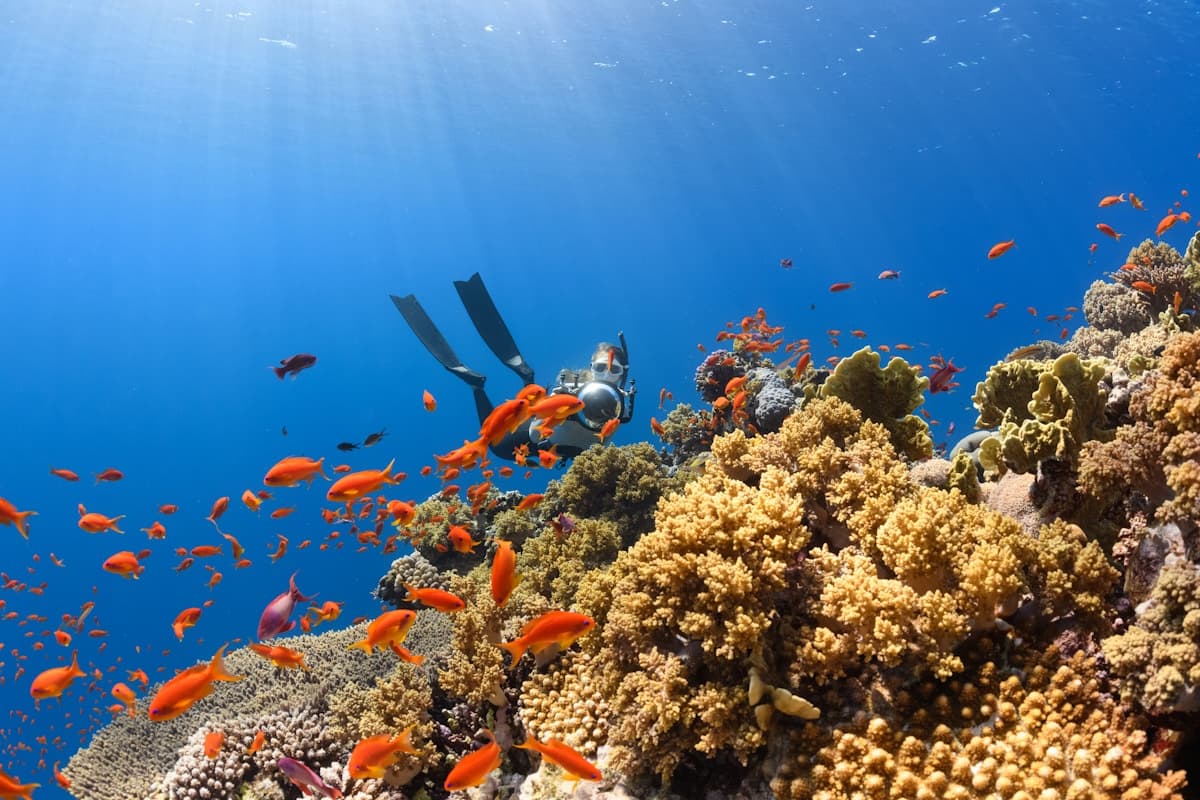
The country stretches 3,200 km along Biển Đông — the East (South China) Sea. Warm water year-round (25–30 °C), an underwater world of coral, turtles and tropical fish, and low prices on everything from courses to gear rental. Vietnam is consistently among the cheapest dive destinations in Southeast Asia. Both certified divers with hundreds of logged dives and first-timers pulling a mask on at the beach come here.
The six main spots for underwater time:
- Nha Trang — the dive capital, though the Hon Mun reserve has been closed to divers since 2022
- Phu Quoc — shallow, calm sea, ideal for beginners and families
- Con Dao — untouched reefs, sea turtles and visibility up to 30 m
- Cham Islands — a UNESCO reserve 40 minutes from Hoi An
- Whale Island — eco-tourism and whales in Van Phong Bay
- Ha Long — snorkelling among limestone karsts
Variety is Vietnam's big edge for divers. Off Nha Trang and Con Dao you dive the East Sea with its reef diversity and depths past 30 m. At Phu Quoc you drop into the Gulf of Thailand, where the water is calmer and warmer and reefs start near the surface. Off Hoi An you dive inside a UNESCO biosphere reserve with 200-plus species of tropical fish. All in one country, linked by cheap domestic flights (from about 1,000,000 VND / ~$40).
One more argument: you can earn a PADI Open Water Diver certification here for $250–350 — one of the lowest prices in the world. For comparison, the same course on Koh Tao in Thailand runs $350–450, and on the Gili Islands in Indonesia $400–500. English-speaking instructors are the norm at every PADI centre listed below.
Below: each spot in detail with VND prices, seasons and practical tips.
Prices current as of March 2026. Rate: $1 ≈ 26,000 VND.
- Nha Trang (Nha Trang): Vietnam's dive capital — Hon Mun closed since 2022, dives at Hon Rom rock
- Phu Quoc (Phú Quốc): Snorkelling and beginners — An Thoi archipelago
- Con Dao (Côn Đảo): Untouched reefs, sea turtles — Visibility up to 30 m
- Cham Islands (Cù Lao Chàm): UNESCO reserve — 40 min from Hoi An
- Whale Island (Hòn Ông / Whale Island): Eco-diving, whales in season — Van Phong Bay
- Ha Long (Vịnh Hạ Long): Snorkelling among karsts — Combine with a cruise
- Mui Ne / Phan Thiet (Mũi Né): Entry-level diving — Season: November–April
Where to dive: the 6 best spots for scuba and snorkelling
Vietnam has underwater time for every level — from a first snorkel in Phu Quoc's warm shallows to serious deep dives among sharks at Con Dao. Here is a side-by-side table of all six regions to make the choice easier.
| Spot | Who for | Best season | Visibility | Highlight | 2 dives |
|---|---|---|---|---|---|
| Nha Trang | All levels | March–October | Up to 20 m | Cheapest, but the reef has thinned | $70–95 |
| Phu Quoc | Beginners, families | October–April | 10–20 m | Calm sea, shallow reefs | $85–95 |
| Con Dao | Advanced | March–September | Up to 30 m | Turtles, living reef | ~$138 |
| Cham Islands | Snorkelling, families | April–September | 10–15 m | UNESCO, 200+ fish species | $75–120 |
| Whale Island | Eco-divers | April–July | 15–25 m | Whales, plankton, eco-resort | On request |
| Ha Long | Nature lovers | March–November | 5–10 m | Karsts and caves | — |
Now each spot in more detail — what you'll see, what you'll spend, who to book with.
Nha Trang — Vietnam's dive capital
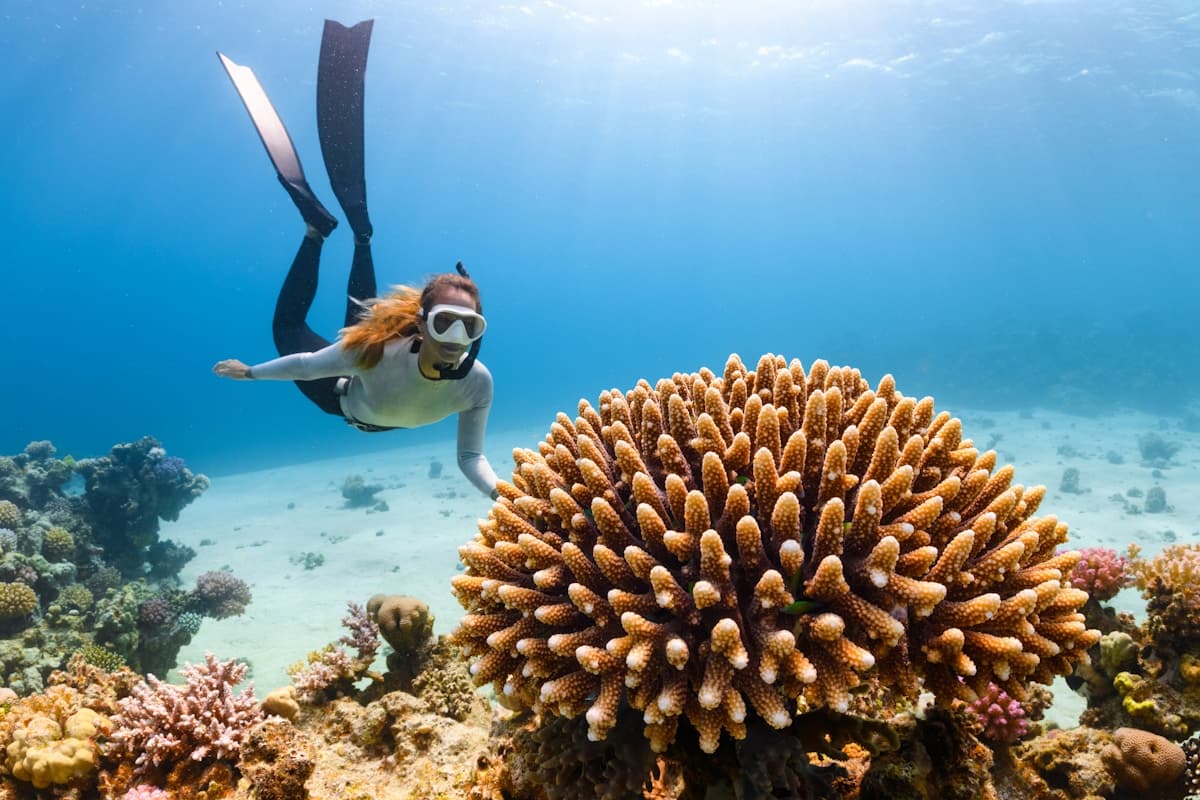
Nha Trang is the country's most accessible dive destination: it is the easiest to fly into, has the most centres and the lowest prices. Most of the diving used to happen off Hòn Mun (Hon Mun) island, 10 km offshore, in a marine reserve with 350 coral species, a national record. Diving in the reserve has been banned since 27 June 2022, and dive centres now go to Hon Rom rock (Hòn Rơm), also known as Madonna Rock. You'll still meet clownfish tucked in anemones, groupers the size of a dog, clouds of anthias and nudibranchs in every colour.
Top dive sites in Nha Trang Bay
Some of these sites lie inside the Hon Mun reserve, where diving has been banned since 2022. Ask your centre which ones are open now.
- Madonna Rock — a cascade of underwater caves and rock formations at 18–25 m. Lionfish hover in the water column, morays peer from crevices, and the walls carpet with soft coral. It is also nudibranch territory, which photographers stalk for hours
- Mushroom Reef — soft corals shaped like mushrooms at 12–18 m. Weak current and good visibility make it a fine site for underwater photography
- Moray Beach — a moray in every crack, plus rays, cuttlefish and large reef fish. Depth 10–20 m
- Mama Hanh — a gentle reef for beginners, 5–12 m. Plenty of hard coral and small tropical fish; a common site for first dives
Visibility reaches 20 m in the peak months, June to August. Water is 28–30 °C, so a wetsuit is more about scrapes than warmth. In winter (November–January) storms are common: visibility drops to 5–8 m, swell picks up, and many centres cut back their trips.
Dive centres you can trust
- Vietnam Active — a PADI 5-Star Dive Center, modern Aqualung and Suunto kit, instructors in six languages, groups of up to four. Two dives from $85
- Rainbow Divers — a dive school chain with centres in several regions of Vietnam. English is the working language; book ahead in high season
- Sailing Club Divers — a long-standing PADI centre on the beachfront, English-speaking staff, small groups and a good record for absolute beginners
…we went diving through a street agency. It was a total mess… the boat was packed, and then a conveyor belt: two people at a time grabbed by the scruff and into the water, “go-go”. Some people didn't even get fins.mnzi, Vinsky Forum, 2018, translated by VietnamSpot
The rules in the bay have tightened to protect the ecosystem: diving and swimming are stopped in the core of the Hon Mun reserve, and visitor numbers at Hon Rom rock are capped. Great news for the reef, but a reason for travellers to book a tour two or three days ahead rather than at the last minute. Sites, centres and prices in detail — in our Nha Trang diving guide.

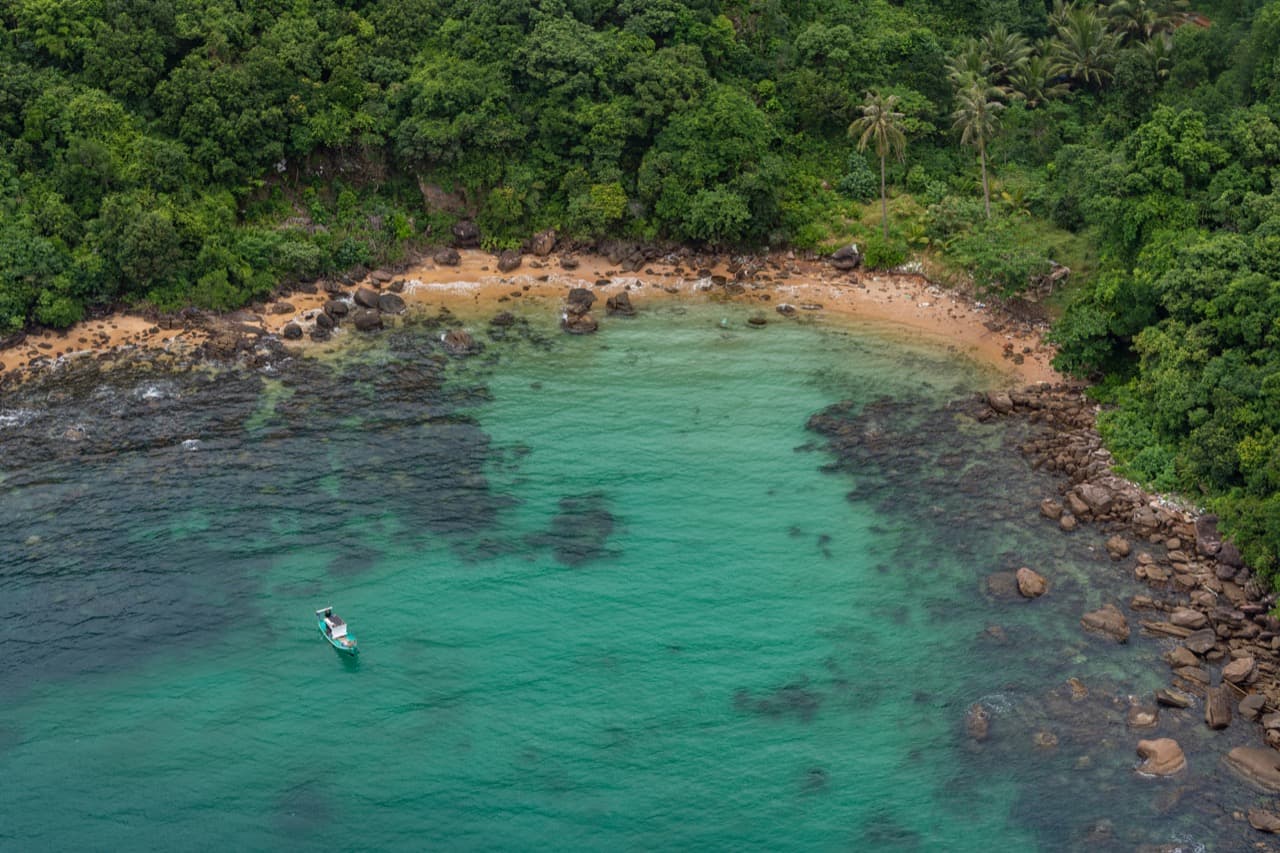
Phu Quoc — a snorkelling haven for families and beginners
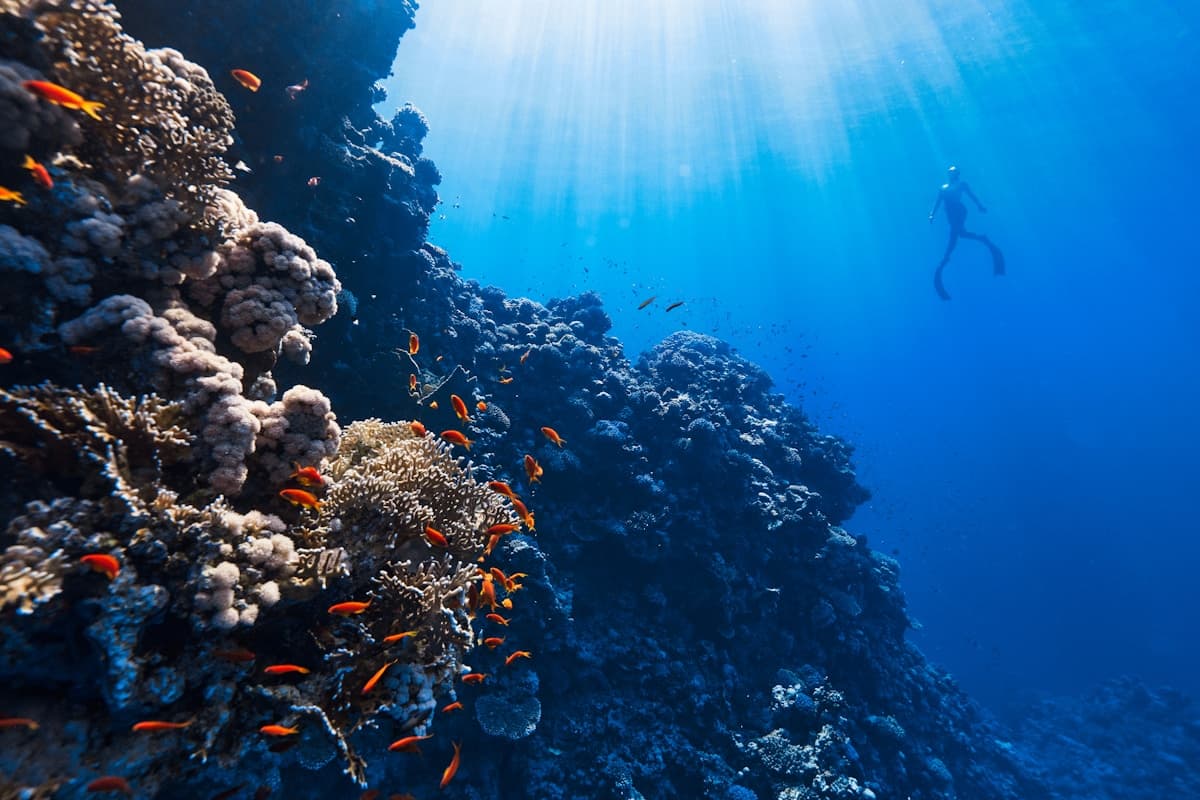
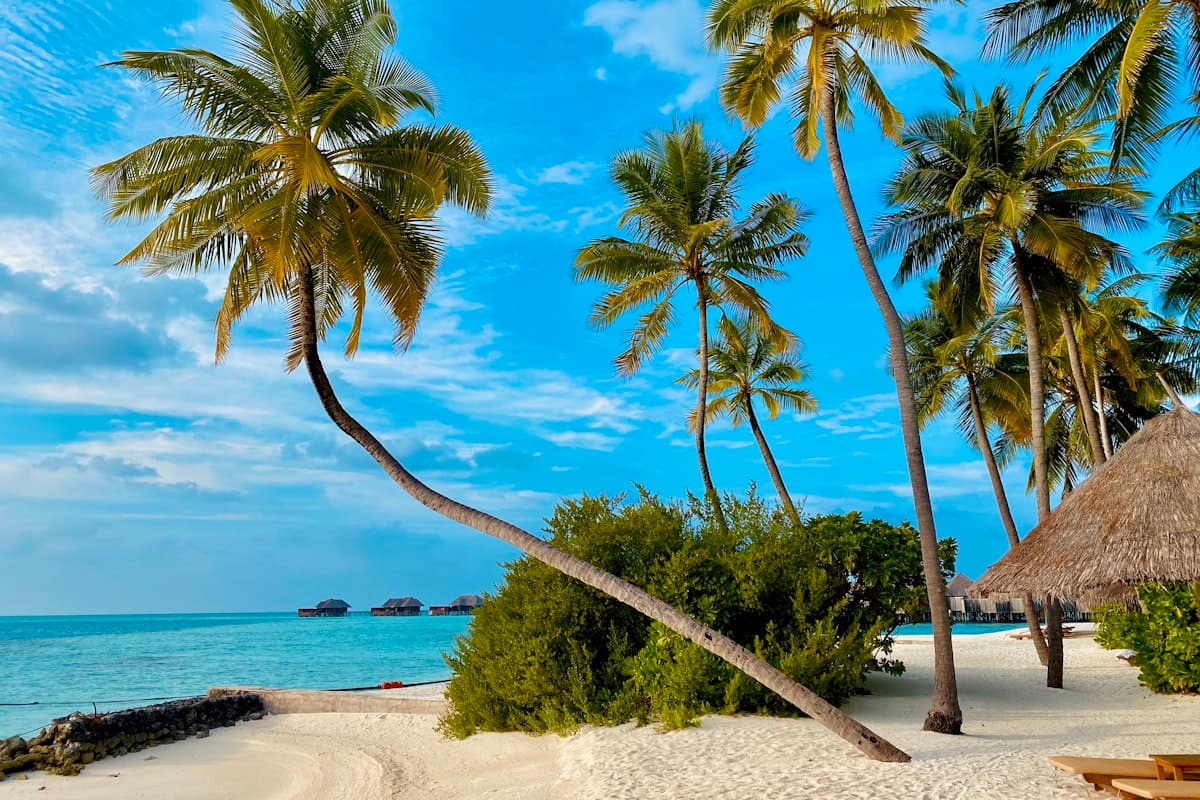
Phu Quoc is Vietnam's largest island, sitting not in the East Sea but in the Gulf of Thailand. If Nha Trang is about serious diving with caves and currents, Phu Quoc is about relaxed snorkelling in calm turquoise water. Ideal for families with kids, couples, and anyone picking up a mask for the first time.
The main snorkelling area is the An Thới (An Thoi) archipelago in the south — 15 islets with coral gardens, clear water and tropical fish. The boat from An Thoi harbour takes 20–30 minutes. A standard tour is a full day: two or three snorkel stops of 45–60 minutes each, with lunch on board or on an island beach.
What you'll see underwater
- Soft and hard corals in shades from purple to bright yellow
- Butterflyfish, angelfish, parrotfish, schools of barracuda
- Cuttlefish, starfish, sea cucumbers
- Sea urchins near the rocks (don't touch — the spines are venomous and take a week to heal)
- With luck, small reef sharks (bottom-dwelling, harmless)
Popular snorkelling islands
- Hon Thom (Pineapple Island) — the largest and most accessible, reached by the world's longest sea cable car (7.9 km). It has a beach, restaurants and a water park; snorkelling is off the north coast
- Hon May Rut — white sand, shallow water, clear visibility. Coral starts right off the beach, so you can snorkel without a boat
- Hon Mong Tay — a wild, quiet islet. Longer to reach, but fewer people and more fish
- Hon Dam Ngoai — a coral garden of soft corals, good for photography
Season: October–April. In the monsoon (May–September) swell rises, visibility drops to 3–5 m, and some tours are cancelled. In winter the sea is calm, visibility is 15–20 m and the water 28–30 °C.
Diving is available too. Two dives run $85–95. Centres: Rainbow Divers Phu Quoc, Flipper Diving Club, Phu Quoc Diving Center — all with English-speaking instructors. Depths are more modest than Nha Trang (to 18 m), but plenty for training and first certification dives. Dive sites, prices and choosing a centre — in our Phu Quoc diving guide.
Fast Track — no queue at the border
5–10 minutes instead of an hour in the immigration queue
from$11per passenger
Con Dao — turtles, sharks and untouched reefs
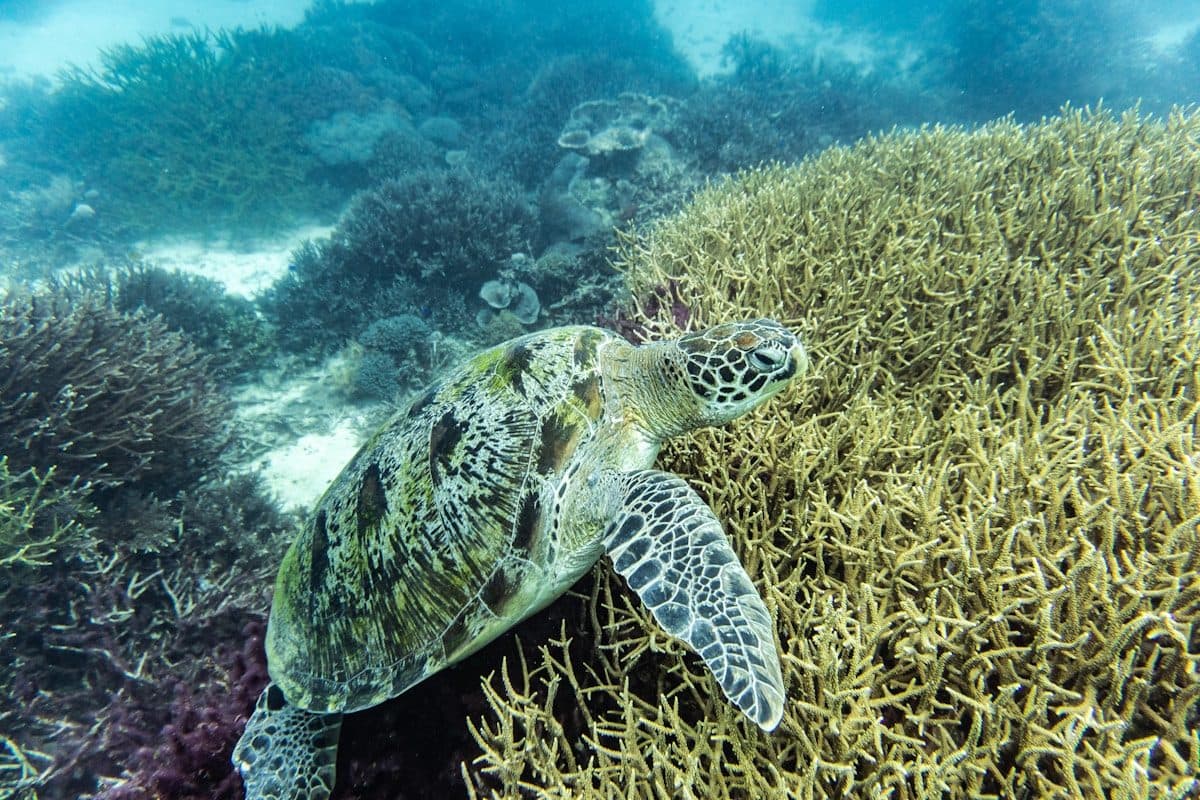
Côn Đảo is an archipelago of 16 islands about 180–190 km from Vung Tau — a national park and marine protected area. The reefs really are in a different state compared with the tourist-crushed islands of Nha Trang or Phuket.
Why Con Dao is special
- Visibility up to 30 m — the best in Vietnam. On a good day you see the bottom from the surface at 20 m. The water is pool-clear, but with coral
- 400+ coral species — healthy, bright, with no trace of mass tourism. No snapped branches, no bleached patches
- Sea turtles everywhere. Green and hawksbill turtles nest on Hòn Bảy Cạnh (Bay Canh) island — the main nesting site in Vietnam
- Large marine life: rays, barracuda up to a metre and a half, cobia, bamboo sharks (bottom-dwelling, harmless), batfish, giant groupers
Night turtle excursions are an experience worth flying in for. From April to October (peak June–August), females come ashore on Bay Canh to lay eggs. The trip starts in the evening: a boat to the island, a night in a tent or simple hut, and at dawn you can watch tiny hatchlings scramble to the sea. From about 1,500,000 VND (~$60), including boat, guide and overnight. Book well ahead — in peak season (June–August) there are simply no spots left.
Downsides: Con Dao is hard to reach. The flight from Ho Chi Minh City takes about an hour (Vietnam Airlines and Vietjet); check fares early, as flights are few. The infrastructure is modest: a few hotels, a couple of restaurants, no nightlife or shopping. Diving is pricier than Nha Trang, too — there are just two centres and little competition. But that seclusion is exactly what keeps the reefs intact: what Nha Trang has already lost is still here in full.
Diving: March–September, with the clearest water in April and May. From October to February the northeast monsoon blows: centres go out only on calm days, and boats stay in during storms. Two PADI centres work on the island, Con Dao Dive Center and Amadive; Rainbow Divers sells Con Dao dives through a local partner. Two dives cost 3,600,000 VND (~$138). A half-day snorkelling tour is about 1,000,000 VND (~$40): speedboat, gear, snacks and a guide. More on the island in our Con Dao diving guide.
Cham Islands — a day snorkel from Hoi An
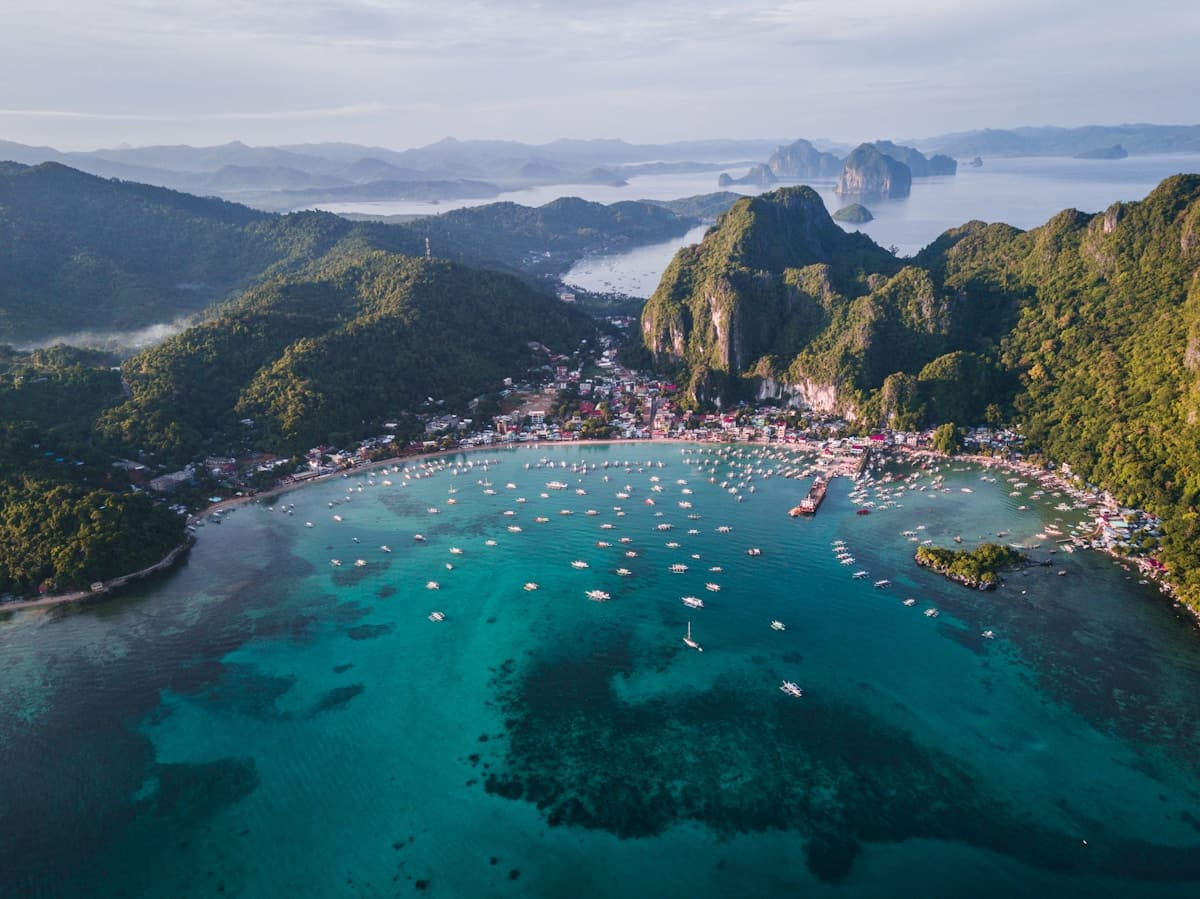
Eight granite islands 15 km off the Hoi An coast, a UNESCO biosphere reserve since 2009. Cù Lao Chàm has 135 coral species and more than 200 species of tropical fish. It is a 40-minute speedboat ride from Cửa Đại harbour.
The Cham Islands are a great one-day trip out of Hoi An or Da Nang. No need to fly anywhere, switch hotels or plan a separate trip. Board the boat in the morning, spend two hours in the water, have lunch on the beach with a view of the island, and you're back in Hoi An by dinner.
A standard snorkelling tour includes
- Speedboat (40 min each way)
- Gear (mask, snorkel, fins, vest)
- Two snorkel stops of 45–60 min
- Lunch on the beach (rice, seafood, fruit)
- A guide
Price: $30–50. Diving is $75–120 for two dives.
Dive centres
- Cham Island Diving Center (Blue Coral Diving) — on Nguyễn Thái Học street, Hoi An. PADI-certified, with instructors in English, French and Italian
- Tiger Fish Divers — daily catamaran trips, a more comfortable boat, a little pricier
Season: April–September. In winter the sea is rough and tours are cancelled. Best visibility is June–August (up to 15 m). Water in those months is 28–29 °C — swimwear and a mask, no wetsuit needed.
Pair the snorkel with a walk through Hoi An's old town and some Vietnamese food, and you get one of the best days of the trip. More in our Cham Islands guide.
Whale Island — eco-diving for the discerning

Hòn Ông (Hon Ong) is an uninhabited island in Van Phong Bay, two hours north of Nha Trang. The whole island has a single resort: Whale Island Resort. Power comes from solar panels, plastic is banned, Wi-Fi works only in the lobby, and there is no air conditioning — just sea breeze through the shutters.
Why come here instead of Nha Trang? From April to July jellyfish and plankton spawn off the island, which draws whales. Seeing one from the boat is a real possibility, if not a guarantee. Underwater: untouched reefs with no anchor scars or mass tourism, sea turtles and rays.
It is a place for people who value quiet and ecology over comfort and nightlife.
The resort runs the diving itself, with its own instructors and gear. Prices are on request, usually $60–90 for two dives. Snorkelling from the boat is free for resort guests.
Getting there: car or taxi from Nha Trang to Đầm Môn pier (2 h), then a boat to the island (20 min). Booking directly through Whale Island Resort is the simplest option.
Season: April–October, best April–July (the chance to see whales). From November to March, check with the resort whether it is open: storms are common.
Ha Long — snorkelling among the karsts

Hạ Long Bay is a UNESCO site with around 2,000 limestone islands. Snorkelling here is more of a bonus to a cruise than the main reason to come. The water is murkier than in the south and centre (visibility 5–10 m) because the rivers carry in sediment. But the setting is unmatched — thousands of karst towers, hidden lagoons, bat caves and emerald water.
Snorkelling is folded into some cruise itineraries (usually the two- or three-day ones). There's no point booking a standalone snorkel tour — pick a cruise with a swim stop instead. Marine life is modest by Vietnamese standards: small reef fish, crabs and molluscs.
Season: March–November. In winter (December–February) it is cold for the tropics — the water drops to 18–22 °C, uncomfortable without a neoprene wetsuit. In summer it is 25–28 °C, fine in a rash guard.
How much diving and snorkelling costs in Vietnam
Vietnam is one of the cheapest dive destinations in the world. Two full dives with gear, boat, lunch and a certified instructor cost $70–140 — cheapest in Nha Trang, priciest on remote Con Dao. For scale: the same programme in Thailand runs $90–150, in Bali $100–170, in the Maldives $150–250. Only Egypt competes on price ($60–80).
| Service | Price (~USD) | Price (VND) | Notes |
|---|---|---|---|
| Intro dive (1 dive) | ~$50–70 | 1,300,000–1,820,000 | Nha Trang, Phu Quoc — with instructor and gear |
| 2 fun dives with lunch | ~$70–140 | 1,820,000–3,600,000 | Nha Trang $70–95 · Phu Quoc $85–95 · Con Dao ~$138 · Cham $75–120 |
| Snorkelling tour (full day) | ~$25–50 | 650,000–1,300,000 | Boat, mask, lunch · Nha Trang $25–35 · Phu Quoc $30–40 · Cham $30–50 |
| PADI Open Water Diver (3 days) | ~$250–400 | 6,500,000–10,400,000 | Nha Trang $250–350 · Phu Quoc $300–400 · Theory + 4 dives + cert |
| PADI Advanced Open Water (2 days) | ~$250–300 | 6,500,000–7,800,000 | Dives to 30 m, 5 specialties |
| Underwater camera rental (day) | ~$15–25 | 390,000–650,000 | GoPro or similar at the dive centre |
What a tour price usually includes
- Transfer from hotel to harbour and back (minibus or motorbike)
- Gear rental: BCD, regulator, mask, fins, wetsuit
- Air tanks (or nitrox for a $5–10 surcharge)
- Boat lunch: typically rice, seafood, fruit, tea, water
- A certified dive guide or instructor
- Basic accident cover
What's not included: underwater camera (rental $15–25/day), crew tip (50,000–100,000 VND is the norm, not an obligation), the PADI certification card if you train (the e-card is free, a plastic card is $30–40).
How to save
- Book directly on the dive centre's website — no markup from aggregators like GetYourGuide (a $10–20 difference)
- A package of 4–6 dives is cheaper than 2+2+2 booked separately, usually 10–15% off
- Staying in Nha Trang a while? Ask about a discounted PADI Open Water rate when booking two weeks ahead
- A snorkel tour through your hotel is often $5–10 more than one booked at a local office on the promenade — the front desk takes a cut
- On Phu Quoc, snorkelling the "wild" islands (Hon Mong Tay, Hon Dam Ngoai) is cheaper than the built-up Hon Thom
- Bringing your own mask saves $3–5 in rental each time — it pays for itself in two tours
When to go: dive seasons by region
There is no single "best month" to dive in Vietnam — the country runs 3,200 km north to south, and the weather in Ha Long and Phu Quoc differs completely. A simple rule: going in winter, choose Phu Quoc; in summer, Nha Trang or the Cham Islands; from March to September, Con Dao.
| Region | Best season | Peak visibility | Avoid | Water t° |
|---|---|---|---|---|
| Nha Trang | March–October | June–August (to 20 m) | November–January (storms) | 26–30 °C |
| Phu Quoc | October–April | December–March (to 20 m) | May–September (monsoon) | 27–30 °C |
| Con Dao | March–September | April–May (to 30 m) | October–February (monsoon) | 26–29 °C |
| Cham Islands | April–September | June–August (to 15 m) | October–March (swell) | 25–29 °C |
| Whale Island | April–July | May–June (to 25 m) | November–February | 26–29 °C |
| Ha Long | March–November | — | December–February (18–22 °C) | 22–28 °C |
Universal months: March–April and October. In these windows you can dive almost everywhere — no storms, no monsoon, warm water, decent visibility.
Worst months: November–January, unless you're on Phu Quoc. Storms, murky water, cancelled tours. On Phu Quoc, meanwhile, this is high season with the clearest water.
The slightest storm and visibility drops to zero for days. So if you have the choice, make your first ever dive in more comfortable conditions.Вьетнамец, Vinsky Forum, 2013, translated by VietnamSpot
Want to combine diving in Nha Trang with snorkelling on Phu Quoc? Plan for March–April — both regions are in season, and the Nha Trang → Phu Quoc flight is from 1,500,000 VND (~$60) on VietJet.
Learning to dive: PADI and SSI in Vietnam
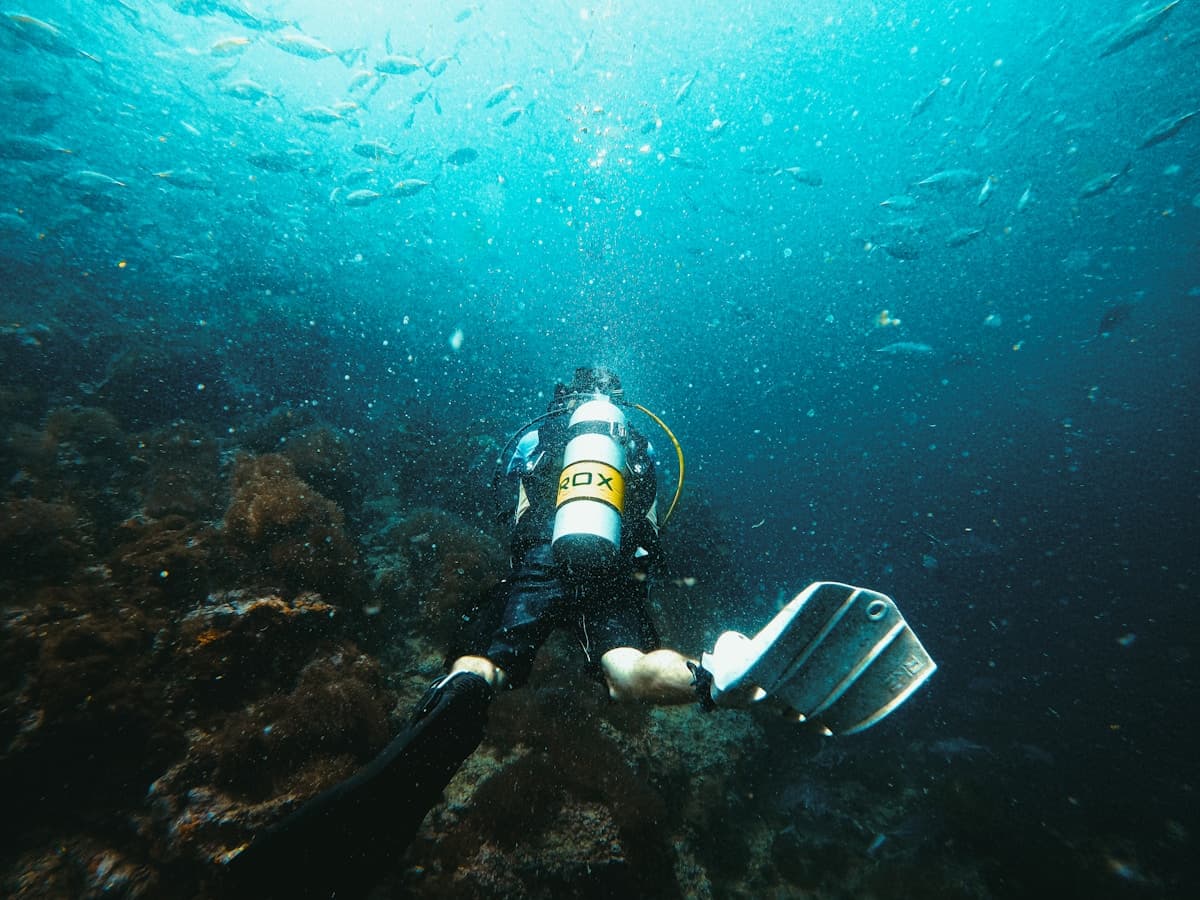
Vietnam is one of the cheapest places in the world to earn a PADI Open Water Diver certification. The full course is $250–350 and takes three days. For comparison: in Thailand the same course is $350–450, in Bali $400–500, in Egypt $300–400. Quality is no lower — PADI standards are identical worldwide.
| Course | What you get | Days | Price (~USD) | Price (VND) |
|---|---|---|---|---|
| Discover Scuba (intro) | A dive with an instructor, no certification | 1 | ~$50–70 | 1,300,000–1,820,000 |
| PADI Open Water Diver | Certification, dive to 18 m worldwide | 3 | ~$250–350 | 6,500,000–9,100,000 |
| PADI Advanced Open Water | Dives to 30 m, 5 specialties | 2 | ~$250–300 | 6,500,000–7,800,000 |
| PADI Rescue Diver | Rescue skills, in-water first aid | 3 | ~$300–400 | 7,800,000–10,400,000 |
How the 3-day Open Water course works
Day 1: theory plus pool. You cover dive physics (pressure, gases, decompression), safety rules and hand signals, then practise in a pool or shallow water: kitting up, breathing underwater, mask clearing, emergency ascent.
Day 2: two open-water dives, 8–12 m. You repeat the day-one exercises, now on the reef, with coral and fish alongside.
Day 3: two more dives, deeper (12–18 m). You lock in the skills and sit the exam (a tablet test). After that you get your PADI e-card and plastic card.
PADI vs SSI — which system? There is no meaningful difference: both are recognised worldwide, the programmes are similar and the price is the same. PADI says it has certified over 30 million divers. SSI is a little younger but equally respected. If you plan to dive around the world, PADI is slightly more convenient — a centre that accepts your card without questions turns up in any country.
English-speaking instructors are standard everywhere in Vietnam, and centres are used to non-native speakers, briefing slowly and visually. If you want a fixed slot, book a week or two ahead in high season — the good instructors fill up.
What you need for the course
- Being comfortable in water — you don't have to swim like an Olympian, but you should manage 200 m
- Age: from 10 (Junior Open Water, limited depth) or from 15 for the full course
- A completed medical questionnaire (heart, lungs, epilepsy, diabetes). With any chronic condition you'll need a doctor's clearance
- Your passport for the certification paperwork
Safety and what to know before you dive
Diving in Vietnam is safe — every licensed centre follows international PADI and SSI standards, gear is serviced regularly and instructors are certified. But the underwater world is not a water park. A few things are worth knowing in advance.
Jellyfish. The main nuisance, especially in the monsoon (November–March in Nha Trang, June–September on Phu Quoc). Stings are painful — like a bad nettle — but not deadly. The best defence is a rash guard (a long-sleeve lycra top), which also saves you from sunburn.
Sea urchins. They live near rocks and reefs, especially in the shallows. Standing on a spine hurts and can get infected (the spines snap off and stay in the skin). Simple rule: don't wade barefoot on rocky shores, and underwater don't touch anything or stand on the bottom.
Sharks. The question everyone asks. Shark attacks on divers in Vietnam are rare, and there is little data on them. Con Dao has bamboo reef sharks — small (up to a metre), bottom-dwelling, feeding on molluscs and completely harmless.
Coral. Don't touch, stand on or break it. Coral is a living organism that takes decades to recover. Cuts heal slowly (2–4 weeks) and infect easily in the tropics — plus there are fines for damaging coral in protected zones (Hon Mun, Con Dao, the Cham Islands).
Recompression chamber. Nha Trang has one, but not at a dive centre: ask your centre where it is and how they would get you there before your first dive. From the islands — Phu Quoc, Con Dao, the Cham Islands — decompression sickness may mean emergency evacuation. That is another reason to dive only with licensed centres.
Medical contraindications: cardiovascular disease, lung conditions (asthma), epilepsy, pregnancy, chronic ear infections. Don't dive after alcohol or when badly fatigued. Leave at least 18–24 hours between your last dive and a flight (otherwise you risk decompression sickness from the cabin pressure change).
Sunscreen. Use reef-safe only — free of oxybenzone and octinoxate. Ordinary sunscreen kills coral: chemical filters cause bleaching and polyp death, and in protected zones reef-safe matters even more. Don't want to read labels? Wear a rash guard: it protects better than any cream and doesn't harm the reef.
Currents and swell. In open water (Con Dao, Whale Island) you meet moderate currents. Beginners should stay within the instructor's limits. Snorkelling, don't swim far from the boat and follow the guide. Off Phu Quoc and the Cham Islands the currents are weak — safe even for children.
Insurance. Standard travel insurance often does not cover diving. You need specialist cover: DAN International or DiveAssure; check current prices on the insurer's site. It covers decompression sickness, helicopter evacuation and chamber treatment. Without it, a single chamber session runs $5,000–15,000.
What to bring: a gear checklist
Dive centres provide everything — from mask to tanks. But a few items are better brought yourself.
For snorkelling
- A mask (your own — fitted to your face, doesn't fog, leak or pinch the nose)
- A snorkel (optional — tours provide one, but quality varies)
- A rash guard or lycra suit — against jellyfish, sun and coral scrapes
- Reef-safe sunscreen (brands: Badger, Stream2Sea, Raw Elements)
- A GoPro or a waterproof phone case
- Water shoes — for coral beaches and rocky entries
For diving
- Your PADI/SSI card (plastic or the e-card in the PADI App)
- A logbook with your recent dives (if you have one)
- A personal mask (optional but recommended — centre masks can be worn)
- Dive insurance (DAN International or DiveAssure)
- A dive torch for night dives (if you plan any)
- A dive computer (optional — the instructor has one, but your own is handy)
BCD, regulator, wetsuit, tanks and weight belt are all provided at the centre. There's no point flying your own heavy gear in: 15 kg of excess baggage costs more than renting on the spot.
FAQ
Yes, and it is excellent. Vietnam is one of the best snorkelling destinations in Southeast Asia, on par with Thailand and the Philippines. Four main spots: Phu Quoc (the An Thoi archipelago, calm shallows), Nha Trang (cheap and easy, snorkelling at Hon Mot: the Hon Mun reserve has been closed since 2022), the Cham Islands (a UNESCO reserve near Hoi An) and Con Dao (turtles and genuinely living reefs). The water is warm year-round (25–30 °C) and a snorkelling tour with lunch and boat starts at about 650,000 VND (~$25). Mask and fins are provided; your own gear is optional.
It depends on your level and the season. Nha Trang is for diving and confident swimmers: 350 coral species, deep dives to 30 m, developed infrastructure with PADI centres and a recompression chamber. Phu Quoc is for snorkelling and beginners: calm shallows, warm water, good for families with kids from age 6. In summer (June–August) choose Nha Trang; in winter (December–March) choose Phu Quoc. Want both? Come in March or October.
A first Discover Scuba / intro dive is $50–70 (about 1,300,000–1,820,000 VND). That covers a 30-minute briefing on land, full gear and one dive to 5–12 m with a personal instructor who stays at your side. No certification is needed — you just have to be comfortable in the water and not panic. It takes 3–4 hours with the transfer. If you enjoy it, you can start the PADI Open Water course the next day ($250–350).
No paperwork or training needed. Snorkelling is swimming on the surface with a mask and snorkel — face in the water, body on top. Being able to swim is enough. A life vest is provided on the boat, and you can float in it without moving at all. Kids from age 6 join most tours. A PADI certification is only required for scuba diving with a tank at depth.
The risk is low. Shark attacks on divers in Vietnam are rare and there is little data on them. Con Dao has bamboo reef sharks — small, bottom-dwelling fish up to a metre long that eat molluscs and shrimp. They are harmless.
There is no single season — it depends on the region. Nha Trang: March–October, the Cham Islands: April–September, peak June–August (visibility to 20 m, calm seas). Phu Quoc: October–April, peak December–March (glassy sea). Con Dao: March–September, best visibility April–May (to 30 m). The universal months, when you can dive almost everywhere, are March–April and October.
Snorkelling is fine from age 6 — a life vest is provided, no depth is involved, and the child floats on the surface. The best family snorkelling is Phu Quoc (shallow, calm, no currents) and the Cham Islands (a short tour, warm water). PADI Bubblemaker, a try-dive in water under 2 m, starts at 8. The Junior Open Water Diver course starts at 10. A kids' course costs the same as an adult's — $250–350 for Open Water.
- Guide
Mekong Delta Towns 2026: My Tho, Ben Tre, Vinh Long
My Tho, Ben Tre or Vinh Long? Compare three Mekong Delta towns: 1 to 7 day itineraries, homestays, buses from Ho Chi Minh City and costs in USD.Mekong Delta Towns 2026: My Tho, Ben Tre, Vinh Long - Guide
Ho Chi Minh City 2026: Saigon Guide for Travellers
Saigon guide: which district to stay in, what to see, the Cu Chi Tunnels, street food, getting around and visas for Vietnam's biggest city.Ho Chi Minh City 2026: Saigon Guide for Travellers - Guide
Phu Quoc Photo Spots: Beaches, Sunsets & Instagram
The best photo spots in Phu Quoc: Sao and Khem beaches, the cable car, Sunset Town, Grand World and where to catch the sunset — with tips.Phu Quoc Photo Spots: Beaches, Sunsets & Instagram