The Ha Giang Loop: a motorbike adventure in Vietnam's far north
About 400 km of mountain roads along the Chinese border, 19 ethnic groups and a pass that ranks among Vietnam's four legendary ones. Self-drive is about $68–106 over 3 days; an easy rider with a driver, roughly $150–200. Here's the day-by-day route, the permit and licence rules, safety, the best time to go and how to get there from Hanoi.

The Hà Giang Loop is not a beach holiday and not a bus tour. It is 3–5 days on a motorbike through karst plateaus, canyons hundreds of metres deep and villages where Hmong women weave hemp on the porch.
Self-drive runs about $68–106 over 3 days. An easy rider — a local driver you ride pillion behind — is $150–200. From Hanoi to Hà Giang it is 6–7 hours by bus for around 250,000 VND (~$10), usually on a sleeper coach.
Below: the day-by-day route, prices in VND with dollar conversions, an honest self-drive vs easy-rider comparison, the permit and licence situation, and the warnings nobody puts on the postcards.
What the Ha Giang Loop is

The loop starts and ends in Hà Giang, the former capital of the province of the same name in Vietnam's far north (since 2025 part of Tuyên Quang province) and the easiest place to reach from Hanoi on an overnight bus. The road winds through mountain passes, karst plateaus and narrow valleys along the Chinese border. It is the best known of Vietnam's motorbike adventures.
The headline sight is the Đồng Văn plateau, a recognised UNESCO Global Geopark. Limestone peaks hundreds of millions of years old, terraced fields wedged between cliffs, and villages where time seems to have stopped.
Nineteen ethnic groups live in the former Hà Giang province — Hmong, Dao, Tay, Lo Lo and others — each with its own language, dress, food and customs. On Sunday at the Đồng Văn market you can watch Hmong men in black haggle over a buffalo.
The route day by day — the 4-day classic

Day 1: Hà Giang → Quản Bạ → Yên Minh (~100 km)
Leave Hà Giang in the morning. First stop is Heaven's Gate Cổng Trời Quản Bạ, a viewpoint over the Twin Mountains. The road climbs and the switchbacks begin straight away. By lunch you reach the small town of Yên Minh. Good sealed tarmac all the way.
Most tour operators bring you into Ha Giang on a night bus or van from Hanoi, arriving at about 3am – which gives you just a few hours of sleep before the first day of action. If you’re not in a rush, consider arranging transport to arrive in the city a day in advance so you can start your loop adventure restedHanoi-based writer Benjamin Engelbach, Lonely Planet, 2026
Day 2: Yên Minh → Đồng Văn → Mã Pí Lèng → Mèo Vạc (~120 km)
The big day. In the morning, the old town of Đồng Văn with its stone Hmong houses and the Lũng Cú flag tower (3 km from Vietnam's northernmost point). Then the Mã Pí Lèng pass: 20 km of road carved into the cliff, looking down on the Nho Quế river at the bottom of the canyon. Overnight in Mèo Vạc.
Day 3: Mèo Vạc → Du Già → Yên Minh (~110 km)
A less touristy stretch. Smaller passes, but more authentic villages. The road is dirt in places — slick after rain. Via Du Già (Du Già) you rejoin the southern arm of the loop.
Day 4: Yên Minh → Hà Giang (~100 km)
Back along the same road as day 1. No need to rush — stop at the rice terraces and have lunch at a roadside café. You're back in Hà Giang by evening.
Self-drive vs easy rider — the cost breakdown

| Item | Self-drive (3 days) | Easy rider (3 days) |
|---|---|---|
| Bike rental | 540,000–750,000 VND (~$22–30) | Included |
| Fuel | 250,000–350,000 VND (~$10–14) | Included |
| Permit | $10 (~260,000 VND) | Included |
| Lodging (2 nights) | 200,000–400,000 VND (~$8–16) | Included |
| Food (3 days) | 450,000–900,000 VND (~$18–36) | Included |
| Total | ~1.7–2.7M VND (~$68–106) | ~3.8–5M VND (~$150–200) |
When to pick an easy rider: you have no experience riding mountain roads, you'd rather relax and look around, and you value local knowledge — the driver knows the hidden spots.
Due to an increased police presence in Ha Giang (and fines that start at 2,000,000 Vietnamese dong) your best options are now to join a guided tour (you'll ride on the back of the motorbike as a passenger) or hire a private car and driverHanoi-based writer Benjamin Engelbach, Lonely Planet, 2026
When to ride yourself: you handle a motorbike confidently (steep switchbacks, dirt sections), you want the freedom to stop anywhere, and the budget is tight.
Renting a bike, the permit and prep

Where to rent: in Hà Giang city, on the streets near the bus station. Popular outfits: QT Motorbikes, Strawberry House, Bong Hostel. All hand over a GPS map of the route.
Bike types and prices
- Semi-automatic (Honda Wave, Dream): 180,000 VND/day (~$7) — fine for most people
- Manual (Honda XR150, Win): 250,000 VND/day (~$10) — for experienced riders
- On rental you leave a deposit: your passport or $100–200 in cash
Permit: the loop runs through a border zone (Quản Bạ, Đồng Văn, Mèo Vạc, Mã Pí Lèng), so foreigners need a border-area permit — the fee is $10 (~260,000 VND) per person under Finance Ministry Circular 28/2026. Easiest is to have your hostel arrange it: hand over your passport and bike plate, pick it up the next day. You can also apply yourself at the provincial immigration police; the official processing time is up to 5 working days. Without one you can be turned back or fined at a checkpoint.
Check before you ride
- Brakes — on mountain descents this is life or death
- Tyres — there must be tread
- Lights — headlight and brake light
- Mirrors — both of them
Fast Track — no queue at the border
5–10 minutes instead of an hour in the immigration queue
from$11per passenger
The main highlights along the route

Mã Pí Lèng pass
A 20 km road carved into the cliff by volunteer labourers in the 1960s. Below lies the Hẻm Tu Sản canyon, hundreds of metres deep, with the turquoise Nho Quế river running through it. The pass tops out at around 1,200–1,400 m. The viewpoint is free and a coffee at the café on the cliff edge is 30,000 VND (~$1.20). Down at the water, boats run trips into the canyon — about 150,000–200,000 VND (~$6–8) per person, and one of the best views on the whole loop. Prices as of July 2026.
Lũng Cú flag tower
3 km from Vietnam's northernmost point. A stone stairway climbs to the tower with the national flag. You look across into China over a small river. Entry: 45,000 VND (~$1.80, July 2026). Come in the morning — less fog.
Đồng Văn old town
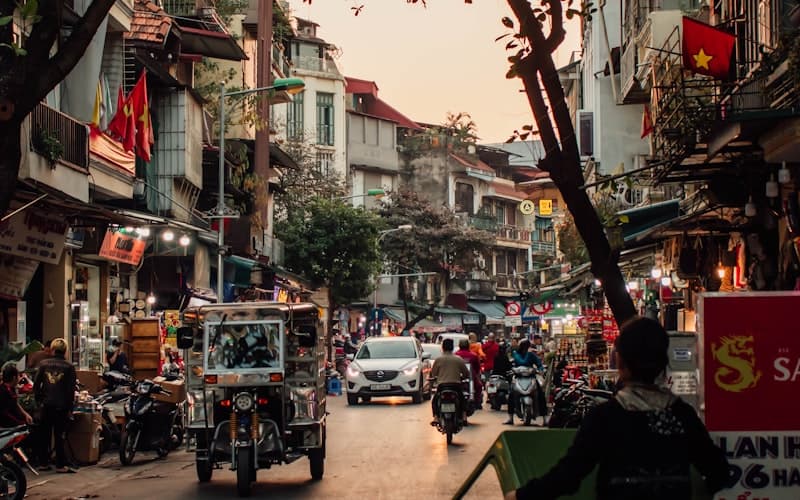
Stone Hmong houses, a market (most colourful on Sundays), cafés and hostels. This is where most riders spend the second night of the loop.
The Happiness Road
The whole QL4C highway is 185 km; its best-known stretch runs from Hà Giang to Đồng Văn and Mèo Vạc. It took 6 years to build, from 1959 to 1965. Youth brigades from 16 ethnic groups cut the path through the rock by hand. The memorial stands at the start of the road in Hà Giang.
Mèo Vạc Sunday market
Every Sunday in Mèo Vạc there's a market that draws Hmong, Dao and other groups. Buffalo, chickens, home-made rice wine, embroidered cloth. Plan your route to be here for it.


Where to sleep and where to eat

Lodging
- Hostels in Hà Giang: 100,000–200,000 VND/night (~$4–8). Bong Hostel and QT Hostel are the popular ones
- Homestays in Đồng Văn and Mèo Vạc: 150,000–300,000 VND/night (~$6–12). Simple rooms, plenty of character
- Hot water can be hit or miss. Electricity — nearly everywhere
Food
- Breakfast: pho or bánh mì for 30,000–40,000 VND (~$1.20–1.60)
- Lunch: com (rice + meat + veg) for 40,000–60,000 VND (~$1.60–2.40)
- Dinner at a homestay: often included in the price, or 80,000–100,000 VND
- The local specialty: thắng cố — a thick offal stew simmered at the markets. Strong smell, an acquired taste
When to go and what to pack

Best time
- September–November: golden rice terraces before the harvest until early October, buckwheat blooming purple across the Đồng Văn plateau in October–November, clear skies after the rains. Peak is October
- March–May: dry and comfortable
- June–August: green terraces, but rain and slick roads
- December–February: cold (down to +5°C at night), foggy, but the fewest tourists
It’s very rainy from June to August, so bring spare changes of clothes, particularly socks and underwearHanoi-based writer Benjamin Engelbach, Lonely Planet, 2026
What to pack
- A warm jacket — at 1,500 m it's cold at night even in summer
- A rain shell — the rain starts without warning
- Gloves — your hands will freeze at speed
- Sunscreen — the UV is stronger at altitude
- Cash — ATMs are few on the loop; Hà Giang is the safest place to withdraw
- Hà Giang city (Hà Giang): Start and finish of the loop — Bike rentals
- Quản Bạ Heaven's Gate (Cổng Trời Quản Bạ): Viewpoint over the Twin Mountains
- Yên Minh (Yên Minh): Day 1 overnight stop — Cafes, fuel
- Đồng Văn old town (Phố cổ Đồng Văn): Stone Hmong houses — Market, homestays
- Lũng Cú flag tower (Cột cờ Lũng Cú): 3 km from Vietnam's northernmost point — Entry 45,000 VND (~$1.80)
- Mã Pí Lèng pass (Đèo Mã Pí Lèng): View over the Tu Sản canyon — and the Nho Quế river
- Mèo Vạc (Mèo Vạc): Sunday market — Homestays, overnight stop
- Du Già (Du Già): Southern arm of the loop — Authentic villages
FAQ
A self-drive loop over 3 days runs about 1,700,000–2,660,000 VND (~$68–106): bike rental, fuel, permit, lodging and food. An easy rider with a driver is 3,750,000–5,000,000 VND (~$150–200) all-in.
Three days minimum, four is ideal. Three days hits the main stops but the pace is high. Four days lets you linger on the Mã Pí Lèng pass and catch the Sunday market in Mèo Vạc. Five days is for riders who want to branch onto side roads.
Officially yes — an International Driving Permit with category A1 (up to 125 cc) or A, plus your home licence. The fine for riding without one is 2–4 million VND (~$80–160) on a bike up to 125 cc and 6–8 million above that (Decree 168/2024). In practice police on the loop don't always check, but in Hà Giang city they do so regularly.
September–November: golden terraces until early October, then buckwheat in bloom, and clear skies. March–May: dry and comfortable. December–February is cold and foggy with slick roads.
Yes. Option one: an easy rider (you ride pillion behind a local driver). Option two: a jeep tour (pricier, from about $250 per person). Option three: local buses between towns, but the timetable is patchy and you miss half the viewpoints.
The tarmac on the main route is good, but the switchbacks are steep, the drops are unguarded and trucks come the other way. Rain makes it slick. The real risks are fatigue on long stretches and overrating your own skill. If in doubt, take an easy rider.
- Guide
Hon Thom Cable Car, Phu Quoc: Tickets & Tips 2026
The Hon Thom cable car in Phu Quoc — the world's longest sea crossing: tickets, Sun World, what's on the island and how to get there.Hon Thom Cable Car, Phu Quoc: Tickets & Tips 2026 - Guide
Ninh Binh Boat Tours: Trang An & Tam Coc Guide 2026
Ninh Binh boat tours: Trang An vs Tam Coc, the foot-rowing boats, the "inland Ha Long", tickets, the golden-rice season and day trips from Hanoi.Ninh Binh Boat Tours: Trang An & Tam Coc Guide 2026 - Guide
Phan Thiet vs Nha Trang & Phu Quoc: Which to Pick
Phan Thiet and Mui Ne vs Nha Trang and Phu Quoc: beaches, weather, prices, food and who each suits — kiters, families or the party crowd.Phan Thiet vs Nha Trang & Phu Quoc: Which to Pick