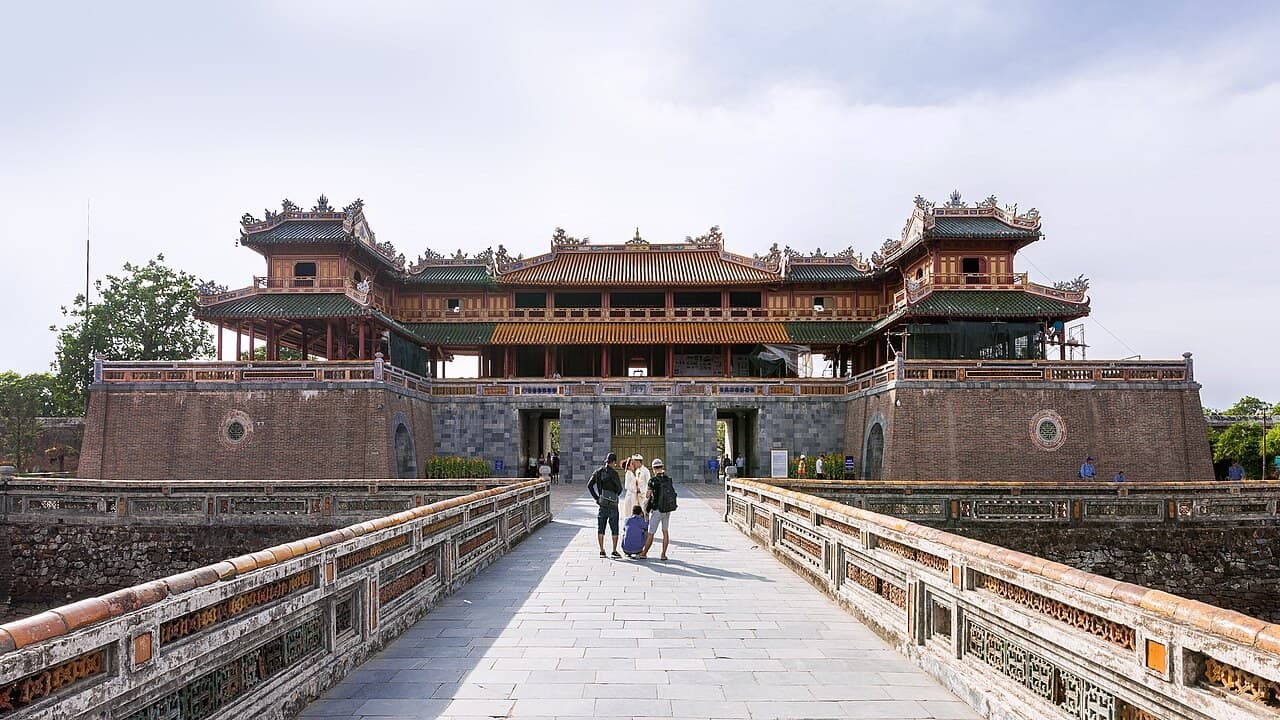
Tours from Hue in 2026: Bach Ma, Thien Mu, the DMZ and 7 more day trips
People come to Hue for two or three days and leave feeling they saw half of it. The city is compact, but it sits at a crossroads of routes: an hour by car to a national park with waterfalls, two to the DMZ tunnels, two and a half to Hoi An over the Hai Van Pass — plus seven royal tombs and the Citadel in town. This guide breaks down six types of day trip from Hue, with USD prices, real timings and advice on which format fits your schedule.

Prices current as of June 2026. Confirm entry and tour fees before you travel; the conversions below use ~25,000 VND = $1.
If it is your first time in the city, start with the overview — the full guide is in Hue, Vietnam's imperial capital. This piece is about everything around it.
The numbers at a glance
| Metric | Value |
|---|---|
| Main types of day trip | 6 |
| Half-day city overview from | ~$16 |
| Most expensive (Phong Nha) | $58–85 |
| Bach Ma group tour | from 900,000 VND (~$35) |
| Combo ticket for the tombs | 530,000 VND (~$21), 2 days |
| Distance to Bach Ma | 45–50 km / 1 hour |
| Distance to the DMZ (Vinh Moc) | 110 km / 2 hours |
| Best month for every tour | March–April |
6 types of day trip from Hue — which to pick
Six main routes run out of Hue: the classic overview of the Citadel and tombs, trekking in Bach Ma National Park, a trip to the Demilitarised Zone with the Vinh Moc tunnels, a dragon boat on the Perfume River, a transfer to Hoi An over the Hai Van Pass, and a long day out to the Phong Nha caves. Per person in a group, that runs from about $16 to $85. Time on the ground ranges from 2 hours to a full day with a 6 a.m. start.
| Tour | Time | From (~USD) | Effort | Best for |
|---|---|---|---|---|
| Tombs + Thien Mu | 6–8 h | $16 | easy | your first day in town |
| Bach Ma (trekking) | 8–10 h | 900,000 VND (~$35) | moderate | nature lovers |
| DMZ + Vinh Moc + Khe Sanh | 10 h | $25 | easy | history buffs |
| Dragon boat | 2–4 h | $4 | easy | an easy evening |
| Hai Van → Hoi An | 7–8 h | $35 | easy | moving on to Hoi An |
| Phong Nha (caves) | 12 h | $58 | easy | one long day |
The logic is simple:
- One full day in Hue — take the morning tomb overview, add a dragon boat in the evening, and you are free by dinner. Budget: $20–35.
- Two days — the city and tombs on day one, then choose between Bach Ma and the DMZ. Nature versus history.
- Three days or more — add Phong Nha, or trek Bach Ma with a night in the village by the park.
- Moving on to Hoi An — a Hai Van Pass tour replaces the plain transfer: for the same 7 hours you get the Marble Mountains, an oyster lagoon and the pass.
What makes Hue easy is that almost every tour runs in one direction out of the centre. Hotels cluster within 3 km of the Perfume River, so morning pickups are no trouble. Hotel-desk prices usually run $5–10 above what you would pay on GetYourGuide, Klook or Viator — so if you have an hour in a café with Wi-Fi, book it yourself and pay by card.
Imperial City and tombs — the classic route

The "Hue in a day" overview is the workhorse tour out of the city. The programme is standard: the Citadel, two or three Nguyen-dynasty royal tombs, and Thien Mu Pagoda. A group bus tour starts around $16; a full day with three tombs and a guide runs $34–45. A private tour with a car and an English-speaking guide is from about $60 for two. Entry tickets are almost always paid separately on site and are not included in the tour price.
Tickets in 2026: the Citadel is 200,000 VND (~$8), each tomb 150,000 VND (~$6), Thien Mu free. A combo for the Citadel plus the three main tombs is 530,000 VND (~$21), valid two days, saving 120,000 VND versus buying separately. For the sites themselves — the legends, the best photo angles — see the Hue attractions guide; here we treat the day as a tour format.
Group or private — which to choose
The group bus is cheap and predictable, but the schedule is tight: you get 40–50 minutes per tomb, driving and toilet stop included. Slow walkers who like to read every plaque will feel it is a conveyor belt. A private tour costs about double, but you decide where to linger and can reorder the stops to catch the light for photos. The middle ground is a rented motorbike (100,000–150,000 VND/day) on the same loop: your own pace, but you need a licence and some nerve in traffic.
What you can realistically cover in a daylight day: the Citadel (2 hours), three tombs — Minh Mang, Khai Dinh, Tu Duc — and Thien Mu at sunset. The other four tombs are further out and need a day of their own. The tombs cluster within 12 km south of the centre, so the logistics are short: 10–20 minutes of driving between them.
Which tombs go into the tour
The standard set is the three most striking, and the most different in style:
- Minh Mang — the most textbook feng shui: a symmetrical axis, lotus ponds, an avenue of stone figures. Many groups then float down the river by dragon boat afterwards — a popular pairing.
- Khai Dinh — black concrete, gold mosaics of broken porcelain, baroque staircases. The least "Vietnamese" of them, and usually the favourite for looks.
- Tu Duc — intimate, with a lotus pond and a pavilion over the water; closest to the centre (7 km), reachable by bicycle.

Honestly: if you are not into imperial history, by the third tomb they start to blur into one — stone, dragons, lotuses. In that case take just two (Minh Mang and Khai Dinh for the contrast) and give the freed-up time to the river or to Thien Mu. Full emperor biographies, a tomb-by-tomb comparison and the secret fourth tomb are in the attractions guide.
Thien Mu Pagoda — an essential stop

Thien Mu Pagoda (Chùa Thiên Mụ) stands on a hill above the Perfume River, 5 km from the centre — almost every overview tour ends the day here, at sunset. It is the oldest pagoda in Hue (1601), and its seven-tier Tháp Phước Duyên tower is the unofficial symbol of the city. Entry is free, so it adds nothing to the tour price.
Inside are a working Buddhist monastery, 17th-century bronze bells, a bonsai garden — and the blue Austin Westminster, the car of the monk Thích Quảng Đức: in 1963 he drove it to Saigon and set himself on fire in protest against the persecution of Buddhists. The photo of the burning monk went around the world. Group tours give the pagoda 30–40 minutes; if you want it unhurried, come on your own.
How to get there:
- Grab/taxi — 10–15 minutes from the centre, ~80,000–120,000 VND (~$3.20–4.80)
- Dragon boat — 30 minutes upriver, ~150,000 VND per boat
- Bicycle — 30 minutes along the Kim Long riverside, rental 30,000–50,000 VND/day
- Motorbike — 15–20 minutes, rental 100,000–150,000 VND/day
The best time to visit is morning (08:00–09:00, no crowds) or sunset (16:30–17:30, golden light for photos). The dress code is relaxed: shoulders and knees covered and you are in without a fuss.
Hue attractions · Hue — the full guide
Bach Ma — a national park with trekking

Bach Ma National Park (Vườn quốc gia Bạch Mã) lies 45–50 km by road southeast of Hue, near the town of Phú Lộc. Its high point is Bach Ma mountain (1,450 m), a former French hill station from the early 20th century. On top are a dozen abandoned villas and the Hải Vọng Đài lookout, with views over the Annamite Range and the South China Sea. A day tour from Hue costs from 900,000 VND (~$35) and includes transfer, guide and lunch. For how the park runs now, see Bach Ma after the landslide.
The main trekking routes:
- Five Lakes (Ngũ Hồ) — a cascade of five small lakes with natural pools. 2–2.5 hours one way from Km12, swimming allowed. The most popular route.
- Do Quyen Waterfall (Do Quyen) — 300 m high, one of the tallest in Vietnam. The trail is steep, with a metal staircase down and back up. 2.5–3 hours one way from Km12.
- Pheasant Trail (Trĩ Sao) — a short 2.5 km route to the lookout through the jungle. Good if you are not up for a long trek.
What matters about logistics: the October 2025 landslides broke the summit road at Km9+500, so vehicles stop at Km12 and you walk from there, about 7 km to the summit. From the Visitor Center to Km12 you drive your own car (up to 16 seats) or hire a park car for the day: 900,000 VND (~$35) for 4 seats, 1,000,000 VND (~$38) for 7, 1,200,000 VND (~$46) for 16. Motorbikes are not allowed on the mountain road, so the bike stays at the Visitor Center. Check in there before 09:00 and be back by 17:00; overnight stays in the park are suspended. Park entry is 65,000 VND (~$2.50) for an adult, 25,000 VND for a child.
What to bring to Bach Ma:
- Shoes with good grip — the trails are rocky and often wet
- A rain jacket — even in the dry season it can drizzle up in the mountains
- At least 1.5 litres of water — there are no shops on the trail
- Swimwear — for the Five Lakes cascade
- A light jacket — it is 18 °C on the summit while it is 30 °C below
Bach Ma gives you the contrast people head to the mountains for: a humid tropical city one moment, pines, cool air and waterfalls an hour later. English-speaking day tours are easy to book on GetYourGuide or Klook if you would rather not sort out the park car yourself.
The DMZ — the 17th parallel, Vinh Moc tunnels, Khe Sanh

The Demilitarised Zone (DMZ) was a strip along the 17th parallel that divided North and South Vietnam from 1954 to 1976. From Hue it is 70 km to the nearest point, 110 to the Vinh Moc tunnels, 140 to the Khe Sanh base. A full tour takes the whole day: out at 06:30, back by 18:00–19:00. Prices run from about $25 for a budget group tour to $72.50 per person for a private one with lunch and a car. A standard group tour with lunch is $53–56.
What a full tour includes:
| Site | From Hue | Entry | What to see |
|---|---|---|---|
| Vinh Moc tunnels | 110 km | 50,000 VND (~$2) | about 2 km of tunnels, 3 levels, museum |
| Hien Luong Bridge | 90 km | free | North–South border over the Ben Hai River |
| Khe Sanh base | 140 km | 40,000 VND (~$1.60) | museum, runway remnants, wrecked hardware |
| Ho Chi Minh Trail (section) | ~120 km | free | mountain military road |
Vinh Moc — the details
The Vinh Moc tunnels (Địa đạo Vĩnh Mốc) are the strongest stop on the whole tour. This coastal village ended up directly under the bombing of 1965–1972. Its people dug about 2 km of tunnels on three levels, the lowest more than 20 metres down, with 13 entrances, wells, a school, a maternity room and a kitchen vented through the dunes. Seventeen children were born in the tunnels. Three hundred people lived here for seven years straight.
Tours usually descend to the third level, 23 metres underground. The air is damp, the ceiling low, the passages tight. Better without claustrophobia, but even calm people find it unnerving. By the exit there is a small museum with photographs, a map of the tunnels and everyday objects.
…right before the exit there will be a small square, and behind it a building — it houses a hall… where a documentary with newsreels of that hard time plays non-stop! I highly recommend going there right after the tunnelsbezal, Vinsky Forum, 2025, translated by VietnamSpot
Khe Sanh — a different war
Khe Sanh base was the site of one of the best-known battles of 1968. From January to April, 6,000 US Marines faced 20,000 North Vietnamese troops. The battle lasted 77 days, after which the Americans abandoned the base. Today there is a small museum (it and others are covered in our guide to Vietnam's war museums), remnants of the runway, and wrecked helicopters and tanks. Entry is 40,000 VND (~$1.60).
Khe Sanh feels closer to a war film than a sightseeing stop. If you have read up on the siege or seen Full Metal Jacket, it hits several times harder. If you show up just to tick a box, it can feel dull.
What to bring on a DMZ tour: at least a litre of water (few stops on the route), comfortable shoes (there is walking), a phone torch for the tunnels, insect repellent. No long sleeves needed — tours run in the dry heat.
A dragon boat on the Perfume River

The Perfume River (Sông Hương) takes its name, local legend says, from the scent of flowering herbs that the current carries down from upstream. The name is romantic; whether it still holds is a job for your own nose. Dragon boats are a local classic — old, metal, blue-and-yellow hulls with a carved dragon on the bow. There are no seats: low tables and cushions on the floor. A cruise runs from 100,000 VND (~$4) for an evening group boat to 1,200,000 VND for a private boat for 2 hours.
Three main formats:
- Short evening (1.5 hours) — group, 100,000–150,000 VND per person. With folk court music (Nhã nhạc) on the water. Leaves the Tòa Khâm pier at 19:00 and 20:30, running up to Thien Mu and back.
- Long daytime (4–6 hours) — combined with sightseeing: Thien Mu + Minh Mang Tomb + lunch on board. 350,000–500,000 VND per person.
- Private — rent the whole boat (up to 10 people) for 2 hours. 700,000–1,200,000 VND.
The best time is sunset: from 17:00 to 18:30 in the dry season the sun drops behind the Thien Mu hills, the water turns gold and the banks light up. On the new moon, paper floating lanterns go onto the water (200,000 VND for a set of 10) — not a tourist gimmick but a local Buddhist tradition, a wish for relatives and ancestors.
In the rainy season (September–November) the programme is usually cut short: the water turns muddy, storms roll in, the music shows get cancelled. If you come then, check with your hotel before booking.
The Hai Van Pass and the transfer to Hoi An

The Hai Van Pass (Đèo Hải Vân) is a 21 km mountain road between the Hue and Da Nang provinces, 496 m above sea level. The name means "sea and cloud" — the summit is often wrapped in mist. The full Hue → Hoi An route over the pass is 130 km, 7–8 hours with stops. A group tour costs $35–53, a private one $86–145, an Easy Rider (pillion on a motorbike) $53–85.
The standard stops on the route:
| Stop | Where | How long |
|---|---|---|
| Lang Co Beach | 70 km from Hue | 30 minutes for photos |
| Lap An Lagoon | 75 km | 30–60 minutes for oysters |
| Hai Van Pass (Hải Vân Quan) | 80 km | 30 minutes at the summit |
| Marble Mountains | 110 km | 1.5–2 hours |
| Hoi An | 130 km | finish |
Lap An Lagoon (Đầm Lập An) is known for its oyster farms. Locals serve fresh oysters with lime at 50,000 VND each (~$2) — a third of what a Da Nang restaurant charges. The best time is low tide, when the lagoon bed is exposed and you can see the stilted walkways the harvesters use.
…we arrived at a big café-shop where you can also pick up that very pearl at steep prices… we settled for coffee, juice and a walk along the lagoon shore. Of course, the place is nothing especially uniquebezal, Vinsky Forum, 2025, translated by VietnamSpot
The Marble Mountains (Ngũ Hành Sơn) are five marble hills with caves, pagodas and coastal views. Entry is 40,000 VND (~$1.60) plus 15,000 VND for the lift if you would rather not climb the stairs. One cave holds the Huyen Khong Buddhist temple with a large Buddha statue reached by steep steps. An hour to ninety minutes is enough.
The pass itself has been closed to heavy traffic since 2005 (there is a tunnel underneath now), so the road is empty. You can stop at the top by the 19th-century Hải Vân Quan fort, recently restored, with views over Lang Co one way and Da Nang the other. Clouds often close in within ten minutes — take your photos quickly.
Da Nang — the full guide · Hoi An · Tours from Da Nang
Fast Track — no queue at the border
5–10 minutes instead of an hour in the immigration queue
from$11per passenger
Phong Nha — caves in a day (or with an overnight)

Phong Nha-Ke Bang National Park (Vườn quốc gia Phong Nha-Kẻ Bàng) is a karst cave system in north-central Vietnam. It was UNESCO-listed in 2003 and extended in 2015. It holds the largest cave in the world — Son Doong (Sơn Đoòng), reachable only on special tours from $3,000 (2026 price). Ordinary visitors can see Phong Nha, Paradise and the Dark Cave. It is 200 km from Hue, 4 hours each way. A day tour costs $58–85.
What a standard tour includes:
- Phong Nha Cave — 8 km of tunnels, of which you explore the first kilometre by boat along the underground Son River. Entry 150,000 VND + boat hire 550,000 VND for 12 people (included in the tour).
- Paradise Cave (Thiên Đường) — 31 km in total length, but visitors get the first kilometre on a wooden walkway. Stalactites up to 60 m. Entry 270,000 VND, including the electric buggy.
- Dark Cave — the extreme option: a zipline across the river, mud baths, swimming by torchlight in the dark. Entry 450,000 VND; sometimes Paradise replaces it in the tour.
A typical day's timing:
- 05:30–06:30 — depart Hue
- 09:30 — arrive at Phong Nha
- 10:00–12:00 — Phong Nha Cave + boat
- 12:30 — lunch at a local restaurant
- 13:30–15:30 — Paradise or Dark Cave
- 16:00 — head back
- 19:00–21:00 — Hue
It is a long day. Four hours each way by bus is not the most scenic stretch of the trip. Plenty of people, once they see the distances, choose to overnight in Phong Nha village instead — there are hotels from $20 a night and rivers to swim in. If you have a spare day, do it that way. The full area is covered in the Phong Nha guide.
What to bring: swimwear (essential for the underground river), non-slip shoes, a torch (phone is fine), a dry change of clothes for after the caves. Water is provided on the tour.
Alternative tours — a water park, spa, craft villages
Beyond the classics there are three niche options: an abandoned water park, hot springs and craft villages. All within 30 km of the centre.
Ho Thuy Tien — the former abandoned water park
Ho Thuy Tien (Hồ Thuỷ Tiên) is a water park by the lake of the same name, 8 km southwest of Hue. It opened in 2004 and went bankrupt in 2006. The main draw is a giant three-storey dragon, 16 m tall, whose mouth once held a viewing platform. For years it was overgrown with vines, the dragon peeling and the pools turning to swamp. In May 2024 the province decided not to demolish the dragon, handing the site to the Hue parks centre to tidy up for visitors.
The park became an internet attraction after a series of 2017 photo shoots. Its access status changes from time to time: sometimes it is closed off, sometimes open again. Check the current status before you go — travel forums and Reddit threads post updates every few months. You can only get there by motorbike or taxi, 30 minutes from the centre.
Ho Thuy Tien is for post-apocalyptic-aesthetic lovers. If that is not you, skip it.
Alba Wellness — hot springs
Alba Wellness Valley by Fusion is a resort with natural hot springs 30 km northwest of Hue. Hot mineral water rises from the ground, feeding Japanese-style onsen, a spa and pools.
Prices:
- Day pass (springs access) — check the price on the resort's website
- Spa day with massage and lunch — $79–120
- A night at the resort — from $79
Getting there: Grab/taxi 30 minutes (~250,000 VND one way), or 40 minutes by motorbike on a mountain road. Alba works well as a counterweight to an intense sightseeing schedule — after two days of tombs, a day in the water makes sense.
Village tours
Within 10–40 km of Hue there are three popular craft villages:
- Thuy Bieu (Thuỷ Biều) — 7 km, known for old houses and pomelo farms. A cycling tour + home lunch is $25–40. Good if you are tired of stone tombs.
- Sinh (Sình) — 8 km, where they make tranh làng Sình woodblock prints, folk paper pictures made as altar offerings. A workshop is 100,000 VND.
- Phuoc Tich (Phước Tích) — 40 km, an old pottery settlement with 19th-century houses. A half-day tour is $30–45.
These tours are for anyone who stayed in Hue a third or fourth day and doesn't fancy another 200 km on the road.
Hue and its surroundings on an interactive map
Few places in Vietnam pack this much into a small radius. The map has 13 points: the main tombs, the Citadel, Thien Mu, Bach Ma, the DMZ sites, the Hai Van Pass, Alba, Ho Thuy Tien and Phong Nha. It gives you the distances at a glance — what is next door, what is an hour away, what is four.
- Thien Mu Pagoda (Chùa Thiên Mụ): 5 km, free entry — 08:00–17:00
- Imperial City (Đại Nội): 200,000 VND (~$8) — Opens at 06:30
- Khai Dinh Tomb (Lăng Khải Định): 150,000 VND (~$6) — Mosaic and baroque
- Tu Duc Tomb (Lăng Tự Đức): 150,000 VND (~$6) — Poetic, 7 km out
- Minh Mang Tomb (Lăng Minh Mạng): 150,000 VND (~$6) — Symmetry and ponds
- Bach Ma (Vườn quốc gia Bạch Mã): 45–50 km, entry 65,000 VND (~$2.50) — Tour from 900,000 VND (~$35)
- Vinh Moc (Địa đạo Vĩnh Mốc): 110 km, DMZ — 50,000 VND (~$2)
- Khe Sanh (Khe Sanh Combat Base): 140 km, 40,000 VND (~$1.60) — War museum
- Hai Van Pass (Đèo Hải Vân): 80 km, free — On the way to Hoi An
- Lap An Lagoon (Đầm Lập An): 70 km — Oysters 50,000 VND (~$2) each
- Phong Nha (Phong Nha-Kẻ Bàng): 200 km, 150,000 VND (~$6) — Tour ~$58–85
- Ho Thuy Tien (Hồ Thuỷ Tiên): 8 km — Former water park, dragon over the lake
- Alba Wellness (Alba Wellness Valley): 30 km — Hot springs
Prices and combo tickets — how to save
The main money-saver in Hue is the combo ticket for the tombs and Citadel. The Hue Monuments Conservation Centre sells two combos, both valid for two days from activation:
Currency converter
| Ticket | VND | ~USD | Included |
|---|---|---|---|
| Citadel + Khai Dinh + Minh Mang | 420,000 | $17 | 3 sites, 2 days |
| Citadel + Minh Mang + Khai Dinh + Tu Duc | 530,000 | $21 | 4 sites, 2 days |
| Bought separately | 650,000 | $26 | 4 sites, no combo |
The full combo saves 120,000 VND (~$5) versus buying separately. Tickets are sold at each site's ticket office, cash or card; check ticket office hours on site.
What is free:
- Thien Mu Pagoda — free entry all day
- Hai Van Pass — free to drive; the fort at the top may charge an entry fee
- Lang Co Beach — free to enter, you only pay for a lounger (~100,000 VND)
- Hien Luong Bridge in the DMZ — free
What else trims the budget:
- Bicycle instead of taxi — for 30,000–50,000 VND a day you reach all the nearer tombs and Thien Mu
- A group dragon boat in the evening instead of a private one — an 80% saving
- A DIY trip to Bach Ma by motorbike — about $10 for fuel and entry versus from 900,000 VND (~$35) for a tour (but the bike can't go past the Visitor Center, so you'll need a park car to Km12)
- A group DMZ tour — $25 versus $72.50 for a private one
Tomb entry prices usually go up once every 12 months or so. Confirm the current rates with your hotel or online before you travel.
When to go — which tours run when
Hue is one of the wettest cities in Vietnam: September to November brings 60% of the annual rainfall. In those three months Bach Ma closes, dragon boats stop and the DMZ turns to mud. December to February is cool (20–22 °C) but without heat. The best season is March–April: 24–27 °C, little rain, everything open. May to August is hot (30–32 °C) with short evening downpours.
| Month | t° | Rain mm | Bach Ma | DMZ | Boat | What to do |
|---|---|---|---|---|---|---|
| Jan | 20 | 130 | poor | OK | OK | tombs, DMZ |
| Feb | 22 | 60 | OK | good | good | all open |
| Mar | 24 | 50 | good | good | great | peak season |
| Apr | 27 | 60 | great | good | great | best month |
| May | 30 | 100 | great | OK | OK | hot in town |
| Jun | 32 | 100 | good | OK | OK | evening rain |
| Jul | 32 | 110 | good | OK | OK | peak heat |
| Aug | 31 | 130 | OK | OK | OK | heavy rain |
| Sep | 30 | 470 | poor | poor | poor | typhoons |
| Oct | 28 | 700 | closed | poor | poor | avoid |
| Nov | 25 | 600 | closed | poor | poor | avoid |
| Dec | 22 | 250 | poor | OK | OK | tombs only |
What "poor" and "closed" mean: at "poor" the trekking is unsafe and shuttles may not let you up. At "closed" the park officially bars visitors. It does not always mean "no way in," but check the status through your hotel.
What to bring by season:
- April: sun hat, sunglasses, a light rain layer, trainers
- June–August: the same plus SPF50, light long clothing in the evening
- December–February: a light jacket for Bach Ma and evenings, the rest as in summer
- September–November: all of that plus waterproof shoes and a plan B for cancellations
What matters — practical tips
Early starts. The DMZ picks up at 06:30, Bach Ma at 07:00, Phong Nha at 05:30–06:30. This is not an after-breakfast format. Sort dinner the night before or eat on the road. Most tours include lunch at a local restaurant, but it lands at 11:30 or 14:30 rather than a neat 13:00, whenever suits the guide.
What to pack. A universal kit: a litre of water, comfortable shoes, insect repellent, wet wipes, a small torch (phone is fine), and cash in VND (cards do not work inside the parks). Add a jacket and swimwear for Bach Ma, a change of clothes for Phong Nha. For the DMZ, nothing special.
How to book. Three options that work:
- GetYourGuide / Klook / Viator — reviews, filters, card payment, instant confirmation. Prices match or beat the hotel desk, and everything is in English.
- Through your hotel — the desk usually works with one or two local agencies. Prices run $5–10 higher, but they pick you up at the door and sort problems on the spot.
- Street agents — they will find you by the Citadel or the pagoda. Cheapest, but with a risk of cancellation or a "flexible" itinerary. Walk away if the price sounds too good.
Guides' language. English is the working language on most tours. Good guides speak clearly, average ones are understandable. If you want a specific language other than English or Vietnamese, arrange a private guide or interpreter in advance ($50–80/day).
Money. All park and museum entries are cash-only in VND. A few stalls inside the Citadel take QR payments, but do not count on it. Vietcombank and BIDV ATMs work in Hue — the withdrawal limit is usually 3,000,000 VND (~$120) per go, with a 50,000 VND (~$2) fee. Draw 5–6 million for a day of touring.
Language barrier. Menus in tourist spots are in English with photos. Village cafés are Vietnamese only. Google Translate's camera works about 90% of the time; the voice mode more like 60%.
What to buy. Hue is known for silk fabric (Đông Ba market, ~150,000 VND a metre), conical hats (50,000 VND), bronze figurines (from 200,000 VND) and spice packs for bun bo Hue.
FAQ
You can see the highlights — the Citadel, two tombs and Thien Mu — in 8–9 hours from morning to evening. Getting to know the city and its surroundings properly takes two days: one for the historic centre and tombs, one for a trip out to Bach Ma or the DMZ. If time is really tight, take a private tour with a guide and you will fit in more.
Group day trips run from about $16 for a city overview to $85 for the long haul to Phong Nha. A standard day with the Citadel, three tombs and Thien Mu is roughly $34–45. Bach Ma is from 900,000 VND (~$35), the DMZ $25–72. Private tours cost two to three times more than group ones.
- Tourist buses and taxisabout an hourcover the 45–50 km on the toll road
- On your own, rent a motorbike100,000–150,000 VNDa day
- A park car to Km12900,000–1,200,000 VNDa day for 4, 7 or 16 seats; on foot beyond that, motorbikes are not allowed on the mountain road
- Park entry65,000 VNDis per person
- A group day tour from Huefrom 900,000 VND (~$35)is the easiest format at
Check in at the Visitor Center before 09:00 and be back by 17:00; there are no overnight stays in the park. Details in our Bach Ma National Park guide
Yes, if you have one long day or are happy to overnight in Phong Nha village. It is 200 km and about 4 hours each way, so the trip runs 5:30 in the morning to 9 at night. Inside you see two UNESCO caves: Phong Nha by boat and Paradise on foot. Tours cost $58–85. With a spare day, stay the night in Phong Nha village.
You can do the three main ones — Minh Mang, Khai Dinh and Tu Duc — in a day with a car. They sit within 12 km of the centre, about an hour each plus driving. A full loop with the Citadel is a packed 8 hours. Seeing all seven royal tombs in a day is impossible: the other four are further out and need a day of their own.
At minimum a litre of water, closed comfortable shoes, insect repellent, a phone torch for the Vinh Moc tunnels and cash for entry (50,000 VND at Vinh Moc, 40,000 VND at Khe Sanh). No long sleeves needed — tours run in the dry heat. Keep your head covered. Inside the tunnels it is cool and stuffy at once — if you are claustrophobic, skip the third level.
The best season is March–April: 24–27 °C, little rain, every tour running. February and May–August work too but are hotter and more humid. From September to November typhoons flood Hue: Bach Ma closes, the DMZ gets rescheduled, dragon boats stop. December–January are cool (20–22 °C) with shorter rains.
There are three options
- Flyingabout 1.5 hoursVietnam Airlines or Vietjet, the fare depends on when you book
- The overnight train13–14 hoursfrom 600,000 VND for a seat to 1,800,000 VND for a cabin
- A sleeper busaround 700,000 VND16 hours
Flying is fastest, though many routes go via Da Nang. See also: Hue — the full guide · Hue attractions · tours from Da Nang


- Guide
Is Hue Worth Visiting in 2026? An Honest 8/10 Review
Is Hue worth visiting? Our verdict is 8/10. The Citadel, the tombs and bun bo make the case for; ruins, rain and dead nights make the case against.Is Hue Worth Visiting in 2026? An Honest 8/10 Review - Guide
Hue Attractions 2026: Citadel, Tombs & Pagodas
Hue attractions: the imperial Citadel, the royal tombs, Thien Mu Pagoda, the Perfume River and Dong Ba Market — tickets, routes and tips.Hue Attractions 2026: Citadel, Tombs & Pagodas - Guide
Hue 2026: Imperial City Guide — Citadel & Tombs
Hue guide: the imperial citadel, royal tombs, Thien Mu, imperial cuisine, the Hai Van Pass and how to visit Vietnam's old capital.Hue 2026: Imperial City Guide — Citadel & Tombs