Vietnam's hidden gems: 10 places without the crowds
Ten quiet corners of Vietnam the crowds haven't reached — from the rice terraces of Pu Luong to the volcanic island of Ly Son. How to get there, what it costs, and what to expect.

Most travellers see the same three places in Vietnam: Nha Trang, Phu Quoc, Da Nang. Yet the country stretches 1,650 km. Beyond the resort strip there are rice terraces without a single foreigner, volcanic islands lined with garlic fields, floating Mekong villages, and ethnic communities where "tourist" isn't a word people use.
Ten of them below. One honest caveat first: "untouristy" is relative. Backpackers have already found Quy Nhon and Phong Nha, while in Kon Tum or on Ly Son you can go a week without seeing another foreigner. For each place: how to get in, what it costs, what to expect, and how quiet it really is.
- Pu Luong (Pù Luông): Rice terraces — homestays from 300,000 VND (~$12)
- Mu Cang Chai (Mù Cang Chải): Golden terraces Sep–Oct — from 200,000 VND (~$8)
- Lan Ha Bay (Vịnh Lan Hạ): A quieter Ha Long — kayaking
- Ly Son (Đảo Lý Sơn): Volcanic island — garlic fields
- Ban Gioc (Thác Bản Giốc): Widest waterfall in Vietnam — 300+ m
- Quy Nhon (Quy Nhơn): Empty beaches — Cham towers
- Phong Nha (Phong Nha): World-class caves — Bong Lai Valley
- Chau Doc (Châu Đốc): Floating villages — Tra Su forest
- Kon Tum (Kon Tum): Ethnic villages — almost no tourists
- Cay Sao (Cây Sao): The other Phu Quoc — wellness, farms
Why go off the map in Vietnam
Nha Trang and Phu Quoc are fine resorts. But by day three on the beach you start wanting something else. Northern Vietnam in particular still sits off the usual resort routes.
The backcountry shows you the real Vietnam. Villages where life hasn't changed in decades. Mountain roads with views that stop you cold. Islands where you can count the hotels on one hand.
And the prices. In non-touristy places a homestay runs 200,000–400,000 VND (~$8–16) a night, and lunch is 50,000–80,000 VND (~$2–3). Roughly a third of Nha Trang.
Pu Luong — the alternative to Sapa

The Pù Luông nature reserve in Thanh Hóa province is all rice terraces, misty forests, and Thai and Muong villages. It looks a lot like Sapa, but without the stream of buses and souvenir sellers.
How to get there: 4–5 hours from Hanoi, or 3 hours from Ninh Binh by car. There's no direct coach into the reserve — limousine minibuses run from Hanoi, but around the villages themselves a rented motorbike is easiest.
What to do: trek the terraces (routes from 2 to 15 km), stay in village homestays, cycle the valley, and swim in the natural pools below the waterfalls.
Where to stay: homestays from 300,000 VND (~$12) a night with breakfast. Rooms are simple — a mattress on the floor of a wooden stilt house. There are no hotels in the usual sense. Getting there, the villages and itineraries: our Pu Luong guide.
Tourist level: 2/10. You might run into a couple of European backpackers, and that's it.
Best time: May–June (green terraces) and September–October (golden harvest).
Mu Cang Chai — the golden terraces

Mù Cang Chải in the mountains of Lào Cai province (Yên Bái before the 2025 reform) is Hmong country, famous for the steep terraces generations of farmers have carved into the hillsides.
From late September to early October the terraces turn gold — the harvest. That window lasts only 2–3 weeks, and it is exactly why photographers fly in from around the world, and why it made our list of photo locations in Vietnam.
How to get there: 6 hours from Hanoi on mountain roads. A bus to Mu Cang Chai runs from 250,000 VND (~$10).
What to do: photography, trekking, homestays with Hmong families. There may be no internet — mobile signal only, and not everywhere.
Where to stay: homestays from 200,000 VND (~$8). Facilities are basic.
Tourist level: 1/10 out of season, 4/10 during the harvest.
Lan Ha Bay — Ha Long without the crowds

Vịnh Lan Hạ is the bay just south of Ha Long Bay, off Cat Ba island. The same limestone cliffs, but the water is cleaner, the boats are fewer, and the prices are lower. Most of the boats here belong to fishermen, not tour groups.
How to get there: speedboat from Hai Phong to Cát Bà island (45–60 min, about 250,000 VND / ~$10), then a boat out into the bay. If the water isn't your thing, there's the Cát Hải — Cat Ba cable car.
What to do: kayak among the cliffs, swim in secluded coves, trek in Cat Ba National Park (a UNESCO biosphere reserve — and since 2023 part of the Ha Long Bay–Cat Ba Archipelago World Heritage Site), and visit the floating fishing villages.
Where to stay: on Cat Ba, guesthouses from 300,000 VND (~$12), hostels from 150,000 VND (~$6).
Tourist level: 3/10. European backpackers know it, but mass tourism hasn't arrived yet.
Fast Track — no queue at the border
5–10 minutes instead of an hour in the immigration queue
from$11per passenger
Ly Son — the volcanic island

Đảo Lý Sơn sits 30 km off the coast of Quảng Ngãi province. Three islands of volcanic origin: the main one, An Bình (the small island), and Hòn Mù Cu.
The landscape is like nowhere else. Volcanic rock, vivid green garlic fields (Ly Son is Vietnam's garlic capital), turquoise water. Infrastructure is minimal — both an advantage and an inconvenience.
How to get there: a ferry from Sa Kỳ port near Quang Ngai (30–35 min, 205,000–237,000 VND / ~$8–9). There is no bridge — it's ferry-only, and crossings depend on the weather: in the storm season (October–December) they can be cancelled.
What to do: swim, snorkel, hike the volcanic craters, and walk the garlic fields. The small island has empty beaches.
Where to stay: guesthouses from 200,000 VND (~$8). Few hotels.
Tourist level: 2/10. Vietnamese tourists come at weekends; foreigners almost never. For the full breakdown — ferries, garlic fields, where to sleep — see the dedicated Ly Son guide.
Ban Gioc — the widest waterfall

Thác Bản Giốc in Cao Bằng province is Vietnam's widest waterfall (over 300 metres in the rainy season) and is often called the fourth-largest border waterfall in the world. The right side is Vietnam, the left is China.
How to get there: about 90 km of mountain road from Cao Bang, 8–9 hours from Hanoi. A Hanoi–Cao Bang bus runs from 250,000 VND (~$10), then local transport to the falls.
What to do: the waterfall itself, the Phong Nam valley (10 km of rice fields and villages), and, on the way from Cao Bang, Núi Thủng mountain with the hole through its centre (the "Angel's Eye"), and the 36-lake system of Thang Hen.
Where to stay: homestays and small hotels near the falls, from 250,000 VND (~$10).
Tourist level: 3/10. Popular with Vietnamese, but few foreigners. Ban Gioc isn't on the usual bucket lists yet — and that's a good thing. Cao Bang sits right next to Ha Giang, so if you don't mind switchbacks you can tie the falls into the Ha Giang Loop and the Mã Pí Lèng pass. Getting there from Hanoi and the best months to go — in our Ban Gioc waterfall guide.
Quy Nhon — empty beaches and Cham towers

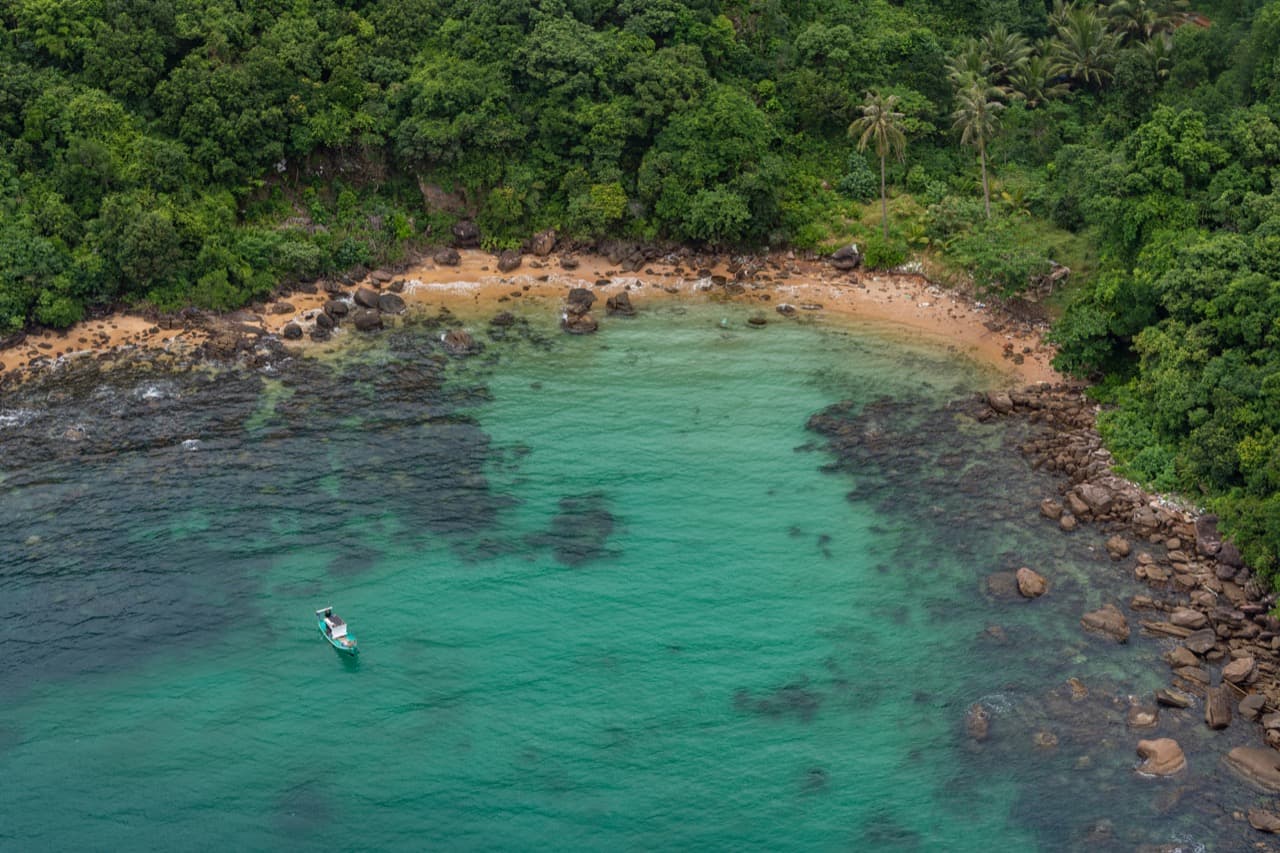
Quy Nhơn is a coastal city in Gia Lai province (Bình Định before the 2025 reform), between Nha Trang and Da Nang. Long beaches, clean water, 11th–13th-century Cham towers — and it's ten times quieter than Nha Trang.
How to get there: Phù Cát airport (30 min from town) with flights from Hanoi and Ho Chi Minh City. Or a bus from Nha Trang (~5 hours, from 200,000 VND / ~$8).
What to do: beach time without the crowds, the Cham towers of Tháp Đôi and Tháp Bánh Ít, and seafood at local places (2–3 times cheaper than Nha Trang).
Where to stay: hotels from 300,000 VND (~$12), decent mid-range from 600,000 VND (~$24).
Tourist level: 4/10. Gaining a following, but still quiet. In 2–3 years it could be the next Da Nang.
The line you hear about Quy Nhon: it's Nha Trang ten years ago — the same beaches, but without the package tours and the tourist-menu restaurants.



Phong Nha — more than caves

The village of Phong Nha sits on a riverbank at the entrance to the national park. But people don't come only for the caves — backpackers are drawn to the pace of life itself.
Bong Lai Valley is a farming valley 10 km from the village. Rent a bicycle (50,000 VND / ~$2) and ride the dirt track past rice fields, water buffalo, and quiet farm cafés.
How to get there: fly or take the train to Dong Hoi (Đồng Hới), then about 50 km, 45 minutes, to the village. Options and prices are in our Phong Nha guide.
Where to stay: hostels from 150,000 VND (~$6), guesthouses from 300,000 VND (~$12). The vibe is relaxed and backpacker-friendly.
Tourist level: 5/10. Backpackers know it; the package crowd doesn't.
Chau Doc — the floating Mekong

Châu Đốc is a town in the Mekong Delta near the Cambodian border. Floating villages, canals, markets on the water — the real life of river Vietnam.
About 30 km away is the flooded Trà Sư melaleuca forest: a boat ride and kayaking among herons and duckweed. It's one of the most photogenic spots in the delta.
How to get there: a bus from Ho Chi Minh City (~6 hours, from 150,000 VND / ~$6).
What to do: the floating villages by boat, the Tra Su forest (entry 120,000 VND / ~$5), and Sam Mountain (Núi Sam) with its pagodas.
Where to stay: hotels from 250,000 VND (~$10).
Tourist level: 3/10. It's a transit stop on the way to Cambodia — but few people linger, which is a shame.
Kon Tum — the forgotten highlands

Kon Tum is a mountain town in the Central Highlands. Ethnic Bahnar and Jarai villages with wooden communal longhouses (nhà rông). Almost no foreign tourists.
How to get there: a bus from Da Nang (~7 hours, from 200,000 VND / ~$8), or a domestic flight to Pleiku plus a transfer.
What to do: visit the villages (with a local guide), see the early-20th-century Wooden Church built in Bahnar style, cross the cầu treo Kon Klor suspension bridge, and browse markets with ethnic crafts.
Where to stay: hotels from 200,000 VND (~$8). The choice is modest.
Tourist level: 1/10. One of the least-visited places in Vietnam. If you're after the "real" Vietnam, this is it.
Cay Sao — the other Phu Quoc
The east coast of Phu Quoc is the opposite of the west's resort shoreline. The village of Cây Sao is slowly becoming a wellness spot: farm-to-table food, herbal spas, meditation.
On the other side of the island, in the northwest, the fishing village of Rạch Vẹm has starfish in the shallows and sunsets from the fishing jetties.
How to get there: motorbike or taxi from the west coast (30–40 min).
Where to stay: boutique guesthouses from 400,000 VND (~$16).
Tourist level: 3/10. Locals know it; organized tours don't come out this way. Want an island that's quieter still, with no resort sprawl? That's Con Dao — a former prison island turned national-park getaway with empty beaches.
Practical tips for the backcountry
Language. English is thin on the ground off the tourist track. Download Google Translate offline (Vietnamese) and learn a few basics: xin chào (hello), cảm ơn (thank you), bao nhiêu (how much).
Cash. Cards are accepted only in the cities. In the villages it's VND cash only. Withdraw from an ATM before you set out.
Transport. Between off-track spots there are buses (slow but cheap), or a motorbike. Grab works in the cities but not in the backcountry. A car with driver runs from 1,500,000 VND a day (~$60).
Connectivity. Mobile data works almost everywhere (Viettel has the best coverage), but Wi-Fi in homestays is a gamble. Buy a local SIM or an eSIM before you go.
FAQ
Kon Tum in the Central Highlands. Ethnic Bahnar and Jarai villages, communal longhouses, and almost no foreign visitors. Get there by bus from Da Nang (about 7 hours, from 200,000 VND / ~$8). Rooms start around 200,000 VND (~$8) a night. You'll want at least basic Vietnamese or a local guide.
Quy Nhon has the same beaches without the crowds and at a fraction of the price. Lan Ha Bay is like Ha Long but with cleaner water and no bus tours. Pu Luong offers Sapa-style rice terraces without the souvenir sellers. Phong Nha pairs world-class caves with a laid-back backpacker scene.
Late September to early October, the golden harvest season. The window lasts only 2–3 weeks. Outside it the terraces are green (May–August) or bare (winter). The road from Hanoi is about 6 hours of mountain switchbacks.
Vietnam is one of the safest countries in Southeast Asia and crime in the countryside is minimal. The real risks are the mountain roads (ride carefully), the distance from medical help (carry a first-aid kit), and the language barrier. Travel insurance is a must.
A ferry from Sa Ky port near Quang Ngai takes about 30–35 minutes, 205,000–237,000 VND (~$8–9). There is no bridge — it's ferry-only, and crossings can be cancelled in rough weather, especially October–December. To reach Quang Ngai, take a train from Da Nang or Nha Trang. The island is small — you can loop it on a motorbike in a couple of hours.
If you want to see Mekong life without the tourist gloss, absolutely. Floating villages, the flooded Tra Su forest with kayaking, and floating markets. It's about 6 hours by bus from Ho Chi Minh City (from 150,000 VND / ~$6). Two days is enough — many travellers combine it with the crossing into Cambodia.
- Guide
Hon Thom Cable Car, Phu Quoc: Tickets & Tips 2026
The Hon Thom cable car in Phu Quoc — the world's longest sea crossing: tickets, Sun World, what's on the island and how to get there.Hon Thom Cable Car, Phu Quoc: Tickets & Tips 2026 - Guide
Nha Trang Reviews 2026: Is It Worth Visiting?
Honest Nha Trang reviews: the pros, the cons and who it suits — beaches, food, hotels and season, with traveller quotes and a clear verdict.Nha Trang Reviews 2026: Is It Worth Visiting? - Guide
Sapa 2026: Rice-Terrace Trekking & Village Guide
Sapa guide: trekking the rice terraces with local guides, ethnic villages, Fansipan, homestays, getting there from Hanoi and when to go.Sapa 2026: Rice-Terrace Trekking & Village Guide