Is Vietnam safe? A traveller's guide to the real risks in 2026
Vietnam ranks in the top five safest countries in Southeast Asia, and violent crime against tourists barely registers. But don't switch off: petty theft, street scams, chaotic traffic and tropical illness are the real threats thousands of travellers meet every year. Here's what actually goes wrong and how to stay ahead of it.
Is Vietnam safe? Yes — very safe when it comes to crime, but the roads are the real risk. The US State Department gives Vietnam its lowest risk rating, Level 1, and by the Numbeo Safety Index 2025 it sits fourth-safest in Southeast Asia. That does not mean you can coast: petty theft, street scams, chaotic road traffic and tropical illness are all genuine risks.
This guide covers the concrete threats, medical costs in USD, an emergency-contacts table and a checklist of the mistakes most tourists make. Prices are current as of July 2026 (roughly 26,000 VND to $1).
How safe is Vietnam — where it sits among its neighbours

Vietnam is safer than Cambodia, Indonesia and the Philippines, a step behind Thailand, with Singapore and Brunei at the top — that is the picture from the Numbeo Safety Index 2025, which folds in resident and visitor surveys on street crime, robbery and harassment.
| Country | Numbeo Safety Index 2025 | US State Dept. |
|---|---|---|
| Singapore | 1st in SE Asia | Level 1 |
| Thailand | 3rd | Level 1 |
| Vietnam | 4th | Level 1 |
| Philippines | 5th | Level 2 |
| Indonesia | 6th | Level 2 |
| Cambodia | 9th | Level 2 |
The real risks for a visitor are not knife-wielding gangs but plain inattention. A bag snatched off your shoulder by a passing rider, an "accidentally" inflated restaurant bill, a crash on a rented bike with no licence. All of it is preventable.
For solo women, Vietnam is generally calm. Still, the UK Foreign Office warns of drink spiking and assaults on women, often linked to unlicensed taxis. The rules are simple: keep your drink in sight, don't get into a car with strangers, stay alert in late-night bars, and share your location with someone back home.
Theft and pickpockets — the number-one problem
Petty theft is the main headache tourists run into in Ho Chi Minh City, Hanoi, Nha Trang and Da Nang. Thefts peak around the holidays: Vietnamese New Year (Tết), the Christmas break and the long weekends in early May.
How it happens — the usual scenarios
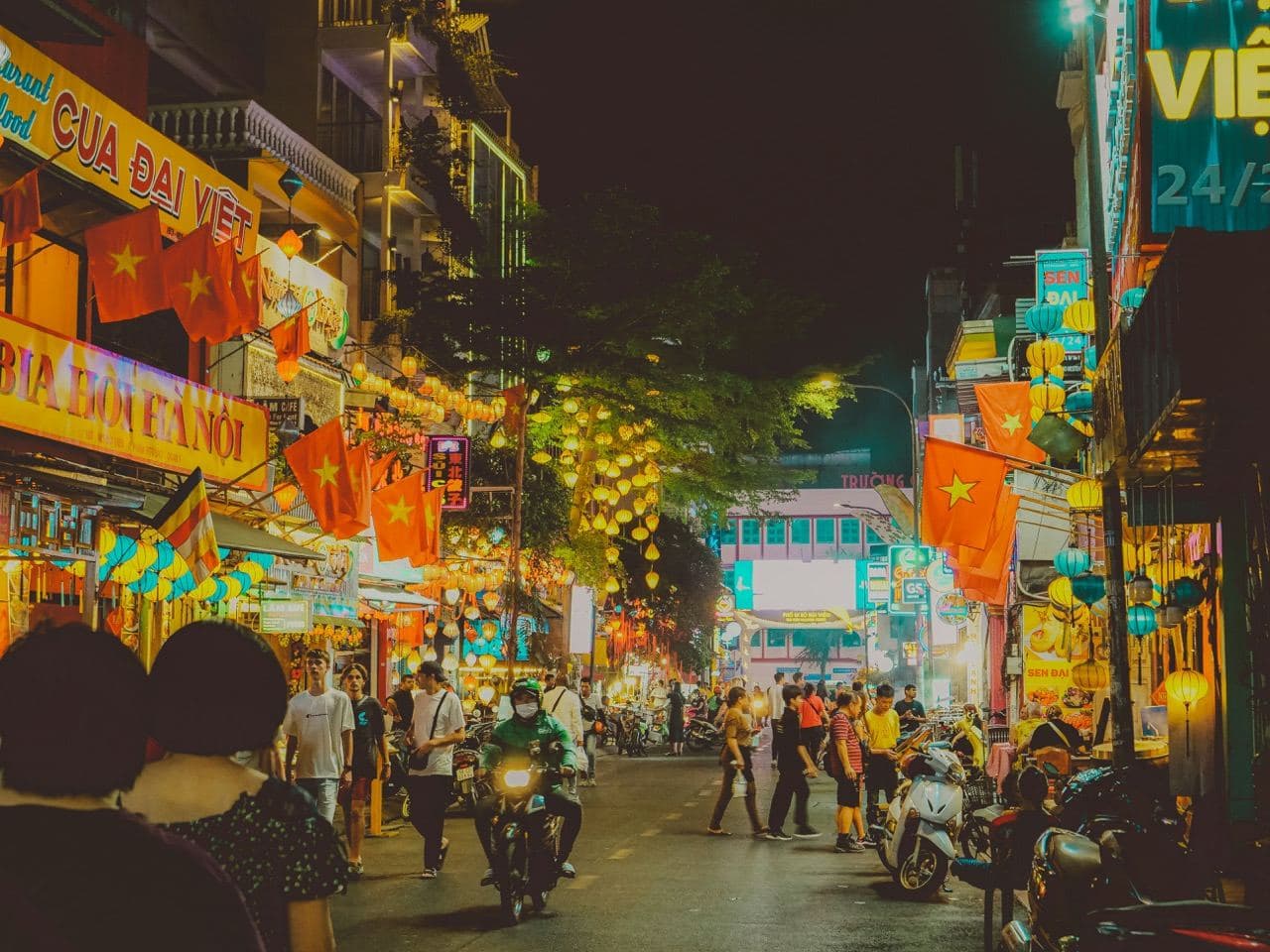
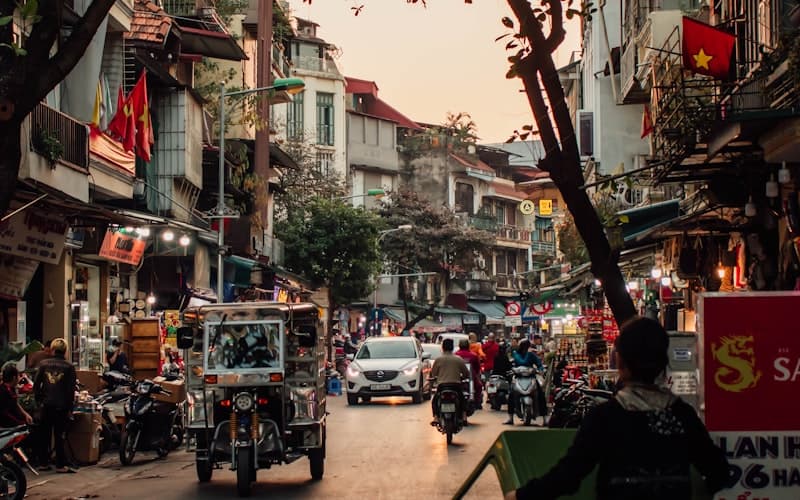
The most common move is a rider snatching your bag on the fly. He drifts past, grabs the strap, guns the throttle. One second and your bag, phone and documents are gone. It happens in Ho Chi Minh City (the Phạm Ngũ Lão and Bùi Viện areas) and along the Nha Trang promenade.
The second is pickpocketing in crowds. Bến Thành market (Ho Chi Minh City), Đồng Xuân market (Hanoi) and the Nha Trang night markets are classic hotspots. A wallet in a back pocket vanishes without a trace.
The third is the phone out of your hand. You're standing at the kerb checking a map on your phone when a passing rider plucks it away. It happens most on the Ho Chi Minh City streets of Đề Thám and Phạm Ngũ Lão.
The fourth is theft from a bike basket. You park the motorbike, leave a bag of shopping in the front basket, and a minute later it's gone. A handlebar lock does nothing against thieves who only want what's in the basket.
Theft in hotels
Rare, but it happens. The in-room safe is no guarantee: in budget guesthouses at $10–15 a night the locks are primitive and staff hold a master code. In four- and five-star hotels this is rarely an issue, but even there, don't leave cash lying around.
Large sums and your passport original go to reception against a receipt, or into the safe at the desk. Keep your laptop and camera on you, or in the daypack you carry with you.
Anti-theft checklist
- Bag across the body, held tight, on the side away from the road
- Backpack in front of you in crowds
- Don't pull your phone out at the kerb (or hold it with both hands)
- Passport original in the hotel safe; carry a photocopy
- Split large amounts of cash across two or three places
- Don't leave valuables on a roadside café table
- In a taxi, keep your bag on your lap, not the next seat
According to GOV.UK, bag-snatching by thieves on motorbikes is common in Vietnam.
What to do after a theft
- Police. Call 113 or go to the nearest station. Ask for a report (biên bản) — you'll need it for insurance. The police may not speak English, so use a phone translator.
- Bank cards. Freeze them in your banking app. If your phone was taken too, call the bank hotline (write the number on paper beforehand and keep it separate from the card).
- Passport. The steps are in the lost-passport guide.
- Insurer. Call and report the incident. Most policies cover theft of documents and personal belongings.
Fast Track — no queue at the border
5–10 minutes instead of an hour in the immigration queue
from$11per passenger
Scams and tourist rip-offs
Most tourist scams follow the same few patterns from city to city. Here are the specific plays and how to shut them down.
Taxis and motorbike-taxis
The "broken" meter is a classic. The driver says it doesn't work and names a fare three to five times the real one.
Fix: use Grab or XanhSM. The price is locked before you set off and the driver can't bump it. If you hail on the street, take only Vinasun or Mai Linh and only with the meter running.
Swapped notes in your change
The 50,000 VND and 500,000 VND notes look alike in colour and size. The difference is tenfold. A vendor "accidentally" hands back 50s instead of 500s. You only notice back at the hotel.
Fix: check the denomination the moment you get your change. On the 500,000 VND note the portrait of Ho Chi Minh is larger and the colour is blue; the 50,000 VND note has a pinkish tone. Learn to tell them apart in your first couple of days.
Change money only at banks (Vietcombank, BIDV, Techcombank) or trusted exchange counters. Street money-changers in Nha Trang and Ho Chi Minh City may short-change you or slip in fakes.
Restaurants and bars
On Phu Quoc and in other resort areas, tourists complain about inflated bills: a menu with no prices and "special" dishes at astronomical rates.
Fix: always ask for a menu with prices. If there isn't one, walk out. Photograph the menu before you order. In bars, don't leave a tab open.
The night play: in bar districts (Bùi Viện in Ho Chi Minh City, the Nha Trang seafront) women approach tipsy tourists, flirt, hug — and lift a phone or wallet. An accomplice waits on a motorbike round the corner.
Card games
A "friendly" local invites you home to "meet a relative who wants to travel abroad." While you wait for the relative, someone suggests a "casual" game of cards. By the end of the evening the stakes have ballooned and the tourist is out thousands of dollars. Canada's travel advisory warns about this one.
The rule is simple: don't go home with strangers, however sincere and welcoming they seem.
How not to get caught — general rules
- Fix the price before the service starts (taxi, tour, massage, repair)
- Photograph menus, price tags, the taxi meter
- Don't carry large amounts of cash
- Use fixed-price apps (Grab, Klook)
- If you feel pressured, leave. Don't be afraid to be blunt with scammers
Bag-snatching by thieves on motorcycles is common, hold bags in front of you or on the opposite side of the traffic to make them difficult to steal.
GOV.UK, Foreign travel advice: Vietnam
Traffic and road accidents — the most serious risk
A road accident is statistically the most likely threat to a visitor in Vietnam. Not night-time robbery, not typhoons. It's the tens of millions of motorbikes whose riders treat the traffic code as a suggestion, not a law. In the first ten months of 2025, 8,515 people died on Vietnam's roads, about 28 a day, according to official statistics. More than 90% of road deaths involve a motorbike, per the Global Road Safety Facility. If you want the full picture of how the traffic rules actually work here, we cover it in the Vietnam road rules guide.
Why the roads are dangerous
Red light? Plenty of riders go through. Oncoming lane? Fair game for overtaking. Pavement? Motorbike parking. A horn means "I'm coming, watch out," not "go ahead."
Crossing the road as a pedestrian is a hardcore-level quest. There's one rule: walk slowly and predictably. The flow parts around you. Stop suddenly or run and you'll get hit. Look left, look right, start walking and don't stop.
One extra hazard: e-scooters and e-bikes. They're silent, and you won't hear them until it's too late. In high-traffic cities (Ho Chi Minh City, Hanoi), keep your head on a swivel.
Renting a motorbike — what to know
To ride a bike (even a 110cc semi-auto) you need an International Driving Permit category A, together with your national licence. Without it:
- A police fine of 2,000,000–4,000,000 VND for bikes up to 125cc, 6,000,000–8,000,000 VND above 125cc (Decree 168/2024)
- The bike can be temporarily impounded (storage fees cost extra)
- Your insurance won't cover a crash
Safer alternatives
Grab (the local Uber) and XanhSM are the best choice. The price is known in advance, the route is logged and the driver's rating is transparent.
For longer trips, a rented car with driver. It's from 1,500,000 VND (~$60) a day, but you arrive in one piece.
Another option is the sleeper buses run by Phương Trang (FUTA) and Thế Thành. Comfortable coaches with lie-flat berths, air conditioning and Wi-Fi link the cities. Nha Trang to Ho Chi Minh City is from 200,000 VND (~$8). Safe, predictable, stress-free.

Dangerous animals and insects
Venomous snakes, killer jellyfish and giant cockroaches — it sounds alarming. In practice most of the dangerous creatures live far from the resorts, and the real risk is mosquitoes.
Snakes
Vietnam is home to many species of snake, some of them venomous. The most dangerous are the king cobra and the banded krait (night-active, neurotoxic venom). But the venomous species live in the thinly populated Mekong Delta and mountain provinces. You won't meet them on the beaches of Nha Trang, Phu Quoc or Da Nang.
If bitten: keep the limb still, apply a pressure bandage above the wound, call an ambulance (115). Don't suck out the venom — that's a myth.
Jellyfish
Jellyfish season runs May to October. Warm water draws them closer to shore. A sting hurts, and a strong reaction, shortness of breath or an irregular heartbeat needs a doctor.
First aid: douse the sting generously with vinegar, not fresh water. See a doctor. Beach lifeguards usually keep vinegar in the kit.
Sharks — nothing to fear
There are no large pelagic sharks in the coastal waters off Vietnam's resorts, and attacks on people are rare.
Mosquitoes and dengue fever
This is the real threat. By December 2025, Vietnam's Ministry of Health had logged 135,515 dengue cases and 26 deaths for the year, over three-quarters of them in the south, as SGGP reported. Dengue spreads via mosquito bites, the CDC does not recommend a dengue vaccine for travellers, and treatment is only symptomatic. The CDC rates it a year-round risk in Vietnam, and the mosquito that carries it bites by day, not just at dusk.
Malaria is only a risk in rural areas; there is none in the big cities (Hanoi, Ho Chi Minh City, Da Nang, Nha Trang).
How to protect yourself:
- Repellent with 30%+ DEET — apply morning and evening
- Mosquito screens on windows (check at the hotel)
- Long sleeves and trousers after dark
- A plug-in vaporiser or coils in the room
Other critters
Centipedes turn up in budget bungalows and on ground floors. The bite is painful (like a bad burn) but not deadly. Apply ice and take an antihistamine.
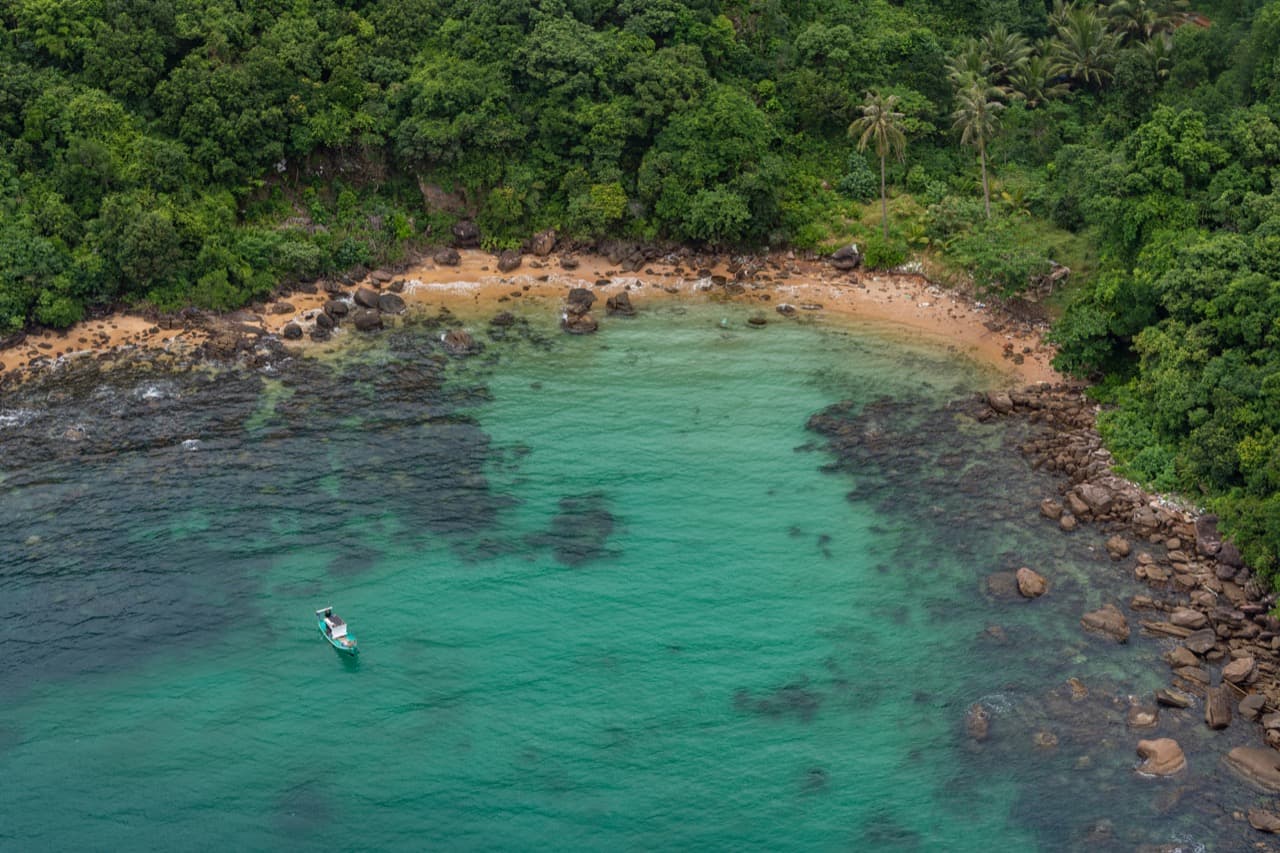
Sea urchins live on rocky beaches (Doc Let, the wild coves of Mui Ne). Stepping on one hurts and can get infected. Wear water shoes on wild beaches.
Dogs. Vietnam has plenty of strays, and they're usually not aggressive. But don't pet them: rabies is present in the country. If a dog bites, wash the wound with soap immediately and get to a hospital for vaccination. Rabies is fatal without treatment.
Health, medicine and insurance

Do you need vaccinations for Vietnam?
None are required for entry. But the CDC recommends (see a doctor at least a month before you go):
- Hepatitis A — spread through food and water
- Hepatitis B — for all unvaccinated travellers
- Typhoid — for most travellers
- Tetanus — if it's been a while (the standard booster is every 10 years)
- For trips deep into the countryside — talk to a travel doctor about anti-malarials
That is the short version; for the full CDC/WHO/NHS breakdown, timing and a first-aid kit, see our vaccinations guide for Vietnam.
Food and water — what's safe
Don't drink tap water. Full stop. Bottled only — it's 5,000–10,000 VND (~$0.20–0.40) for 1.5 litres.
Street food is one of Vietnam's great pleasures, and it's broadly safe. The rule: pick stalls with a queue of locals and high turnover. An untouched tray of food is a red flag.
Ice in drinks: factory ice (cylindrical, with a hole through the middle) is safe — it's made from filtered water. Hand-crushed lumps of irregular shape are a gamble. In tourist restaurants and chain cafés the ice is usually factory-made.
The common cause of an upset stomach isn't the food, it's your hands. Sanitiser or wet wipes before eating is a small thing that saves days of your trip.
What treatment costs for foreigners
Foreigners aren't covered by Vietnam's public health insurance. It's all out of pocket, or through your policy.
| Service | VND | ~USD |
|---|---|---|
| Doctor consultation (public hospital) | 50,000–300,000 | ~$2–12 |
| Consultation (private clinic) | 1,250,000–2,500,000 | ~$50–100 |
| Hospital stay (public, per night) | ~500,000 | ~$20 |
| Hospital stay (international clinic) | 6,000,000–20,000,000 | ~$240–800 |
| Appendix removal (private, HCMC) | ~125,000,000 | ~$5,000 |
These are rough guides, not quotes: prices vary by clinic, so ask for the price list on the spot.
Private clinics (FV Hospital in Ho Chi Minh City, Vinmec in Hanoi and Nha Trang) require prepayment or proof of insurance before treatment begins. For which hospitals to head to, how pharmacies work and what you can buy over the counter, see our guide to hospitals and pharmacies in Vietnam.
Insurance — not required, but essential

Medical insurance isn't required to enter Vietnam. But without it, an operation at a private hospital can run to thousands of dollars.
| Policy type | Cover | Notes |
|---|---|---|
| Basic (7 days) | up to $30,000 | Short trips, essentials only |
| Standard (30 days) | up to $50,000 | Most travellers |
| Extended (30 days) | up to $100,000+ | Add motorbike + adventure cover |
Recommended cover is at least $100,000 emergency medical. If you're going to rent a bike, make sure the policy covers motorbike accidents (not all do). Many insurers void cover unless you hold an International Driving Permit category A. We break down what to look for, where to buy and how to claim in our travel insurance guide for Vietnam.
Natural disasters — typhoons and floods
Typhoons are the main natural hazard in Vietnam. The season runs June to November, peaking August–October. On average there are 5–6 typhoons and 2–3 tropical depressions a year.
What happened in 2025
2025 was a hard year:
- Typhoon Bualoi (late September) — deaths and damage
- Typhoon Matmo (October) — deaths and damaged homes
- Typhoon Kalmaegi (early November) — hit central Vietnam; the government's preliminary count on 7 November was 5 dead, 3 missing and about 2,600 homes damaged
Which regions are hit
| Region | Typhoon risk | Danger window |
|---|---|---|
| Central (Da Nang, Hoi An, Hue) | High | September – November |
| North (Hanoi, Ha Long, Sapa) | Medium | June – August |
| South-central (Nha Trang, Phan Thiet) | Moderate | October – November |
| Far south (Ho Chi Minh City, Phu Quoc) | Low | Minimal direct hits |
The 2026 outlook
The 2026 storm season is expected to be milder than 2025: near-normal storm counts from February to July, below average from August to December. But the risk of a single powerful typhoon remains.
Safest travel window: December to April. If you're heading to central Vietnam (Da Nang, Hoi An), avoid October and November.
What to do during a typhoon
- Follow the hotel staff's instructions
- Stock drinking water and charge every device
- Don't go outside during the storm — debris and flooded roads are dangerous
- Don't swim for two days before and after a typhoon — waves and currents are unpredictable
- Track updates from local authorities and English-language weather services
Where to find the official forecast, what insurance actually covers and an hour-by-hour plan if a storm is heading your way are in our guide on what to do when a typhoon hits.
During Kalmaegi in November 2025, the US Embassy in Hanoi issued a storm alert for central Vietnam and told citizens to follow local authorities and shelter in place. Coastal hotels usually warn guests a day or two ahead and move people off the beachfront in a severe storm. Panic is unnecessary. Preparation is not.
Common tourist mistakes — the "don't do this" checklist
- Walking with your phone out at the kerb — it'll be snatched off a bike in a second
- Skipping travel insurance — one clinic visit can cost a month's salary
- Riding a bike with no International Driving Permit — in a crash you're uninsured
- Changing money with a street dealer — short-changed, handed fakes or small notes
- Not checking the restaurant bill — "mistaken" line items aren't rare here
- Drinking tap water — even for brushing your teeth, use bottled
- Ignoring repellent — dengue isn't treated with antibiotics, and the mosquitoes bite by day
- Visiting central Vietnam in October–November — typhoon and flood season
Every item is a real case from travellers' experience. Half of these are made even by people who aren't in Vietnam for the first time.
A few practical notes for foreign visitors
- Visa. Many nationalities enter visa-free for a set period, and others use the e-visa via evisa.gov.vn — check the rules for your passport. Overstay and you face a fine and deportation.
- Language. English is basic in tourist zones. Carry an offline translator and a printout of your hotel address in Vietnamese.
- Connectivity. A local SIM or eSIM from around 100,000 VND (~$4) solves the phone problem. Roaming is expensive and unreliable.
Emergency contacts and help
Vietnam emergency services
| Service | Number | Note |
|---|---|---|
| Police | 113 | 24/7 |
| Fire | 114 | 24/7 |
| Ambulance | 115 | 24/7 |
In a road accident, call 113 (police) first, then 115 (ambulance). Don't move an injured person before the medics arrive.
Your embassy
Save your own country's embassy and consulate details before you travel — most maintain a 24-hour emergency line for citizens abroad. Vietnam hosts embassies in Hanoi and consulates in Ho Chi Minh City and Da Nang, so wherever you are, there's a point of contact within reach. For a lost or stolen passport, your embassy issues an emergency travel document.
What to do in a road accident
- Call the police (113) and an ambulance (115)
- Don't leave the scene — it's treated as fleeing and can bring criminal charges
- Photograph the scene, the damage, the vehicle plates and any witnesses
- Don't sign documents in Vietnamese you don't understand — demand a translator
- Don't agree to "settle on the spot" in cash — it can be a trap
- Contact your insurer and your embassy
In a minor accident (no injuries), Vietnamese drivers often suggest settling amicably. For them it's normal. But for you as a foreigner it's risky: with no report you won't get an insurance payout, and the rental owner may bill you an inflated repair cost.
How worried should you actually be?
Put the risks in order and Vietnam is a straightforward country to travel safely. Almost none of the serious threats are random violence — they're preventable: ride carefully or not at all, insure yourself properly, keep your phone off the kerb, drink bottled water, and use repellent. Do that, and the biggest problem most travellers face is deciding which street-food stall to try next.
FAQ — common questions about safety in Vietnam
Mostly yes: violent crime against tourists is rare. But the UK Foreign Office (FCDO) warns of drink spiking and sexual assaults in tourist areas, often linked to unlicensed taxi drivers. The usual rules apply: keep your drink in sight, don't get on a motorbike with strangers, use Grab rather than hailing taxis on the street, avoid empty lanes after 11 pm, and keep your bag on the side away from the road. Da Nang and Nha Trang have large expat communities, so help is never far.
None are required for entry, including yellow fever. The CDC recommends hepatitis A, hepatitis B and typhoid, plus a tetanus booster if it's been more than 10 years. See a doctor at least a month before you fly. Malaria occurs only in rural areas; there is none in the big cities (Hanoi, Ho Chi Minh City, Da Nang, Nha Trang).
Insurance isn't required to enter, but foreigners aren't covered by Vietnam's public system, so a hospital visit is out of pocket without it. Look for at least $100,000 emergency medical, plus dengue and heatstroke treatment, motorbike-accident cover (standard policies often exclude it) and helicopter evacuation from remote islands. If you plan to ride, make sure the policy covers motorbikes — many void it unless you hold an International Driving Permit category A.
No. Traffic is chaotic, the rules are unwritten, and road accidents are the leading reason tourists end up in hospital. With no experience, use Grab and GrabBike for the first few days to learn the flow, then practise in an empty car park. Non-negotiables: an International Driving Permit category A together with your national licence, a helmet, and insurance that covers motorbikes.
Three signs of a safe stall: a queue of locals (high turnover), food cooked in front of you over fire or in boiling water, and single-use or boiled-water-washed dishes. Avoid pre-cut fruit sitting in the heat, raw-vegetable salads and hand-crushed ice (only cylindrical factory ice is safe). For the first two or three days, eat hot food and let your stomach adjust.
Wash the wound under running water with soap for 10–15 minutes straight away. Disinfect it, then get to the nearest hospital within 24 hours for a rabies vaccine; rabies is present in Vietnam. Post-exposure vaccination works if it starts before symptoms appear. Note the time and place of the bite for the doctor.
Yes, with seasonal caveats. Safe months: the south (Phu Quoc, Phan Thiet) November–April, the centre (Da Nang, Nha Trang) March–August, the north (Ha Long) May–September. Watch for rip currents — don't swim past the buoys — jellyfish in Nha Trang from May to October, and strong surf in the rainy season. Red flags on the beach mean swimming is banned.
- Guide
Ninh Binh Tours from Hanoi 2026: Day Trips, Costs, Routes
Every way to do Ninh Binh from Hanoi in 2026: group, small-group and private tour prices, one-day and two-day routes, trains, buses and the DIY maths.Ninh Binh Tours from Hanoi 2026: Day Trips, Costs, Routes - Guide
Hanoi Reviews 2026: An Honest 7.2 out of 10
Honest Hanoi reviews for 2026: rated across 10 categories, the real pros and cons, food, air quality, day trips to Ha Long and Ninh Binh. Is it worth it?Hanoi Reviews 2026: An Honest 7.2 out of 10 - Guide
Vung Tau Beaches: Front Beach, Back Beach & Where to Swim
Vung Tau beaches: Front Beach, Back Beach (Bai Sau) and Bai Dua — where to swim, how clean they are and the weekend crowds from Saigon.Vung Tau Beaches: Front Beach, Back Beach & Where to Swim