Vung Tau attractions 2026: Christ, lighthouse, palace
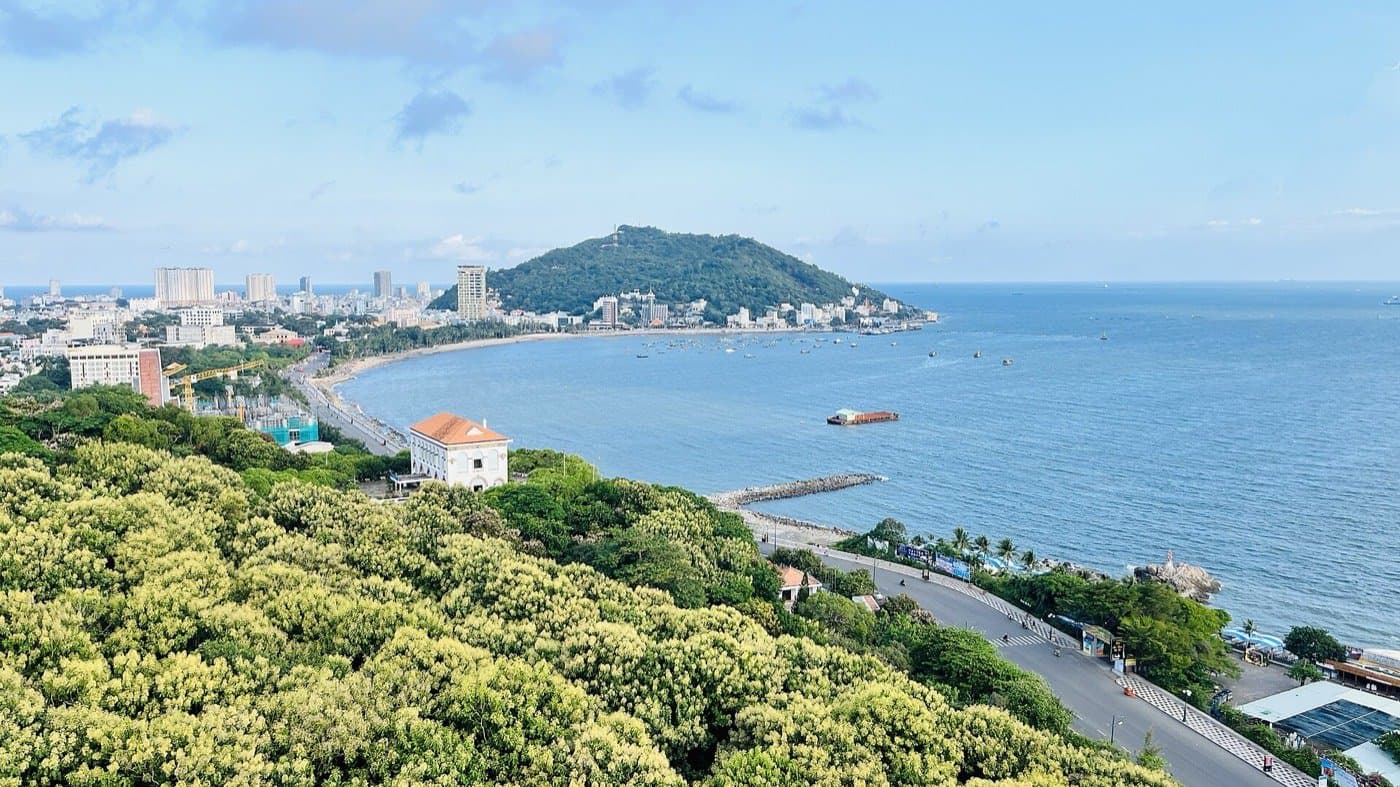
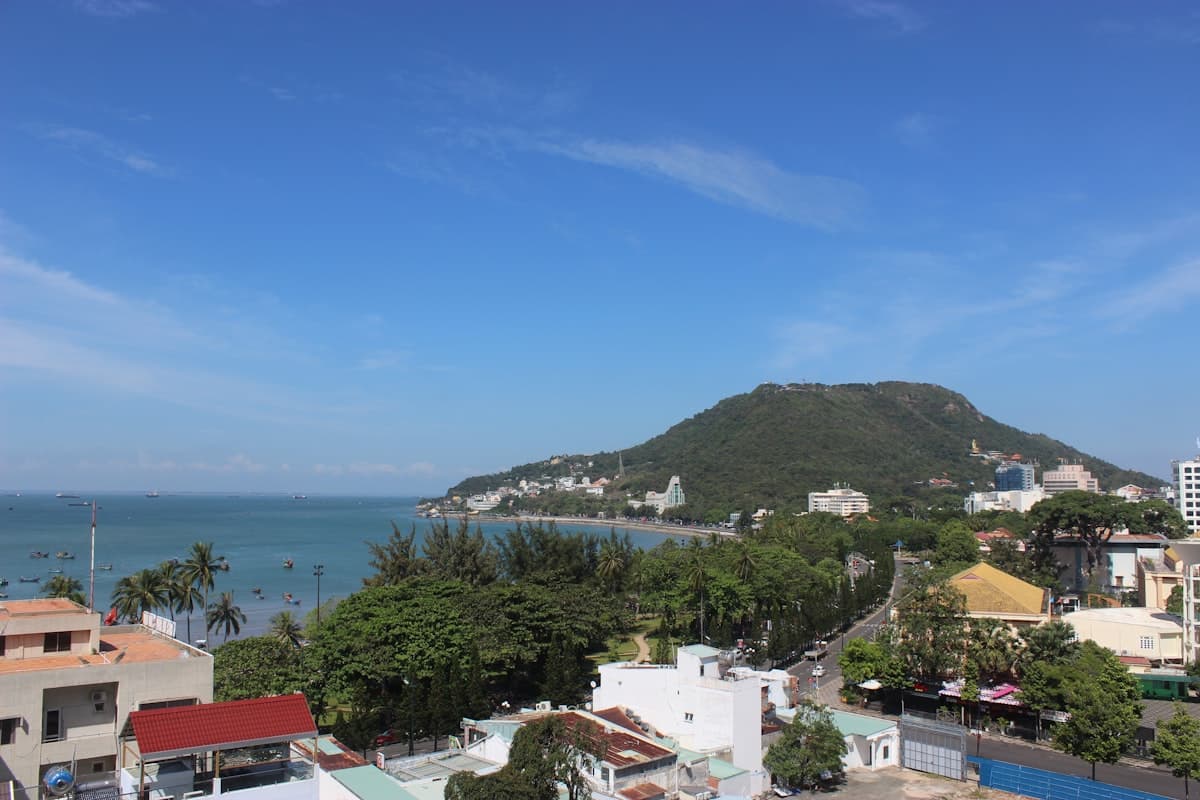
A 32-metre Christ statue with a balcony inside its shoulder stands on the hill above Vung Tau, and at its foot is a lighthouse the French raised in 1862. Nearby: the summer residence of Vietnam's last emperor, a cable car up the Big Mountain, and a pagoda with a 12-metre reclining Buddha. All within three kilometres of the centre — and an easy day trip from Ho Chi Minh City.

The Vung Tau attractions aren't postcard beaches or coral gardens — they're history, views and Buddhist symbolism. Vung Tau was a summer resort for French colonial elites, then the summer residence of Emperor Bao Dai, then an oil town with a Soviet imprint. Every layer left a landmark. This guide covers the main sights with 2026 prices in USD, step counts, opening hours and a ready-made day route.
Information current as of July 2026. Prices can change — confirm on the spot.
Planning a trip? Bookmark this page. Our full Vung Tau guide covers the rest: districts, hotels and food.
Top attractions in Vung Tau — what's worth seeing
Eight places worth the trip, from the most symbolic (the Christ statue) to the one almost no guidebook mentions (the tidal islet of Hòn Bà). Prices as of July 2026.
- Christ of Vung Tau (Tượng Chúa Kitô Vua): 32 m, on Núi Nhỏ hill — 800 steps, free
- Vung Tau lighthouse (Hải Đăng Vũng Tàu): 1862, the oldest in Vietnam — 360° view, free
- White Palace (Bạch Dinh): Built 1898–1902, later Bao Dai's residence — Entry 15,000 VND (~$0.60)
- Ho May Park (Hồ Mây Park): Cable car up the Big Mountain — From 100,000 VND (~$4)
- Niết Bàn Tịnh Xá (Nirvana Temple): 12-metre reclining Buddha — Free
- Linh Sơn Cổ Tự (Chùa Linh Sơn): Temple built in 1919 — ~1,400-year-old Champa statue
- Thích Ca Phật Đài (Thích Ca Phật Đài): Theravada complex — 10.2-metre Buddha, free
- Hòn Bà (Đảo Hòn Bà): Temple-islet, 1881 — Walk over at low tide
- Christ of Vung Tau (Tượng Chúa Kitô Vua) — 32 m, recognised as the largest in Asia. 800 steps up, free
- Vung Tau lighthouse (Hải Đăng) — 1862, the oldest in Vietnam. Free, 360° view
- White Palace (Bạch Dinh) — built in 1898–1902 for the Governors-General of Indochina, later Bao Dai's summer residence. Entry 15,000 VND (~$0.60)
- Ho May cable car & park (Hồ Mây) — up the Big Mountain, water park and rides. From 100,000 VND (~$4) for the cable car
- Niết Bàn Tịnh Xá — a temple with a 12-metre reclining Buddha. Free
- Linh Sơn Cổ Tự — a temple built in 1919, with a ~1,400-year-old Champa statue. Free
- Thích Ca Phật Đài — a Theravada Buddhist complex with a 10.2-metre Buddha. Free
- Hòn Bà — a temple-islet you reach on foot across the gravel at low tide. Free
Each one is detailed below: history, numbers, price, how to get there and whether it's worth your time.
Christ of Vung Tau — 32 metres above the sea
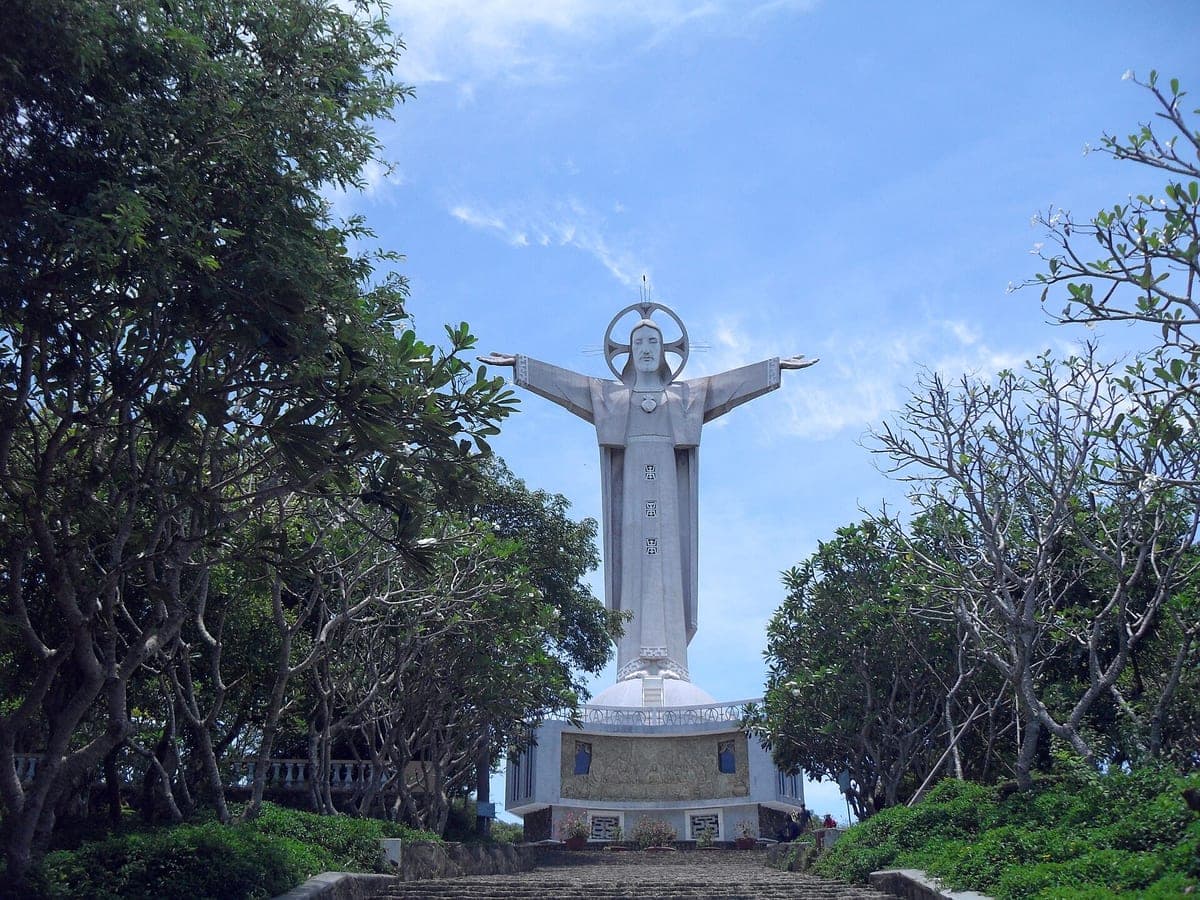
The city's icon. It stands on the summit of Núi Nhỏ (the Small Mountain, also Tao Phung), 170 metres above the sea. The figure itself is 32 metres, plus a 4-metre pedestal. The arm span is 18.3 m. In 2012 it was recognised as the largest Christ statue in Asia. For comparison: Rio's Christ the Redeemer is 30 m with a 28 m span — Vung Tau's is a touch taller, if narrower in the arms.
Entry is free. This isn't a tourist attraction but a working Catholic shrine: monks keep order, and the grounds hold a chapel and a shop selling religious items.
From military lookout to city symbol
The idea for a monumental statue here dates to 1972. Construction started in March 1974, but war and the change of government stretched the project across two decades. It was officially unveiled in November 1994, built by the local Catholic community.
Núi Nhỏ had earlier served French and South Vietnamese forces as a lookout — from the top you can see the approaches to the bay on three sides. Today the hill holds the statue, the lighthouse, remnants of French fortifications and some basic telecom kit. An odd mix, but it works.
800 steps and a balcony in the shoulder
A staircase of about 800 steps leads to the feet of Christ (some count 811 — don't bother arguing with the locals). The climb takes 30–60 minutes. Not a marathon, but a test in the heat. The stairs are wide, with rest landings every 100 steps and the odd drinking fountain.
The 811 steps up… were fairly easy for me. Only, because of the heat and humidity, I was completely soaked, as if I'd just had a shower… here in Vung Tau the steps are very lowOlga, olgatravel.com, 2016, translated by VietnamSpot
Halfway up is a viewpoint over Front Beach — a good spot to catch your breath and shoot the city from above. Then the last push: the steps steepen and the staircase starts to spiral around the pedestal.
The real surprise waits at the feet of the statue. Inside Christ is a spiral staircase of 133 steps. It takes you up into the shoulders, where there's a balcony — not on the arm, as many assume, but a small platform under the outstretched arm, with windows facing out. The view is 360°: Front Beach, Back Beach, the lighthouse (about 100 m lower), and the Vietsovpetro oil platforms on the horizon. On a clear day you can even see Long Hai, 30 km north.
The balcony is tight — no more than 4–6 people at once. At peak times (weekends from 10:00) the inner staircase jams with two-way traffic, and going up and down gets awkward. In the morning there are no crowds.
What to know before the climb
The dress code is strict: shoulders and knees covered. Show up in shorts or a tank top and staff will hand you a sarong or ask you to cover up. Without covered clothing you won't be let inside the statue.
You take your shoes off before the inner staircase. Bag them and carry them with you — you can leave them at the entrance, but if a group arrives your pair vanishes into the pile.
Bring: water (at least 0.5 l — on-site it's 15,000 VND, triple the shop price), a hat or scarf, sunscreen, and a phone charged above 50% (photos drain the battery).
Don't bring: backpacks over 30 litres (you won't get inside the statue with a big one), food (eating on the grounds is banned), or a tripod (allowed, but tripod shots take ten minutes while the queue behind you grows).
Best time and opening hours
| Detail | Info |
|---|---|
| Address | Đường Hạ Long, Vũng Tàu |
| Coordinates | 10.3265, 107.0845 |
| Hours | 07:00–17:00 daily |
| Entry | Free (donations welcome) |
| Time needed | 1.5–2 hours (with climb and balcony) |
| Best time | 07:00–09:00 (no sun, no crowds) |
| Bike parking | 5,000–10,000 VND at the base |
| Dress code | Shoulders and knees covered, shoes off before the inner stairs |
Arrive at opening, 07:00 — the rule for every Vietnamese stair-climb sight. By 10:00 the sun heats the stone to 40 °C and the climb gets brutal. By 11:00 the first tour buses roll in from Ho Chi Minh City. By noon the shoulder balcony becomes a 30-minute queue.
Sunset is its own thing. Not everyone knows the statue is open until 17:00 and the hill itself until nearly 22:00. You can linger on the platform below Christ until sunset (~18:30 in any season), then walk down in the dusk — the staircase is lit.
Vung Tau lighthouse — 1862 and a 360° view

The oldest working lighthouse in Vietnam. The French built it in 1862, a few years after founding the Cochinchina colony. It first stood lower, at 149 m; in 1913 it was dismantled and moved to a new spot at 170 m, directly opposite the future Christ statue. Today the lighthouse and Christ share the same hill, Núi Nhỏ, about 1 km apart.
The tower is 18 m, whitewashed with a red roof. Inside, 55 steps lead to the rooftop platform. Its beam reaches 63 kilometres — it still does its job, guiding ships in the South China Sea. A rare case of a historic monument that's still on active duty.
Views and sunsets
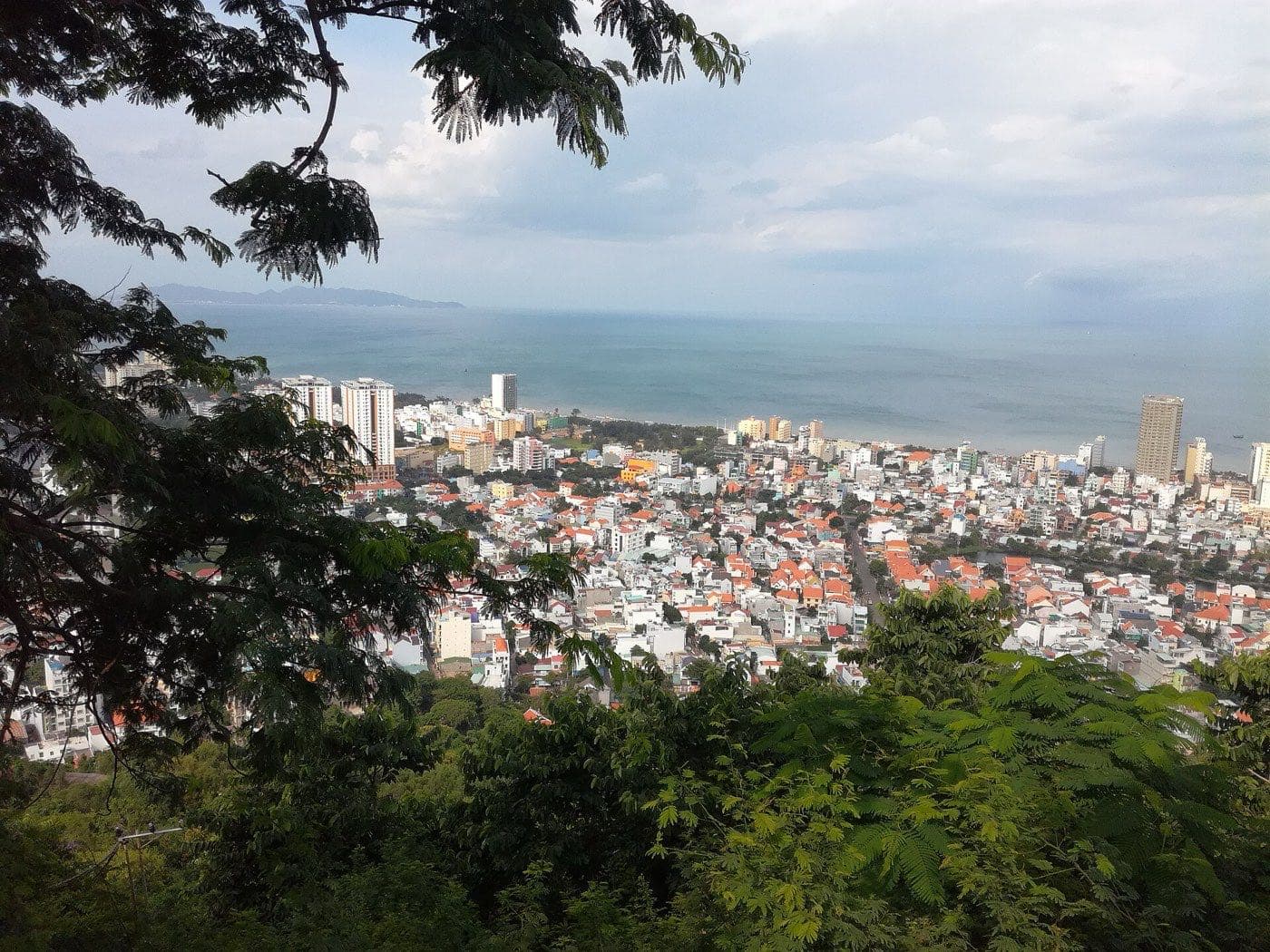
From the lighthouse platform you get a full 360° panorama. Right below: Front Beach and central Vung Tau with its French villas and market roofs. To the left: Back Beach, its 8-kilometre strand and the hotels along Thùy Vân promenade. To the right: the port and cargo cranes. Behind you: the forested hill, and on a clear day Long Hai, 30 km away.
Sunset is the main reason to come. The sun drops into the South China Sea directly opposite the lighthouse. From December to March the sky is clear and the sun sinks as an orange disc; in the rainy season (July–September) you get dramatic clouds with gaps of light. Which beach to watch it from — Front, Back or the rocky Pineapple Beach — is covered in the Vung Tau beaches guide.
The lighthouse doesn't close at dark: it stays open until about 22:00. You can stay for the sunset and walk down in the dusk. The switchback road is gentle; streetlights are sparse but there.
Getting there
By bike it's 10 minutes from the centre up the switchbacks. The road is paved with no sharp turns. Parking at the lighthouse is 5,000 VND (~$0.20), almost always with free spots.
On foot it's 15–20 minutes from Quang Trung — a paved forest path, less punishing than the Christ staircase thanks to a steady gradient and shade. If you've already climbed the statue and aren't wiped out, combine them: walk down from Christ, follow the ridge for 1 km, climb up to the lighthouse. A ready half-day mini-trek.
Taxi or Grab is 30,000–50,000 VND (~$1.20–2) from the centre, and the driver takes you right to the tower.
| Detail | Info |
|---|---|
| Coordinates | 10.3341, 107.0777 |
| Elevation | 170 m above sea level |
| Tower height | 18 m |
| Steps inside | 55 |
| Beam range | 63 km |
| Hours | ~07:00–22:00 |
| Entry | Free |
| Time needed | 30–45 minutes |
| Bike parking | 5,000 VND |
White Palace (Bạch Dinh) — Bao Dai's residence

Bạch Dinh, the "White Palace," is Vung Tau's best-known colonial building. It sits on the slope of the Big Mountain (Núi Lớn) at 27 m above the sea, facing Front Beach. Whitewashed plaster, turquoise shutters, a tropical garden with trees planted back in the 19th century. If the French left one building in Vung Tau worth stopping for, this is it.
French Cap Saint-Jacques and Paul Doumer
Construction began in 1898 on the orders of Paul Doumer — then Governor-General of Indochina and a future president of France (assassinated in Paris in 1932). The palace was finished in 1902. The style is Beaux-Arts with a tropical adaptation: high ceilings for ventilation, wide verandas, louvred shutters against the monsoon rains.
Vung Tau was then called Cap Saint-Jacques and served as the summer capital of Indochina — colonial officials would escape stifling Saigon for a month or two. The palace became the governor's official summer residence.
Bao Dai and Nam Phuong
In 1934 the palace passed to Emperor Bảo Đại — the last monarch of the Nguyen dynasty and Vietnam's nominal ruler under the French. He spent several years here with his wife Nam Phương and their children. This was his "summer house" — his official residence stayed in Hue.
Bao Dai was known as the "playboy emperor": he loved hunting, women, casinos and cars, leaving the running of the country to French and pro-American advisers. In 1955 a referendum stripped him of the throne, and he left for France, where he lived until his death in 1997. After him, presidents of the Republic of Vietnam used Bạch Dinh as a summer residence.
After 1975 the palace became a museum. Some original furniture survives; the rest was restored from photographs.
Inside — imperial Qing porcelain
The main exhibit is a collection of Qing dynasty porcelain (17th–19th century): 100+ pieces — vases, plates, tea sets. Some were gifts to Vietnamese rulers from Beijing; others were found in digs around the city, since the bay was a transit point in China–Europe trade.
Besides the ceramics:
- Bao Dai's bedroom and study with original furniture and photographs
- The ground-floor reception hall with chandeliers and mirrors
- A collection of 19th-century French furniture (trophies and gifts)
- Bronze Age finds from Núi Lớn (axes and 2,500-year-old ceramics)
Outside stand two late-19th-century cannons that once guarded the bay from pirates, plus a tropical garden of jacarandas, banyans and plumerias. The trees planted under Doumer are still alive — some are over two metres around.
Practical info
| Detail | Info |
|---|---|
| Address | 4 Trần Phú, Vũng Tàu |
| Coordinates | 10.3540, 107.0700 |
| Hours | 07:30–17:00 daily |
| Entry | 15,000 VND (~$0.60) |
| Bike parking | 5,000–10,000 VND |
| Guide (per group) | 150,000–300,000 VND |
| Time needed | 45–90 minutes |
| Best time | morning (10:00–11:00) — no sun on the facade |
Tip: ask for the English floor plan at the entrance — without it some labels under the exhibits are in Vietnamese only. Photos inside are fine, but no flash.
Bạch Dinh is easy to pair with other sights: 500 m to the Hồ Mây cable car up the slope, 300 m to Front Beach, 1 km to Linh Sơn Cổ Tự. You can cover it all in half a day.

Ho May cable car and park (Hồ Mây)

Hồ Mây is a park on top of Núi Lớn (the Big Mountain, 245 m). The cable car takes you up — and that's part of the fun: five minutes floating over the city, the sea and the roofs of French villas. The ride alone is worth the trip.
Up top is a 30-hectare complex: a water park with slides, a mini-zoo, a rides park, restaurants, two lotus ponds, a waterfall and an amphitheatre. In the evening there's a musical fountain and a UFO Fulldome cinema with a 360° screen.
What's inside: water park, rides, zoo
Water park — a dozen slides of varying difficulty (from gentle kids' ones to a 60-metre kamikaze), a wave pool, a lazy river, a kids zone. Clean, with newish equipment. Busy with Vietnamese families on weekends, near-empty on weekdays.
Rides park — more modest than VinWonders in Nha Trang: 15–20 rides, a Ferris wheel with a sea view, a mini roller coaster, shooting galleries, a maze. Heaven for kids 6–12; enough for half a day for teens.
Mini-zoo — deer, camels, ostriches, rabbits, peacocks, parrots. You can hand-feed them (feed sold at the entrance). Not a safari, but kids love it.
Musical fountain — every evening at 19:00 and 20:30, a 15-minute show with lights and music. Free if you're already inside.
UFO Fulldome — a dome cinema with a 360° screen showing popular-science films about space, the ocean and Vietnam's nature. 20 minutes, included in the main ticket.
Prices and hours — 2026
| Category | Price (VND) | Price (~USD) |
|---|---|---|
| Adult ticket (all included) | 475,000 | ~$18 |
| Child (100–130 cm) | 237,500 | ~$9 |
| Children under 100 cm | Free | — |
| Cable car round-trip only | 100,000 | ~$4 |
| Hours | 08:00–22:00 | — |
| Address | 1A Trần Phú | — |
| Coordinates | 10.3522, 107.0716 | — |
The combo ticket includes: the round-trip cable car, unlimited slides and rides, and entry to the water park, mini-zoo and dome cinema. Food is separate (the restaurants up top aren't cheap — figure 300,000–500,000 VND for two).
Buying online on the official site, homaypark.com, takes 5% off the gate price (prices checked 01.10.2026, non-resident rate). The e-ticket is accepted at any of the six entrances.
When to go and when to skip it
When to go: weekdays, mornings (08:00–11:00) — empty, no cable-car queues, the water park nearly to yourself. Sunsets from the hill are a picture of their own; worth staying until 18:00.
When to skip it: Sunday after noon — crowds and a 30–40 minute cable-car queue. In heavy rain half the rides close and mist swallows the views. In the rainy season (July–September) check the forecast before you go.
Hồ Mây is a three-hour stop, not a five-hour one. If you're not with kids and not a rides fanatic, you can realistically see it all in 2.5–3 hours. With kids, a full day. Tip: bring water and a snack — the restaurants up top are pricey and there's no decent coffee.
Pagodas and temples of Vung Tau

Vung Tau has four large pagodas and dozens of small ones. Together they don't add up to a "temple trail" in the spirit of Hue or Bangkok, but each is worth a stop in its own way. Entry to the pagodas is usually free.
Niết Bàn Tịnh Xá — the Nirvana temple and reclining Buddha
Niết Bàn Tịnh Xá (Temple of Pure Nirvana) is the city's most photogenic pagoda. Built in 1968–1974 on the slope of the Small Mountain, it faces the sea. The architecture echoes an ancient lotus stupa in a modern take: white concrete, gold accents, tiered roofs.
The main draw is a 12-metre reclining Buddha on the temple's second tier. He lies in the parinirvana pose (the moment of passing into final release), white with a gold finish. Inside it stays cool even at +35 °C — thick walls and a draught through the latticed windows act like air conditioning.
In front of the temple stands a 21-metre tower with 42 steps. Each step symbolises a page of Buddhist scripture. At the top is a small viewpoint over the bay.
| Detail | Info |
|---|---|
| Address | 66/7 Hạ Long, Vũng Tàu |
| Coordinates | 10.3306, 107.0768 |
| Hours | 06:00–18:00 |
| Entry | Free |
| Dress code | Shoulders and knees covered |
| Time needed | 30–40 minutes |
Niết Bàn Tịnh Xá pairs neatly with the Christ statue — it's 1 km from the foot of the Christ staircase. Climb down, drop in.
Linh Sơn Cổ Tự — the temple with the Champa statue
Linh Sơn Cổ Tự (Ancient Temple of the Sacred Mountain) was built in 1919. Address: 104 Hoàng Hoa Thám, right in the centre. Outside it's an ordinary temple with red-and-gold gates, the kind scattered by the thousand across Vietnam. Inside is a genuine rarity.
The main relic is a seated sandstone Buddha, 1.2 metres tall. Archaeologists date it to the 6th–7th century — roughly 1,400 years old. It comes from the Champa or Chenla (Khmer) civilisation. How it reached Vung Tau, no one is sure. One version says it was found during road-building in the 1900s; another that pilgrims brought it.
The statue survives almost whole: fine carving, a soft facial expression, and a clear Indian iconographic school (via Champa). It's one of the oldest Buddhist artefacts on public view in southern Vietnam.
| Detail | Info |
|---|---|
| Address | 104 Hoàng Hoa Thám, Vũng Tàu |
| Coordinates | 10.3389, 107.0837 |
| Hours | 06:00–18:00 |
| Entry | Free |
| Time needed | 20–30 minutes |
The temple is compact — half an hour does it. It pairs well with a walk through the centre and the Chợ Vũng Tàu central market.
Thích Ca Phật Đài — Theravada Buddhism

Thích Ca Phật Đài is a rare Vietnamese Buddhist complex of the Theravada school (the southern branch common in Thailand, Sri Lanka and Myanmar). Most Vietnamese temples are Mahayana; Theravada here is the exception.
Built in 1961–1963 on the slope of the Big Mountain, it covers 5 ha — a lot for an urban temple. The main statue is a Shakyamuni Buddha on a lotus throne, 10.2 m tall. An octagonal 19 m tower holds Buddha relics — real or symbolic, accounts differ.
The heart of it is the path up to the statue. Along both sides are sculptures of the key episodes of the Buddha's life:
- The birth of Prince Siddhartha
- The renunciation of the world
- Enlightenment under the Bodhi tree at Bodh Gaya
- The first sermon at Sarnath
- Passing into Parinirvana at Kushinagar
Each sculpture carries a plaque and short story (in Vietnamese, but the plot is recognisable). An open-air illustrated primer of Buddhism.
Below the main statue grows a Bodhi tree (sacred fig), brought from Sri Lanka in 1960 by Venerable Narada, a well-known Sri Lankan missionary monk who spread Theravada across Southeast Asia. The tree is thriving, already over a metre around.
| Detail | Info |
|---|---|
| Address | 25 Trần Phú, Vũng Tàu |
| Coordinates | 10.3746, 107.0705 |
| Hours | 07:00–17:00 |
| Entry | Free |
| Time needed | 1–1.5 hours |
| Dress code | Shoulders and knees covered |
Take your shoes off at the main statue (not across the whole grounds). Bring water — the path up is in full sun and there's no café on site.
Hòn Bà — a temple on a rock, reached at low tide
Hòn Bà is almost a secret. A tiny islet (1,600 m²) 200 metres offshore, opposite Bãi Dứa (Pineapple Beach). On it stands a miniature 4-metre temple built in 1881 in honour of the sea spirits.
The trick: at low tide the island connects to shore by a gravel causeway. You can walk across the sea floor in 5–10 minutes. At high tide the causeway sinks and there's no way over.
Tides shift with the lunar cycle. To reach the island, check the tide table for your visit day (any "Tides" app or a site like tideschart.com for Vung Tau). The window of access is usually 2–3 hours in a row, sometimes once a day, sometimes twice.
Barely anyone comes to Hòn Bà — mostly local retirees and pilgrims. No ticket booths, guides or shops — just the temple, rocks and sea. It's the least touristy spot you'll find within the city limits.
What to see in Vung Tau in one day — a ready route

One day is enough to see everything that matters in Vung Tau. This route is built for an independent trip: 60% by bike or taxi, 40% on foot. Start at 7 a.m., finish at sunset on Front Beach.
| Time | Stop | Duration | Cost | Getting there |
|---|---|---|---|---|
| 07:00–09:00 | Christ statue (800 steps + balcony) | 2 h | Free | Bike / taxi to the base |
| 09:30–10:00 | Niết Bàn Tịnh Xá (reclining Buddha) | 30 min | Free | 1 km walk from the Christ base |
| 10:30–11:30 | Vung Tau lighthouse | 1 h | Free | Bike up the switchbacks, 10 min |
| 12:00–13:00 | Lunch: banh khot on Nguyễn Trường Tộ | 1 h | 50,000–100,000 VND (~$2–4) | Bike, 10 min |
| 14:00–15:30 | White Palace + garden | 1.5 h | 15,000 VND (~$0.60) | Bike, 5 min |
| 16:00–18:30 | Hồ Mây cable car + sunset on the hill | 2.5 h | 475,000 VND (~$18) | 500 m walk from Bạch Dinh |
| 19:00–20:30 | Front Beach + seafood dinner | 1.5 h | 200,000–400,000 VND (~$8–16) | On foot |
Total: about 700,000–1,200,000 VND (~$28–48) for entries, food and drinks, plus a bike rental of 150,000 VND (~$6).
Breakfast idea: grab a bánh mì and a coffee to go from the nearest quán cà phê — the Christ staircase has good landings to stop and eat. A full sit-down breakfast is dead weight for the climb.
For lunch, make it bánh khọt (mini shrimp pancakes) — Vung Tau's signature dish, cooked on every corner, but best at the small cafés on Nguyễn Trường Tộ and Hoàng Hoa Thám. About 30,000–50,000 VND for a plate of eight.
A two-day alternative
If you have time, stretch it over two days and add some breathing room.
Day 1 (history and panoramas): the Christ statue in the morning → Niết Bàn Tịnh Xá → the lighthouse → lunch in the centre → the White Palace → sunset at the lighthouse.
Day 2 (nature and culture): the Hồ Mây cable car in the morning (3–4 hours in the park) → seafood lunch on Back Beach → Linh Sơn Cổ Tự + the central market → Thích Ca Phật Đài → sunset at Bãi Dứa beach looking out at Hòn Bà.
At that pace there's no rush — time for coffee and photos, with the evening free for dinner in the port district.
Lesser-known spots in Vung Tau
Once you've done the main route, or if you want something off the list — four places that don't make the tourist round-ups.
Cap Saint-Jacques guardians (Hộ Pháp)
Giant Dharmapala guardians at the entrance to Quan Âm pagoda. They're painted in bright red and gold. Locals believe they protect the city from pirates and typhoons. Photogenic, free, and busy on weekends (Vietnamese come to pray).
Ba Ria–Vung Tau Museum
A regional history museum on Thành Thái street, next to Bạch Dinh. The exhibits cover the region's history: Champa artefacts, the colonial era, the war with the French, the Vietsovpetro oil venture. In Vietnamese with English labels. For anyone into history.
The Virgin Mary statue (Bãi Dâu)
A Catholic statue on the slope of Núi Lớn, off Trần Phú — the counterpart to Christ on Núi Nhỏ. The white statue, 25 m tall (1992), holds the infant Jesus and faces the sea. Almost no tourists; pilgrims come on Sundays. Free.
The Bến Đá fishing village
In the north of the city by the port is the Bến Đá district, where fishing boats dock in the morning and the day's fresh catch is traded wholesale. Colourful, loud, and smelling of the sea. Best time: 05:30–07:30. No tourists, and prices a third of the restaurants'. You can't buy anything (wholesale only), but it's worth a look.
Fast Track — no queue at the border
5–10 minutes instead of an hour in the immigration queue
from$11per passenger
Getting there and around
Vung Tau is compact — the furthest points are 4 km apart. A bike is the easiest way to move around, but you won't be stuck without one.
From Ho Chi Minh City
Vung Tau is a classic day trip from Ho Chi Minh City, about 95 km southeast. One option is the GreenlinesDP high-speed ferry from Pier No. 4 on the Bạch Đằng riverfront, opposite Hàm Nghi Street: from 1 July 2026 an adult ticket is 320,000 VND (~$12) Monday to Friday and 350,000 VND (~$13) at weekends. By road, the new Long Thanh–Dau Giay and Bien Hoa–Vung Tau expressways cut the drive to roughly 2–2.5 hours. A limousine van (Hoa Mai, Toàn Thắng — book by phone or app) runs 150,000–200,000 VND (~$6–8) per seat, door to door, leaving every 15–30 minutes. A Grab car or private taxi costs 900,000–1,200,000 VND (~$36–48) one way. There are also public buses from the Miền Đông bus station, cheaper but slower. Details of the city itself are in the Ho Chi Minh City guide.
Around town
| Route | Mode | Price (VND) | Price (~USD) | Time |
|---|---|---|---|---|
| Centre → foot of Christ statue | Bike / walk | 0 / 30,000 | $0 / ~$1.20 | 10 / 25 min |
| Foot of Christ → lighthouse | Walk | 0 | $0 | 15–20 min |
| Centre → White Palace | Walk | 0 | $0 | 5 min |
| Centre → Hồ Mây cable car | Walk | 0 | $0 | 7 min |
| Front Beach → Back Beach | Taxi / Grab | 40,000–60,000 | ~$1.60–2.40 | 10 min |
| Bike rental | Per day | 150,000 | ~$6 | — |
| Petrol (5 l = 200 km) | — | 110,000–125,000 | ~$4.40–5 | — |
For the most freedom, rent a bike at 150,000 VND/day. Everything sits within 4 km of the centre and the roads are good. One catch: rental insurance won't cover an accident unless you hold a licence Vietnam recognises. Legally you need an International Driving Permit (the 1968 Vienna Convention version) plus your home licence; without it police can fine you. In practice checks are uncommon, but the risk is real.
Grab works in Vung Tau, but there are fewer cars than in Ho Chi Minh City, so you may wait 5–10 minutes. At peak times or from outlying areas, book ahead.
Mai Linh (green) and Vinasun (white) are the most reliable taxis. Flagfall is about 12,000 VND, then 15,000–17,000 VND/km. A ride around the centre is usually 30,000–60,000 VND (~$1.20–2.40).
Walking is a real option in the centre. Front Beach, Bạch Dinh, the Hồ Mây cable car and the promenade are all within 1 km. Only the Christ statue and the lighthouse mean climbing the hill — and there a bike or a taxi to the base beats your feet.
Solo or on a tour — what to choose
The eternal question. Vung Tau is one of those places where a tour really isn't needed. Here's an honest comparison:
| Factor | Solo | Guided tour |
|---|---|---|
| Cost | 700,000–1,200,000 VND/day per person (~$28–48) | From 1,500,000 VND/person (~$60) for a group tour |
| Freedom | Full: your own schedule, stops wherever you like | Fixed schedule, the bus won't wait |
| Comfort | Down to you and the weather | Air-con, lunch, a guide with stories |
| Language | Need Google Translate or basic Vietnamese | English-speaking guide |
| Time | You decide how long to spend at each stop | 5–7 hours by the programme |
| Best for | Young travellers, couples, expats, backpackers | Families with kids, older travellers |
The main sights — the Christ statue, the lighthouse, Bạch Dinh, the cable car — are all easy to do on your own. Everything is compact, entries are free or nearly free, and getting around is simple. You don't need a guide to climb a staircase.
A tour only makes sense for trips out of Vung Tau — to Long Hai or Ho Coc (50–80 km; out-of-town options are in our Vung Tau tours guide). For the city itself, it's overpaying for what you'll see anyway.
The sweet spot: day one in Vung Tau on your own around the main sights, day two (if you have it) as an organised trip to Gò Găng.
What to know before you go
A few things the guidebooks skip.
Heat and sun. Climbing the 800 steps to Christ between 11:00 and 15:00 is a physical ordeal — the stone hits 40 °C with almost no shade. Plan activities for 07:00–10:00 and 16:00–18:00. Keep midday for the beach or air-conditioned spaces (Bạch Dinh, the Hồ Mây restaurant).
Dress code. All the temples and the Christ statue require covered shoulders and knees. Staff may hand you a free sarong or ask you to leave. If you're doing a temple day, wear light trousers or a below-the-knee skirt and a sleeved top. Flip-flops are fine, but lace-up shoes save time you'd spend taking them on and off.
Shoes for stairs. Trainers or sneakers. The staircases to Christ and inside the temples are stone slabs, slippery in the rain. Flip-flops and sandals work, but for 800 steps something with a heel strap is better.
Water. A 1.5 l bottle is 10,000–15,000 VND (~$0.40–0.60) in a shop, two to three times that at the sights. Carry at least 1 l for the day. The Christ statue has fountains, but they're for washing hands — drink from your own bottle.
Rain. The wet season runs July–September. Downpours are short but heavy, and the Christ staircase turns slick. The Hồ Mây cable car closes in strong wind. Caught in the rain? Wait it out in Bạch Dinh (an indoor building) or at Niết Bàn Tịnh Xá pagoda.
Money. The Vietnamese dong (VND); roughly 26,000 VND to $1 as of mid-2026. Withdraw cash from BIDV, Vietcombank or Sacombank ATMs — the fee is 50,000–55,000 VND per withdrawal. Cards in Vung Tau are only accepted at Lotte Mart, big hotels and a few restaurants. Temples and street food are cash only.
SIM and connectivity. There's no Wi-Fi at the Christ statue or the lighthouse, so you'll need mobile data. A Viettel SIM with 4G starts at 100,000 VND (~$4), sold at any phone shop or at Tan Son Nhat airport on arrival; an eSIM you set up before flying works too. Without data it's hard to call a Grab or check the tide table for Hòn Bà. Bring your passport — it's required to register a SIM.
Safety. Vung Tau is a calm town. Petty theft is rarer than in Ho Chi Minh City. Still, don't leave your phone on a café table or hang your bag on a chair back. Watch your things on the Christ staircase — pickpockets work the weekend crowds.
FAQ — common questions about Vung Tau attractions
- Morning (07:00–09:00): the Christ statue with the balcony inside its shoulderfreethen the Niết Bàn Tịnh Xá pagoda and the lighthouse
- Lunch on banh khotin the centre
- Afternoon: the White Palace15,000 VND
- Evening: the Hồ Mây cable car475,000 VNDand sunset from the hill
- Seafood dinner on Front Beach
- Budget per personabout $28–48plus a bike rental (~$6)
A detailed table with timings is in the "One-day route" section above
Around 800 steps up the outdoor staircase from the foot of the hill to the feet of Christ (some count 811). Then another 133 steps inside the statue, up a narrow spiral in the right arm to the balcony in the shoulder. That's 933 steps to the top viewpoint. From the bottom to the balcony takes 45–60 minutes with photo stops.
15,000 VND (~$0.60) for everyone
- Bike parking5,000–10,000 VND
- A guide (Vietnamese or English)150,000–300,000 VNDruns per group
- Open07:30–17:00daily, no days off
Address: 4 Trần Phú. Allow 45–90 minutes with the garden
Yes, access is free. Inside the tower are 55 steps up to the rooftop viewpoint. It's open roughly 07:00–22:00 (the schedule is loose, but it's usually open). The best time is sunset (~18:30) or early morning. The lighthouse still does its job — its beam reaches 63 km.
It depends on the package
- The cable car round-trip only100,000 VND~$4
- The full ticket with park, water park and mini-zoo — an adult475,000 VND~$18
- A child 100–130 cm237,500 VND~$9
- Children under 100 cmfree
- Booking online on the official site5% cheaperthan at the gate
At the Niết Bàn Tịnh Xá pagoda (Temple of Pure Nirvana), 66/7 Hạ Long
- On the slope of the Small Mountainabout a kilometrefrom the foot of the Christ staircase
- The statue12 metres long
- Entryfreeopen 06:00–18:00
- Dress codeshoulders and kneescovered
Yes, more than one. The biggest is Sun World Vung Tau in the new Blanca City district: 15 hectares and about 100 water rides, opened in February 2026, tickets from 199,000 VND (~$8) according to the official site. Another water park is inside Hồ Mây Park on top of the Big Mountain, reached by cable car. A dozen slides of varying difficulty, a wave pool, a lazy river and a kids zone. It's all included in the full 475,000 VND ticket. A smaller pool sits at Intourco Resort on Back Beach — enough for a beach day with kids.
Yes. It's about 95 km southeast, and the new expressways make it a 2–2.5 hour drive — a limousine van seat is 150,000–200,000 VND (~$6–8), a private car about $36–48 one way. The GreenlinesDP high-speed ferry from central Saigon is another option: 320,000 VND for an adult on weekdays, 350,000 VND at weekends (from 1 July 2026). In a single day you can climb the Christ statue, see the lighthouse and the White Palace, and catch the sunset on Front Beach before heading back. For an easier pace, stay a night. More on the departure city is in the Ho Chi Minh City guide.
- Guide
Vung Tau Weekend Trip from Ho Chi Minh City: 2-Day Plan
Vung Tau weekend trip from Ho Chi Minh City: ferry times and fares, a 2-day hour-by-hour itinerary, where to stay, what to eat and budgets from $42.Vung Tau Weekend Trip from Ho Chi Minh City: 2-Day Plan - Guide
Vung Tau Tours from Saigon 2026: Prices and Formats
Vung Tau day trips from Ho Chi Minh City in 2026: city tour, Long Son oysters, Ho Tram, food tours. Real prices in USD, hour-by-hour plans, map.Vung Tau Tours from Saigon 2026: Prices and Formats - Guide
Vung Tau 2026: Beach Escape from Ho Chi Minh City
Vung Tau guide: an easy beach weekend from Saigon — the Christ statue, lighthouse, beaches, seafood and how to get there by ferry or bus.Vung Tau 2026: Beach Escape from Ho Chi Minh City