Where to live in Ho Chi Minh City: a 2026 district guide
Ho Chi Minh City abolished its districts in mid-2025, but people still divide the city by them, and the one you pick changes everything — from your monthly rent to whether you fall asleep to a rooster or a club bassline. A backpacker with a rucksack and an expat on a contract need opposite corners of the city, sometimes on different banks of the Saigon River. In December 2024 the first metro line finally opened, and living in one district while working in another stopped being a daily ordeal.

Why choosing the right district matters in Saigon
Saigon — officially Ho Chi Minh City, HCMC to most foreigners — sprawls over 6,772 km². In 2025 the city absorbed Binh Duong and Ba Ria–Vung Tau and grew to about 14 million people, and its districts (quận) were abolished: officially it is now split into wards (phường) and communes (xã). Listings, agents and drivers still use the district numbers, and so does this guide. In rush hour, crossing from one district to another can eat 60–90 minutes even when the map says 7 kilometres.
From Tân Sơn Nhất airport to District 1 is 20 minutes with no traffic and 60 in the rain. Thao Dien to Phu My Hung is 45 minutes without the metro, 35 with metro plus Grab. So "rent by the sea" simply doesn't exist here: the sea beaches, at Can Gio and Vung Tau, are far from the centre, even though both now count as part of the city. What you get instead is a river, parks, tower blocks with pools, and districts with real personality.
For a traveller's overview of the city — what to see and where to eat — see our Ho Chi Minh City guide. This piece is only about districts and where to live.
Map of Ho Chi Minh City districts — interactive
Six practically relevant zones for a newcomer, plus a couple of bonus ones. Each pin is clickable — it opens a panel with a quick summary and a link to Google Maps. Sights, the metro and the airport are on our Ho Chi Minh City map with districts and landmarks.
- District 1 (Quận 1): Centre, Bui Vien, Notre-Dame — Studio rent: 12.5–23M VND (~$500–900)
- District 3 (Quận 3): Quiet centre, cafés, Tân Định market — Studio: 10–18M VND (~$400–700)
- Binh Thanh (Bình Thạnh): Landmark 81, Vinhomes Central Park — Studio: 9–15M VND (~$350–600)
- Thao Dien (Thảo Điền): Expat district, Metro Line 1 — Studio: 18–30M VND (~$700–1200)
- District 5 / Chinatown (Chợ Lớn): Cho Lon, temples, street food — Studio: 7.5–13M VND (~$300–500)
- Phu Nhuan (Phú Nhuận): Local, everyday — Studio: 7.5–13M VND (~$300–500)
- Tan Binh (Tân Bình): By Tân Sơn Nhất airport — Studio: 6.5–13M VND (~$250–500)
| District | Studio/mo | Best for | Main downside |
|---|---|---|---|
| District 1 | ~$500–900 | Tourist, short trip | Loud, pricey, crowded |
| District 3 | ~$400–700 | Quiet centre, local feel | Less English-speaking service |
| Binh Thanh | ~$350–600 | Budget expat, remote work | Big complexes, little street life |
| Thao Dien | ~$700–1,200 | Expat families, Western comforts | Expensive, expat bubble |
| District 5 (Chinatown) | ~$300–500 | Culture, cheap food, local life | Dense, chaotic, little English |
| Phu Nhuan | ~$300–500 | Local, near airport | Thin Western service |
| Tan Binh | ~$250–500 | Transit, frequent flyers | Aircraft noise |

District 1 — the tourist heart of Saigon
This is where most arrivals land. Quận 1 is packed with sights: Bến Thành Market, Notre-Dame, the Central Post Office, Bùi Viện street with its all-night bars, the riverside towers. And a hotel every hundred metres — from $15 a hostel bunk to $400 for a suite at the Park Hyatt.
Since December 2024 the first metro line runs here. The terminus, Bến Thành, sits right in the heart of Quận 1; from there trains head through Binh Thanh and Thao Dien out to Suối Tiên — 19.7 km, 14 stations. A ticket costs 7,000–20,000 VND in cash or 6,000–19,000 VND by card (~$0.25–0.80), and Thao Dien is 17 minutes away.
What you'll find in District 1
- Bùi Viện — the backpacker street. Hostels, bars, round-the-clock street food. Until 2am there's dancing right on the pedestrian strip.
- Đồng Khởi — the main shopping axis. Brands, museums, the Opera House.
- Bến Thành Market — a market with tourist prices, but the real local stalls are there too.
- The Tôn Đức Thắng waterfront, with Landmark 81 across the river.

Rent in District 1
As of 2026, studios within walking distance of Bến Thành run ~$500–900 a month — roughly $16–30 a night on a long lease, about what a decent low-season hotel costs. One-bedrooms with a balcony and a view are ~$700–1,300. Most landlords want a 6-month minimum; for shorter stays, use Airbnb or serviced apartments like The Reverie Residence.
| Pros | Cons |
|---|---|
| Everything on foot: sights, restaurants, banks | The highest prices in the city |
| Metro Line 1, terminus at Bến Thành | Nightly noise, especially on Bùi Viện |
| Every world cuisine around the corner | Tourist crowds and pushy vendors |
| English-speaking service | Traffic jams and dense scooter flow |
Who it suits: a tourist here for 3–14 days with a lot to see. Business trips. Not for a family with kids or a long remote-work stay — the density and noise will burn you out.
We moved further out from the very centre. District 1 is very polluted: fine for tourists to spend a week, but living there long-term and breathing exhaust fumes is not great, even if it's beautiful and convenientKimCa(2), Vinsky Forum, 2016, translated by VietnamSpot
District 3 — the quiet centre for insiders
Quận 3 borders District 1 to the north-west. Same closeness to Notre-Dame and the Post Office, but without the backpacker carnival. Coffee shops in colonial villas, boutiques, local markets. Fewer tourists, and prices 20–30% below neighbouring D1.
The main landmark is Tân Định Market, an authentic spot for fruit, meat and fabrics. And Tân Định Church — a pink cathedral from 1876, the district's star photo point. The War Remnants Museum technically sits in D3, a 15-minute walk from Bến Thành station.

Prices and housing type
Studios ~$400–700, one-bedrooms ~$550–900. More common here are small private houses — three or four floors, a narrow façade, stairs instead of a lift. This is the "Vietnamese townhouse" (nhà phố), and renting a whole one runs ~$800–1,500.
D3 has plenty of small English schools and language centres, so it's a favourite with young expat teachers and mid-income remote workers.
| Pros | Cons |
|---|---|
| Local atmosphere plus a central location | Less English-speaking service |
| Cheaper than D1 at the same proximity | Older housing stock — lifts, infrastructure |
| Good cafés and markets | Noisy junctions on the main streets |
| 15–20 minutes on foot to D1 | Fewer new-build apartments to choose from |
Who it suits: anyone who wants to "live like a local" but stay near the centre. Long leases of 6+ months. Remote workers on a budget up to ~$700.
Fast Track — no queue at the border
5–10 minutes instead of an hour in the immigration queue
from$11per passenger
Binh Thanh — Landmark 81 and the best value
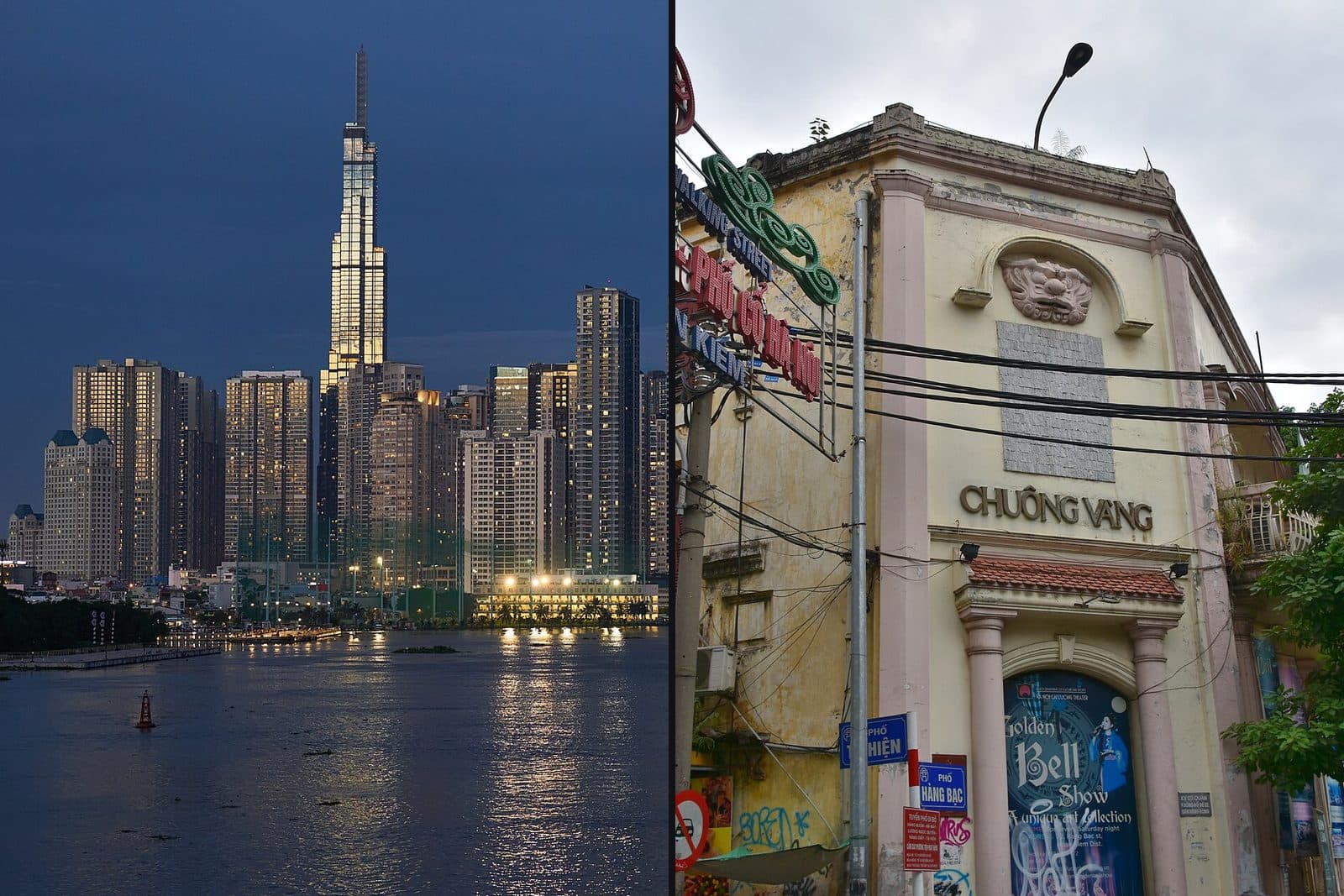
Quận Bình Thạnh is the district that has spent the last three years pulling mid-tier expats and remote workers out of D1. It holds Vietnam's tallest tower, Landmark 81 (461 m), and the whole vast Vinhomes Central Park complex with its own 14-hectare riverside park. On the other side of the district runs the old street Lê Quang Định with traditional Vietnamese shophouses. Both worlds in one place.
Since December 2024, Binh Thanh has two Metro Line 1 stations: Tân Cảng and Văn Thánh. It's 6 minutes to Bến Thành and 4 to Thao Dien. Before the metro, that same trip took 40–50 minutes at peak.

What to know
- Vinhomes Central Park — the district flagship. Landmark Plus and Park 1–7 towers. Studio in the complex ~$450–650, 1BR ~$650–950, 2BR ~$900–1,500. Inside: gym, pool, a Vinschool campus, a WinMart supermarket.
- Sài Gòn Pearl — the neighbouring complex, a little older. Prices 15–20% lower.
- Vinmec Central Park — a top clinic with English-speaking doctors; insurers like Cigna are accepted.
- Plenty of Korean and Japanese families live here — Korean marts, Japanese bakeries.
Prices
A studio in a regular apartment block (not Vinhomes) is ~$350–500. In Vinhomes, ~$450–650. A one-bedroom outside the complex is ~$500–700; inside Vinhomes, ~$700–1,100.
| Pros | Cons |
|---|---|
| Metro Line 1, 6 minutes to D1 | Big complexes cut off from street life |
| The city's best hospital — Vinmec | Inside Vinhomes, food costs as much as in D1 |
| Central Park with a lake and trails | The old streets are noisy and narrow |
| Korean and Japanese infrastructure | Not the most "Vietnamese" district |
Who it suits: remote workers on a $500–1,000 budget, couples without kids, and families who want a school within walking distance. It ranks in the top three for foreign residents alongside Thao Dien and D7. For more on budgets and the cost of living, see our Ho Chi Minh City guide.


Thao Dien — the main expat district
Thảo Điền is the former District 2, folded in 2021 into the new administrative unit of Thu Duc City, which was itself abolished on 1 July 2025 along with all the districts. Out of habit everyone still says "Thao Dien" or "District 2," and it's the single most recognisable address for a Western expat in Saigon. Americans, Koreans, French and Australians live here, alongside foreigners who've relocated with family to work in tech or education.
The district is low-rise and green — essentially a villa-and-townhouse suburb. The main streets are Nguyễn Văn Hưởng, Thảo Điền and Xuân Thủy. On Xuân Thủy you'll find Sống, The Workshop, Italian and French restaurants, a bar strip. The Deck is a well-known riverside restaurant with a sunset view.
Since December 2024, Thao Dien has two Metro Line 1 stations: Thảo Điền and An Phú. This is the district's turning point: pre-metro, getting into the centre meant 30 minutes on a bike or 250,000 VND (~$10) in a peak-hour Grab Car. Now it's 17 minutes for 15,000 VND (~$0.60).

Infrastructure
- International schools: ISHCMC (from $25,000/yr), British International School (from $30,000), EIS Saigon, AIS Saigon
- Supermarkets: Annam Gourmet, Nam An Market — imports from all over the world
- Hospitals: Family Medical Practice District 2; FV Hospital across the river, 15 minutes away
- Estella Place — a large mall with international brands
- Dozens of Western cafés, burger joints and vegan spots
Rent
The priciest of the "accessible" districts. A studio in a modern building is ~$700–1,200, a 1BR ~$1,000–1,800. Villas with a garden and pool run ~$2,500–6,000. A two-bedroom in a complex like Masteri Thao Dien or Gateway Thao Dien is ~$1,300–2,200.
Who it suits: expat families with kids in international schools, anyone working remotely on a Western salary, and lovers of Western comfort. Not for a budget long-stay.
District 5 — Chinatown (Cho Lon)
Quận 5, together with parts of D6, forms Chợ Lớn — the largest Chinatown in Vietnam, and one of the biggest in the world. This is the least "expat" and most atmospheric corner on this list: Chinese-Vietnamese temples, herbal-medicine shops, wholesale markets and some of the best street food in the city. Foreigners rarely base themselves here, which is exactly the appeal for those who want the real, unpolished Saigon.
The anchor is Bình Tây Market, a grand 1920s wholesale hall, plus the Thiên Hậu and Quan Âm pagodas draped in coiled incense. Nights on Hà Tôn Quyền are famous for wonton noodles; Trần Hưng Đạo runs straight from here into District 1, so you're never truly cut off from the centre.

What to know
- Dense and chaotic — this is old Saigon, not a planned district. Charming to visit, intense to live in.
- Some of the cheapest, best Chinese-Vietnamese food in the country: hủ tiếu, dim sum, roast duck.
- English is thin on the ground; a translation app is a daily tool here.
- No metro station yet, but D1 is only 15–20 minutes by bike or Grab.
- Rent is low: studios ~$300–500, 1BR ~$450–700, mostly in older local blocks and shophouses.
| Pros | Cons |
|---|---|
| Lowest rents near the centre | Dense, noisy, chaotic streets |
| World-class cheap street food | Very little English |
| Real local culture, temples, markets | No metro, few modern apartments |
| 15–20 minutes to D1 | Almost no Western services or expat scene |
Who it suits: culturally curious long-stayers, food obsessives, and anyone on a tight budget who wants to be near the centre without paying for it. Not for those who need English-speaking services or a Western bubble.
Phu Nhuan and Tan Binh — local districts, low rents
Two neighbouring districts between the centre and the airport. You'll barely meet Western expats here, but rent runs 1.5–2× lower than in Thao Dien.
Phu Nhuan (Phú Nhuận, Quận Phú Nhuận)
5–10 minutes by bike from D3, effectively an extension of the centre but without the tourists. Local markets, Vietnamese coffee shops, small guesthouses. Studio rent ~$300–500, 1BR ~$400–700. The main street is Phan Đăng Lưu.
Tan Binh (Tân Bình, Quận Tân Bình)
Right next to Tân Sơn Nhất international airport. The logic is simple: if you fly every couple of weeks, this is your district. Seven minutes to the terminal by bike, 10–15 by Grab. A studio near the airport is ~$250–400.
The downside — planes roar from 5am to midnight. Not everywhere, but under the flight path the noise is real. Around Lê Văn Sỹ there's a sizeable Korean community, with Korean restaurants and shops.
Hoàng Văn Thụ Park is a big green space in Tan Binh — at dawn it has more joggers and tai-chi practitioners than D1 has tourists.
Who it suits: budget long-stayers, freelancers, and frequent flyers. Koreans via the community. Not for those who want Western services nearby.
Rent by district — 2026
Conversion rate: 1 USD ≈ 26,000 VND. All USD figures below are approximate.
| District | Studio (~$) | 1BR (~$) | Studio (VND/mo) | 1BR (VND/mo) |
|---|---|---|---|---|
| District 1 | $500–900 | $700–1,300 | 13–23.4M | 18.2–33.8M |
| District 3 | $400–700 | $550–900 | 10.4–18.2M | 14.3–23.4M |
| Binh Thanh (Vinhomes) | $450–650 | $700–1,100 | 11.7–16.9M | 18.2–28.6M |
| Binh Thanh (older stock) | $350–500 | $500–700 | 9.1–13M | 13–18.2M |
| Thao Dien | $700–1,200 | $1,000–1,800 | 18.2–31.2M | 26–46.8M |
| District 5 (Chinatown) | $300–500 | $450–700 | 7.8–13M | 11.7–18.2M |
| Phu Nhuan | $300–500 | $400–700 | 7.8–13M | 10.4–18.2M |
| Tan Binh | $250–500 | $400–700 | 6.5–13M | 10.4–18.2M |
On top of rent, add:
- Electricity: 3,500–4,500 VND/kWh (with AC running, ~$30–80/mo)
- Water: 11,000 VND/m³, usually ~$5–10/mo
- Internet: 200,000–300,000 VND/mo (~$8–12)
- Building service fee: ~$20–60/mo
That's ~$50–150 a month in utilities. Most long-stay rentals here aren't on international portals — expats find them through Facebook groups like "Apartments for rent in Saigon" and "Ho Chi Minh City Expats," or through a local agent (who typically takes a half-month commission). For a broader overview of costs, see our Ho Chi Minh City guide.
Metro Line 1: how it rewired the city
22 December 2024 is the date after which choosing a district in Saigon is a new calculation. The line runs from Bến Thành to Suối Tiên — 19.7 km, 14 stations, 30 minutes end to end. Trains come every 5–8 minutes at peak.
Key stations for residents:
- Bến Thành — D1, by the market
- Văn Thánh, Tân Cảng — Binh Thanh, Vinhomes
- Thảo Điền, An Phú — Thao Dien (former Thu Duc City)
- Rạch Chiếc, Phước Long, Suối Tiên — the north-eastern Thu Duc suburbs
A ticket is 7,000–20,000 VND in cash or 6,000–19,000 VND by card (~$0.25–0.80) depending on distance, with discounted multi-ride cards. Before Line 1, a Thao Dien → Bến Thành peak-hour Grab Car cost 250,000–350,000 VND (~$10–14) and took 40–60 minutes. Now it's 17 minutes for 15,000 VND.
If you live in a district without the metro (D7, D5, Phu Nhuan, Tan Binh, the outer parts of D3), you'll combine: Grab Bike or your own scooter to the nearest station, then the train. It's still faster than the jams.
How to pick your district — a matrix
A short checklist by segment. If you land in several, choose by budget.
| Who you are | Best district | Alternative | Budget/mo |
|---|---|---|---|
| Tourist, 3–10 days | District 1 | District 3 | from ~$40/night in a hostel |
| Family with kids, school matters | Thao Dien | D7 (Phu My Hung) | ~$2,000–4,000 |
| Family, no school, wants quiet | District 7 | Binh Thanh (Vinhomes) | ~$1,200–2,000 |
| Remote worker, $500–1,000 budget | Binh Thanh | District 3 | ~$800–1,500 |
| Budget long-stayer | Phu Nhuan | Tan Binh / D5 | ~$500–900 |
| Premium, villas | Thao Dien | District 2 (outside Thao Dien) | ~$4,000+ |
| Frequent flyer | Tan Binh | Phu Nhuan | ~$600–1,200 |
| Wants the "real Vietnam" | District 5 / D3 | Phu Nhuan | ~$400–1,200 |
What to ask yourself before choosing
- Budget. Rent + utilities + food + transport. In Thao Dien, figure ~$2,000/mo minimum for one person. In Phu Nhuan or D5 you can land under ~$700.
- Transport. Ready to ride a scooter? Saigon is a motorbike city — 7.4 million registered bikes. Without one, outside D1 you're on 30–50 Grab rides a month.
- Kids. If schools are in play — Thao Dien or D7, no debate. If not, every district is open.
- Noise. A quiet night's sleep in D1 is impossible. Phu My Hung is quieter than any residential suburb you're used to.
- Community. Want an expat scene — Thao Dien or Binh Thanh/Vinhomes. Want local life — D3, D5 or Phu Nhuan.
Schools, hospitals, groceries — what ties you to a district
International schools
| School | District | Fees/year |
|---|---|---|
| ISHCMC (International School) | Thao Dien | from $25,000 |
| British International School (BIS) | Thao Dien / D7 | from $30,000 |
| Saigon South International School (SSIS) | District 7 | from $22,000 |
| European International School (EIS) | Thao Dien | from $20,000 |
| American International School (AIS) | Thao Dien | from $18,000 |
Local Vietnamese kindergartens are $200–400/mo; private international ones, $700–1,500/mo.
Hospitals
- FV Hospital (District 7) — French-managed, one of the leading private hospitals in Vietnam. English-speaking staff, European prices.
- Vinmec Central Park (Binh Thanh) — premium, accepts Cigna/AXA insurance.
- Family Medical Practice (D1, D2, D7) — an expat network with European doctors.
- Hoan My Saigon Hospital — a budget chain with decent quality.
- City International Hospital (Binh Tan, west of the centre) — English-speaking doctors, mid-range prices.
For serious cases, expats fly to Bangkok or Singapore. But 95% of things get handled at FV or Vinmec.
Where to buy groceries
- Annam Gourmet (Thao Dien, D1) — European imports, cheese, wine
- Nam An Market (Thao Dien) — Asian and European delicacies
- VinMart / WinMart — mass-market chain, everywhere
- Co.op Mart — budget chain
- Lotte Mart (D7) — Korean range
- Local markets — Bến Thành (D1), Tân Định (D3), Bình Tây (D5), Bà Chiểu (Binh Thanh)
Safety by district — where it's calmer
Ho Chi Minh City is broadly calm, but there's a district gradient.
- Safest: Thao Dien, Phu My Hung (D7), Vinhomes Central Park (Binh Thanh) — gated complexes, little petty crime.
- Middle: District 3, District 5, Phu Nhuan, Tan Binh.
- Stay alert: District 1 at night on Bùi Viện — pickpockets and phone-snatchers on motorbikes. Phạm Ngũ Lão, the old backpacker quarter, is another active pickpocket zone.
The main risk for a visitor is the drive-by phone snatch. Don't pull out an expensive phone at the kerb, and don't carry bags on the shoulder facing the road. For more on this kind of practical detail, see our guide to staying safe in Vietnam.
Real scenarios — what to pick
A week of sightseeing
Book a hotel in District 1 within walking distance of Bến Thành. Budget $40–80/night in a 3–4-star — our guide to Ho Chi Minh City hotels by district has picks for every budget. Everything is on foot or 10 minutes by Grab.
A three-month stay, $1,500/mo budget
Binh Thanh or Phu Nhuan. Studio ~$400, utilities ~$80, food ~$400, transport (bike + Grab) ~$200, cafés and fun ~$300. Metro nearby, 10 minutes to the centre. Alternative — District 3, but ~$100–150/mo more.
Family with kids, two-year contract
Thao Dien or District 7, no contest if the kids are at an international school. If the school is in Thao Dien, live there. If it's SSIS (D7), live in Phu My Hung. Budget for a family of four with one child in school is ~$3,500–6,000/mo, school fees on top.
Digital nomad, $2,500–3,500/mo
Thao Dien, an apartment at Masteri Thao Dien or Gateway. A 1BR at ~$1,200, a coworking pass (Toong) ~$200, gym ~$80, food ~$600, the rest on fun and trips. Metro plus airport 30 minutes away plus Western services.
Those who can't take Saigon
Many move on after 2–4 months to Da Nang or Hoi An — quieter, closer to the sea, less traffic. Compare the cities in our Da Nang guide.

The downsides of Saigon nobody warns you about
- Air. On bad days the AQI hits 150–200 (unhealthy). The worst window is December–March, the dry season. Worth keeping a mask.
- Rainy season (May–October). Thao Dien floods regularly, D1 in spots. Delivery mopeds sometimes wade through it.
- Traffic. Peaks are 7:30–9:00 and 17:00–19:30. Without the metro, best not to head out then.
- Heat. Averages 28 °C, but humidity adds a subjective +5. Air-con isn't a luxury, it's a utility bill.
- Bureaucracy. Visa, extensions, a bank card, local registration — all via agents or with a lot of patience. Your visa options depend on your passport: citizens of the UK, Norway, Switzerland, Japan, South Korea and 18 EU countries get 45 days visa-free, most others, including US, Australian and Canadian travellers, apply for an e-visa of up to 90 days at evisa.gov.vn. Full rules are in our visa guide.
FAQ
Three clusters
- Thao Dienexpat familiesWestern comforts
- Binh Thanh / Vinhomes Central Parkremote workers, couples
- Phu Nhuan / Tan Binh / D5budget long-stayers
Unlike some beach towns, Saigon has no single expat quarter — the community is spread out. Most rentals turn up in Facebook groups like «Apartments for rent in Saigon,» not on international portals
- A studio in Tan Binhfrom ~$250/mo
- In Thao Dien~$1,200runs to
- A one-bedroom~$400–1,800
- A two-bedroom~$700–2,500
- Villasfrom ~$2,000
- Utilities~$50–150add for
At roughly 26,000 VND to the dollar
- Tan Binh7 minutesright by the airport, by bike
- Phu Nhuan10 minutes
- District 315
- Binh Thanh20
- Thao Dien25–40over the Saigon Bridge
- District 730–60 minutesthe farthest
In Thao Dien and Phu My Hung, no — English is enough. In D1 it usually is too. In D3, D5, Phu Nhuan and Tan Binh, English shows up mainly in tourist spots; for renting from a local landlord and dealing with neighbours, Google Translate does the job. Basic phrases like "thank you" (cảm ơn) and "how much?" (Bao nhiêu tiền) go a long way.
Thao Dien if the kids are at an international school and the budget is $3,000+/mo. District 7 (Phu My Hung) is quieter and cheaper, but farther out with no metro. Both count as the safest and greenest.
Yes — Line 1 has run since December 2024 (Bến Thành — Suối Tiên, 19.7 km, 14 stations). It passes through D1, Binh Thanh and Thao Dien. A ticket is 7,000–20,000 VND in cash, 6,000–19,000 VND by card. Line 2 is under construction, due around 2030.
Ho Chi Minh City is bigger, pricier and more Western. Hanoi is more compact, cheaper and more "Vietnamese." Rent in equivalent Hanoi districts is 20–30% lower. See our guide to Hanoi districts for the northern capital.
In Thao Dien, Phu My Hung and Vinhomes — yes, like any quiet neighbourhood in Bangkok or Singapore. In D1 (especially Bùi Viện) you need basic vigilance: phone in your pocket, bag on the inside. Serious crime is rare; the main threat is drive-by phone snatching.
- Guide
Ho Chi Minh City vs Hanoi for Living 2026: Costs, Climate
Living in Ho Chi Minh City or Hanoi in 2026: monthly costs and rent, climate by season, the new metro, coworking and remote work. A verdict for 14 profiles.Ho Chi Minh City vs Hanoi for Living 2026: Costs, Climate - Guide
Ho Chi Minh City Spa & Massage 2026: Where to Go
Saigon spa and massage guide: types of treatment, the best spas by budget, Korean saunas, hotel spas and what a massage costs in 2026.Ho Chi Minh City Spa & Massage 2026: Where to Go - Guide
Ho Chi Minh City Nightlife & Shows 2026: What to Do
Saigon entertainment guide: the AO Show, water puppets, rooftop bars, clubs, karaoke, cinemas, theme parks and river dinner cruises.Ho Chi Minh City Nightlife & Shows 2026: What to Do