Tết Trung Thu — Vietnam's Mid-Autumn Festival, 15 September 2027
On 15 September 2027 Vietnam's streets fill with lantern light, drums and children's laughter. This is Tết Trung Thu, the Mid-Autumn Festival — the country's festival for kids. Here is the exact date, why it isn't the Lunar New Year, the two kinds of mooncake with prices, the legend of Cuội, and the three cities where it shines brightest — with Hoi An the most photogenic of all.

On Wednesday, 15 September 2027, Vietnam's streets fill with lantern light, the boom of drums and children's laughter. This is Tết Trung Thu — the Mid-Autumn Festival, or, as the Vietnamese call it, the children's festival. Once a year the full moon of the eighth lunar month turns the whole country into a stage for lantern parades, lion dances and mooncakes eaten under the open sky.
Note: this is not the Lunar New Year. Tết Nguyên Đán, the one guidebooks usually mean, falls in February. Tết Trung Thu is a much lighter, more open and more photogenic affair — it opens the autumn season, doesn't shut the shops and slots neatly into a September holiday.
Below we break it all down: the exact 2027 date, how it differs from Tết and from the Chinese Mid-Autumn, the core traditions, the two kinds of mooncake with prices, the legend of the woodcutter Cuội, and the three cities where it comes alive — Hanoi, Hoi An and Ho Chi Minh City.

What Tết Trung Thu is, and why it is a children's festival
Tết Trung Thu literally means "mid-autumn festival." In China it is Zhōngqiū Jié, in Korea Chuseok — the East Asian roots are shared, but each country grew its own version, and Vietnam's stands out for one thing: the main characters are children.
Historically the festival was tied to the rice harvest. The middle of the eighth lunar month is when farming families finished bringing in the main crop. The fields were clear, the barns full, and everyone could breathe out. The moon rises especially round and bright on this night, and across Southeast Asia the full moon has always stood for abundance and family togetherness.
Tradition traces Tết Trung Thu in Vietnam back to the 11th century, under the Lý dynasty. At the court in Thăng Long (the old name for Hanoi) it was reportedly marked with boat races on the Red River, water-puppet shows and a lantern parade. Over time the festival moved into the home and towards children: while the adults thanked their ancestors and the moon for the harvest, parents prepared lanterns, masks and sweets for the kids — making up for the attention they missed during the rice harvest.
By the 20th century it had settled firmly as a "children's day." In modern Vietnam, Tết Trung Thu plays much the same role Christmas does for kids in the West: lanterns instead of a tree, mooncakes instead of gingerbread, a lion dance instead of Santa.
It is not an official day off — the key contrast with Tết Nguyên Đán (the official days off are listed in our Vietnam public holidays calendar). Schools and offices run as normal, but come evening the whole population spills onto the streets. Kindergartens and lower grades hold daytime parties with lantern parades, and many parents leave work early to make it.
When it falls: dates for the next four years
Tết Trung Thu always lands on the 15th day of the 8th lunar month — the full moon. On the Gregorian calendar that floats between mid-September and early October.
The active festival window opens about a week before the festival and lasts roughly ten days. During that time:
- Hàng Mã street in Hanoi turns into the country's main lantern market.
- Hoi An holds several lantern-parade nights (its regular lantern festival plus the climax on 15 September).
- Supermarkets and patisseries in Saigon fill up with mooncake boxes, from artisan bakeries to premium brands.
- Kindergartens, schools and offices run family and corporate events.
If your trip lands on these dates, it is worth reading up on September weather by region — the north is dry and warm, the centre still catching the tail of the rains, the south in its wet season. Shift a month later and October brings a different mix again.

Not the Lunar New Year: how it differs from Tết
This is the most common mix-up for travellers: they hear the word "Tết" and assume it means New Year. In fact Tết is just a general word for "festival" — the second word tells you which one.
| Feature | Tết Nguyên Đán (New Year) | Tết Trung Thu (Mid-Autumn) |
|---|---|---|
| 2026 date | 17 February | 25 September |
| Lunar calendar | 1st day, 1st month | 15th day, 8th month |
| Status | Biggest national holiday | Not a day off |
| Time off | 9 days (14–22 Feb) | None |
| Centred on | Family, ancestors, the new year | Children and the moon |
| What closes | Shops, markets, banks for 5–7 days | Almost nothing |
| Transport | Tickets sell out months ahead | Runs as normal |
| Hotel prices | Rise 1.5–2× | Barely move |
| Signature food | Bánh chưng (sticky-rice cake) | Bánh trung thu (mooncakes) |
| Planning needed | Book ahead or fail | Sort it on the day |
Put simply: Tết Nguyên Đán is "Vietnam heads back to the village for nine days," while Tết Trung Thu is "Vietnam comes out in the evening with kids and lanterns." For a traveller the second is far easier: the country works, the cities are alive, crowds gather at night and days stay quiet.
How it differs from the Chinese Mid-Autumn
The roots are shared — the festival came from China many centuries ago. But over the years the Vietnamese version bloomed in its own direction. The main differences are in the table.
| Feature | Vietnam (Tết Trung Thu) | China (Zhōngqiū Jié) |
|---|---|---|
| Focus | Children | Adults, family reunion |
| Legend | Woodcutter Cuội and his banyan | Chang'e and the archer Hou Yi |
| Dance | Lion (múa lân) | Various, dragon among them |
| Mooncakes | 2 types: bánh nướng + bánh dẻo | Mostly baked |
| Lanterns | Stars, carp, butterflies, rabbits | Round red ones |
| Status | Not a day off | Official day off |
| Lantern parade | Kids march through the streets | Lanterns hung at home and in temples |
The signature of the Vietnamese version is bánh dẻo — an unbaked mooncake of roasted rice flour, white, with the scent of pomelo flowers. In Vietnam it is a tradition in its own right, not a variant of the baked cake. And one more thing you can spot with the naked eye: the main dance of the Vietnamese festival is the lion (a compact costume for two).
The main traditions
Tết Trung Thu has five main traditions: the lantern parade, the lion dance, masks, the moon altar and the songs. Here is each.
The lantern parade (rước đèn)
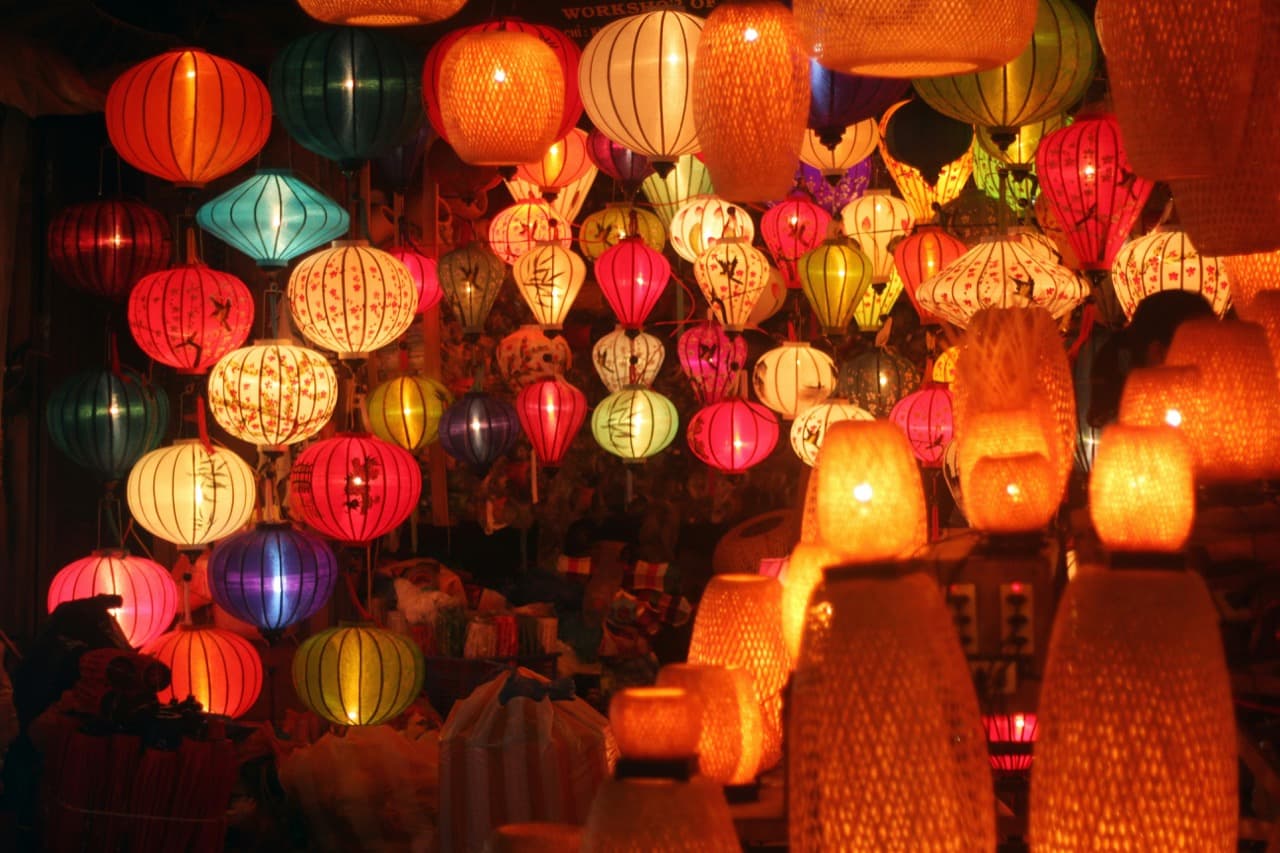
The one thing you'll see on the evening of 15 September in any Vietnamese city: children with lanterns. They move in groups through the streets, each holding a paper or plastic lantern with a candle or LED inside. Stars, carp, butterflies, lotuses, rabbits, dragons — the shapes vary wildly.
The most recognisable model is the star lantern (đèn ông sao). A red five-pointed star of cellophane over a bamboo frame, on a carrying pole. On Hàng Mã in Hanoi it runs from 15,000 to 60,000 VND (~$0.60–2.40) depending on size.

Kids sing traditional songs — the main one is "Tết Trung Thu rước đèn đi chơi" (literally "At Mid-Autumn we go out with a lantern"). The words and tune are learned in kindergarten, so Vietnamese of any age can join in.
The lion dance (múa lân)
Tết Trung Thu isn't Tết Trung Thu without the lion dance. Troupes perform in front of homes, shops, restaurants and public squares. To the roar of drums and clash of cymbals the "lion" (a costume for two dancers) bows to the hosts, spins, leaps onto stools and sometimes onto tall poles — the acrobatic version reserved for seasoned teams.
The point is to bring luck and drive off evil spirits. Hosts hang a red envelope of cash (lì xì) from a rope or pole, and the lion has to jump and "eat" it. That is both the troupe's pay and a small ritual.
The lion is accompanied by Ông Địa — a round, grinning figure in the mask of the "Earth God," with a fan. He plays the clown and keeps the children entertained.
The best places to catch a lion dance are the Old Quarter in Hanoi, the Chợ Lớn (Cholon) district in Ho Chi Minh City — where the tradition runs strongest thanks to the Chinese-Vietnamese community — and the Old Town of Hoi An.

Masks of Cuội and animals
A mask usually comes with the lantern. The classics:
- Chú Cuội — the hero of Vietnam's main legend (more on him below).
- A lion's head in bright patterns.
- Ông Địa — the round, smiling Earth God mask.
- Animal masks — cat, dog, rabbit, tiger, pig.
Masks used to be made of papier-mâché. Today it is plastic, cloth, sometimes plush. On the Hàng Mã market they run 20,000–80,000 VND (~$0.80–3.20).
Older Vietnamese lament that traditional paper masks are getting rarer. A few makers in Hanoi's Old Quarter still craft them by hand — collector's pieces you can take home as a souvenir.
The moon altar (mâm cỗ) and "phá cỗ"
In the evening, when the full moon rises, families lay out a mâm cỗ Trung Thu — a festive altar — in courtyards and on balconies. On it:
- Mooncakes of both kinds — bánh nướng and bánh dẻo.
- Five kinds of fruit (five is a lucky number): pomelo is a must (often carved "hedgehog" style, peeled and fanned into rays), plus apples, pears, grapes, bananas, tangerines, dragon fruit.
- Tea — green or jasmine.
- Dough figurines (con tò he) — roosters, fish, zodiac animals. Handmade from coloured rice dough; kids love them.
- Sometimes toys and sweets, set aside just for the children.
The family gathers around the altar, admires the moon, sips tea and tells the kids the legend of Cuội. At the climax comes phá cỗ — literally "breaking the altar." The children get the go-ahead to grab the sweets and fruit and eat them. It is the most anticipated part of the night.
Songs and rhymes
Beyond "rước đèn đi chơi," kids learn other verses too — "Chiếc đèn ông sao" (The Star Lantern), "Rước đèn tháng tám" (The Eighth-Month Lantern Parade) and "Thằng Cuội" (The Boy Cuội). On school parties and children's TV these songs play on loop in the run-up to the festival.
Mooncakes: two types, 2026 prices and which to choose
The signature food is the bánh trung thu(mooncake). It goes with tea, gets given in boxes and sits on the altar. There are two main dough types, and both are worth trying.
Bánh nướng — the baked mooncake
This is the "classic" mooncake often shown in guidebooks. A crust of wheat flour, sugar syrup and oil, brushed with egg wash before baking — hence the golden-brown colour. The top usually carries a stamped pattern: an ornament, a character, a lotus.
The traditional filling is thập cẩm("the mix"): lotus jam, candied peel, nuts, dried melon seeds, bits of dried meat, and often a whole salted duck egg yolk at the centre. The yolk stands for the full moon. The result is rich, filling and very sweet against the salty note — an acquired taste.

- Shelf life: 2–4 weeks factory-packed; 5–7 days for artisan cakes without preservatives.
- Size: 80–250 g, the classic format being 150–180 g.
- 2026 price (per cake): 50,000–150,000 VND, or roughly ~$2–6.
Bánh dẻo — the unbaked rice mooncake
In Vietnam this is a tradition in its own right. The crust is roasted glutinous rice flour (bột nếp) and sugar syrup, mixed with pomelo-flower water (nước hoa bưởi) — hence the gentle floral scent. It isn't baked. The crust stays white, soft, chewy and a little sticky.
The filling is simpler than in bánh nướng and almost always sweet: a smooth mung-bean or lotus paste, or sweet shredded coconut. A salted yolk is sometimes added for contrast.

- Shelf life: 3–5 days (no preservatives, the crust goes stale fast).
- Size: 100–200 g.
- 2026 price (per cake): 40,000–80,000 VND, or ~$1.60–3.20.
Side by side, and which to pick
| Feature | Bánh nướng | Bánh dẻo |
|---|---|---|
| Crust | Baked, dense, golden | Unbaked, white, chewy |
| Scent | Baked pastry, vanilla | Pomelo flowers |
| Shelf life | 2–4 weeks | 3–5 days |
| 2026 price (VND) | 50–150k | 40–80k |
| 2026 price (~USD) | ~$2–6 | ~$1.60–3.20 |
Modern formats and brands
Since the 2010s the mooncake market has gone premium. The main names:
- Kinh Do — the number-one mass brand, sold in every supermarket. A safe gift.
- Brodard — a historic French-Vietnamese patisserie in Ho Chi Minh City. A classic for colleagues.
- Givral — another old Saigon patisserie with a strong reputation.
- Maison Mooncake — fashionable artisan cakes with creative fillings (salted caramel, tiramisu, matcha).
- Hotel boxes — Sofitel, Park Hyatt, Caravelle and JW Marriott put out premium boxes, 1,500,000–3,500,000 VND (~$60–140) for a set of 4–6.
Snow-skin mooncake is its own sub-category. A crust of chilled glutinous rice flour, brightly coloured (pink, purple, green — natural dyes). Kept in the fridge and served cold, the texture is somewhere between mochi and cake.
2026 prices in VND and USD
- Bánh nướng, regular (each)50,000–150,000 VND ≈ $2–6
- Bánh dẻo, regular (each)40,000–80,000 VND ≈ $1.60–3.20
- Snow-skin (each)60,000–120,000 VND ≈ $2.40–4.80
- Premium box of 4500,000–1,200,000 VND ≈ $20–48
- Premium box of 61,500,000–3,500,000 VND ≈ $60–140
Rough conversion: ~25,000 VND ≈ $1 (mid-2026).
The legend of Cuội and the banyan on the moon
Every Vietnamese child knows this story. If you want to really understand the festival, learn it.
Once there was a woodcutter named Cuội (Chú Cuội). One day in the forest he came across a family of tigers by a stream. The tigress was feeding her cubs special leaves from a nearby tree. Cuội was amazed: the leaves had a wondrous power — they healed wounds and even brought the dead back to life.
He carefully dug up the little tree and carried it home. It was a banyan (cây đa) — a mighty South Asian tree with aerial roots. As he left, a wise old man of the forest gave him a warning: "Water this tree only with clean water from the east. Water it with dirty water and it will fly up to the sky."
Cuội lived with his wife, healed villagers with the banyan's leaves and even revived the dead. One day he went off into the forest for a long while. His wife forgot the warning and, carelessly, watered the banyan with unclean water.
The tree shuddered, its roots tore from the earth, and it began to rise. Cuội got back just in time. To save the tree he grabbed its roots — and the banyan pulled him up with it. Higher and higher they climbed, until they came to rest on the moon.
Ever since, Cuội sits under his banyan on the moon. On a full moon, especially the night of Tết Trung Thu, Vietnamese point out the dark patches on the lunar disc to their children: "See there — that's Cuội with his tree." The kids light their lanterns and take to the streets — to light Cuội's way home, so that one day he might return to Earth.
Beyond Cuội, the folklore has other lunar figures. Hằng Nga is the moon goddess, the counterpart of the Chinese Chang'e; she often appears on mooncake packaging. Sometimes there is the jade rabbit, pounding the elixir of immortality in its mortar — an image from the shared East Asian mythology.
Fast Track — no queue at the border
5–10 minutes instead of an hour in the immigration queue
from$11per passenger
Where to watch: Hanoi, Hoi An, Ho Chi Minh City
Every region marks Tết Trung Thu its own way. Three cities give the strongest experience.
- Hanoi — Hàng Mã street (Phố Hàng Mã): The country's main lantern market — Old Quarter, peak in the week before the festival
- Hue — Perfume River (Sông Hương): Boat processions and water puppets — Landmark: Trường Tiền bridge
- Da Nang — Dragon Bridge (Cầu Rồng): Bridge light show and installations — Bạch Đằng riverside
- Hoi An — Bạch Đằng riverside (Bạch Đằng): Thousands of candles on the Thu Bồn by 21:00 — Lantern parades through the Old Town
- Nha Trang — 2 April Square (Quảng trường 2 tháng 4): Children's shows in the resort strip — Landmark: Tram Huong Tower
- Da Lat — Lam Vien Square (Quảng trường Lâm Viên): Lantern parades with schoolchildren
- HCMC — Nguyễn Huệ (Phố đi bộ Nguyễn Huệ): City installations and photo zones — District 1, the polished version
- HCMC — Chợ Lớn (Chùa Bà Thiên Hậu, Chợ Lớn): Chinatown: dragon dances — Lantern market on Lương Nhữ Học nearby
- Phu Quoc — Vinpearl (Vinpearl Phú Quốc): Kids parties and baking workshops — Resort strip in the north of the island
Hanoi — Hàng Mã street and the Old Quarter
If you had to pick one place in the country as a traveller, make it Hàng Mã (Hàng Mã) in Hanoi's Old Quarter. Three or four weeks before the festival the street turns into a lantern market: the whole roadway and pavements fill with stalls of star lanterns, masks, drums and toys. By evening the street is closed to traffic, the crowds turn impassable and every shopfront glows with hundreds of lights.
Peak activity is the week before the festival. Best time to come: 18:30 to 22:00. Bring cash — most stalls don't take cards.
What to do here:
- Buy a star lantern (15,000–60,000 VND) and carry it with you — that's the point.
- Take a photo against the lights — Hàng Mã is Hanoi's most recognisable backdrop.
- Walk to a nearby corner (Hàng Lược, Hàng Đào) and catch a lion performance.
Other spots — Hoàn Kiếm Lake (Hồ Hoàn Kiếm) for the evening stroll, the Old Quarter at large (lion troupes work shop to shop), and the Museum of Ethnology (Bảo tàng Dân tộc học) with a daytime party and lantern workshops (ticket around 40,000 VND, check at the desk). For the full picture of the capital, see our guide Hanoi: everything you need to know.
Hoi An — a double festival
In Hoi An, Tết Trung Thu comes right after the town's monthly lantern festival, held on the 14th of every lunar month, the night before. So the town is already in "lantern mode," and in September the festival gets especially big. For the regular lantern night, see our guide Hoi An Lantern Festival 2026.
What happens in the Old Town on the evening of 15 September:
- Around 19:00 — a children's lantern parade along Trần Phú street.
- An adults' parade from the Quan Công temple through the main streets — with costumed troupes from Hoi An's five traditional guilds.
- Lion and dragon dances in the Chinese community halls all evening.
- By 21:00, several thousand floating candles on the Thu Bồn river. Candles in little paper boats are sold on the embankment (10,000–15,000 VND each).

The downside: rooms need booking 2–3 months ahead, prices rise 1.5–2× and the crowds are dense. The workaround is to arrive a day earlier or later — the atmosphere holds all festival week. For the full guide to the town, see Hoi An: a guide to central Vietnam's gem.
Ho Chi Minh City — Cholon and Nguyễn Huệ
Saigon has two centres of celebration, and they are very different.
The Nguyễn Huệ walking street (Phố đi bộ Nguyễn Huệ) in District 1 is the modern format. The city sets up installations: giant lanterns, themed zones, photo spots. Families come with kids, take pictures, eat street food. The mood is festive, safe and easy for travellers.
Cholon (Chợ Lớn, District 5) is the authentic side. Saigon's historic Chinese quarter, home to Vietnam's largest Chinese community. Here Mid-Autumn is marked "the Chinese way": more dragon dances than lion, red lanterns everywhere, dense crowds in the narrow streets. Key points in Cholon: the Thiên Hậu temple (Chùa Bà Thiên Hậu), the lantern market on Lương Nhữ Học street, and Bình Tây market (Chợ Bình Tây) for mooncakes from local bakeries.
If you're choosing between the two, do both — Nguyễn Huệ by day, Cholon in the evening; they're 20–30 minutes apart by taxi. For the full city guide, see Ho Chi Minh City (Saigon): what to see and where to stay.
More spots around the country
| City | Main spot | What to see |
|---|---|---|
| Hue | Perfume River (Sông Hương) | Boat processions, water puppets |
| Da Nang | Dragon Bridge, Bạch Đằng riverside | Bridge lights, installations |
| Nha Trang | 2 Tháng 4 Square, VinWonders | Kids' shows in the resort zone |
| Phu Quoc | Vinpearl, JW Marriott | Parties, baking workshops |
| Da Lat | Lâm Viên Square | Lantern parades with schoolkids |
A family evening, step by step
To picture what an ordinary Vietnamese family feels on 15 September, here is a typical day.
Morning. Parents hand the kids their gifts. The main one is a lantern (chosen a week earlier on Hàng Mã or at a supermarket). With it come a mask and a set of sweets. The little ones light their lanterns straight away and tear around the flat.
Daytime. Mum and grandma prepare the altar. They buy mooncakes (usually two boxes — one for the family, one to give to neighbours or the in-laws). They head to the market for fruit. The pomelo gets carved "hedgehog" style. Dough figurines of animals are shaped. Fresh tea is brewed.
Early evening. Around 17:00–18:00 the family gathers. Office-working parents leave early. The children dress up, many in a traditional áo dài. In districts with an active community, the first lion dances start at the shops.
Evening. The family heads out. The kids join the neighbourhood parade with their lanterns. Along the way they meet lion troupes, take photos and eat street food. Markets grill bánh tráng nướng (a rice cracker known as "Vietnamese pizza") and sell candy floss and ice cream.
Around 20:00. Back home. The family sits around the altar in the street or on the balcony. The moon is high by now. The elders tell the children the story of Cuội, point at the lunar disc and look for the silhouette of the man with his tree. They drink tea and eat mooncakes.
The climax — phá cỗ. Around 21:00 the parents say "go ahead." The children pounce on the altar and grab the sweets and fruit. This is the part they wait a whole week for.
In modern city families the format shifts a little. Couples without kids go out with friends to a café or restaurant with a themed menu. Companies throw small parties. Department stores put on kids' shows with entertainers. But the basic frame — altar, lantern, mooncake, moon — survives in almost every version.
What to take home
Mid-Autumn gifting is nearly an industry in itself, much like the Christmas gift season back home. A few categories.
For children
The basic set: a lantern, a mask, a small box of mooncakes. A toy is often added — a little wooden drum (trống cơm), an animal figurine, a set of markers. Budget per child: 100,000–300,000 VND (~$4–12).
For relatives and elders
A mid-range box of mooncakes — Kinh Do, Brodard, Givral. Four to six cakes in a handsome tin or wooden box. Price 500,000–1,200,000 VND (~$20–48).
For colleagues and business partners
Here the budgets get serious. Premium boxes from hotel patisseries (Sofitel, Park Hyatt, Caravelle, JW Marriott) or artisan bakeries. Six cakes plus tea or wine. Price 1,500,000–3,500,000 VND (~$60–140). Corporate etiquette: gifts go out a week before the festival, no later; hand them over with two hands and a slight bow, with a card naming giver and recipient.
For travellers — what to bring back
| Souvenir | 2026 price | Where to buy |
|---|---|---|
| Star lantern | 15,000–60,000 VND | Hàng Mã, Lương Nhữ Học |
| Handmade paper mask | 50,000–150,000 VND | Hanoi Old Quarter |
| Box of mooncakes | 300,000–1,500,000 VND | Brodard, Givral, supermarkets |
| Tea for the mooncakes | 200,000–800,000 VND | Tea shops in Cholon, Hoi An |
| Jade-rabbit figurine | 100,000–500,000 VND | Old Quarter souvenir stalls |
Bánh nướng keeps for 2–4 weeks, so it travels home fine. The star lantern goes in the suitcase taken apart.
An evening plan: three cities, 15 September 2027
If you're in one of the main cities on festival night, here are ready-made 4–5 hour routes.
Hanoi
| Time | Spot | What to do |
|---|---|---|
| 17:30 | Hàng Đào | Dinner at an Old Quarter restaurant |
| 18:30 | Hàng Mã street | Lantern market, photos, buy a lantern |
| 19:30 | Hàng Lược | Hunt for a lion performance |
| 20:30 | Hoàn Kiếm Lake | Walk, photograph the lights |
| 21:30 | A café with a view | Tea and a mooncake |
Hoi An
| Time | Spot | What to do |
|---|---|---|
| 17:30 | Enter the Old Town | Ticket 120,000 VND (check at the booth), walk along Trần Phú |
| 18:30 | Quan Công temple | Start of the lantern parade |
| 19:30 | Riverside café | Dinner, photos of lanterns over the street |
| 20:30 | An Hội bridge | Float a candle |
| 21:30 | The market square | The final performance |
Ho Chi Minh City
| Time | Spot | What to do |
|---|---|---|
| 17:00 | Nguyễn Huệ | Installations, photos, dinner |
| 18:30 | Taxi to Cholon | Grab ~80,000 VND, over to District 5 |
| 19:00 | Thiên Hậu temple | Incense, parade |
| 20:00 | Lương Nhữ Học | Cholon lantern market |
| 21:00 | Bình Tây market | Street food, mooncakes from local bakeries |
Checklist: what to taste, buy and do
5 things to buy:
- A star lantern (đèn ông sao) — the main souvenir.
- A handmade Cuội or lion mask.
- A box of 4–6 mooncakes in a nice tin.
- Tea for the mooncakes — jasmine or green.
- A little wooden drum, trống cơm — a mini-souvenir.
5 things to do:
- Walk Hàng Mã in the evenings of the week before the festival.
- Catch a lion dance on the street.
- Float a candle on the Thu Bồn river in Hoi An.
- Photograph the kids on the lantern parade.
- Find Cuội's silhouette on the moon.
Practical notes for travellers
A few practical notes to save you surprises.
Transport. Runs as normal. Trains, buses and flights — no disruptions. Grab and taxis — no surcharges. That is a big contrast with Tết Nguyên Đán, when transport is all but paralysed.
Shops and markets. Open. A week ahead the big supermarkets roll out huge mooncake stands — WinMart, Co.op Mart, Big C, AEON.
Accommodation. In Hanoi and Ho Chi Minh City prices barely move (10–15%). In Hoi An expect 50–100% for the festival night — book 2–3 months ahead. In Nha Trang, Phu Quoc and Da Nang, little change. September is a shoulder month, so it is worth reading up on the weather by region before you go.
Dress code. None. Ordinary summer clothes are fine. For a touch of the authentic, a light cotton áo dài (from 600,000 VND in tourist shops).
Weather. September is a transitional month. In the north (Hanoi), evenings are warm, around 27–30°C, but the month is still wet — 248 mm of rain in September. In the centre (Hoi An, Da Nang), the rainy season is only starting — downpours are frequent and long, so pack a rain poncho. In the south (Ho Chi Minh City) it is the wet season, with short but heavy showers.
Money. Cash is your friend. Lantern markets and street vendors don't take cards, so withdraw ahead. A 500,000 VND note is large and small stalls struggle for change; ideally carry 50,000s and 100,000s.
FAQ
Wednesday, 15 September 2027. It is the 15th day of the 8th lunar month — the full moon. The active events start about a week before the festival.
No. Unlike Tết Nguyên Đán, Tết Trung Thu is not an official day off. Schools and offices work, but many parents leave early in the evening to join the lantern parade with their kids.
They are two different holidays. Tết Nguyên Đán is the Vietnamese Lunar New Year (6 February 2027), the biggest event of the year: in 2027 either 7 or 10 days off (the government picks the option), everything closed. Tết Trung Thu is the Mid-Autumn Festival (15 September 2027) — centred on children, not a day off, with the country working.
Literally "mid-autumn festival." In English you'll also see it called the Moon Festival, the Lantern Festival or the Children's Festival. The regional cognates are Zhōngqiū Jié (China) and Chuseok (Korea).
It depends on taste. Bánh nướng is baked, dense, with a multi-part filling (including a salted yolk). Bánh dẻo is the unbaked rice cake — white, soft, with a pomelo-flower scent. Newcomers usually find bánh dẻo easier. Best to try both; they cost about the same.
2026 prices
- A mid-range box of 4 from Kinh Do or Brodard500,000–1,200,000 VND~$20–48
- A premium box of 6 from a hotel patisserie or Maison Mooncake1,500,000–3,500,000 VND~$60–140
- A budget supermarket box200,000–400,000 VND
In any city on the evening of 15 September. The best spots are Hanoi's Old Quarter, the Cholon district in Ho Chi Minh City (where the tradition runs strongest), and the Old Town of Hoi An. Troupes move shop to shop and collect red envelopes of cash.
For an authentic family atmosphere, Hanoi (Hàng Mã street). For the most photogenic festival, Hoi An (the double lantern night on the Thu Bồn river). For a mix of tradition and modern spectacle, Ho Chi Minh City (Nguyễn Huệ plus Cholon). Ideally, catch both Hanoi and Hoi An on one trip.
Yes, easily. The lantern parade is open to everyone, masks and lanterns are sold on every corner, and the lion dance is free to watch. For a deeper dive, book a mooncake-baking workshop — 4–5 star hotels run these around the festival for about 800,000–1,500,000 VND (~$32–60) per person.
Focus: in China it is about adults and reunion, in Vietnam about children. Legend: Chang'e and the archer Hou Yi in China, Cuội and the banyan in Vietnam. Dance: in Vietnam the lion dance leads. Mooncakes: next to the baked kind, Vietnam has the unbaked bánh dẻo, a tradition in its own right. Status: a working day in Vietnam.
Ideal. The festival is built around children, and every activity is family-friendly. Bonus: hotel prices in the big cities barely rise (Hoi An aside), but September weather is mixed: the rainy season starts in the centre (Hoi An, Da Nang), so for the beach Mui Ne and Nha Trang are the safer bets.
Almost nothing. Unlike Tết Nguyên Đán, the country keeps working. Shops, restaurants, museums, markets and banks are open. Some offices finish early so staff can make the family dinner. Transport is unaffected.
In season (August–October), yes, in every big supermarket. Out of season bánh nướng is nearly impossible to find, and bánh dẻo even more so. In December or March, only at a handful of premium patisseries in Ho Chi Minh City and Hanoi, and then to order.
In short: date, mooncakes, legend, places
- Date: Wednesday, 15 September 2027. The 15th day of the 8th lunar month — the full moon.
- It's not the Lunar New Year. Tết Trung Thu is the festival of mid-autumn and of children, while Tết Nguyên Đán was on 17 February.
- Signature food: two kinds of mooncake — the baked bánh nướng (~$2–6) and the unbaked bánh dẻo (~$1.60–3.20).
- The main legend: the woodcutter Cuội flew to the moon with his magic banyan. Children light lanterns to show him the way home.
- The main places: Hàng Mã in Hanoi (the lantern market), Hoi An Old Town (the double lantern night on the Thu Bồn river), Cholon in Ho Chi Minh City (the Chinese tradition).
If your holiday falls in September 2027, add this evening to the plan. It is a light, photogenic festival, free of the logistical traps of Tết Nguyên Đán. Grab a lantern, head out, and look for Cuội on the moon. And if you are anywhere near central Vietnam, the citadel version is the one to catch — the "Royal Palace Mid-Autumn Night" is part of Hue Festival 2026.
- Guide
Quy Nhon Tours 2026: Islands, Phu Yen, Real Prices
Every day tour from Quy Nhon in 2026 — Ky Co and Hon Kho islands, the Phu Yen day trip, Cham towers. Verified prices in VND and USD, operators, what to skip.Quy Nhon Tours 2026: Islands, Phu Yen, Real Prices - Guide
Da Nang Hot Springs: Nui Than Tai & Mud Baths 2026
Hot springs near Da Nang: Nui Than Tai park, Japanese-style onsen and mud baths — tickets, how to get there and which one to pick.Da Nang Hot Springs: Nui Than Tai & Mud Baths 2026 - Guide
Things to Do in Hoi An at Night: Shows, Bars & Lanterns
What to do in Hoi An after sightseeing: the Memories show, VinWonders, the night market, riverside bars, lantern boats and family picks.Things to Do in Hoi An at Night: Shows, Bars & Lanterns