
Hoi An Lantern Festival 2026: dates, programme, how to go
Once every lunar month, on the eve of the full moon, Hoi An switches off the power. For four hours the town slips back to the 17th century: hundreds of silk lanterns glow over the streets and candles drift down the Thu Bon river. The biggest of these nights is Nguyen Tieu, the eve of the first full moon of the lunar year, when the year's main Buddhist ceremony opens at Quan Cong Temple. In 2026 it fell on 2 March; in 2027 it falls on 19 February. The next dates in 2026 are 23 October, 22 November and 22 December.

And there will be thirteen such nights in 2026. The festival returns every lunar month, and each date feels different. Below: the exact year-long calendar, boat and lantern prices, the best photo spots and the route in from Da Nang — no filler.
What the Hoi An lantern festival actually is

The lantern festival (Lễ hội Hoa đăng, "flower-lantern festival") falls on the 14th day of each lunar month — the eve of the full moon. The town cuts the street power in the historic centre from around 18:00 to 22:00. For those hours the only light comes from silk and paper lanterns.
At the same time, candle floats are set adrift on the Thu Bon river — each one carrying a wish, or the memory of someone gone.
The roots reach back to the 16th and 17th centuries, when Hoi An was the largest trading port in Southeast Asia. Junks arrived from Japan, the Netherlands, Portugal and China. Chinese merchants from Fujian, Guangdong and Chaozhou built clan assembly halls and hung paper lanterns at their entrances — with a family name, an ancestral character, a symbol of luck. The lantern became the town's calling card long before tourism.
The modern format was born in 1998, when Hoi An's authorities merged the Buddhist custom of honouring ancestors on the 14th lunar day with the town's lantern craft and its history. It paid off fast: by 2000 the festival was the town's main draw, and in 1999 the Old Town was inscribed on the UNESCO World Heritage List, locking the festival into a protected culture.
The lantern festival at a glance
- When: the 14th day of every lunar month, 18:00–22:00
- In 2026 — 13 nights
- Key dates: 2 March (Nguyen Tieu), 24 September (Mid-Autumn), 30 April (public-holiday weekend)
- Old Town entry ticket: 120,000 VND (~$4.80)
- Sampan boat: 170,000 VND for 1–3 people, 20–30 minutes
- Floating lantern from the riverfront ladies: 5,000–20,000 VND
The religious meaning of the 14th day is easy enough to grasp. In the Buddhist calendar the full moon (ngày rằm) is holy; by tradition the key moments of the Buddha's life — birth, enlightenment, passing — all fell on a full moon. On the 14th or 15th lunar day Vietnamese visit pagodas, light incense and pray for their family's health and the souls of their dead. Ancestors are said to return home that night, and a candle floated on the river is a simple way to "send" them word.
For Hoi An as a whole — its streets, restaurants, shopping and daily life — there is a separate full guide to Hoi An. Here we cover only the festival.
The 2026 festival calendar — all 13 nights
In 2026 the Hoi An lantern festival runs thirteen times. April gets it twice in a row (1 and 30 April), because the 14th days of the second and third lunar months both land in the same Gregorian month. The full calendar:
| # | 2026 date | Weekday | Lunar month | Notes |
|---|---|---|---|---|
| 1 | 2 January | Friday | 11th (2025) | First night of the year |
| 2 | 1 February | Sunday | 12th (2025) | Last full moon before Tet |
| 3 | 2 March | Monday | 1st | Nguyen Tieu — the year's main event |
| 4 | 1 April | Wednesday | 2nd | Dry season, ideal weather |
| 5 | 30 April | Thursday | 3rd | Falls on Reunification Day |
| 6 | 30 May | Saturday | 4th | End of the dry season |
| 7 | 28 June | Sunday | 5th | Hot and humid |
| 8 | 27 July | Monday | 6th | Eve of the remembrance month |
| 9 | 26 August | Wednesday | 7th | Vu Lan — honouring parents |
| 10 | 24 September | Thursday | 8th | Mid-Autumn eve — the second key night |
| 11 | 23 October | Friday | 9th | Wet season, boats may be cancelled |
| 12 | 22 November | Sunday | 10th | Rains easing off |
| 13 | 22 December | Tuesday | 11th | Just before Western New Year |
Three dates stand out. 2 March — Nguyen Tieu, the eve of the first full moon after Tet and officially the biggest festival of the year. 24 September — the eve of the Mid-Autumn Festival, which in Hoi An is amplified by the eighth-lunar-month full moon. 30 April — a double holiday: the 14th lunar day lands on national Reunification Day, the country gets four days off in a row, and half of southern Vietnam heads for Hoi An.
Choosing a date for a first visit, the sweet spot is March and April: dry season, low humidity, 26–30 °C. The wet season in Hoi An starts in September, and from October to December the festival risks a downpour. In rain the boatmen do not go out, the first gust snuffs the floating lanterns, and some concerts get moved. For a month-by-month breakdown of temperature, water and rainfall, see the Hoi An weather guide.
January and February are stable but cool (19–24 °C), and up to Tet on 17 February the town lives in lunar-new-year prep mode. Tet and the lantern festival are different events and easy to confuse — see our guide to Tet, the Vietnamese lunar new year, for the details.
What happens on festival night

Hoi An starts getting ready in the morning. Candles in the lanterns are swapped, vendors bring out fresh batches of Chinese and Japanese silk models, and boat owners check their kerosene lamps. By midday the Old Town already hums with anticipation, and the main action kicks off around 17:00. Here is the hour-by-hour rhythm of the day.
| Time | What happens |
|---|---|
| 17:00 | The central pedestrian zone closes to bikes and cars |
| 17:30 | Shopfronts and neon go dark; vendors bring out baskets of lanterns |
| 18:00 | Street lighting is cut across the five blocks around the Japanese Bridge |
| 18:30 | Silk lanterns are lit over the streets — the end of "blue hour" for photos |
| 19:00–21:00 | Peak of floating-lantern launches on the Thu Bon river |
| 19:30 | Traditional-music concerts at the An Hoi Bridge stage and Quan Cong Temple |
| 20:00 | Bài Chòi folk sing-and-bingo (UNESCO) on the square by the market |
| 21:00 | Closing songs by Fujian and Chaozhou choirs in the clan halls |
| 22:00 | The power comes back, the crowd drifts to the cafés |
A normal festival evening draws roughly 10,000–15,000 people, locals included. On the big dates (2 March and 24 September) the town takes 20,000–50,000 in a single night. That is a lot for a historic centre less than a square kilometre around. By 19:30 Tran Phu and Nguyen Thai Hoc are packed; in the tightest spots people move single file.
…tourists and locals alike come to enjoy the festival and it can get very busy by the bridges. We recommend heading further along the riverside in either direction for a calmer festival experienceCharlie Stamp, Goats On The Road, 2016
Bài Chòi is a culture of its own — a folk sing-and-bingo game recognised by UNESCO as intangible heritage in 2017. About ten bamboo huts go up on the square by the market, a caller sings verses full of hints, and guests try to match their cards. Hard to follow without Vietnamese, but the mood is magnetic: laughter, drums, flags, kids with mooncakes.
What definitely stays open on festival night: restaurants, cafés, bars, lantern and souvenir shops. Banks are shut by evening, and so are some exchange counters. Draw cash beforehand at any ATM on Le Loi street.
Floating lanterns on the Thu Bon river

Floating a lantern is the most common ritual of the evening. For Vietnamese each candle on the water is a wish for a parent's health, luck in a child's studies, or a peaceful road for a departed soul. For tourists it is often just a beautiful shot, and that is fine — nobody asks what you wished for.
Traditionally, this only happened on the eve of the full moon… With the development of tourism in Hoi An, this now happens on a nightly basisSasha and Rachel, Nomadasaurus, 2026
The easiest place to buy a lantern is from the older women on the Bạch Đằng riverfront. They sit right on the kerb with baskets of colourful paper cones, a candle inside each. Standard prices:
- One lantern: 5,000–20,000 VND (~$0.20–0.80). On the big nights it rises to 30,000 VND.
- A set of three: 50,000 VND.
- Small flower lantern (palm-sized): 5,000 VND.
- Large lotus lantern: 20,000–30,000 VND.
Haggling is not done here. A few thousand dong is real income for these women, for many of whom the riverfront is the only work. If you have small notes, hand them over without asking for change. It is part of the local code: buy from the ladies, pay without bargaining.
Sampan boats wait at the jetty along the whole riverfront. Official rates are posted on boards:
- 1–3 people: 170,000 VND (~$6.80) for 20–30 minutes.
- 4–5 people: 220,000 VND (~$8.80).
- Decorated motorboat with a roof: 200,000–250,000 VND.
- Private guided tour via GetYourGuide or Klook: $8–15 a head, usually with a lantern and water thrown in.
On a normal evening a boat pushes off within five minutes of paying. On the big dates there is a queue at the jetty, sometimes an hour long. If you are going on 2 March or 24 September, get to the riverfront by 17:30 and claim your spot.

Map & the best spots to photograph the festival

On festival night Hoi An is one of the most-photographed towns in Asia, and nearly all the signature views sit on a 600-metre stretch along the river. If you only have one evening, keep seven spots in mind — you can shoot them in sequence over two hours.
Green pins are the two postcard angles everyone comes for — the Japanese Bridge and An Hoi Bridge. Blue pins are street-level spots you can just walk up to. Amber pins are café balconies, where you need a table. Tap a pin to see what to shoot and when. From one end of the map to the other is a 15-minute walk.
- Japanese Covered Bridge: The bridge silhouette against the lanterns — 18:30–19:00, end of dusk
- An Hoi Bridge: Symmetrical reflection of lanterns in the water — 19:00–20:00
- Bach Dang riverfront: Lantern-lit boats, ladies with paper floats — All evening
- An Hoi islet: Wide panorama of the Old Town from the water — 19:30–20:30
- Nguyen Thai Hoc street: Tunnels of lanterns overhead — All evening
- Quan Cong Temple: Red lanterns, traditional architecture — 20:00–21:00
- Faifo Coffee balcony: Looking down over the crowd and lanterns — Book a table a day ahead
- Mango Mango balcony: The river and the Japanese Bridge from across the water — Book a table a day ahead
| Spot | What to shoot | Best time |
|---|---|---|
| Japanese Covered Bridge (Chùa Cầu) | The bridge silhouette against the lanterns | 18:30–19:00, end of dusk |
| An Hoi Bridge (pedestrian) | Symmetrical reflection of lanterns in the water | 19:00–20:00 |
| Bạch Đằng riverfront | Lantern-lit boats, ladies with paper floats | all evening |
| An Hoi islet (across the bridge) | Wide panorama of the Old Town from the water | 19:30–20:30 |
| Mango Mango / Faifo Coffee balcony | Looking down over the crowd and lanterns | book a table a day ahead |
| Quan Cong Temple | Red lanterns, traditional architecture | 20:00–21:00 |
| Nguyễn Thái Học street | Tunnels of lanterns overhead | all evening |
The most Instagram-famous shot is the lantern reflection at An Hoi Bridge. From the middle of the bridge the mirrored river surface shows both ways, and with the right exposure you get a symmetrical frame: lanterns above, lanterns below. Best time is 19:00–19:30, while there is still a faint blue in the sky and the crowd on the bridge itself has not thickened to a critical mass.
The Japanese Covered Bridge, Hoi An's symbol since the 17th century, is lit from below with soft warm light on festival night. Its silhouette with lanterns over the roof is the postcard everyone takes home. But it is also the worst crush — shoot before 19:00 or after 21:00, once some of the crowd has gone. For more on the bridge itself and its legend, see the Hoi An attractions guide.
Blue hour in Hoi An in March is around 18:05–18:40; in September it is 17:55–18:30. The street lanterns are lit at 18:30, so in March you get about ten minutes of glowing lanterns against a blue sky, and in September the sky is almost dark by then.
Shooting from café balconies is a genre of its own. Mango Mango (across the river from the Japanese Bridge) and Faifo Coffee (Tran Phu 130) both have open second-floor terraces with a clear view of the main streets. Book a table a day ahead — on the big nights, two or three days ahead.
Lantern-making workshops

Making your own lantern takes an hour or ninety minutes and is a good reason to leave Hoi An with something you built rather than a shop souvenir. The build is simple: a bamboo frame, six wire rings, silk or oiled paper, glue. The folding design lets you pack the finished lantern flat in a suitcase, like an umbrella, and reassemble it at home.
| Studio | Address | Price | Length |
|---|---|---|---|
| Happy Smile Lantern | Old Town | about 150,000–200,000 VND | 60 min |
| The Lantern Lady | Huyen Tran Cong Chua | 250,000 VND | 90 min |
| The Yang's Lantern | Nguyen Thai Hoc | 200,000 VND | 75 min |
| Hoi An Discovery | Tran Phu | 300,000 VND | 90 min, with transfer |
On GetYourGuide and Klook the same workshops go for $8–15 a head, usually with a drink and a certificate. In person it is cheaper, but the sites are easier for booking ahead.
What a standard kit includes: bamboo already prepared and fire-treated (so it won't mould), silk cut into six panels to size, glue and scissors from the studio. The finished lantern is completed by the master, who fits a candle or a battery-powered LED string. Size is usually 20–30 cm across. A large lantern (40+ cm) takes ninety minutes and costs 400,000–500,000 VND.
Culture and legends
Why the 14th day and not the 15th, if the full moon is technically the 15th lunar day? Travellers ask this often. The answer is simple: the evening of the 14th slides straight into the full-moon night of the 15th. The moon is already nearly full, about 99%. The ritual mood concentrates on the eve rather than the day itself, because the 15th is a working day for Vietnamese, with a morning pagoda visit. On the evening of the 14th people stay out longer, and the floating lanterns turn into a crowd event.
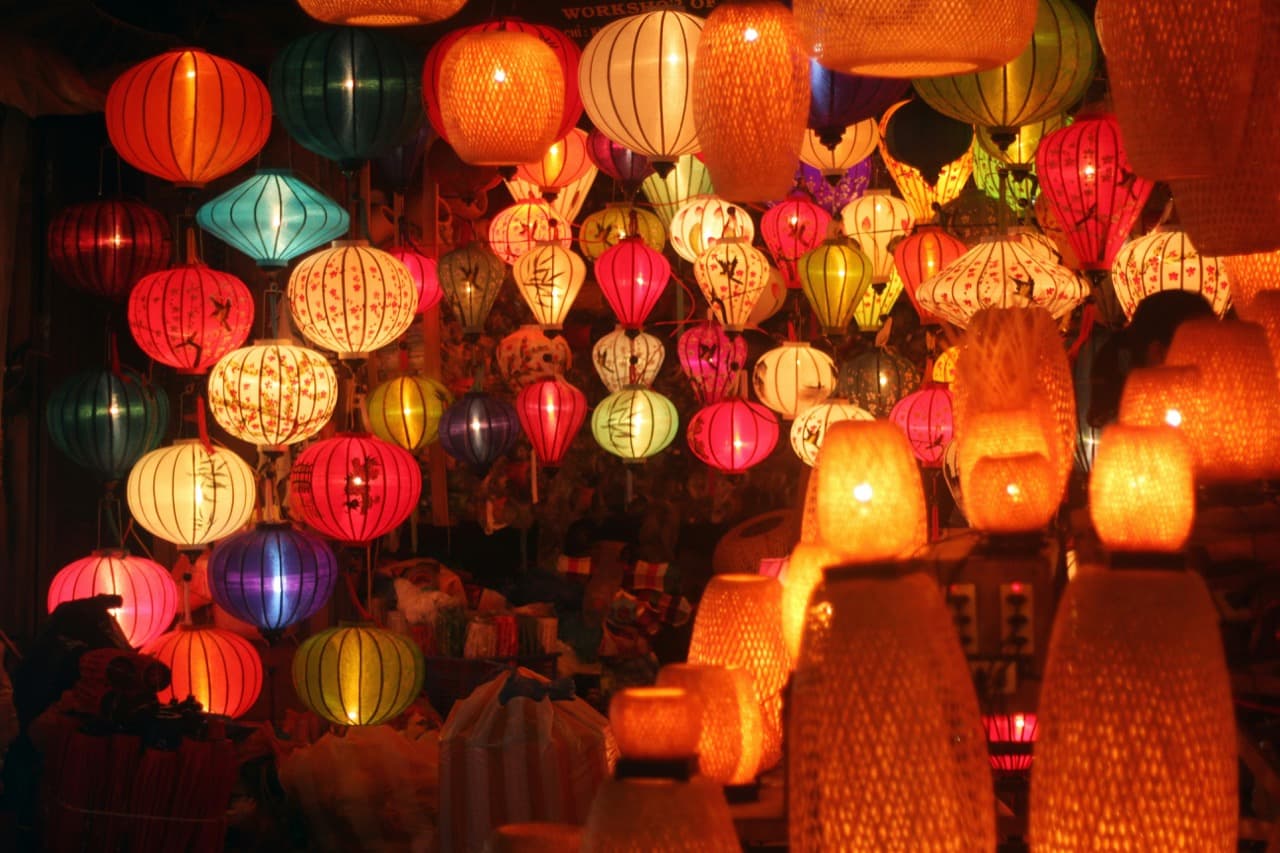
Lantern colours in Hoi An carry meanings locals know by heart and tourists usually miss. Red — luck and protection from evil spirits. Yellow — wealth and prosperity. Pink and orange — joy and fertility. White, in tradition, means mourning and remembrance, so you will hardly see a white lantern in town; they hang only on Buddhist memorial days.
The shape reads too. The most common in Hoi An are silk round globes (Chinese tradition), stretched cylinders (Vietnamese), the lotus (Buddhist symbol of enlightenment), the carp (endurance and luck in study) and the star (a children's shape, for the Mid-Autumn Festival).
The candle in a floating lantern, in the traditional reading, is a wish or a memory. Tourists tend to think "make a wish," and locals do not mind. But semantically, for Vietnamese it is closer to "sending a departed relative word that all is well with us." The parallel with Tet and ancestor worship is direct: the lantern festival is a light, monthly version of the big Tet rite.
Elders in Hoi An say the festival was far quieter in their childhood (the 1960s–70s). Electricity came late, and there was nothing to "switch off" on the eve of the 14th — it rarely worked anyway. Lanterns then were homemade, not shop-bought, hung for family occasions. The mass programme with organised concerts is a 1998 construction, and locals take it in stride: tourists love it, the town profits, and the culture lives outside a museum.
Fast Track — no queue at the border
5–10 minutes instead of an hour in the immigration queue
from$11per passenger
How to get to the festival
Hoi An is a small town with no airport. The nearest is Da Nang, 30 km away. From Da Nang you can reach the Old Town four ways.
Taxi or Grab. The most convenient option. The ride takes 40–50 minutes normally, 60–80 on festival night because of the jam at Cửa Đại bridge. Prices:
- Mai Linh or Vinasun taxi: 400,000–500,000 VND (~$16–20).
- Grab: 350,000–450,000 VND (~$14–18).
- Grab back after 22:00: 1.5–2× the price (from 600,000 VND), few cars around.
Shuttle. Sinh Tourist, Hoi An Express and Barbara's Kiwi Connection run tourist coaches both ways. It is 120,000–150,000 VND one way, 60–80 minutes. They run in the daytime, and the last coach from Hoi An to Da Nang leaves in the early evening — too early for the festival. Use it inbound only; take a taxi back.
Motorbike. Rental in Da Nang is 150,000 VND/day plus 60,000 VND fuel for the 60 km round trip. The ride is 50–60 minutes along the coast (My Khe → Cua Dai → Hoi An) with great views. Downside: parking a bike near the centre on festival night is hard, and riding back to Da Nang at night on a narrow highway with lorries is not for everyone.
Bicycle. Rental 20,000–40,000 VND/day. No good for Da Nang, but ideal if you are staying in Hoi An and want to reach the centre from An Bang beach (4 km, 20 minutes).
From Nha Trang a train runs to Da Nang on the North–South line, but it is more than 500 km by rail. Flying is faster: Cam Ranh → Da Nang on Vietjet, Vietnam Airlines or Bamboo Airways, about an hour in the air, fares vary by date. From Ho Chi Minh City and Hanoi it is also a flight, about an hour and a half.
Parking in Hoi An on festival night is paid and limited. Cars and bikes go on Hùng Vương, Phan Chu Trinh and Trần Hưng Đạo — the edge of the pedestrian zone. It is 20,000 VND for a bike, 50,000 VND for a car. Lots fill by 17:30, and by 16:30 on the big dates.
The Old Town needs an entry ticket: 120,000 VND (~$4.80, price as of June 2026), covering five sites of your choice (clan halls, craft workshops, museums). On festival night the control is tighter, with checkpoints at the Japanese Bridge, An Hoi Bridge and the market side. Without a ticket you are let only onto the far edges.
Where to stay on festival night

Where you stay matters more on festival night than on ordinary Hoi An days. The key question: how fast can you walk to the riverfront after 22:00, when a taxi is no longer catchable.
| Location | Good for | Downsides |
|---|---|---|
| Old Town | 2-minute walk to the riverfront | noisy, pricey, few rooms |
| Cẩm Nam (across the river) | balcony view of the lantern show | 15-minute walk to the centre |
| An Bang Beach | calm, beach in the morning | 4 km, needs a bike or taxi |
| Nam Hoi An / Vinpearl | resort, pools | 17 km, leave at 16:00, back past midnight |
Old Town boutiques are the most convenient if the budget allows. Anantara Hoi An sits on the edge of the Old Town, about a 15-minute walk from An Hoi Bridge; La Siesta Hoi An Resort is outside the centre, with a shuttle into town. On normal days $80–150/night; on festival night rates rise 30–50%, and on the big dates (2 March, 24 September) 50–80%.
Cẩm Nam is an islet across the river opposite the Old Town. It is cheaper ($40–80/night), and some hotels have balconies looking straight onto the lantern show. Downside: getting back across An Hoi Bridge through the crowd in the evening, and a 15-minute walk to the cafés and market in the morning.
An Bang Beach is Hoi An's beach suburb, 4 km north. Good if you are pairing the festival with beach time. Prices are moderate ($60–120/night), with plenty of guesthouses and small resorts. The centre is an easy bike ride (20 minutes) or a short taxi (5 minutes, 60,000 VND).
Nam Hoi An (Vinpearl Resort Golf, Wyndham Royal Beachfront) means the "big" resorts 17 km from the Old Town. They suit family trips where the festival is one item on a long list. But on festival night you have to leave at 16:00 and return past midnight. If you have 2–3 days and the festival is the point, stay closer.
If you are after not a hotel but a place to eat, shop or find things to do beyond the festival, read the Hoi An attractions guide, the beaches of An Bang and Cua Dai and the day tours from Hoi An.
The key 2026 dates in detail
2 March 2026 — Nguyen Tieu

Nguyen Tieu (Tết Nguyên Tiêu) is the first full moon of the first lunar month; in 2026 it falls on 3 March, and Hoi An's main festival night is the eve, Monday 2 March. After Tet on 17 February this is the first truly mass holiday, and Hoi An opens up fully for it.
The programme officially spreads over three days: 2, 3 and 4 March (the 14th, 15th and 16th lunar days). 2 March is the main night. At 18:00 a large ceremony runs at Quan Cong Temple with Buddhist monks, a city delegation and the Chinese clan-hall choirs. At 19:00 the An Hoi Bridge stage opens a two-hour show: songs in Vietnamese, Chinese, Japanese and Korean (Hoi An was historically a multinational port). At 20:00 comes a lantern parade with participants in traditional dress.
The crowd that night runs to tens of thousands. That is peak load for the town. Some come on a day trip from Da Nang, some book a Hoi An hotel for the night, some for 2–3 nights to catch 3–4 March too. The atmosphere really is strong: on Nguyen Tieu the town runs to the rhythm of another century.
Hotel rates rise 50–80% over normal that night. Book 4–6 months out. The Old Town ticket (120,000 VND) is checked strictly; on 2 March there is no entry without one.
24 September 2026 — the Mid-Autumn Festival

Tet Trung Thu (Tết Trung Thu), the Mid-Autumn Festival, is technically marked on the full moon of the 15th lunar day (25 September 2026). But in Hoi An the main night is the eve, 24 September, because the lantern festival coincides with the Mid-Autumn run-up.
The Mid-Autumn Festival is a family holiday built around children. Across Vietnam that night kids come out with star-shaped lanterns (the star is its symbol), carp, fish and unicorn shapes. Families eat mooncakes (bánh trung thu) filled with mung bean, lotus and salted duck-egg yolk. Lion dances play on the stages.
In Hoi An on 24 September all of this layers onto the usual lantern festival: lanterns, floating candles, the power cut. You get a "festival within a festival." The crowd is smaller than on 2 March (around 20,000–30,000), but the mood is familial, child-centred, with a different sound to it — and mooncakes sold from stalls at 30,000–50,000 VND each.
30 April 2026 — a double holiday
30 April 2026 is a Thursday, and that day the 14th lunar day of the third month lands on national Reunification Day (30 April 1975). 1 May is International Workers' Day. Only two days are official holidays, but with the weekend that makes four days off in a row, 30 April to 3 May.
On these dates Hoi An takes the maximum flow of domestic tourism: Vietnamese come from the south, the north and the central highlands. Hotel rates rise 10–40% over normal, and HCMC–Da Nang and Hanoi–Da Nang flights can cost double.
The programme that night is not far off the usual festival, but denser: more floating lanterns, longer concerts, a thicker crowd. If you are going, book 3–4 months out.
Festival planning checklist
Before the trip it helps to keep a short plan in mind. Here it is, by timeline.
3–4 months out
- Going for 2 March, 24 September or 30 April? Book the hotel now.
- For ordinary festival dates — 2–3 months out.
2–3 weeks out
- Book a flight from Cam Ranh, Ho Chi Minh City or Hanoi to Da Nang.
- Want a balcony table at Mango Mango or Faifo Coffee? Message them on Facebook two weeks ahead.
A week out
- Reserve a lantern workshop (the day before, or the morning of).
- Check the forecast; if it is rain, the boats may not run.
On the day
- Arrive in Hoi An before 16:00, check in, have lunch.
- Draw cash in small notes at an ATM on Le Loi.
- Buy the Old Town entry ticket (120,000 VND).
- Be at the Japanese Bridge or An Hoi Bridge by 17:30.
What to bring
- A light layer (it turns cool by the river after 21:00).
- A power bank (shooting in the dark drains the battery fast).
- Comfortable shoes (the cobbled streets are tiring).
- A small backpack, not a big one (a big one is awkward in the crowd).
- Cash in 10,000, 20,000 and 50,000 VND notes.
FAQ — common questions about the festival
The headline night is Monday 2 March 2026. This is Nguyen Tieu, the eve of the first full moon after Tet, and the programme officially spreads over 2–4 March. The second big night is Thursday 24 September 2026, the eve of the Mid-Autumn Festival. In total there are 13 festival evenings in 2026.
- The Old Town entry ticket120,000 VNDbare minimum
- One floating lantern5,000–20,000 VND
- About150,000 VND~$6per person
- A river boatadds 170,000 VNDfor up to 3 people
- A lantern workshop adds150,000–300,000 VND
A full, busy evening comes to 500,000–800,000 VND per person (~$20–32)
Yes — on festival night the control is strict. The ticket is 120,000 VND (~$4.80, price as of June 2026), covering five sites of your choice (clan halls, museums, craft workshops). Buy it at the gates by An Hoi Bridge, the Japanese Bridge or the market side.
Street lighting and neon signs in the Old Town go dark at 18:00 and come back around 22:00. Silk lanterns over the streets are lit at 18:30. The prettiest window for photos is the end of blue hour, around 18:30, before the sky turns black.
Buy a lantern from the older women on the Bạch Đằng riverfront (5,000–20,000 VND). Take a sampan boat (170,000 VND for 1–3 people). Mid-river the boatwoman hands you a lit candle in a paper float. Lower it onto the water by hand, don't toss it from a height, and never from a bridge.
- Official rates for 1–3 people170,000 VND
- For 4–5 people220,000 VND
- For20–30 minutes
- A decorated motorboat200,000–250,000 VND
Prices are posted on boards at the jetty. On the big dates (2 March, 24 September) the queue can run up to an hour
Yes, especially 24 September (the Mid-Autumn Festival). It is a family holiday built around kids: star- and fish-shaped lanterns, a lion dance, mooncakes. The downside is the crowds and noise; toddlers under 3 tire quickly. A carrier beats a stroller — the cobbled streets are no place for wheels.
Boats do not go out in heavy rain, and the first gust snuffs the floating candles. Silk lanterns over the streets stay lit (they are shielded by awnings), and concerts move into Quan Cong Temple and the clan halls. In the wet season (October–December) the boat programme really can be cancelled. Bring a poncho (sold on every corner for 10,000 VND), rubber shoes and a plan B — a balcony dinner.
Get into the Old Town by 17:30 and grab a spot at An Hoi Bridge or the Japanese Bridge. 18:30–19:30 is peak density; after 21:00 it thins out and you can stroll Tran Phu and Nguyen Thai Hoc in peace. On the big dates the crush holds until 22:00, and the only escape is a balcony café table for the evening.
Yes, with caveats. Shuttles from Da Nang run only in the daytime and one way; the return is by taxi or Grab, and a Grab after 22:00 climbs to 600,000–700,000 VND for lack of cars. The alternative is a day tour with transfer (from ~$40 a head via GetYourGuide) where the return coach waits until 23:00.
Nguyen Tieu is the first full moon of the first lunar month (2–3 March 2026), a Buddhist-flavoured night focused on prayer and ancestors. Tet Trung Thu, the Mid-Autumn Festival, is the full moon of the eighth lunar month (24–25 September 2026), an autumn family holiday centred on children and the harvest. Both fall within the Hoi An lantern-festival schedule, but Nguyen Tieu is grander and more solemn; Mid-Autumn is warmer and more familial.
Top three: An Hoi Bridge (lanterns mirrored in the water, 19:00–20:00), the Japanese Covered Bridge (its silhouette against the lanterns, 18:30–19:00), and the Mango Mango balcony across the river from the Japanese Bridge (a view down over the crowd; book a table). Camera settings: ISO 800–1600, f/2.8–f/4, 1/30–1/60. With a tripod, a 2–5 second long exposure for lantern trails.
Of course. The Old Town is lovely on ordinary evenings too: the lanterns over the streets glow every night from 18:30 to 22:00 (with the power on). Just without the crowds, the concerts or the blackout. Even off a festival date you still get the main thing: lanterns, the bridge, the river. The full town guide is in the Hoi An article.
- Guide
Hoi An 2026: UNESCO Old Town, Tailoring & Beaches
Hoi An guide: the lantern-lit Old Town, custom tailoring, beaches, food, day trips and where to stay in Vietnam's prettiest heritage town.Hoi An 2026: UNESCO Old Town, Tailoring & Beaches - Guide
Cham Islands from Hoi An: Snorkelling & Day Trips 2026
A day trip to the Cham Islands (Cu Lao Cham) from Hoi An: snorkelling and diving, the beaches, tour prices, the season and practical tips.Cham Islands from Hoi An: Snorkelling & Day Trips 2026 - Guide
My Son Sanctuary 2026: Cham Ruins Near Hoi An
My Son guide: the UNESCO Champa temple ruins near Hoi An — history, what to see, how to visit from Hoi An or Da Nang, tickets and tips.My Son Sanctuary 2026: Cham Ruins Near Hoi An

