Con Dao beaches in 2026: Bãi Đầm Trầu and the quiet bays
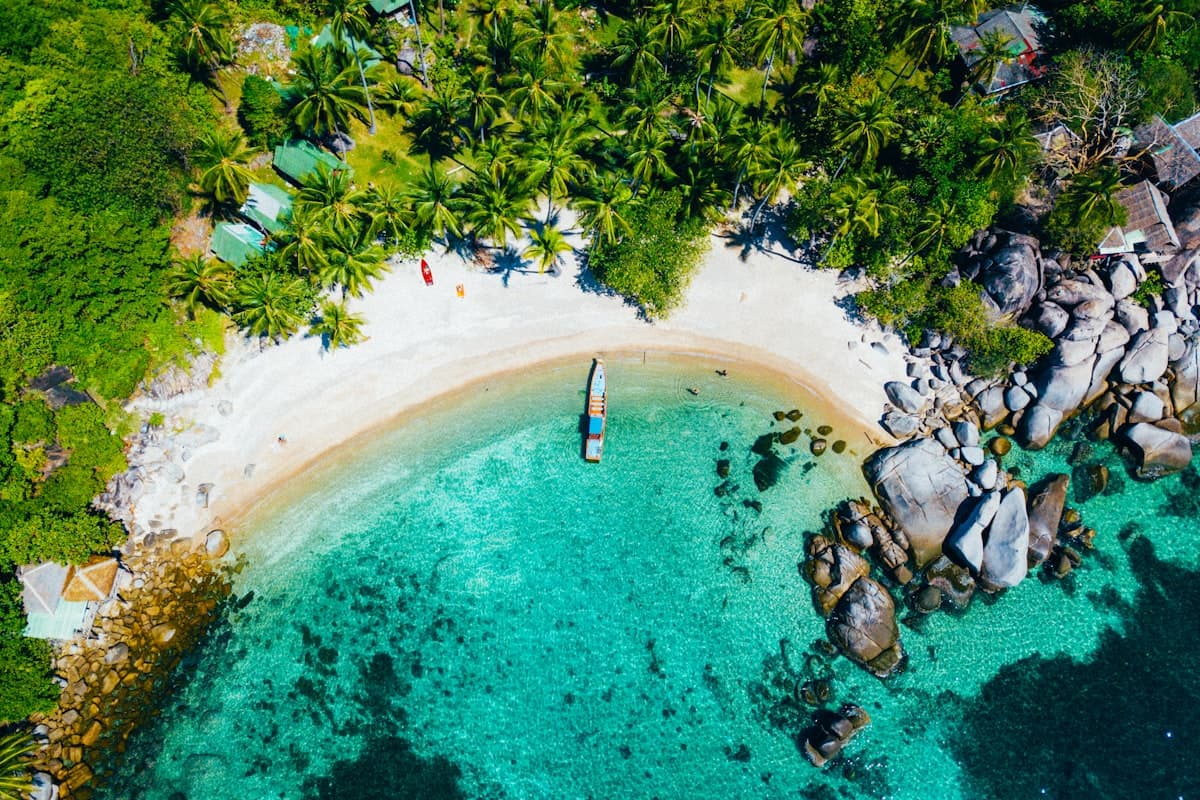
At Bai Dam Trau an aircraft comes in to land directly over your head: the runway of Co Ong airport stops a few hundred metres short of the water, and no other beach in Vietnam does this. Along the same coast sit nine more bays with no rental loungers, no coconut sellers and nobody offering you a massage. Here is all ten of them — where to swim with kids, where to snorkel, where to time the tide for sunset, and where not to go into the water alone.
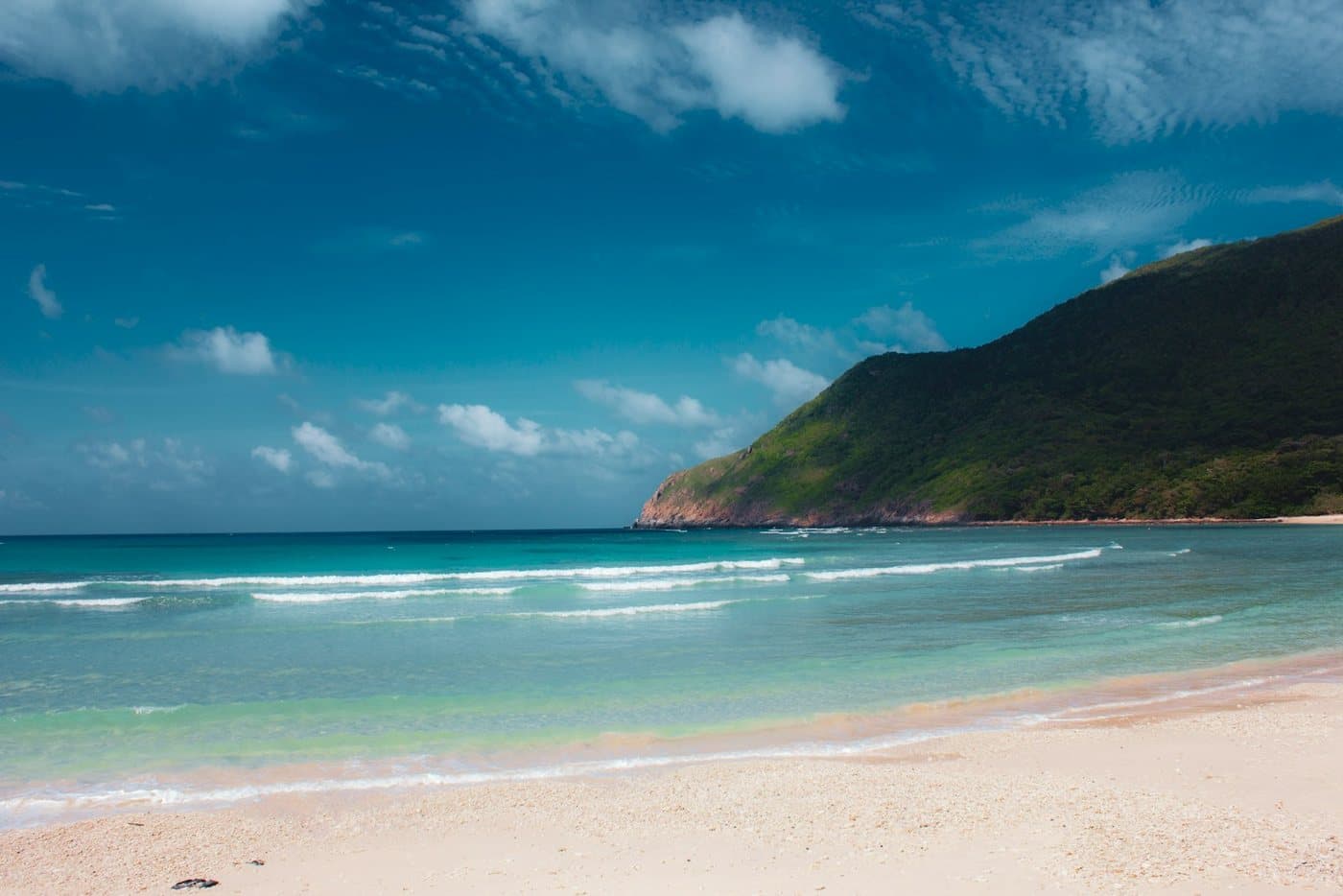
Everything else about the island — the prison museum, hotels, food, how flights and ferries actually work — sits in our Con Dao guide. This piece is only about the coast.
Con Dao beaches on the map: sand, snorkelling, distance
- Dam Trau Beach (Bãi Đầm Trầu): The island's headline beach — Planes on final approach, reef 700 m offshore
- An Hai Beach (Bãi An Hải): Town beach — Five minutes on foot from Con Son market
- Lo Voi Beach (Bãi Lò Vôi): Shallow water, casuarina shade — The best beach here for toddlers
- Dat Doc Beach (Bãi Đất Dốc): Private beach of Six Senses — Reddish sand, Elephant Mountain backdrop
- Bai Nhat (Bãi Nhát): Only exists at low tide — Best sunset on the island, not for swimming
- Ong Dung Beach (Bãi Ông Đụng): 25-40 min jungle trail — Snorkeling, strong current by the rocks
- Dam Tre Lagoon (Đầm Tre): Mangrove lagoon, 2 h hike — Park guide compulsory, never any swell
- Bay Canh Island (Hòn Bảy Cạnh): Main turtle rookery in Vietnam — 19th-century lighthouse, 10-15 min by speedboat
- Tai Island (Hòn Tài): Snorkel and dive site, tours only — Plenty of fish, modest visibility
- Cau Island (Hòn Cau): Best visibility in the archipelago, over 20 m — Co Van temple, coral gardens, diving
Every beach on Con Son island fits inside a 15 km radius. The furthest one, Bai Dam Trau, is 20-25 minutes away by scooter along the coast road. The outer-island beaches — Hòn Bảy Cạnh, Hòn Tài, Hòn Cau — are boat-only, and only on an organised tour: nobody here rents you a boat privately.
| Beach | From town | Sand | Snorkeling | Facilities | Best for |
|---|---|---|---|---|---|
| Đầm Trầu | 14 km / 20 min | Fine white | Yes | Basic | Everyone, photos, snorkeling |
| An Hải | 5 min walk | Golden | No | Good | Budget stays, morning runs |
| Lò Vôi | In town | Fine pale | Weak | Basic | Families with toddlers |
| Đất Dốc | 6 km | Reddish | No | Six Senses | Hotel guests |
| Nhát | 15 min by scooter | Pale, at low tide | No | None | Sunset, photography |
| Ông Đụng | 6 km + hike | Fine, rocky entry | Yes | None | Hikers, snorkellers |
| Đầm Tre | 10 km + 2 h | Lagoon | Excellent | None | Adventurous walkers |
| Hòn Bảy Cạnh | 10-15 min by speedboat | White | Excellent | Ranger post | Diving, turtles |
| Hòn Tài | 5-10 min by speedboat | White | Excellent | None | Snorkeling tours |
| Hòn Cau | 20-30 min by speedboat | Pale | Excellent | Temple | Diving, history |
Two things to sort out before any of this. First, cash. Con Son has ATMs and the bigger hotels take cards, but beach parking, loungers, park tickets and the seafood shacks are cash-only, and there is no ATM anywhere outside town. Draw a day's worth in the morning, and expect international roaming to be close to useless out on the coast — a local eSIM is the difference between having a map and not.
Second, the address on your booking is probably wrong. Since 1 July 2025 Con Dao has not been a district of Ba Ria-Vung Tau province; the province was absorbed into Ho Chi Minh City and the island became a special zone (đặc khu) of the city. Hotel listings, review sites and most guidebooks still say "Ba Ria - Vung Tau Province". It is not a booking error, just a stale line — and the same reshuffle moved the Tran De ferry port from Soc Trang into Can Tho.
Rates used here, late August 2026: $1 ≈ 26,000 VND. Dollar figures are rounded guidance, not a quote.
Bai Dam Trau — the headline beach
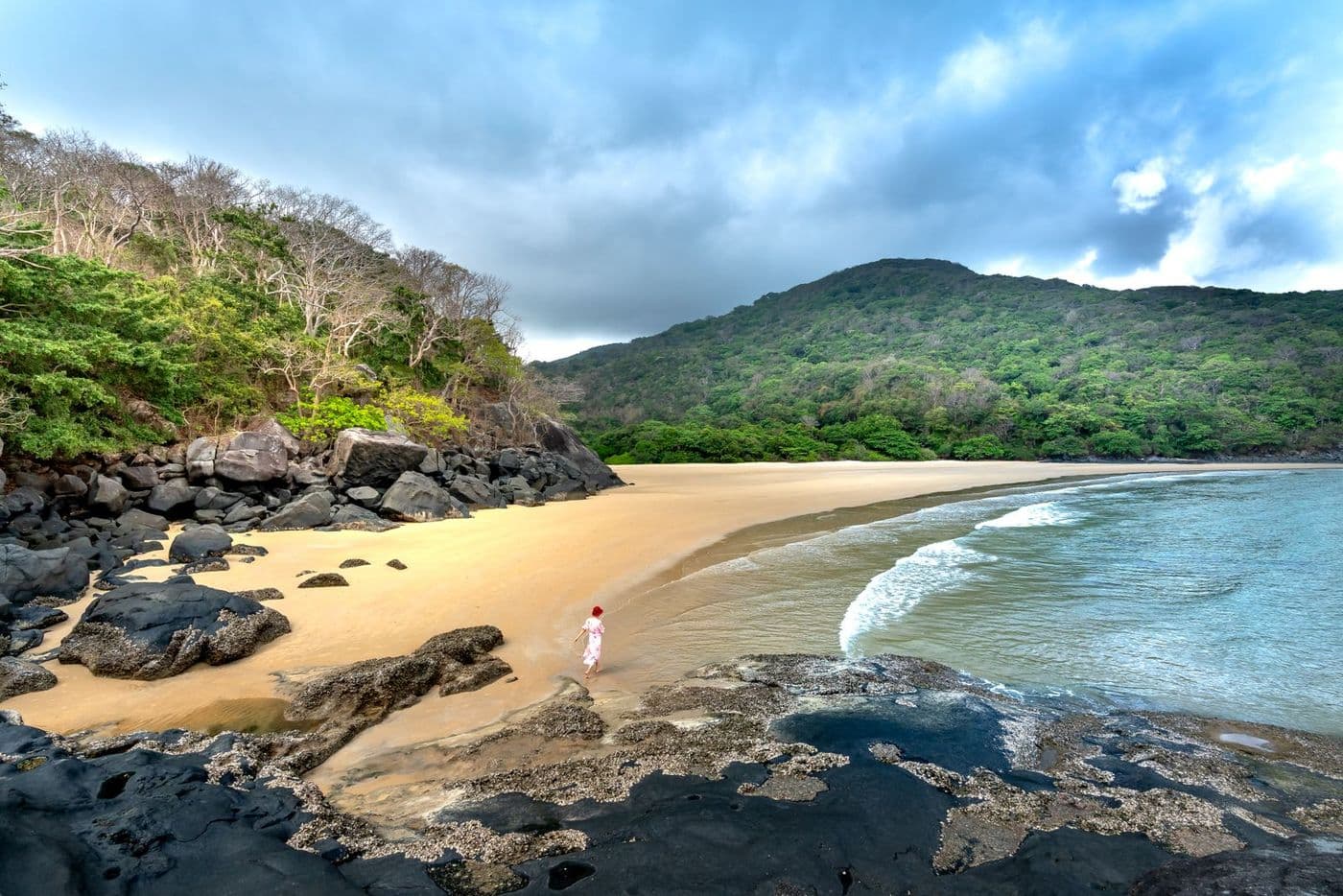
Dam Trau is the best beach in the archipelago and one of the best-known in Vietnam: Travel + Leisure put it on its 2021 list of the world's 25 most beautiful beaches. Fine white sand, clear water, green hills and casuarinas closing off both ends. And the beach sits on exactly the same line as the runway of Cỏ Ống airport (VCS), so several times a day an ATR-72 passes over the water at a few dozen metres.
It reads like a gimmick until you see it. You hear the approach before you see it: engine noise behind the hill, then a shadow crossing the sand, then the aircraft itself, and the entire beach lifts its phones in unison. A minute later it is quiet again. People who do not care about beaches come here for this.
One scheduling detail almost nobody publishes. Flights into Co Ong run in daylight, and by sunset the aircraft are usually done. Check the airlines for the schedule on your date. If you want the shot of a plane over the water, come in the morning or early afternoon; if you want the sunset, come in the evening and do not wait for a landing.
Getting there
| How | Time | Cost |
|---|---|---|
| Scooter from Con Son town | 20-25 min | ~30,000 VND (~$1) of fuel |
| Taxi from town | 20 min | 150,000-200,000 VND (~$6-8) |
| On foot from VCS airport | 15 min | Free |
| Scooter from the airport | 10 min | Pocket change |
Head north out of town on Co Ong Road. Before the terminal, turn left at the "Dam Trau Beach" sign. The last kilometre is a narrow dirt track between hills; in the rainy season it turns greasy, and on worn tyres that matters. If you have not sorted transport yet, our Con Dao transport guide covers flights, the ferry and scooter rental.
What is actually there, and what it costs
The beach itself lies outside the national park boundary, so there is no official entrance ticket and never has been. The services are a handful of private shacks: a toilet with a rinse shower, changing cabins, loungers and hammocks, a couple of seafood kitchens. Nothing has a posted price, which is exactly why you agree the number before you sit down — otherwise it surfaces at the end of the day, always in the vendor's favour.
Rough guidance from what visitors actually pay, not an official tariff:
- Lounger or hammock for the day — roughly 30,000-100,000 VND (~$1-4)
- Freshwater rinse, toilet, scooter parking — a few thousand dong each
- A seafood lunch — roughly 150,000-400,000 VND (~$6-15) per person
One fee that is easy to confuse with beach entry: the park runs walking route no. 10, Ma Thiên Lãnh — bãi Đầm Trầu — bãi Ông Cường, at 50,000 VND (~$2) per person. That buys you the trek across park land, not the walk from the car park to the water.
The menu is short: grilled fish, rice, spring rolls, coconuts. It is cooked twenty steps from the water with no restaurant pretensions attached, and it is still the most straightforward seafood on the island.
Snorkeling and swimming
The reef starts roughly 700 metres offshore. There is nothing to look at in the shallows, but if you can make the swim you get clownfish in anemones, sea stars and the occasional turtle. Bring your own mask: rental is not always available, and half the rental masks leak.
Swimming is safe. The bottom shelves gently and the water is close to flat from January through April. During the monsoon, July to October, there is swell, but the headlands shelter this bay longer than the open beaches.
When to come
Before 10am or after 3pm the beach is nearly empty. Between eleven and two the day tours arrive from Con Son, which by local standards means around thirty people in the whole bay. At sunset Vietnamese visitors turn up with cameras: Dam Trau faces west and the colour is worth the ride.
Although Dam Trau is often described as one of the more popular beaches, this is still Con Dao. Even here, you can often have large parts of the beach to yourself, especially on weekdays.Marnick Schoonderwoerd, Local Vietnam, 2025
- ✓ You came for the shot: aircraft over water, the crescent bay, sunset straight down the beach
- ✓ You snorkel, own a mask and can manage a 700-metre swim
- ✓ You want a toilet, a shower and lunch rather than a bare shoreline
- ✓ You have kids over about four: the entry is gentle and the bottom is clean
- ✗ You burn easily: the trees sit at the edges, and there is almost no midday shade
- ✗ You planned to read here in the evening — the setting sun goes straight into your eyes
- ✗ You came for silence: every couple of hours a turboprop passes low overhead
Bai An Hai — the town beach
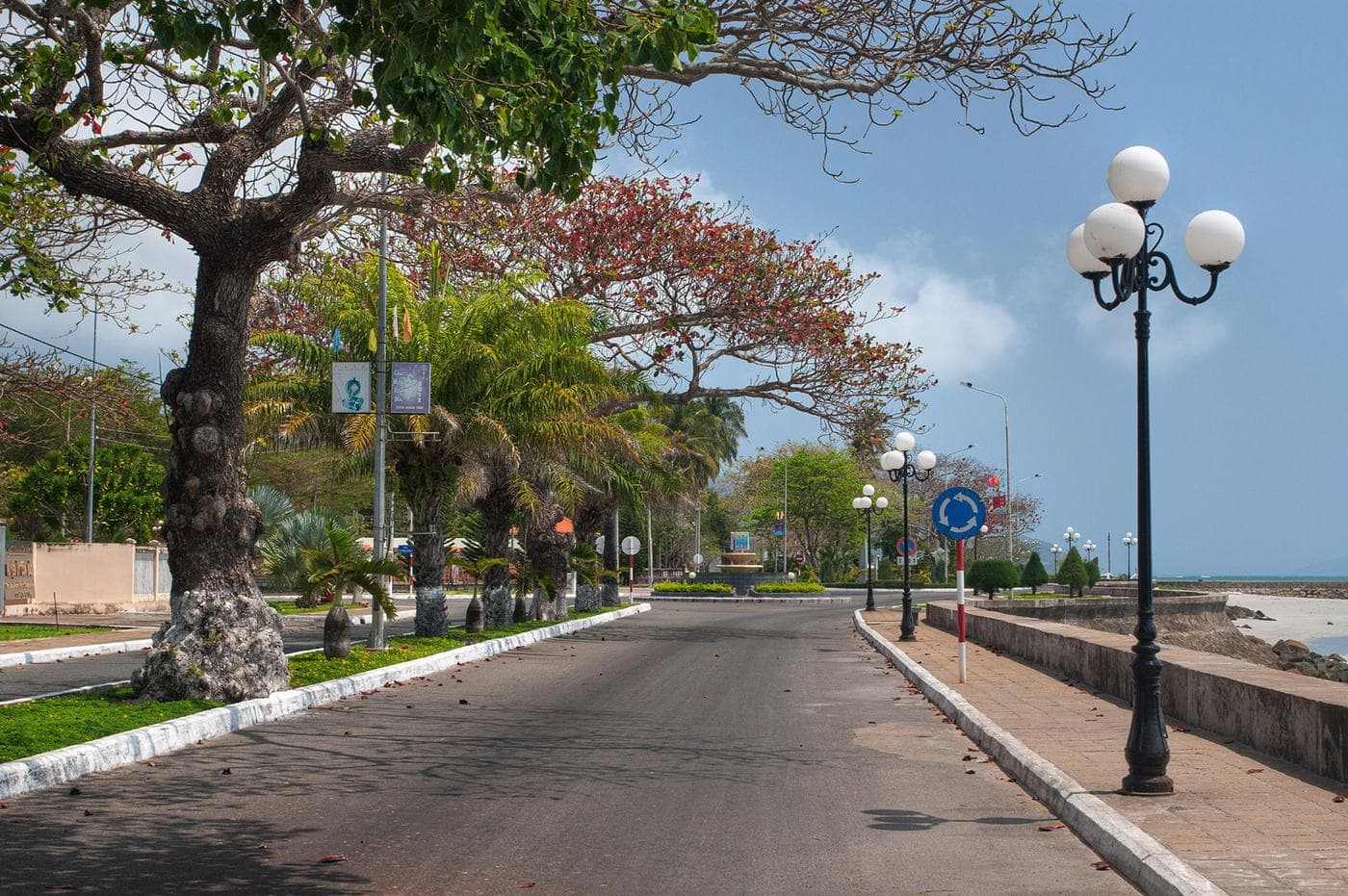
An Hai is five minutes on foot from Con Son market. Fine golden sand, calm water, a shallow entry. This is the default beach if you are staying in town and have no intention of renting a scooter every time you want a swim.
It is not a postcard. What it is: you walk out of your hotel in flip-flops, swim before breakfast and get back before the coffee goes cold.
What is nearby
- Con Son market — 10 minutes on foot
- Con Dao Museum — 5 minutes on foot
- Cafés and restaurants the whole length of the promenade
- Umbrella and lounger rental — 50,000-80,000 VND (~$2-3)
An Hai: the downsides
- Darker, coarser sand than Dam Trau or Dat Doc
- Town buildings in the background of every photo
- No snorkeling: the water near shore is cloudy
- Seaweed collects along the waterline in the rainy season
If you want a beach to swim at and forget, An Hai does the job. If you want a beach you will remember, that is Dam Trau, and it is worth the trip at least once.
There are also two resorts along An Hai Beach that are much more affordable than the high-end resorts on private beaches. Both have a slightly dated feel, with concrete buildings and rooms that haven't been renovated in years. That said, the location makes up for it.Marnick Schoonderwoerd, Local Vietnam, 2025
Bai Lo Voi — shallow water for families
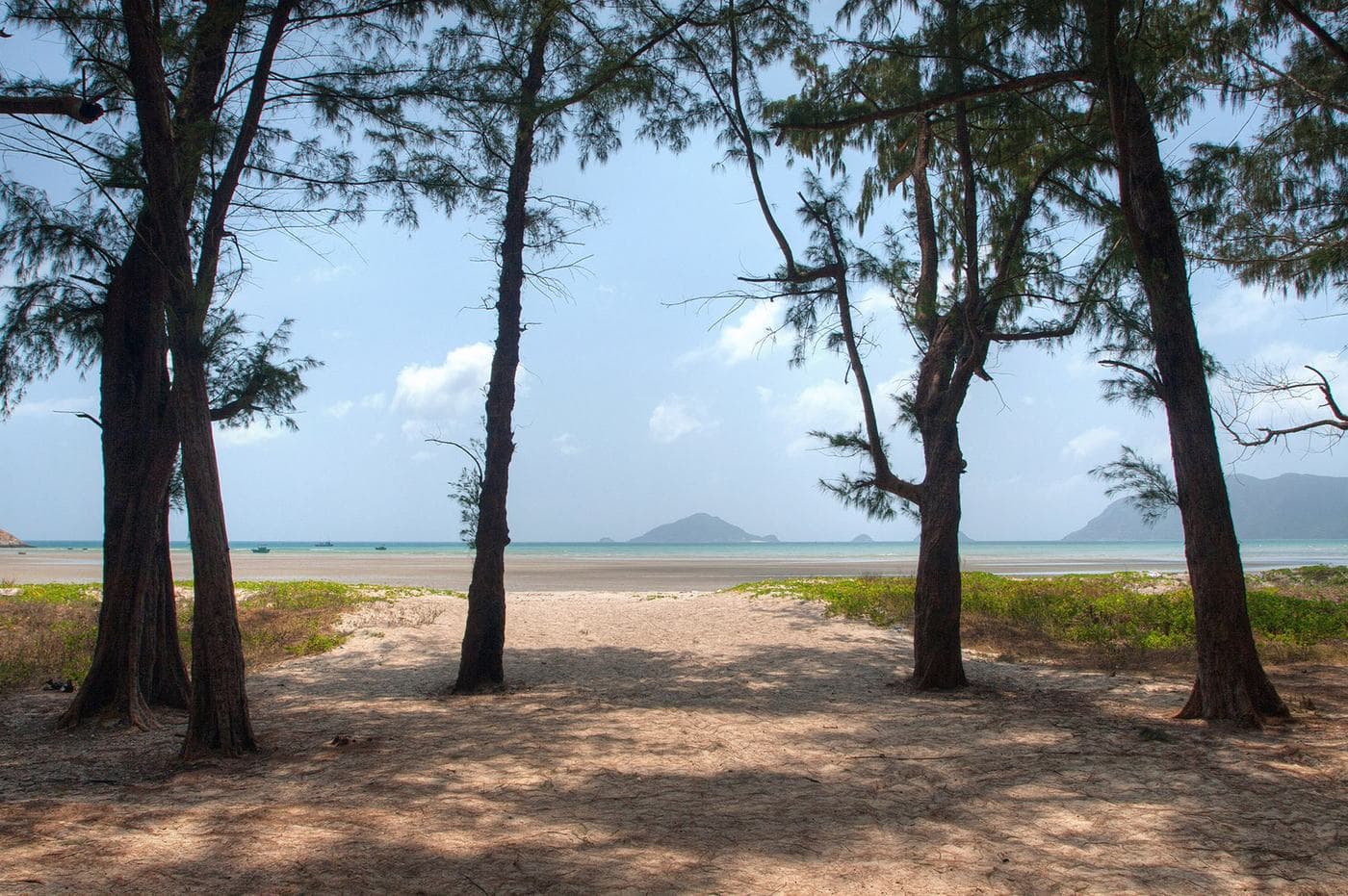
Lo Voi is the second town beach, on the eastern edge of Con Son town, near the Con Dao Museum. The point of it is the shallow water and the large casuarinas along the whole shoreline. For families with small children it is the best beach on the island by a wide margin.
What to know
- Ankle-deep at the waterline, knee-deep about ten metres out
- Pale, fine, clean sand
- Enough shade even at midday
- The promenade sells water, coconuts and ice cream
- Locals come here for morning exercise; foreign visitors are rare
Where to stay nearby
Saigon Con Dao Resort and Con Dao Resort sit closer to neighbouring An Hai; check ANA Mandara on the map when you book. If you want the "out of the room and into the water in thirty seconds" format, look at the hotels along the town seafront. Our separate Con Dao hotels review covers the rest of the island.
Lo Voi: the downsides
- No snorkeling at all: silty bottom, no coral
- At a strong low tide the shallows stretch out twenty metres and adults have nowhere to swim
- Storm debris collects along the shore; volunteers clear it, but not instantly
Bai Dat Doc — the private Six Senses beach
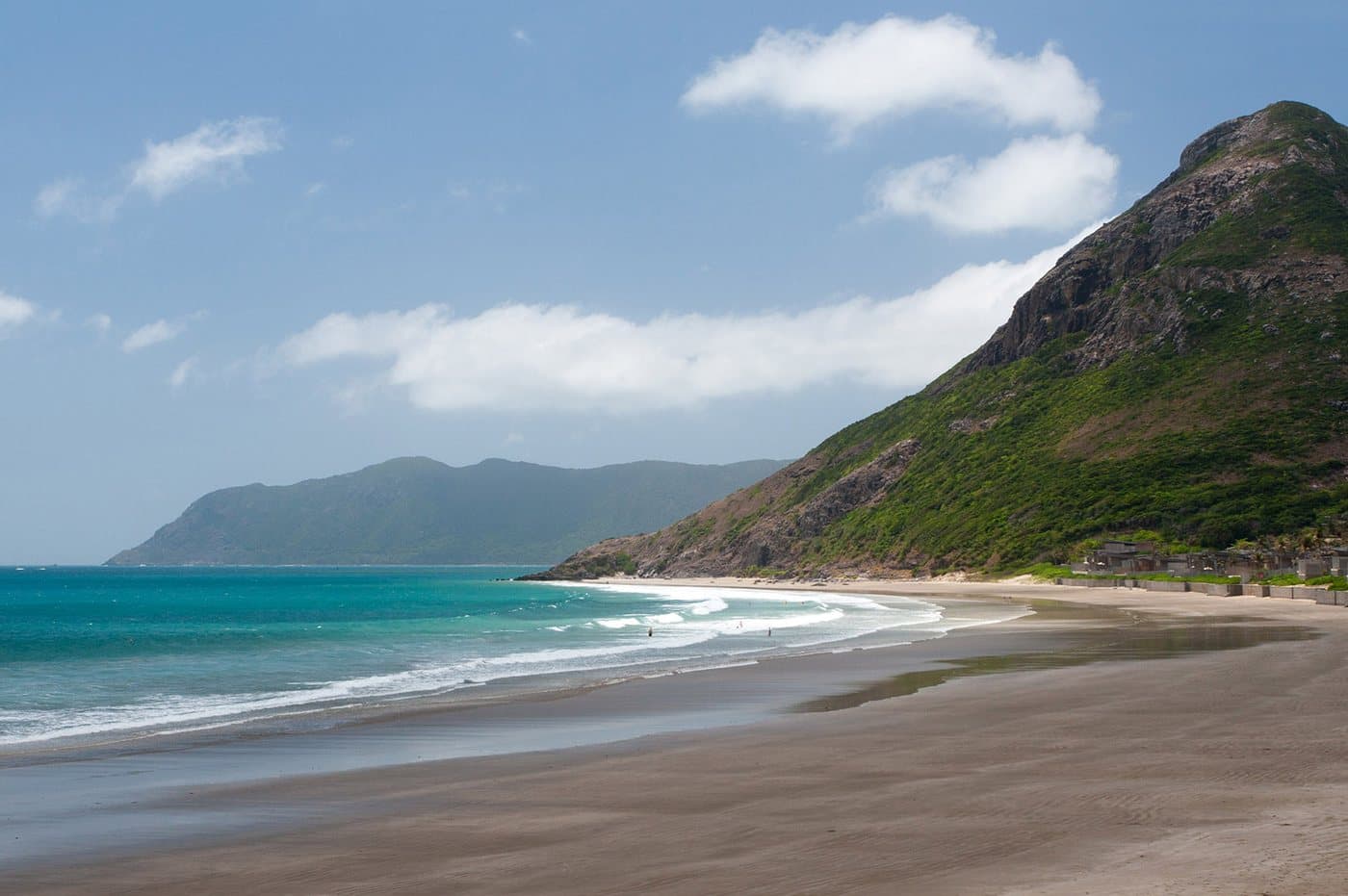
Dat Doc is the closed beach of Six Senses Con Dao, open to resort guests only. Reddish sand, a groomed shoreline, roughly two hundred metres of beach per guest. On the horizon sits the Núi Chúa ridge, which locals call Elephant Mountain.
Getting in without staying
There are three legitimate routes, all of them through the resort's till:
- Dinner at the Six Senses restaurant. Book through reception. Staff usually do not object to a walk along the beach afterwards, up to sunset.
- The spa. Treatments start around $80. A session buys you coffee and access to the lounge area by the water.
- Book the cheapest night you can find. Rates move a lot: four-night stays and 30-day advance bookings routinely knock 30-35% off.
- The Turtle Conservation Centre tour. Six Senses runs a turtle protection programme and sometimes admits visitors for a donation.
Simply walking in does not work: the property is staffed and the beach is watched.
What makes it different
- The softest sunset light on the island — the Núi Chúa ridge acts as an enormous diffuser
- Fine sand underfoot with no rocks at all
- Most of the archipelago is visible from shore: the specks out there are Hòn Bà, Hòn Tài and Hòn Bảy Cạnh
- No outsiders, by definition
Dat Doc: the downsides
- The price of admission is a villa from roughly $800 a night, and $1,100-1,200 for the beachfront categories
- Weak snorkeling from shore: sandy bottom, nothing for coral to grip
- Winter northeasterlies bring surf
What the resort is like inside and what a night costs: Con Dao hotels guide.
Fast Track — no queue at the border
5–10 minutes instead of an hour in the immigration queue
from$11per passenger
Bai Nhat — the beach that only exists at low tide
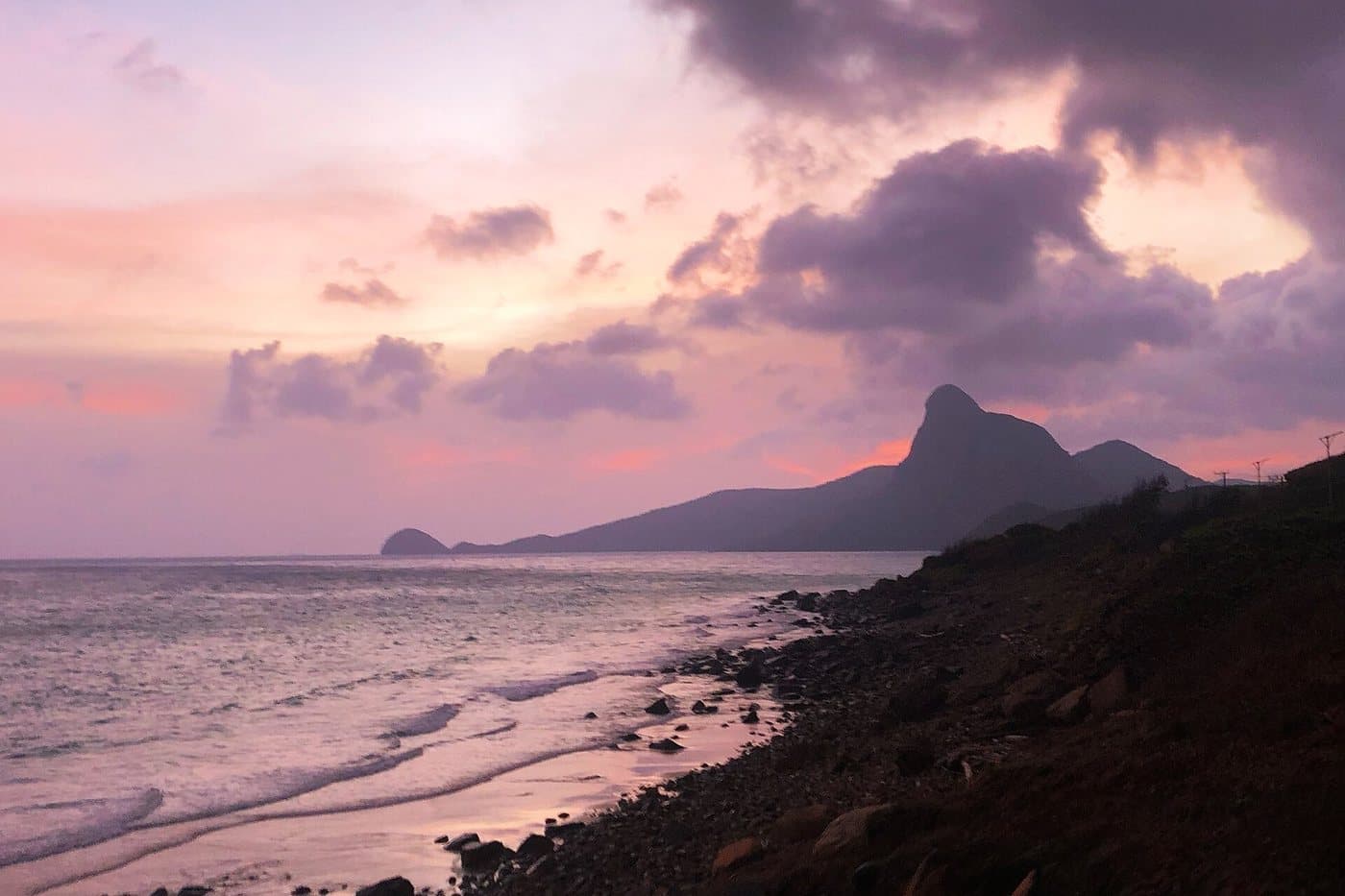
Nhat is the strangest beach on Con Dao. At high tide nothing is left but rock and water. At low tide a strip of pale sand emerges with stone formations scattered across it, and the bay turns into a film set. It sits at the southern tip of Con Son, on the road to the Núi Thánh Giá viewpoint. The island's best sunset is here.
Timing the tide
Look up the tide table for your date — search "Con Dao tide chart" or use any app such as Tide Times. The window you want is 90 minutes to two hours before low water and an hour after. Between April and August the sun sets around 18:15-18:40, and low tide often falls in the same window. That is the lunar cycle rather than luck, but it does feel like a gift.
What to do here
- Walk out over the exposed rock, in reef shoes
- Shoot long exposures of the stone islets and water texture
- Wait for sunset: the view points due west with nothing built on the horizon
- Look at the crabs and molluscs in the rock pools without touching them
Nhat: the downsides
- You cannot swim: at high tide there is no beach, at low tide it is shallow and rocky. Locals avoid bathing here because of the currents, which is a better signal than any sign
- Zero facilities — bring your own water and food
- The road here is a switchback with no lighting, so do not ride it after dark
Bai Ong Dung — the wild beach through the jungle
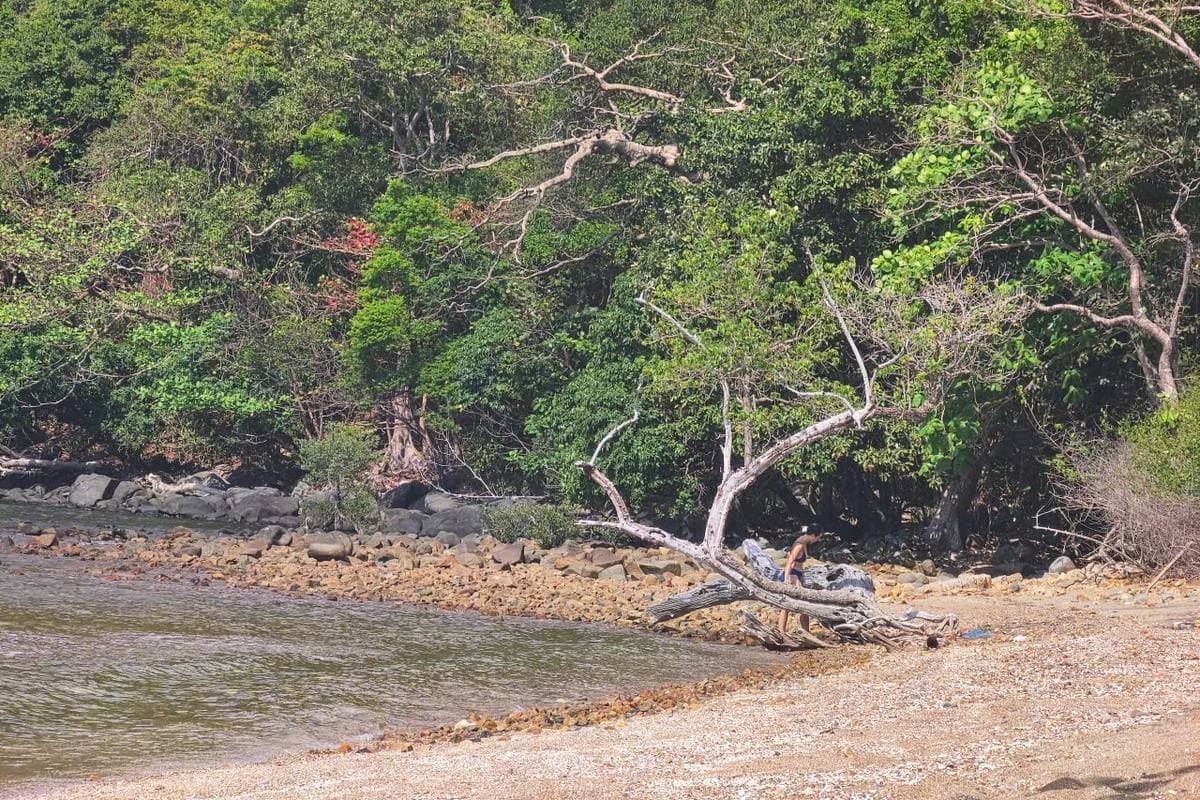
Ong Dung sits inside the national park and has no vehicle access. You leave the scooter at the ranger post and walk about a kilometre of trail through tropical forest — twenty-five minutes if you do not stop for every butterfly. At the far end: a rocky shoreline, almost nobody, and one of the best snorkeling spots on the main island.
The route to Ong Dung
| Stage | Time | What you get |
|---|---|---|
| Con Son town to the car park | 15 min by scooter | Paved road through the park |
| Registering with the ranger | 5 min | Route ticket 50,000 VND (~$2) |
| Trail to the beach | 25-40 min | Butterflies, geckos, monitor lizards |
| The beach itself | 2-3 hours | Snorkeling, silence |
| Walking back | 25-40 min | The climb is harder than the descent |
Clear up the ticket question before you go, because every English-language page gets it wrong. There is no single day pass. The tariff is set by provincial decree and charged per route: 50,000 VND (~$2) per person for a walking route, which covers Ong Dung, Sở Rẫy and Đầm Tre separately, and 60,000 VND (~$2.30) for a boat route to the outer islands. Students pay 20,000, schoolchildren 10,000, under-sixes go free. Services are not included: guide, boat and gear are all extra.
You buy it at the ranger post or at the national park office at 29 Võ Thị Sáu in Con Son town, where staff handle foreign visitors routinely. There is no English online booking, so plan on going in person the day before, or let a tour operator do it. One more practical note: the Sở Rẫy-Ong Dung link was closed for almost a year for cable works and only reopened on 15 November 2025. Routes here shut without warning — confirm your plan at the office the day before.
What to bring
- At least 1.5 litres of water per person
- Food — there is nothing at the beach
- Mask and snorkel
- Closed shoes: rocks, roots, slick after rain
- Insect repellent for the forest section
- A dry bag for your phone
- A hat
Snorkeling
The bottom is rocky and the reef begins 30-50 metres out. Visibility depends far more on the wind than on the calendar: on a still dry-season morning it can pass ten metres, and it drops to about five after lunch or in the monsoon. Expect clownfish in anemones, sea stars, occasionally small barracuda. Also sea urchins, which is why nobody walks in barefoot.
Ong Dung: the downsides
- Rocky entry — painful without reef shoes
- Almost no shade on the beach
- The trail turns into a slide in the rain
- No mobile signal, so download offline maps first
Dam Tre Lagoon — mangroves and the best snorkeling on the main island
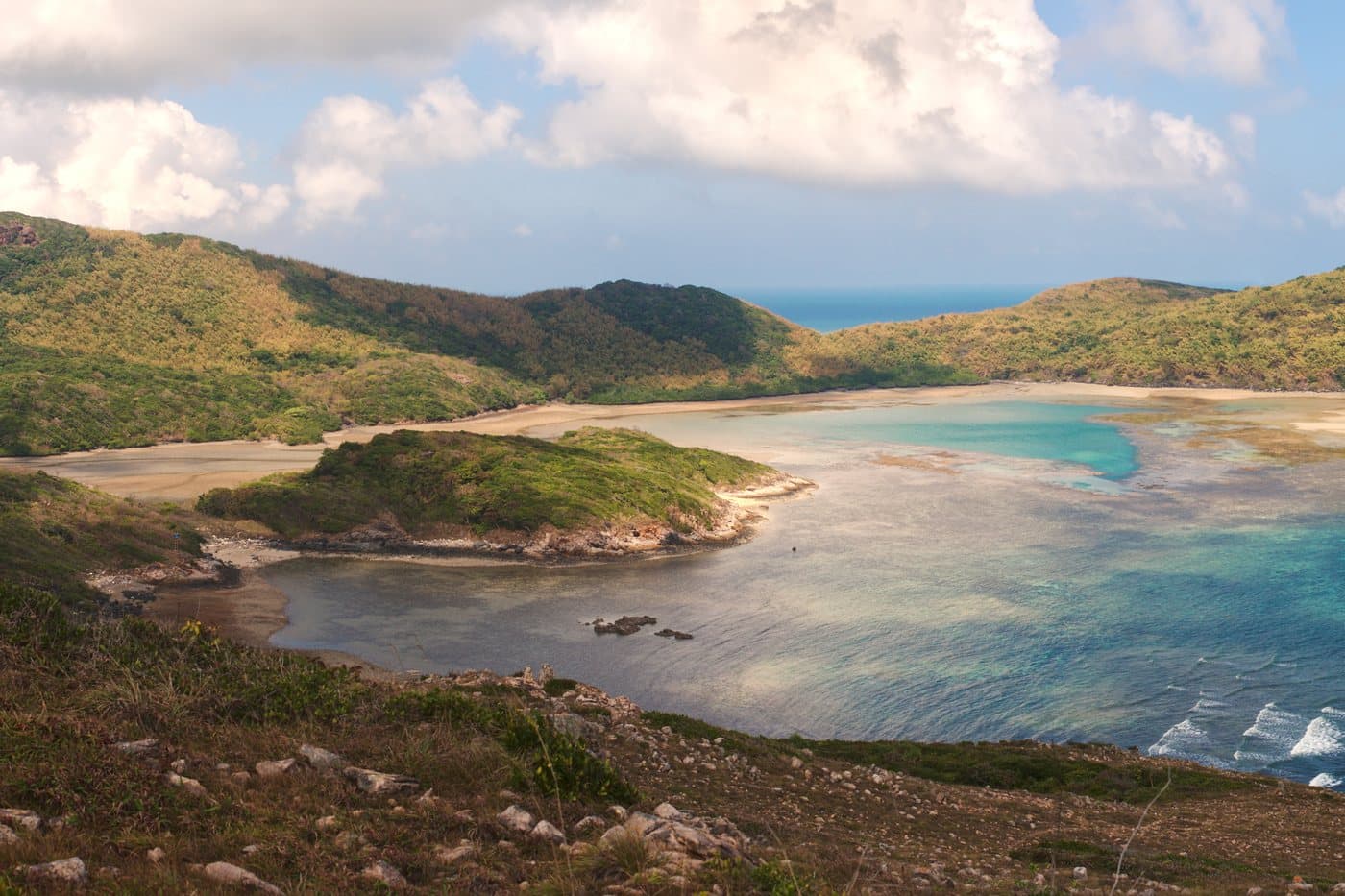
Đầm Tre is an enclosed mangrove lagoon on the northeast side of Con Son, reachable only on foot: two hours through the jungle. The payoff matches the effort — the best snorkeling on the main island, in a bay with no swell, coral at the waterline, molluscs on the bottom and, in season, juvenile turtles.
The route to Dam Tre
- The trail starts near the airport, behind Dam Trau beach
- Two hours each way, about 150 m of elevation gain
- Budget 5-6 hours round trip including swimming time
- Route ticket: 50,000 VND (~$2) per person
- A park guide is compulsory — you cannot walk this one on your own
- Carrying capacity is 45 visitors by day and 24 overnight
The guide requirement is a rule, not an upsell: the park will not let you into the lagoon unaccompanied, and in high season the slots go early. The park's packaged day programme runs 720,000-1,250,000 VND (~$28-48) per person and bundles the route fee with the guide.
What you see on the way
- Mangroves: roots, herons, fiddler crabs
- Tropical butterflies and geckos
- The endemic gecko Cyrtodactylus condorensis, found only on Con Dao
- Long-tailed macaques, sometimes
Snorkeling in the lagoon
The mouth is narrow and almost no sea gets in, so the water stays still and clear even when everything outside has gone murky. Coral starts right at the shoreline, rays sit on the sandy bottom, schools of small fish hang near the surface, and turtles come in during nesting season.
Hazards
- Overheating: the two-hour climb in the heat is the usual reason people turn back
- Junctions are poorly marked and it is easy to lose the trail
- Be heading back by 17:00 — the forest goes dark earlier than the coast
- No signal: download an offline map and tell someone where you went
Do not attempt this without basic fitness, and definitely not in flip-flops.
The outer islands — Bay Canh, Tai and Cau
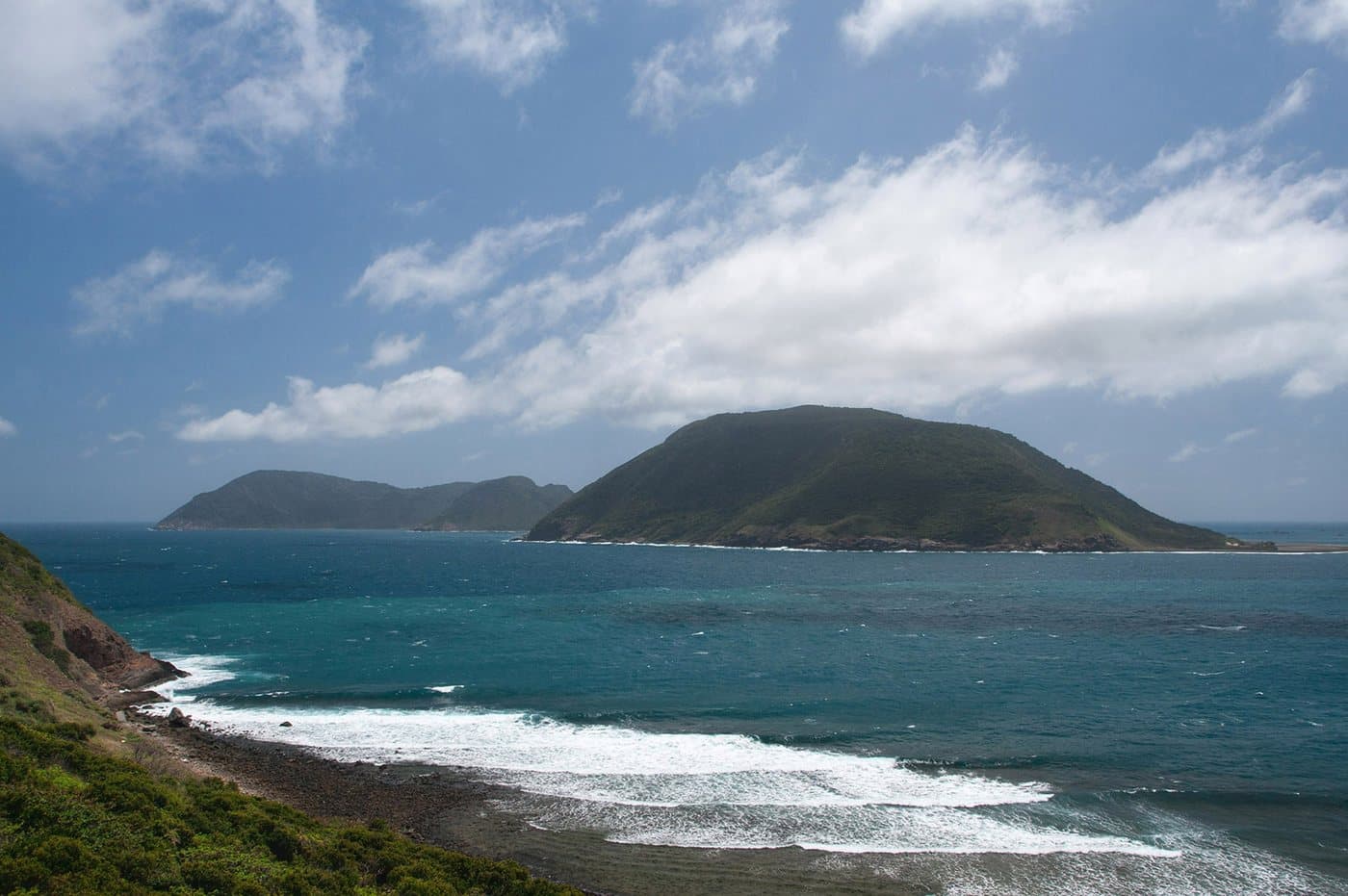
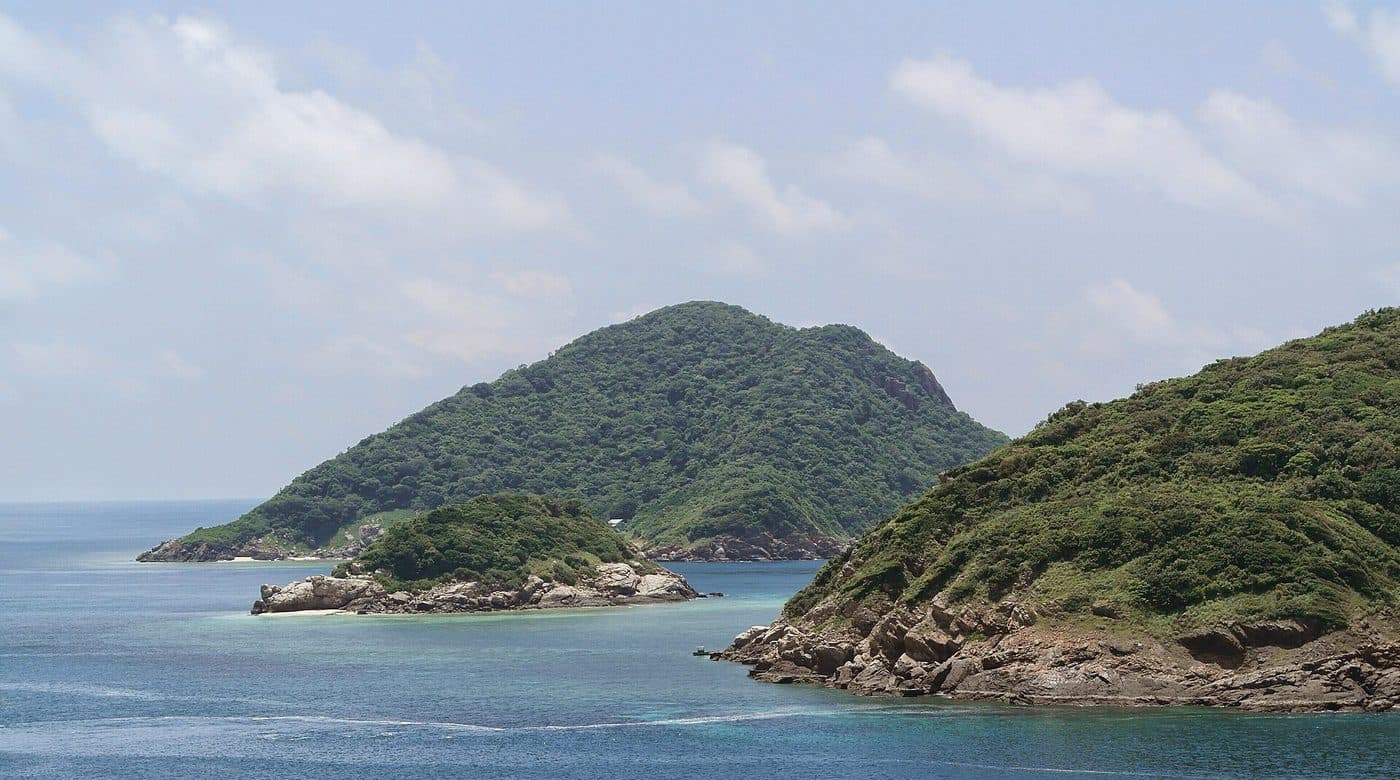
Of the sixteen islands in the archipelago only one is really inhabited. The rest are national park, reached only by tour boat. Three of them are beach destinations: Hòn Bảy Cạnh (turtles and the 19th-century lighthouse), Hòn Tài (reef and snorkeling) and Hòn Cau (best visibility, diving). All three are served by day boats out of Con Son harbour.
Hon Bay Canh
The main green turtle nesting site in Vietnam. Rangers patrol the beaches, nests are monitored overnight, and in season part of the clutches are relocated to a protected hatchery.
In a good year the park records 600-900 nesting females, around 2,000 clutches and roughly 150,000 hatchlings released.
| Detail | Information |
|---|---|
| From Con Son | 10-15 minutes by speedboat |
| Island size | About 6.8 km² |
| Main beach | Nesting beaches on the south are closed; diving is on the north side |
| Lighthouse | Bảy Cạnh, 19th century |
| Snorkeling | Excellent, visibility to 20 m |
| Overnight | Only with a park permit, camping with a guide |
The lighthouse climb takes 30-40 minutes up a steep track. From the top you see the whole archipelago at once, including islands you cannot pick out from Con Son.
Hon Tai
A small island with minimal tourist traffic. The draw is density of life: noticeably more fish than anywhere near Con Son, plus turtles, barracuda and small reef sharks (harmless, but startling the first time). Divers come for the underwater caves. Do not expect clarity, though — visibility at Tai usually sits around four or five metres. For glassy water you go to Hon Cau.
Hon Cau
The furthest of the three and usually the last stop on boat tours. The best water clarity in the archipelago, over 20 metres, with coral gardens to match. The island has the Cô Vân temple, a pilgrimage site, and a small beach.
How to get out there
Tours only. Nobody rents boats privately:
| Tour | Price | Included |
|---|---|---|
| Snorkeling, one island | 700,000-1,000,000 VND (~$27-38) | Boat, guide, mask, park fee |
| Two islands in a day | from 670,000 VND (~$26) per person | Park programme, price scales with group size |
| Whole-boat charter | 2,500,000-3,500,000 VND (~$96-135) | The boat for your group, route of your choice |
| Daytime hatchling release | 680,000-2,200,000 VND (~$26-85) | Half day, boat, ranger |
| Overnight with the turtles | 2,150,000-5,100,000 VND (~$83-196) | 24 hours with an overnight stay, ranger, meals |
| Dive trip, two fun dives | 3,600,000 VND (~$138) | Gear, guide, speedboat, tax and park fees |
What Con Dao usually sells is one- and two-island day trips, the park's own programmes, and whole-boat charter.
Book ahead. Two PADI dive centres work on Con Dao — Con Dao Dive Center and Amadive — plus a handful of tour operators; in the January-to-March high season the day-trip seats go three or four days out. For an overnight turtle stay, allow a month or more: the islands have tiny visitor quotas. Con Dao Dive Center works in English and German and answers on WhatsApp faster than by email; boats leave the Tourist Pier at 07:45 and are back by about 13:00.
What happened to the coral
The part the brochures leave out. In the summer of 2024 the archipelago went through a mass bleaching event: the sea held 32°C down to twenty metres. A joint survey by the national park and the Institute of Oceanography found that on the eastern side — Dam Tre, Hon Cau, Hon Tai — 80-100% of colonies had bleached and 15-20% had died outright. On the western side, off Ong Dung and Ong Cuong, 60-70% bleached.
The practical version: Con Dao still has the best coral in Vietnam, and it is also thinner than the photos from 2019 suggest. Touching the bottom was always a bad idea; now it is a worse one.
Which beach to pick
Ten beaches sounds generous until you have two or three days. A short lookup by purpose:
| If you want | Go to |
|---|---|
| Photos and a proper swim | Bãi Đầm Trầu |
| Aircraft overhead | Bãi Đầm Trầu |
| Dinner and then the sea | An Hải or Lò Vôi |
| Safety with a one to five year old | Lò Vôi |
| A ten-out-of-ten sunset | Bãi Nhát or Đầm Trầu |
| Snorkeling from shore | Đầm Trầu (700 m out) or Đầm Tre |
| Total solitude | Đầm Tre or Ông Đụng |
| Luxury and privacy | Đất Dốc, Six Senses guests only |
| Diving and coral | Hòn Cau, Hòn Tài |
| Turtles | Hòn Bảy Cạnh, on a tour |
| Hiking plus sea | Ông Đụng, Đầm Tre |
A five-day plan that works
- Day 1. Arrive, check in, Dam Trau for sunset if the flight has not finished you off
- Day 2. Boat tour to Hon Cau and Hon Tai, a full day of snorkeling
- Day 3. Dam Trau in the morning, walk out to Ong Dung after lunch
- Day 4. Overnight turtle stay on Hon Bay Canh — the programme runs late May to October and books out far ahead
- Day 5. Bai Nhat for sunset plus the Núi Thánh Giá viewpoint
With only two days, take days one and two: between them you get the headline beach and the best snorkeling. Where to stay near each beach is the subject of a separate Con Dao hotels review.
Swimming safety — swell, currents, jellyfish
Con Dao is a calm beach destination, and there are only three things to hold in your head: seasonal swell, the local current at Ong Dung, and jellyfish in the wet season. Serious incidents are rare, but on the wild beaches there is nobody to call.
Swell by season
| Season | The water | Swimming |
|---|---|---|
| January-April | Calm and clear | Any beach |
| May-June | Light swell | All except Ong Dung in a blow |
| July-August | Swell, murky | Sheltered only: An Hai, Lo Voi, Dam Trau |
| September-October | Heavy swell, peak rain | Unsafe on open beaches |
| November-December | Variable | Depends on the wind |
The month-by-month breakdown with rainfall, water temperature and wind is in our Con Dao weather guide.
Currents
The one well-documented hazard is Bai Ong Dung: a strong longshore current along the rocks on the right side of the bay. Swim in the middle, not alone, and stay inside the coral line.
An Hai, Lo Voi and Dam Trau are effectively current-free in the dry season. During the monsoon, rips form on the open beaches. The response is always the same: do not swim against the water, move along the shore, come back in at an angle.
Jellyfish
From June to October there are noticeably more jellyfish in the shallows. Con Dao has no resident population of severe stingers such as Portuguese man o' war, but individual stings happen every season.
- In the wet season, wear a rash guard or long-sleeved lycra
- Carry vinegar — it neutralises the sting
- Do not rub the sting or rinse it with fresh water: vinegar for 30 seconds, then warm water
- Swelling, nausea or breathing difficulty means the Con Son hospital, immediately
Urchins and coral
On the rocky beaches — Ong Dung, Dam Tre, the outer islands — sea urchins live on the bottom. Reef shoes cost 100,000-200,000 VND (~$4-8) in Ho Chi Minh City, or bring your own, which is the safer plan.
Do not touch coral. Park rules prohibit it, and coral cuts in the tropics heal slowly and infect readily.
Sun
Con Dao sits at 8° north, so the sun is close to equatorial and burning you on a cloudy day is easier than on a clear one. SPF 50+ is not optional. There is shade at Dam Trau, Lo Voi and Dat Doc, but not much of it.
- A cap or a wide-brimmed hat
- A light long-sleeved shirt
- Sunscreen — a 100 ml tube covers roughly five days
- After-sun lotion
Peak sun runs 10:00 to 15:00, so the beach window is early morning until ten and from three until sunset.
Drones and underwater cameras
Be realistic about this one. Vietnam requires Ministry of Defence authorisation for a foreign visitor to fly a drone, applied for roughly two weeks ahead, and agency-assisted applications are quoted in the hundreds of dollars per flying day. The national park covers most of the coastline and needs its own permission on top. And the shot everybody wants — the aircraft over Dam Trau — is over an active approach path, which is a hard no-fly area regardless of paperwork. Every aerial shot you have seen of this island was either licensed or flown by somebody who got away with it. Rules here have changed repeatedly, so check before you pack the drone rather than after.
Turtles on Con Dao beaches
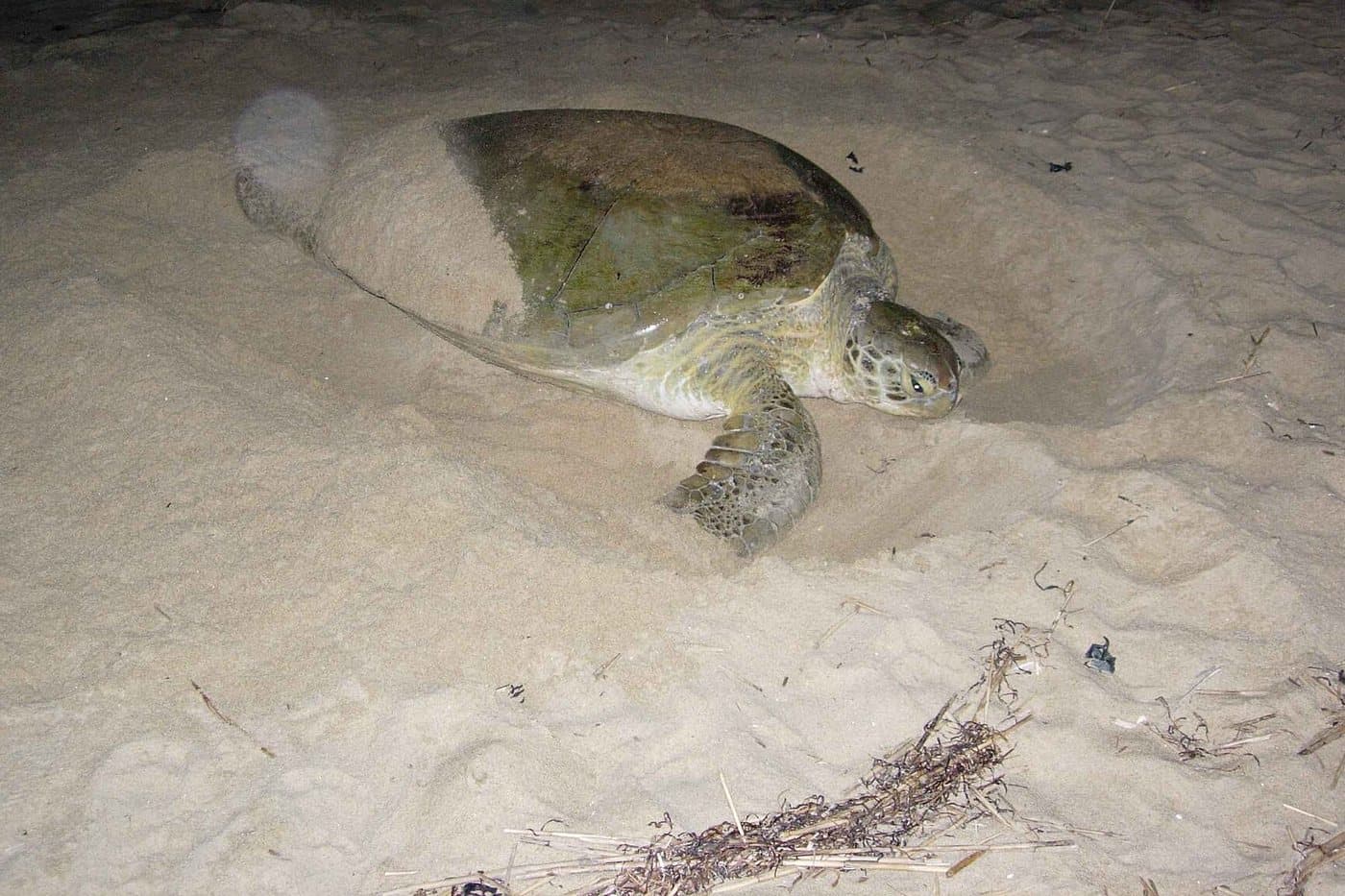
Con Dao is the main green turtle rookery in Vietnam. Clutches appear year-round, with the main season from late May to October. Nesting concentrates on Hòn Bảy Cạnh, though isolated nests appear on Dam Trau and other Con Son beaches too. If you spot tracks or a fresh mound in the sand, walk wide around it.
Where you can see them
| Place | Season | Conditions |
|---|---|---|
| Hòn Bảy Cạnh | Late May to October | Overnight programme, limited places |
| Hòn Tài | Occasionally | Daytime snorkeling tour |
| Hòn Cau | Occasionally | Daytime snorkeling, night tours rare |
| Đầm Trầu | Very rarely | Incidental nests, not an attraction |
Booking the night tour
- Book through the national park, your hotel or a licensed operator — a month or more ahead for the overnight version, because places are limited
- Meet at Con Son harbour in the evening
- The speedboat runs to Hon Bay Canh in 10-15 minutes
- A ranger briefs the group on the island: no noise, red light only, no flash
- You wait on the beach, sometimes deep into the night
- If a female comes ashore, you watch from five metres or more
- You sleep on the island; hatchlings are released at dawn
The park's official overnight programme costs 2,150,000-5,100,000 VND (~$83-196) per person for the 24-hour stay, and commercial operators sit in the same band. If you see "from 500,000 VND" quoted anywhere, it matches neither programme: even the shorter daytime hatchling-release trip, a different product, starts at 680,000 VND. Booking through Six Senses costs considerably more but comes with a conservation guide rather than just a park ranger.
Nothing is guaranteed: no turtle may come ashore at all, and the programme still runs and still costs what it costs.
Hatchling releases
Hatchlings emerge 45 to 60 days after the clutch is laid. Rangers collect them and run an organised release at dawn. Groups are small, and places on the island are limited. There is nothing theme-park about it: you help the hatchlings reach the water past the crabs and the birds, and it is the only part of the programme where you do anything at all.
The rules
- Do not touch turtles, nests or eggs
- No torch, no phone screen: light disorients both females and hatchlings
- No noise
- Keep at least five metres away
- Carry your rubbish out
The island's conservation programmes are covered in the full Con Dao guide, and the tours themselves in Con Dao tours.
What to bring to the beach
| Item | Why | Where to get it |
|---|---|---|
| SPF 50+ | Near-equatorial sun | Home or Ho Chi Minh City |
| Mask and snorkel | Dam Trau, Dam Tre, Hon Cau | Your own; rental is patchy |
| Reef shoes | Rocks and sea urchins | HCMC, 100,000-200,000 VND |
| Hat | Shade is scarce | Any shop in Con Son |
| 1.5 l of water | No kiosks on wild beaches | Shop, 10,000-15,000 VND |
| Dry bag | Boat tours, phone | Con Son, 80,000-150,000 VND |
| Rash guard | Sun and jellyfish | Pack from home |
| Wet wipes | Sand gets everywhere | Shop in town |
| Closed shoes | Ong Dung and Dam Tre trails | Trainers or hiking shoes |
| Towel | Beaches do not supply them | From your hotel |
| Small backpack | Tours and hikes | Anywhere |
| Cash in VND | Loungers, cafés, parking | ATM in Con Son |
A mask-and-snorkel set for $15-25 is the single best-value purchase of this trip. Rental masks leak, and the best minutes of a snorkel go on clearing the lens instead of looking at the reef.
Practical tips
Collected from TripAdvisor reviews, forums and traveller blogs over the last two seasons.
- Dam Trau before 10:00 or after 15:00. Day groups arrive between eleven and two. The rest of the time the bay is close to empty.
- Check the tide before Bai Nhat. Without low water you will find rock and nothing else. Search "Con Dao tide chart" or install Tide Times.
- Book day trips three or four days out, and an overnight turtle stay a month out. January to March fills fast, and island places are limited. Con Dao Dive Center replies quickest on WhatsApp.
- Carry cash to every beach. Cards are almost never accepted: parking, loungers, coconuts, all VND. Draw it in town, and decline the ATM's offer to charge you in your home currency.
- There is barely any shade. At Dam Trau and Nhat there is none at all. A hat and a shirt solve it.
- Snorkel in the morning. Before ten the water is still, the fish are active and visibility is at its best. Wind picks up after lunch.
- Never swim alone at Ong Dung. The current there is real. Stay in the middle of the bay, ideally with company.
- Bring your own mask. Rentals are a lottery, and a set pays for itself on the first swim.
- Ride in trainers. Flip-flops plus the switchbacks down to Nhat is the most common way to leave the island with a scraped leg.
- Keep a rubbish bag in your pocket. Bins are scarce and carrying your own waste out is a park rule.
- Dam Tre without a guide is not allowed. This is a park rule, not advice: the route only runs with a ranger. The packaged day programme is 720,000-1,250,000 VND (~$28-48) per person.
- Get into Six Senses through dinner. To see Dat Doc without paying eight hundred dollars a night, book a table at their restaurant.
- Local kids play at An Hai in the evening. If you are travelling with children, that is your company sorted. The language barrier lasts about five minutes.
- Rent a scooter for two days, not one. The discount is usually 10-20% off the daily rate and up to 30% over three days.
- Take a windbreaker on boat tours. The ride back after sunset gets cold, especially in January and February.
FAQ — Con Dao beaches
Bai Dam Trau. Fine white sand, clear water, a basic strip of services (a toilet and rinse shower, a couple of seafood shacks, loungers at roughly 30,000-100,000 VND / ~$1-4) and a reef about 700 m offshore. It also has something no other beach in Vietnam has: the runway of Co Ong airport ends right beside it, so aircraft pass overhead on final approach. Note that flights land in daylight, so the planes usually stop before sunset. The beach is 14 km from Con Son town, 20-25 minutes by scooter.
From January to April, yes, without caveats: calm sea, clear water, almost no rain. From July to October the monsoon brings swell, and you should stick to the sheltered beaches — An Hai, Lo Voi and Dam Trau. September and October bring peak rain and swell, so skip the open beaches entirely. At Ong Dung a current runs along the rocks in any season: swim in the middle of the bay and never alone.
Ride 14 km north from Con Son town on Co Ong Road
- A scooter20-25 minutestakes and about 30,000 VND (~$1) of fuel
- A taxi150,000-200,000 VND~$6-8
- From the airport itselfa 15-minute walk
- Scooter parking10,000-15,000 VND
Before you reach the terminal, turn left at the "Dam Trau Beach" sign — the last kilometre is a narrow dirt track that gets slick in the rain
Jellyfish numbers rise in the rainy season, roughly June to October, mostly on the exposed beaches. There is no resident population of severe stingers such as Portuguese man o' war, but individual stings happen every season — carry vinegar. The one well-known current runs along the rocks on the right-hand side of Ong Dung bay; Bai Nhat is the other place where locals simply do not swim. An Hai, Lo Voi and Dam Trau are effectively current-free in the dry season; rips can form on open beaches during the monsoon. If you are being pulled out, swim parallel to shore rather than against the water.
January to April. Dry, water at 27-29°C, minimal rain and the clearest water of the year. The main turtle season runs from late May to October, but summer is also full monsoon. September and October are the worst months for a beach trip: peak rainfall, murky water, heavy swell. November and December are transitional and unpredictable.
On Hon Bay Canh island, 10-15 minutes by speedboat from the Con Son harbour. The main nesting season runs from late May to October
- The national park's overnight programme2,150,000-5,100,000 VND~$83-196costs per person
- The shorter daytime hatchling release680,000-2,200,000 VND~$26-85
- Book aheada month or moreplaces on the island are limited
Nests do occasionally appear on the main island, but they are incidents, not an attraction
Bai Lo Voi. Ankle-deep at the waterline, knee-deep ten metres out, fine pale sand, almost no waves, and old casuarina trees that hold shade through the middle of the day. It is a five-minute walk from central Con Son, with cafés on the promenade selling water, coconuts and ice cream. An Hai is the runner-up. Dam Trau is fine from about age four, but it is a 20-minute scooter ride away.
The town beaches, An Hai and Lo Voi, are free, and so is Dam Trau — it sits outside the national park, so you only pay for parking and for whatever you actually use. National park beaches do need a ticket, and it is charged per route rather than per day: 50,000 VND (~$2) per person for a walking route such as Ong Dung, Dam Tre or So Ray, and 60,000 VND (~$2.30) for a boat route to the outer islands. Dat Doc is private: you get in as a Six Senses guest, or through a restaurant or spa booking.
From shore: Dam Trau, where the reef sits about 700 m out, and Dam Tre lagoon, where coral starts at the waterline and swell never reaches. From a boat: Hon Cau, where visibility regularly passes 20 m, Hon Tai for fish density (though clarity there sometimes drops to 4-5 m) and Hon Bay Canh for turtles. Visibility depends on the site and the wind at least as much as on the season. One caveat worth knowing: the archipelago went through mass coral bleaching in 2024 and recovery is still under way. Bring your own mask — rental quality on the island is a lottery.
Con Dao beaches in numbers
| Detail | Value |
|---|---|
| Beaches in the archipelago | About 20 |
| Top three for looks | Đầm Trầu, Đất Dốc, Hòn Bảy Cạnh |
| Town to Dam Trau | 14 km, 20 minutes by scooter |
| Furthest beach island | Hòn Cau, 20-30 minutes by speedboat |
| Park route, on foot | 50,000 VND (~$2) per person |
| Park route, by boat | 60,000 VND (~$2.30) per person |
| Lounger at Dam Trau | roughly 30,000-100,000 VND (~$1-4) |
| Overnight with the turtles | 2,150,000-5,100,000 VND (~$83-196) |
| One-island snorkeling trip | 700,000-1,000,000 VND (~$27-38) |
| Two fun dives | 3,600,000 VND (~$138) |
| Best swimming window | January-April |
| Turtle season | Late May to October |
| Best visibility | Hon Cau, over 20 m |
All ten beaches in short
Around twenty beaches sit in the archipelago and ten of them matter. Dam Trau is the postcard: white sand, a reef 700 metres out, aircraft overhead. An Hai and Lo Voi are in Con Son itself, minutes from the market, which is where families and morning runners go. Dat Doc is behind the Six Senses fence, and the Elephant Mountain view comes bundled with a villa.
Then the wild half. Nhat surfaces for a couple of hours at low tide and hands you the best sunset on the island. Ong Dung and Dam Tre are reached only on foot through jungle. And Hon Bay Canh, Hon Tai and Hon Cau are boat-tour islands, which is where the best snorkeling, the diving and the turtles live. Best windows: January to April for the water, July to September for the turtles.
Read next: Con Dao guide · Con Dao attractions · Con Dao weather · Best beaches in Vietnam
VietnamSpot on InstagramTips, lifehacks and news for living in VietnamFollow



- Guide
Con Dao 2026: Vietnam's Wild Islands Guide
Con Dao guide: pristine islands, eco-luxury, diving and sea turtles, the former prison-island history, how to get there and when to go.Con Dao 2026: Vietnam's Wild Islands Guide - Guide
Con Dao Attractions: Prison Museum, Beaches & Diving
What to see on Con Dao: the prison museum, the national park, beaches, sea turtles, Vo Thi Sau temple and diving — with tickets and how to get there.Con Dao Attractions: Prison Museum, Beaches & Diving - Guide
Con Dao Diving 2026: Dive Sites, Turtles and Prices
Con Dao diving in 2026: 8 dive sites, turtle nesting on Bay Canh, month-by-month visibility, dive center prices in USD and how it compares to Phu Quoc.Con Dao Diving 2026: Dive Sites, Turtles and Prices