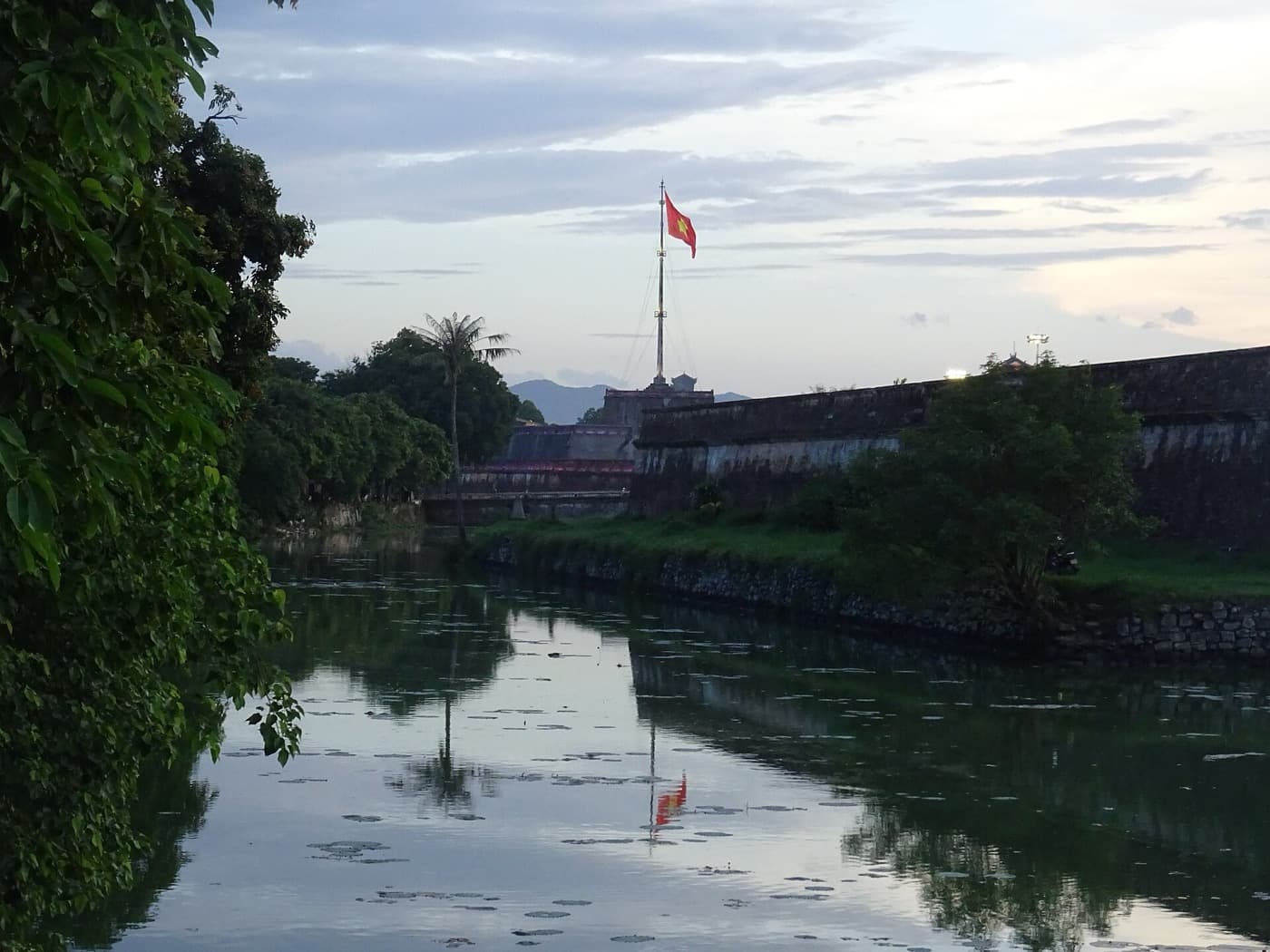
Getting around Hue in 2026: taxis, scooters, dragon boats
Two kilometres from Truong Tien Bridge is the whole walkable city. The Citadel, the riverfront and Dong Ba market are on foot; past that you need wheels or a hull. The tombs sit 7 to 14 km out, the airport 15 km, Da Nang 100 km over one of the best train rides in Asia. Here are the ten ways to move around Hue and out of it, with 2026 prices in dong and dollars, real timetables and the licence rules that decide whether you can legally ride.
The map and the distances
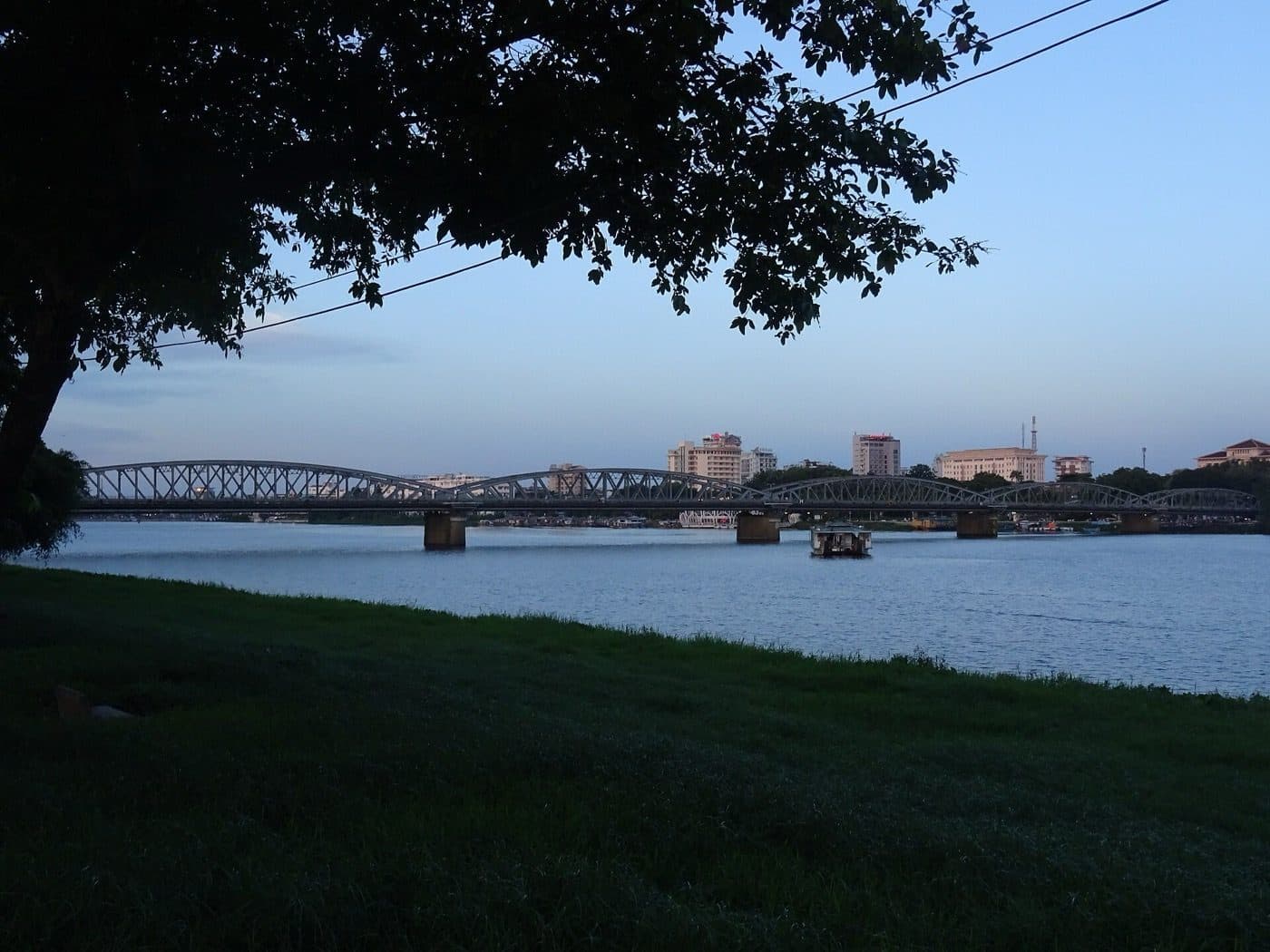
Hue sits on the Sông Hương, the Perfume River, which splits the city cleanly in two. The north bank holds the Citadel and the Imperial City. The south bank is where you will actually sleep and eat: the Pham Ngu Lao backpacker grid, the hotels along Le Loi, the bars. The hinge between them is Truong Tien Bridge, six steel spans that have been there since 1899.
- Truong Tien Bridge (Cầu Trường Tiền): The main bridge over the Perfume River — Everything in Hue is measured from here
- The Citadel (Kinh thành Huế): 1.5 km from the bridge — A 20-minute walk
- Tu Duc Tomb (Lăng Tự Đức): 7 km out — Taxi 90,000–130,000 VND (~$3.5–5)
- Khai Dinh Tomb (Lăng Khải Định): 10 km out — Taxi 130,000–180,000 VND (~$5–7)
- Minh Mang Tomb (Lăng Minh Mạng): 14 km out — Easier to reach by dragon boat
- Toa Kham Pier (Bến thuyền Tòa Khâm): 49 Le Loi — Official dragon-boat ticket window
- Thien Mu Pagoda (Chùa Thiên Mụ): 4 km upriver from the pier — The classic boat run
- Dong Ba Market (Chợ Đông Ba): Cyclo stand — Where the trishaw tours start
- Hue Railway Station (Ga Huế): 2 Bui Thi Xuan, 1 km from the centre — SE and HĐ trains
- Northern bus station (Bến xe phía Bắc): Hanoi, Vinh — and everything north
- Southern bus station (Bến xe phía Nam): Da Nang, Hoi An — and Ho Chi Minh City
- Phu Bai Airport (Sân bay Phú Bài): IATA HUI, 15 km out — Domestic only: HCMC, Hanoi
Measure everything from that bridge and the city makes sense immediately:
| Destination | Km | Best way to get there |
|---|---|---|
| Imperial Citadel | 1.5 | 20 minutes on foot, 5 by bike |
| Dong Ba Market | 1.2 | On foot, or a cyclo if it is hot |
| Thien Mu Pagoda | 4 | Bike, scooter or dragon boat |
| Tu Duc Tomb | 7 | Taxi or scooter |
| Khai Dinh Tomb | 10 | Taxi or scooter |
| Minh Mang Tomb | 14 | Half-day dragon boat, or taxi |
| Railway station | 1 | 15 minutes on foot, taxi 50,000 VND |
| Phu Bai Airport | 15 | Shuttle, taxi or city bus |
| Da Nang | 100 | Train 2.5 hrs, limousine van 3 hrs |
| Hoi An | 130 | Limousine van 3.5 hrs, Easy Rider 7–9 hrs |
Inside a two-kilometre radius you walk. The Citadel itself is also a walking job, but the tombs are 5 to 10 km apart from each other, and that is where a scooter or a car stops being optional.
Taxis and ride-hailing
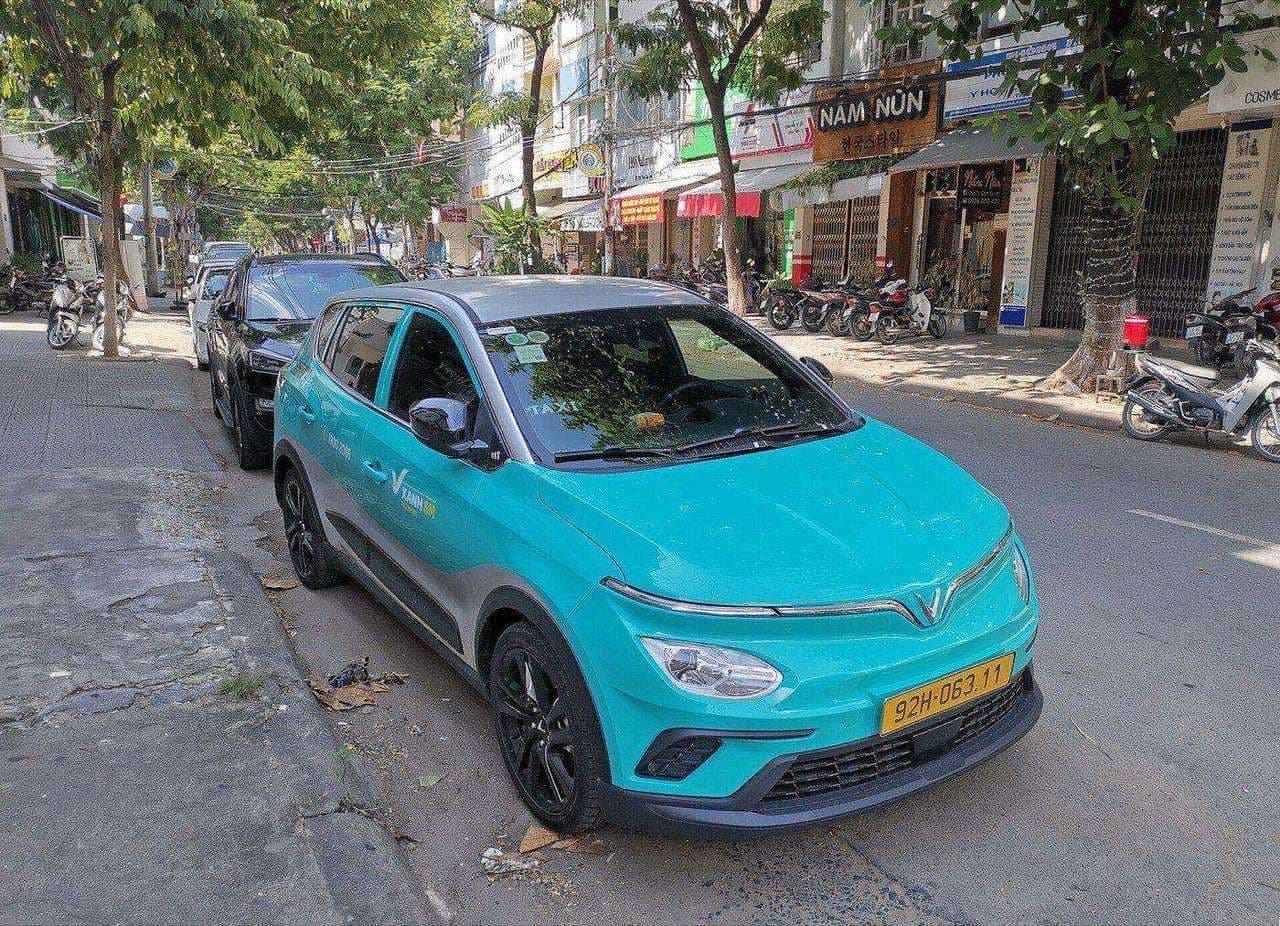
Five operators, and that is the complete list. Mai Linh (green) and Vinasun (white with a red stripe) are traditional metered taxis. Xanh SM runs cyan VinFast electric cars booked in an app at a fixed price. Grab and Be are ride-hailing platforms where the fare appears before you confirm. Uber left Southeast Asia in 2018 and is not coming back.
Currency converter
Mai Linh, Vinasun and the meter
Mai Linh is the country's biggest taxi network and the easiest to spot: green paint, a big M. Flagfall is 10,000–15,000 VND and covers the first 700–800 metres, then the meter runs at 12,000–18,000 VND per km, dropping to around 10,000 VND once you pass 30 km. Vinasun costs roughly 10% more for a newer car.
| Route | Distance | VND | USD |
|---|---|---|---|
| Phu Bai Airport → centre | 15 km | 250,000–300,000 | $10–12 |
| Pham Ngu Lao → Citadel | 3 km | 50,000–70,000 | $2–3 |
| Centre → Tu Duc Tomb | 7 km | 90,000–130,000 | $3.5–5 |
| Centre → Khai Dinh Tomb | 10 km | 130,000–180,000 | $5–7 |
| Centre → Minh Mang Tomb | 14 km | 180,000–240,000 | $7–9 |
| Hue → Da Nang, point to point | 100 km | 1,100,000–1,500,000 | $42–58 |
| Hue → Hoi An | 130 km | 1,400,000–1,800,000 | $54–69 |
Dollar figures use the August 2026 Vietcombank rate of roughly 26,000 VND to $1.
The one phrase worth learning is "meter, please", or in Vietnamese mở đồng hồ. If the answer is "no meter, 200,000", walk away and flag the next car. Around the station and the airport there is a standing population of unmarked cars that reach you before the green Mai Linhs do, and their fare is always negotiable in the sense of being two to three times higher.
No data? Call a dispatcher
- Meter. A rigged meter races up, or the driver says it is broken and names a flat price. If it climbs too fast, stop and pay for the distance so far
- Knock-offs. Fake cars copy the Vinasun and Mai Linh colours. Read the full company name on the door
- Small notes. The ride is 35,000 VND and all you have is a 500,000 note: the driver may not have change
Xanh SM, the electric fleet
Xanh SM (Green SM abroad, old name at home) launched in Hue on 24 May 2023 with nearly 400 VinFast VF e34s, making the city the network's third after Hanoi and Ho Chi Minh City. Three years on, a cyan car in traffic is unremarkable.
The launch tariff in May 2023 was simple: 17,000 VND for the first kilometre, 16,500 VND per km from the 2nd to the 25th, 12,000 VND from the 26th. The app shows the current fare before you book. On short hops that lands slightly above Mai Linh, on long ones clearly below.
The real selling point is not price but the absence of negotiation: the app quotes a number and that number is what you pay. The cars are quiet, they do not smell of petrol, and the air conditioning keeps running at lights without pumping exhaust past the windows. Cards, Apple Pay and cash all work.
The same app runs Xanh SM Bike, electric motorbike taxis, under a separate icon. A ride across the centre is 25,000–40,000 VND (~$1–1.50). It is the honest middle option when a car feels excessive and renting your own scooter feels like commitment.
Grab and Be
Grab is the regional default and does everything here: GrabCar, GrabBike, GrabFood. Pricing is dynamic and adds 20–30% at rush hour, and you can pay by card or cash.
Be is the Vietnamese rival, usually 10–15% cheaper but with a thinner fleet. In Hue that shows up in the evening, when Be quotes a seven to ten minute wait against Grab's two. Install it anyway as a fallback.
The arithmetic that matters most: centre to Citadel is 50,000–70,000 VND in a car and 20,000–30,000 VND on a GrabBike. The trade is weather, a helmet of uncertain hygiene, and no room for luggage.
The scams, briefly
| Situation | What to do |
|---|---|
| Driver refuses to start the meter | Get out without arguing |
| Meter "breaks" two minutes in | Say stop, get out, do not pay |
| Several men crowd you at the airport or station | Walk to the official taxi desk or open Grab |
| A 50,000 VND luggage surcharge appears | Mai Linh and Vinasun carry luggage free |
| Change comes back short | Pay exact, keep small notes ready |
| "Your hotel is closed, I know a better one" | The oldest one in the book. Insist on your address |
Renting a scooter
A scooter is the most useful thing you can rent in Hue. One machine covers all three tombs in a day, gets you to Thien Mu, and takes you out to Thuan An beach 15 km away and back before dinner. At 100,000–200,000 VND a day ($4–8) it costs less than a single taxi run to Minh Mang.
Prices and where to rent
| Type | Per day | Deposit |
|---|---|---|
| Semi-automatic (Honda Wave, Yamaha Sirius) | 100,000–150,000 VND ($4–6) | Passport or $50–100 |
| Automatic (Honda Vision, Yamaha Janus, AirBlade) | 150,000–200,000 VND ($6–8) | Passport |
| 150–250cc bike for the Hai Van Pass (needs category A, not A1) | 250,000–400,000 VND ($10–16) | Passport plus cash |
| Monthly rental | 1,500,000–2,500,000 VND ($58–96) | Contract and passport |
Rental shops in town include Tuan Motorbike, Style Motorbikes, Hue Motorbike Rental, Tigit. Most hotels in Pham Ngu Lao rent from the front desk at the same rate, which saves a walk. One or two helmets are included; fuel is on you. Petrolimex publishes the current price per litre, and a full tank in a Vision lasts roughly 150 km.
Handing over your passport is normal practice here, but you do not have to. Plenty of shops accept a photocopy plus $50–100 in cash, and that version is worth insisting on: your passport stays with you.
Licences, and the 1968 problem
Police in Hue rarely stop foreigners; the checkpoints that matter sit on highway AH1 towards Da Nang and on the Hai Van Pass. What has changed is the price of getting caught. Decree 168/2024, in force since 1 January 2025, roughly doubled traffic fines: riding without a valid licence now costs 2,000,000–4,000,000 VND (~$77–154) on a scooter up to 125cc and 6,000,000–8,000,000 VND (~$230–308) on anything bigger.
The rental shop's own insurance, around 50,000 VND a day, covers damage to the scooter in a minor no-fault incident and nothing else. Buy proper travel medical cover before you fly, and read the two-wheeler exclusion clause, because most policies have one.
One-way rentals to Hoi An, Da Nang or Hanoi
You can pick a bike up in Hue and drop it in another city. Style Motorbikes, Hue Scooter Rental and Hidden Land Travel all do it.
| Route | One-way fee | Riding time |
|---|---|---|
| Hue → Hoi An over Hai Van | $30–40 | 5–6 hours with stops |
| Hue → Da Nang | $25–35 | 3–4 hours |
| Hue → Hanoi via Phong Nha and Ninh Binh | $80–120 | 5–7 days |
The Hue to Hoi An run is the one everybody does, and it is not really a transfer. It is a day: switchbacks over bays, the fishing village of Lang Co halfway, seafood for lunch, a long stop at the top of the pass. A 130 km line on the map turns into the thing people remember about Vietnam.
GrabBike and Xanh SM Bike
If you would rather not ride but a car feels wasteful, book a motorbike taxi in Grab or Xanh SM. A driver arrives in three to five minutes with a spare helmet. Three kilometres costs 25,000–40,000 VND, ten kilometres around 100,000 VND. Far cheaper than a car, useless in rain, and no good for anything larger than a daypack.
Fast Track — no queue at the border
5–10 minutes instead of an hour in the immigration queue
from$11per passenger
Bicycles
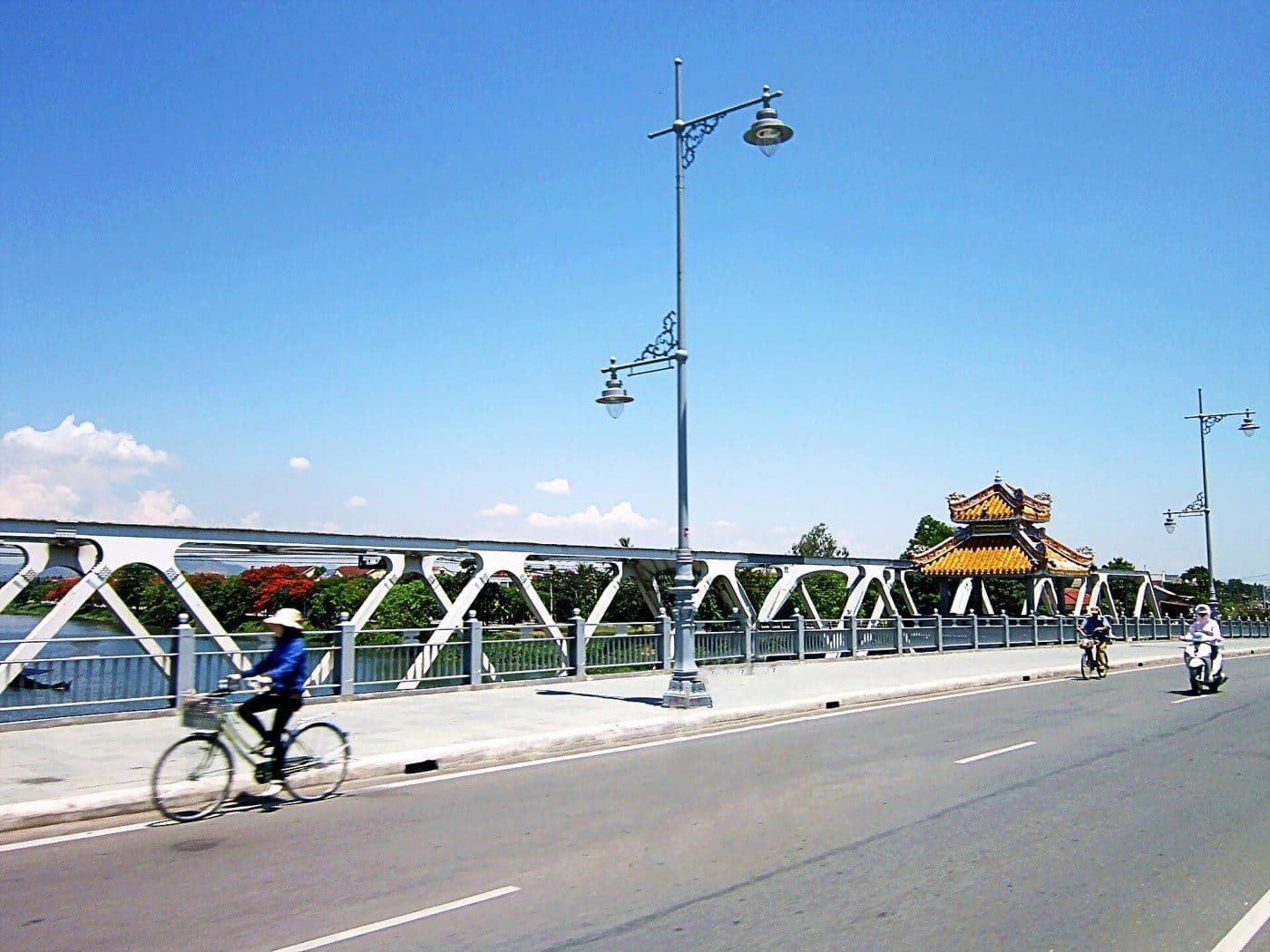
If you are staying near the river and the plan is a slow morning rather than a checklist, a bicycle beats everything else. A single-speed city bike is 30,000–50,000 VND a day, geared 50,000–80,000 VND, an e-bike 200,000–300,000 VND. Most hotels lend theirs free or for a token fee; Hue Charming Rental, Bikesbooking and Klook cover the rest.
Rides worth doing on two wheels
- The Le Loi riverfront — four to six kilometres out and back along the south bank, best at sunset when the bridge lighting comes on.
- Around the Citadel — the walls run about 10 km, and the streets inside the Imperial enclosure are shaded and nearly car-free.
- Out to Thien Mu Pagoda — 4 flat kilometres along the water, the same route every bicycle tour uses.
- Con Hen island (Cồn Hến) — a sliver of land mid-river two kilometres from the bridge, with quiet lanes and the best cơm hến, baby-clam rice, in the city.
Where not to cycle
Minh Mang Tomb at 14 km is too far in mid-thirties heat. The Hai Van Pass is a mountain climb for people who brought their own bike and cleats. The airport road is highway AH1 with trucks on it. Take a scooter or a taxi for all three.
Dragon boats on the Perfume River

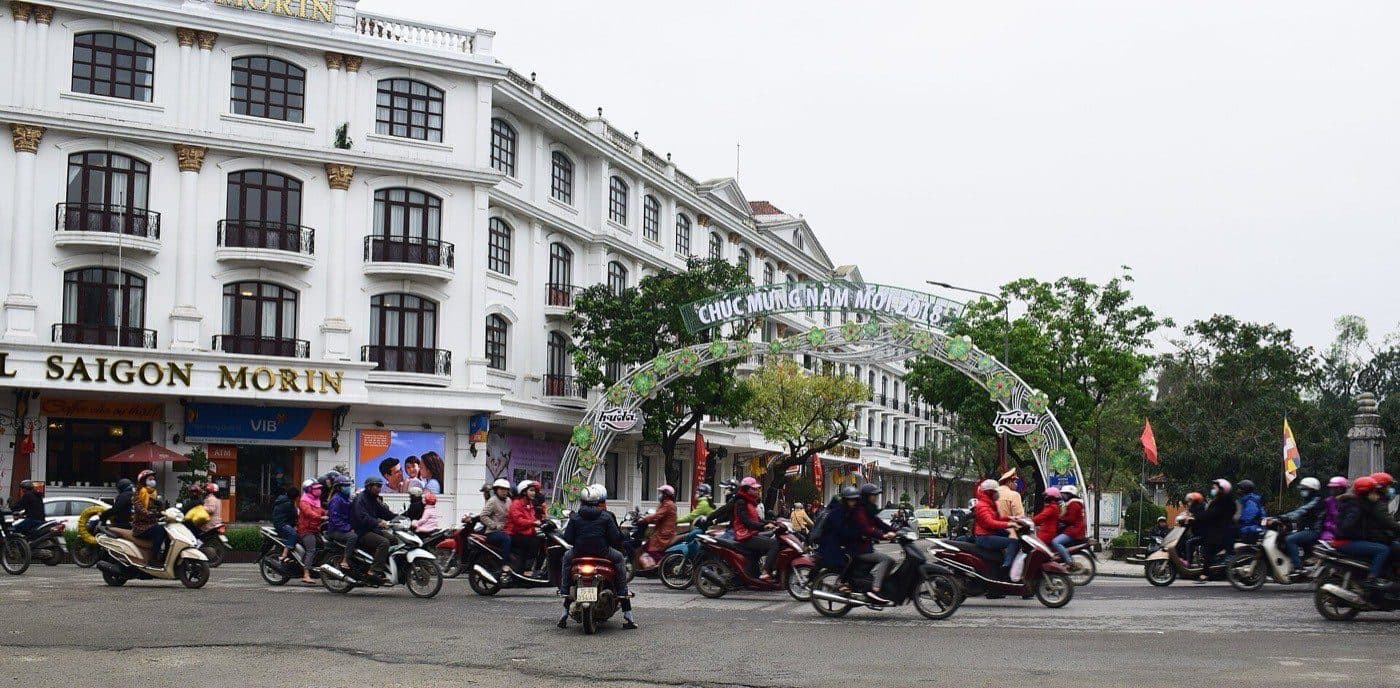
A dragon boat is a wooden river boat with a carved dragon head at the bow, called thuyền rồng in Vietnamese. It is both a working tourist ferry and the thing everyone photographs. The main dock is Toa Kham Pier (Bến thuyền Tòa Khâm) at 49 Le Loi, directly across from the Saigon Morin hotel.
Formats and prices
| Format | Capacity | Price | Duration |
|---|---|---|---|
| Shared seat to Thien Mu and back | mixed group | 80,000–90,000 VND (~$3–3.5) each | 30–45 min each way |
| Single-dragon boat, chartered | up to 15 | 450,000 VND first hour, 350,000 after | 1–2 hours |
| Double-dragon boat, chartered | up to 35 | 550,000 VND first hour, 450,000 after | 1–2 hours |
| Toa Kham → Thien Mu one way, whole boat | 15 / 35 | 450,000 / 600,000 VND | 40–50 min |
| Evening dinner cruise with folk music | — | 500,000–900,000 VND (~$19–35) each | 2 hours |
| Half day: Thien Mu, Minh Mang, Hon Chen | group | 250,000–450,000 VND (~$10–17) each | 5 hours |
These are the official 2026 pier rates, the ones printed on the board inside the Toa Kham ticket window. Children under a metre ride free; one metre to 1.3 m pay half. On shared boats the per-seat price drops with group size: 90,000 VND for a party of four, 80,000 VND once there are ten of you.
The classic river run
The standard half-day boat leaves Toa Kham at 08:00, takes 40 minutes upriver to Thien Mu Pagoda and waits half an hour, then 90 minutes on to Minh Mang Tomb, where the jetty is at the gate. Ninety minutes there, back at the pier by 13:00. Tomb entry (150,000 VND each) is not included; the pagoda is free.
The two-hour version goes only to Thien Mu and back, with the boat waiting while you look around. That is the right call if you have already done the tombs or have run out of appetite for them.
Ca Hue, the evening music boats
Two sessions a night, at 19:00 and 20:00, with extra 18:00 and 21:00 runs on holidays. Small boats leave the pier with a Ca Huế ensemble aboard: four or five musicians playing court songs on the đàn tỳ bà lute and the single-stringed đàn bầu. It runs 45 minutes and a group ticket is 100,000–150,000 VND (~$4–6).
Do not confuse the two evening products. Ca Hue is a seated recital with no food. The dinner cruise is a meal with music behind it. If you want the instruments, book Ca Hue; if you want dinner with the bridge lit up outside, book the cruise. Quality on the cheap sessions varies, and the last boat of the night tends to be the rushed one.
The boat scam to watch for
- Agree the itinerary in writing or as a screenshot before you leave the dock: which tombs, arrival time, departure time
- Confirm that waiting at each stop is included, or a $5–10 waiting fee will appear
- Never pre-pay the captain for tomb tickets he offers to buy "at a discount"
- Toa Kham has an official window with a fixed price list. If a quote is higher, go to the window
Cyclo
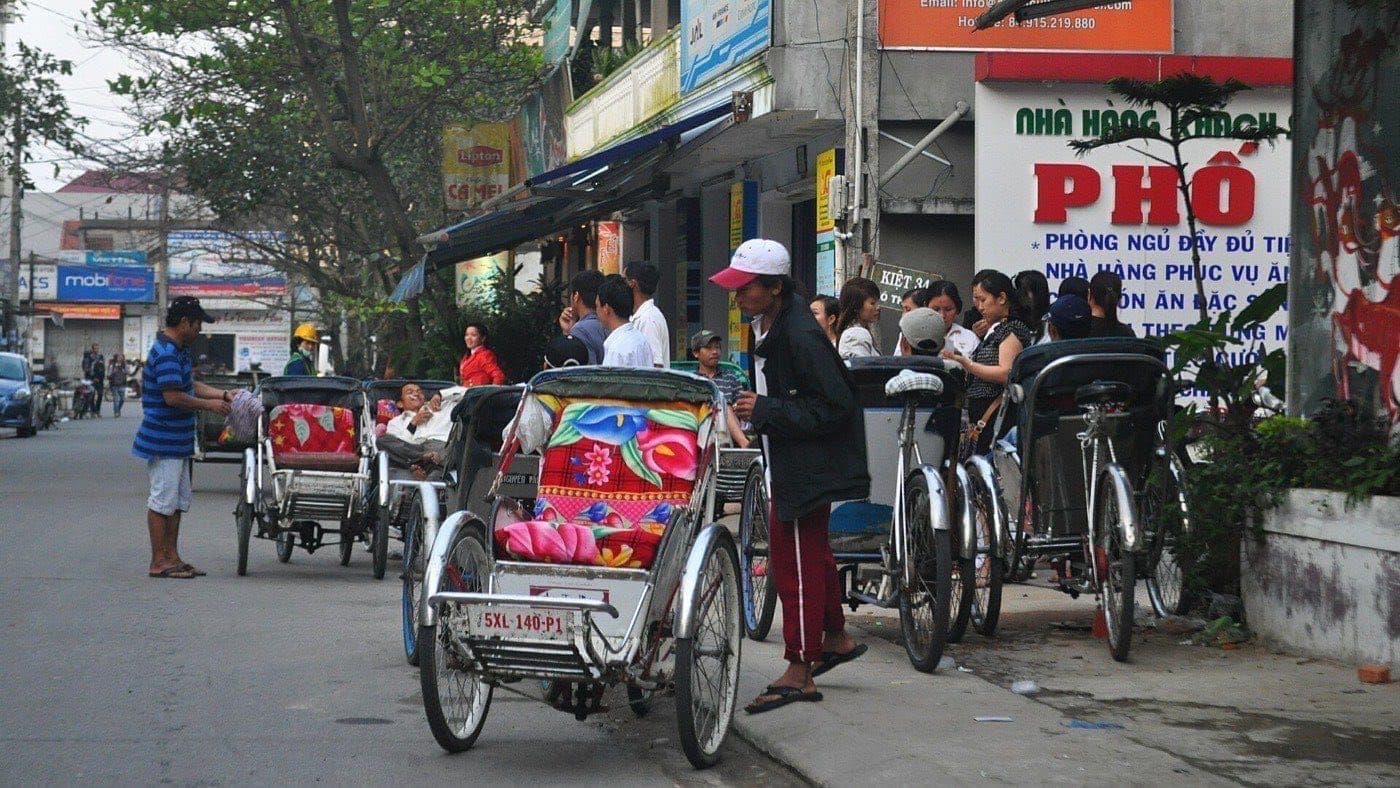
A cyclo (sích-lô) is a three-wheeled trishaw with the passenger seat in front and the driver pedalling behind. Hue has far fewer than Hanoi or Ho Chi Minh City, maybe two hundred in the whole city, clustered on Hung Vuong near the bridge and beside Dong Ba market.
| Format | Price | Duration |
|---|---|---|
| Short hop across the centre, 1–2 km | 30,000–60,000 VND ($1–2.50) | 10–20 min |
| An hour, including Dong Ba market | 150,000–250,000 VND ($6–10) | 1 hour |
| Heritage cyclo tour with entry tickets | from $79 | 4 hours |
There is no meter, so the price is whatever you agree before you sit down. Locals pay 15,000–20,000 VND an hour and you will not be offered that. A realistic floor after bargaining is 80,000–100,000 VND for half an hour around the Citadel walls.
Take one for the sunset lap of the Imperial City, or for a slow drift through the shaded lanes of Pham Ngu Lao, especially if you land a driver who speaks some English and narrates. Do not take one if you actually need to be somewhere: walking or a GrabBike is faster and half the price.
Trains: the Reunification Express and the heritage service
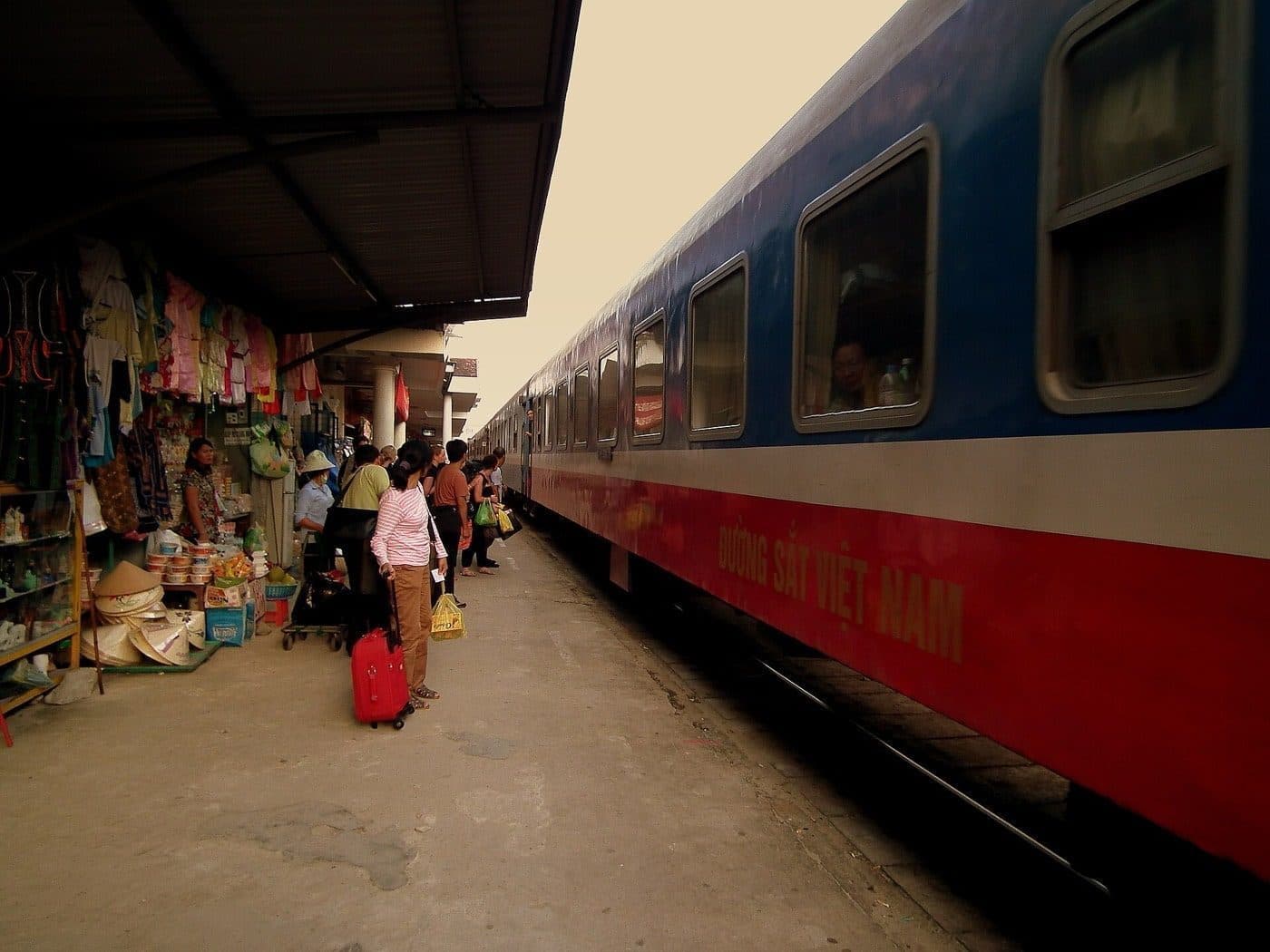
Hue is a major stop on the North-South line. The stretch from here to Da Nang runs over the Hai Van Pass and turns up on every list of the world's best rail journeys: mountain switchbacks with the sea below, for the price of a coffee back home.
Ga Hue
The station is at 2 Bùi Thị Xuân, a kilometre from Truong Tien Bridge. The French built it in the early 20th century, and it still looks the part: cream stucco, arched windows, tiled roof, more provincial France than central Vietnam. Fifteen minutes on foot west along Lê Lợi, or 50,000 VND in a Grab.
Routes, times and fares
| Route | Services | Time | Seat, VND | Sleeper, VND |
|---|---|---|---|---|
| Hue → Da Nang | SE series, several a day | 2.5–3.5 hrs | 92,000–120,000 | 200,000–271,000 |
| Hue → Hanoi | SE series, several a day | 13–14.5 hrs | 400,000–550,000 | 900,000–1,400,000 |
| Hue → Ho Chi Minh City | SE series | 18–22 hrs | 600,000–800,000 | 1,200,000–1,900,000 |
| Hue → Dong Hoi (Phong Nha) | SE services | 3–4 hrs | 90,000–140,000 | — |
The heritage train to Da Nang
Most English-language guides still miss this one. Since 2024 Vietnam Railways has run a dedicated tourist service on the Hue to Da Nang stretch, the "Central Heritage Connection" (Kết nối di sản miền Trung), with HĐ numbers rather than SE. Southbound: HĐ1 leaves Hue at 07:45 and reaches Da Nang at 10:35; HĐ3 leaves at 14:25 and arrives at 17:40. Northbound from Da Nang: HĐ2 at 07:50 and HĐ4 at 15:00.
One class only, an air-conditioned soft seat at 207,000 VND one way (~$8) or 414,000 VND return. The consist is five passenger cars plus a community car where you can stand at a panoramic window, listen to live music and buy coffee. It is not faster than an ordinary SE. The difference is that this train is built around the view rather than treating it as scenery going past a curtained window.
Carriage classes on the SE trains
- Hard seat (ngồi cứng) — wooden benches, no air conditioning. Short daytime hops only.
- Soft seat (ngồi mềm) — padded, air-conditioned. The default for Hue to Da Nang.
- Hard sleeper (nằm cứng) — six berths, no compartment door. Budget overnight option.
- Soft sleeper (nằm mềm) — four berths, a door, bedding. The one to book for Hanoi or Saigon.
Although the bottom bunk is slightly more expensive, if your main concern is sleeping, you should opt for the top bunk… when your head is on the pillow on the bottom bunk you can hear and feel every bump on the tracksTom Divers, Vietnam Coracle, 2025
Buying tickets
The official site is dsvn.vn. It is in Vietnamese, navigable with a translation extension, and its card gateway is temperamental with foreign cards. The reliable English-language resellers are Baolau and 12Go, which charge 10–15% on top and take international cards without drama. You can also buy at the station on the day, but from December to March sleeper berths go a week ahead.
Buses and limousine vans
There are two intercity bus stations. The northern one (Bến xe phía Bắc) serves Hanoi and points north; the southern one (Bến xe phía Nam) covers Da Nang, Hoi An and Ho Chi Minh City. Cheapest of everything, and it shows.
The scheduled bus to Da Nang
A plain public route, LK01, runs to Da Nang, and it undercuts every tourist service: the full-route ticket costs less than the cheapest sleeper. It leaves from the southern bus station, and you barely wait.
LK01BusHải Vân
- Da Nang central bus stationBến xe Trung tâm Đà Nẵng
- Hai Van tunnelHầm Hải Vân
- Hue southern bus stationBến xe phía Nam Huế
100 km
- Timetable
- Every 14–15 minWhole route05:30–19:00
- Fare
- 80,000 VND
Runs through the tunnel, not over the pass — no Hai Van views from the window
Official source — Da Nang public transport portal · Checked on Sep 18, 2026
Sleeper buses
A sleeper bus is a double-decker with flat berths instead of seats. The berths are sized for a Vietnamese passenger up to about 170 cm. Above that it is an endurance event; below it, a workable night.
| Route | Operators | Time | Fare |
|---|---|---|---|
| Hue → Da Nang | Hoang Long, Hanh Cafe, The Sinh Tourist | 3 hrs | 119,000–250,000 VND ($4.50–10) |
| Hue → Hoi An | Hanh Cafe, The Sinh Tourist | 3.5 hrs | 250,000–400,000 VND ($10–16) |
| Hue → Hanoi, overnight | Hoang Long, Camel | 13–14 hrs | 350,000–550,000 VND ($14–21) |
| Hue → Ho Chi Minh City, overnight | Hoang Long, Phuong Trang | 22 hrs | 500,000–800,000 VND ($19–31) |
What you get: a cheap fare, a hotel night saved, and door-to-door pickup with most operators. What you also get: constant motion, everyone's shoes off at the door, a toilet only on some buses, and air conditioning that is either off or arctic.
Limousine vans
A limousine van is a nine-seat Ford Transit or Mercedes Sprinter fitted with leather seats, wifi, USB charging and a water cooler. In central Vietnam the names to look for are The Sinh Tourist, Hanh Cafe and DK Travel.
| Route | Time | Fare |
|---|---|---|
| Hue → Hoi An | 3.5 hrs | 250,000–400,000 VND ($10–16) |
| Hue → Da Nang | 3 hrs | 200,000–300,000 VND ($8–12) |
| Hue → Phong Nha | 5 hrs | 350,000–500,000 VND ($14–19) |
They collect you from your hotel and drop you at your hotel in the next city, which removes both bus stations from the equation. For anything under four hours this is the sweet spot: a few dollars more than a sleeper bus, and a completely different afternoon.
Easy Rider over the Hai Van Pass
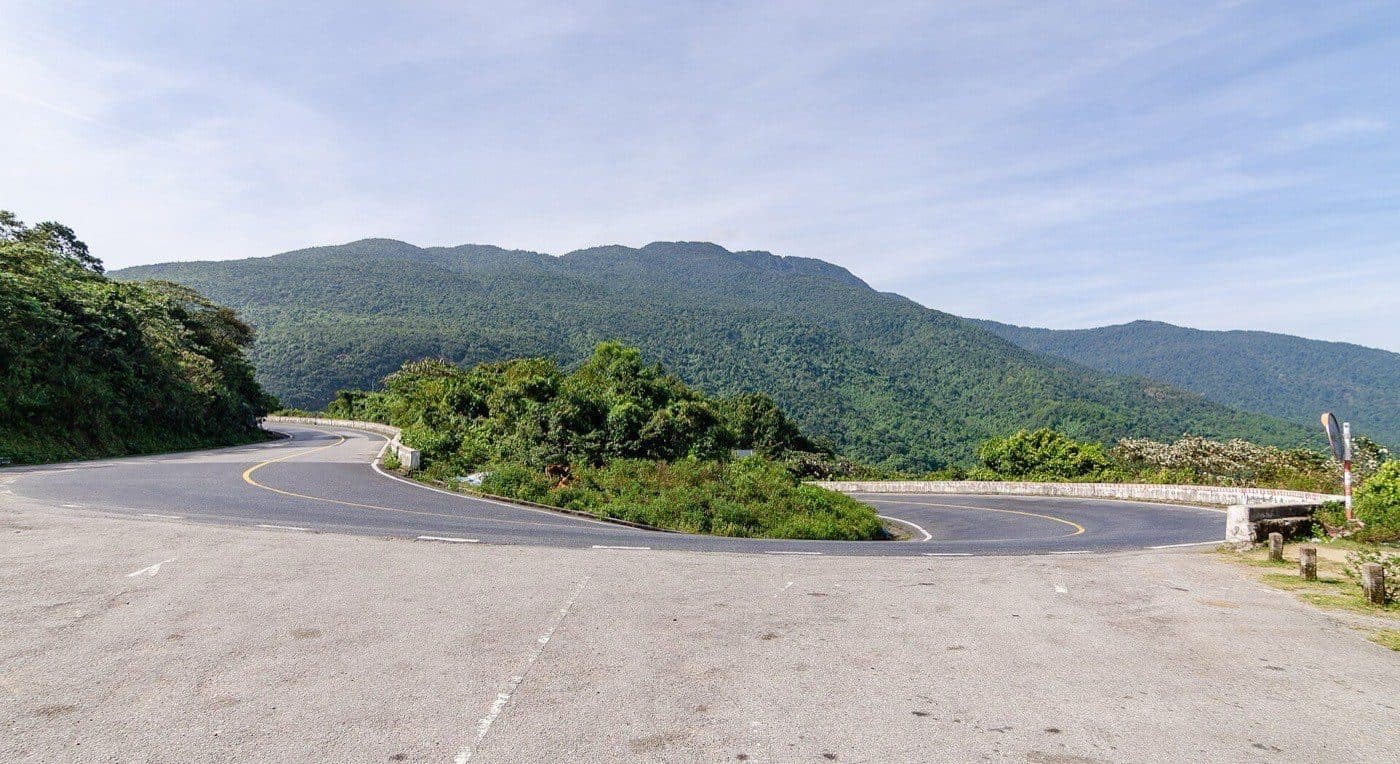
Easy Rider means you ride pillion and a local rides the bike. Your bag is strapped to the rack, you carry a daypack. The classic run is Hue to Hoi An or Hue to Da Nang over the Hai Van Pass, seven to nine hours with stops for photographs, lunch and simply looking at things.
What it costs and what is included
| Option | Price |
|---|---|
| Solo: one rider, one passenger | $50–70 |
| Couple: two riders, two passengers | $80–110 |
| Adding Lang Co and the Marble Mountains | plus $10–15 |
| One-way, bikes stay in Hoi An | no extra charge |
| Return trip in a day | plus $20 |
Fuel, helmets, rain ponchos and every photo stop are in the price. A roadside lunch is included by some operators, not by others. Operators offering the ride include Hue Riders, Vespa Adventures, Tuan Motorbike Easy Rider and Bee Bee Travel. All take cash; some take cards through an app.
How the day runs
Pickup at your hotel around 08:00. First stop is the fishing harbour at Thuận An or the salt flats 15 km out. Then the switchbacks up Hai Van to the viewpoints near the top, at almost 500 m: Lang Co Bay on one side, Da Nang on the other. Lunch in Lang Co village, seafood for $8–12 for two. After lunch the Marble Mountains outside Da Nang, caves included, and you roll into Hoi An or Da Nang around 17:00.
The best months for good weather and conditions are March to September. At other times, the pass might be covered in cloud and very wetTom Divers, Vietnam Coracle, 2024
Bring sunscreen, a cap or buff to wear under the helmet, something for the dust, and cash for lunch and souvenirs. Ponchos are provided. Your bag goes to the rider, who will lash it to the rack better than you would.
Phu Bai Airport
The airport itself
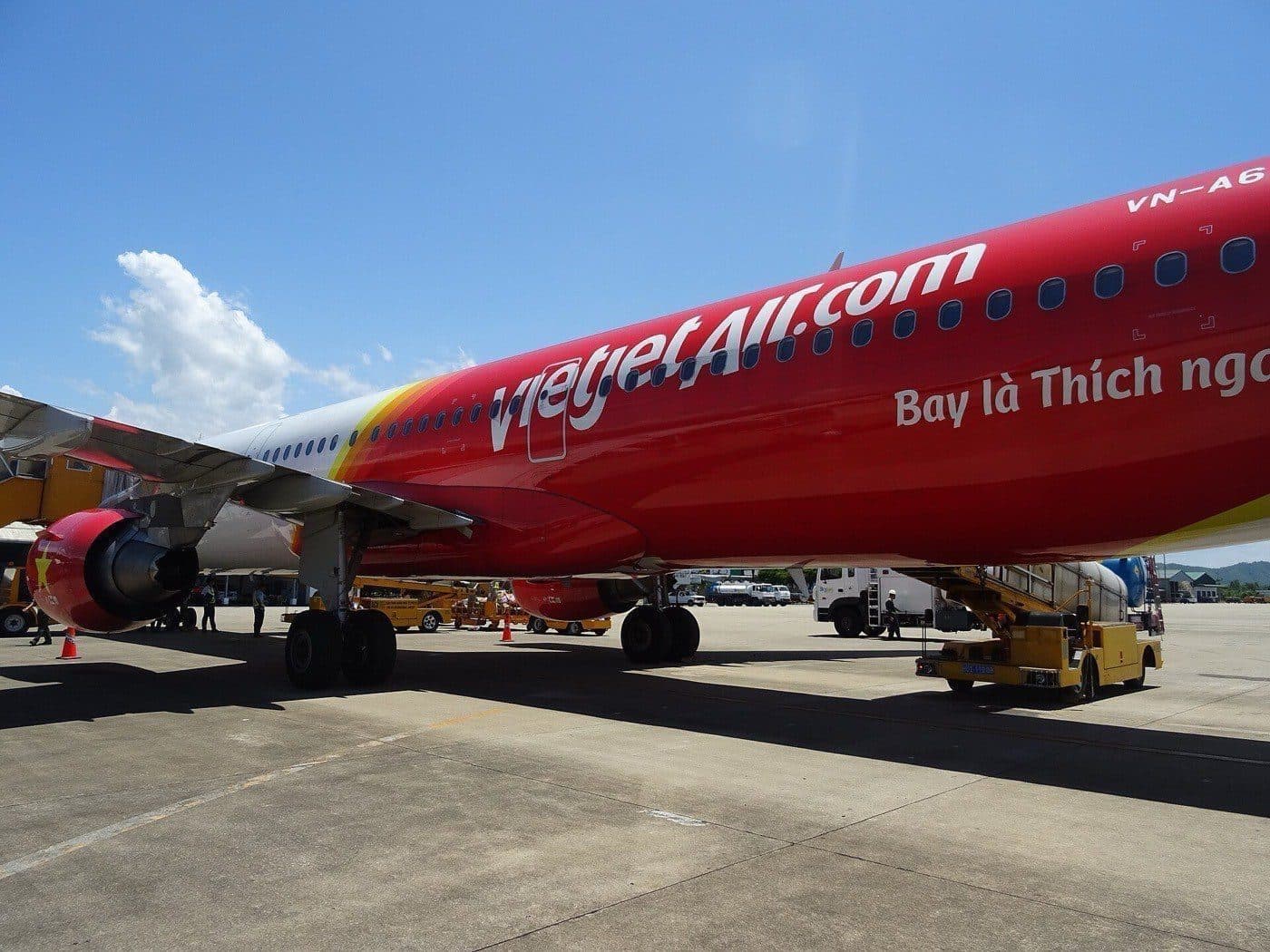
Phu Bai International (IATA: HUI) is 13.5 km from the centre as the crow flies, about 15 km on highway AH1, and 20–30 minutes in a car. It operates from 05:30 until the last flight around midnight.
The T2 terminal opened in June 2023: 22,000 square metres and capacity for five million passengers a year, with headroom to seven. Departures and arrivals are properly separated and the air conditioning copes, which is not something you can say about every provincial Vietnamese airport.
Inside you get free wifi, one café selling water and bánh mì at airport prices ($4–5 a sandwich), Vietcombank and BIDV ATMs, a currency desk 5–10% worse than town, and Viettel and Vinaphone counters selling tourist eSIMs at $8–15 for 30 days with 30 GB.
Routes for 2026: Ho Chi Minh City (1 hr 25 min, 5–7 flights a day), Hanoi (1.5 hrs, 2–3 a day). Vietnam Airlines, Vietjet and Pacific Airlines serve it.
Five ways into town
| Method | Price | Time | When to choose it |
|---|---|---|---|
| Metered taxi, Mai Linh or Vinasun | 250,000–300,000 VND ($10–12) | 20–25 min | Daytime arrival, happy to watch the meter |
| Grab or Xanh SM, fixed price | 200,000–280,000 VND ($8–11) | 20–25 min | You want the number before you get in |
| Vietnam Airlines shuttle | 50,000 VND ($2) | 30–40 min | You flew VN and their timing works |
| City bus 2 or 11 | from 4,000 VND | 50–60 min | Tight budget, light bag, daylight |
| Pre-booked private transfer | $12–18 | 20 min | Name board, kids, or a lot of luggage |
There is an official taxi desk to the left of the arrivals exit with a posted fare of around 300,000 VND into town. Use it when the apps will not load or you have no data yet.
Heading back out
- Domestic flight: check-in closes 90 minutes before departure, add 20–30 minutes on the road, so leave two hours out.
- International charter: two hours before departure plus half an hour driving, so leave two and a half.
- Rush hour (08:00–09:00 and 17:00–19:00) adds another 15–20 minutes.
The Vietnam Airlines shuttle is meant for passengers on its own flights. Ask at the airline's ticket office or check-in desk where and when it leaves.
City buses
By 2026 the local network runs fourteen active routes linking the centre with the outskirts, from Phong Dien to the coast. Fares scale with distance: from 3,000 VND on city and short routes up to 26,000 VND on the long suburban runs. Pay the conductor in cash or through the ONBus app. Service runs roughly 05:30 to 18:30 at 30 to 60 minute intervals.
The three routes a visitor might actually use:
- Route 2 — northern bus station to southern bus station to the Phu Bai stop by the airport
- Route 3 — centre to Thuan An beach (Thuận An), the cheapest way to reach the sea, from 4,000 VND
- Route 11 — airport to the northern bus station, though with a change you may as well take a taxi
Google Maps in transit mode knows the whole network and its timings are honest. The local ONBus app does the same job with a harder interface and essentially no English.
What to pick for what
Choose by the job, not the price. Across a three-day stay the difference between the cheap option and the comfortable one adds up to about two lunches.
| Scenario | Best option | Budget |
|---|---|---|
| Airport to hotel with suitcases | Grab or Xanh SM | $8–12 |
| All three tombs in one day | Automatic scooter | $6–8 plus fuel |
| Half a day on the river | Shared dragon boat | $3–3.50 |
| Citadel and back | GrabBike | about $2 return |
| Sunset lap of the centre | Cyclo for an hour | $6–10 |
| Hue to Hoi An, the scenic way | Easy Rider | $50–70 |
| Hue to Hoi An, the fast way | Limousine van | $10–16 |
| Hue to Da Nang for the ride | Heritage train HĐ1 or HĐ3 | $8 |
| Hue to Hanoi overnight | Soft sleeper | $35–54 |
| Family with kids doing the tombs | Half-day taxi with driver | $40–50 |
| Solo traveller on a tight budget | Bicycle plus city bus | $2–3 a day |
Ten things worth doing
- Install three apps before you land. Grab as the default, Be for when Grab is empty, Xanh SM for fixed pricing. All three take foreign numbers.
- Sort a data plan on arrival. A Viettel or Vinaphone eSIM is $8–15 for 30 days and 30 GB. Without data, none of the apps are any use.
- Keep small notes. Change from taxis, cyclos and boats has a way of coming back short. Hold on to 10k, 20k and 50k notes.
- Screenshot your hotel address in Vietnamese. Most drivers do not recognise hotel names in English but read the Vietnamese line instantly.
- Say "meter, please" and mean it. Every Mai Linh and Vinasun driver understands it. If you hear "no meter", get out.
- Ignore unmarked cars at the station and airport. Green Mai Linh, white Vinasun, cyan Xanh SM, or a plate that matches your app.
- Helmet and closed shoes on a scooter. Flip-flops are the fastest way to get pulled over, and the fastest way to lose skin. Ask for a second helmet if you are riding two-up.
- Fix the boat itinerary before you leave the dock. Which tombs, how long at each. Otherwise the captain optimises for himself.
- Book trains a week ahead in high season. December to March, Tet and the Chinese New Year period all clear out the sleepers.
- Do not fly Hue to Hoi An. Hoi An has no airport; the nearest is Da Nang, 40 km away. A limousine van goes door to door in 3.5 hours against most of a day with connections.
FAQ — getting around Hue
Yes. Grab covers Hue and is still the default ride-hailing app here, with GrabCar, GrabBike and GrabFood all live. You see the fare before you book, there is no meter to argue about, and you can pay by card or cash. The two alternatives are Be, a Vietnamese app that runs slightly cheaper, and Xanh SM, the electric taxi fleet.
- On the meter with Mai Linh or Vinasun250,000–300,000 VND~$10–12around
- Grab and Xanh SM quote a fixed200,000–280,000 VND~$8–11in the app
- The ride15 km along AH1highway and takes 20–25 minutes
- The Vietnam Airlines shuttle50,000 VND~$2the cheapest option, but it only runs for VN flights and only on their schedule
Rental shops will hand you the keys against your passport alone, and most never ask about a licence. Legally you need your home licence plus an International Driving Permit issued under the 1968 Vienna Convention. The 1949 Geneva-style IDP issued in the US, Canada, Australia and New Zealand is not valid in Vietnam, so riders holding one have no legal route short of converting to a Vietnamese licence. Riding without one voids your travel insurance in a crash, and since January 2025 the fine is 2,000,000–4,000,000 VND (~$77–154) for a scooter up to 125cc and up to 8,000,000 VND (~$308) above that.
By train is the best answer. Several SE services a day cover the 100 km in 2.5–3.5 hours from about 92,000 VND (~$3.5) for a seat, and the tourist "Central Heritage Connection" train leaves Da Nang at 07:50 and 15:00 with one class of air-conditioned soft seat at 207,000 VND (~$8). Both run over the Hai Van Pass with ocean views. Alternatives: a door-to-door limousine van in 3 hours for 200,000–300,000 VND (~$8–12), a private taxi for four at 1,100,000–1,500,000 VND (~$42–58), or an Easy Rider motorbike transfer over the pass in 6–8 hours for $50–70.
- A seat on a shared boat to Thien Mu Pagoda and back80,000–90,000 VND~$3–3.5per person, cheaper the bigger the group
- Chartering a single-dragon boat for up to 15 people450,000 VNDcosts for the first hour and 350,000 VND for each hour after
- A double-dragon boat for up to 35550,000 and 450,000 VND
- An evening dinner cruise500,000–900,000 VND~$19–35runs per person
- A Ca Hue music session without food100,000–150,000 VND~$4–6while
- A half-day trip out to Minh Mang Tomb250,000–450,000 VND~$10–17per person, tomb entry not included
Almost every hotel in the Pham Ngu Lao and Le Loi area lends bikes, often free to guests or for a token 20,000 VND (~$0.80) a day. Dedicated shops include Hue Charming Rental, Bikesbooking with hotel delivery, and Klook for e-bikes. A single-speed city bike is 30,000–50,000 VND a day, a geared one 50,000–80,000 VND, an e-bike 200,000–300,000 VND (~$8–12).
No. Uber sold its Southeast Asian business to Grab in 2018 and has not operated in Vietnam since. What you install instead is Grab as the main app, Be as a backup when Grab has no cars, and Xanh SM for the electric fleet with fixed in-app pricing. All three accept foreign phone numbers and international cards.
- An Easy Rider transfer$50–70 solothe best version: you ride pillion, a local rides, and the 7–9 hour day includes a seafood lunch in Lang Co, three viewpoints on the pass and the Marble Mountains outside Da Nang
- For two$80–110
- A door-to-door limousine van250,000–400,000 VND~$10–16if you just want to arrive, does it in 3.5 hours
- Riding yourself one-way and dropping the bike in Hoi Ana $30–40 relocation feeadds on top of the daily rate
Yes, if you value a saved hotel night over a smooth one. A soft sleeper (four berths, a door, linen, air conditioning) is 900,000–1,400,000 VND (~$35–54) for 13–14.5 hours. Overnight SE trains leave in the evening and arrive in Hanoi in the morning. It rattles, the corridor is noisy and the toilets go downhill after midnight. The counter-argument is a 90-minute Vietjet flight from Phu Bai, from about $40 if you book early.
Hue is one of the calmer Vietnamese cities to ride in: far less traffic than Hanoi or Ho Chi Minh City, more patient drivers, better road surface. The real risks are the October-to-January rains that make everything slick, the trucks on highway AH1 towards the airport and Hai Van, and the insurance problem if you ride without a valid permit. If you have never ridden a scooter before, start with GrabBike or a taxi: Hue is not the place to learn.
Checklist
Before you fly:
- Install Grab, Be and Xanh SM and register your number
- Download the Hue offline map in Google Maps or Maps.me
- Screenshot your hotel address in Vietnamese
- If you plan to ride, check whether your IDP is the 1968 kind, and check the two-wheeler clause in your travel insurance
- Travelling December to March? Book the Hanoi train or the Hoi An van in advance
On arrival at Phu Bai:
- Buy a Viettel or Vinaphone eSIM at the arrivals counter
- Draw cash at the Vietcombank ATM rather than the currency desk
- Book a Grab or Xanh SM and skip the unmarked cars
- Keep the ATM receipt in case of a rate dispute
First day in town:
- Walk from Truong Tien Bridge to the Citadel and calibrate your own walking radius
- Ask the front desk for scooter and bicycle rates
- Stop by Toa Kham pier and photograph the official boat price list
- Break large notes into small ones at the exchange counter
Bottom line
Walk the centre: the Citadel, the riverfront, Dong Ba market. Take a scooter, a taxi or a boat to the tombs and Thien Mu. Use Grab or Xanh SM for short hops, the train for the Hai Van views, a limousine van when you just need to arrive, and an Easy Rider when the road is the point.
A three-day version that works: day one on foot and by cyclo around the centre, day two on a scooter through the tombs, day three either on the river to Thien Mu and Minh Mang or over Hai Van to Hoi An. Budget $30 to $100 per person for transport across those three days, and the spread comes down entirely to how often you pick comfort over cost.
Hue is kind to both walkers and riders. There is no metro to learn, the traffic is a fraction of Hanoi's, and you never have to memorise district names, because almost everything worth reaching sits inside a short walk of one bridge.
See also: Hue city guide · Hue attractions · Day trips from Hue · Transport across Vietnam
VietnamSpot on InstagramTips, lifehacks and news for living in VietnamFollow




- Guide
Hue Tours 2026: Tombs, DMZ & Day Trips
Hue tours guide: imperial tombs, Bach Ma, the DMZ, a Perfume River boat and the Hai Van Pass to Hoi An — how to book and 2026 prices.Hue Tours 2026: Tombs, DMZ & Day Trips - Weather
Hue Weather by Month 2026: Best Time to Visit
Hue weather by month: temperature, rain and sea tables, the October flood season and 2025 record, plus when to go for sights, beaches and festivals.Hue Weather by Month 2026: Best Time to Visit - Food
Hue Food Guide 2026: What to Eat and Where
What to eat in Hue in 2026: 12 dishes with addresses, bun bo Hue, imperial dinners from $20 to $60, vegan chay spots, Dong Ba market and real prices.Hue Food Guide 2026: What to Eat and Where