Bun cha: Hanoi's legendary lunch
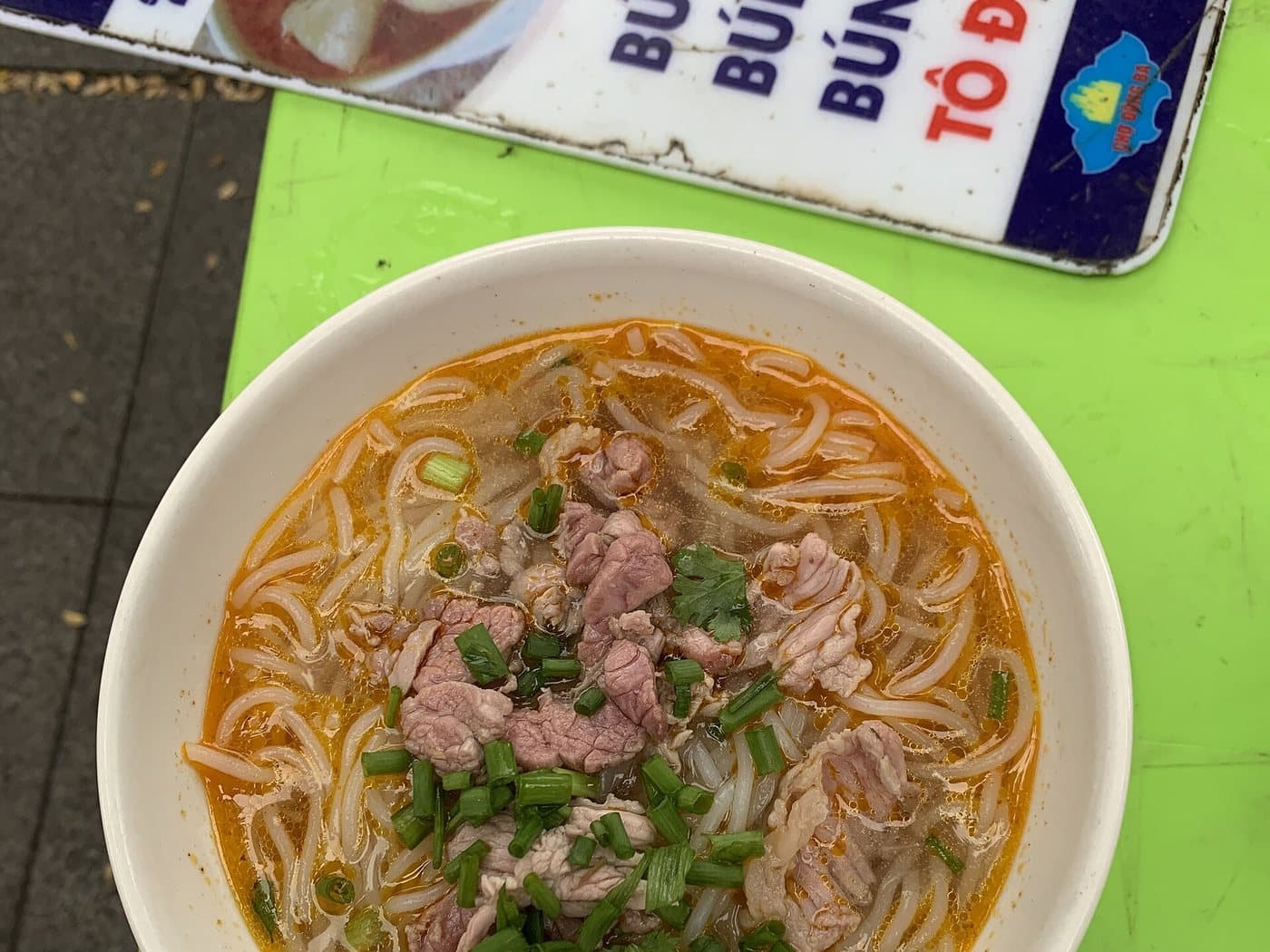
At noon in Hanoi the alleys fill with smoke and the sweet smell of pork marinated in fish sauce and shallots. This is bun cha — not a soup and not a salad, but a genre of its own: cool rice vermicelli, a warm nuoc cham sauce with two kinds of charcoal-grilled pork, and a basket of herbs. A portion starts around $1.15, and in 2016 it is what Barack Obama ate with Anthony Bourdain.

Below: how bun cha is built, the secret of the nước chấm sauce, how the Hanoi version differs from the southern one, a home recipe for four, and the best spots in Hanoi with 2026 prices. If you want the wider view of the country's food first, see our guide to Vietnamese cuisine and the roundup of Vietnamese street food.
What is bun cha — the parts and the plating
Bun cha (bún chả) is a Hanoi lunch dish built from three non-negotiable parts: rice vermicelli (bún), two kinds of charcoal-grilled pork, and a warm nước chấm sauce. It does not come in one bowl. It arrives as a set: sauce and meat in a bowl, noodles on a separate plate, herbs off to the side. You eat by dipping the noodles and leaves in the sauce and picking up pieces of pork with them.

The name is two words. Bún is rice vermicelli made from fermented rice flour: thin, white, always served cool and a little sticky. Chả is the general Vietnamese word for a grilled or processed meat; in Hanoi it means pork cooked over charcoal. No beef, chicken or seafood in the canonical version.
In every portion the pork shows up twice — and that is the pivot the whole dish turns on.
| Type of pork | What it is | What it tastes like |
|---|---|---|
| Chả miếng | Thin slices of fatty pork belly marinated in fish sauce, garlic, shallot and sugar | Caramelised bacon with a smoky edge |
| Chả viên | Minced-shoulder patties in the same marinade, sometimes wrapped in betel or jujube leaf | Mini-burgers with a sweet-salty crust |
The belly brings depth and fat; the patties bring tenderness and more spice. Locals order both and never choose between them.
The nước chấm sauce is served warm, not hot. The Hanoi version is watery and clear, tasting of diluted fish sauce with sugar and vinegar. At the bottom of the bowl there are always thin slices of pickled green papaya and carrot — they add crunch and acidity, without which the sauce-broth would fall flat.
The set comes with a big basket of greens: lettuce, perilla (tía tô), mint, Thai basil, cilantro, sometimes bean sprouts. In Hanoi the pork is almost always joined by a separate plate of nem cua bể — fried rolls with crab, shrimp and shiitake. Technically a different dish, but in Hanoi bun cha and nem travel together like fish and chips. The other kinds of nem are in our guide to Vietnamese spring rolls.
A short history — from Hanoi's alleys to the Michelin Guide
Bun cha is a relatively young dish. It is about a hundred years old, and unlike pho or banh mi it has no French godfather — it is a purely northern Vietnamese thing that grew out of street trade in Hanoi's Old Quarter.

The first reliable written mention is from 1959. The Vietnamese writer and food critic Vũ Bằng, in his memoir of pre-war Hanoi, describes the capital as "a city hypnotised by bún chả." He places the shops around the Gia Ngư area, and by then the dish was clearly not new — which means it appeared at least a couple of decades earlier, in the 1920s or 1930s. This is echoed on Wikipedia.
Who invented bun cha
There is no single inventor, which is typical of street food. The common theory: the dish came together from two habits that already existed in Hanoi side by side. First, the northern habit of grilling pork on small clay braziers right by the front door, to pull in customers with the smoke and smell. Second, the custom of serving cool rice vermicelli with a warm fish-sauce dip, which came in from the rice fields of the Red River delta.
At some point vendors thought to set those two things next to each other — and there was bun cha. No French influence here: pork is an ancient northern meat, rice vermicelli is local, and the charcoal brazier is older than colonisation.
Bun cha carried on a shoulder pole
In the 1930s bun cha was sold from shoulder poles. On one end, a basket of noodles, herbs and sauce; on the other, a small brazier of glowing charcoal. The vendor would set the pole down on the pavement, fan the coals, thread pork onto bamboo skewers and grill it right at the customer's feet. You ate sitting on a low plastic stool, or just standing.
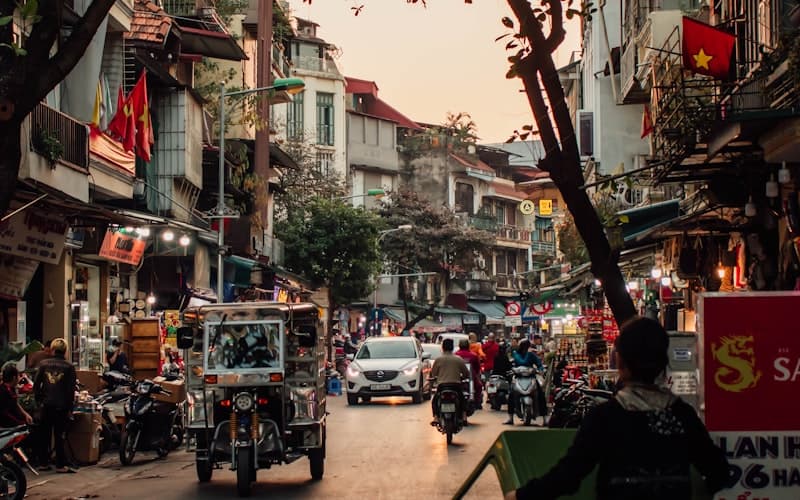
That tradition has barely changed. In the Đống Đa district and the alleys of the Old Quarter, grandmothers still grill bun cha on the pavement in open braziers. For a first-timer it is disorienting: you sit on a 20-centimetre stool, pork smokes half a metre away, mopeds roar past, and it is all happening at noon in 35 °C heat. But that is exactly how you should eat bun cha the first time.
War, shortages and a comeback
In the 1960s and 70s, because of war and pork shortages, bun cha nearly vanished — meat was rationed once a month and no one would spend it on street food. The revival came in the 1980s, after the đổi mới reforms made private trade legal again. Many of the shops now treated as iconic opened in those years: Hương Liên, for one, has run since the late 1980s.
Bib Gourmand and global recognition
In 2023 Michelin launched its Vietnam guide. In that very first edition, Bún Chả Ta and Tuyết Bún Chả 34 landed in the Bib Gourmand category (good food at a fair price); the second edition, in 2024, added Bún Chả Chan. Bún Chả Đắc Kim and Hương Liên are in the guide too, but as Selected restaurants, without a Bib. By then the dish was already one of Hanoi's main brands — on a par with Hoan Kiem Lake and the Old Quarter.
Obama and Bourdain — how one meal changed a shop
An evening in May 2016 shifted the geometry of Vietnamese tourism. Not just one eatery, but the whole idea of what a traveller means by "the real Hanoi."

At the time, Parts Unknown on CNN was the biggest food-travel show in the world. Bourdain deliberately picked Hương Liên: a small family place off the tourist trail, no English menu, plastic stools, one hand-wash sink for twenty tables. The US president sat on a knee-high stool and ate with thin chopsticks. It was not a PR stunt — it was an honest demonstration of how Hanoi's street kitchen actually works.
The scene aired that autumn and spread quickly across social media. Later the owner sealed the table where the guests sat under a glass case, together with the bowls, chopsticks and Hanoi beer bottles. More on the episode at Vietnam Tourism.
The Obama Combo in numbers
The "Obama Combo" is a menu item introduced two weeks after the broadcast. It repeats exactly what the president ordered: bun cha, one nem cua bể and a bottle of Hanoi beer.
| Year | Obama Combo price | In USD (approx.) |
|---|---|---|
| 2017 | 85,000 VND | ~$3.70 |
| 2020 | 85,000 VND | ~$3.60 |
| 2023 | 100,000 VND | ~$4.10 |
| 2025 | 120,000 VND | ~$4.60 |
| 2026 | 130,000 VND | ~$5 |
The price has climbed, but in dollar terms the "Obama Combo" is still one of the cheapest presidential lunches on Earth. For comparison: an average bill at a Michelin restaurant in Hanoi starts at 400,000 VND (~$16).
Should you go there specifically
The honest answer is yes — but only if you are ready for the tourist crowd. Hương Liên has long stopped being the family shack of 2016. At lunch the queue of Europeans, Chinese and Koreans stretches half an hour. Staff speak English, the menu is translated, and prices run 30–40% above the Hanoi average. The pork is still tasty and the sauce is solid, but it is no longer a "secret local spot."
If it is the 2016 atmosphere you want, go instead to Đắc Kim at 1 Hàng Mành or to Tuyết Bún Chả 34. Fewer tourists, shorter queue, same prices. Save Hương Liên for the photo of the glass case and a tick on the bucket list.
The nuoc cham sauce — the secret of the flavour
Bun cha stands or falls on its sauce. The pork can be a bit dry, the noodles clumped, the herbs limp — if the sauce is right, you will still empty the bowl. If the sauce is bad, even perfect pork will not save it.

The nước chấm for bun cha is very different from the dip served with spring rolls or rice-paper rolls. The key difference: it is warm, not room temperature, and it is deliberately loaded with liquid. It is essentially a diluted, light sauce-broth with pickled vegetables and garlic flakes floating in it.
The ratio
Over decades Hanoi settled on a stable formula. To reproduce it at home, hold these proportions by volume: 1 part fish sauce, 1 part sugar, 1 part vinegar (rice or white wine), 4 parts warm water. That is the base; you can flex it about ten percent either way.
Nuoc cham recipe for 4 servings
| Ingredient | Amount | Why |
|---|---|---|
| Fish sauce (nước mắm) | 80 ml | Umami and salt |
| Sugar (cane or yellow rock) | 80 g | Sweetness, balances the fishy note |
| Rice vinegar | 60 ml | Acidity, lightness |
| Warm water | 320 ml | Softens the edge, makes it drinkable |
| Lime juice | 1 lime | Freshness at the end |
| Garlic | 3 cloves | A sharp accent |
| Chilli (Thai bird's eye) | 1–2 | Heat |
| Carrot | 1 medium | Crunch and sweetness |
| Green (unripe) papaya | 100 g | Crunch and a light bitterness |
Combine the fish sauce, sugar, vinegar and water in a small pan over low heat. The sugar must fully dissolve, but do not let it boil — boiling turns fish sauce sharp and bitter. Take it off the heat the moment the first bubbles appear.
Pickle the vegetables separately. Cut the carrot and papaya into thin diamonds or flower shapes — in Hanoi they use a special fluted vegetable knife for this. Cover them with a mix of 2 tbsp vinegar, 1 tbsp sugar and 1 tbsp warm water. Let stand 15–20 minutes.
Before serving, combine the sauce and the pickled vegetables in one bowl. Add lime juice, finely chopped garlic and sliced chilli. The sauce should be warm, clear and a pale amber. On the palate: salty-sweet-sour, with a hint of heat and a background note of fermentation.
What ruins nuoc cham
- Cold water instead of warm — the sugar won't fully dissolve and you get sediment at the bottom
- Too strong a fish sauce (an "extra fish sauce" concentrate) — dilute it further with water, one to one
- Lemon instead of lime — too harsh an acidity. If you have no lime, use lemon juice, but half as much
- Boiling — take it off the heat at the first bubbles. Long boiling kills the aroma
Fast Track — no queue at the border
5–10 minutes instead of an hour in the immigration queue
from$11per passenger
The pork — two forms of chả
Hanoi bun cha is built on two kinds of pork: thin-sliced belly (chả miếng) and minced patties (chả viên). They cook over the same coals but are marinated and eaten differently. If your bowl has only one kind, it is either a simplified tourist version or a weak shop.

The marinade
The base marinade in Hanoi has barely changed in half a century. Per kilo of pork: 3 tbsp fish sauce, 1 tbsp dark soy sauce, 2 tbsp caramelised sugar (cooked separately from sugar and water to a dark brown), 4 chopped shallots, 4 garlic cloves, a teaspoon of black pepper, 1 tbsp vegetable oil. For the patties, add cornstarch — it binds the mince.
Shallot in the marinade is essential. Ordinary onion won't replace it: shallot is finer in aroma, less pungent, sweeter. If you have no shallot, use red onion, but a half more of it.
Marinate at least three hours, ideally overnight. The sugar in the marinade gives that caramel crust, which is what separates real bun cha from plain grilled pork.
Grilling over charcoal
The ideal bun cha is cooked only over charcoal. A gas burner won't give the smoky aroma that soaks into the meat and then keeps working in the sauce. In Hanoi they grill over coconut charcoal — it gives clean smoke without soot.
The belly is cut into 3–4 mm slices, threaded onto flat bamboo skewers (flat, not round, so the meat doesn't spin) and grilled 2–3 minutes a side. The patties are shaped to the size of a walnut, slightly flattened, and grilled longer — 4–5 minutes a side.
The main sign of doneness is a caramel crust with dark spots at the edges. Inside, the meat should stay juicy. If the crust is grey and the inside dry, it was overcooked. If the crust is pale, it was undercooked or the marinade was short on sugar.
A Hanoi subtlety: the patties are often wrapped in a betel leaf (lá lốt) before grilling. The leaf burns on the coals but has time to pass on a spicy aroma with notes of clove and eucalyptus. If you find fresh betel at an Asian grocer, give it a try.
Hanoi vs Ho Chi Minh City
Bun cha is a northern dish, and that is both its strength and its curse. In the south they make it, but don't love it, and often confuse it with a similar dish — bún thịt nướng. These are two different foods, and in Ho Chi Minh City it pays to know that in advance, or you'll order something other than what you expected.
| Feature | Hanoi (bun cha) | HCMC (bun thit nuong) |
|---|---|---|
| Noodles | Thin rice vermicelli bún, cool | The same rice vermicelli bún, at room temperature |
| Pork | Belly + patties, two separate kinds | Often only belly, cut larger |
| Sauce | Warm, light, watery, with pickled veg | Sweeter, thicker, no pickled papaya |
| Serving | A set: sauce and pork in a bowl, noodles apart | Often all in one bowl, like a salad |
| Skewers | Bamboo, flat | More often metal |
| Herbs | Perilla, mint, Thai basil, cilantro | Often just lettuce and mint |
| Time of day | Mostly at lunch | Any time of day |
If you want the true Hanoi bun cha in the south, look for a shop with "Hà Nội" or "Bún chả Bắc" in the name. There are plenty in Ho Chi Minh City, especially in the former Districts 3 and 10, home to many northern migrants.
Why southerners don't love bun cha
It is cultural. The south leans toward dishes where everything is mixed in one bowl — cut it up, pour on sauce, toss and eat. The northern "dip and assemble piece by piece" approach feels slow and fiddly to them. And southerners are used to a sweeter, thicker cuisine, so the Hanoi nước chấm reads to them as "watered-down vinegar."
In Ho Chi Minh City you'll mostly find bun cha in places with a northern family tradition or in tourist restaurants aimed at foreigners who want to try "that Obama dish." Locals don't go — they go for bun thit nuong or street food.


Bun cha at home — recipe for 4
Bun cha is one of the few Vietnamese dishes you can genuinely recreate at home without special gear. No charcoal brazier, no bamboo skewers, no fluted vegetable knife needed. You need a grill pan, two hours, and a basic set of Asian pantry staples.

This recipe is the version Hanoi family cafes grill the pork by. Minimum ingredients, maximum honesty.
For the pork (4 servings)
| Ingredient | Amount |
|---|---|
| Pork belly with a fat layer | 500 g |
| Minced pork (shoulder, not lean) | 300 g |
| Shallots | 6 |
| Garlic | 5 cloves |
| Fish sauce | 4 tbsp |
| Dark soy sauce | 1 tbsp |
| Cane sugar | 3 tbsp |
| Ground black pepper | 1 tsp |
| Vegetable oil | 2 tbsp |
| Cornstarch | 1 tbsp (for the mince only) |
For the nước chấm sauce, use the 80/80/60/320 ml formula from the section above.
For serving
Step by step
Step 1. Marinade. Caramelise the sugar: pour 2 tbsp water into a small pan, add 3 tbsp sugar, set over medium heat. Don't stir. After 4–6 minutes the syrup turns dark amber — take it off the heat and add 2 more tbsp of hot water (careful, it spatters). That is your nước màu, the marinade caramel. Finely chop the shallots and garlic. Mix the fish sauce, soy sauce, cooled caramel, pepper, shallots, garlic and oil.
Step 2. Split the meat. Slice the belly into 3–4 mm pieces across the grain. Put it in a bowl, cover with two-thirds of the marinade, mix by hand. Into the mince add the rest of the marinade, the cornstarch and a pinch of pepper. Knead until sticky — 2–3 minutes by hand, as for meatballs. Shape into walnut-sized balls, slightly flattened. Cover both bowls with film and chill at least 3 hours. Overnight is ideal.
Step 3. Pickled veg. Cut the carrot and papaya (or daikon) into thin diamonds. Cover with a mix of 3 tbsp rice vinegar, 1 tbsp sugar and 100 ml warm water. Let stand 20 minutes, then drain.
Step 4. Sauce. In a small pan combine 80 ml fish sauce, 80 g sugar, 60 ml vinegar and 320 ml warm water. Dissolve the sugar over low heat without boiling. Off the heat, add lime juice, chopped garlic and sliced chilli. The sauce should be warm at serving.
Step 5. Grill. Heat a grill pan to max. If you have an oven with a top broiler, set it to max with the rack on top. Grill the belly 2–3 minutes a side to dark spots at the edges. The patties, 4 minutes a side. The pork should smoke a little — that's normal; the marinade is caramelising.
Step 6. Noodles. Soak the bún in boiling water for 5–7 minutes, stirring. Drain and rinse under cold water. The noodles should be cool, white and not sticky.
Step 7. Serve. Pile the belly and patties into a big bowl. Cover with warm sauce and pickled veg — the meat should float in the sauce, neither drowned nor left dry. Cool vermicelli on a separate plate. Herbs and lettuce on a third.
Time: 30 minutes of active work + 3 hours marinating. One serving is roughly 480–520 kcal.
How to eat bun cha — step by step
The first bun cha stumps most travellers. Three separate things sit in front of you: a bowl of sauce with pork floating in it, a plate of noodles, a basket of herbs. What do you do with them? Pour what into where? Grab it with what?

The canonical Hanoi way is to dip. Not to mix. Not to pour the sauce over the noodles. You dip, piece by piece.
Step 1. Smell the sauce. A good nước chấm smells in three layers: first sweet vinegar, then a fermented fish note, then smoke off the pork. If it smells only of fish and nothing else, the sauce is young or the meat is cold. If it smells of vinegar and plastic, the shop has watered it down.
Step 2. Take a pinch of noodles with chopsticks. Don't grab the whole portion — the little mound should fit on a spoon. Dip it in the sauce, hold 2–3 seconds so the noodles soak up liquid. Pick up a slice of pork or a patty and set it on the noodles.
Step 3. Add herbs. Onto the same lump of noodles and meat, add a mint leaf, a piece of perilla or some bean sprouts. Eat it all in one bite. Chew slowly — the flavour assembles from the parts like a mosaic.
Step 4. Between bites, a sip of sauce. Don't drink the sauce like a soup, but you can spoon out a couple of pickled carrots and eat them on their own. They "reset" the palate for the next piece of pork.
Step 5. If there is nem cua bể. Eat the rolls separately, also dipping them in the sauce. They aren't part of the noodle-meat-herb rhythm — they're a side of their own.
A mini phrasebook for ordering
| Phrase | Roughly | Meaning |
|---|---|---|
| Cho tôi một bún chả | cho toy mot bun cha | "One bun cha, please" |
| Thêm chả viên | them cha vien | "More patties" |
| Không cay | khom kai | "No chilli" |
| Tính tiền | tinh tien | "The bill, please" |
The pronunciations here are rough — Vietnamese is tonal, and the same word in different tones means different things. But in everyday speech at tourist cafes you'll be understood, especially if you point at the menu.
Map & where to try bun cha in Hanoi — top spots for 2026
Bun cha is sold on every corner in Hanoi, mostly from 11 a.m. to 2–3 p.m. But five to seven places either made the Michelin Guide, held the standard for decades, or became tourist icons. Here they are, with 2026 prices.
Start with where they actually are. The green pins are up to 55,000 VND a portion, the blue ones sit at 60,000–80,000, the amber one starts at 90,000. Tap a pin for the address, the hours and what people order there. Start in the north and all five fit into one day.
- Tuyết Bún Chả 34: 34 Hàng Than, Ba Đình — 50,000 VND (~$1.90) · 08:30–17:30 — Patties in jujube leaf · Bib Gourmand
- Bún Chả Hương Liên: 24 Lê Văn Hưu, Hai Bà Trưng — 60,000 VND (~$2.30) · Obama Combo 130,000 — Michelin Guide 2025, no star
- Bún Chả Đắc Kim: 1 Hàng Mành, Hoàn Kiếm — 80,000 VND (~$3.10) · 09:00–21:00 — Same family since 1966 · Michelin Guide 2025
- Bún Chả Ta: 21 Nguyễn Hữu Huân, Hoàn Kiếm — 90,000 VND (~$3.50) · 08:00–22:00 — Air conditioning, English menu · Bib Gourmand
- Bún Chả Chan: 114 Mai Hắc Đế, Hai Bà Trưng — 55,000 VND (~$2.10) · 11:00–16:00 — Patties in betel leaf · Bib Gourmand
Bún Chả Hương Liên — the Obama spot
| Address | 24 Lê Văn Hưu, Hai Bà Trưng district |
|---|---|
| Hours | 08:00–20:00 daily |
| Regular portion | 60,000 VND (~$2.30) |
| Obama Combo | 130,000 VND (~$5) |
| Michelin Guide 2025 | Listed, no star |
Obama's table sits under glass; at lunch, a 20–30 minute queue of tourists. The pork is average, the sauce is good but not the best in town. Come for the experience and the photo, not for the best bun cha in Hanoi. English menu, Wi-Fi. No espresso after lunch — pop next door, or try the local cà phê trứng (egg coffee).
Bún Chả Đắc Kim — an institution since 1966
| Address | 1 Hàng Mành, Hoàn Kiếm district |
|---|---|
| Hours | 09:00–21:00 |
| Regular portion | 80,000 VND (~$3.10) |
| Add-on | nem cua bể 40,000 VND (~$1.55) |
| Michelin Guide 2025 | Listed |
The oldest bun cha shop in the tourist heart of Hanoi, run by the same family for over sixty years. The portion is bigger than the city average — the pork is literally piled into a pyramid. Prices run a touch higher for the Old Quarter location, but the quality is steady and the queue moves fast. Details on its Michelin Guide page.
Tuyết Bún Chả 34 — patties in leaves
| Address | 34 Hàng Than, Ba Đình district |
|---|---|
| Hours | 08:30–17:30 |
| Regular portion | 50,000 VND (~$1.90) |
| Signature | Patties wrapped in jujube leaf |
| Michelin Guide 2025 | Bib Gourmand |
A small family place that mostly draws locals. Fewer tourists than in the Old Quarter, and the mood is closer to 1990s Hanoi: plastic stools, metal tables, the grandmother-owner personally checking the sauce in every bowl. The patties are wrapped in jujube leaf — it almost fully burns on the coals but passes a spicy aroma to the meat.
Bún Chả Ta — a comfortable Bib Gourmand
| Address | 21 Nguyễn Hữu Huân, Hoàn Kiếm district |
|---|---|
| Hours | 08:00–22:00 |
| Regular portion | 90,000 VND (~$3.50) |
| Signature | Big air-conditioned room, English menu |
| Michelin Guide 2025 | Bib Gourmand |
If you want your first-ever bun cha without the "pavement stool and 40-degree heat" shock, go to Ta. Air conditioning, proper tables, a photo menu, English. The pork and sauce are at Bib Gourmand level, and the portion is fairly priced. Details on its Michelin Guide page.
Bún Chả Chan — betel leaves and a Bib Gourmand
| Address | 114 Mai Hắc Đế, Hai Bà Trưng (per OSM) |
|---|---|
| Hours | 11:00–16:00 |
| Regular portion | 55,000 VND (~$2.10) |
| Signature | Patties in betel leaf, minced beef as an option |
| Michelin Guide 2025 | Bib Gourmand |
Over ten years in business and a loyal local base. The bun cha here is unusual: alongside the classic pork patties in betel leaf, you can get a beef version in the same leaf — one of the few shops that serves it.
How much does bun cha cost in 2026
Bun cha is one of the most affordable full meals in Vietnam. Even in tourist Hanoi a portion is under $7, and in neighbourhood shops around $2.
2026 prices
| Venue type | Price (VND) | In USD (approx.) | What you get |
|---|---|---|---|
| Neighbourhood street stall | 30,000–45,000 | ~$1.15–1.75 | Bun cha without nem, plastic stool |
| Mid-range cafe | 50,000–80,000 | ~$1.90–3 | Bun cha + tea or water |
| Michelin Bib Gourmand | 50,000–90,000 | ~$1.90–3.50 | Bun cha + optional nem cua bể |
| Tourist restaurant | 100,000–180,000 | ~$3.85–7 | Bun cha + rolls + a drink |
| Obama Combo (Hương Liên) | 130,000 | ~$5 | Bun cha + nem + Hanoi beer |
Rate used here: about 26,000 VND = $1 (mid-2026). Carry small notes (20,000, 50,000 VND) — street stalls rarely break a 500,000 VND bill, and paying by card is not an option at these places. Bun cha is cash only.
To put it in traveller terms: a full bun cha lunch — crisp pork, patties, noodles and greens — costs about what a single coffee does back home, and comes with almost a century of history and a plastic stool. For the bigger picture on food, lodging and transport, see our guide to prices across the country.
Calories and nutrition
Bun cha is considered one of the more balanced street meals in Hanoi. It has carbs (rice noodles), protein (pork), fibre (herbs) and little excess fat — the meat grills over charcoal and a good share of the fat drips away.
Nutrition of a standard portion (estimate)
| Metric | Per 100 g | Per portion (~450 g) |
|---|---|---|
| Calories | 110 kcal | 480–520 kcal |
| Protein | 6.5 g | 25–28 g |
| Fat | 4.5 g | 18–22 g |
| Carbs | 13 g | 55–60 g |
| Sugar | 2.5 g | 11–13 g |
| Salt | 0.9 g | 4.0 g |
The figures above are for a canonical Hanoi portion with belly, patties and a normal amount of sauce. Add nem cua bể and tack on another 280–320 kcal. If the sauce is more diluted (tourist places often do this), it's slightly fewer calories, thanks to less sugar.
By our estimate, bun cha is close to a bowl of pho on calories — around 500 kcal per serving. It usually has more protein, from the two kinds of pork.
Who it suits
- For lunch — ideal. Protein and carbs carry you to evening without heaviness
- For dinner — less so. If you eat after 7 p.m., note that around 4 g of salt (the WHO advises under 5 g a day) is a lot
- Post-workout — works, especially for strength training: 25 g protein plus fast carbs
- For breakfast — no. The Vietnamese don't eat it in the morning, and for good reason: 22 g of fat is heavy on an empty stomach
Rookie mistakes — and how not to get the tourist treatment
Bun cha is a simple dish, and simple dishes are exactly where a tourist is easiest to fool. Here are the situations that come up regularly, and how to dodge them.
1. Ordered bun cha for dinner and wondered why everyone left
Bun cha is a lunch food. The braziers fire up around 10 a.m. and the pork usually runs out by 2–3 p.m. If at 6 p.m. a tourist menu still lists bún chả, it's often a reheated portion or a version adapted for foreigners. In the evening, the well-known places that stay open late are a safer bet.
2. Paid 200,000 VND for an ordinary portion
A few Old Quarter shops run "double pricing": 50,000 VND for locals, 150,000–200,000 for tourists. The tells: a menu with no prices, an English-speaking waiter who brings food without asking, no price list on the wall.
The defence is simple: always ask the price before ordering, and look at the Vietnamese menu, not the English one. If it's English-only with a "special" label, it's a tourist spot, marked up at least double.
3. Got cold pork
Good bun cha reaches the table 5–7 minutes after you order: the pork is grilled in front of you and arrives still steaming. If you wait more than 15 minutes, either the shop has a charcoal problem or they're reheating a batch cooked in the morning. Cold pork in bun cha is almost always the second.
4. No pickled vegetables in the sauce
Not a disaster, but a sign of cutting corners. Pickled carrot and green papaya are a required part of the nước chấm for bun cha. Without them the sauce is one-dimensional — just salty-sweet, no crunch or acidity. In Michelin places they're always there.
5. Ordered bun cha in a southern city and got bun thit nuong
In Ho Chi Minh City, Nha Trang and Da Nang, a dish labelled bún chả is often bun thit nuong — a different dish, similar ingredients, different plating. It's not a scam, it's a regional habit. If you want the Hanoi version, look for "Hà Nội" or "Bắc" (north) on the menu, and ask the waiter straight: "bún chả Hà Nội?" More on southern food in our street food guide.
FAQ — common questions about bun cha
It is Hanoi's classic lunch: a plate of cool rice vermicelli, a bowl of warm sauce with two kinds of grilled pork — thin charred belly and little patties — and a basket of fresh herbs. You dip the noodles and greens in the sauce and pick up the pork. Bun cha is a northern dish, and in Hanoi it is eaten only at lunch.
They are two very different dishes, though both are northern. Pho is a soup: hot broth and noodles in one bowl, eaten for breakfast. Bun cha is a "dipping set": sauce and meat in one bowl, noodles on a separate plate, eaten by dipping, only at lunch. Pho is about the broth; bun cha is about the charcoal smoke.
- At a normal local cafe50,000–80,000 VND~$1.90–3usually
- At a street stallfrom 30,000 VND~$1.15
- At a Michelin Bib Gourmand spot50,000–90,000 VND~$1.90–3.50
- At tourist restaurantsup to 180,000 VND
- The Obama Combo at Hương Liên130,000 VND~$5
Rate used: about 26,000 VND = $1
It is the set Barack Obama ordered in 2016 at Bún Chả Hương Liên, 24 Lê Văn Hưu, Hanoi. It is a portion of bun cha, a fried crab roll (nem cua bể) and a bottle of Hanoi beer. In 2026 it costs 130,000 VND. The table where the president sat is under a glass case.
With chopsticks. Take a pinch of noodles, dip them in the sauce for a couple of seconds, pick up a slice of pork or a patty, add a leaf of mint or perilla on top, and eat it in one bite. Never pour the sauce straight over the noodles — in Hanoi that reads as a tourist mistake. Between bites, spoon out the pickled carrot and papaya from the sauce.
Yes, and it is one of the more doable Vietnamese dishes for a home kitchen. You need pork belly and mince, fish sauce, rice vermicelli, shallots, garlic, lime and sugar. Everything except the rice vermicelli and fish sauce is in an ordinary supermarket; those two come from an Asian grocer or online. Full recipe for four is in the section above.
In the classic Hanoi version, no. Chilli is served separately in slices and you add it to the sauce yourself, to taste — or not at all. In the south it is sometimes made hotter to begin with, but even there it is not "fiery." To order without chilli, say "không cay."
Traditionally at lunch, roughly 11 a.m. to 2–3 p.m. Most street shops close by evening, but well-known places such as Đắc Kim and Bún Chả Ta stay open into the evening. For the proper experience, go around noon.
The pork and noodles are safe. The main risks are the fish-sauce dip (high in salt) and the raw herbs, which may be poorly washed. If pregnant, ask for less sauce and stick to well-known, busy cafes. Kids over three usually love it — especially the patties. Skip the chilli in their portion.
Bun cha is a hundred years of Hanoi lunches in one bowl. Noon smoke over the alleys, shallot in the marinade, pickled papaya in the sauce, bamboo skewers of caramel-crusted pork. Not a soup, not a salad — a genre of its own, easiest to understand by tasting it. Cook it at home from the recipe above, or come to Hanoi and order a portion at Đắc Kim on Hàng Mành at exactly noon.
- Food
Vietnamese Coffee Guide 2026: What to Order and Where
Eight Vietnamese coffee drinks explained: how they taste, what they cost in VND and USD, and 12 cafés in seven cities, from Hanoi to Nha Trang.Vietnamese Coffee Guide 2026: What to Order and Where - Food
Vietnamese Cuisine 2026: 20 Dishes to Try
A guide to Vietnamese food: pho, banh mi, banh xeo, bun cha, coffee and more — what to order, what it costs and which dishes are spicy.Vietnamese Cuisine 2026: 20 Dishes to Try - Food
Hue Food Guide 2026: What to Eat and Where
What to eat in Hue in 2026: 12 dishes with addresses, bun bo Hue, imperial dinners from $20 to $60, vegan chay spots, Dong Ba market and real prices.Hue Food Guide 2026: What to Eat and Where