7-day northern Vietnam route: Hanoi, Ha Long, Sapa in 2026
In 7 days across northern Vietnam you see three different worlds: old Hanoi, the limestone karsts of Ha Long Bay and the rice terraces of Sapa with the Hmong and Giay peoples. A ready-made plan with specific trains and buses, 2026 prices in USD, and three budget tiers — from ~$305 to ~$1,200 per person, flights aside.

In 7 days across northern Vietnam you see three different worlds: old Hanoi with a thousand years of history and egg coffee whipped from yolk; the limestone karsts of Ha Long jutting from emerald water; and the rice terraces of Sapa, home to the Hmong and Giay peoples. This is a ready-made plan with specific trains and buses, 2026 prices in USD, and three budget tiers — from ~$305 to ~$1,200 per person (international flights aside).
The route is built for anyone with one week off who wants three climates in a single trip: monsoon Hanoi, maritime Ha Long and mountain Sapa with its +5 °C nights. Seven days is generous here — you cover the capital, the bay and the mountains and still keep a buffer for the flight home without a scramble on the last morning.
Getting in is easy for most nationalities: whether you enter visa-free or on an e-visa depends on your passport (see the visa note at the end), but for a one-week trip the paperwork is minimal. If you have two weeks, this route stretches naturally into a longer north-to-south loop.
Seven days in northern Vietnam — three worlds, one route
In a week you can realistically run the Hanoi → Ha Long → Sapa triangle without wrecking your pace. The base scheme: 2 days in Hanoi, 1 night on a Ha Long cruise, 2.5 days in Sapa, plus one overnight transfer between Ha Long and Sapa and a buffer day to return. The budget per person, flights aside, runs from about ~$305 (backpacker) to ~$1,200+ (comfort).
The whole route in one table:
| Day | Location | Programme | Where to sleep |
|---|---|---|---|
| 1 | Arrive Hanoi | Grab from Noi Bai (280,000 VND), evening on Ta Hien street, Hoan Kiem | Old Quarter, Hanoi |
| 2 | Hanoi | Ho Chi Minh Mausoleum, Temple of Literature, bun cha lunch, water puppets, Train Street | Old Quarter, Hanoi |
| 3 | Hanoi → Ha Long | 07:30 transfer, 11:30 board the cruise, Sung Sot Cave, kayaks, sunset | Cabin on the boat |
| 4 | Ha Long → Hanoi → Sapa | 09:00 breakfast, 12:00 bus to Hanoi (back by 15:00), dinner, 22:00 night train or limousine bus | Train / sleeper bus |
| 5 | Sapa | 04:00–07:00 arrival (limousine bus / train), hotel, breakfast, Cat Cat trek (3 h), café, dinner | Central Sapa |
| 6 | Sapa | Main trek Lao Chai → Ta Van (9 km / 5 h), lunch with a Hmong family | Central Sapa |
| 7 | Sapa → Hanoi → fly out | Morning Fansipan or the Silver Waterfall, 14:00 limousine to Hanoi, airport | — |
The plan gives three budget tiers in one table, a full comparison of the four ways from Hanoi to Sapa (limousine, the SP1/SP3 night train, the premium Victoria Express, sleeper bus), a clear split of the three northeastern bays (Halong vs Bai Tu Long vs Lan Ha) and a plan B for when a typhoon closes the port. Prices are in dong with a rough USD conversion at ~26,000 VND = $1 (July 2026).
Route map: 20 points from Hanoi to Sapa
All 20 points of the route on one map. Hanoi (10 points), Ha Long Bay (4 points), Sapa (6 points). Tap a point for the entry price, opening hours and the one thing worth knowing.
- Ho Chi Minh Mausoleum (Lăng Chủ tịch Hồ Chí Minh): Free, 1–2 h queue in summer — Closed Mon & Fri, strict dress code
- Temple of Literature (Văn Miếu – Quốc Tử Giám): 70,000 VND / ~$2.80 — Vietnam's first university, 08:00–17:00
- Hoan Kiem Lake (Hồ Hoàn Kiếm): The heart of Hanoi — Ngoc Son Temple 50,000 VND, The Huc bridge
- St Joseph's Cathedral (Nhà thờ Lớn Hà Nội): Free — Neo-Gothic, 1886, a classic photo spot
- Old Quarter (Phố cổ Hà Nội): 36 streets, market, cafés — Best base for backpackers and mid-range
- Train Street (Phố Đường Tàu): Trains at 15:00, 19:00 and 19:45 — Enter via a café, coffee 50,000–80,000 VND
- Hoa Lo Prison (Nhà tù Hỏa Lò): 50,000 VND / ~$2 — The "Hanoi Hilton" museum, 08:00–17:00
- Water Puppet Theatre (Nhà hát múa rối Thăng Long): 100,000–200,000 VND — 50-min show, sessions from 15:00
- Imperial Citadel (Hoàng thành Thăng Long): 70,000 VND — UNESCO site, closed Mon
- Tran Quoc Pagoda (Chùa Trấn Quốc): Free — On West Lake, the best sunsets
- Tuan Chau Marina (Cảng Tuần Châu): Main cruise port for the bigger boats — Check-in 11:30
- Ha Long International Passenger Port (Cảng tàu khách quốc tế Hạ Long): The newer port — For 5★ cruises
- Sung Sot Cave (Hang Sửng Sốt): 10,000 VND — Ha Long's biggest cave, 10,000 m²
- Bai Tu Long Bay (Vịnh Bái Tử Long): Eastern part, no mass tourism — Indochina Junk, ~$30–50 pricier
- Central Sapa (lake) (Hồ Sapa): Square, hotels, restaurants — 1,600 m above sea level
- Cat Cat Village (Bản Cát Cát): 150,000 VND — 30 min on foot, Black Hmong
- Lao Chai Village (Lao Chải): Start of the Muong Hoa trek — Free, Hmong guide ~$15–20
- Ta Van Village (Tả Van): End of the trek, Giay people — Homestay ~$20–30 with dinner
- Fansipan (Cáp treo Fansipan): 800,000 VND / ~$32 — Sun World cable car to 3,143 m
- Silver Waterfall (Thác Bạc): 20,000 VND — 12 km from Sapa, 100 m high
The map makes the logic obvious at a glance. Hanoi to Sapa is 280 km as the crow flies; Hanoi to Ha Long is 130 km. The roads loop through plains and mountains: 2.5 hours to Ha Long on the QL5B expressway, about 6 hours to Sapa by limousine bus up the switchbacks. The north's main airport is Noi Bai (HAN) outside Hanoi, and most traffic goes through it. Van Don (VDO) is closer to Ha Long, about 50 km away, and Cat Bi (HPH) serves Hai Phong.
Days 1–2. Hanoi — what to see in 48 hours

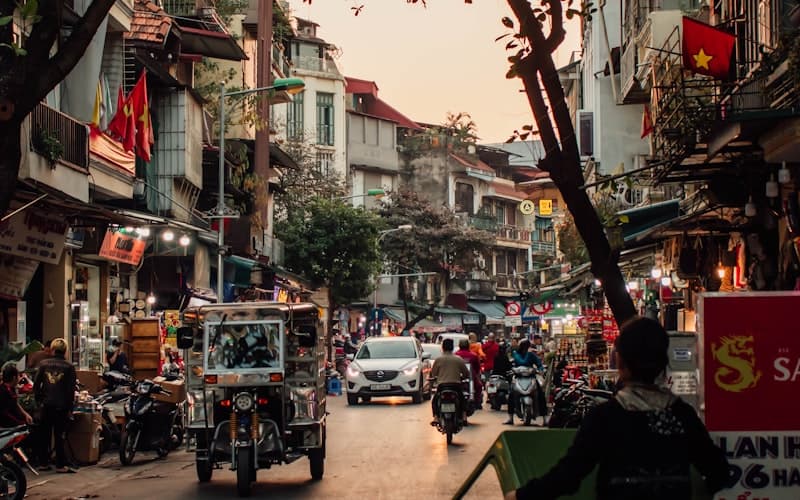
Hanoi is Vietnam's capital, 8.5 million people in the metro area, founded in 1010 as Thang Long ("Ascending Dragon"). In 48 hours you can cover the historic centre on foot and by Grab: the Old Quarter, Hoan Kiem Lake, the Ho Chi Minh Mausoleum, the Temple of Literature, a water-puppet show and Train Street in the evening. Museum entries run 40,000–200,000 VND (~$1.60–8); two people with lunch fit a day into ~$8–12.
From Noi Bai Airport (HAN) to the Old Quarter — 4 ways
Noi Bai sits 30 km north of the Old Quarter. Plane down, passport control 20–40 minutes (have your entry declaration QR ready), then four ways to reach your hotel:
| Transport | Price | Time | When to use |
|---|---|---|---|
| Grab Car | 280,000–380,000 VND (~$11–15) | 40–50 min | Default, fixed fare in the app |
| Bus 86 | from 30,000 VND (~$1.15), per xe-buyt.com, September 2026 | 50–60 min | Best value, stops by Hoan Kiem and the opera |
| City buses 7, 17 | 9,000–12,000 VND (~$0.40) | 60–80 min | Cheapest, awkward with a suitcase |
| Mai Linh taxi | 350,000–450,000 VND + fee | 40–50 min | If your data is down — from the official desk only |
Tip. Bus 86 runs every 20–30 minutes from early morning to late evening (check times at the stop) and stops right by Hoan Kiem Lake and the opera house — a 5-minute walk from any hostel in the Old Quarter. For under $2 you are in the centre. With luggage, Grab is easier, but if you travel light, bus 86 wins on price.
Day 1 — landing, the Old Quarter, dinner on Ta Hien
Arrival usually leaves you in "I'm at the hotel, I'm not moving" mode. That's fine. Minimum plan: check in around the Old Quarter / Hoan Kiem, shower, lie down for an hour, dinner within a kilometre of your room.
Where to stay (Hoan Kiem / Old Quarter):
- Hostel / dorm — ~$4–12 a bed. Old Quarter View Hostel, Vietnam Backpacker Hostel, Hanoi Rendezvous.
- Budget 2–3★ — ~$20–45 a room. Hanoi Golden Hotel, Bonjour D'An Nam Home, May de Ville Old Quarter.
- Mid-range 4★ — ~$60–110. Rex Hanoi, Authentic Hanoi, La Siesta Diamond.
- Premium 5★ — ~$200–500+. Sofitel Legend Metropole (from ~$400), Capella, Apricot Hotel, Peridot Grand.
By evening, walk to Hoan Kiem Lake — the heart of Hanoi. The red The Huc bridge leads to an islet with Ngoc Son Temple (entry 50,000 VND). At weekends the waterfront closes to traffic and the pedestrian zone fills with traditional games and dancing. From there it's a short walk into the Old Quarter to Ta Hien street (Tạ Hiện) — Hanoi's "beer street": dozens of cafés with plastic stools on the pavement and local bia hơi at 5,000–10,000 VND (~$0.20–0.40) a glass.
Your first junction is a rite of passage. Few traffic lights, endless motorbikes, flows crossing at right angles. The trick: walk slowly and steadily, don't flinch. Scooters part around a pedestrian like water round a rock. Don't make sudden moves and don't step backwards. For dinner have bún chả (grilled pork in a sweet-sour broth with noodles and herbs) — 50,000–80,000 VND (~$2–3). The classic spot is Bun Cha Huong Lien on Le Van Huu, the one where Barack Obama ate with Anthony Bourdain in 2016.

For dessert, cà phê trứng (egg coffee, invented at Café Giang in 1946 when milk was scarce). A thick foam of whisked yolk and sugar over strong Vietnamese coffee. Around 30,000–50,000 VND (~$1.20–2). Café Giang is open 7am to 10pm at 39 Nguyen Huu Huan.
Day 2 — the mausoleum, Temple of Literature, water puppets, Train Street
A full day you can genuinely cover on foot and by Grab (80,000–150,000 VND / ~$3–6 for short hops):
| Sight | Entry | Hours | Time |
|---|---|---|---|
| Ho Chi Minh Mausoleum | free | Tue–Thu, Sat, Sun, mornings only | 1.5–2 h with the queue |
| Stilt House + One Pillar Pagoda | 40,000 VND / ~$1.60 | 07:30–11:00, 14:00–16:00 | 45 min |
| Temple of Literature | 70,000 VND / ~$2.80 | 08:00–17:00 | 1–1.5 h |
| Museum of Ethnology | 40,000 VND / ~$1.60 | 08:30–17:30 (closed Mon) | 1.5–2 h |
| Water Puppet Theatre | 100,000–200,000 VND / ~$4–8 | shows 15:00, 16:10, 17:20, 18:30, 20:00 | 50 min |
| Hoa Lo Prison | 50,000 VND / ~$2 | 08:00–17:00 | 1 h |
| Imperial Citadel | 70,000 VND / ~$2.80 | 08:00–17:00 (closed Mon) | 1 h |
| Train Street (via a café) | free + coffee 50,000–80,000 VND | trains 15:00, 19:00, 19:45 | 30–45 min |
| Tran Quoc Pagoda | free | 07:30–11:30, 13:30–17:30 | 30 min |
| Hoan Kiem + Ngoc Son Temple | 50,000 VND / ~$2 | 07:00–18:00 | 30–60 min |
Start at 07:30 at the Ho Chi Minh Mausoleum. The queue is the real "price": 1.5–2 hours in summer, 30–60 minutes in winter. Inside lies the embalmed body of the founder of North Vietnam; the pass-through is quick and silent, no stopping, no photos. The mausoleum closes from time to time for maintenance, so check the hours and dates before you go, especially in autumn. The dress code is strict — no shorts, bare shoulders, backpacks or phones out. Turn up in shorts and you'll be sent to buy a sarong at the kiosk round the corner.
After the mausoleum comes the Stilt House, where Ho Chi Minh lived from 1958 to 1969, and the One Pillar Pagoda (Chùa Một Cột) beside it — the original temple on a single column in a lotus pond; the pillar you see was cast in concrete during the 1955 rebuild. Then Grab to the Temple of Literature (Văn Miếu), the country's first university, founded in 1070. Five courtyards, statues of sages, stone stelae listing graduates — a quiet corner in a loud city.
Lunch — bun cha again, or phở (a noodle broth with beef or chicken, 50,000–80,000 VND). By 14:00 head to the Museum of Ethnology on the western edge: open-air reconstructions of houses from the country's 54 ethnic groups, a pavilion for each. It isn't a dull museum — it's ninety minutes of understanding that Vietnam is not one people, which makes Sapa on day 5 click into place.
By 18:30, the water-puppet show at Thang Long Theatre by Hoan Kiem Lake. It's an 11th-century Vietnamese art: puppets dance across the water while hidden operators work waist-deep in a pool. The show runs 50 minutes, tickets 100,000–200,000 VND (three tiers — the best seats sit closest to the water). Book ahead or at the box office two hours before — in high season they sell out.

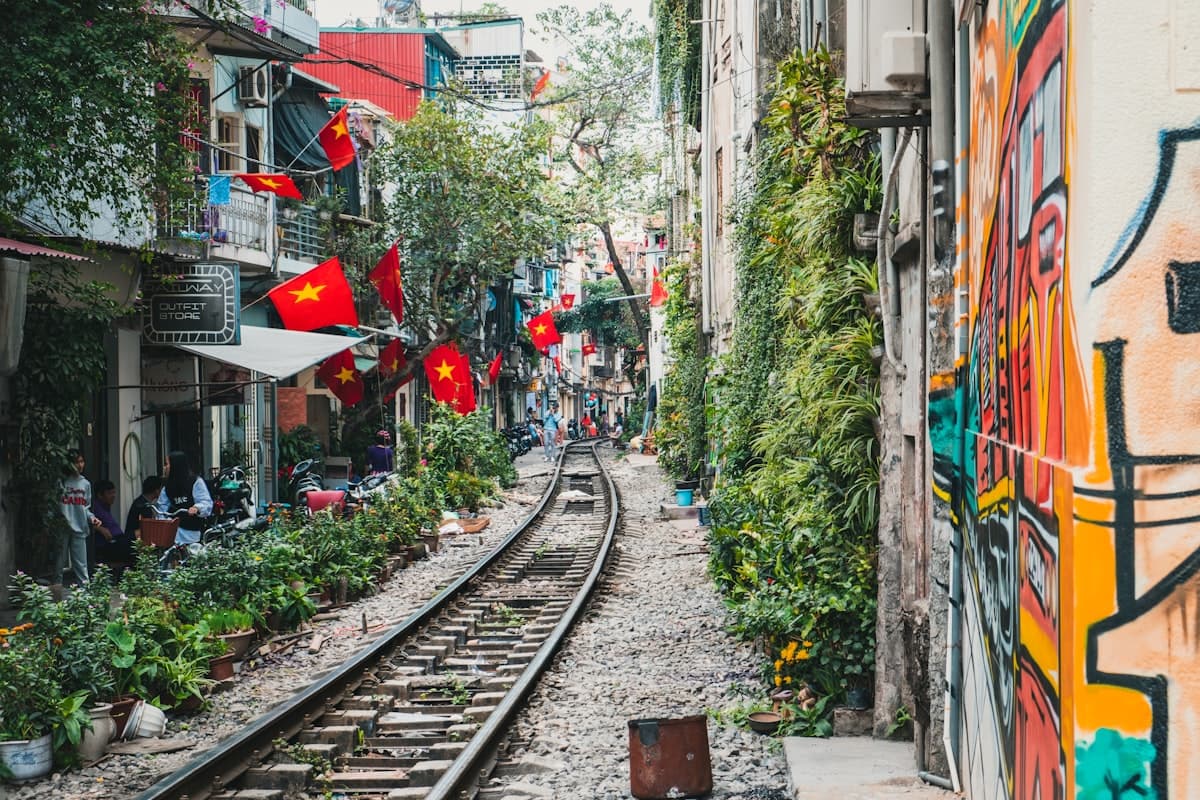
In the evening, Train Street (Phố Đường Tàu). A narrow street between two rows of houses with a live railway line running through it. Trains pass at 15:00, 19:00 and 19:45 — a minute before each, the cafés call you onto their terraces (that's the rule: since 2022 police periodically close the street for safety, and you can only enter through a café with an order). Coffee is mandatory, 50,000–80,000 VND. Standing on the tracks as a train passes is banned and dangerous.
Fast Track — no queue at the border
5–10 minutes instead of an hour in the immigration queue
from$11per passenger
Day 3. Ha Long Bay — cruise, caves, kayaks

Ha Long Bay (Vịnh Hạ Long) is 1,553 km² of water with 1,969 limestone islands, added to the UNESCO list in 1994; in 2023 the site was extended as "Ha Long Bay – Cat Ba Archipelago". It's the most recognisable image of northern Vietnam, and the reason Ha Long cruises run ~$105–450 a night. For day 3 you take a 2-day / 1-night cruise with a night on a junk: board at 11:30, return by 12:00 the next day. It's the only format that fits a 7-day route.
Getting there: Hanoi → Ha Long
It's 170 km along the QL5B Hanoi–Haiphong expressway, 2.5–3 hours. Three ways to go:
| Transport | Price | Time | When to pick |
|---|---|---|---|
| Cruise shuttle bus | ~$25–45 round trip (included) | 2.5–3 h | Default; hotel pickup 07:30–08:15 |
| Limousine van, 9 seats | 280,000–350,000 VND / ~$11–14 | 2.5–3 h | Without a cruise package |
| Sleeper bus | 200,000–280,000 VND / ~$8–11 | 3–3.5 h | Budget, to Bãi Cháy |
Recommendation for this route. If you book a cruise, the transfer is usually included (or ~$25 as an add-on). Don't buy a separate limousine — you'll overpay and then wrestle with timing it to the boarding slot. Save yourself the hassle on the first morning after Hanoi.
Halong vs Bai Tu Long vs Lan Ha — three bays in one area
The difference between these three bays is fundamental — it decides what you actually see:
| Bay | Where | Tourism | Known for |
|---|---|---|---|
| Halong Bay (classic) | Centre and west, Tuan Chau | Very high | The main caves (Sung Sot), standard routes |
| Bai Tu Long Bay | Eastern part | Low, quiet | No crowds, a "wild" feel |
| Lan Ha Bay | South, from the Cat Ba side | Medium | Cheaper, ferry + a night on the island |
For a 7-day route the choice is usually Halong or Bai Tu Long. Halong is the tick-box (the main must-see); Bai Tu Long is for anyone who wants quiet and is happy to pay ~$30–50 more for an Indochina Junk cruise. Lan Ha is its own story — a full 2–3 days staying on Cat Ba, hard to wedge into a week.
Comparing cruises by operator — what to book in 2026
2026 prices for 2-day / 1-night cruises, per person (double occupancy):
| Category | Example operators | Price $/person | What's included |
|---|---|---|---|
| Budget 3★ | Cozy Bay, Garden Bay | ~$105–160 | Cabin, meals, kayaks, excursions |
| Mid-range 4★ | Bhaya Classic, Paradise Sails, Indochina Junk | ~$145–250 | + better cabins, tastings, sunset bar |
| Luxury 5★ | Paradise Elegance, Heritage Binh Chuan, Era Cruise | ~$250–450 | + spa, premium menu, balconies |
| Ultra-luxury | Stellar of the Seas, Au Co, Ylang | ~$450–980+ | All-inclusive, pool, wine cellar |
Add 15–30% for extras: the bar (~$3–5 beer, ~$25–60 wine), an extra kayak (~$5–10), spa (~$25–60), tips for the crew (~$3–5/person/day + ~$5–10 for the guide). It's entirely optional, but most travellers leave something.
What to book for this route. A mid-range 4★ (~$150–200) is the best "wow without overpaying." Bhaya Classic and Paradise Sails are the most recommended on Reddit and Tripadvisor; they leave from Tuan Chau marina and return right around noon. Indochina Junk heads to Bai Tu Long for ~$30 more — pick it if you want to dodge the crowds.
What a day on the cruise looks like
Standard timeline for an 11:30 boarding:
- 11:30 — board at Tuan Chau marina, check into the cabin, welcome cocktail
- 12:30 — lunch on board (5–7 courses, usually seafood)
- 14:30 — the boat heads out into open water between the karsts, views from the top deck
- 15:30 — stop by an island for Sung Sot Cave (Hang Sửng Sốt, 10,000 VND) — the biggest in Ha Long, 10,000 m², three chambers of stalactites
- 17:00 — kayaks or SUP around a floating fishing village (1.5 h, included)
- 18:30 — sunset on the top deck with a cocktail (bar is paid)
- 19:30 — dinner on board, sometimes with a spring-roll cooking class
- 21:00 — night squid fishing off the boat, or karaoke in the bar
- 07:00 next day — tai chi on deck for the willing
- 08:00 — breakfast, then Luon Cave (by kayak) or Titop Island (400 steps up to the viewpoint)
- 10:30 — late breakfast / brunch
- 11:30 — back to Tuan Chau; by 12:00 you're on the bus to Hanoi
You're back in Hanoi around 14:30–15:00 — lunch, then a couple of relaxed hours to shop in the Old Quarter before the overnight transfer to Sapa. If your cruise returns at 16:00 (as some Indochina Junk trips from Bai Tu Long do) you'll only make dinner, and the shopping is off.
2 days / 1 night vs 3 days / 2 nights — what to take
Short answer: 2/1 only. The longer answer has nuance:
- 2 days / 1 night — one night on the boat, the classic; you cover only the main caves (Sung Sot) and one kayak session. This is the format for a 7-day northern route.
- 3 days / 2 nights — one night on the boat plus one on Cat Ba island, a deeper route into Bai Tu Long Bay. That's for anyone with 10+ days who can drop Sapa.
If Sapa is in your week, 3/2 won't fit. After the 2/1 cruise you need the night train or limousine bus the same day, or you lose a day and a half.
Plan B — if a typhoon closes Ha Long
In summer (July–August) the Ha Long port closes 24 hours before a typhoon arrives — cruise companies usually refund or reschedule. In typhoon season, closures of several days are not rare.
What to do if you get caught in a storm:
- Option 1: a Cat Ba day tour from Haiphong. Bus from Hanoi to Haiphong (1.5 h / 100,000 VND), then a ferry to Cat Ba (45 min / 100,000 VND), stay 2 nights in a ~$30–60 hotel and take a Lan Ha Bay day tour (~$25–40). No wow overnight on a junk, but you still see the karsts.
- Option 2: Ninh Binh. The "inland Ha Long" — the same limestone formations, but in the Ngo Dong river valley, storm free. 100 km / 2 hours from Hanoi, day tour ~$25–35. Tam Coc, Trang An (UNESCO), caves by sampan. A good one-day swap.
- Option 3: get the refund. If a port closure cancels your cruise, the operator usually refunds you or moves you to other dates. Check the cancellation terms when you book, and don't rush to accept a "partial refund".

Hanoi → Sapa: 4 ways to get there

Hanoi to Sapa is 320 km by the new highway, or 296 km by rail to Lao Cai. There's no train to Sapa itself: the line runs to the Chinese border town of Lao Cai, and from there it's another 38 km up mountain switchbacks by minibus. Four real options: the Sapa Express limousine bus, a sleeper bus, the SP1/SP3 night train with a transfer, and the premium Victoria Express.
| Transport | Price | Time | When to pick |
|---|---|---|---|
| Sapa Express limousine bus | $16–24 (~420,000–620,000 VND) | 6 h | Default; Old Quarter pickup, to central Sapa |
| Sleeper bus | 320,000–450,000 VND (~$13–18) | 6–6.5 h | Reclining berths, budget, overnight |
| SP1/SP3 train + minibus | 500,000–850,000 + 80,000 VND (~$23–37) | 8 h + 1 h | Romance, saves a hotel night |
| Victoria Express | 2,605,000 VND / ~$104 | 8 h | Premium cabin with dining car |
What most people should take. The Sapa Express limousine bus at $16–24. About 6 hours, air conditioning, Wi-Fi, free pickup in Hanoi's Old Quarter and drop-off at the operator's office in central Sapa (01 Vườn Treo). No transfer at Lao Cai, no minibus up the switchbacks at 6am. Unless riding a night train is the whole point for you, this is the best value and comfort.
Lao Cai ≠ Sapa: the classic mix-up
Lao Cai (Lào Cai) is the town on the Chinese border with the railway station. Sapa (Sa Pa) is the mountain resort 38 km to the southwest. The train drops you in Lao Cai early in the morning; Sapa is another hour by minibus up switchbacks with a 1,200 m altitude gain.
The Lao Cai → Sapa minibus is 80,000 VND (~$3.20). Taxi drivers at the station may ask 500,000 VND or more — the usual station markup. Don't take it: Sapa Express, Inter Bus and G8 minibuses meet every train, and you buy the ticket from the driver or a kiosk by the exit.
Sapa Express, Inter Bus, G8 — which limousine bus
Sapa Express leads on comfort per Tripadvisor 2025–2026. Wide seats (3 rows instead of 4) and two rest stops on the way, at km 98 and km 237. There are two bus types (per the operator's site, September 2026):
- 28 soft seats, $16 — from Hanoi at 07:00 and 15:00, from Sapa at 07:30 and 15:00
- Premium, 24 sleeping cabins, $24 — from Hanoi at 07:00 and 22:00, from Sapa at 14:00 and 22:00
Inter Bus Lines, G8 Open Bus and Hà Sơn Hải Vân are workable alternatives. The main edge Sapa Express has is a convenient timetable (from Hanoi at 07:00, 15:00 and 22:00) and steadier reviews.
The SP1/SP3 night train — is the romance worth it?
The Vietnam Railways SP1 and SP3 night trains leave Hanoi late in the evening and reach Lao Cai early in the morning. Check exact times at the station or with a ticket seller — the timetable changes.
Rough prices as of June 2026: a soft seat 250,000 VND (~$10), a 4-berth VIP cabin 500,000–850,000 VND (~$20–34), depending on the carriage and season. Buy tickets on 12go.asia or baolau.com. Inside: narrow cabins with bunk berths, air conditioning, a light blanket, a hot-water tap. The toilet is shared at the end of the carriage.
Pros: you save a hotel night in Hanoi (minus ~$25–50), wake up in the mountains, kids love it. Cons: you arrive around dawn, then face another hour by minibus to Sapa — checking in at 7am, underslept.
Victoria Express is the premium option for anyone who wants comfort. Check the days, times and whether the carriage still runs in 2026 with a ticket seller: we couldn't confirm them on the Victoria chain's site. A 2-berth cabin is 3,816,000 VND (~$150), a 4-berth is 2,605,000 VND (~$104). Inside: air conditioning, an en-suite bathroom, the Le Tonkin dining car. Whether ~$104 beats $16–24 for the limousine comes down to how much you love trains.
Days 5–7. Sapa — trekking, Hmong villages, Fansipan

Sapa is a mountain resort at 1,600 m in Lao Cai province, and the easiest place in Vietnam to see snow in winter. The French founded it in 1922 as a hill station; today it's the main base for trekking the Muong Hoa valley and for climbing Fansipan, the highest point in Indochina (3,143 m). For a 7-day route, budget 2.5 days across three part-days: one trek to Cat Cat village, the main Lao Chai → Ta Van trek, and a final morning on Fansipan or at the Silver Waterfall.
Day 5 — arrival, hotel, a morning trek to Cat Cat
If you took the Sapa Express limousine on the 22:00 overnight run, you reach Sapa around 04:00 and get dropped at the operator's office in the centre. By train, it's around 07:00 (after an hour on the minibus from Lao Cai). Either way it's early: check-in is usually from 14:00, but for 200,000–300,000 VND (~$8–12) many hotels let you in earlier, or offer a free shower and luggage storage — just ask.
Where to stay (central Sapa, steps from Sapa Lake and the main square):
- Hostel / homestay — ~$8–20 a bed. Phơri's House, Mountain Cat Hotel, Eco Palms House.
- Budget 3★ — ~$25–50. Sapa Center Hotel, Sunny Mountain, Bamboo Sapa.
- Mid-range 4★ — ~$60–120. Pao's Sapa Leisure, Pistachio Hotel, Aira Boutique.
- Premium 5★ — ~$150–350. Hotel de la Coupole (MGallery, a Gothic hotel in the centre), Silk Path Grand, Topas Ecolodge (18 km out, bungalows with a valley panorama).
Morning of day 5: breakfast on the main square (Vietnamese coffee + banana pancakes, 60,000–100,000 VND), recover from the overnight ride. By 10:00, walk out to Cat Cat village (Bản Cát Cát).
Cat Cat is a Black Hmong village 3 km from central Sapa, downhill through a pine forest. You can walk it in 30–40 minutes (the trail is marked) or take a motorbike taxi for 100,000–150,000 VND. Entry is 150,000 VND (~$6) per adult, 70,000 for a child. Cash only.
Inside there are three "levels" by height: the upper with traditional Hmong houses, the middle with water mills and a waterfall, the lower with a suspension bridge and a Hmong cultural show every half hour (included). Allow 2.5–3 hours. Back to central Sapa is on foot (45 minutes uphill) or a motorbike taxi for the same 100,000–150,000 VND.
Tip. Cat Cat is the most touristy village — take it as a first-morning stroll, not the main event. Tomorrow's big trek is the main event. After Cat Cat, lunch in a café (say, The Hill Station Signature on Muong Hoa), rest, dinner with a local Sapa Beer.
Day 6 — the main Muong Hoa Valley trek (Lao Chai → Ta Van)

The reason people come to Sapa. The Muong Hoa valley runs 14 km southeast of Sapa, through rice terraces cut into the slopes. The standard walk is 9 km from Lao Chai to Ta Van via Y Linh Ho village, 3.5–4 hours, with a 300 m descent (mostly downhill).
The day:
- 09:00 — Grab or taxi from Sapa to Lao Chai (15 km, 250,000 VND). You can arrange a guide at your hotel the day before: a Hmong guide is ~$15–20 for the day and speaks good English.
- 09:30 — start at Lao Chai (a Black Hmong village) and walk down the valley through the terraces. The views are Tour de France through the mountains, minus the tarmac.
- 11:00 — Y Linh Ho village (a midpoint). 15–20 minutes' rest, photos of buffalo in the fields.
- 12:30 — reach Ta Van (a Giay village). Lunch with a family (~$5–8/person: rice, vegetables, sometimes grilled chicken or pork). This is the authentic "lunch with the Hmong" that group tours charge ~$40 for.
- 14:00 — back to Sapa. Options: another 2 hours uphill on foot (hard after the trek), or a Grab / minivan from Ta Van for 200,000–300,000 VND.
- 16:00 — hotel, shower, rest. Dinner in Sapa.
Hmong guides. At the entrance to Lao Chai you'll usually find 10–15 Hmong women in traditional indigo-black dress offering to walk with you. The ~$15–20 for the day includes lunch with a family in Ta Van. They know the trails, translate the Giay, and explain the customs (courtship, tattoos, indigo dyeing). All speak Vietnamese, most speak working English. If you already have a hotel guide, a local Hmong woman may still walk alongside and ask for a ~$3–5 tip at the end — that's normal practice.
If you don't wish for them to join you, be polite but firm with your rejection. These ladies can be rather persistent!Jenny and Jay, TraveLynn Family, June 2025
For a deeper experience. A homestay in Ta Van is ~$20–30 with dinner and breakfast. A family stilt house, a shared toilet in the yard, sleep under a mosquito net. The next morning you continue to Ban Ho or Giang Ta Chai with its hot springs. This doesn't fit a 7-day route — but if you drop Cat Cat and move Fansipan to a spare day, a night in Ta Van becomes possible.
Day 7 — Fansipan or the Silver Waterfall, back to Hanoi
A morning choice: 3,143 metres by cable car, or a 100-metre waterfall 12 km from Sapa. There's no time for both — the limousine to Hanoi leaves at 14:00, arrives 20:00, and from there it's a Grab to the airport for a late flight.
Option A: Fansipan (Sun World). A cable car from the base station 5 km from central Sapa. It's 800,000–900,000 VND (~$32–36) per adult, 600,000 for a child. One way: 15 minutes on the Mường Hoa tram from Sapa to the base station + 15 minutes on the cable car + a 10-minute walk to the viewpoint. At the top: the Bích Vân pagoda, a 21-metre Buddha statue, viewpoints over the valley. On a clear day you see Lao Cai and the Chinese border; on a grey one, fog, as everywhere in the mountains.
Option B: the Silver Waterfall (Thác Bạc). 12 km northwest of Sapa, on the road to the O Quy Ho pass. Entry 20,000 VND (~$0.80). A 100-metre drop; you can climb halfway up the stairs (300 steps). Nearby are the Love Waterfall (Thác Tình Yêu, 70,000 VND, a 2 km trail each way) and the O Quy Ho pass — one of the "four great passes of the north," with a free viewpoint over the mountains of Lai Chau province.
From Sapa, take a motorbike taxi for 200,000 VND (round trip with a 2-hour wait) or your own rented scooter (150,000 VND/day, rentals at any hotel). The road is all switchbacks — if you're new to riding, don't.
14:00 — the Sapa Express limousine (sleeping cabins, $24) back to Hanoi. Around 19:00 it passes Noi Bai, and by 20:00 it reaches the Old Quarter (204 Trần Quang Khải). You can get off at the airport turn-off, but per the operator's site the gate is about 2 km from there. A Grab to Noi Bai airport is 350,000–500,000 VND (~$14–20), 50 minutes. If your flight is 23:00–01:00, you make it without stress, with time for airport dinner.
Sapa's 7 top spots: entry fee and time needed
| Sight | Entry | Feature | Time |
|---|---|---|---|
| Cat Cat | 150,000 VND / ~$6 | Black Hmong, 30 min from town | 2.5–3 h |
| Lao Chai | free | Start of the Muong Hoa trek | 4–5 h with the trek |
| Ta Van | free | End of the trek, family lunch, Giay people | + to Lao Chai |
| Fansipan (cable car) | 800,000 VND / ~$32 | Highest point in Indochina, 3,143 m | 3–4 h |
| Silver Waterfall | 20,000 VND / ~$0.80 | 12 km from Sapa, 100 m high | 1.5 h |
| O Quy Ho pass | free | One of the "four great passes of the north" | 30 min |
| Ham Rong stone garden | 70,000 VND / ~$2.80 | In Sapa itself, town views | 1–1.5 h |
What to pack for Sapa (winter and summer)
The route crosses three climates (Hanoi's plains, Ha Long's sea, Sapa's mountains), and Sapa is the demanding one.
Winter (Dec–Feb), Sapa 0–13 °C by day, –5…+5 at night:
- A warm jacket (fleece + windproof layer, or a 600-fill down)
- Hat, gloves (thin ones for the Fansipan viewpoint)
- Waterproof shoes (trekking or membrane city shoes — clay after rain turns the trail into an ice rink)
- Thermal base layer (one spare)
- Thick socks
Summer (Jun–Aug), Sapa 19–24 °C by day, rain:
- A rain poncho (Sapa shops sell them for 50,000 VND — buy on the spot)
- Closed-toe trekking sandals (Teva, Keen) — mud after rain, and wet shoes take a day to dry
- Insect repellent (midges on the Muong Hoa trails)
- A light fleece or hoodie for the evening (it drops to +15 after dark)
Universal for the whole route:
- Light clothes for Hanoi and Ha Long (cotton, linen, shorts)
- Swimwear for the cruise (pool on 4–5★ boats) and the beach
- Small USD notes ($1, $5, $20) for tips
- A 10,000 mAh power bank (long transfers without sockets)
- A Viettel or Mobifone eSIM (60,000–80,000 VND for 10 GB / 30 days)
- Visa/Mastercard for hotels, cash VND for markets (cards aren't taken everywhere)
Budget for 7 days — three tiers from ~$305 to ~$1,200
An independent 7-day trip to northern Vietnam runs one person ~$305–465 backpacker style, ~$695–1,070 mid-range, and from ~$1,200 for comfort. These figures exclude the international flight, which adds ~$700–1,200 round trip depending on where you fly from. Conversion at ~26,000 VND = $1 (June 2026).
Backpacker — ~$44–66/day (~$305–465/week)
For anyone used to Southeast Asia and happy in a dorm, eating on the street and joining group tours.
| Item | For 7 days | What it covers |
|---|---|---|
| Lodging (hostels) | ~$50–80 | ~$5–12/night dorm, ~$8–15 in Sapa |
| Food (street) | ~$50–70 | ~$7–10/day, banh mi / pho / bun cha |
| Intercity (buses) | ~$40–60 | Ha Long bus (~$10) + Sapa sleeper (~$14) round trip |
| Local (Grab) | ~$15–25 | From Noi Bai, around Hanoi and Sapa |
| Ha Long cruise 3★ | ~$105–160 | 1 night Cozy Bay or Garden Bay |
| Sapa (tours & entries) | ~$25–40 | Cat Cat ~$6, Hmong guide ~$20, waterfall ~$1 |
| Pocket money | ~$20–30 | SIM, water, coffee, odds and ends |
| Total | ~$305–465 | flights aside |
Mid-range — ~$100–155/day (~$695–1,070/week)
The base level for most independent travellers: 3★ hotels, mid-level cafés, private tours, a limousine bus instead of the sleeper.
| Item | For 7 days | What it covers |
|---|---|---|
| Lodging (3★ hotels) | ~$180–260 | ~$30–45/night |
| Food (cafés) | ~$100–140 | ~$15–20/day |
| Intercity (limousine) | ~$80–120 | Sapa Express $16–24, limousine van ~$14 |
| Local (Grab) | ~$40–60 | No scrimping on transfers |
| Ha Long cruise 4★ | ~$145–250 | 1 night Bhaya / Paradise |
| Sapa + Fansipan | ~$80–120 | Guided tour ~$40, cable car ~$35 |
| Shows + museums | ~$20–40 | Thang Long, Museum of Ethnology |
| Pocket money, SIM | ~$50–80 | Shopping, SIM card, coffee |
| Total | ~$695–1,070 | flights aside |
Comfort — ~$170+/day (~$1,200+/week)
4–5★ hotels, a private car with a driver, restaurants at ~$25–40 a dish. Sofitel Legend Metropole in Hanoi (from ~$400/night, opened 1901), Hotel de la Coupole in Sapa (~$200–350), a luxury cruise like Paradise Elegance or Au Co (~$300–500/person). A realistic band is ~$1,200–1,800 for 7 days, flights aside.
What it covers:
- Hanoi 4–5★: Sofitel Legend Metropole (~$400+), Capella (~$350+), Apricot Hotel (~$200+)
- Luxury cruise: Paradise Elegance, Heritage Binh Chuan, Au Co — ~$300–500/person for 1 night
- Sapa premium: Hotel de la Coupole MGallery (~$200–350), Topas Ecolodge (~$250–400, bungalows with a panorama)
- Hanoi → Sapa: the Victoria Express (~$104) instead of the regular train
- Private car: ~$100–150/day with a driver in Hanoi or Sapa
- Restaurants: ~$25–40 a dish at the Sofitel, dinner for two ~$80–150
Reference prices for the whole route
- Bus 86 airport → Hanoi30,000 VND ≈ $1.15
- Grab from Noi Bai airport280,000–380,000 VND ≈ $11–15
- Limousine van Hanoi → Ha Long280,000–350,000 VND ≈ $11–14
- Sleeper bus Hanoi → Ha Long200,000–280,000 VND ≈ $8–11
- Sapa Express limousine bus416,000–624,000 VND ≈ $16–24
- Sleeper bus Hanoi → Sapa320,000–450,000 VND ≈ $13–18
- SP1/SP3 train (soft cabin)500,000–850,000 VND ≈ $20–34
- Victoria Express (4-berth)2,605,000 VND ≈ $104
- Temple of Literature, Hanoi70,000 VND ≈ $2.80
- Imperial Citadel70,000 VND ≈ $2.80
- Hoa Lo Prison50,000 VND ≈ $2
- Water Puppet Theatre100,000–200,000 VND ≈ $4–8
- Cat Cat village, Sapa150,000 VND ≈ $6
- Fansipan cable car800,000–900,000 VND ≈ $32–36
- Silver Waterfall20,000 VND ≈ $0.80
- Ha Long cruise 3★ (1 night)— VND ≈ $105–160
- Ha Long cruise 4★ (Bhaya/Paradise)— VND ≈ $145–250
- Ha Long cruise 5★— VND ≈ $250–450
- Sapa 1-day tour (Lao Chai → Ta Van)— VND ≈ $35–45
- Sapa 2-day / 1-night tour + homestay— VND ≈ $70–90
The flight — a separate line item
A round-trip to Hanoi in 2026 runs roughly ~$650–1,100 from Western Europe and ~$900–1,400 from North America, usually with one stop via a Gulf or Asian hub (Qatar Airways via Doha, Emirates via Dubai, Singapore Airlines, Cathay Pacific via Hong Kong, Korean Air via Seoul). Book 2–3 months out, compare on Google Flights or Skyscanner, but buy on the airline's own site — aggregator fees run 5–10%.
From within Southeast Asia it's far cheaper: AirAsia, Vietjet and Vietnam Airlines connect Hanoi to Bangkok, Singapore and Kuala Lumpur for ~$60–150 one way, often as a short 2–3 hour hop.
When to go — the best time for the northern route
The best season for Hanoi → Ha Long → Sapa is March–April (still cool in Sapa but not cold, blossom in the mountains) and September–October (golden rice terraces, clear Ha Long). The worst month is August: typhoons close the Ha Long port, Sapa is rainy and foggy, Hanoi is +34 °C at 90% humidity. December–February is its own thing: Sapa can snow (–5 °C at night), Hanoi is cool (+14–22), Ha Long is doable but the sea sits at +17–18.
Climate by month (Hanoi / Ha Long / Sapa)
| Month | Hanoi °C | Ha Long sea °C | Sapa °C day / night | Rating |
|---|---|---|---|---|
| January | 14–20 | 17–18 | 8–12 / 0 (snow possible) | ★★ Cold |
| February | 15–22 | 18 | 9–13 / 2 | ★★ Fog in Sapa |
| March | 18–24 | 19–20 | 12–17 / 6 | ★★★★ Blossom |
| April | 22–28 | 22 | 15–20 / 10 | ★★★★★ Ideal |
| May | 25–32 | 24 | 17–23 / 13 | ★★★★ Warm, rains start |
| June | 27–34 | 27 | 19–24 / 15 | ★★★ Humid, rain |
| July | 27–34 | 28 | 19–24 / 16 | ★★ Wettest |
| August | 27–33 | 28 | 19–24 / 16 | ★★ Typhoons, Ha Long closes |
| September | 26–31 | 27 | 17–22 / 14 | ★★★★★ Golden terraces |
| October | 24–28 | 25 | 15–20 / 11 | ★★★★★ Dry, clear |
| November | 21–25 | 23 | 12–17 / 8 | ★★★★ Dry, cool |
| December | 17–22 | 20 | 9–13 / 3 (snow possible) | ★★★ Winter |
The season rules that matter
Sapa — Vietnam's main snow spot. Snow also falls on Mau Son in Lang Son province and at Y Ty near Lao Cai, but Sapa is far easier to reach. December–February it's 0…+5 at night in town, down to –5 in the surrounding mountains. Snowfall averages 1–3 times a year (December–January, a peak draw for local tourists who come to "see snow"). Winter in Sapa means a warm jacket and waterproof shoes. The switchback roads stay open but get slick.
Ha Long — typhoons. In July–August the port closes 24 hours before a cyclone. Cruise companies usually refund or reschedule — but the "flew into Hanoi, can't sail on day three" scenario is real. The best months for the sea: April–May (+22–24) and September–October (+25–27). In December–February the sea is +17–20 — chilly to swim, but the cabins are warm.
Hanoi — year-round. The anchor city of the route. January–February is cool (a light jacket in the evening), March–May is ideal, June–August is humid with short storms, September–November is perfect (dry and not hot).
Tet (Lunar New Year) — closures and markups
A moving date, late January to mid-February (17 February in 2026). Vietnam's biggest national holiday: five days off by law, but with swapped days the break runs longer — in 2026 it was 14–22 February, nine days. Lodging and bus prices rise 25–40%, many Hanoi shops and cafés close for the first 3 days (locals head to the provinces to see family), and museums and the mausoleum run reduced hours. Sapa is especially popular with Vietnamese tourists over Tet — hotels book a month ahead.
If you land during Tet, budget for it and book lodging two months out. The downside is closures and markups; the upside is fireworks over Hoan Kiem, peach- and apricot-blossom markets on every corner, and the feel of a real festival.
The single best window for the route
If you must pick one window — October (gold in Sapa, +25 at Ha Long, +25 in Hanoi, dry everywhere) or April (warm everywhere, blossom in Sapa, Ha Long sea +22). The worst window is July–August (typhoon risk at Ha Long + rain in Sapa). December–February works for anyone who wants "the north with snow in Sapa" — just pack warm.
Package tour or independent — which to choose
Package tours to Vietnam almost always land you on a beach — Cam Ranh (Nha Trang), Da Nang or Phu Quoc — not in Hanoi with the northern triangle. Charters usually fly to the coast, so the north stays off the standard package map. Building the mid-range route yourself comes to roughly ~$1,500 per person with a one-stop international flight.
| Factor | Package (beach charter) | Independent (north) |
|---|---|---|
| Price for two with flights | from ~$2,000 (but a beach!) | from ~$3,000 |
| What's included | Flight, transfer, 4★ hotel FB, insurance | You decide each line item |
| Where they fly | Cam Ranh / Da Nang — coast | Hanoi (HAN), one-stop from most hubs |
| Ha Long in the package | Only as a paid excursion (~$60–100/person) | Built in (a 4★ cruise) |
| Sapa in the package | Almost never | Built in (2.5 days) |
| Flexibility | Low, fixed hotel and dates | High |
| Best for | First Asia trip, a lounger | The north with Sapa and Ha Long |
When a package makes sense (but not for the north):
- First trip to Southeast Asia, you want all-inclusive on a beach
- Travelling with kids under 10 (constant transfers wear them out)
- The goal is sun and sea, not history and mountains
- You're happy flying into a coastal airport — that's central/south Vietnam
When to go independent (especially for the north):
- You want Hanoi, Ha Long and Sapa in one trip
- You have some experience with self-guided transfers in Asia
- Budget matters but isn't make-or-break
- You don't like crowds on a group tour
The regional catch: where charters land
This is the crucial point for a northern route. Charter package tours usually fly into coastal airports — Cam Ranh (CXR, for Nha Trang), Da Nang (DAD) or Phu Quoc (PQC). That's central/southern Vietnam, the South China Sea coast. From Cam Ranh to Hanoi is 1,100 km: 2 hours on a Vietnam Airlines / Vietjet domestic flight (~$60–120 one way) or a full day on the SE night train.
If you specifically want the north, book a scheduled flight into Hanoi (HAN) — a one-stop via a Gulf or Asian hub, or a regional hop from Bangkok or Singapore. The north isn't "touristy" in the mass-market sense: most beach traffic historically heads to Nha Trang and Phu Quoc, so you'll have Sapa's trails more to yourself.
FAQ — common questions on the 7-day northern route
The classic frame: 2 days in Hanoi (Old Quarter, the mausoleum, Temple of Literature, Train Street) + 1 night on a Ha Long Bay cruise + 2.5 days in Sapa (the Cat Cat trek, the main Lao Chai → Ta Van trek, then Fansipan or the Silver Waterfall) + a buffer day to return to Hanoi and fly out. Alternatives: drop Sapa and add 2 days in Ninh Binh (the "inland Ha Long," a UNESCO site); or swap the classic cruise for Cat Ba with a night on the island.
Three ways along the 170 km QL5B expressway: the cruise operator's shuttle (~$25–45 round trip, usually included, hotel pickup 07:30–08:15), a 9-seat limousine van (280,000–350,000 VND / ~$11–14, 2.5 hours, air-con and Wi-Fi), or a sleeper bus (200,000–280,000 VND / ~$8–11, 3–3.5 hours, the budget option). If you book a cruise, the transfer is usually part of the package — no need to buy it separately.
From ~$13 for a sleeper bus to ~$104 for the Victoria Express. Real options for the 320 km: Sapa Express limousine bus ~$16–24 (about 6 hours, free pickup in the Old Quarter, drop-off in central Sapa — the best value and comfort), sleeper bus ~$13–18 (6 hours, reclining berths), the SP1/SP3 night train ~$20–34 plus a minibus (80,000 VND / ~$3, 1 hour of switchbacks) from Lao Cai, or the Victoria Express ~$104 (premium cabin, dining car; check the schedule and fare before you go).
At least 2.5 days for a proper visit
- Day 1 — the Cat Cat trek3 hoursa Black Hmong village 30 minutes on foot from town
- Day 2 — the main Muong Hoa Valley trek: Lao Chai → Y Linh Ho → Ta Van9 km / 3.5 hoursrice terraces, lunch with a Hmong family
- Day 3 — Fansipan by cable car (3,143 m)~$32
- The Silver Waterfall (12 km from Sapa)~$0.80or
In one day you only manage Cat Cat and miss the best of it
March–April (mountain blossom, +12–20 °C by day, not cold) and September– October (golden rice terraces, +15–22 °C by day, clear, ideal trekking). December–February is cold (0…+13 °C by day, down to –5 at night, occasional snow): people come mainly to see snow in Vietnam. June–August brings rain and fog, slippery trails, hidden views. The most reliable month is October: golden terraces, the rains gone, +20 by day.
Day 1: walk around Hoan Kiem Lake and Ngoc Son Temple, wander the 36 streets of the Old Quarter, dinner on Ta Hien beer street (local bia hoi at 5,000–10,000 VND a glass), evening by the lake. Day 2: the Ho Chi Minh Mausoleum early (07:30, a 1–2 hour queue in summer), the Stilt House and One Pillar Pagoda, the Temple of Literature (70,000 VND, the country's first university), a bun cha lunch, the 18:30 water-puppet show at Thang Long Theatre, then Train Street (via a café, trains at 19:00 and 19:45).
Yes — this is the classic frame: 2 days in Hanoi, 1 night on a Ha Long cruise (day 3), an overnight transfer to Sapa on the evening of day 4 (Sapa Express limousine at 22:00 or the SP1/SP3 train), 2.5 days in Sapa, then back to Hanoi to fly out on day 7. The key is not to squeeze Ninh Binh in as well, or the week becomes a rush with no rest. If you really want Ninh Binh, drop Sapa and swap in 2 days there with Trang An (UNESCO).
Yes, it is safe. The SP1 and SP3 night trains are standard Vietnam Railways trains with 2- and 4-berth cabins, air conditioning and a guard in each carriage. The cabin locks from the inside. Buy your ticket officially on 12go.asia or baolau.com, reach Hanoi station 30 minutes before departure, and don't leave valuables unattended when you use the toilet. The Victoria Express (~$104) is the premium option with an en-suite cabin and a dining car.
- Guide
Hon Thom Cable Car, Phu Quoc: Tickets & Tips 2026
The Hon Thom cable car in Phu Quoc — the world's longest sea crossing: tickets, Sun World, what's on the island and how to get there.Hon Thom Cable Car, Phu Quoc: Tickets & Tips 2026 - Guide
Phu Quoc Map: Areas, Beaches & Where to Stay
A traveller's map of Phu Quoc: areas, beaches, attractions and where everything is — so you can plan where to base yourself on the island.Phu Quoc Map: Areas, Beaches & Where to Stay - Guide
Nha Trang Mud Baths: Thap Ba, I-Resort & 100 Egg
Nha Trang's mud baths compared: Thap Ba, I-Resort and 100 Egg — prices, what to expect, which to pick and how to get there.Nha Trang Mud Baths: Thap Ba, I-Resort & 100 Egg