Mi Quang: Da Nang and Hoi An's turmeric noodles in 2026, where to eat and how
A bowl of mi Quang in Da Nang costs from 30,000 VND (~$1.15). The first time you see one, it looks like the kitchen forgot something. Yellow rice noodles, a couple of slices of pork, a prawn, a pile of herbs, a quail egg, and almost no broth. Just a few spoonfuls of concentrated liquid at the bottom. You ordered soup and got pasta.
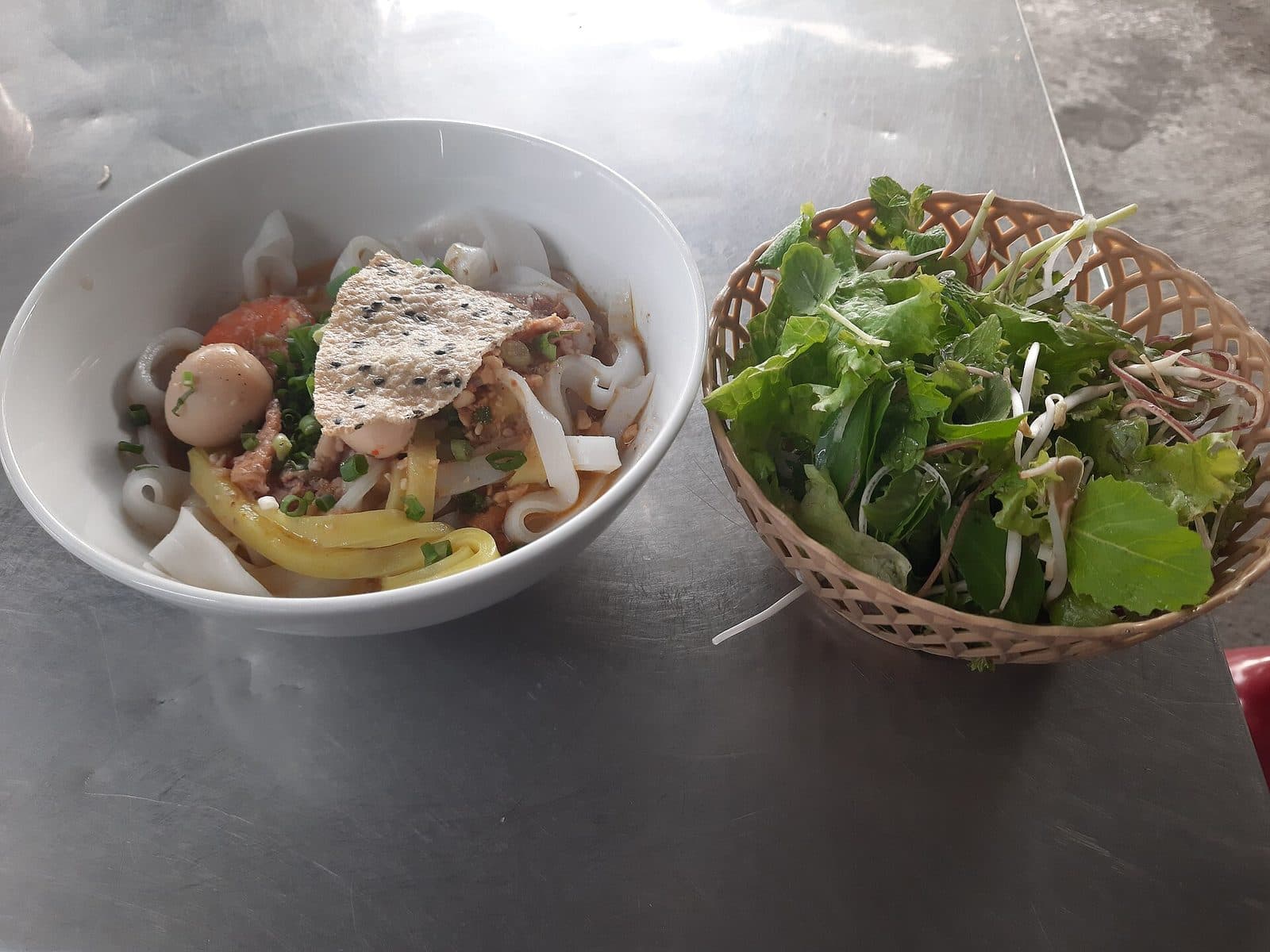
That's mì Quảng, "Quang noodles". The name points to the former Quảng Nam province, which on 1 July 2025 was merged into Da Nang city along with Hoi An. In Da Nang it's the default breakfast, in Hoi An every food tour stops for it, and the Michelin Guide, which has covered Da Nang since 2024, has picked several mi Quang shops for its lists. The name itself is a small puzzle: "mì" usually means wheat noodles in Vietnamese, but mi Quang is made from rice. Nobody bothered to rename it.
On 9 August 2024 Vietnam's Ministry of Culture added the folk knowledge of making mi Quang to the national list of intangible cultural heritage. Northern pho got the same status that summer. Below: what's in the bowl, how mi Quang differs from Hoi An's cao lau and from pho, 12 places in Da Nang and Hoi An with addresses and prices, and how locals actually eat it. For the wider picture, see our guide to Vietnamese food.
Prices checked September 2026. Rate used: ~26,000 VND = $1.
Mi Quang vs pho vs cao lau
Vietnam's three best-known noodle dishes are pho from the north (Nam Dinh and Hanoi), cao lau from Hoi An and mi Quang from former Quang Nam. All three use rice, all three come with herbs and chopsticks, and that's about where the similarity ends. Calling mi Quang "pho" in front of someone from Da Nang goes down about as well as calling a burrito a taco.
The quickest way to tell them apart is the amount of liquid. Pho sits in a full bowl of clear brown broth, and you eat it with a spoon and chopsticks at once. Cao lau is nearly dry, with a couple of spoonfuls of dark braising sauce at the bottom. Mi Quang sits in between: 50–80 ml of yellow concentrate, enough to coat the noodles when you toss them, not enough to make it soup.
| Feature | Mi Quang | Pho | Cao lau |
|---|---|---|---|
| Broth / sauce | 50–80 ml of yellow concentrate | Full bowl of clear soup | A few spoonfuls of dark sauce |
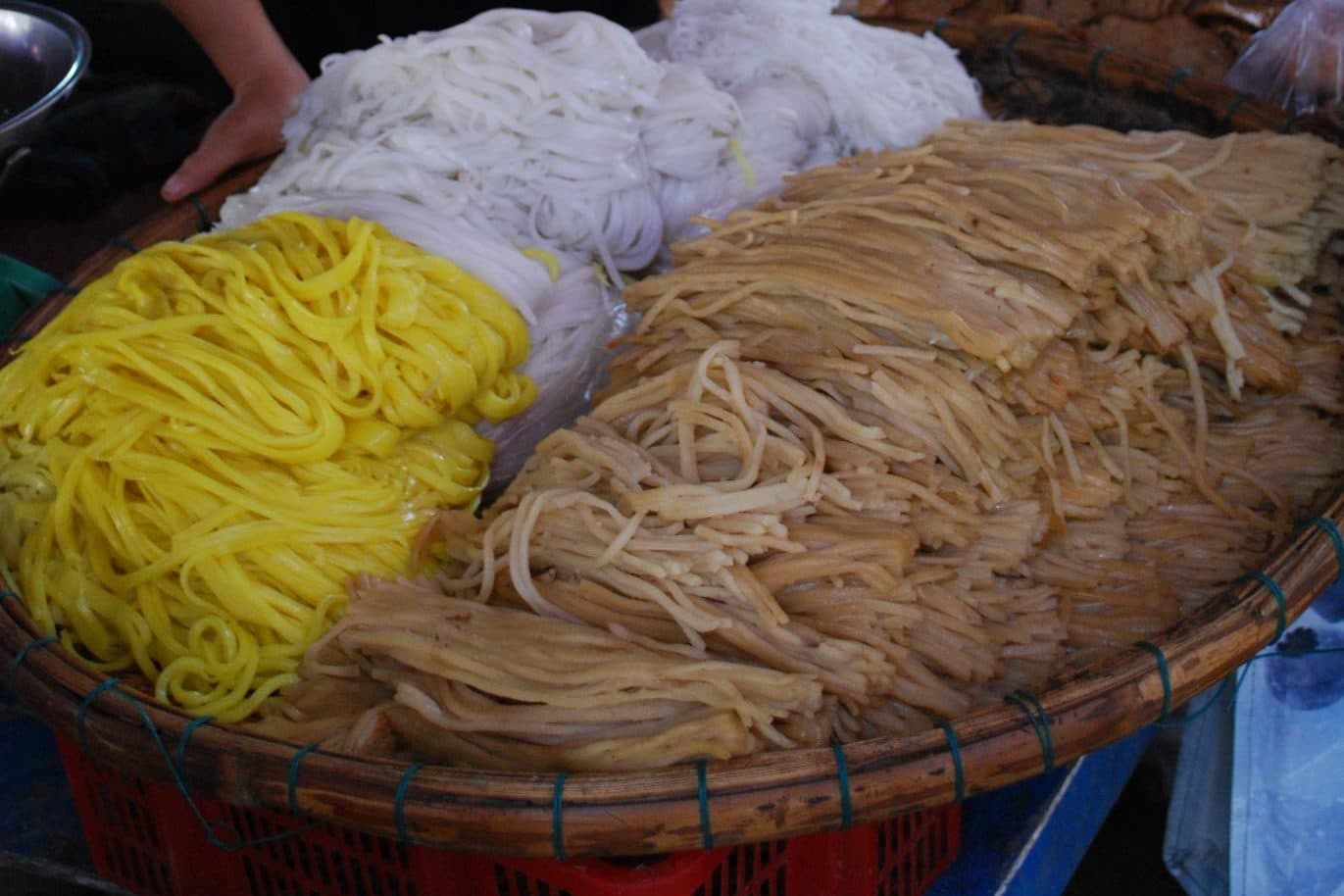
| Noodle colour | Usually yellow (turmeric), sometimes white | White | Greyish yellow |
| Noodle shape | Wide, flat, soft | Narrow, flat | Thick, dense, chewy |
| Origin | Former Quang Nam province (centre) | Nam Dinh / Hanoi (north) | Hoi An (centre) |
| Classic protein | Prawn with pork, or chicken | Beef | Char siu style pork |
| Signature topping | Peanuts + sesame cracker | — | Crunchy fried dough squares |
| When people eat it | Breakfast, early lunch | Any time | Any time |
| Where to find it | Central and southern Vietnam | Everywhere | Mostly Hoi An |
The technique differs too. Turmeric goes straight into the rice-flour dough, which is where the yellow comes from. The sauce is made separately: an ordinary stock reduced several times over with turmeric, fish sauce, shallots and garlic, sometimes with tomato or annatto for colour. Noodles and sauce never cook together. They meet in the bowl just before it goes out, so what you're eating is a half-dry dish with a warm sauce.
What's in a classic bowl
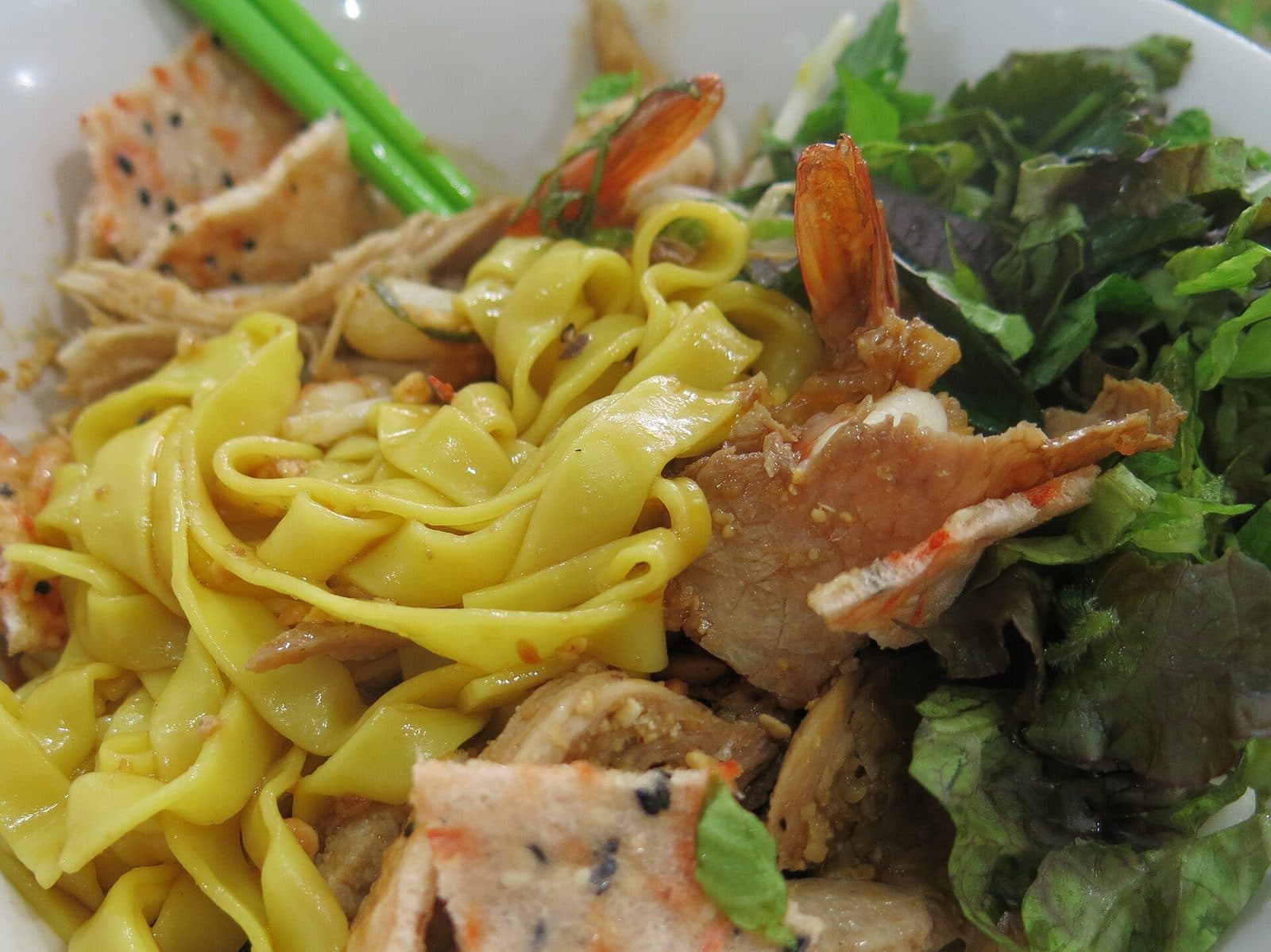
A classic prawn-and-pork bowl (mì Quảng tôm thịt) has six parts, and each one pulls its weight. Take one away and the balance goes. Think of it less as soup with extras and more as a kit where the toppings matter as much as the base.
The noodles: rice, yellow, flat
The dough is rice flour, often with some tapioca starch (roughly 2 to 1 in a common recipe) and turmeric, fresh or powdered. It's rolled into thin sheets, steamed and cut into wide ribbons, somewhere between fettuccine and tagliatelle, but made of rice. Soft with a bit of bounce, and they don't turn to mush in the sauce.
Plenty of shops, especially in Hoi An, use plain white noodles. That counts as authentic too: the ministry's heritage description says the noodles can be white or yellow. Good shops make them fresh every morning, because a day-old noodle loses its spring.
The sauce: a reduction, not a soup
The sauce (nước nhân) is stock from pork bones or chicken, reduced with turmeric, garlic, shallots and fish sauce. Some cooks add annatto for colour, tomato or pineapple for a little sourness. It simmers for hours until it tastes almost like a pasta sauce. Each bowl gets 50–80 ml, just enough to cover the bottom and coat the noodles.
In the Phu Chiem village style, the base is a stock made from fresh prawns, and the pork belly is then cooked in it. That gives a sweet, seafood-heavy flavour you won't get from a basic city version.
The protein: from chicken to eel
The classic is prawn with pork (tôm thịt): two thick slices of pork belly and one or two big prawns. Next most popular is chicken (gà), often on the bone, marinated in turmeric and ginger. Then beef (bò), eel (lươn), frog (ếch), fish and a vegetarian version (chay) with tofu and mushrooms. More on those below.
Herbs and sprouts
Herbs come as a generous handful on a side plate: Thai basil, mint, coriander, lettuce, bean sprouts, sometimes shredded banana blossom. Lemon basil (lá é) is the "proper" one, with a faint citrus note that suits turmeric. If there's none, mint does the job.
Peanuts and the cracker
Roasted peanuts go on top, and nobody's stingy with them: coarsely crushed, oily, skins off. They bring fat and crunch. The other must-have is the round sesame rice cracker (bánh tráng mè), toasted over charcoal or in an oven. You don't eat it whole. You snap it into coin-sized pieces and drop them into the bowl. Some soak up the sauce and go chewy, some stay crisp.
Quail egg and the finish
Many Da Nang shops add one or two boiled quail eggs. On the table you'll find lime wedges, sliced chilli and sometimes chilli paste. Squeeze the lime, add chilli to taste, toss everything with chopsticks, done.
Foreign diners keep writing the same thing: they expected soup, got a bowl with more noodles than liquid, and only got the point once they'd crumbled the cracker and mixed it all through the sauce.
Where mi Quang comes from: Phu Chiem and old Quang Nam
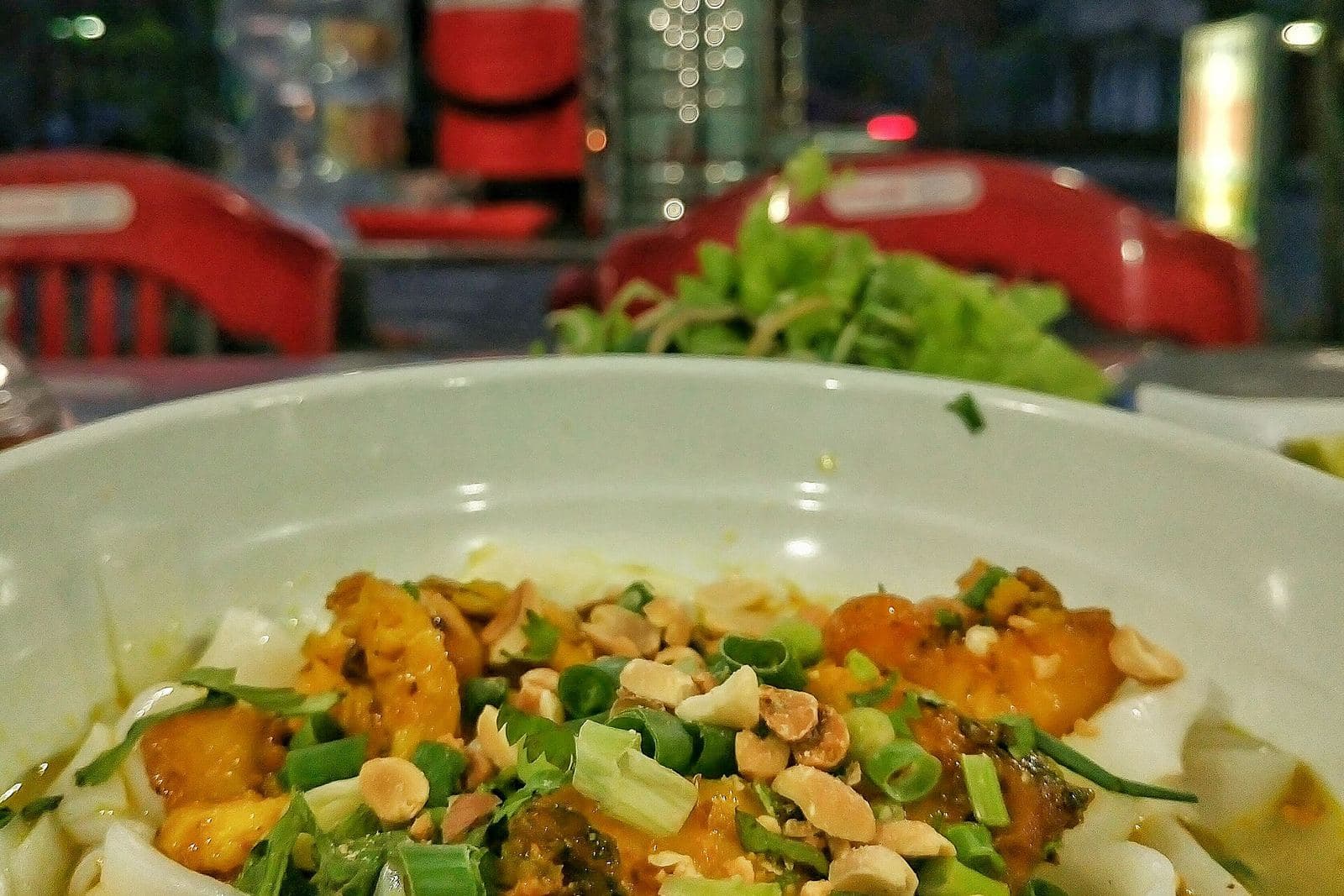
The official story is in the ministry's heritage decision. The craft took shape in Quang Nam in the 15th century, as Vietnamese settlers pushed south and farmed this coast. That makes the dish roughly 500 years old, and for most of that time it was farmers' and fishermen's food, not court cuisine.
Phu Chiem village in Điện Bàn sits between Da Nang and Hoi An, closer to Hoi An. It's one of the best-known mi Quang centres: noodle makers work here, and the "original" prawn-stock version is cooked here. Until July 2025 Dien Ban was a town in Quang Nam province. Now it's part of Da Nang city, though signs and guidebooks will say "Quang Nam" for years yet.
The Hoi An trading-port theory
A popular version ties mi Quang to Hoi An in the 16th and 17th centuries, when it was a busy port full of Chinese and Japanese ships and home to Chinese and Japanese communities. According to this story, they brought noodle and marinated-pork techniques, and local cooks swapped wheat for rice and added turmeric. No documents back this up. It does explain the name, though: "mì" is a Chinese loanword for wheat noodles.
Vietnamese people like to joke that mi Quang is the only "mì" that's really a "bún", a rice noodle.
Heritage status in 2024
Decision No. 2327/QĐ-BVHTTDL of 9 August 2024 put "the folk knowledge of mi Quang in Quang Nam province" on the national intangible heritage list (government news portal, in Vietnamese). It covers the whole chain, from growing and milling the rice to cutting noodles and seasoning. Nam Dinh pho and Hanoi pho joined the list that same summer, so the signature noodles of the north and the centre got official status at almost the same time.
Regional branches
Over the centuries mi Quang has split into dozens of local versions. Hoi An leans towards white noodles and more herbs, Da Nang serves bigger bowls with thicker sauce. There are versions with jellyfish, snakehead fish and frog. Saigoneer in 2026 drew it as a family tree: a chicken branch in Đại Lộc, another in Tam Ky, and separate Da Nang and Hoi An styles.
Types of mi Quang: which to order first
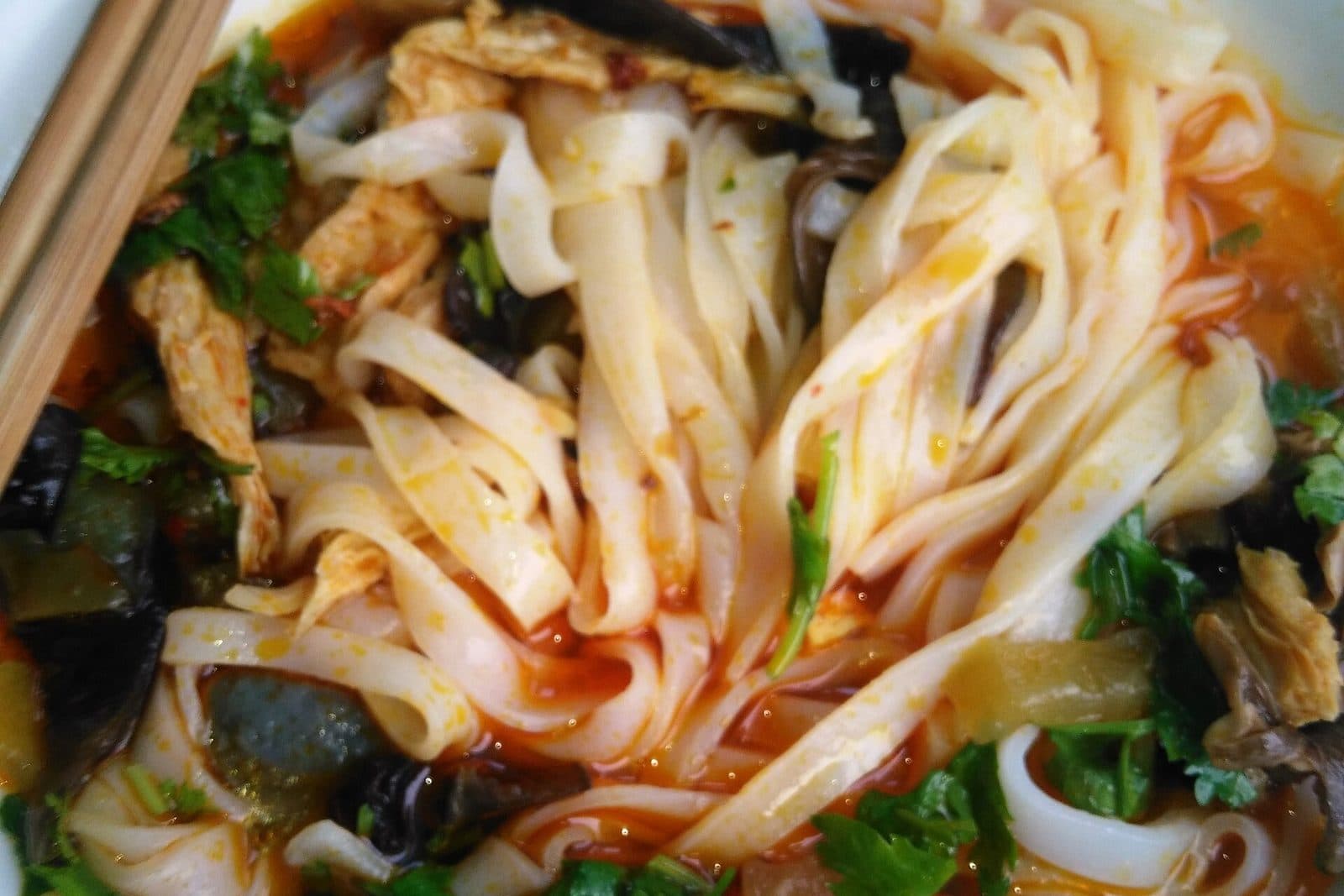
A typical Da Nang menu lists four to eight kinds of mi Quang, sorted by protein. The difference isn't only the meat: kitchens often make a separate sauce for each protein, and the herbs change too.
Mì Quảng gà (chicken): best first bowl
The chicken is braised with turmeric, ginger and lemongrass until it's juicy with yellow skin. Pieces usually come on the bone, which locals say tastes better. The sauce is a little lighter and milder than the classic. If you're cautious about unfamiliar food, start with mì Quảng gà. In Da Nang it costs 35,000–55,000 VND (~$1.50–2).
Mì Quảng tôm thịt (prawn and pork): the classic
Two slices of pork belly and a big prawn. The sauce is thick and deep yellow, sometimes with a hint of tomato. It's the most popular version in Da Nang and Hoi An, and the one you see in almost every guidebook photo. Price: 40,000–70,000 VND (~$1.50–2.75).
Mì Quảng lươn (eel): for the curious
River eel is a delicacy in central Vietnam. Small pieces are fried with turmeric and lemongrass and laid over the noodles. Tender texture, flavour somewhere between fish and chicken. Price: 55,000–90,000 VND (~$2–3.50).
Mì Quảng ếch (frog)
Frog legs are marinated in turmeric and garlic, fried and piled on the noodles. It tastes a lot like chicken, with firmer meat. Less scary than it sounds. In Da Nang, go to Mì Quảng Ếch Bếp Trang for this one. Price: 60,000–85,000 VND (~$2.50–3.50).
Mì Quảng chay (vegetarian)
No meat: tofu, mushrooms, sometimes sweet potato, and a vegetable-based turmeric sauce. It's popular on Buddhist fasting days, the 1st and 15th of each lunar month. Hoi An has plenty of vegetarian cafes that serve it. Price: 35,000–60,000 VND (~$1.50–2.50).
Mì Quảng sứa (jellyfish)
A coastal version with strips of jellyfish, crunchy and nearly flavourless on their own, so the sauce does the work. In Da Nang, the place for it is Mỳ Quảng Hồng Vân, a Michelin Bib Gourmand shop. Price: 30,000–40,000 VND (~$1.15–1.50).
Mì Quảng Phú Chiêm: the "original"
Prawn-stock sauce, pork belly, lots of herbs and shredded banana blossom. Look for it at roadside shops on the Da Nang to Hoi An road around Dien Ban, or at places with "Phú Chiêm" on the sign. Prices are about the same as a classic bowl.
Mì Quảng niêu (clay pot)
A newer style: mi Quang arrives in a small clay pot straight off the fire. It photographs well, and the pot keeps the sauce hot longer. You'll find it in mid-range and upmarket restaurants. Price: 80,000–120,000 VND (~$3–4.50).
Where to eat mi Quang in Da Nang: 7 places
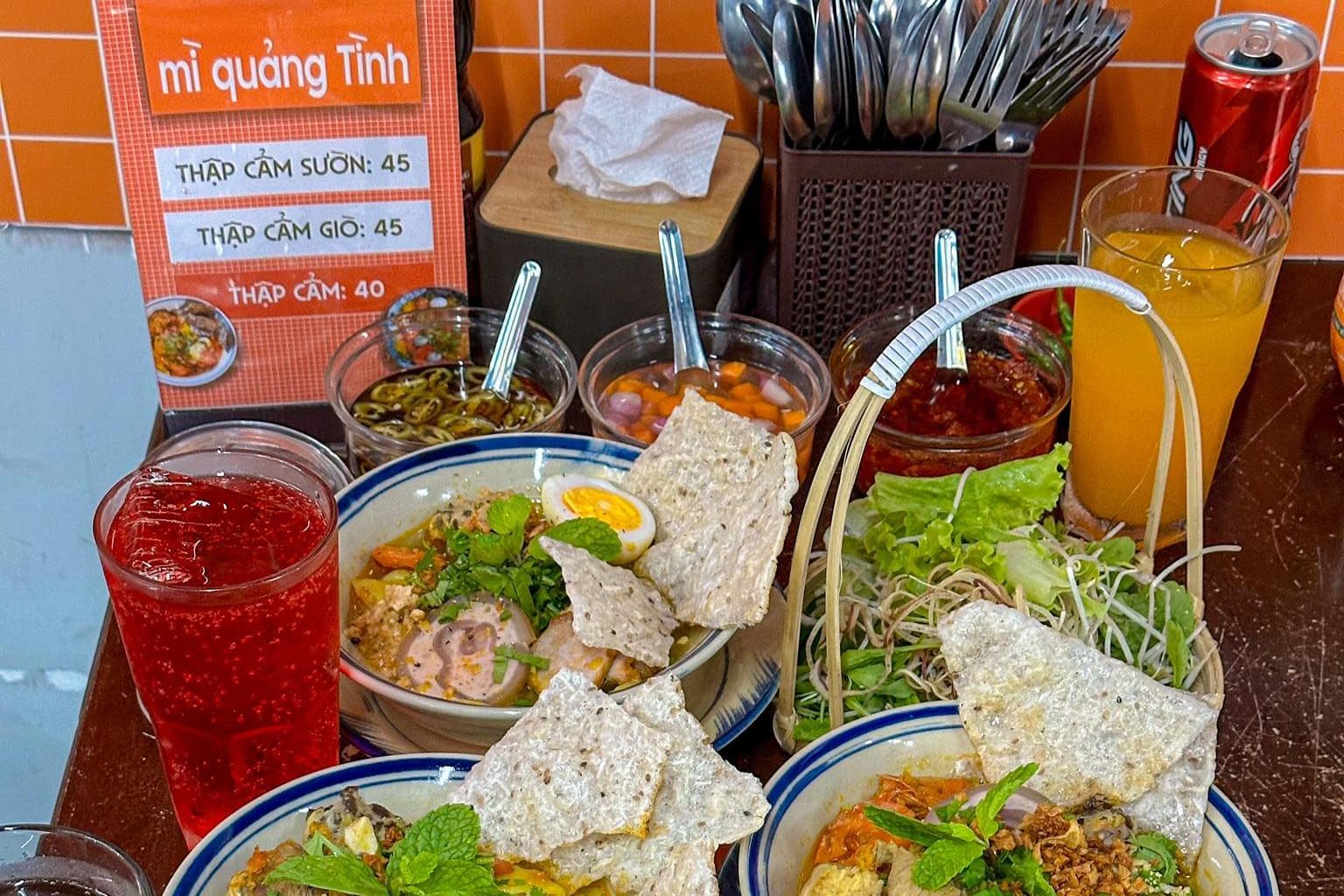
Most good addresses in Da Nang are in Hai Chau ward, within half an hour's walk of each other. Fame and quality don't always line up. Some of the best bowls come from plain family shops with handwritten menus and no English at all.
The map shows seven addresses across both cities: green for shops, amber for restaurants. Tap a point for the address and price.
- Mì Quảng 1A (Mì Quảng 1A Hải Phòng): 1A Hai Phong, 6:00–21:00 — 40,000–55,000 VND (~$1.50–2) — Michelin Selected
- Mì Quảng Bà Mua (Mì Quảng Bà Mua): 19 Tran Binh Trong plus about 10 branches — 45,000–70,000 VND (~$1.75–2.75), until 22:00
- Madame Lân (Nhà hàng Madame Lân): 4 Bach Dang, Han River front — 80,000–120,000 VND (~$3–4.50), restaurant
- Mì Quảng Ếch Bếp Trang (Mì Quảng Ếch Bếp Trang): 441 Ong Ich Khiem — 50,000–70,000 VND (~$2–2.75), frog mi Quang
- Mì Quảng Ông Hai (Mì Quảng Ông Hai): 6A Truong Minh Luong, Hoi An — About 40,000 VND (~$1.50), cao lau too
- Mì Quảng Bích (Mỳ Quảng Bích): 272 Hung Vuong, Hoi An — 30,000–45,000 VND (~$1.15–1.75)
- Morning Glory Original (Morning Glory Original): 106 Nguyen Thai Hoc, Hoi An — From 95,000 VND (~$3.50), restaurant
| Place | Address | Hours | Price, VND | Price, USD | Why go |
|---|---|---|---|---|---|
| Mì Quảng 1A | 1A Hải Phòng | 6:00–21:00 | 40–55k | ~$1.50–2 | The famous one, Michelin Selected. Prawn and pork, lunchtime queue |
| Mì Quảng Bà Mua | 19 Trần Bình Trọng, 95A Nguyễn Tri Phương and other branches | 7:00–22:00 | 45–70k | ~$1.75–2.75 | Local chain of about 10 shops, clean, lots of proteins |
| Mỳ Quảng Hồng Vân | 59C Lê Hồng Phong | 6:00–13:00 | 30–40k | ~$1.15–1.50 | Michelin Bib Gourmand 2024, jellyfish mi Quang |
| Mì Quảng Ếch Bếp Trang | 441 Ông Ích Khiêm (branches on Hồ Nghinh and Bạch Đằng) | 7:00–22:00 | 50–70k | ~$2–2.75 | Frog is the speciality, classic bowls too |
| Madame Lân | 4 Bạch Đằng (Han River front) | Lunch and dinner | 80–120k | ~$3–4.50 | Big air-conditioned restaurant with an English menu |
| Mì Quảng Bà Vị | 166 Lê Đình Dương | 6:00–23:00 | 30–70k | ~$1.15–2.75 | Around 40 years old, a local breakfast favourite |
| Mì Quảng Bà Lữ | K90/8 Nguyễn Văn Linh (in an alley) | 7:00–21:00 | ~25k | ~$1 | One of the oldest shops, cheapest bowl on the list |
All of these are in Hai Chau ward. Da Nang abolished its districts in July 2025, so "Hai Chau District" on older signs and map listings is out of date.
Mì Quảng 1A is the obvious tourist pick. That doesn't make it bad: it's on the Michelin list, the prawns are big, the noodles are fresh and the sauce is rich. Because everyone knows it, there's nearly always a queue, and in high season you can wait 20 minutes for a table. Go at 7:00 or after 14:00.
Mì Quảng Bà Mua is a chain for when you want to eat in peace. There are about ten branches, so Google Maps is the easiest way to find the nearest one. The menu is long: chicken, prawn, pork, beef, eel, a mixed bowl. Prices are a little above street level, and the dining rooms are clean.
Mỳ Quảng Hồng Vân is a small shop that Michelin added to its Bib Gourmand list in 2024. The thing to order is jellyfish mi Quang, which is rare even in Da Nang. It only opens until lunchtime, so make it a morning stop. In 2025 Michelin also gave a Bib Gourmand to Quê Xưa (165–167 Núi Thành), whose menu is built around mi Quang and pork rice-paper rolls.
Madame Lân is a different league: a big restaurant on the Han River front with air conditioning and an English menu, popular with tour groups. The mi Quang is good, but it's the restaurant version. You're paying for comfort, not for the family-shop experience.
Mì Quảng Bà Vị has been going for about 40 years. Locals come for breakfast, everyone else drops in later, since it stays open until 23:00, which is rare for mi Quang.
Prices and hours as of September 2026, from VinWonders and the shops' own listings. Family shops close early when the noodles run out.
Where to eat mi Quang in Hoi An: 5 places
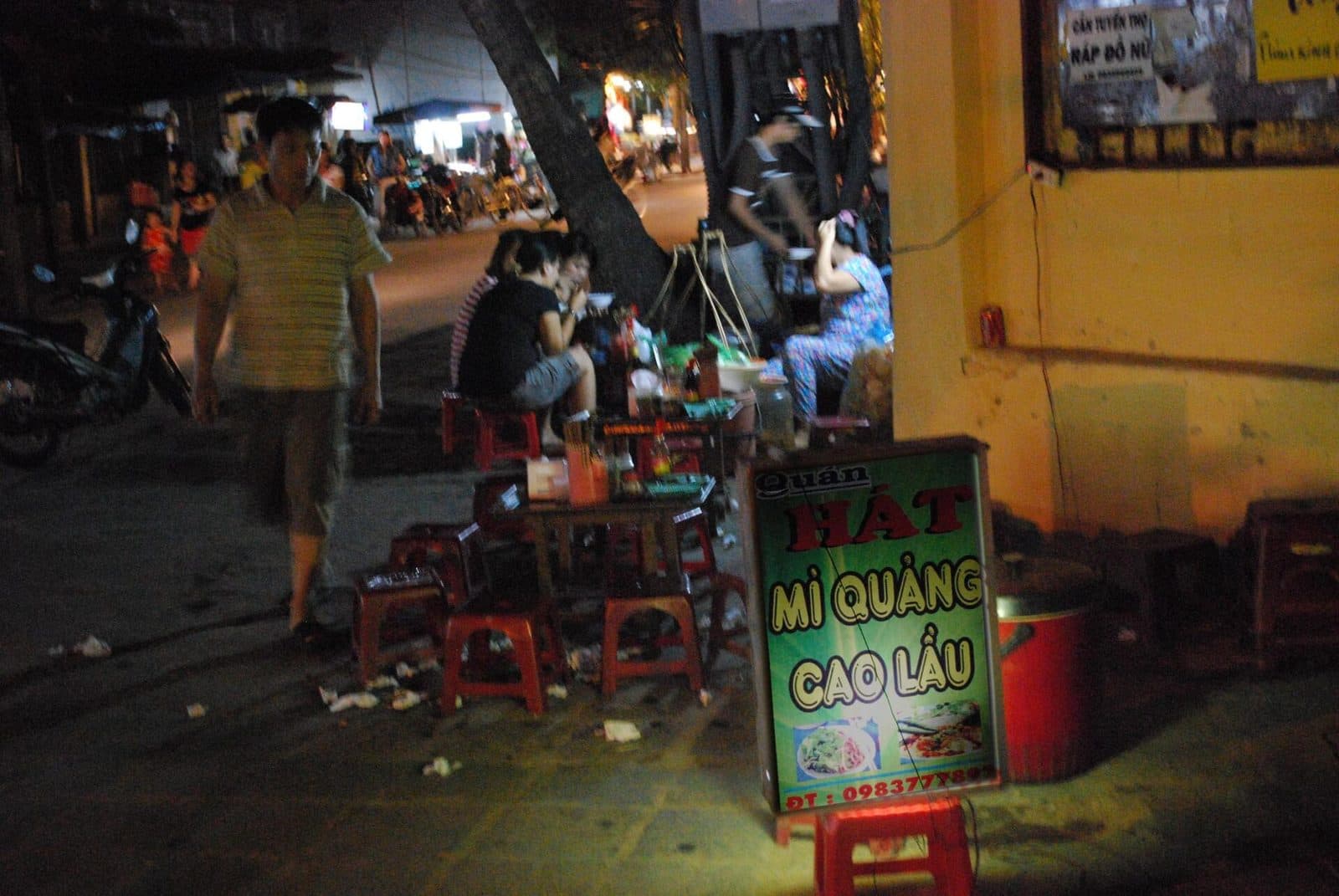
In Hoi An mi Quang isn't the headline dish. That title belongs to cao lau. The upside is that mi Quang here is cooked mostly for locals, and a bowl near the Old Town costs no more than in Da Nang. Since July 2025 the Old Town and its surroundings are Hoi An ward, part of Da Nang city.
| Place | Address | Price, VND | Price, USD | Why go |
|---|---|---|---|---|
| Mì Quảng Ông Hai | 6A Trương Minh Lượng | ~40k | ~$1.50 | Family place that also does cao lau |
| Mì Quảng Bích | 272 Hùng Vương | 30–45k | ~$1.15–1.75 | Local shop about 15 minutes' walk from the Old Town |
| Mì Quảng Dì Hát | Corner of Nguyễn Huệ and Thái Phiên | 35–50k | ~$1.50–2 | Easy stop on an Old Town walk |
| Hoi An Central Market | 19 Trần Phú, food hall inside | 35–50k | ~$1.50–2 | Rows of mi Quang and cao lau stalls, fast and cheap |
| Morning Glory Original | 106 Nguyễn Thái Học | from 95k | from ~$3.50 | Trinh Diem Vy's restaurant, stylish, 2–3 times street price |
Mì Quảng Ông Hai is a family place in a lane by the Old Town. They also cook cao lau, so you can compare Hoi An's two signature noodles in one breakfast. A bowl is about 40,000 VND.
Mì Quảng Bích on Hung Vuong is where locals go. English-language Hoi An guides regularly name it among the best mi Quang in town. Short menu, and pointing works fine.
Dì Hát is on the corner of Nguyen Hue and Thai Phien, at the edge of the Old Town. Handy if you're mid-walk and don't feel like riding out to the suburbs.
Hoi An Central Market is a good first taste. The food hall inside has rows of stalls cooking mi Quang, cao lau and banh mi in front of you. Prices are close to local shops, though you'll be surrounded by other tourists.
Morning Glory Original belongs to Trinh Diem Vy, who runs several places and a cooking school in Hoi An. Mi Quang is one line on a long menu of home-style dishes. The presentation is polished and the ingredients are good, but it costs two to three times the street price. Come for a relaxed dinner, not a quick bowl.
How to eat mi Quang, step by step
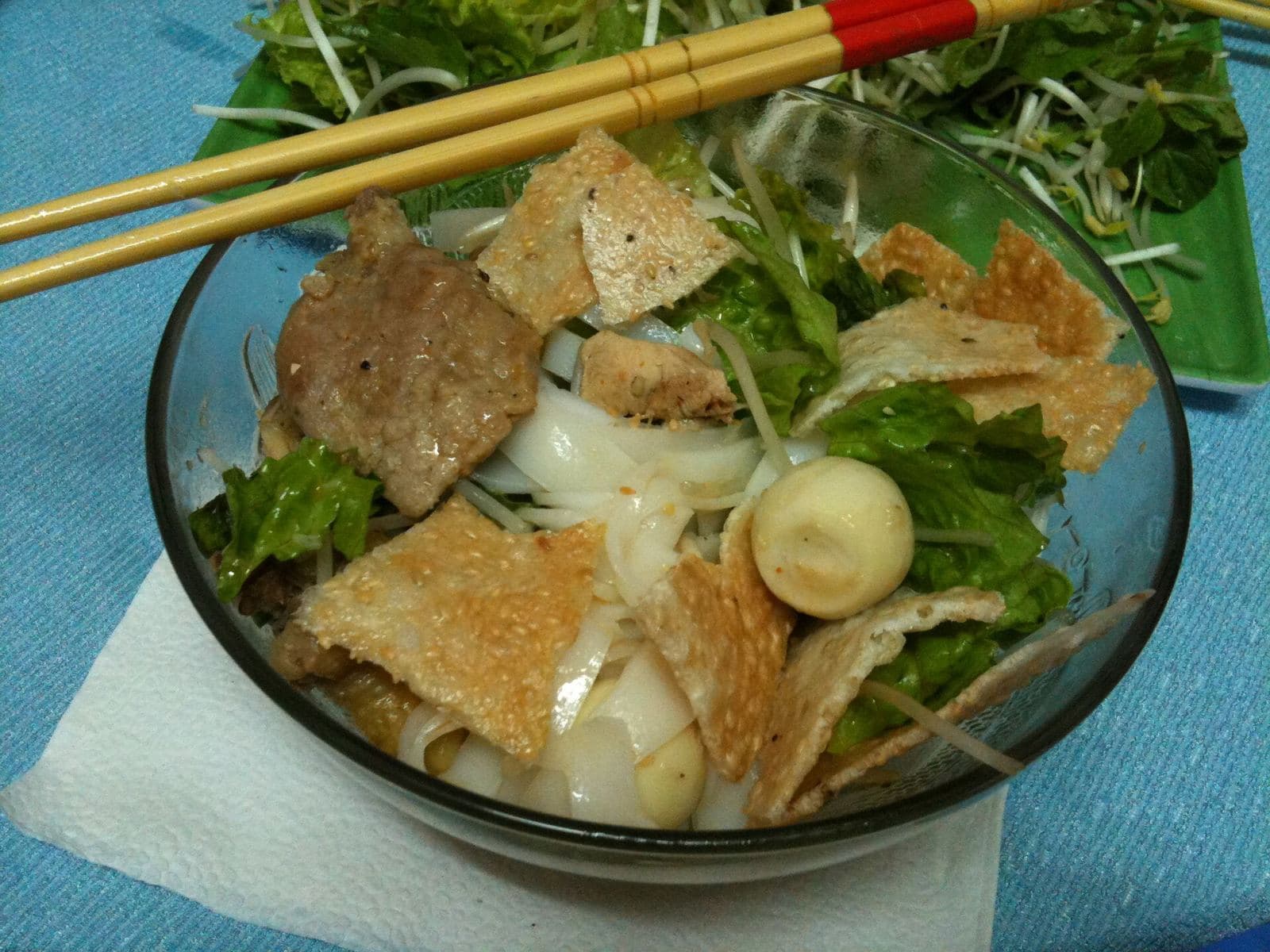
Locals eat mi Quang fast, barely looking at the bowl. First-timers usually get stuck on two things: what the cracker is for, and the urge to spoon it up like soup. Here's the order Hoi An cooking classes teach.
- Toss with chopsticks first. The sauce is at the bottom, noodles on top, herbs wherever. Lift everything from the bottom and turn it over two or three times until the noodles are evenly coated. This is the step that matters most.
- Break the cracker. Take the round bánh tráng mè and snap it into coin-sized pieces. Drop half into the bowl: some pieces soften and go chewy, others stay crisp. Keep the rest for later.
- Squeeze a lime wedge. The sourness cuts through the peanuts and turmeric. A whole lime is too much.
- Chilli to taste. There's usually fresh sliced chilli or paste on the table. Locals use a lot. If you're not used to heat, start with one slice.
- Add herbs a handful at a time. Not all at once, a little with each new bite of noodles. Mint, basil, bean sprouts, whatever you like. Lemon basil is especially good with chicken.
- Don't top it up. Don't ask for hot water, soy sauce or extra broth. It dilutes the concentrate and the flavour goes flat. If the bowl really is too dry, ask politely for more sauce: xin thêm nước nhân ("sin tem nook nyan").
- Eat it quickly. The noodles are best in the first few minutes, while they're warm and before the cracker goes completely soft. Nobody lingers over a bowl of mi Quang.
Mi Quang prices in 2026
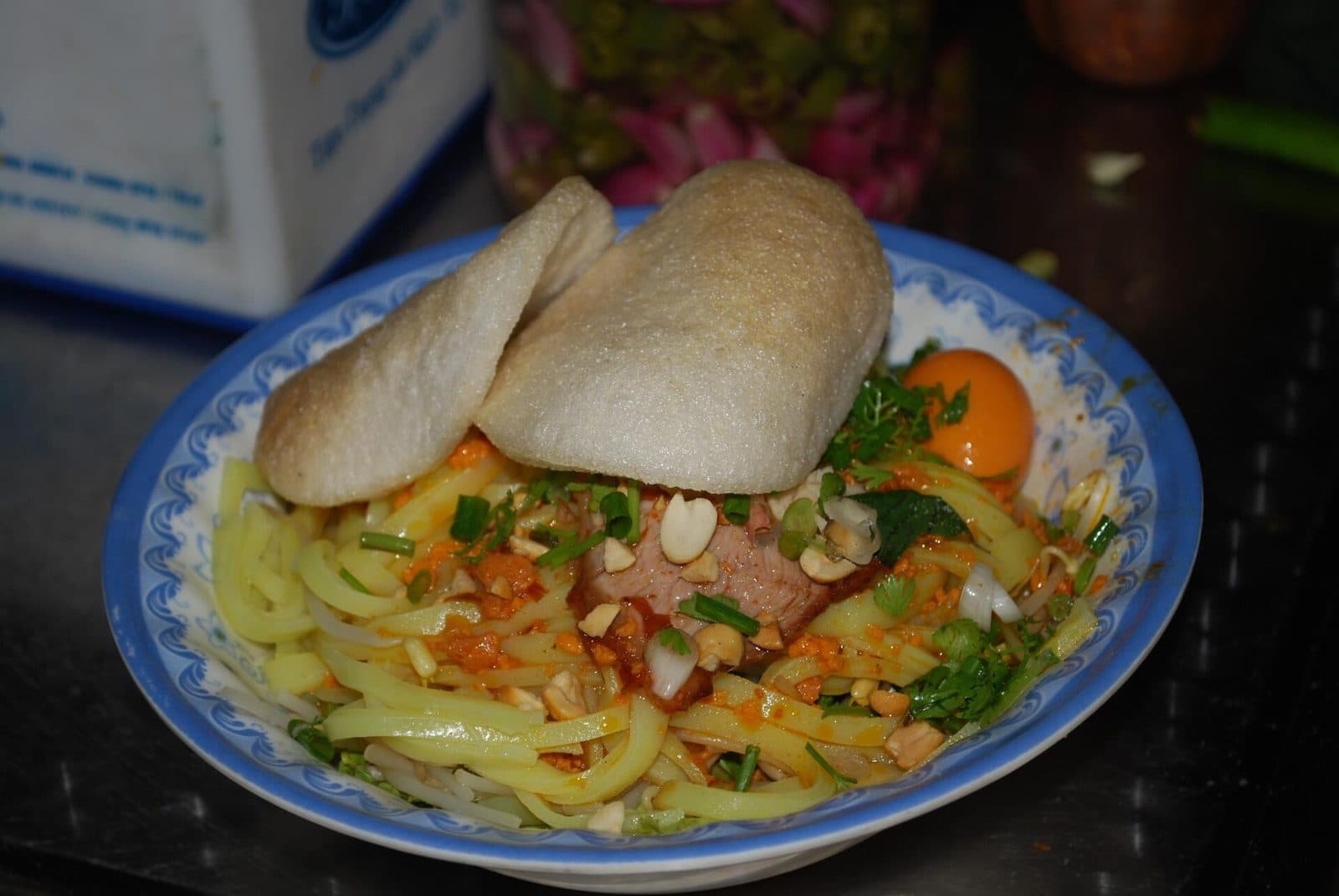
Mi Quang is still cheap in Da Nang and Hoi An: at a family shop, a bowl costs about the same as a coffee in a mall. The price range is wide, and it depends almost entirely on the kind of place you're in, not on the noodles.
| Type of place | Price, VND | Price, USD | What you get |
|---|---|---|---|
| Street stall / market | 25,000–45,000 | ~$1–1.75 | Standard bowl, chicken or prawn and pork, plastic stools |
| Local cafe | 45,000–70,000 | ~$1.75–2.75 | Clean room, sometimes air con, 3–5 proteins |
| Tourist restaurant | 70,000–120,000 | ~$2.75–4.50 | English menu with photos, air con |
| Upscale (Madame Lan, Morning Glory) | 100,000–180,000 | ~$4–7 | Restaurant plating, clay pots, river views |
A bowl normally includes noodles, protein, sauce, herbs, peanuts and one cracker. An extra cracker is 5,000–10,000 VND (~$0.20–0.40), green tea is often free, and soft drinks run 10,000–25,000 VND (~$0.40–1).
Prices as of September 2026, rounded. In high season, tourist areas of Hoi An can charge more.
Currency converter
Budget for a mi Quang day
If you want to plan a day around mi Quang in Da Nang, set aside 200,000–300,000 VND (~$8–12) for two, including drinks and a couple of extras. That covers breakfast at Hong Van, a late lunch at Ba Mua and coffee in between.
Paying and ordering as a foreigner
Family shops take cash VND or Vietnamese bank QR codes, so carry small notes; a 500,000 VND bill for a 35,000 VND bowl will cause a sigh. Madame Lan and Morning Glory take Visa and Mastercard. English menus are standard at 1A, Ba Mua, Madame Lan and Morning Glory and rare elsewhere, but "mi Quang ga" (chicken) or "mi Quang tom thit" (prawn and pork) will get you fed anywhere. Grab works across Da Nang and Hoi An, and the ride between the two takes about 45 minutes.
For the bigger picture on street food, with prices for pho, banh mi and desserts, see Vietnam street food 2026.
Fast Track — no queue at the border
5–10 minutes instead of an hour in the immigration queue
from$11per passenger
Cooking classes: learn to make mi Quang
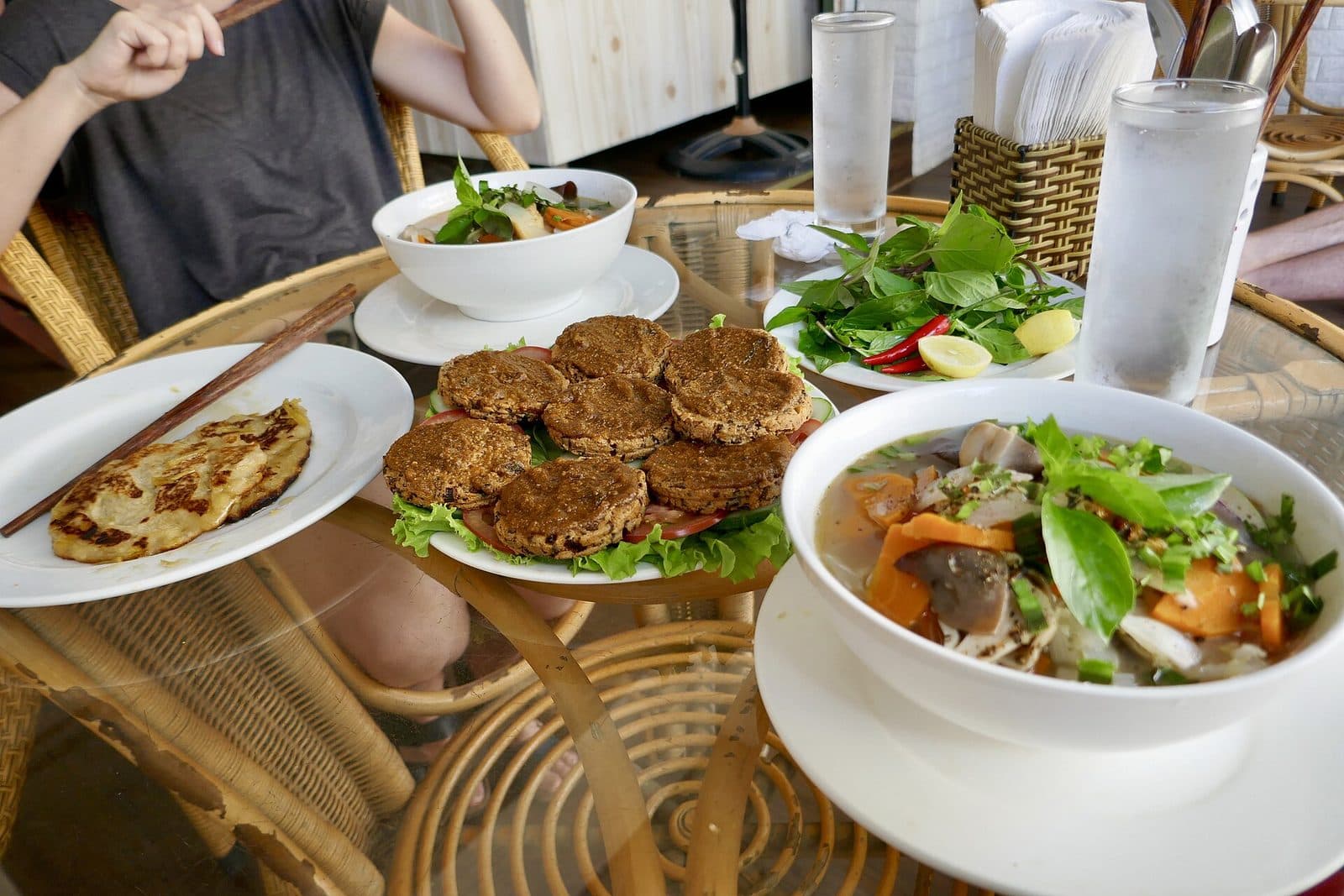
Hoi An and Da Nang have dozens of cooking schools where mi Quang is part of the standard menu, usually alongside cao lau, banh xeo, fresh rolls and a dessert. It's a good option if you'd like to take a skill home, not just souvenirs.
| School | City | Price, USD | What's included |
|---|---|---|---|
| Red Bridge Cooking School | Hoi An | $35–55 | Boat to the farm, market, 4–5 dishes |
| Morning Glory Cooking School | Hoi An | $30–45 | Class by Trinh Diem Vy's team, in town |
| Thuan Tinh Island Cooking | Hoi An | $28–40 | Island trip, organic farm |
| Sabirama Cooking Class | Da Nang | $25–35 | In the city, no transfer |
| Hoi An Eco Cooking Class | Hoi An | $20–30 | Budget option, small group |
Prices are indicative, so check the school's website before booking.
A class usually takes 3–4 hours with 6–10 people, so everyone cooks rather than just watching. The format is standard: market visit (about an hour), prep, 4–5 dishes, then lunch together.
For mi Quang, classes usually teach two things: mixing the turmeric dough and reducing the sauce. Most schools buy the noodles ready-made, since they're made by hand and rarely come out right on a first try at home.
Common first-timer mistakes
First-timers tend to trip over the same things, and they come up again and again in reviews and Da Nang food guides. Avoid even half of them and the bowl makes a lot more sense.
- Leaving the herbs on the side. They aren't a garnish. Without them you lose the freshness and acidity.
- Not crumbling the cracker. The most common one: people eat it separately like a chip or don't touch it. It's half the texture.
- Pouring in soy sauce. The sauce is already salty and balanced. More soy just drowns it.
- Eating it with a spoon like soup. Noodles and toppings go on chopsticks. The spoon is only for the last of the sauce.
- Starting with a tourist restaurant. Try a street bowl for 30,000–40,000 VND first, then the restaurant version. You'll taste the difference right away.
- Saving it for dinner. Family shops like Hong Van close by lunchtime. Chains like Ba Mua and Ba Vi stay open late, but the morning bowl is fresher.
What else to eat in central Vietnam
If you're in Da Nang or Hoi An for the food, mi Quang is the first stop, not the last. Central Vietnamese cooking is noticeably different from both northern and southern.
- Cao lau: Hoi An's signature dish, thick greyish noodles that legend says are made with water from the old Bá Lễ well.
- Pho bo: the northern classic with a long-simmered beef broth. Decent in Da Nang and Hoi An, but for the real thing you go to Hanoi.
- Bun bo Hue: the spicy soup from neighbouring Hue, about 100 km from Da Nang. Red broth, lemongrass, shrimp paste.
- Bánh xèo: a crisp golden pancake with prawns and bean sprouts, wrapped in rice paper with herbs.
- Bánh tráng cuốn thịt heo: Da Nang's own dish of thin boiled pork slices, rice paper and herbs that you roll yourself.
- Mì Quảng cá lóc: the snakehead fish version. Hard to find, look in village shops.
- Bun cha: a Hanoi dish, but Da Nang has a couple of places doing a decent one.
More on all of it in our Vietnamese food guide.
FAQ
Liquid, noodles and how you eat it. Pho comes in a full bowl of clear broth. Mi Quang has only 50–80 ml of concentrated yellow sauce at the bottom. Pho noodles are narrow and white, mi Quang noodles are wide and usually yellow, because turmeric goes into the dough. You eat pho with a spoon and chopsticks together. Mi Quang is mostly a chopsticks dish, tossed first with the sauce and crumbled cracker
Not really. It has broth, but so little that it's better described as a sauce: 50–80 ml per bowl, just enough to coat the noodles. People eat it with chopsticks like pasta and use the spoon only for what's left at the bottom. If a cafe brings "mi Quang" in a full bowl of liquid, it's probably a version adjusted for tourists. In Hoi An and Da Nang the classic bowl is half dry
It depends on the kind of place, not on the noodles
- Street stall or market25,000–45,000 VND~$1–1.75
- Local cafe45,000–70,000 VND~$1.75–2.75
- Tourist restaurant with an English menu70,000–120,000 VND~$2.75–4.50
- Upscale: Madame Lan, Morning Gloryto 180,000 VND~$7
Almost all of the price difference pays for the room and the service. The noodles at a cheap family shop are often just as good
- Mi Quang 1A40,000–55,000 VND1A Hải Phòng, on the Michelin list, a safe first bowl
- Hong Van30,000–40,000 VND59C Lê Hồng Phong, Bib Gourmand 2024, jellyfish mi Quang, mornings only
- Ba Mua and Ba Vi30,000–70,000 VNDabout ten Ba Mua branches and Ba Vi on Lê Đình Dương: open late, rarely a queue
- Madame Lan80,000–120,000 VNDon Bạch Đằng, restaurant plating and a river view
It's bánh tráng mè, a round rice cracker with sesame, toasted over charcoal. You don't eat it on the side like a chip. You snap it into coin-sized pieces and drop them into the bowl. Some soften in the sauce and go chewy, others stay crisp, so every bite is a little different. Without the cracker the dish loses half its texture. If one doesn't come, ask for "banh trang"; an extra costs 5,000–10,000 VND
Between 6:00 and 9:30 is best. The noodles are fresh, the sauce has just been made, and the tables around you are full of locals eating breakfast. Family shops often close by lunchtime: Hong Van, for example, shuts at 13:00. Chains like Ba Mua and Ba Vi stay open until 22:00–23:00, so an evening bowl is possible, but the morning one is noticeably fresher. For dinner, pick another dish
Be careful with peanuts and shellfish. Roasted peanuts go on almost every bowl, the classic sauce often uses prawn stock, and fish sauce is in nearly everything. Ask for no peanuts with không đậu phộng and order chicken, not prawn and pork, if shellfish is a problem. For a serious allergy, carry a card in Vietnamese that names the allergen, because family shops won't have an English ingredient list and staff may not follow spoken English
Yes, mì Quảng chay comes with tofu, mushrooms and sometimes sweet potato, in a vegetable-based sauce. It's easiest to find at Hoi An's vegetarian cafes and on Buddhist fasting days, the 1st and 15th of the lunar month, when many shops add a meat-free menu. At an ordinary shop, check that the sauce has no fish sauce or meat stock: không thịt, không nước mắm means "no meat, no fish sauce"
Checklist
The short version
You can't judge mi Quang from a photo. The bowl looks thrown together: yellow noodles, a bit of meat, a heap of herbs, a strange round "chip". At a good shop at seven in the morning, with a Vietnamese coffee on the next table, it all comes together into one dish.
For a first try, two addresses are enough: Hong Van or 1A in Da Nang in the morning, Ong Hai in Hoi An around lunchtime. A bowl costs 30,000–55,000 VND (~$1.15–2), and you'll finish a piece of national heritage in ten minutes. Most visitors drive right past these shops on the way to Ba Na Hills. You don't have to.
Read next: Cao lau in Hoi An · Bun bo Hue · Da Nang food · Hoi An food
- Food
Saigon Food Tour 2026 with a Private Local Guide
Saigon food tour 2026 with local guide Denny: 11 or 8 tastings from ~$39. Book a vetted English-speaking private guide through VietnamSpot.Saigon Food Tour 2026 with a Private Local Guide - Food
Banh Xeo: Vietnam's Sizzling Pancake — Where to Eat It
What banh xeo is, how southern and central versions differ, how to eat it, where to try it in Vietnam with prices, and whether it's gluten-free.Banh Xeo: Vietnam's Sizzling Pancake — Where to Eat It - Food
Phan Thiet Food: Seafood, Banh Can & Fish Sauce
What to eat in Phan Thiet and Mui Ne: fresh seafood on Bo Ke, banh can, the home of fish sauce and local dishes — where to eat and what it costs.Phan Thiet Food: Seafood, Banh Can & Fish Sauce