Ninh Binh weather by month — when to go in 2026
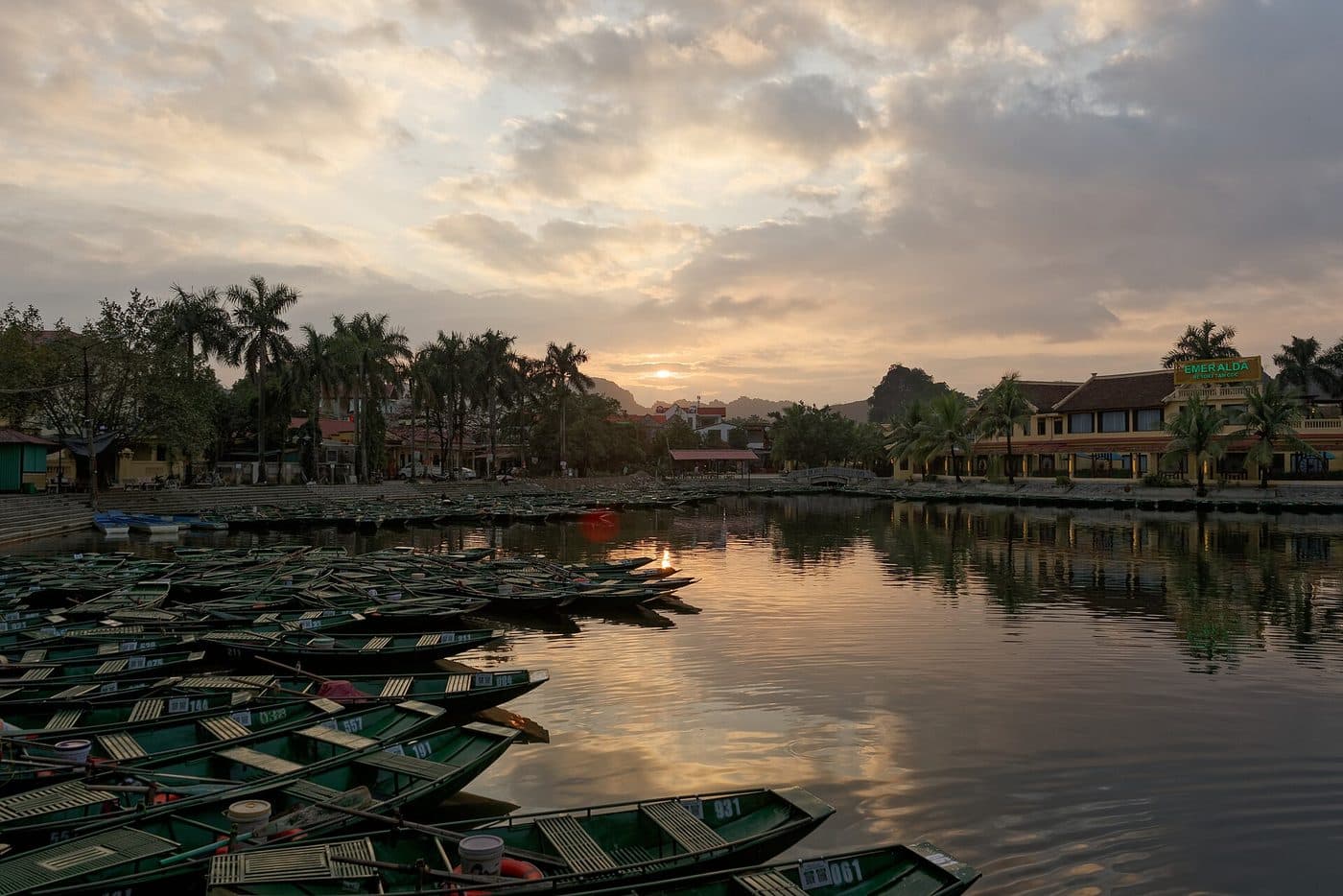
On 23 August 2026 Trang An halted every boat "until further notice" as Storm Narra closed in. Three months earlier, on 22 May, the same paddies below Tam Coc met the harvest festival in solid gold. One landscape, three months apart — which is the best argument there is for reading a weather guide before you book.
The short answer — when to go
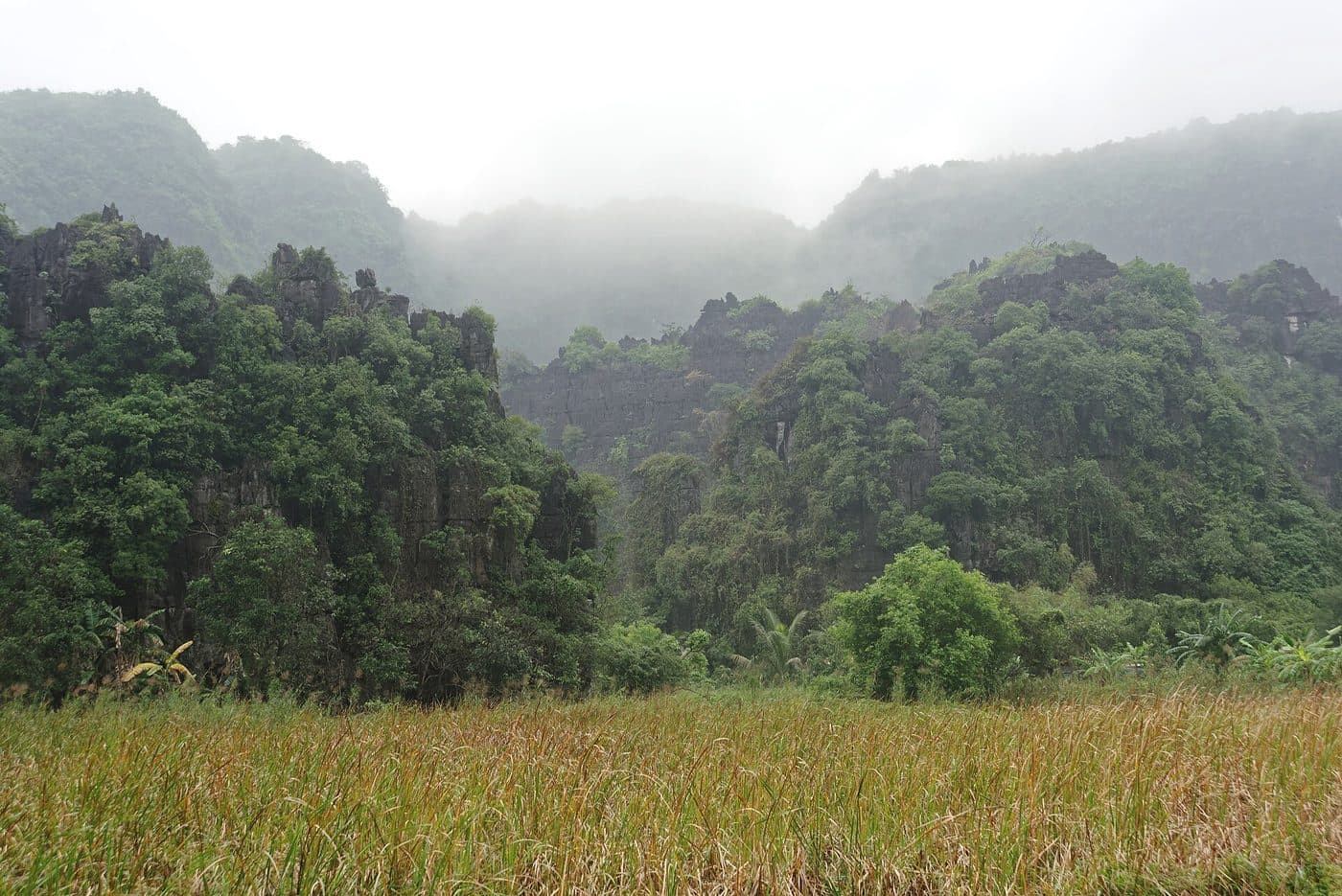
The best months to visit Ninh Binh are November, December and April: 16–28°C and 30–80 mm of rain a month. There is one extra window — the second half of May, when the Tam Coc paddies turn gold and stay that way for 10–14 days.
The worst time is August and September: 315 and 370 mm of rain, heavy air and typhoons that shut boat tours for days at a time.
By what you came for:
- Cycling and walking the valley — November, December, April
- Golden rice at Tam Coc — roughly 18–20 May to the first days of June; the window drifts every year
- Lotus ponds — early June to mid-July, shooting before 8:30am
- Fewest tourists and cheapest beds — July to September, with a spare day budgeted for a storm
Two corrections to the list you will find everywhere else. First, March is overrated. The temperature is lovely, but it is the darkest month of the year — 1.5 hours of sunshine a day, a lid of grey and constant drizzle. For photographs it is the worst month there is. Second, October is not a dry month: 245 mm and 12 rainy days. The break only comes at the turn of October into November.
- ✓ Dates are flexible and the landscape is the point: take November
- ✓ You want the golden paddies: second half of May, timed to the festival announcement
- ✓ You are here for the cycling and the staircase, not the photos: March and April
- ✗ A fixed one-week August or September trip with no room to move
- ✗ February and March if you came to photograph: 1.5 hours of sun a day
- ✗ Late June "for the gold" — the fields have already been cut
If the choice is between going and skipping it, even July is not a write-off: the rain arrives as a front and moves on, and mornings are reliably usable. What you need is a Plan B for a storm. For what to actually see and in what order, see the Ninh Binh guide.
The climate in one picture
Ninh Binh has a subtropical monsoon climate with two clear seasons. The annual mean is 24°C and annual rainfall is 1,830 mm. Every month from May to October clears 150 mm, and the peak sits at the end of summer: 315 mm in August, 370 mm in September. Weather stations disagree about which of the two is wetter — weather-and-climate backs August, climatestotravel backs September — and the disagreement is honest: it comes down to how many typhoons reached the delta in a given year.
The seasonal shape:
- Dry and cool, November to April. 15–27°C, little rain, but an overcast lid from December to March; February and March deliver just 1.5 hours of sunshine a day, the annual floor.
- Hot and wet, May to October. 30–33°C by day, short heavy showers mostly in the afternoon. From July to October, tropical storms and typhoons.
Humidity deserves its own paragraph. It never drops below 78% and holds at 85–88% from February to April. At 28°C and 88% your body reads 33–35°C; laundry does not dry overnight and your lens fogs the moment you step out of air conditioning. Weatherspark calls the muggy season nine months long, from 25 February to 30 November. It is not a dealbreaker, but from April to October air conditioning stops being a bonus and becomes a requirement.
Geographically, Ninh Binh is 90 km south of Hanoi and the weather is almost identical — the karst simply squeezes 10–15% more rain out of the same clouds. If you already know Hanoi's weather, you know this one.
One name, two different territories
In July 2025 Ninh Binh province absorbed neighbouring Ha Nam and Nam Dinh. That is not administrative trivia if you are reading a forecast: "Ninh Binh province" now means 3,943 km² and 4.4 million people, with a Gulf of Tonkin coastline made longer by Nam Dinh (old Ninh Binh already reached the sea in the former Kim Son district). The old districts were abolished in the same reform, and the provincial capital is now literally called Hoa Lu ward (phường Hoa Lư).
Two consequences. Provincial closure bulletins now list Trang An alongside seaside sites — Thinh Long, Giao Ninh, Xuan Thuy National Park — which are the old Nam Dinh, far from the karst; a coastal storm warning does not mean the Tam Coc boats stopped. And if you meet an address written as huyện Hoa Lư, that is a pre-reform record: no district by that name exists any more.
Ninh Binh weather month by month
Karst Ninh Binh sits well inland, so the sea-temperature column every beach guide carries is meaningless here. What matters instead is how much water is in the rivers and what the rice is doing — that decides whether the boats run and what the landscape looks like. That is the column we put last.
Weather in Ninh Binh month by month
colour depth — rainfall per month
October
Mixedrainfall 245 mm · rainy days 12Not dry yet — 245 mm is more than May. The mugginess eases and a second harvest runs outside Tam Coc. The real break comes late in the month.
| Month | Night–day | Rainfall | Rainy days | Sunshine | Humidity | Fields and water |
|---|---|---|---|---|---|---|
| January | 15–20°C | 25 mm | 9 | 2.5 h | 80% | Stubble and first shoots, rivers low |
| February | 15–20°C | 30 mm | 13 | 1.5 h | 85% | Seedlings, drizzle, little water |
| March | 18–22°C | 50 mm | 16 | 1.5 h | 88% | Green shoots, mist over the water |
| April | 22–27°C | 80 mm | 13 | 3.0 h | 87% | Valley solid green, rivers calm |
| May | 25–31°C | 165 mm | 13 | 6.0 h | 84% | Gold at Tam Coc from the 20th on |
| June | 26–33°C | 230 mm | 14 | 6.0 h | 82% | Harvest, then bare earth; lotuses open |
| July | 27–33°C | 225 mm | 13 | 6.5 h | 82% | Lotus peak, Ngo Dong starts rising |
| August | 26–32°C | 315 mm | 16 | 5.5 h | 85% | High water, tours cancelled |
| September | 25–30°C | 370 mm | 15 | 5.5 h | 85% | Peak water, floods, paddies submerged |
| October | 22–28°C | 245 mm | 12 | 5.5 h | 83% | Water falling; second harvest outside Tam Coc |
| November | 19–25°C | 70 mm | 8 | 4.5 h | 80% | Dry, rivers in their banks, fields cut |
| December | 16–22°C | 30 mm | 6 | 4.0 h | 78% | Low water, morning fog |
Three things the table shows that tour-operator copy never does.
The dry season starts in November, not October. October's 245 mm is more than May gets. The actual cliff falls between October and November: 245 mm down to 70, rainy days from 12 to 8.
February and March are the darkest months of the year. An hour and a half of sunshine a day. They log 13 and 16 rainy days but only 30 and 50 mm — this is mưa phùn, the northern Vietnamese drizzle that runs for weeks, never really soaks you, and eats all the light. If you came for photographs, cross both months off.
The wettest stretch is late summer, not midsummer. Rainfall nearly doubles from June to September, 230 mm to 370 mm. September logs 15 rainy days out of 30, which does not mean it pours for days — it means rain is more often falling than not.
Season by season, in detail
December to February: cool, grey, quiet
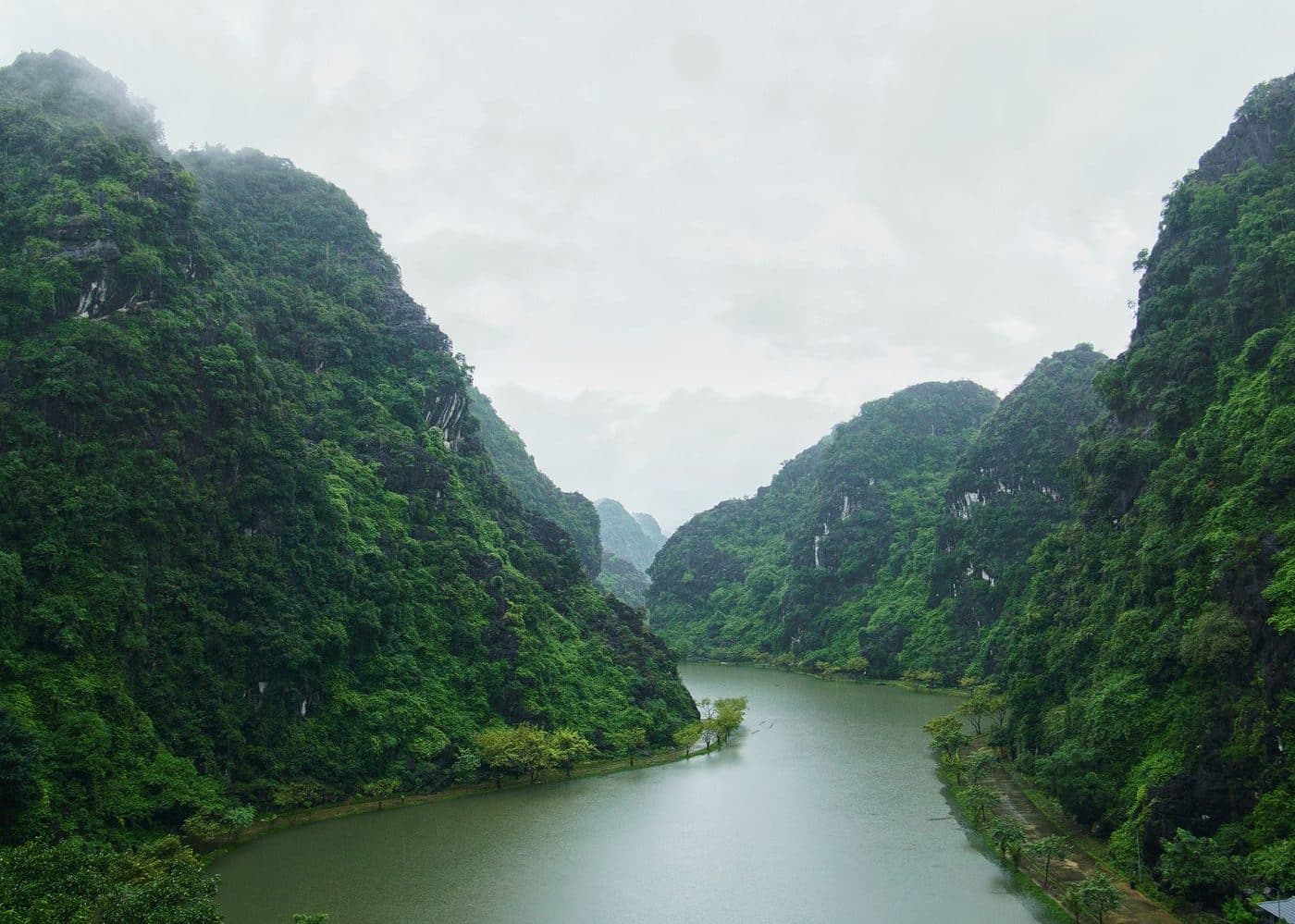
Winter here is 20–22°C by day and 15–16°C at dawn — chilly enough for a hoodie or a light jacket first thing. There is barely any rain, 25–30 mm a month, but the sky is often shut, especially in January and February. You can get two or three days of solid grey without a single drop falling.
February adds the fine drizzle: thirteen rainy days totalling 30 mm. Mist over the paddies at dawn looks extraordinary; sunsets, at 1.5 hours of sunshine a day, mostly do not happen. Humidity climbs to 85%, and even without heat the air already feels thick.
What winter is good for:
- The Mua Cave staircase, which you climb without stopping when it is not hot
- Tam Coc boats still run, but the river is low and slow, and so is the rower
- Homestays are cold — hot water yes, heating almost never. Bring layers you would use in a European spring
- December is the clearest month of the cool half-year: 4 hours of sun against February's 1.5
March and April: spring, and the best hiking
These two get lumped together constantly, and they are different months.
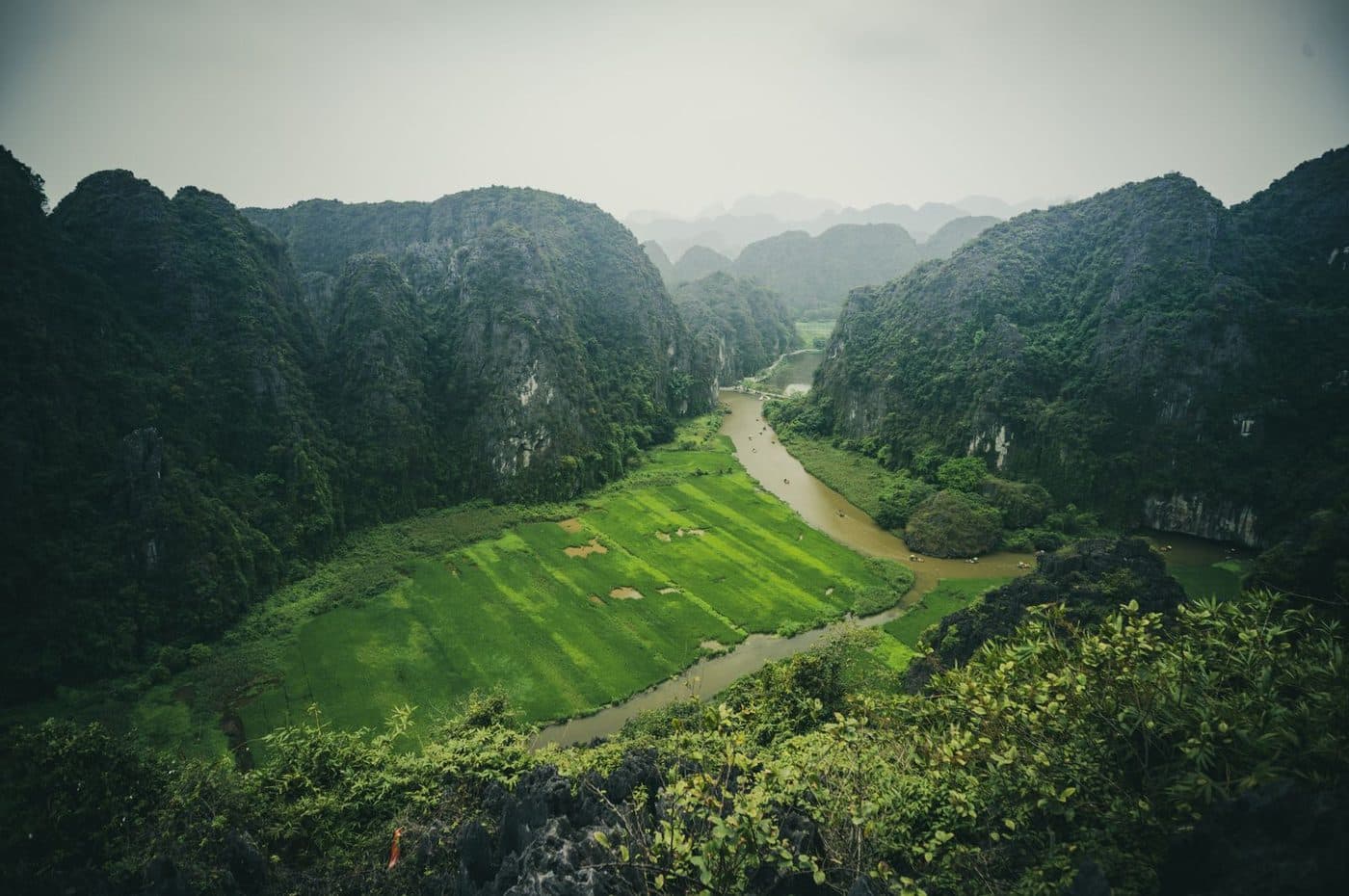
March is warm (18–22°C) and nearly dry by volume, at 50 mm. But it logs sixteen rainy days and 1.5 hours of sun: the sky is white, the karst loses its depth, and the far ridges vanish into haze. For a bike and a staircase, March is excellent. For a camera it is the second-worst month of the year after February. If you are travelling for the pictures, that is worth knowing before you book.
April is the turn. Sunshine doubles to 3 hours, the valley floor goes solid green, the air clears. Rain, when it comes, is a short afternoon thunderstorm — you wait an hour and carry on. April sunsets are among the year's best: the light turns the limestone pink and you can see 30 km from the top of Mua Cave. The only real drawback is cost — April collides with the European Easter break, and Vietnam's own 30 April and 1 May holidays follow immediately. Rooms go up 20–30%; book a month ahead.
May and June: the monsoon starts, the fields turn gold
May is the pivot. Through the first half it holds around 25–29°C with moderate rain. From mid-month the monsoon switches on: rain becomes regular, the air thickens, daytime temperature climbs to 31°C. And in exactly those two weeks the year's single best sight arrives.
The second half of May is the golden harvest at Tam Coc. The paddies turn bright yellow, and every photograph you have seen of a boat threading between the karst was taken in this window. It holds for 10–14 days and it moves every year. Full detail in the section below.
The lotus season starts alongside it, in ponds along the Bich Dong road and around Mua Cave, peaking from early June to mid-July.
June is hot: 26–33°C at 82% humidity, which feels like 38. Take the boat before 9am or after 4pm — midday on open water with no shade is punishing. It logs 230 mm of rain, yet still gets 6 hours of sunshine a day, more than April. Summer rain here arrives as a front and leaves; it does not sit on you all day.
July and August: peak rain, peak lotus
These are the hardest months. August brings 315 mm across 16 rainy days out of 31. That does not mean sixteen days of continuous rain. It means: often clear in the morning, cloud building by 2pm, a short violent downpour around 4pm, dry again by 7pm.
We personally got very lucky with the weather. In 6 days in the north of the country it rained once, in Hanoi, for 20 minutes; all the other days were dry and sunny. We travelled in the first half of AugustTsunya on an August trip, Vinsky Forum, 2026, translated by VietnamSpot
At 32°C and 85% humidity the air is dense — without air conditioning you will not sleep. Mosquitoes become a genuine problem in these months, and a DEET repellent is not optional.
The upsides: fewer tourists (bar the August European holiday spike), homestay rates down 20–30%, lotuses in full bloom, and the harvested fields replanted so the valley is green again. The downside that does not show in a forecast: from late July onward, boat routes close not because of rain overhead but because of water that arrived from upstream.
September and October: typhoons, then the turn
September is the wettest and riskiest month of the year: 370 mm, 15 rainy days, and peak typhoon season for northern Vietnam. When a tropical storm reaches the region it drops 200–350 mm in two or three days — April's entire monthly total in a weekend.
October is usually described as "already dry". It is not: 245 mm across 12 rainy days, more than May. What genuinely changes is the temperature (22–28°C) and the feel — the mugginess lets go and the evenings turn pleasant. The real dry break lands at the turn into November, and you start to feel it in the final ten days of October. October is a fine month to travel. Expecting November's clarity from it is not.
November: the best window of the year
November wins without qualifications. 19–25°C, 70 mm of rain across the whole month, 8 rainy days, 80% humidity. Mostly clear skies, 4.5 hours of sun, a light chill at dawn that a sweatshirt handles. The days are still long, the sunsets are strong, and you stop gasping on step two hundred of the Mua Cave climb.
It is also not high season, so rooms cost less than in December, January or April. On weather against price against crowds, November is Ninh Binh's best month outright. The one thing November does not have is gold on the fields: the rice is long cut and the valley around Tam Coc reads dry and brown.
Fast Track — no queue at the border
5–10 minutes instead of an hour in the immigration queue
from$11per passenger
The golden rice window at Tam Coc
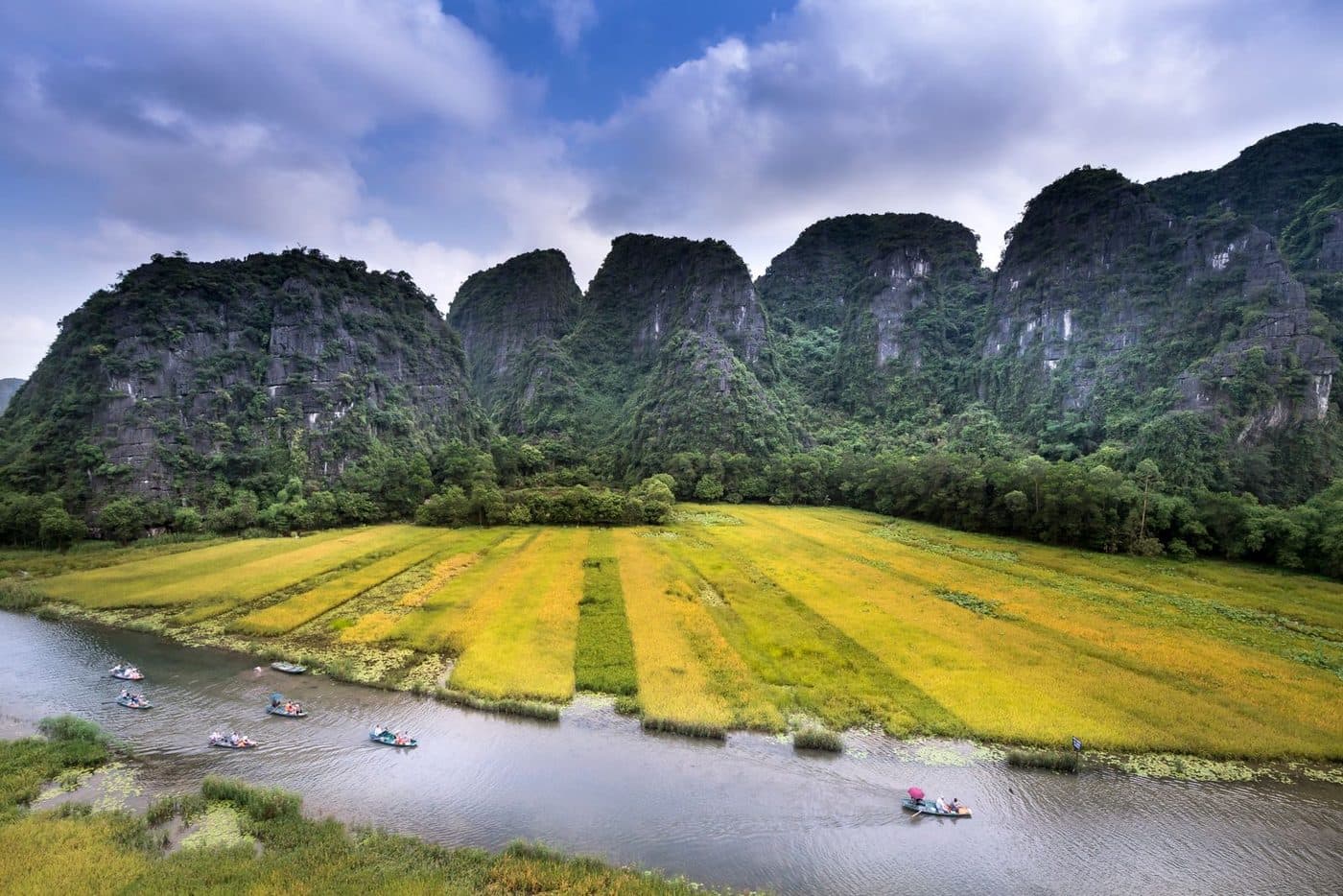
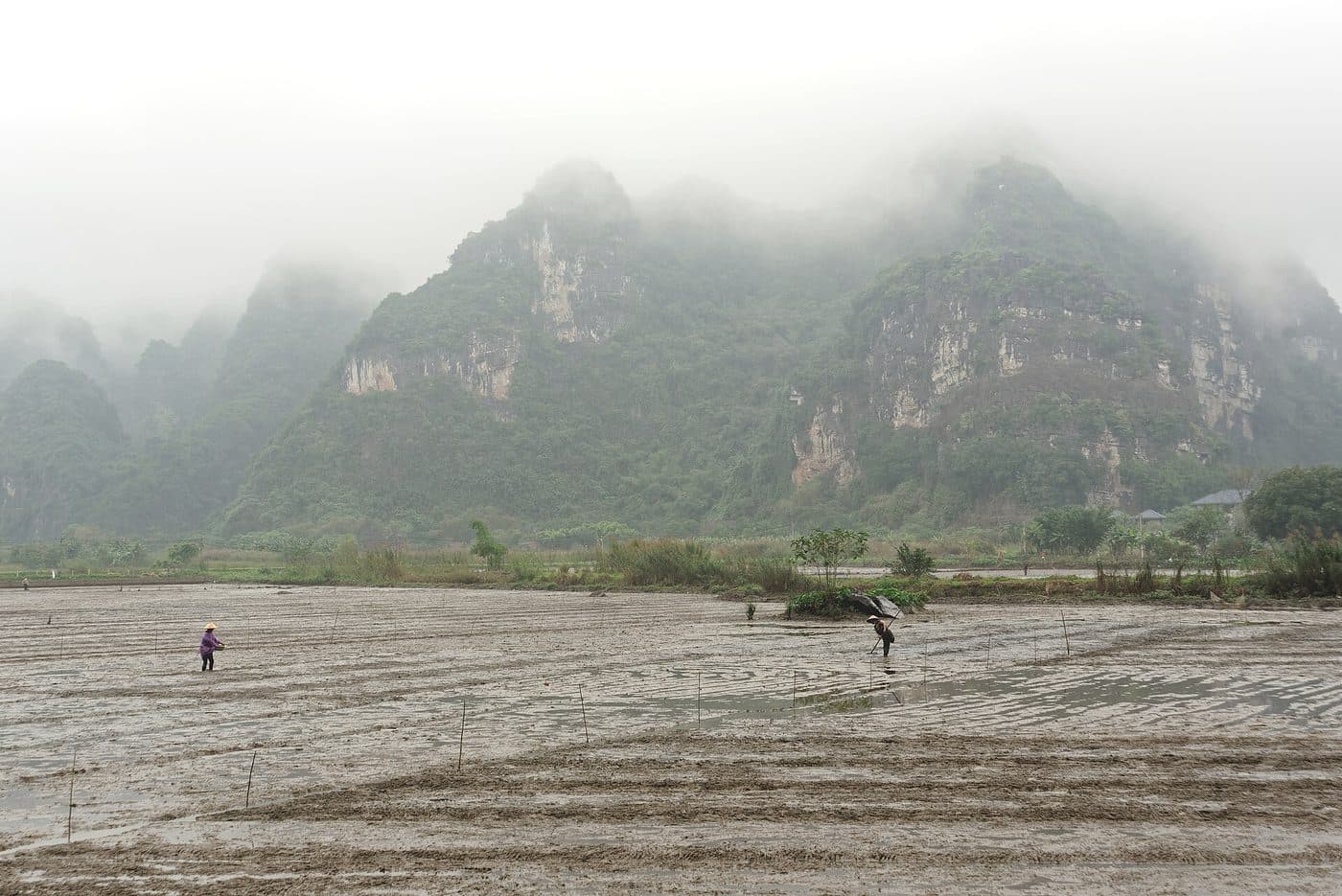
The golden paddies of Tam Coc are Ninh Binh's visual signature and the shortest weather window in the country. The golden phase runs 10–14 days, and the exact date moves year to year because it is set not by the calendar but by when the farmers put the seedlings in back in February.
The verifiable anchor is the date of the harvest festival, which the province deliberately times to the peak. It ran 23–31 May in 2025 and 22–24 May in 2026. So the working window is roughly 18–20 May to the first days of June — not "late May to early June" as most guides put it. That week of difference decides everything: arriving on 10 June in 2026 meant arriving to stubble.
| Stage | Dates | What you see |
|---|---|---|
| Green paddies | mid-April to early May | Solid fresh green — lovely, but not the shot |
| Turning | 12–18 May | Yellow in patches, photographs already work |
| Golden peak | ~18 May to early June | The brightest fields, the classic postcard frame |
| Harvest | late May to mid-June | A mosaic of gold and brown, cut by hand, no machines |
| After harvest | mid-June to July | Brown earth, puddles, fresh seedlings |
The festival itself deserves a paragraph. Sắc vàng Tam Cốc — Tràng An ("Golden Colours of Tam Coc — Trang An") is not a show staged for tourists but a harvest rite: the 2026 edition ran 22–24 May under the theme of thanksgiving to Thần Nông, the god of agriculture, with a procession of offerings from all 34 provinces of the country. Its centrepiece is a giant picture "painted" directly onto the field in different rice varieties — in 2026 a composition called Song mã chầu báo công — and you can only read it from above, from Mua Cave. Visitors are invited onto the field to cut rice with a sickle alongside the locals.
Where to see the gold:
- From a Tam Coc boat — the classic: down the Ngo Dong between the karst and the yellow fields. Admission is 250,000 VND (~$10) per adult, or 350,000 VND (~$13) with the electric shuttle between sights. The official price list does not say whether the boat is included, so check at the ticket desk
- From the Mua Cave viewpoint — the overhead view of the boats, the fields and the rice painting; the best vantage point there is
- By bicycle around Tam Coc — slower, closer, and you stop wherever you like. Bikes rent for 50,000 VND (~$2) a day
One thing worth understanding: Tam Coc gets one crop a year, and the weather is why. In the monsoon the Ngo Dong rises and the riverside paddies go under, so a second crop simply cannot be grown there. The rest of Ninh Binh gets two — the second harvest runs late September into early October — but that landscape comes without the famous boats.
Lotus season
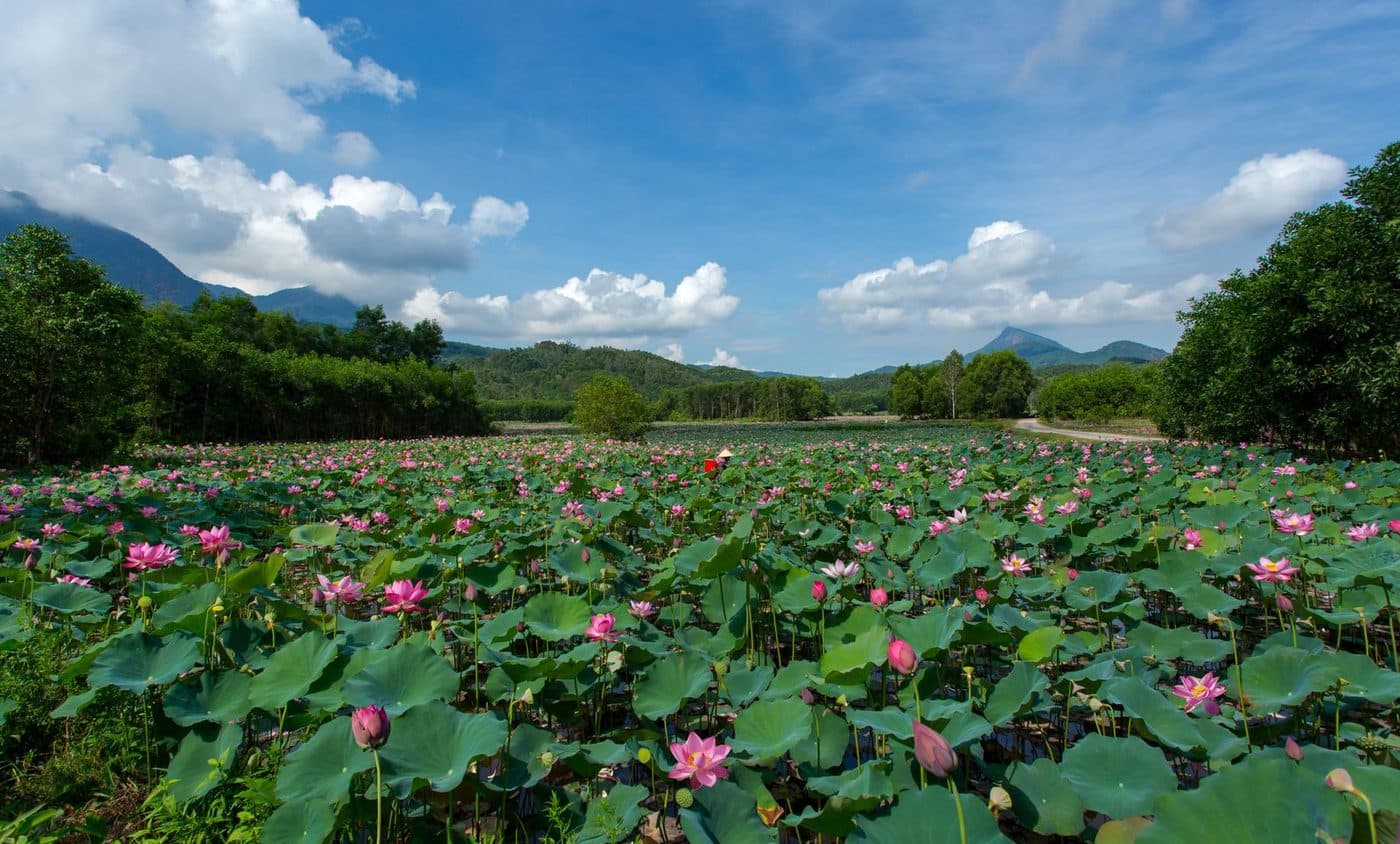
The year's second window is the lotus, and it is longer and far more forgiving than the rice. Flowering runs from late May through July, but the peak splits in two: the first three weeks of June give the densest, freshest buds, while late June to mid-July brings the mass bloom.
The real trick is the hour, not the date. Lotus opens at dawn and closes against the heat, so the working window is 5:30 to 8:00–8:30am; after that the flower tightens and the light goes hard. You will be up before sunrise, but the pond is cool and empty at that hour.
Where to go:
- The Tam Coc — Bich Dong road — cultivated ponds between the pier and the pagoda, the densest blooms, with karst towers as a backdrop. The reliable choice
- The wetlands by the Tam Coc pier — wild lotus, peaking in early July; a livelier frame, with boats and the river in it
- The Hoa Lu approach road — three kilometres of agricultural ponds where lotus is grown for seeds and tea; a working landscape rather than a postcard
- Around Mua Cave — several ponds right by the entrance, easy to pair with a sunrise climb
The lotus is a reason to add a night. But note the two windows barely overlap: if you came in late May for the harvest, June's ponds are still two or three weeks away. The one date that catches both is the first week of June — the tail of the harvest and the first lotuses.
Climbing Mua Cave, season by season

Hang Múa is 500 steps up a limestone ridge, unshaded and largely without handrails. The top gives you the single best view of everything Ninh Binh has: paddies, the river with its boats, karst ranges to the horizon. The climb takes 20–40 minutes depending on your fitness and the weather.
| Period | Conditions | Verdict |
|---|---|---|
| December–February | 16–22°C, cool, mist sometimes blocks the view | Yes, but check visibility first |
| March–April | 20–28°C, clear in April, hazy in March | Best season for the legs |
| May–June | 25–33°C, hot, 84% humidity | Yes, but sunrise or sunset only |
| July–August | 27–33°C, downpours, wet steps | Dangerous — postpone |
| September–October | 22–30°C, slippery after rain | Dry days only |
| November | 19–25°C, clear, 30 km visibility | Perfect |
If you are coming on an organised trip, note this: day tours from Hanoi reach Mua Cave in the middle of the day — precisely the worst hour for both light and heat. Setting your own pace is worth more here than the money a group saves you.
The best hours to climb, all year round, are 5:30–7:00am or 4:30–6:00pm. At dawn the valleys are often full of mist and the boats have not started; at sunset you get gold on the limestone and the boats coming back to the pier.
Admission is about 100,000 VND (~$4, September 2026). It is a private site with no official price list, so check the price, parking and opening hours on the spot.
Boat tours and the flood season
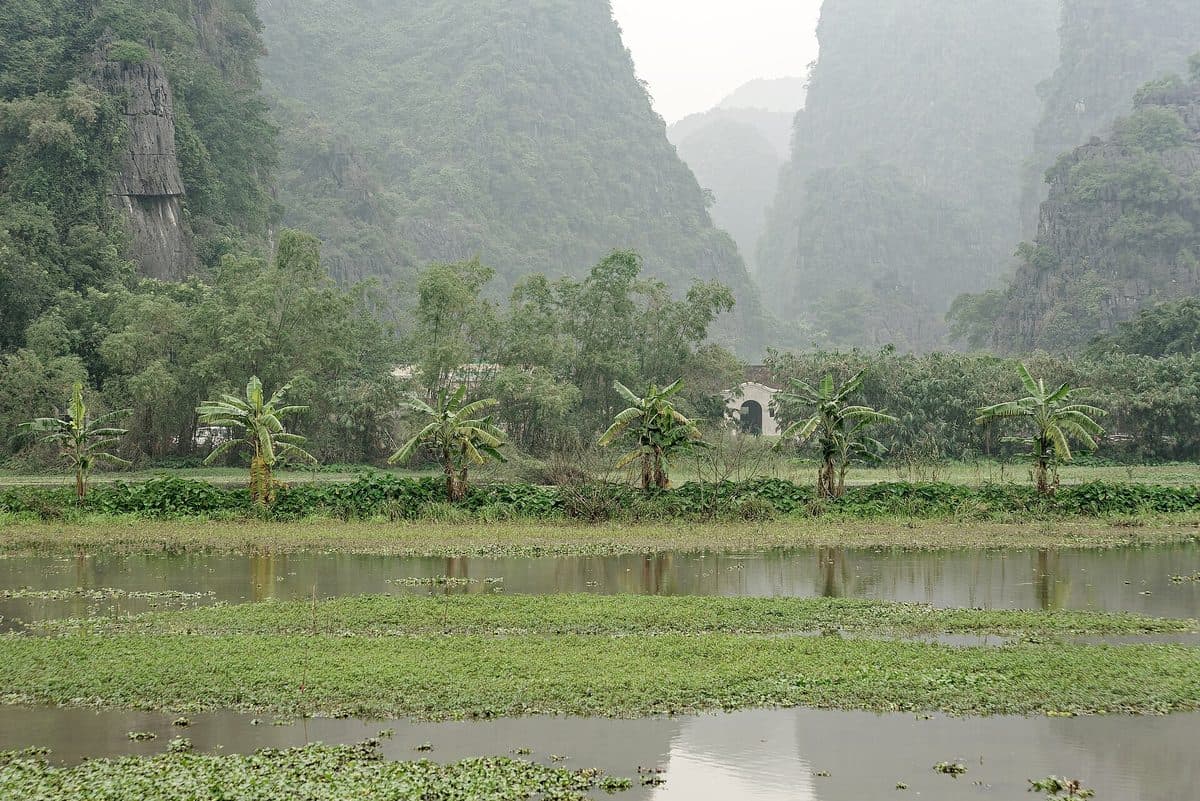
Northern Vietnam, Ninh Binh included, is exposed to typhoons from July to October, peaking in August and September. When a tropical storm reaches the region it drops 200–350 mm in two or three days — April's whole monthly total in a weekend. Rivers spill, the low ground around Tam Coc and Bich Dong floods, and tours stop.
Five years of chronology, not to frighten you but to show the frequency:
- Typhoon Kompasu (October 2021)
- Typhoon Yagi (September 2024) — major flooding on the Hoàng Long and Đáy rivers, above alert level 3. The Đào and Ninh Cơ, reported then as Nam Dinh rivers, now count as Ninh Binh's after the merger
- Typhoon Wipha (22 July 2025) — made landfall right on the Hung Yen–Ninh Binh boundary, meaning on the province itself. Damage to Ninh Binh was put at roughly $15 million
- The autumn 2025 northern floods
- Typhoon Narra (23–24 August 2026) — Trang An suspended all services "until further notice", the Thung Nham caves closed from 21 August, and overnight stays in the Cuc Phuong forest were suspended
Notice the pattern: closures come as the storm approaches, by order of the tourism department, not when the rain begins — and they are not lifted the same day either, because the water has to fall first. So the practical horizon is two or three lost days, not one.
When a tour is off, the usual Plan B is Trang An: its water system is more complex and more tolerant of a surge, and it reopens sooner after a local downpour. But that only holds for rain, not for a typhoon — in August 2026 Trang An closed first, because the decision was made on the forecast rather than the water. If the storm has a name, no boat in the province will run, and the real Plan B looks different: Bai Dinh pagoda under a roof, museums, a long coffee, and the boat moved to the day after tomorrow.
What to arrange in advance if you are coming in the wet season:
- Book accommodation with free cancellation
- Budget two spare days for waiting it out
- Bring rubber sandals — useful in the boat and on flooded lanes alike
- Keep a Hanoi driver's contact handy in case you have to leave in a hurry; the options are covered in getting to Ninh Binh
- Do not schedule this leg tight against a flight — the road back can take much longer than planned
What to pack, by season
Almost everything in Ninh Binh happens outdoors: a boat, a bicycle, a mountain, a rice field. There is nowhere to hide from the weather, so what is in your daypack decides whether you enjoy the day or spend it in a café. The country-wide list lives in our Vietnam packing guide; below is only what is specific to here.
| Season | Clothing | Gear |
|---|---|---|
| December–February | Light jacket or hoodie, long trousers, trainers | Scarf for dawn at Mua Cave, small umbrella for drizzle, thermos |
| March–April | T-shirts, a light layer for the evening, trainers | Umbrella, SPF 30+, repellent |
| May–June | Light tees, shorts, breathable shoes, a hat | Rain poncho, repellent, 1.5 l water bottle, sunscreen |
| July–September | Quick-dry clothing, sandal-trainers | Rain jacket, rubber sandals for the boat, waterproof phone pouch, strong repellent |
| October–November | All-rounder: tee by day, a layer for evening | Umbrella, sunscreen, repellent |
A few specifics worth the space in your bag:
- Bring a jacket in winter. A January dawn at Mua Cave is 15°C with wind, and plenty of visitors turn up with nothing but shorts because "it is Vietnam". You can buy a hoodie at the market for 200,000 VND (~$8), but the first cold morning will already be gone
- DEET repellent. In the wet season mosquitoes work from dusk to dawn, and in the paddies around the clock. Local pharmacies sell it — ask for thuốc xịt muỗi
- Rubber sandals for the boat. Between June and October your feet end up in water in a Tam Coc sampan more often than not, and wet trainers do not dry here
- Waterproof phone pouch. Around 50,000 VND (~$2) at the market, and it saves your phone in a downpour
- A head torch in May and June–July. Both of the year's signature shots — harvest and lotus — are taken before sunrise, which means leaving the homestay in the dark on unlit farm tracks
It's very hot. The boatwoman has umbrellas, bring water with you — my son and I got our legs quite badly sunburnt in shorts!bezal on the Trang An boat in June, Vinsky Forum, 2025, translated by VietnamSpot
What it costs, by season
Weather moves your experience and it moves half your budget — but only half. Tickets, transport and food in Ninh Binh cost the same all year; accommodation swings by a factor of two and a half.
| Season | Homestay per night | Trang An ticket | Tam Coc entry | Bicycle per day |
|---|---|---|---|---|
| High (December–January, April) | $10–18 | 300,000 VND (~$12) | 250,000 VND (~$10) | 50,000 VND (~$2) |
| Low (July–September) | $6–11 | 300,000 VND (~$12) | 250,000 VND (~$10) | 50,000 VND (~$2) |
| Harvest peak (second half of May) | $15–25 | 300,000 VND (~$12) | 250,000 VND (~$10) | up to 100,000 VND (~$4) |
Rate used: 26,000 VND ≈ $1. Tickets follow the official price list as of March 2026, per adult. The headline from that table: tickets do not rise in season at all. Entry to Trang An and Tam Coc is set by the province and identical in May and September — only beds move, plus a little on bike hire.
Accommodation spikes hardest during the golden harvest: domestic visitors from Hanoi book a month or two ahead and the good homestays with a view over the fields are gone early. If those are your dates, book at least 30 days out. For a full breakdown of where to stay, see our Ninh Binh hotel guide.
In the low season, July to September, you can save 20–30% on a room and turn up without a booking at all. Just price in the risk of a wasted day — and book only with free cancellation.
Compared with Hanoi, Ha Long and Sapa
If you are building a northern Vietnam route, the neighbours' weather helps you decide the order.
| Month | Ninh Binh | Hanoi | Ha Long | Sapa |
|---|---|---|---|---|
| January | 17°C, dry | 17°C, dry | 17°C, dry | 8°C, occasional snow |
| April | 24°C, green and clear | 24°C, ideal | 23°C, fog over the bay | 18°C, clear |
| July | 30°C, afternoon rain | 30°C, rain | 29°C, rain | 22°C, cool |
| October | 25°C, still wet | 26°C, mixed | 25°C, cruises cancelled | 18°C, rice terraces |
What that means in practice:
- Ninh Binh and Hanoi share a forecast. If the capital is hot and heavy, so is this, plus a little more rain. The detail is in Hanoi weather by month
- Ha Long carries more risk in the wet season. August cruises in Ha Long Bay get cancelled under the same storm orders, but the cancellation costs you more: an overnight cruise cannot be pushed to tomorrow as easily as a 300,000 VND boat ride in Trang An
- Sapa is the opposite. Cool year-round, with snow some Januaries. If you want to escape the mugginess, go to Sapa: a kilometre of altitude buys you 8–10°C
- The two golds do not coincide. Ninh Binh's rice turns in the second half of May; Sapa's terraces turn in September and early October. Convenient in a year, impossible in a single trip
Mistakes travellers keep making
The recurring ones, year after year, almost all come down to confusing the months or underestimating the weather.
1. Going to Tam Coc in June for the golden fields.
The most common and the most painful. Everyone has seen the photograph, but they book "late May to early June" with a safety margin and arrive a week or ten days late: in 2026 the fields were yellow by 22 May and reduced to stubble by mid-June. The anchor is the second half of May, cross-checked against the harvest festival announcement rather than a three-year-old guide.
2. Climbing Mua Cave in the rain.
Wet steps with no handrail is a real injury risk. If it is pouring or has just stopped, leave it for tomorrow. Hang Mua is not going anywhere, and a slippery 500-step ridge is not a story about a view.
3. Expecting a picture from March.
Spring reads as sunshine. In reality March delivers 1.5 hours of sun a day and sixteen days of drizzle: warm, dry by volume, but with a white sky and the far karst dissolved in haze. Excellent for a bicycle and a staircase, poor for a camera. And you still need rain gear — a poncho lives in the daypack all year round here.
4. Travelling in August or September with no Plan B.
Peak typhoon season, and the last example is fresh: on 23 August 2026 Trang An halted its boats "until further notice" as Narra approached. Closures come by official order, ahead of the storm, and they are not lifted the same day. Book with free cancellation and budget two spare days, not one.
5. Underestimating humidity.
28°C at 88% reads as 35°C. Weatherspark counts nine muggy months out of twelve, from late February to late November. At midday visitors drift to the nearest air-conditioned café and lose two or three hours. Plan activity before 11am and after 4pm, and put lunch and a long pause in the middle — which is, conveniently, what the local food scene is built for.
6. Booking the second half of May a week out.
The harvest window is the busiest time of Ninh Binh's year, and domestic travellers take the good rooms a month or two ahead. If you want a terrace looking over the fields, book the moment your flights are confirmed.
7. Assuming rain cancels the day.
It does not. The summer downpour arrives as a front and clears in an hour or ninety minutes, and June and July get more sunshine than April. What cancels a day is high water in the river plus a storm order — a different thing entirely, and worth keeping straight. If the sky is grey but the boats are running, your day is fine.
FAQ — Ninh Binh weather
November, December and April: 16-28°C and 30-80 mm of rain a month. There is one extra window — the second half of May, for the golden rice fields at Tam Coc. Avoid August and September: 315 and 370 mm of rain and peak typhoon season. March and October are overrated: March gets only 1.5 hours of sunshine a day, and October still delivers 245 mm.
The second half of May — roughly the 18th-20th through the first days of June. The golden phase lasts only 10-14 days and shifts every year: the harvest festival, which the province times to the peak, ran 23-31 May in 2025 and 22-24 May in 2026. By mid-June the fields are cut. Tam Coc gets one crop a year — the river rises in the monsoon and floods the paddies, so a second crop cannot grow there.
Yes: 315 mm over 16 rainy days, and September is wetter still at 370 mm. But the rain usually falls in the afternoon for an hour or two rather than all day, and August still gets 5.5 hours of sun. Mornings are yours. August's real problem is not rain but typhoons: on 23 August 2026 Trang An halted all boats as Storm Narra approached.
22°C by day, 18°C at night, around 20°C on average. Only 50 mm of rain, but sixteen rainy days — that is drizzle, not downpours. Humidity sits at 88% and sunshine falls to 1.5 hours a day, the annual low. March is good for hiking Mua Cave and cycling: not hot, no long downpours. It is a poor month for photography — white sky, distant karst lost in haze.
Yes, with caveats. Book accommodation with free cancellation and budget two spare days, and pack a rain poncho and repellent. July and August rain mostly falls in the afternoon, so shift your plans to early morning. The real risk is not the rain but storm orders: sites close as a typhoon approaches and reopen only once the water drops, which takes two or three days.
From late May through July, with two peaks: the first three weeks of June give the freshest buds, and late June to mid-July brings the mass bloom. Flowers are open from about 5:30 to 8:00-8:30am, then close against the heat. The best spots are the ponds along the Tam Coc-Bich Dong road, the wetlands by the Tam Coc pier, and the road out to Hoa Lu. You will be getting up before dawn.
It always had one: the coast of the former Kim Son district. In July 2025 the province absorbed neighbouring Ha Nam and Nam Dinh, the coastline grew longer with Nam Dinh, and the old districts were abolished. But the karst landscape — Tam Coc, Trang An, Mua Cave — lies well away from the sea. Practically: a coastal storm warning for "Ninh Binh province" does not automatically mean the Tam Coc boats are cancelled, and the reverse is also true.
Yes. Northern Vietnam is exposed to tropical storms from July to October, peaking in August and September. In the last five years the region was hit by Kompasu (2021), Yagi (2024), Wipha (July 2025, which made landfall right on the Ninh Binh border), the autumn 2025 floods and Narra (August 2026). A typhoon drops 200-350 mm in two or three days, and tourist sites close by official order: in August 2026 Trang An shut down "until further notice".





- Guide
Ninh Binh Tours from Hanoi 2026: Day Trips, Costs, Routes
Every way to do Ninh Binh from Hanoi in 2026: group, small-group and private tour prices, one-day and two-day routes, trains, buses and the DIY maths.Ninh Binh Tours from Hanoi 2026: Day Trips, Costs, Routes - Housing
Where to Stay in Ninh Binh 2026: Tam Coc vs Trang An
Where to stay in Ninh Binh in 2026: Tam Coc, Trang An or town, 7 checked hotels from $40 to $330, homestays from $15, a comparison table and booking tips.Where to Stay in Ninh Binh 2026: Tam Coc vs Trang An - Guide
Things to Do in Ninh Binh 2026: 10 Sights, Prices in USD
Ninh Binh attractions for 2026: Trang An, Tam Coc, Mua Cave, Hoa Lu, Bai Dinh, Phat Diem. New ticket prices in VND and USD, a map and 1–3 day itineraries.Things to Do in Ninh Binh 2026: 10 Sights, Prices in USD