How to get to Quy Nhon in 2026: trains, Phu Cat airport and buses
Tickets to Quy Nhon arrive somewhere called Dieu Tri, the airport is Phu Cat, and Binh Dinh province — the one printed in every guidebook — no longer exists. Here is the May 2026 timetable, fares in dong and dollars, and all four ways into the city.
On 21 October 2025 Lonely Planet put Quy Nhon in its 25 best destinations for 2026 — the only Vietnamese entry on the list. Six months later the search results filled up with the same three questions: which airport, which station, and why do tickets to Quy Nhon actually arrive somewhere called Dieu Tri.
Short answers: Phu Cat (UIH), Dieu Tri, and because the town's own station is a dead-end spur that almost nothing runs to. Everything else is below, with the May 2026 timetable, fares in VND and dollars, and the parts that other guides get wrong.
There is no international airport here, so every foreign arrival clears immigration in Ho Chi Minh City, Hanoi or Da Nang first and continues domestically. That leaves four ways in: a short flight to UIH, an overnight train on the Reunification line, a sleeper bus, or a chartered car. Each has a catch.
- Fastest: fly Ho Chi Minh City → UIH, 1 h 15 min in the air plus a 45-minute transfer. Roughly three hours door to door.
- Best value overnight: SE4 leaves Sai Gon 19:20 and reaches Dieu Tri 06:51. A 4-berth soft sleeper is 1,100,000–1,450,000 VND (~$42–56).
- Cheapest: Phuong Trang sleeper from Ho Chi Minh City, 255,000–285,000 VND (~$10–11), 11–12 hours.
- The bus from the airport exists, whatever older guides say: 50,000 VND (~$1.90) from the arrivals hall to the city centre.
- As of 1 July 2025 there is no Binh Dinh province. This is Gia Lai now, and Quy Nhon is its capital. Booking sites have not caught up.
Schedules and fares verified 08/2026 at an exchange rate of ~26,000 VND to the dollar. Vietnam Railways reworked the Reunification timetable in May 2026, so any times you find in older guides will not match.
Every route into Quy Nhon, compared
The fastest way in is the flight from Ho Chi Minh City: 1 h 15 min airborne, 45 minutes from the terminal to the seafront, about three hours door to door. The cheapest is the Phương Trang sleeper bus at around $10. The one most people remember is the overnight SE4. Board in Sai Gon after dinner, wake up ten kilometres from the sea.
Currency converter
| Option | From | Price (VND) | ~USD | Time | Best for |
|---|---|---|---|---|---|
| Flight | HCMC / Hanoi | 1,200,000–2,200,000 | $46–85 | 1 h 15 / 1 h 40 + transfer | Short trips, mid budget |
| Train, 4-berth sleeper | HCMC / Hanoi / Nha Trang | 420,000–1,800,000 | $16–69 | 11.5–25 h | Sleeping through the journey |
| Train, soft seat | Same | 160,000–750,000 | $6–29 | 11.5–25 h | Short hops, tight budget |
| Sleeper bus | HCMC / Nha Trang / Da Nang / Hue | 230,000–430,000 | $9–16.50 | 5–14 h | Lowest fare |
| VIP capsule bus | HCMC / Nha Trang | 380,000–550,000 | $15–21 | 5–12 h | Comfort without train prices |
| Private car | Neighbouring cities | 1,500,000–2,200,000 per day | $58–85 | By distance | Families with luggage |
The short version. Travelling alone and in a hurry: VietJet plus Grab. A couple with suitcases: the overnight SE2 or SE4 in a 4-berth compartment. On a budget: Phương Trang. Already in Nha Trang or Da Nang: forget flying, take the train. It is cheaper than routing through Ho Chi Minh City and there is no connection to miss.
One thing to sort out before you book
On 1 July 2025 Vietnam went from 63 provinces to 34 and abolished the district tier entirely. Binh Dinh province was merged into Gia Lai, the merged unit kept the name Gia Lai, and Quy Nhon became its administrative capital. Districts are gone nationwide: the airport is now in Phu Cat commune, Dieu Tri station is in Tuy Phuoc commune, and Ho Chi Minh City's eastern bus terminal is no longer in "District 9", a unit that stopped existing back in 2021.
None of this changes how you travel. It does change what you read. Airline drop-downs, hotel listings and virtually every English guide still say "Binh Dinh Province," and searching that way still finds the right places. Do not panic when the label on your ticket disagrees with the label on the map.
- Phu Cat Airport (UIH) (Sân bay Phù Cát): 30 km by road to the northwest — Shuttle 50,000 VND, flat-fare taxi 250,000 VND
- Dieu Tri Station (Ga Diêu Trì): Junction on the main line, 10 km west of the centre — Every SE train stops, taxi into town 120,000–160,000 VND
- Quy Nhon Station (Ga Quy Nhơn): Dead-end spur inside town — Two or three local trains a day, no SE services
- Quy Nhon Bus Terminal (Bến xe Quy Nhơn): 3 km from the centre — Every sleeper bus arrives here
- Ham Tu Pier (Cảng Hàm Tử): Boats to Cù Lao Xanh and Hòn Khô — Speedboat 300,000 VND return
- Bai Xep Beach (Bãi Xếp): 12 km south along the coast road — Grab 150,000 VND return
- Eo Gio Cape (Eo Gió): 20 km northeast over the Thi Nai bridge — Entry 22,000–40,000 VND, taxi 250,000 VND
- Ky Co Cove (Kỳ Co): 25 km northeast — Gate 120,000 + shuttle from the gate 110,000 VND
- Banh It Cham Towers (Tháp Bánh Ít): 20 km along the QL19 highway — Entry 20,000 VND
Phu Cat airport (UIH): what to expect
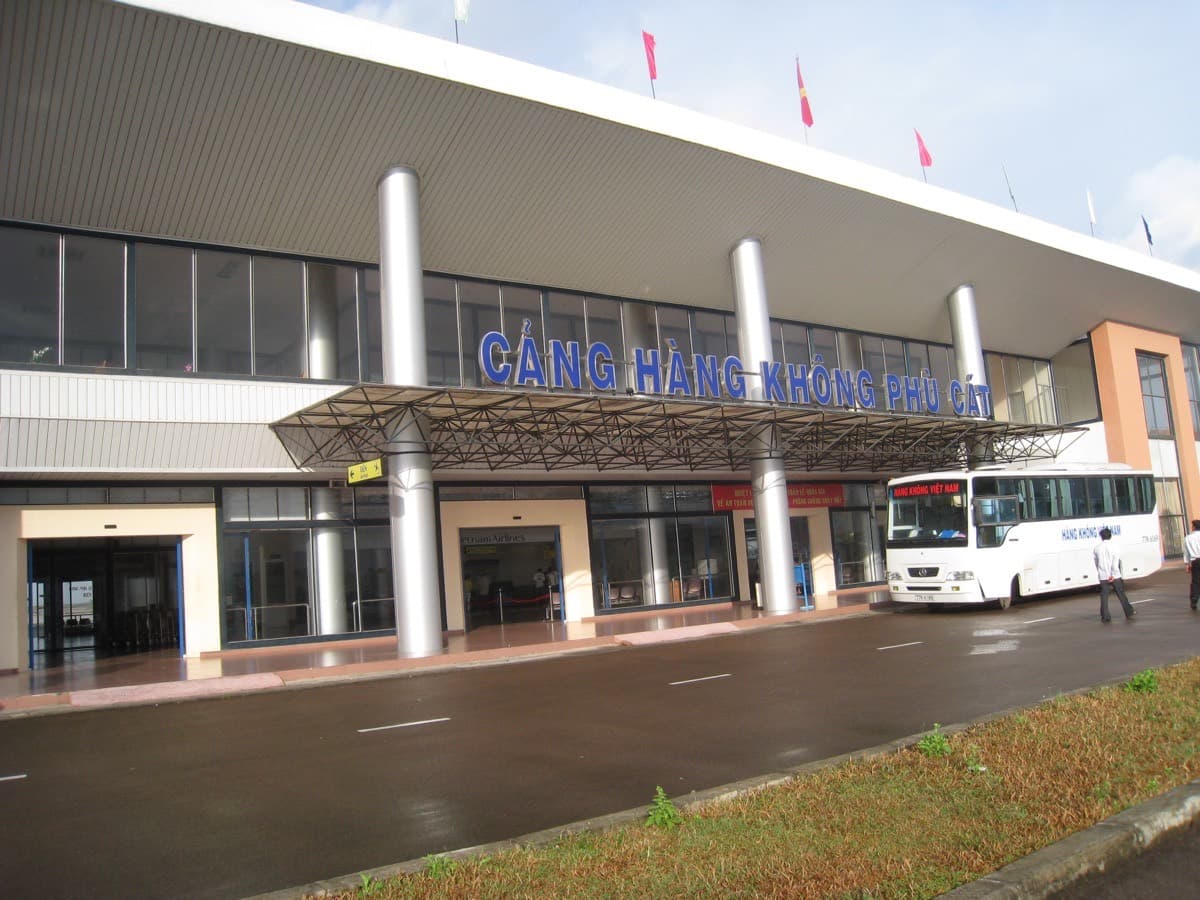
Phu Cat (Sân bay Phù Cát, code UIH) is Quy Nhon's only airport, 30 km northwest of the centre in what is now Phu Cat commune. It started life as a US airbase during the war and still shares the field with the Vietnamese air force, which is why you sometimes see military transports parked on the far taxiways as you land.
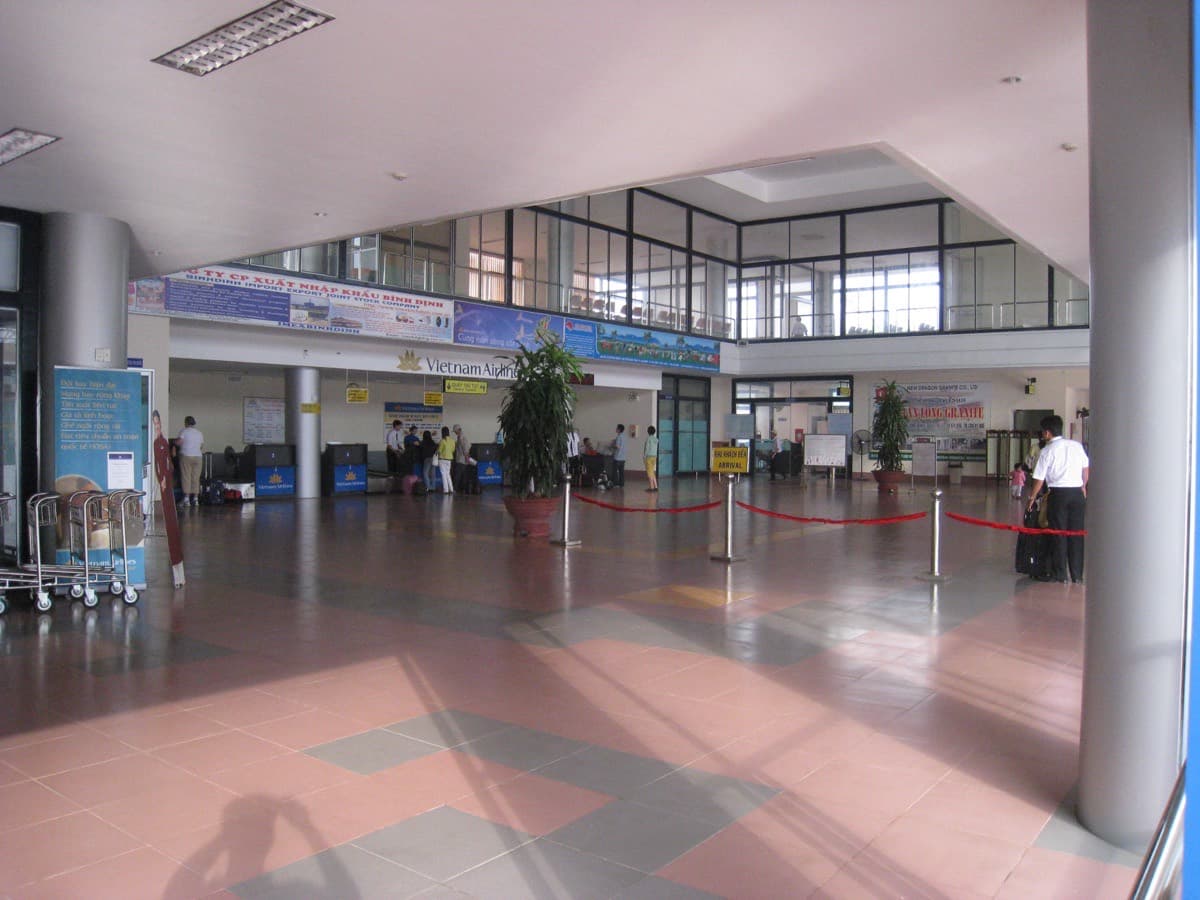
There is one terminal and it is small, but it has what you need: a couple of cafés, a mini-market, a BIDV ATM, a currency counter whose rates you should ignore, and Viettel and Vinaphone SIM desks. Wi-Fi is free. Check-in takes fifteen or twenty minutes even at the busiest hour, which after Tan Son Nhat feels like a small gift.
Which flights land here
Domestic only. There is no international terminal and none on the drawing board, so budget for a connection at Tan Son Nhat, Noi Bai or Da Nang.
| Route | Airlines | Frequency | Flight time |
|---|---|---|---|
| Ho Chi Minh City (SGN) → UIH | Vietnam Airlines, VietJet, Bamboo, Vietravel | 8–10 daily | 1 h 15 |
| Hanoi (HAN) → UIH | Vietnam Airlines, VietJet, Bamboo, Vietravel | 4–6 daily | 1 h 40 |
| Hai Phong (HPH) → UIH | VietJet | 3–4 weekly | 1 h 30 |
| Vinh (VII), Thanh Hoa (THD) | VietJet | 2–3 weekly, seasonal | 1 h 10 |
| Can Tho (VCA), Da Lat (DLI) | VietJet, Vietravel | Summer only | 1 h 05 |
The network is seasonal beyond the two trunk routes. Hanoi and Ho Chi Minh City run close to daily all year; everything else appears and disappears with summer demand. The old Da Nang link is not in the regular schedule, because 300 km overland is easier to close by train.
Ticket prices
Booking window matters more than airline here.
| Route | Promo, 3+ weeks out | Standard | Peak or last minute |
|---|---|---|---|
| HCMC → UIH | 600,000–900,000 VND ($23–35) | 1,200,000–1,800,000 VND ($46–69) | 2,400,000+ VND ($92+) |
| Hanoi → UIH | 900,000–1,400,000 VND ($35–54) | 1,600,000–2,200,000 VND ($62–85) | 3,000,000+ VND ($115+) |
VietJet is the cheapest and the most consistently discounted, with $25–35 fares surfacing two or three weeks out, but checked baggage and seat selection are extras, and the schedule slips more often than the others. Vietnam Airlines runs 20–40% higher with 23 kg included, real legroom and a hot meal. Bamboo and Vietravel sit in between and are worth checking when the big two have nothing at a sensible hour. General booking tactics are in our guide to domestic flights in Vietnam.
Opening hours, and why the last flight matters
The airport runs roughly 04:00 to 22:30. There are no night flights: last arrival is usually 21:30, last departure 21:00. If your inbound is delayed past 22:00 you can sit in the terminal until morning, but the cafés will be shut, there will be one or two cars outside, and the ride into town will cost half again as much. On a delay-prone evening flight, book a transfer in advance and let the driver wait.
From Phu Cat airport to central Quy Nhon

Thirty kilometres of two-lane AH1, 40 to 50 minutes when the road is clear, closer to an hour in the morning peak. There is a bus, and it picks up at the arrivals hall. Most English guides still say otherwise.
| Option | Price (VND) | ~USD | Time | Where |
|---|---|---|---|---|
| Airport shuttle to 01 Nguyễn Tất Thành | 50,000 | $1.90 | 50–60 min | Outside arrivals |
| City bus T7 (airport → bus terminal) | 18,000 | $0.70 | ~50 min | Same spot, every 50–60 min, 05:30–19:00 |
| Taxi, 4 seats (Mai Linh, Sun, Xanh SM) | 250,000 flat | $9.60 | 40–50 min | Rank outside arrivals |
| Taxi, 7 seats | 300,000 flat | $11.50 | 40–50 min | Same rank |
| Grab Car, 4 seats | 250,000–320,000 | $9.60–12.30 | 40–50 min | In app, pickup point on the right |
| Private transfer (Klook, Booking) | 400,000–600,000 | $15–23 | 40–50 min | Pre-booked |
The shuttle is the default budget option: it runs on arrivals, drops at 01 Nguyễn Tất Thành in the centre, and the driver sells the ticket at a fixed 50,000 VND with no negotiation. One caveat that matters on a full flight: there is generally one bus per arrival, so if you are slow off the plane you may find it gone or full.
City bus T7 covers the same corridor for 18,000 VND but runs only every 50–60 minutes and stops for the day at 19:00. Fine if you land in the afternoon with nowhere to be.
Taxis here work on a flat airport fare, not a meter. Mai Linh, Sun Taxi and Xanh SM all quote 250,000 VND for a car and 300,000 for a seven-seater before you get in. That is the normal arrangement, not an attempt to overcharge you. What is worth avoiding is the unbranded driver who approaches you inside the terminal.
Grab costs about the same as the flat taxi fare and spares you the conversation. The pickup point is marked in-app, off to the right as you exit. In the evening the app sometimes takes 5–10 minutes to find a car, because the airport is small and the driver pool is thin. Worth also installing Xanh SM, VinFast's electric fleet: the app is fully in English and the cars are new. More on both in our Grab and taxi guide for Vietnam.
The train: Dieu Tri station and the Reunification line
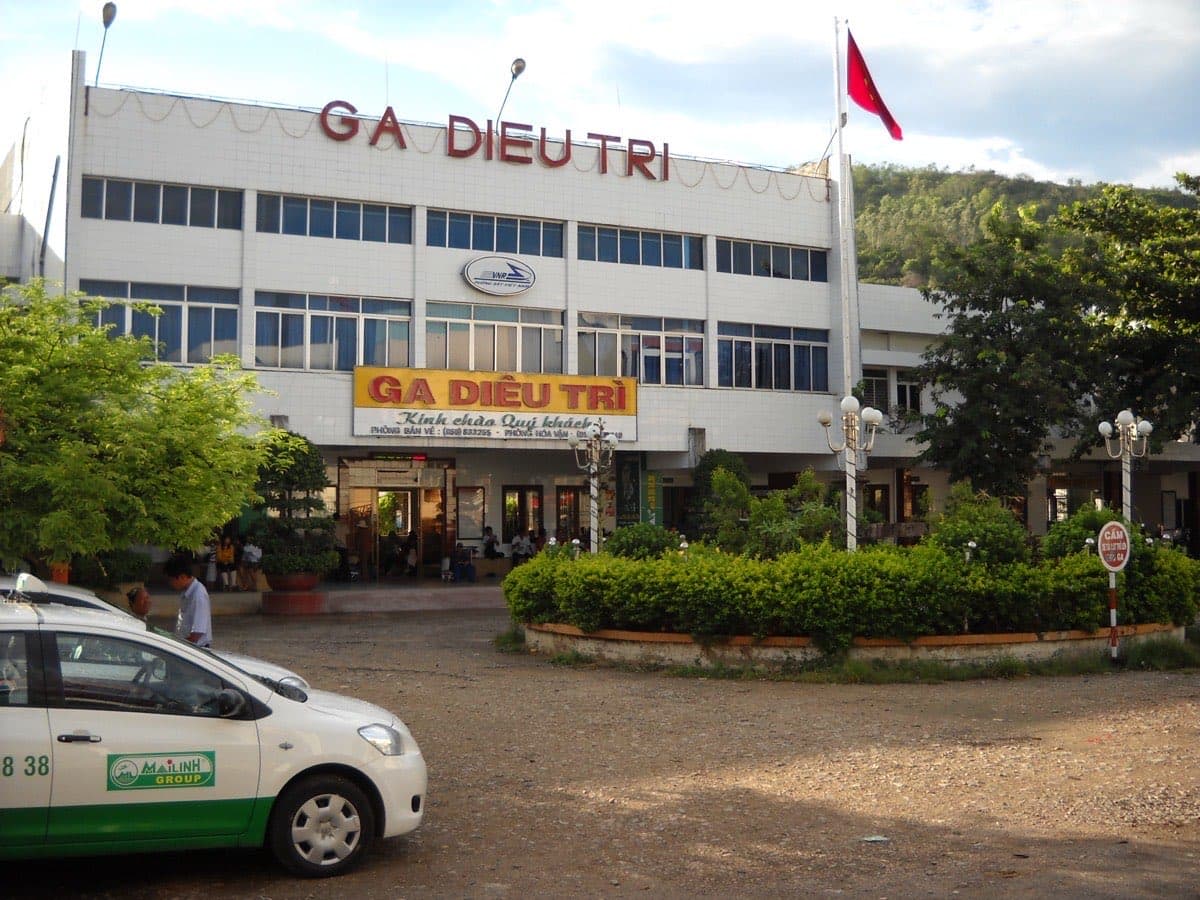
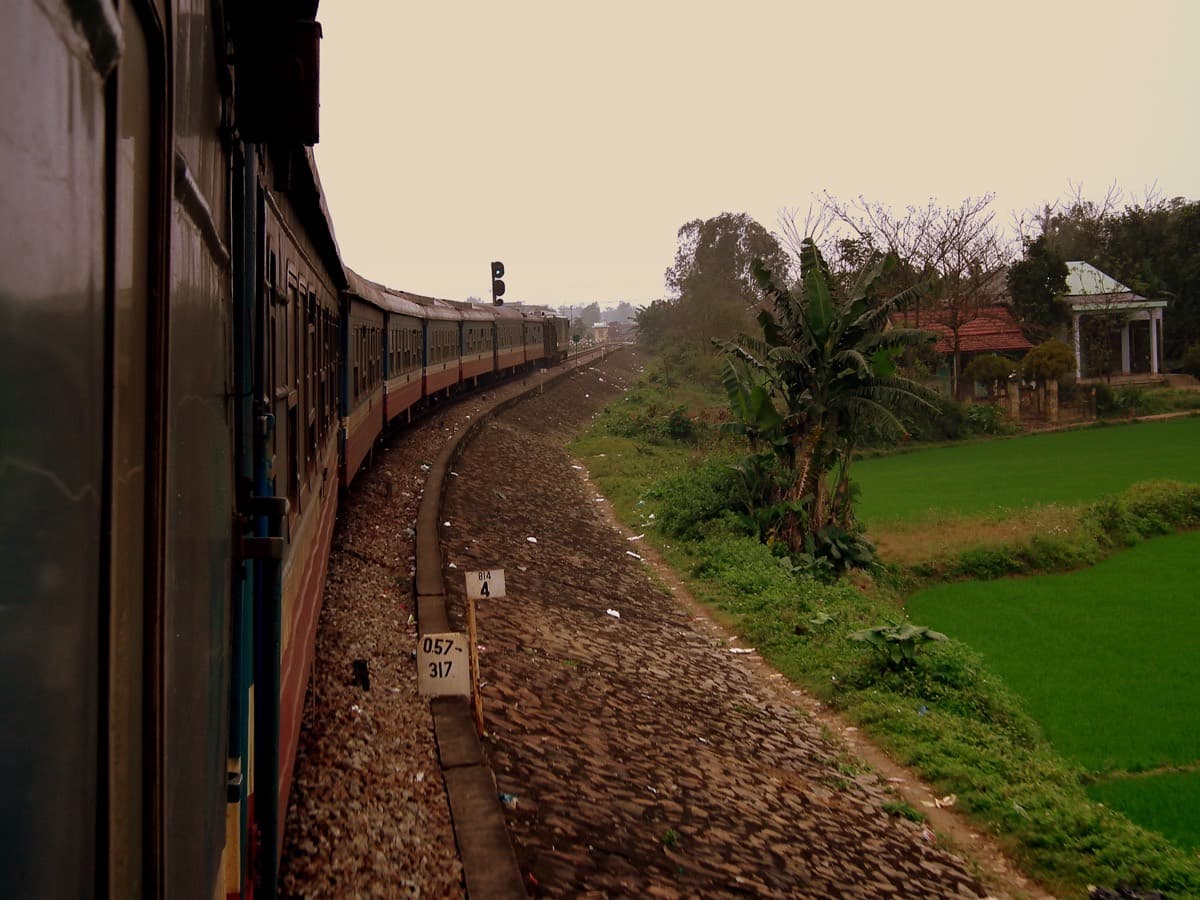
The train is slow and, I think, the best way to arrive here. The Reunification line (Đường sắt Thống Nhất) runs 1,726 km from Hanoi to Ho Chi Minh City along the coast; Quy Nhon sits nearer the southern end, 630 km of rail from Sai Gon and roughly 1,100 from Hanoi. The station you want is Dieu Tri (Ga Diêu Trì), and it is the right answer for about 95% of travellers.
Dieu Tri or Quy Nhon: which station
There are two, and the difference catches almost everybody.
| Dieu Tri | Quy Nhon | |
|---|---|---|
| Type | Junction on the main line | Dead-end spur off Dieu Tri |
| Distance from centre | 10 km, to the west | In town |
| Trains per day | Every SE, 12+ services | Two or three local |
| Book it for | Any long-distance journey | Short local hops only |
Here is the scenario. You buy a ticket "to Quy Nhon" on an international booking site and the confirmation says you arrive at somewhere called Dieu Tri. That is correct. No SE train enters Quy Nhon station. Only the slow branch line does, two or three times a day. Book Dieu Tri (DIT) and stop worrying.
💬 "If you're heading to Quy Nhon by train, you'll most likely be using Diêu Trì train station some ten kilometres to the west of town." — Travelfish, Qui Nhon transport guide
Ho Chi Minh City → Dieu Tri
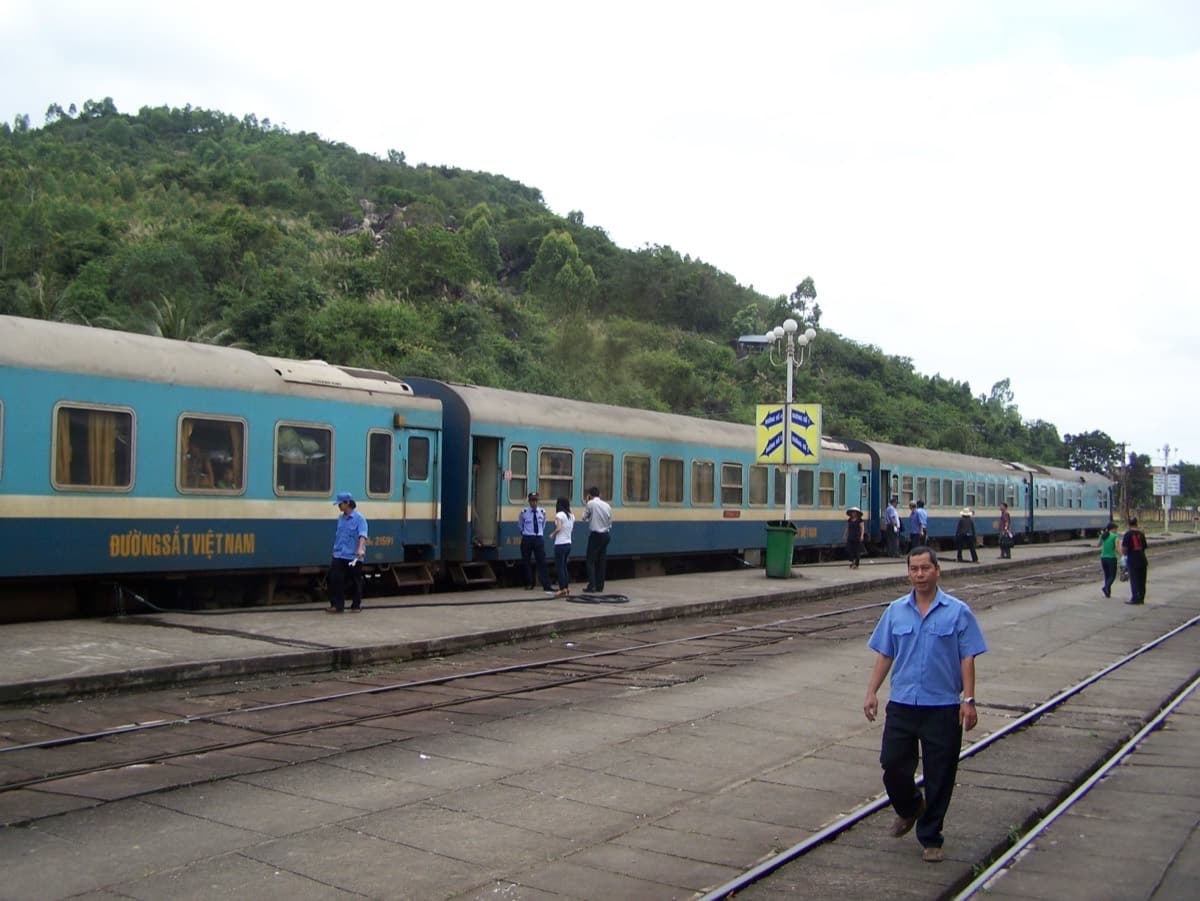
Six trains a day, 11 h 27 min to 12 h 49 min. Vietnam Railways reworked this timetable in May 2026, so departure times printed in older guides no longer hold. The times below come from Vexere and Seat61; confirm them on dsvn.vn before you buy.
| Train | Dep. Sai Gon | Arr. Dieu Tri | Duration | Notes |
|---|---|---|---|---|
| SE8 | 06:00 | 18:07 | 12 h 07 | Daylight run, coast views all afternoon |
| SE6 | 08:45 | 20:39 | 11 h 54 | Daylight, arrives in time for dinner |
| SE10 | 13:15 | 02:04 (+1) | 12 h 49 | Middle-of-the-night arrival, skip it |
| SE4 | 19:20 | 06:51 (+1) | 11 h 31 | Overnight, dawn in Quy Nhon |
| SE2 | 20:35 | 08:02 (+1) | 11 h 27 | Flagship, newest carriages |
| SE12 | 21:00 | 09:46 (+1) | 12 h 46 | Cheaper, slower |
The two in bold are the ones to book. SE2 is the flagship: refurbished carriages, soft lighting and a working socket at every berth. SE4 lands you at 06:51, which means shower, breakfast and a full day still ahead of you.
Hanoi → Dieu Tri
Six trains, 21 to 25 hours. This is a serious journey and it should be an overnight.
| Train | Dep. Hanoi | Arr. Dieu Tri | Duration |
|---|---|---|---|
| SE7 | 06:00 | 04:12 (+1) | 22 h 12 |
| SE5 | 08:00 | 06:02 (+1) | 22 h 02 |
| SE9 | 13:00 | 12:29 (+1) | 23 h 29 |
| SE3 | 19:20 | 16:54 (+1) | 21 h 34 |
| SE11 | 20:40 | 21:21 (+1) | 24 h 41 |
| SE1 | 21:45 | 18:50 (+1) | 21 h 05 |
SE1 and SE3 are the sensible picks: board in the evening, have breakfast in the dining car looking at the paddies of Quảng Bình, step off in the late afternoon. Twenty-one hours is a long time to be on a train. It is not a lost day if you have a berth, a book and a working socket, and the stretch through central Vietnam is the part everyone photographs.
Nha Trang and Da Nang → Dieu Tri
If you are already on the coast, the train beats the bus outright: no traffic, no mountain switchbacks, and the same view people pay several hundred dollars a head for on the luxury Vietage service.
| From | Distance | Journey | 4-berth fare |
|---|---|---|---|
| Nha Trang | 215 km | 4–4.5 h | 420,000–560,000 VND ($16–22) |
| Da Nang | 305 km | 5–5.5 h | 850,000–1,100,000 VND ($33–42) |
| Hue | 400 km | 7–8 h | 1,000,000–1,300,000 VND ($38–50) |
Seven trains a day cover the Da Nang leg, with soft seats from 328,000 VND ($13). From Nha Trang there are about as many, from 160,000 VND ($6) in a seat. For getting around at either end, see the Nha Trang transport guide and the Da Nang transport guide.
Classes and what they cost
Four classes on the modern SE trains, plus a VIP option on some.
- Hard seat (Ngồi cứng) — a wooden bench with air conditioning. Under five hours only.
- Soft seat (Ngồi mềm) — reclining, coach-style. Bearable for six to eight hours.
- 6-berth soft sleeper (Nằm mềm 6) — three tiers. Top bunk is narrow, bottom is the one you want.
- 4-berth soft sleeper (Nằm mềm 4) — two tiers, linen, sockets, a door that closes and a small table. The default foreigner choice.
- 2-berth VIP — only on some formations, at 1.5–2× the 4-berth fare.
| Route | Soft seat | 6-berth | 4-berth |
|---|---|---|---|
| Sai Gon → Dieu Tri | 520,000–680,000 VND ($20–26) | 750,000–1,150,000 VND ($29–44) | 1,100,000–1,450,000 VND ($42–56) |
| Hanoi → Dieu Tri | 580,000–750,000 VND ($22–29) | 1,265,000–1,500,000 VND ($49–58) | 1,500,000–1,800,000 VND ($58–69) |
| Nha Trang → Dieu Tri | 160,000–260,000 VND ($6–10) | 300,000–420,000 VND ($12–16) | 420,000–560,000 VND ($16–22) |
| Da Nang → Dieu Tri | 328,000–450,000 VND ($13–17) | 550,000–750,000 VND ($21–29) | 850,000–1,100,000 VND ($33–42) |
Prices also move inside a carriage: the lower berth runs 100,000–200,000 VND above the top one. On a twelve-hour run, pay it. The top bunk is narrow and you cannot sit upright on it.
Booking with a foreign card
This is where most travellers lose an hour, so here is the honest version.
- Pick your train on dsvn.vn, the real Vietnam Railways site. It has an English interface and the lowest prices, and it accepts overseas cards. The 3-D Secure step does still drop foreign cards at random. Retry, or switch browser.
- Or use a reseller. Baolau and 12Go both take Visa, Mastercard, PayPal, Google Pay and Apple Pay without drama, both show a seat map, and both charge roughly 8–12% over the counter price. On a $45 sleeper that is four or five dollars for not fighting a payment gateway.
- Search for Dieu Tri, not Quy Nhon. Several booking engines list both. The Quy Nhon entry is the dead-end spur.
- Enter your name exactly as printed in your passport. Staff do check documents at the barrier, and a mismatched letter is a real problem.
- Arrive 30 minutes early. You show the ticket on your phone and your passport at the entrance. Luggage goes into the compartment with you, under the lower berths and on the rack by the door.
Book 7 to 14 days ahead as a rule, and a month ahead for Tet, late December to January, April and the July–August peak.
Dieu Tri to your hotel
The station is 10 km from the centre and a lot of trains arrive at awkward hours. First city bus is 05:15, last 18:50. Outside that window it is a car.
| Option | Price (VND) | ~USD | Time |
|---|---|---|---|
| Taxi (Mai Linh, Sun, Xanh SM) | 120,000–160,000 | $4.60–6.15 | 15–25 min |
| Grab Car | 140,000–180,000 | $5.40–6.90 | 15–25 min |
| GrabBike, no luggage | 35,000–50,000 | $1.35–1.90 | 18–25 min |
| City bus T8, via the centre | 22,000 | $0.85 | 30–45 min |
| City bus T3, to Chợ Lớn market | 18,000 | $0.70 | 35–45 min |
Arriving on SE4 at 06:51 or SE2 at 08:02, Grab picks up fine and the buses are running. Arriving on SE10 at 02:04, message the hotel in advance and ask for a pickup at 200,000–250,000 VND. Standing on an empty platform at two in the morning negotiating with the one driver who showed up is a worse plan than paying eight dollars.
Buses from Ho Chi Minh City, Nha Trang, Da Nang and Hue
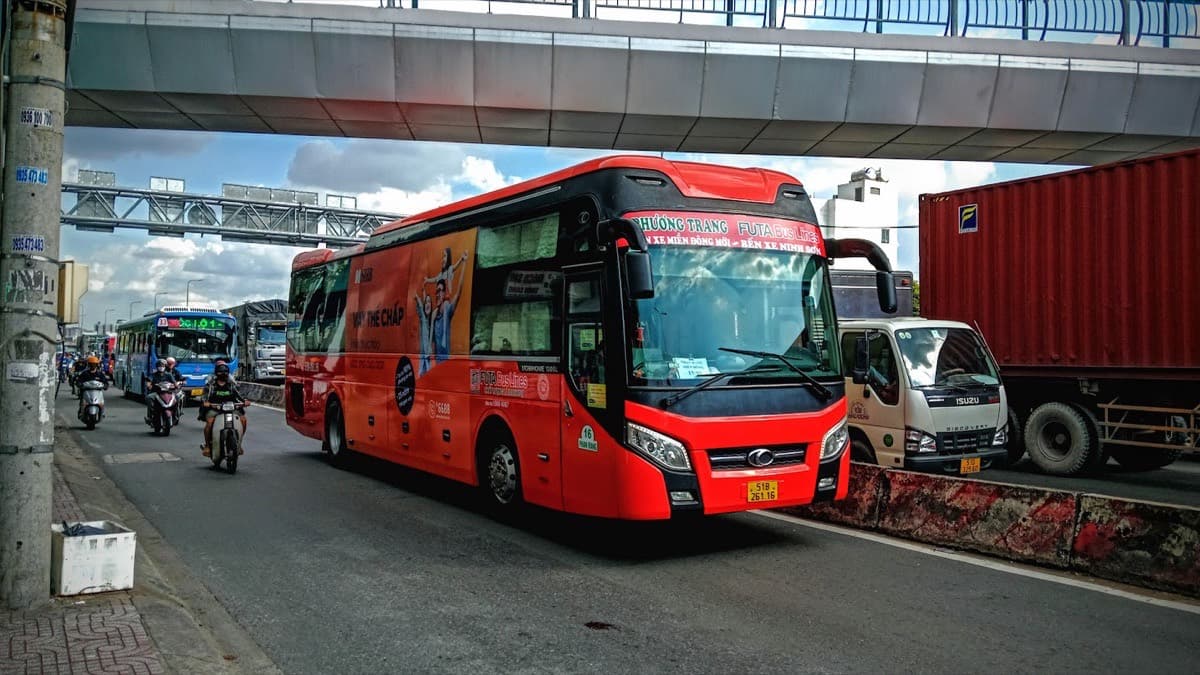
The bus is the cheapest way in, and Vietnamese sleeper coaches are an acquired taste. The berths are 1.8 m long, which is a problem if you are taller than that, the aisle is barely an aisle, and the driver leans on the horn at every junction all night. In exchange: half the train fare and departures every hour instead of six a day.
From Ho Chi Minh City
Eleven to twelve hours, several operators, plus capsule coaches at the top of the range.
| Operator | Type | Time | Price (VND) | Notes |
|---|---|---|---|---|
| Phương Trang (FUTA) | 40-berth sleeper | 11–12 h | 255,000–285,000 ($10–11) | Cheapest and the most punctual; departures 17:00–20:00 |
| Thuận Thảo | 40-berth sleeper | ~14 h | 270,000 ($10) | Budget, older fleet, slowest |
| An Phú Buslines | 34–44 berth | 12 h | 300,000 ($11.50) | Middle ground, 18:00 departure |
| Mạnh Hùng, Tân Dũng Tiến | 20–22 VIP capsules | 11–12 h | 380,000–550,000 ($15–21) | Private capsule, curtain, own screen |
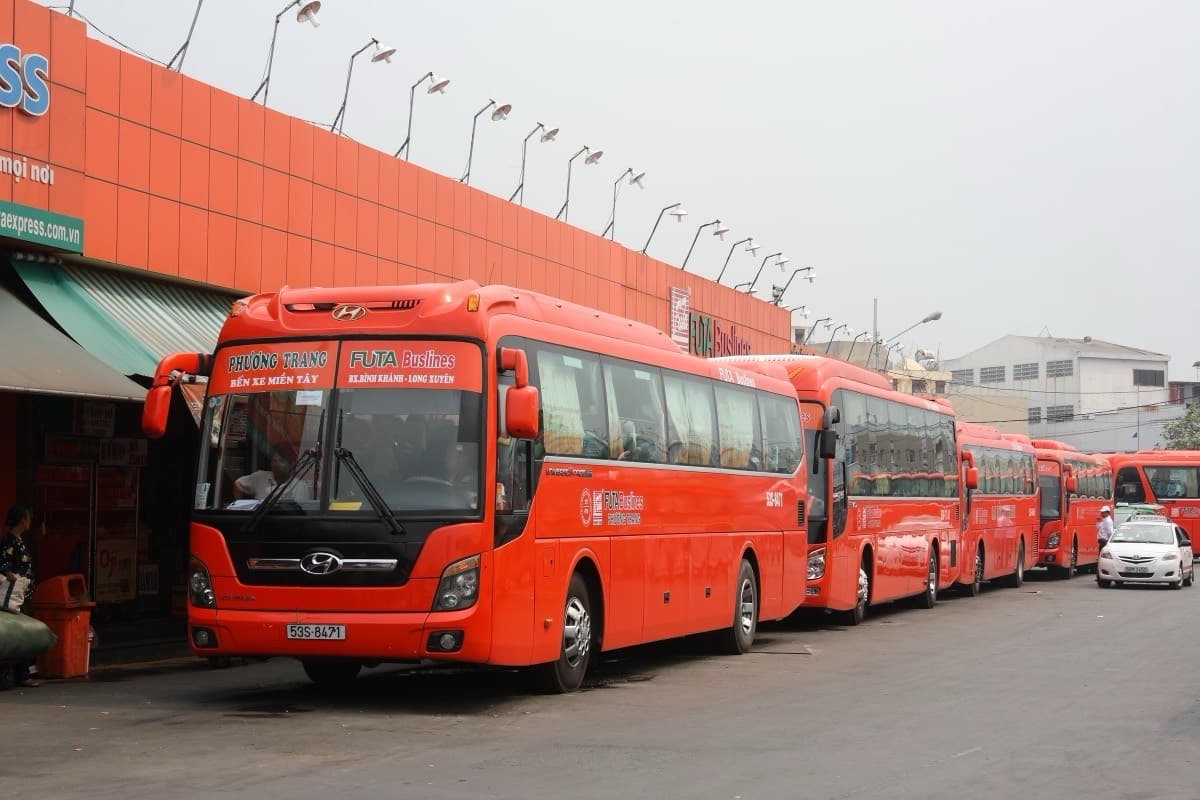
Departures are from Bến xe Miền Đông Mới, the eastern terminal on the far side of the city. It opened in 2020 and took over all long-distance services by autumn 2022. The easy way there is the metro: Line 1's terminus, Bến xe Suối Tiên, is right next to the coach station, about 30 minutes from Bến Thành in the centre. A Grab Car does the same job for 150,000–200,000 VND. Full detail on both in the Ho Chi Minh City transport guide.
You arrive at Bến xe Quy Nhơn, 3 km from the centre; a Grab from there is 40,000–70,000 VND. One useful trick: Phương Trang usually includes a free shuttle from its downtown offices out to the terminal. Ask when you book on futabus.vn.
From Nha Trang
Five to six hours, plenty of departures, and genuinely competitive with the train on this leg.
| Operator | Type | Time | Price (VND) |
|---|---|---|---|
| Phương Trang (FUTA) | Sleeper | 5–6 h | 280,000–400,000 ($11–15) |
| The Sinh Tourist | Open bus | 6 h | 200,000–280,000 ($8–11) |
| Hanh Cafe | Sleeper | 5.5 h | 200,000–250,000 ($8–10) |
| Limousine, 9–22 seats | Limo | 5 h | 400,000–520,000 ($15–20) |
Departures are from the operators' own offices on Hùng Vương in central Nha Trang or from the southern terminal. The Sinh Tourist open bus is the friendliest for a first-timer: hotel pickup at one end, central drop-off at the other.
From Da Nang and Hoi An
Six to seven hours by road, four or five services a day.
| Operator | Type | Time | Price (VND) |
|---|---|---|---|
| Phương Trang (FUTA) | Sleeper | 6–7 h | from 430,000 ($16.50) |
| Hanh Cafe | Sleeper | 6.5 h | 250,000–350,000 ($10–13) |
Take the train instead if you can. It covers the same ground in about five hours and does it without the switchbacks over the Hải Vân pass. Coming from Hoi An, add a 30-minute transfer to Da Nang station first.
From Hue
The longest leg at eight to nine hours, and an overnight makes the most sense: board in the evening in Hue, arrive around dawn.
| Operator | Type | Time | Price (VND) |
|---|---|---|---|
| Trường Thịnh | 44-seat coach | 8–9 h | from 230,000 ($9) |
| Cúc Tùng | Sleeper / limousine | 8 h | from 550,000 ($21) |
Where to buy bus tickets
- futabus.vn — Phương Trang's own site, in English, takes international cards, and lets you pick your exact berth. Lower deck is more comfortable.
- 12Go and Baolau — English aggregators covering every operator, with a comparison view and an 8–12% markup.
- vexere.com — the widest operator coverage in the country, but the interface is Vietnamese-first.
- Your hotel — any reception in Ho Chi Minh City, Nha Trang or Da Nang will book it in half an hour for a 30,000–50,000 VND fee. Worth it if you are already on the road.
Getting around Quy Nhon
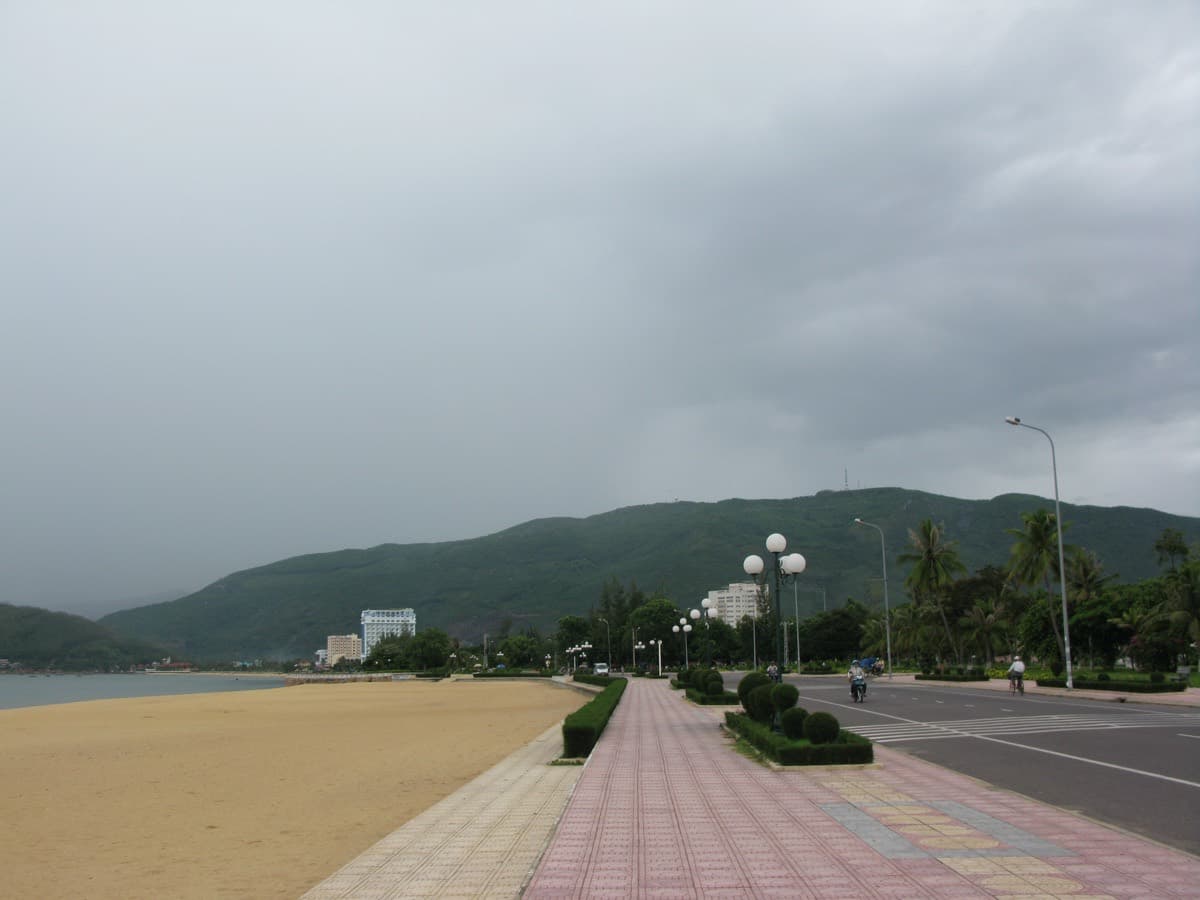
The city is compact, six kilometres from the northern edge to the southern headland. In the centre almost everything is walkable: the Xuân Diệu seafront, the market, the cafés and most hotels sit within a twenty-minute walk of each other.
On foot and by bicycle
The best way to see the central blocks. The promenade runs 4.5 km and is pleasant early, before the heat, and again after sunset. Plenty of hotels lend bicycles free or rent them at 50,000 VND a day.
Taxis and ride-hailing
| Service | Flagfall (VND) | Per km (VND) | Notes |
|---|---|---|---|
| Mai Linh | 5,000 for the first 300 m | 13,100 | The reliable default |
| Sun Taxi | ~5,000 | ~13,000 | Local operator, most cars on the street |
| Xanh SM | In-app | In-app | VinFast electric, app fully in English |
| Grab Car | from 25,000 | In-app | Fixed price shown before you book |
| Grab Bike | from 12,000 | In-app | Two to three times cheaper than a car |
Grab works fine here but the driver pool is thinner than in Nha Trang or Da Nang; a 5–10 minute wait between 18:00 and 20:00 is normal for a city this size. Grab Bike turns up almost instantly. Xanh SM is worth having as a second app. Its cars are new, the pricing is flat rather than surging, and the drivers are used to foreign passengers.
No data? Call a dispatcher
- Meter. A rigged meter races up, or the driver says it is broken and names a flat price. If it climbs too fast, stop and pay for the distance so far
- Knock-offs. Fake cars copy the Vinasun and Mai Linh colours. Read the full company name on the door
- Small notes. The ride is 35,000 VND and all you have is a 500,000 note: the driver may not have change
Renting a scooter
Quy Nhon is a good place to learn: moderate traffic, decent surfaces, none of the chaos of Ho Chi Minh City or Hanoi. Expect 120,000–180,000 VND a day ($4.60–7) for a semi-automatic Honda Wave or Yamaha Sirius.
| Where | Price (VND/day) | Deposit | Notes |
|---|---|---|---|
| MotoVina | 120,000–180,000 | Passport | Local chain, cheaper |
| Hotel reception | 150,000–200,000 | Passport | Convenient, quality varies |
City buses
Around ten routes numbered T1 to T11. The buses are old but air-conditioned, fares run 5,000–39,000 VND depending on distance, and you pay the conductor in cash, in small notes. Three are useful to a visitor: T7 out to Phu Cat airport, T8 past Ngã 3 Diêu Trì towards the station and on into the hills at Vân Canh, and T1 along the city from Trần Quý Cáp to Suối Mơ every 15 minutes. They run 05:30 to 19:00, so evenings are not covered.
Renting a car
For foreigners this means with a driver, in practice. Budget 1,500,000–2,200,000 VND a day ($58–85) plus fuel at roughly 300,000–500,000 VND. It earns its keep on a day with several stops in it, Cham towers then a beach then a monastery, where a scooter would leave you cooked by mid-afternoon.
Fast Track — no queue at the border
5–10 minutes instead of an hour in the immigration queue
from$11per passenger
Reaching the beaches and the sights
The best of Quy Nhon is outside the city: the beaches on the northern and southern capes, 11th-century Cham towers, the islands. All of it needs transport. What each place is actually like is covered in the Quy Nhon attractions guide. This is the logistics.
| Destination | Distance | How | Time | Cost |
|---|---|---|---|---|
| Bãi Xếp | 12 km S | Grab / scooter | 20 min | Grab 150,000 VND return / 30,000 in fuel |
| Eo Gió cape | 20 km NE | Taxi / scooter / tour | 30 min | Entry 22,000–40,000 + Grab 250,000 VND |
| Kỳ Co cove | 25 km NE | Road to the gate, shuttle down | 40 + 10 min | Gate 120,000 + shuttle 110,000, or a tour at 700,000/person |
| Bánh Ít Cham towers | 20 km N | Taxi / scooter | 25 min | Entry 20,000 VND plus transport |
| Hòn Khô | 15 km NE | Taxi + boat | 25 + 20 min | Entry 60,000 + boat 150,000 return |
| Cù Lao Xanh | 24 km offshore | Boat from Hàm Tử pier | 30 min speedboat / 90 min ferry | Speedboat 300,000 return, tour with lunch 800,000 |
| Trung Lương | 28 km N | Taxi / tour | 40 min | Storm-damaged, closed — check before going |
| Ghềnh Ráng / Quy Hoà | 5 km S | Scooter / Grab | 12 min | Entry 25,000 + Grab 80,000 VND |
| Tuy Hoà (Phú Yên) | 90 km S | Car for the day | 1 h 30 | 1,800,000–2,200,000 VND per car |
Bai Xep, the easy one
A small fishing beach 12 km south. Grab return is 150,000 VND, or 25 minutes on a scooter down the coast road. A few guesthouses, seafood shacks, and quiet. On the way back, stop at Ghềnh Ráng — Quy Hoà: 25,000 VND gets you into the park with the poet Han Mac Tu's grave and the path down past the old leprosarium, under some genuinely beautiful pines.
Eo Gio and Ky Co: tour or independent
Eo Gio is a rock cape with a walkway above the sea and an official 22,000 VND ticket. The operator tried to raise it to 50,000 in June 2026 and the Gia Lai authorities pushed back, but at the end of June the booth was still charging 40,000, so check the price on the spot. Ky Co is the turquoise cove half an hour further on.
There is a road to Ky Co, contrary to a lot of older writing: the coast road reaches the resort gate, and only the final steep descent is closed to private vehicles and served by a shuttle. Independently that is 120,000 VND to enter plus 110,000 for the shuttle, per person.
A group tour runs about 700,000 VND a head and handles everything: minibus from your hotel, boat along the cliffs, snorkelling, lunch, and Eo Gio on the way back. Run the numbers before you choose. For two people the tour and the DIY version land in roughly the same place; for four, going independently is clearly cheaper.
Banh It Cham towers

The most accessible of the Cham complexes: 20 km north, right off the highway. Half an hour by scooter on the AH1, or 200,000 VND for a taxi there and back with waiting time. Entry is 20,000 VND. Go before 10:00 or after 16:00. At midday the hilltop has no shade at all.
Onward from Quy Nhon
Quy Nhon works well as a stop on a coastal route in either direction, and as a jumping-off point inland. Since the merger, mountain Pleiku is technically in the same province, which changes the paperwork and nothing else.
| To | Best option | Time | Price |
|---|---|---|---|
| Tuy Hoà (Phú Yên) | Taxi / minibus | 1.5 h | check on Vexere |
| Nha Trang | Train / Phương Trang coach | 4–4.5 h / 5–6 h | $16–22 train / $11–15 bus |
| Pleiku | Bus | 5 h | check on Vexere |
| Buôn Ma Thuột | Bus | 7 h | check on Vexere |
| Quảng Ngãi | Train / bus | 2.5 h | check on Vexere |
| Hoi An / Da Nang | Train / bus | 5–5.5 h / 6–7 h | $33–42 train / from $16.50 bus |
| Hue | Train / bus | 7–8 h / 8–9 h | $38–50 train / from $9 bus |
| Hanoi | Train / flight | 21–25 h / 1 h 40 | $58–69 train / $62–85 air |
| Ho Chi Minh City | Train / flight | 11.5–13 h / 1 h 15 | $42–56 train / $46–85 air |
The same routes work in reverse, only the train numbers change: SE2 and SE4 are northbound, and southbound trains carry odd numbers (SE1, SE3 and so on). Check the return timetable on dsvn.vn. For the wider picture of moving between regions, see our Vietnam transport guide; for the coastal cities at either end, Ho Chi Minh City and Da Nang.
Mistakes people actually make
- Confusing UIH (Phù Cát) with CXR (Cam Ranh). Both get described as "regional airports on the central coast." Phu Cat serves Quy Nhon; Cam Ranh serves Nha Trang, 250 km south. Check the code on the ticket twice.
- Booking to Quy Nhon station instead of Dieu Tri. The in-town station is a dead-end spur with two or three local services a day. Every SE train stops at Dieu Tri, 10 km out.
- Landing on the last flight and assuming Grab will be there. Final arrival is around 21:30. After that there are one or two cars outside and the price doubles. Pre-book the transfer.
- Taking the cheap slow train to save money. The gap between an SE express and the slowest service is a couple of hundred thousand dong and four or five hours. On an overnight, that difference eats your morning.
- Renting a scooter without an IDP. Since January 2025 the fine is 2–4 million VND for a bike up to 125 cc, and your insurer will use it to deny a claim. If you do not have the permit, use Grab Bike.
- Going to Ky Co at midday without booking. In the dry season the boat seats go by 10:00 and the queue for the shuttle down to the cove backs up by noon. Book a day ahead or arrive at opening.
- Trusting a pre-2025 address. Districts no longer exist. A hotel listing that says "Tuy Phuoc District, Binh Dinh Province" is not wrong about where it is. It is just working from an old map.
FAQ
Phu Cat (code UIH), 30 km northwest of the centre. It is the only airport serving Quy Nhon and the eastern half of Gia Lai province, and it handles domestic flights only: Ho Chi Minh City, Hanoi, Hai Phong, Vinh and a few seasonal routes. There is no international terminal, so you will connect through Tan Son Nhat, Noi Bai or Da Nang. Do not confuse it with Cam Ranh (CXR), which serves Nha Trang.
Technically two, but only one matters. Dieu Tri is the junction on the Reunification main line, about 10 km west of the centre, and every SE train stops there. Quy Nhon's own station is on a dead-end spur with two or three local services a day and no long-distance trains at all. Book to Dieu Tri (DIT). That is what international booking sites will show you, and it is correct.
Between 11.5 and 13 hours depending on the service
- The quickest is SE2a total of 11 h 27 mindeparts Sai Gon 20:35, arrives Dieu Tri 08:02
- The slowest is SE10at 12 h 49 min
- SE2 or SE4 overnight in a 4-berth sleeper1,100,000–1,450,000 VND~$42–56most visitors take, board after dinner and wake up in Quy Nhon
Yes. The official site, dsvn.vn, has an English interface and accepts overseas cards, though the 3-D Secure step still fails intermittently. Baolau and 12Go both take Visa, Mastercard, PayPal and Apple Pay reliably and show a seat map, for an 8–12% markup. Enter your name exactly as it appears in your passport, because documents are checked at the platform barrier.
- A cara flat 250,000 VND~$9.60
- A seven-seater300,000 VND~$11.50quoted at the rank outside arrivals by Mai Linh, Sun Taxi and Xanh SM
- Grababout the samecosts at 250,000–320,000
- The budget options are the airport shuttle50,000 VND~$1.90which runs on arrivals to 01 Nguyen Tat Thanh
- City bus T718,000 VNDwhich runs only once an hour
Fly if time is the constraint: 1 h 15 min from Ho Chi Minh City against 11.5 hours by rail. Take the overnight SE2 or SE4 if you would rather sleep through it, keep the day and pay less. Counting the taxi to Tan Son Nhat and the transfer from Phu Cat, the totals are closer than they look: roughly $46–85 flying against $42–56 in a sleeper, with the train saving you a hotel night.
Yes, both Grab Car and Grab Bike, across the city and at the airport and Dieu Tri station. There are fewer drivers than in Nha Trang or Da Nang, so a 5–10 minute evening wait is normal; bikes turn up almost immediately. Install Xanh SM as well: VinFast's electric fleet, flat pricing and an English app. Both are covered in our Grab and taxi guide for Vietnam.
Gia Lai. Binh Dinh province was merged into Gia Lai on 1 July 2025, the merged province kept the name Gia Lai, and Quy Nhon became its capital. Districts were abolished nationwide at the same time. Airline drop-downs, hotel listings and most guides still say "Binh Dinh," and searching that way still works. The place has not moved, only the label has.
Read next: the full Quy Nhon guide · Quy Nhon attractions · transport in Vietnam · domestic flights.
- Guide
Quy Nhon Attractions 2026: Cham Towers, Coves, Lighthouses
What to see in Quy Nhon in 2026 — 11th-century Cham towers, Ky Co cove, an 1890 French lighthouse, pagodas. Verified fees in VND and USD, day routes, map.Quy Nhon Attractions 2026: Cham Towers, Coves, Lighthouses - Weather
Quy Nhon Weather 2026: Month by Month, Rainy Season
Quy Nhon's dry season runs eight months, January to August, sea at 25-29 °C. Month-by-month table, rainy season, typhoon risk after the 2025 floods.Quy Nhon Weather 2026: Month by Month, Rainy Season - Housing
Where to Stay in Quy Nhon 2026: Hotels, Resorts, Hostels
Where to stay in Quy Nhon in 2026: Anantara, AVANI, Maia, FLC, seafront hotels and Bai Xep hostels. Prices in USD and VND, areas compared, booking tips.Where to Stay in Quy Nhon 2026: Hotels, Resorts, Hostels