Quy Nhon weather month by month: sea, seasons and when to go
Quy Nhon runs on an unusually generous calendar: eight dry months, January through August, with the sea sitting between 25 and 29 °C all year. That is the longest dry run on Vietnam's central coast. The bill arrives in October and November — around 550 mm of rain in October alone, one and a half to two times what Nha Trang gets, and in November 2025 the region had record-breaking floods. Here are all twelve months in numbers, the seasons explained, the typhoon window, and what to pack.

Quy Nhon weather by month
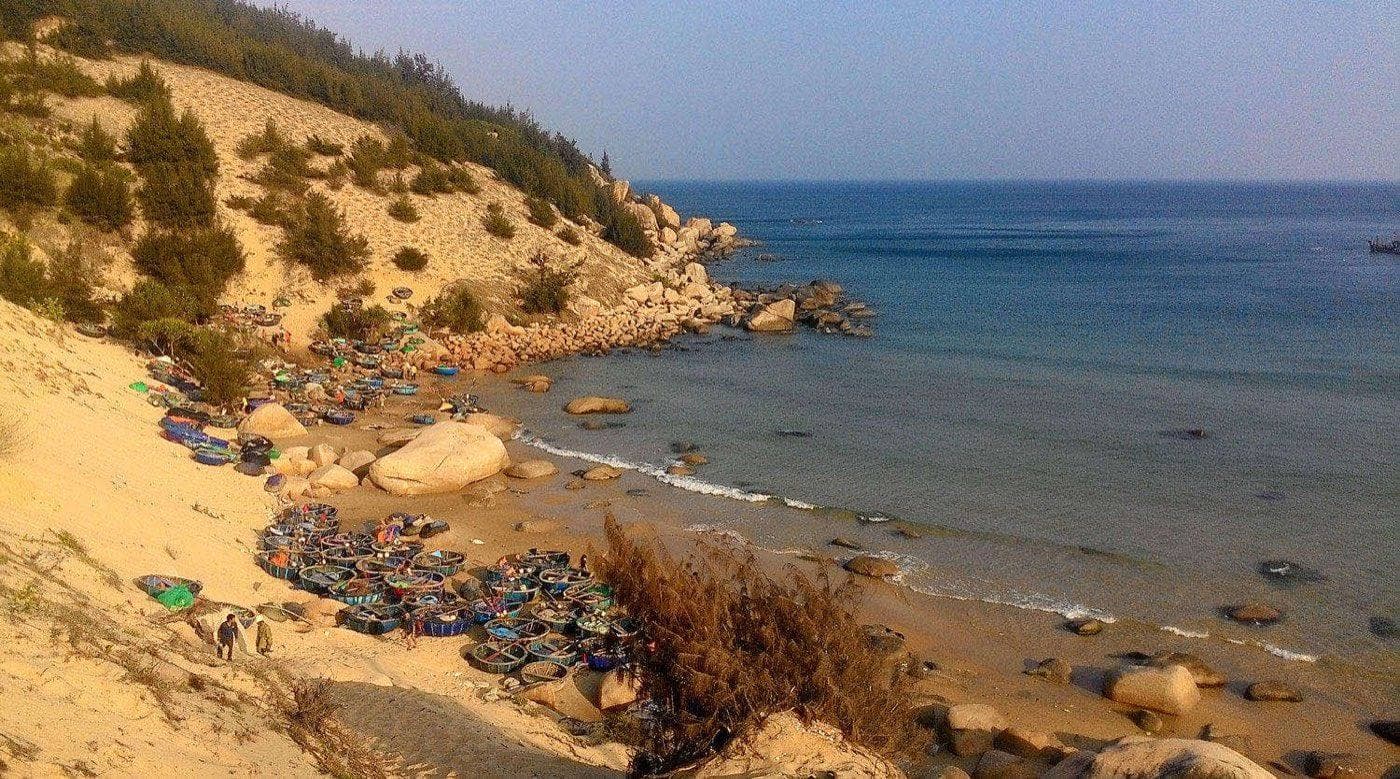
Mean annual air temperature in Quy Nhon is about 26.9 °C and the sea holds 25-29 °C year-round. The city sits on an open stretch of the South China Sea coast with a tropical monsoon climate (Köppen: Aw): sun from January to August, monsoon rain from October to December.
One administrative note before you open a map. Since 12 June 2025 Quy Nhon (Quy Nhơn) has been part of Gia Lai province. The old Binh Dinh province was merged into Gia Lai, and from 1 July the district tier was abolished nationwide, so the city is now split into wards. Nearly every English-language guide, hotel listing and weather site still says "Binh Dinh." Searching that way still finds the right place. Your check-in form will not agree with it.
Weather in Quy Nhon month by month
colour depth — rainfall per month
October
Rainyrainfall 510 mm · rainy days 16–18Wettest month at up to 550 mm, one and a half to two times Nha Trang. Boat trips cancel in bulk; hotels drop 35–50%.
| Month | Day, °C | Night, °C | Sea, °C | Rain, mm | Rainy days | Sun, h/day | Verdict |
|---|---|---|---|---|---|---|---|
| January | 26 | 21 | 25 | 80-120 | 7 | 5 | Cool, high season |
| February | 27 | 22 | 25 | 30-50 | 4 | 7 | Dry and comfortable |
| March | 29 | 23 | 26 | 25-40 | 3 | 8 | Driest month of the year |
| April | 31 | 25 | 27 | 30-50 | 4 | 8.5 | Excellent |
| May | 32 | 26 | 29 | 60-90 | 6 | 8.5 | Hot, sea at its warmest |
| June | 33 | 26 | 29 | 70-100 | 7 | 8 | Beach peak, domestic holidays |
| July | 32 | 26 | 29 | 70-100 | 7 | 8 | Hot, short afternoon showers |
| August | 32 | 26 | 29 | 90-130 | 8 | 7.5 | Thunderstorms appear |
| September | 31 | 25 | 29 | 230-300 | 11 | 6.5 | Transition, prices drop |
| October | 29 | 24 | 28 | 480-550 | 17 | 5.5 | Wettest month |
| November | 27 | 23 | 27 | 400-470 | 16 | 4 | Typhoon peak |
| December | 26 | 22 | 26 | 180-240 | 11 | 3.5 | Rain easing off |
Climate normals for 2026. Sources: climate-data.org, weatherspark.com, climatestotravel.com.
Rainy-day counts vary by source: climatestotravel puts October and November at 21 days each, weather-and-climate at around 17. The disagreement is about what counts as a rainy day, not about the season. Rainfall in millimetres is the more reliable column.
March is the driest month with 25-40 mm across the whole month and three days of rain. October is the wettest at up to 550 mm, one and a half to two times Nha Trang in the same month. The hottest stretch is May to August at a steady 32-33 °C. January and December are the coolest, 26 °C by day and down to 21 °C at night, which is warm by most standards and cool enough that an open-air restaurant in the evening calls for a light layer.
The sea is the part people underestimate. Even in January it holds 25 °C. Not bathwater, but swimmable, and by May it hits 29 °C and stays there through September.
The three seasons: dry, transition, wet

Officially there are two seasons. In practice September behaves like neither, so it is worth treating as its own thing.
Dry season: January to August
Eight months of clear sky, calm water and very little rain, a good two months longer than Da Nang manages. Peak dry runs February to April: 27-31 °C, humidity around 75-78%, under 50 mm of rain a month. Annual rainfall is roughly 1,800 mm, but more than half of it lands in October and November, which leaves February to April with about 80-130 mm between them.
From May the heat takes over. Days hold at 33 °C, and the UV index climbs to 10-12. That is the extreme band. Without SPF 50+ you will burn in twenty minutes of open sun, and thin shade does not save you.
💬 The optimal window is late January to late March, when rainfall is minimal and the heat has not arrived yet — climatestotravel.com, 2025
Hotel rates in high season run 20-40% above the October-November floor. Book February and March two or three months out, especially for Anantara, Avani or FLC Quy Nhon, which have limited room counts and fill early.
September: the transition month
September is the month nobody explains properly. Rain jumps to 11 days and 230-300 mm, which looks alarming next to August's 90-130 mm. But the downpours are still short, an hour or two and then sun again, and the sea is only starting to get restless.
The trade is a good one if you are watching money. Rates have already slid 20-30%, Vietnamese school holidays are over so the domestic crowds have gone home, and the beaches empty out. The Cham towers and pagodas on the attractions list do not care about rain either. You will lose part of some days to rain. You will not lose the trip.
Wet season: October to December
Rain here does not behave the way it does further south. In Nha Trang and Cam Ranh the classic pattern is a night shower and a sunny day. On this coast the northeast monsoon comes straight in off open water with no bay to break it, so a downpour can run three or four hours in the middle of the afternoon and then drizzle for another hour.
- October is the wettest month at 480-550 mm across up to 17 days. Boat trips to Ky Co and Cu Lao Xanh get cancelled in bulk. The sea is rough and the surf is high.
- November brings 400-470 mm over 16 days and the highest typhoon risk of the year.
- December eases off to 180-240 mm over 11 days. By the last week the dry pattern usually returns, so New Year often lands in sunshine. Often, not always.
Low season is when the discounts appear: hotels drop 35-50% and tours roughly halve. Empty beaches, no queues anywhere. If you are coming for quiet and you can absorb a few washed-out days, October and November deliver exactly that.
Typhoon season in Quy Nhon, and what November 2025 changed
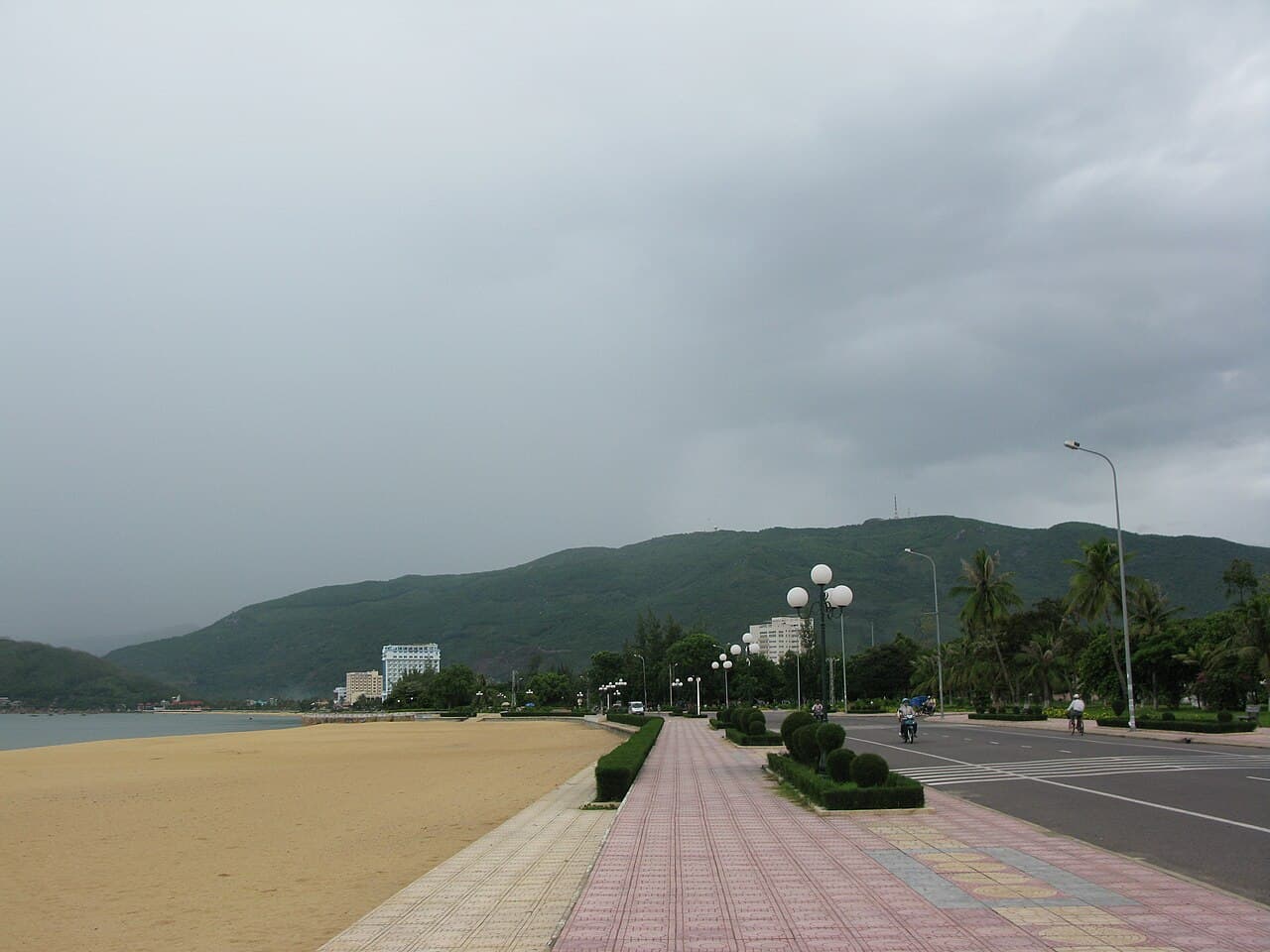
The typhoon window runs from the beginning of September to 10 December according to Climates to Travel, with the peak in October and November. This coast catches storms regularly. Molave came ashore on the Quang Ngai and Binh Dinh boundary in October 2020, the strongest storm to hit central Vietnam in twenty years at that point. Noru in September 2022 landed further north near Da Nang but still closed Phu Cat airport for two days. Then came November 2025, which brought two storms in three weeks.
Kalmaegi made landfall on 6-7 November 2025 on the south-central coast, one of the strongest storms on record to hit Vietnam. Gia Lai was among the three worst-hit provinces. More than 260,000 people were evacuated regionally, 2,413 houses were destroyed outright and nearly 59,000 were damaged.
Then Koto arrived from 15 November and stalled over a region that was already saturated. The centre of the flooding shifted to the south-central coast. Rivers across the south-central region broke records set in 1986, 1993 and 2009. Across the whole 2025 flood season, 219 people died or went missing and damage came to $1.61 billion.
The city has not become a dangerous place to visit. But the averages in the table above now look like a floor rather than a ceiling. If you are booking October or November, read the climate normals as the good case and plan for worse.
What actually goes wrong in a storm
- Boat tours to Ky Co, Cu Lao Xanh and Hon Kho get cancelled one to two days ahead of a forecast hit. Refunds depend entirely on the operator, and most do not put their policy in writing.
- Phu Cat airport (UIH) delays or shuts for 6-12 hours. This matters more for foreign visitors than for domestic ones, because UIH is still a domestic-only airport: every international arrival connects through Hanoi or Ho Chi Minh City, so a closure costs you a connection rather than a beach afternoon.
- The train is the backup. Dieu Tri station, 10 km from the centre, sits on the north-south line. When flights stop, trains to Da Nang or Nha Trang usually keep running unless the track itself has flooded.
- Power goes out in guesthouses and smaller hotels. Resorts at the Anantara and FLC level have generators.
- Mobile data degrades and hotel Wi-Fi dies with the electricity. Buy an eSIM before you fly rather than relying on a local shop being open.
- Mountain roads south towards Tuy Hoa wash out, which makes the run down to Vung Ro bay a bad idea.
If you are booking October or November
- Buy travel insurance that covers trip cancellation and accommodation, not just medical. A 14-day policy runs about $25-50 for most passports.
- Book a room with free cancellation up to 24 hours before check-in.
- Download offline maps. Google Maps offline areas and Maps.me both work without data.
- Carry cash in small notes. ATMs stop working in an outage and card acceptance outside resorts is thin.
- Watch the forecast three to five days out. If a serious system is tracking in, move the trip or switch to Phu Quoc, whose dry season runs from November to April.
Dry-season typhoon risk is close to zero, though April to June throws the occasional tropical storm at the coast. That shows up as a day or two of gusty wind and choppy water, not as a cancelled holiday.
Fast Track — no queue at the border
5–10 minutes instead of an hour in the immigration queue
from$11per passenger
What to do in Quy Nhon when it rains

A wet-season downpour here can run three or four hours, which rules out the Nha Trang tactic of waiting it out over one coffee. Boat trips are almost always off. Everything on land keeps working.
- Thap Doi Cham towers (Tháp Đôi) — two late 12th to early 13th-century towers in the centre on Tran Hung Dao street. Thirty minutes to see. 30,000 VND (~$1.15). Easy to slot between showers.
- Banh It Cham towers (Bánh Ít) — four towers on a hill 20 km out. Open-air, but the walk between them is short. 20,000 VND (~$0.75).
- Long Khanh pagoda (Long Khánh) — the city's largest Buddhist temple, in the centre, free. The main hall and covered galleries will hold you through a heavy one.
- Quang Trung Museum (Bảo tàng Quang Trung) — the Tay Son dynasty museum 45 km out, with martial arts demonstrations. 50,000 VND (~$1.90). Enough for a full wet day.
- Hotel spas — Anantara, FLC Quy Nhon, Avani. Massage, hammam, sauna, pool. 600,000-1,200,000 VND (~$23-46).
- Seafood restaurants on Xuân Diệu — all-you-can-eat buffets on the main seafront. 250,000-400,000 VND (~$9.50-15).
- Cho Lon market (Chợ Lớn) — the covered central market. Street food, spices, fruit. Banh mi at 20,000 VND, coffee at 15,000 VND.
- Bay-view cafes — La Plage, Surf Bar and the string of places along Xuân Diệu. Vietnamese coffee at 30,000-50,000 VND (~$1.15-1.90).
Quy Nhon vs Nha Trang vs Da Nang
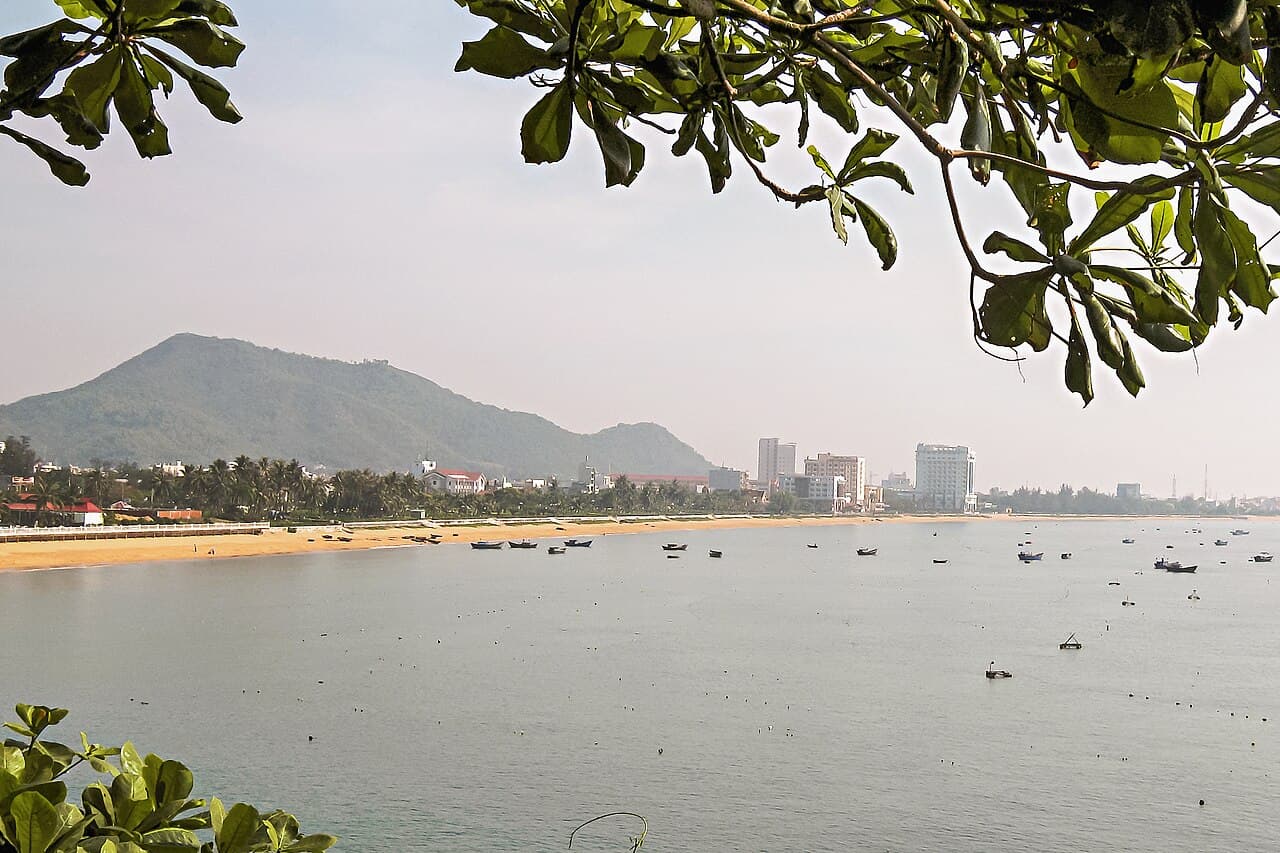
All three sit on the same coast and the differences are bigger than the map suggests. Nha Trang has a dry season of about the same length, but Quy Nhon's wet peak is far heavier. Da Nang is the wettest of the three and its rainy season runs five or six months rather than three or four.
| Metric | Quy Nhon | Nha Trang | Da Nang |
|---|---|---|---|
| Dry season length | 8 months (Jan-Aug) | 8 months (Jan-Aug) | 6 months (Feb-Jul) |
| Wettest month | October, 480-550 mm | November, 280-320 mm | October, 650-720 mm |
| Rainy days in October | 17 | 10 | 19 |
| Annual rainfall | ~1,800 mm | ~1,630 mm | ~2,100 mm |
| Sea, coldest | 25 °C (January) | 25 °C (January) | 22 °C (January) |
| Sea, warmest | 29 °C (June-Sep) | 29 °C (May) | 29 °C (July) |
| Typhoon risk | High, open coast | High (Damrey 2017, Koto 2025) | High |
| International flights | None, connect via HAN or SGN | Yes, Cam Ranh (CXR) | Yes (DAD) |
Pick Quy Nhon when:
- February to April. Dry, not yet brutal, cheap, and quiet in a way the other two stopped being years ago. Weather is near-identical across all three, so quiet is the tiebreaker.
- May to August. Everywhere is hot; this is the one without the tourist crush.
- January. A degree or two cooler than Nha Trang and still comfortably swimmable.
Pick Nha Trang or Da Nang when:
- October or November, if the beach is the point. Nha Trang gets roughly half to two-thirds of the rain and cancels fewer boat trips. Da Nang is worse than Quy Nhon in these months, so it is not the answer.
- You want to land at the beach. As of September 2026, Phu Cat runs domestic flights only. The second runway is due to open on 29 October, and the province expects international charters by the end of the year and scheduled international flights from 2027, but for now every foreign arrival routes through Hanoi or Ho Chi Minh City.
The sheltered-bay argument for Nha Trang is also weaker than it sounds. Damrey came ashore in Khanh Hoa in November 2017 as the strongest storm to hit southern Vietnam in sixteen years, and Koto landed there again in November 2025. Nha Trang is a better October bet on rainfall. It is not a typhoon shelter.
In the dry months the three are close enough that weather stops being the deciding factor. Nha Trang has the nightlife and the developed strip, Da Nang is a proper city, Quy Nhon is the quiet one. If you are still working out the shape of the trip, the country-wide weather picture is the place to start.
When to visit Quy Nhon, by what you came for
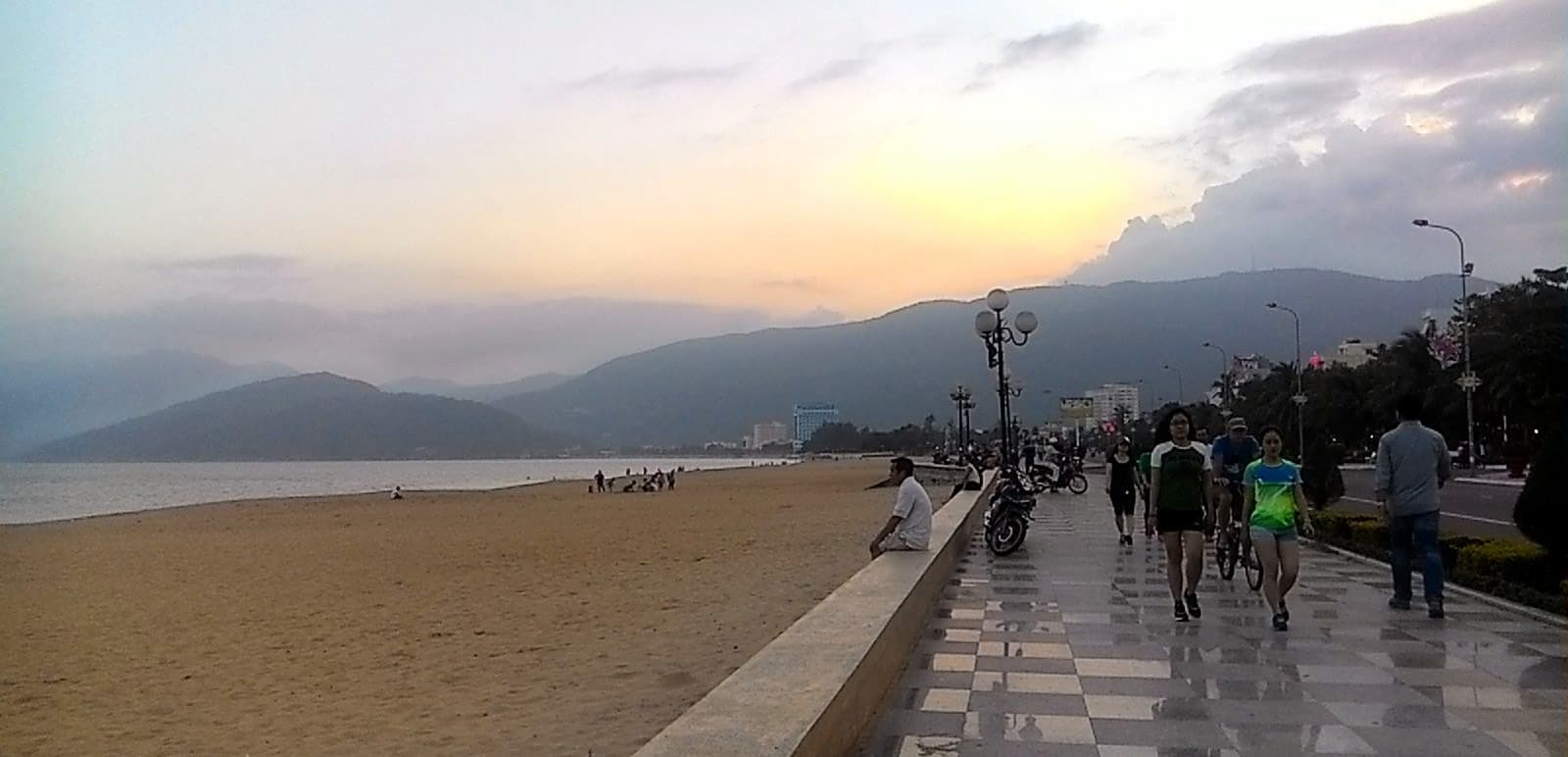
The short answer is February to April: dry, 27-31 °C, calm sea, boat trips running on schedule. A beach trip can stretch to June if you handle heat. For the warmest water, May to September at 29 °C. For the best prices with tolerable weather, September.
| What you want | Best window | Why |
|---|---|---|
| Beach | March-June | 26-32 °C, flat water, good clarity |
| Warmest sea | May-September | 29 °C, the annual maximum |
| Snorkelling and boat trips | March-August | Best visibility, minimal swell, few cancellations |
| Cham towers and culture | January-April | Cool enough to walk hills without suffering |
| Hiking south of the city | January-March | Trails dry, temperatures manageable |
| Budget travel | September | Rates down 20-30%, rain still moderate |
| Travelling with kids | February-April | Dry, mild sun, calm sea |
| Surf (experienced only) | October-December | Real swell at Bai Xep |
Two dates worth thinking about specifically.
May. Hot at 32 °C but dry, with the sea at its annual warmest. A good month if you can handle heat. The catch is getting there: with no international service at Phu Cat, you are connecting through Hanoi or Ho Chi Minh City either way.
Christmas and New Year. December is a coin flip. The first half still carries rain, and things usually settle by the 20th. If those are your only dates, book something with free cancellation and assume one or two days will be written off.
Practical notes the forecast will not tell you
UV. May to August it sits at 10-12, the extreme band. SPF 50+ every two hours and again after swimming. Cloud passes up to 80% of UV through, so overcast days burn people who thought they were safe.
Air conditioning. It is 32 °C outside and 18-20 °C in restaurants and malls. A 12-14 degree swing several times a day is how most visitors end up with a cold by day four. A thin jacket or a scarf solves it.
Humidity. 78-85%. Laundry takes forever and camera lenses fog the moment you step outside from air conditioning. Silica gel packets in the camera bag are worth the small effort in the wet season.
Reading forecasts. Apps show a rain icon across the whole day when the reality is two hours of downpour and then clear sky. Do not cancel plans over an icon. Go out in the morning when it is bright and be back before the evening band arrives.
Acclimatising. The first two or three days are rough on most people. Drink three or four litres a day, skip alcohol in the sun, and do not stack excursions on day one. Tap water is not drinkable; bottled runs 5,000-10,000 VND (~$0.20-0.40) for 1.5 litres, which is roughly the price level across the whole city.
Mosquitoes. Worst in the wet season and at dusk. Resorts are mostly fine because the air conditioning keeps them off. For evening walks on the seafront and open-air restaurants, DEET 30%+ earns its place. Local repellent from a pharmacy costs 40,000-60,000 VND (~$1.50-2.30).
What to pack

Dry season, January to August
- Cotton and linen: shorts, t-shirts, dresses
- SPF 50+ sunscreen, and take it seriously from April onwards
- Hat and sunglasses
- Water shoes for Ky Co and Bai Dai, where there is coral and sharp rock
- Two swimsuits, so one is always dry
- A light jacket for January evenings and over-cooled restaurants
- Trainers or walking sandals for the climb to Eo Gio and the Bodhisattva statue
- A microfibre towel, since resort towels do not travel to the beach
Wet season, September to December
Everything above, plus:
- A proper hooded raincoat. An umbrella is useless in typhoon wind.
- A waterproof phone case, and a power bank for outages
- A dry bag for passport and electronics
- Quick-dry clothing. Cotton takes half a day after a soaking.
- Closed shoes or waterproof trainers. The city has limited drainage and standing water is normal.
- DEET 30%+ repellent
- A fleece or sweatshirt for December and January mornings, which can drop to 21 °C
Quy Nhon weather FAQ
February to April. Dry, 27-31 °C, calm sea, boat trips to Ky Co and Cu Lao Xanh running reliably, and few tourists. A beach trip can stretch into June, though from May days reach 32-33 °C. For the warmest water at 29 °C, May to September works, though June to August fills with Vietnamese domestic travellers on school holidays. For discounts with weather you can still work around, September.
Warm all year: 25 °C in January and February, rising to 29 °C from May through September. It never drops below 25 °C, so winter swimming is comfortable rather than bracing. The annual peak runs June to September. Sea temperatures here sit within about a degree of Nha Trang in any given month, according to seatemperature.org.
October to December, with September as a transition month. October is the peak at 480-550 mm and up to 17 rainy days. November is close behind at 400-470 mm over 16 days. The rain pattern differs from further south: downpours often run three or four hours in the middle of the day rather than overnight, which makes wet-season days harder to plan around.
January to August they are near-identical, within a degree or two. In October and November Nha Trang wins clearly, with roughly half to two-thirds of the rain and fewer cancelled boat trips. The city beach faces the open sea, so storms hit it harder. That said, Khanh Hoa took direct landfalls from Damrey in 2017 and Koto in 2025, so Nha Trang is a rainfall bet, not a safety guarantee.
Yes. December to February the sea holds 25-26 °C and the air 26-27 °C. Only February is properly dry, though: December still gets 180-240 mm over about 11 wet days, January 80-120 mm over about seven, and January nights drop to 21 °C. February sees 30-50 mm and four wet days. Swimming is fine; a light jacket for a morning coffee on the seafront is not a bad idea.
Yes, between early September and 10 December according to climatestotravel.com, peaking in October and November. Molave hit this coast in 2020 and Noru closed Phu Cat airport in 2022. November 2025 brought Kalmaegi and then Koto, followed by floods that pushed rivers in the region past their historic peaks. The Phuong Mai peninsula only shelters the Thi Nai lagoon; the city beach faces the open sea. Book refundable rooms and buy cancellation cover for October and November.
Tropical monsoon (Köppen: Aw). Mean annual temperature 26.9 °C, annual rainfall around 1,800 mm with more than half of it in October and November, humidity 78-85%. Unlike northern Vietnam there is no cold season at all. Compared with Da Nang and Hoi An the wet season is shorter and the dry season runs one to two months longer.
Read next: Quy Nhon guide · Quy Nhon attractions · Nha Trang weather · Vietnam weather month by month
VietnamSpot on InstagramTips, lifehacks and news for living in VietnamFollow





- Food
Quy Nhon Food Guide 2026: Seafood, Banh Xeo, Prices
What to eat in Quy Nhon: banh xeo tom nhay, bun cha ca, imperial crab. Verified addresses, Cho Dam market, seafood prices in VND and USD, a one-day route.Quy Nhon Food Guide 2026: Seafood, Banh Xeo, Prices - Guide
Quy Nhon Attractions 2026: Cham Towers, Coves, Lighthouses
What to see in Quy Nhon in 2026 — 11th-century Cham towers, Ky Co cove, an 1890 French lighthouse, pagodas. Verified fees in VND and USD, day routes, map.Quy Nhon Attractions 2026: Cham Towers, Coves, Lighthouses - Preparation
How to Get to Quy Nhon 2026: Trains, Phu Cat Airport, Buses
Getting to Quy Nhon in 2026: Phu Cat (UIH) flights and the $1.90 airport bus, Reunification Express times to Dieu Tri, sleeper buses. Fares in VND and USD.How to Get to Quy Nhon 2026: Trains, Phu Cat Airport, Buses