Quy Nhon attractions in 2026: Cham towers, coves, lighthouses and pagodas
Eight groups of brick towers, 800 to 1,000 years old, stand within 40 km of the city. Add a cove the colour of bottle glass, a working French lighthouse from 1890, and a beach made of egg-sized basalt stones instead of sand.
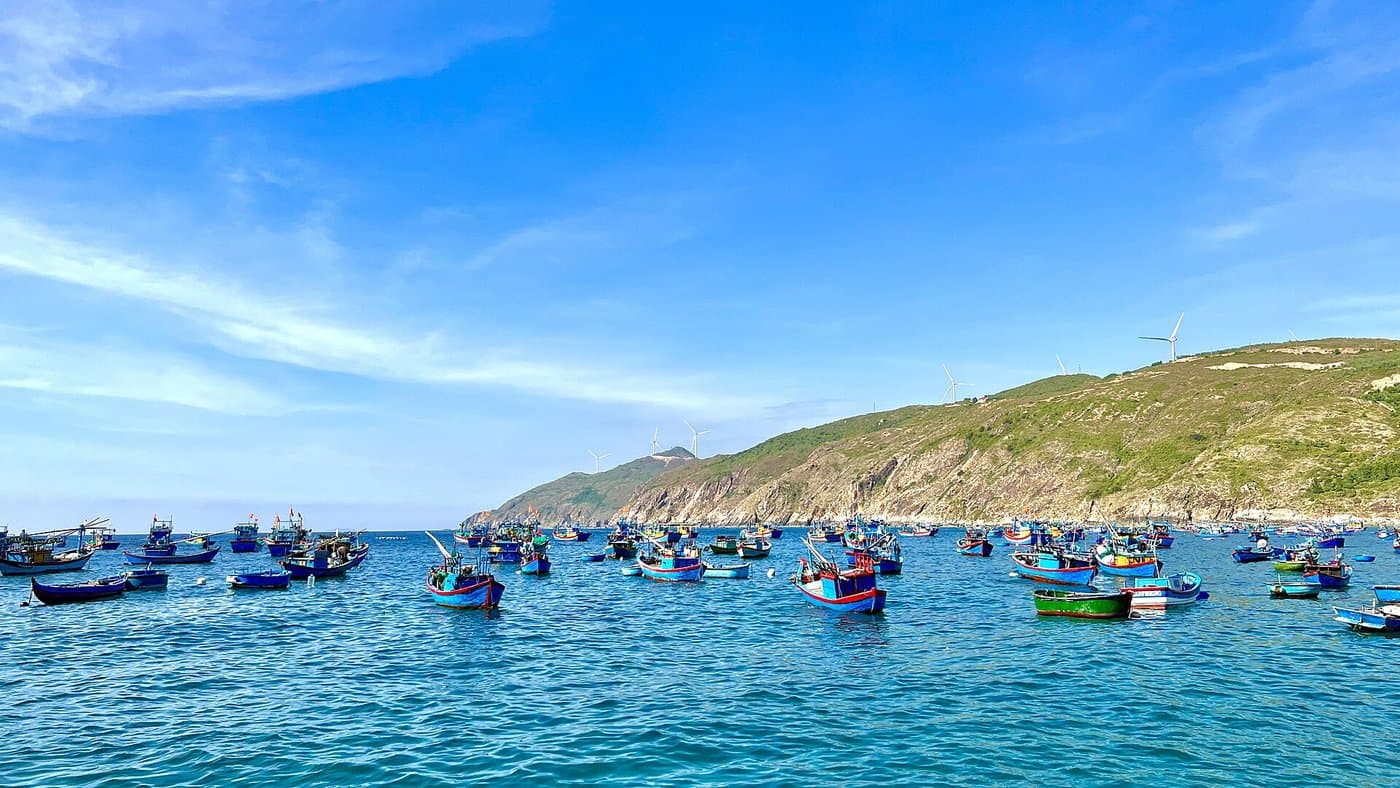
Photos from Wikimedia Commons: Lê Hồ Bắc, CC BY-SA 4.0; Hưng Hồ Bá, CC BY 2.0; Baoothersks, CC BY-SA 4.0; Lê Hồ Bắc, CC BY 2.0
The biggest of the Quy Nhon attractions is not a beach. Eight groups of brick towers, 800 to 1,000 years old, stand within 40 km of the city. This was the last capital of Champa, a kingdom that ran the central coast for a thousand years and left behind Hindu temples built from fired brick laid without mortar. Nobody has convincingly reproduced the technique since.
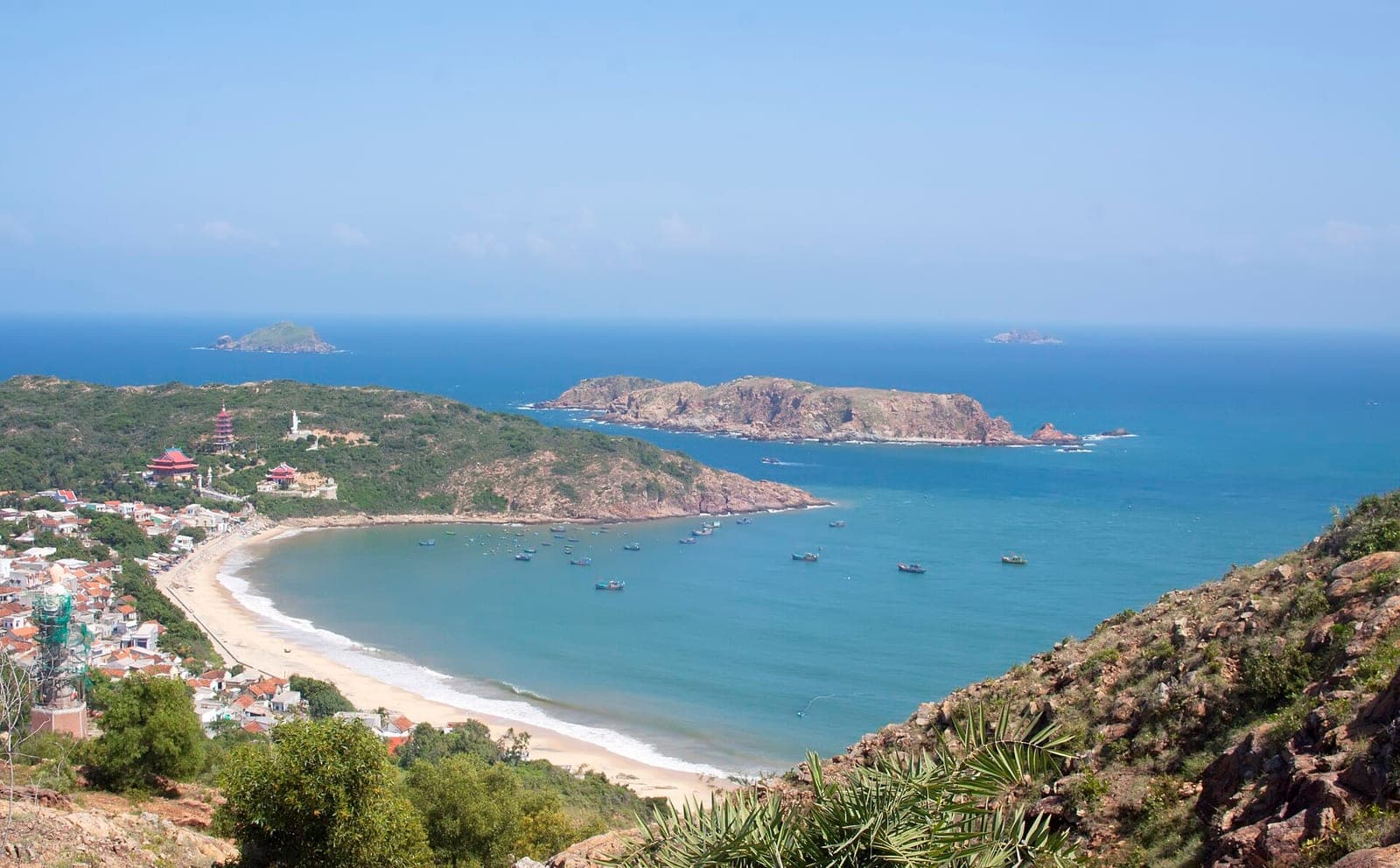
Add a cove the colour of bottle glass, a working French lighthouse from 1890 on an island two hours offshore, a 17-metre bronze Buddha in the middle of town, and a beach made of egg-sized basalt stones instead of sand. That is the Quy Nhon attractions list, and most visitors give it three days and leave wanting a fourth.
This guide covers all of it: coordinates, 2026 entrance fees in VND and dollars as reported by local travel blogs, how to get to each place, and what nobody tells you until you are standing there. At the end there are three ready-made routes: a full day, a half day, and a three-day plan. If you are still deciding whether to come at all, start with the full Quy Nhon city guide and come back here for the detail.
Prices and schedules verified 08/2026. Entrance fees on the peninsula have been actively disputed this year, so treat every figure, including ours, as approximate and confirm at the gate.
What to see in Quy Nhon: the map and the shortlist
Quy Nhon's attractions fall into five groups: Cham towers, coves and beaches, lighthouses, pagodas, and places of memory. Most sit within 30 km of the centre; the furthest of them, Duong Long towers and the Quang Trung museum, are 45–50 km out. Three or four stops of the same type fill a day comfortably. Mixing towers and islands in one day does not work, because they lie on opposite sides of the city.
- Banh It Towers (Tháp Bánh Ít): 11th c., four towers on a hill — 20,000 VND (~$0.75), 07:00–17:30
- Thap Doi (Tháp Đôi): 12th–13th c., twin towers downtown — 30,000 VND (~$1.15)
- Duong Long Towers (Tháp Dương Long): 12th c., 39 m — tallest Cham towers in Vietnam — 20,000 VND (~$0.75)
- Canh Tien Tower (Tháp Cánh Tiên): 12th c., the old Champa capital of Vijaya — Free entry
- Ky Co Cove (Kỳ Co): Turquoise cove between cliffs — Gate 120,000 VND plus 110,000 transfer
- Eo Gio (Eo Gió): Clifftop walkway, 1 km — 22,000–40,000 VND, 05:00–18:30
- Hon Kho Island (Hòn Khô): Snorkelling reef — Entry 60,000 VND, boat 150,000 VND return
- Queen's Beach (Bãi Hoàng Hậu): Beach of round basalt stones inside Ghenh Rang — 25,000 VND (~$1)
- Bai Xep (Bãi Xép): Fishing cove — Sunsets, free
- Phuoc Mai Lighthouse (Hải đăng Phước Mai): Working lighthouse on the southern tip of the Phuong Mai peninsula — Across the bay from Quy Nhon port
- Cu Lao Xanh Lighthouse (Hải đăng Cù Lao Xanh): French, 1890, 24 km offshore — Climb by arrangement with the keeper
- Trung Luong (Trung Lương): Clifftop glamping, 50,000 VND — Flagged as storm-affected in 2026
- Long Khanh Pagoda (Chùa Long Khánh): Founded 1715, bronze Buddha 17 m — Free, 05:00–20:00
- Thap Thap Pagoda (Chùa Thập Tháp): 1665, oldest Zen monastery in the region — Free
- Ong Nui Pagoda (Chùa Linh Phong): 69 m seated Buddha, 600 steps — Free, 30 km north of Quy Nhon
- Ghenh Rang and Han Mac Tu (Ghềnh Ráng): The poet's grave, museum and bay viewpoint — 25,000 VND (~$1)
- Quang Trung Museum (Bảo tàng Quang Trung): Tay Son, 45 km from Quy Nhon — 50,000 VND (~$1.90), 07:00–17:00
Twelve places justify the trip:
- Banh It towers (Tháp Bánh Ít) — four 11th-century towers on a hill, the region's one genuine must-see
- Thap Doi (Tháp Đôi) — twin towers standing in a residential block downtown
- Duong Long towers (Tháp Dương Long) — the tallest Cham towers in Vietnam at 39 m
- Ky Co (Kỳ Co) — a turquoise cove wedged between cliffs, nicknamed the "Vietnamese Maldives"
- Eo Gio (Eo Gió) — a clifftop walkway above open sea
- Hon Kho (Hòn Khô) — an uninhabited island with the best snorkelling around
- Queen's Beach (Bãi Hoàng Hậu) — a beach of round basalt stones instead of sand
- Cu Lao Xanh lighthouse (Hải đăng Cù Lao Xanh) — French-built, 1890, still working
- Long Khanh pagoda (Chùa Long Khánh) — the city's oldest temple, with a 17-metre bronze Buddha
- Thap Thap pagoda (Chùa Thập Tháp) — a Zen monastery founded in 1665
- Ong Nui pagoda (Chùa Linh Phong) — a 69-metre seated Buddha on a mountainside
- Ghenh Rang (Ghềnh Ráng) — the cape holding a poet's grave and the best view over the bay
Distances from the city centre
| Site | Km | Time | How |
|---|---|---|---|
| Thap Doi | 1.5 | 20 min | walk (Grab — 5 min) |
| Quang Trung Square | 1 | 10 min | walk |
| Long Khanh pagoda | 0.8 | 10 min | walk |
| Ghenh Rang | 3 | 10 min | scooter, Grab |
| Bai Xep | 10 | 20 min | scooter |
| Hon Kho (Nhon Hai pier) | 16 | 30 min | scooter |
| Banh It towers | 20 | 30 min | scooter, taxi |
| Eo Gio | 20 | 40 min | scooter |
| Ky Co | 25 | 50 min | scooter + boat |
| Trung Luong | 30 | 50 min | scooter |
| Ong Nui pagoda | 30 | 50 min | scooter |
| Duong Long towers | 50 | 1 h 20 | car |
| Quang Trung Museum, Tay Son | 45 | 1 h 15 | car |
| Cu Lao Xanh | 24 by sea | 1–1.5 h | ferry |
Best for, if you are short on time
- One free morning: Banh It. Nothing else here gives you as much for 20,000 VND and two hours.
- One afternoon: Ghenh Rang. The poet's grave, the stone beach and the bay viewpoint sit in one 25,000 VND zone, 3 km from the centre.
- One full day: Ky Co and Eo Gio on the peninsula, done by boat from Nhon Ly.
- The thing almost nobody does: a night on Cu Lao Xanh. Costs the least, takes the most planning, and is the only stop on this list you will not share with a coach party.
Cham towers, the region's real inheritance
The Cham were a Malayo-Polynesian people who arrived by sea and founded the kingdom of Champa in the 2nd century AD. For a thousand years they held the coast from modern Hue down to Phan Thiet, practised Hinduism and Buddhism, and built temples to Shiva, Vishnu and Brahma. This region was their final capital: after the northern centre of Indrapura fell in the 11th century (the area around what is now Da Nang), Champa's heart moved south to the citadel of Vijaya. It held until 1471, when the Vietnamese emperor Le Thanh Tong stormed the city. According to the chronicle Đại Việt sử ký toàn thư, 40,000 Cham soldiers died and more than 30,000 were taken prisoner.
Champa effectively ceased to exist as a state after that date. The towers stayed.
The bricks were fired from local clay, stacked without mortar, and bonded by some method that scholars still argue about. The candidates: a plant resin glue from the damar tree, grinding the bricks against each other until the faces fused, firing the finished wall from the outside. Whatever it was, the joints have held for a millennium and you cannot see them from a metre away.
Eight tower groups survive in the area. Four are realistically reachable.
Thap Doi: twin towers in the middle of town
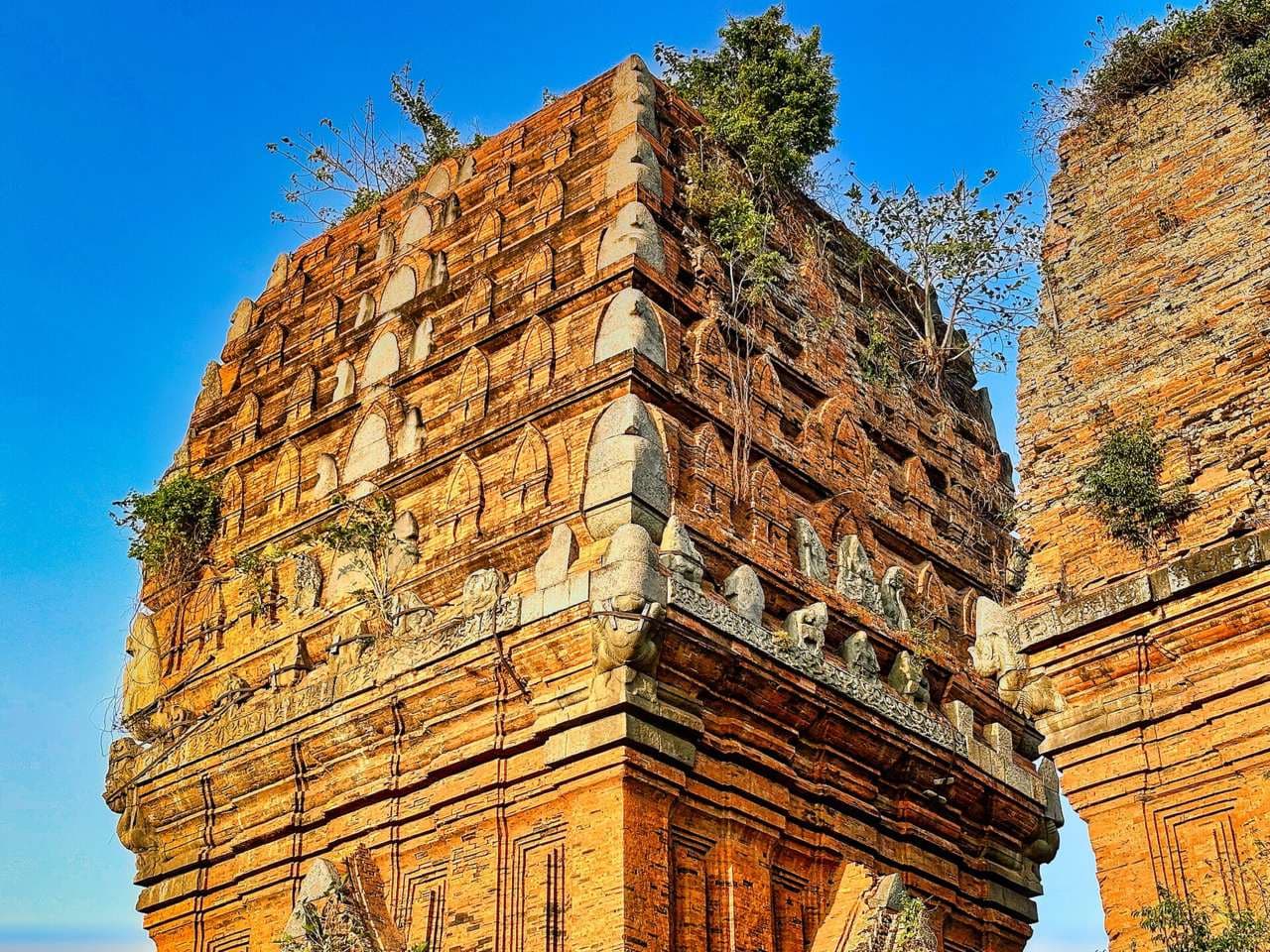
Two towers from the late 12th to early 13th century, standing in a residential block on Trần Hưng Đạo street, 1.5 km from most central hotels. Heights: 18 and 20 metres. Entry is 30,000 VND (~$1.15), open 07:00–11:30 and 13:00–18:00. There is a small park around them with benches and palms, kept tidy.
What makes Thap Doi unusual is the roofs. Most Cham towers are topped with stepped pyramids. These curve into domes, with Garudas, the mythical birds that carry Vishnu, and stone beasts perched at the corners. No other Cham complex in Vietnam looks like this. One theory holds that the craftsmen came from Cambodia during a political alliance with the Angkor empire.
Inside each tower is a cramped chamber with an altar. The original stone yoni-lingams, Shiva's symbols, sit in museums in Da Nang now; what you see here are copies. The walls carry carved panels of dancing apsaras.
Come before 8am. The city is waking up, the park holds nothing but retirees doing tai chi, and the light is soft. By midday there is no shade at all, and the tour coaches arrive after lunch.
The appeal of Thap Doi is that it costs you nothing but an hour and a short walk. Treat it as the introduction. The real Cham experience is 20 km north, on the hill at Banh It.
Banh It towers: the complex on the hill
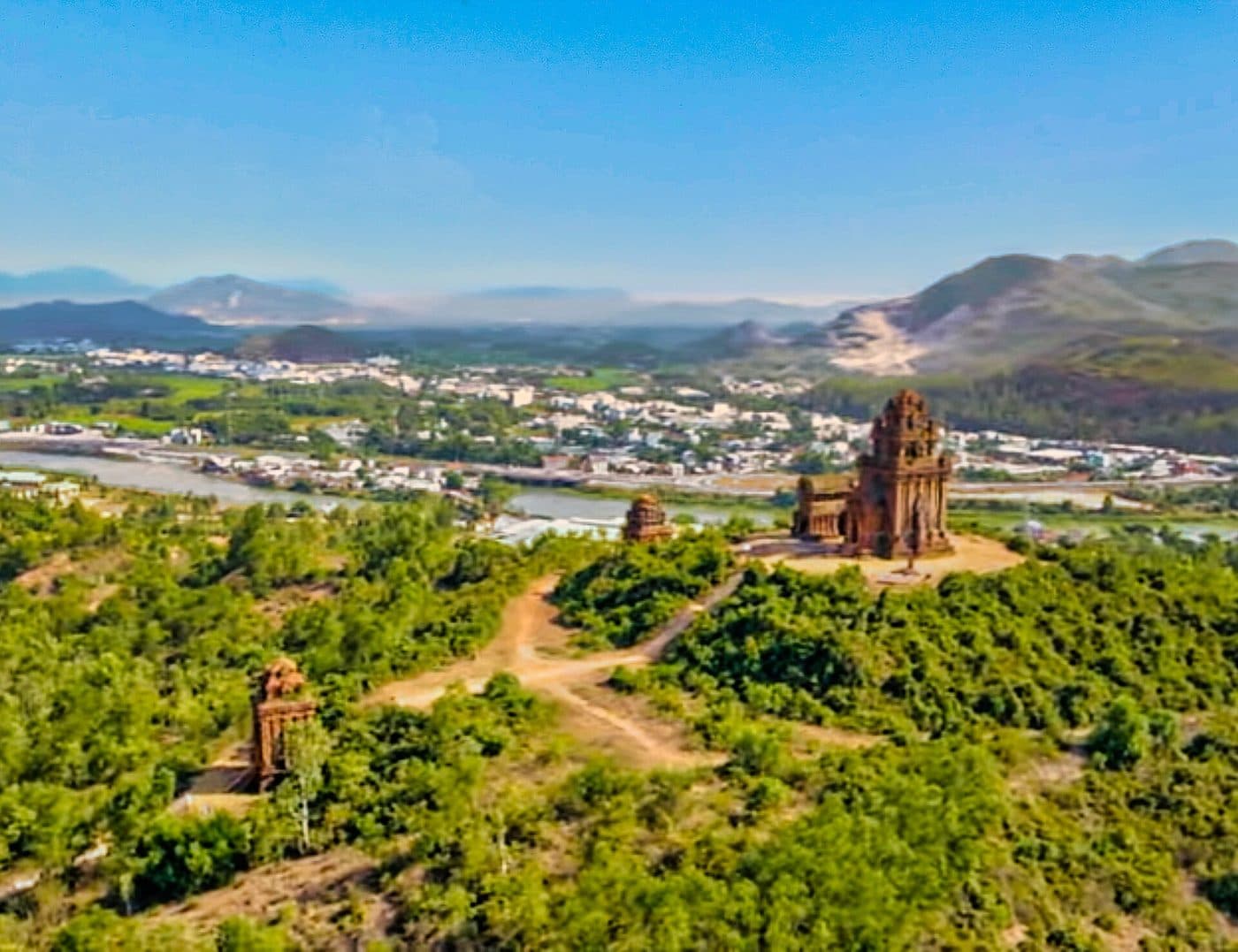
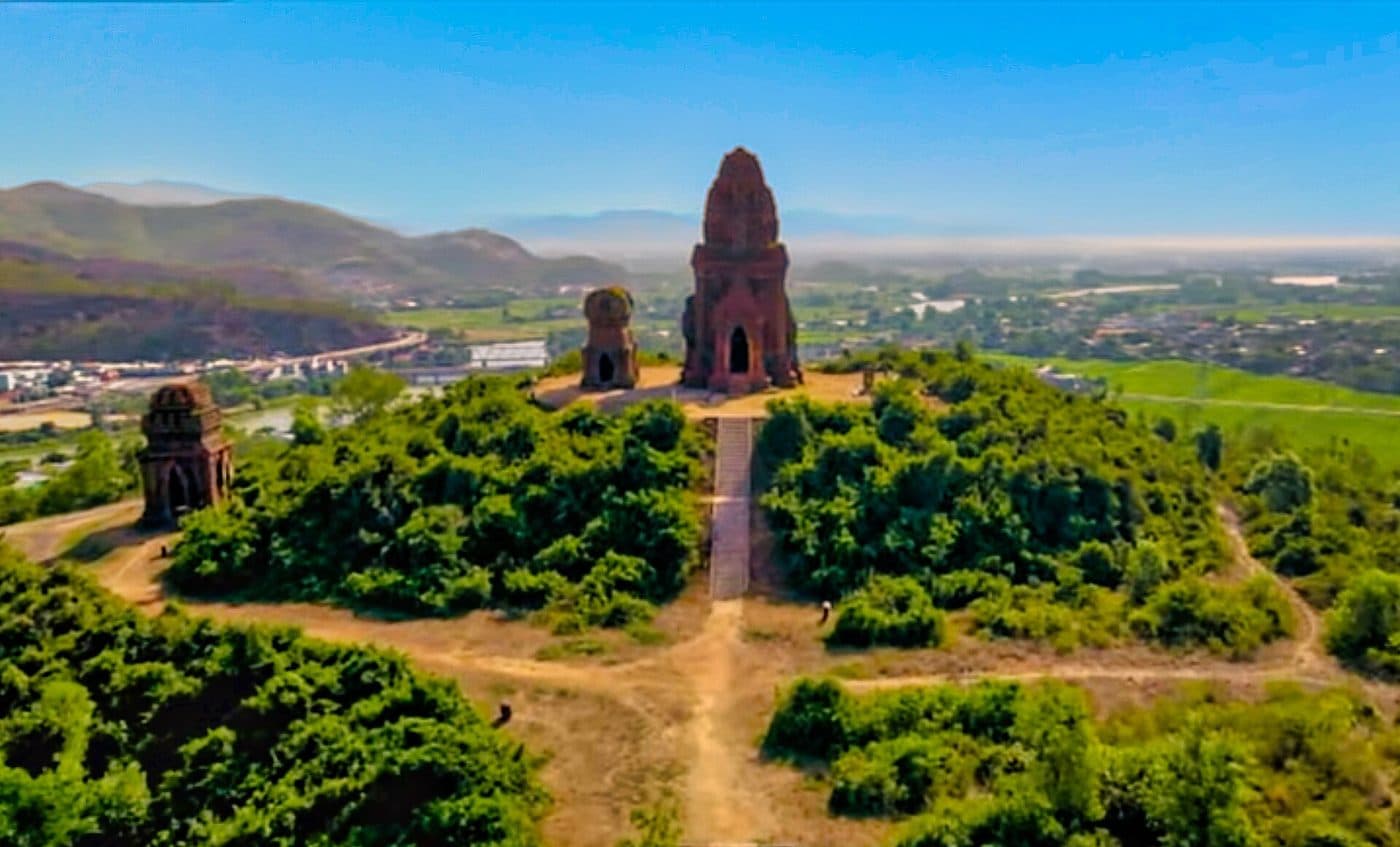
This is the one to prioritise. Four towers on the summit of a 100-metre hill in Tuy Phuoc Bac commune, 20 km north of the city, built in the 11th century under King Harivarman IV. Entry is 20,000 VND (~$0.75), open 07:00–17:30. That is the cheapest ticket for the best site in the region, which tells you something about how little Quy Nhon has monetised itself so far.
The name means "small sticky rice cakes," and the hill does look like four of them set side by side. What makes the complex rare is that it shows all four types of Cham temple building in one place:
- Kalan, the main tower — 22 metres, dedicated to Shiva, entrance facing east
- Gopura, the gate tower — the portal pilgrims passed through
- Kosagriha, the treasury for sacred objects — with a saddle-shaped roof, curved like the back of a buffalo
- The stele tower, for inscriptions and dedications
From the top you look out over rice paddies, the Côn river and distant mountains. The main tower still carries reliefs of a dancing Shiva and an elephant-headed Ganesha — Hindu iconography that survives in very few places in Vietnam.
The climb is a wide stone staircase, roughly 200 steps. Not hard, but do not attempt it between 11:00 and 16:00: the hill has no shade whatsoever. Water, hat, sunscreen.
A well-maintained pathway leads up and around the temple complex and it's possible to enter the towers themselves. Unfortunately, someone at the provincial tourism authority thought it would be a good idea to pump loud music through speakers throughout the site.Tom Divers, Vietnam Coracle, 2024
Getting there:
- Scooter — north on highway QL1A, right onto DT636 after about 17 km, then 3 km to the "Tháp Bánh Ít" sign. Parking at the foot, 5,000 VND.
- Taxi or Grab — 350,000–400,000 VND one way. You can negotiate a wait; expect 100,000–150,000 VND per hour on top. Grab coverage this far out is unreliable for the return, so agree the wait rather than gambling on a pickup.
- Guided tour — around 800,000 VND per person on a Cham heritage day tour with guide and lunch.
Duong Long towers: the tallest in Vietnam
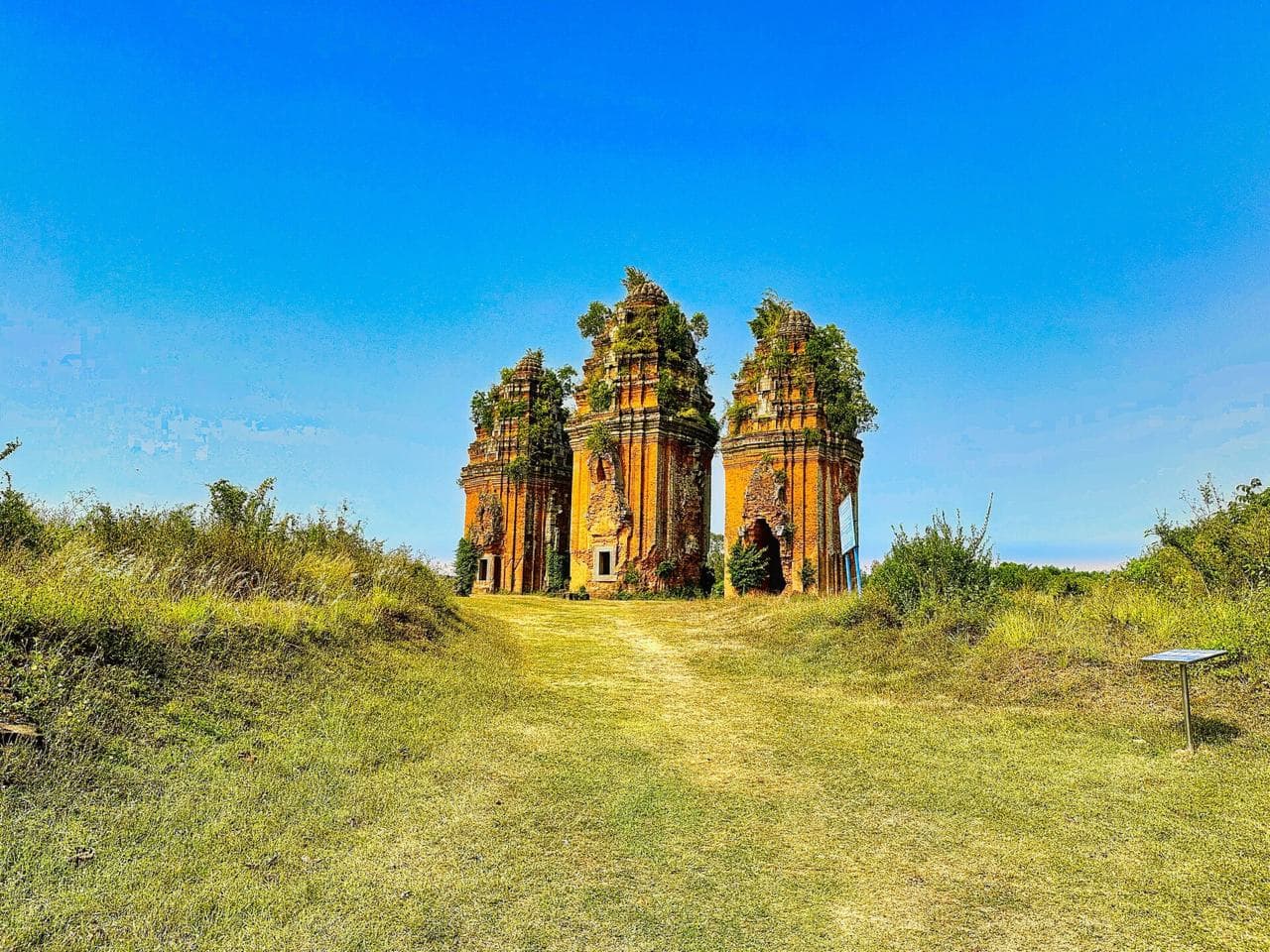
Three 12th-century towers in Binh An commune (formerly Tay Son district), 50 km northwest of Quy Nhon. The central one is 39 metres, taller than any other Cham tower in the country. Entry is 20,000 VND (~$0.75).
Duong Long went up at the height of Champa's power and wears its Khmer influence openly: round ornamental rings at the corners, naga serpents at the base, dancers carved in an Angkorian style. Champa and the Khmer empire spent the 12th century alternating between war and alliance, and the craftsmen moved with the politics.
The complex is partly ruined. The northern tower survives nearly intact, the central one has lost its crown, the southern one is half collapsed. From a distance the ruin arguably reads better than an intact tower would.
Duong Long makes sense as a stop on a Tay Son day, not as a destination in itself. The two sites are 10 km apart. Driving 50 km each way for the towers alone is a poor use of a morning.
Canh Tien tower and the Cha Ban citadel: the old capital
Twenty-seven kilometres from the city lies the archaeological zone of Thành Chà Bàn — Vijaya, capital of Champa from the 11th to the 15th century. What remains is earth ramparts, fragments of wall, and a single tower: Tháp Cánh Tiên, the "Fairy Wings Tower," 12th century, 20 metres tall. Free, open access.
The tower stands in the middle of a rice field, restored, its chamber empty — the altar was carried off long ago. Low earthen banks trace the old fortifications, and pieces of broken Cham sculpture still turn up in the grass.
This is a place for context, not for spectacle. If Champa's history interests you, come here after Banh It and see the capital that almost entirely vanished. If you are here for photographs, skip it without regret.
My Son: the Champa sanctuary near Hoi An · Da Nang: what to see · Vietnam's top attractions
Coves and beaches worth visiting as sights
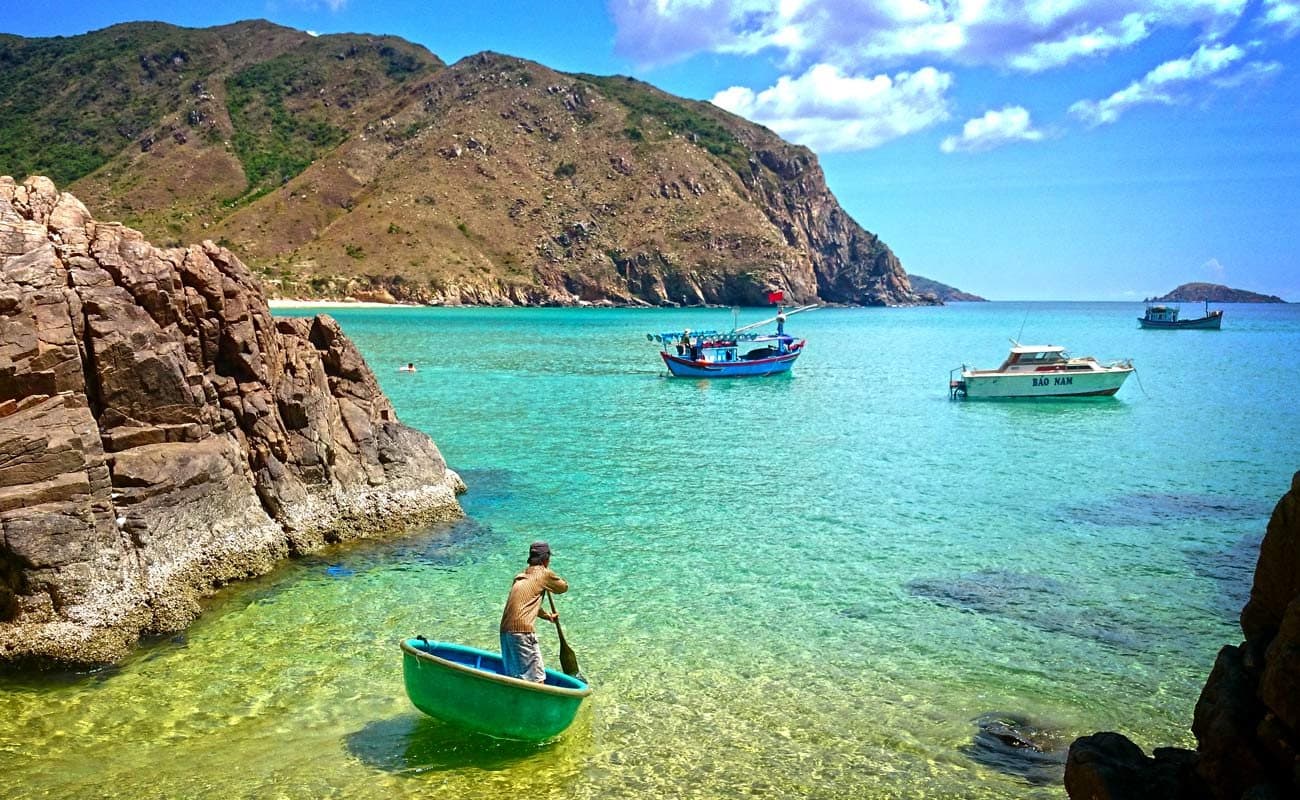
Quy Nhon's beaches split into two categories. Some are for swimming and snorkelling. Others are landscape: you go to look, not to swim. Five of them belong in the second category, starting with the most photographed stretch of coast in central Vietnam.
Ky Co: the turquoise cove between cliffs
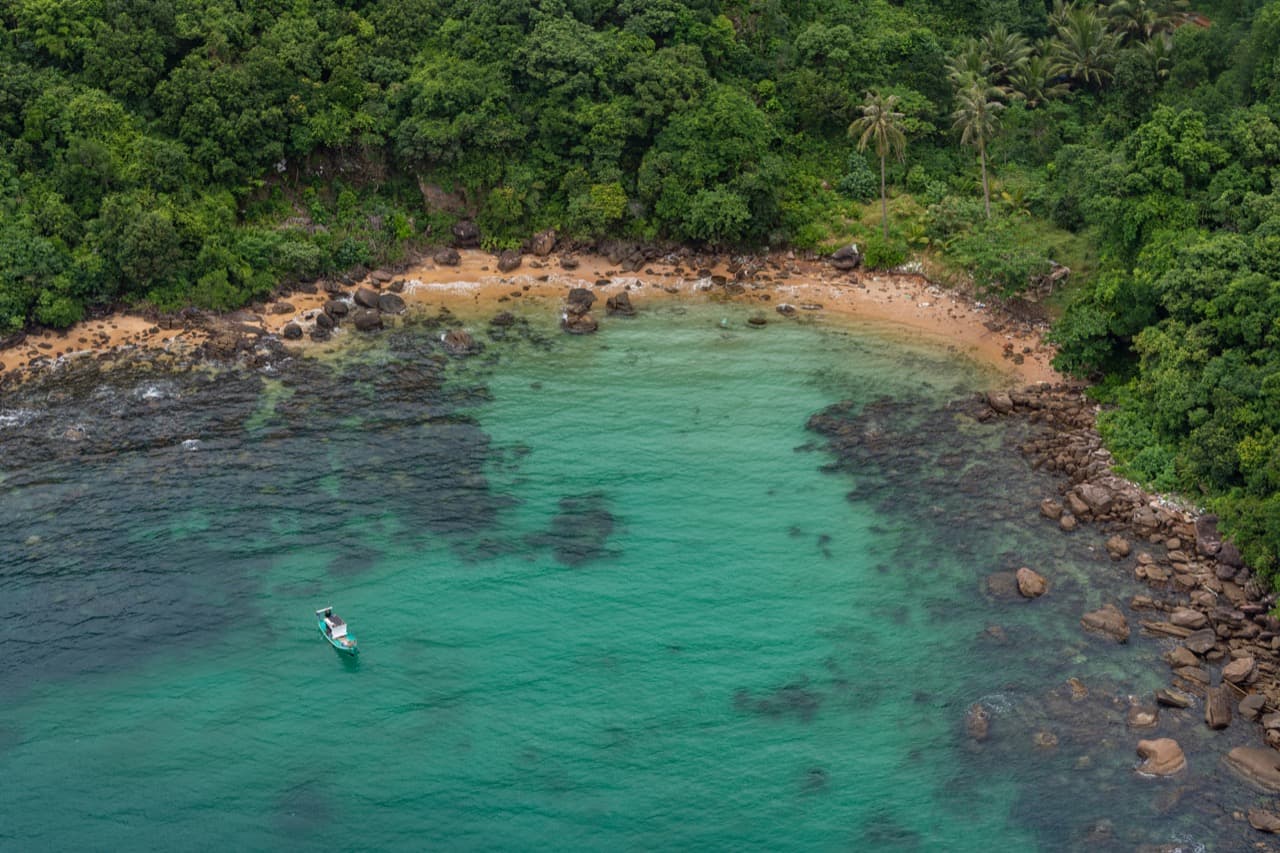
A small enclosed cove on the Phương Mai peninsula, 25 km north of the city. Cliffs 20 to 30 metres high wall it in on two sides, open sea on the third, a 50-metre strip of white sand on the fourth. The water is clear enough to see the bottom at five metres.
Vietnamese bloggers started calling it the "Maldives of Vietnam" in 2016 and the nickname stuck. The colour has nothing to do with reef. It comes from pale sand and light refracting in water that the cliffs keep flat.
Costs and logistics:
| Route | Price | Time |
|---|---|---|
| Gate ticket (mandatory) | 120,000 VND (~$4.60) | — |
| Shuttle vehicle down to the cove | 110,000 VND (~$4.20) | 15 min |
| Boat from Nhon Ly harbour | from ~250,000 VND per boat, return | 15–20 min on the water |
| Canoe package with lunch | 250,000–400,000 VND per person | full day |
Boat pricing at Nhon Ly is negotiated rather than posted, and reported figures for 2026 vary widely depending on whether food is bundled in. Agree the number and the pickup time before you get in.
The overland road is a rutted track with climbs, not the most comfortable introduction to riding a scooter in Vietnam. The boat is faster and more pleasant (it is also how group tours from Quy Nhon get there), but in the wet season from September to November crossings get cancelled when the swell picks up.
On the beach there are seafood cafes, sun loungers (50,000 VND), and masks for rent. Toilets and showers exist. Umbrellas are scarce, so arrive by 8am to claim shade under the cliffs, because after 11:00 the sun is straight overhead and there is nowhere to hide. In the national ranking of Vietnam's beaches, Ky Co scores on water colour rather than size.
Eo Gio: the windy gap with the panorama
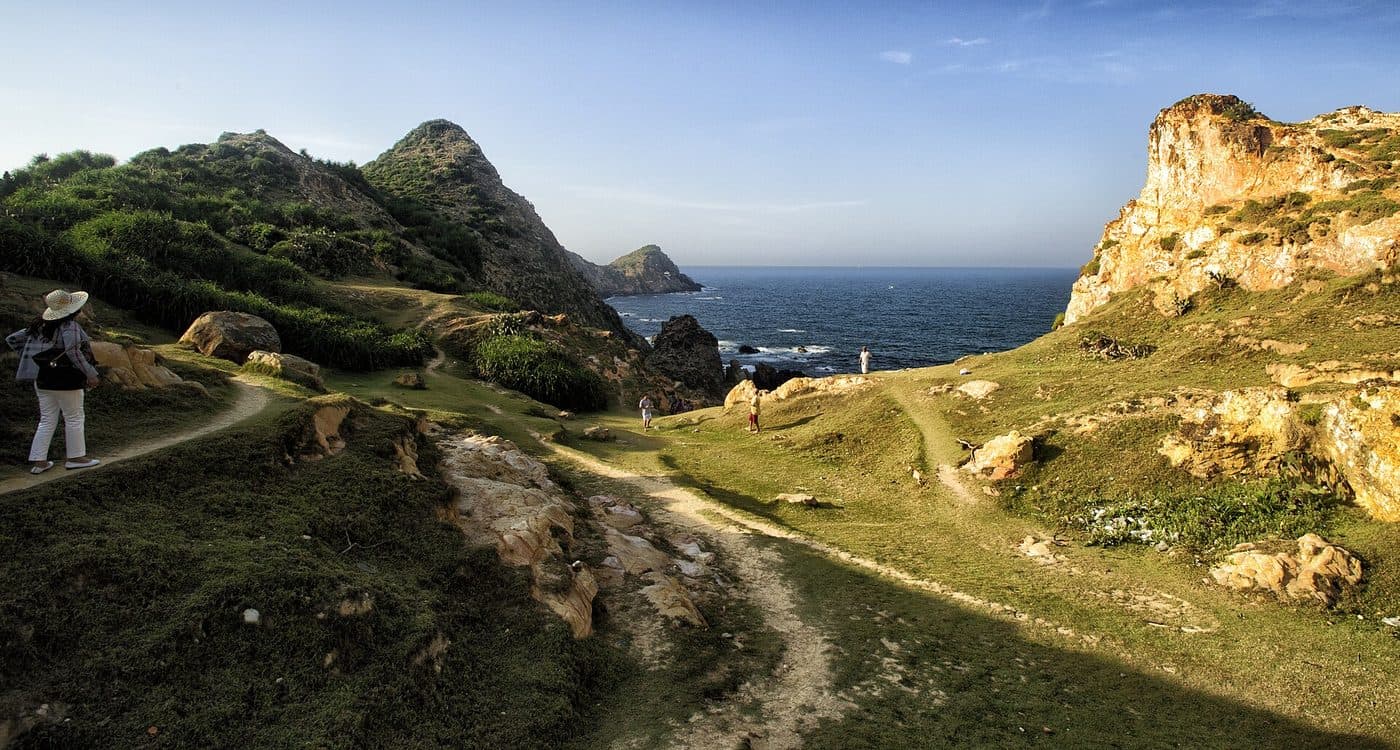
A rock headland on the Phuong Mai peninsula, 20 km from the city and 2 km from Ky Co. "Eo Gio" translates as "windy gap," and the name is honest: the wind here never stops. Entry is 22,000–40,000 VND (~$0.85–1.55), open 05:00–18:30.
That price has a story worth knowing before you argue at the booth. In June 2026 the operator tried to raise the ticket from 22,000 to 50,000 VND. The Gia Lai authorities rejected the 127% increase and instructed the operator to hold the old price until the promised facilities were actually built. The operator raised it anyway, cut it to 40,000 after public complaints, then promised to go back to 22,000, yet at the end of June the booth was still charging 40,000. Local media covered the whole thing, which is a useful signal about how fluid pricing on this peninsula is.
A walkway roughly a kilometre long runs along the headland with viewing platforms, 30 to 80 metres above the water. Below is open sea and a small rocky cove where the swell breaks. There is no swimming here and you should not try. The rip along the cliffs is strong.
Come at sunrise, 05:30–06:30. The sun comes up directly out of the sea to the east and the shots take themselves. Better still, the headland is nearly empty until 7am, when the first coaches pull in.
After 14:00 the wind stops being atmospheric and starts taking hats. If you plan to fly a drone, be careful. Gusts here will flip an aircraft in a second.
Pair Eo Gio with Ky Co. They are 2 km apart in the same peninsula zone, and half a day covers both with time for photographs and a swim.
Hon Kho: the island with the snorkelling
A small uninhabited island 1.5 km off the fishing village of Nhơn Hải, which is 16 km north of the city by road. About a hectare of land with nothing on it: no cafe, no toilet, no shade at all, just beach and scrub.
You come for the reef. The northern shore of Hon Kho is the best coral around Quy Nhon, with 8 to 10 metres of visibility in the dry season. Parrotfish, clownfish, the occasional turtle. Mask and snorkel rent for 50,000 VND from the boatmen. Serious diving in Vietnam happens further south; here a snorkel is enough.
Access has two versions. The scheduled transfer runs 150,000 VND return with a 60,000 VND island entry fee on top. Alternatively you negotiate directly with a fisherman at the Nhon Hai pier, where there are always boats, for 250,000–400,000 VND per boat, up to six people, including a two- to three-hour wait. Life jackets are provided. The boatman drops you, drifts nearby, and returns at the agreed time.
Almost none of the boatmen speak English. Write the pickup time on paper or point at your phone clock, and make them repeat it back. This is the one arrangement on the peninsula where a misunderstanding leaves you stranded on a rock with no shade.
Bring at least two litres of water per person, food, sun protection, your own mask if you would rather not rent, and a waterproof phone pouch.
Queen's Beach: a shoreline of stone eggs
Bãi Hoàng Hậu, 3 km from the centre, inside the Ghềnh Ráng — Tiên Sa complex. Entry to the complex is 25,000 VND (~$1).
There is no sand. The beach is a field of round basalt stones the size of hen's eggs, polished smooth by the sea. Walking barefoot is a foot massage you did not ask for. Lying down is impractical, so bring a towel and low expectations. Swimming happens between the rocks, in natural stone basins that fill at high tide and function as an improvised jacuzzi.
The name comes with a story. In 1927 Bao Dai, Vietnam's last emperor, came here and built a rest house, and the beach was set aside for Queen Nam Phương. It kept her title.
Unlike Ky Co this is not a beach day. An hour and a half is right: walk the stones, sit in a rock pool, take the photograph. It pairs naturally with the Han Mac Tu memorial on the same headland.
Bai Xep: the fishing cove
A small bay 10 km south of the city along the QL1D coast road under the Ghềnh Ráng ridge.
Do not come to swim. The bottom is rock, the entry is awkward, and you climb in over boulders. Come for a fishing village that still looks like one: round basket boats, thúng chai, pulled up on the sand, nets stretched on bamboo frames, women gutting the morning catch. It photographs beautifully, especially at sunset.
A handful of guesthouses sit directly on the shore from 200,000 VND a night, plus a couple of seafood cafes at village prices. No coaches come here and there is no ticket booth, which is exactly the point. Places like this are collected in our roundup of Vietnam's hidden gems. Where to swim, where only to look and what the gates charge: our Quy Nhon beaches guide.
Lighthouses: three points on the coast
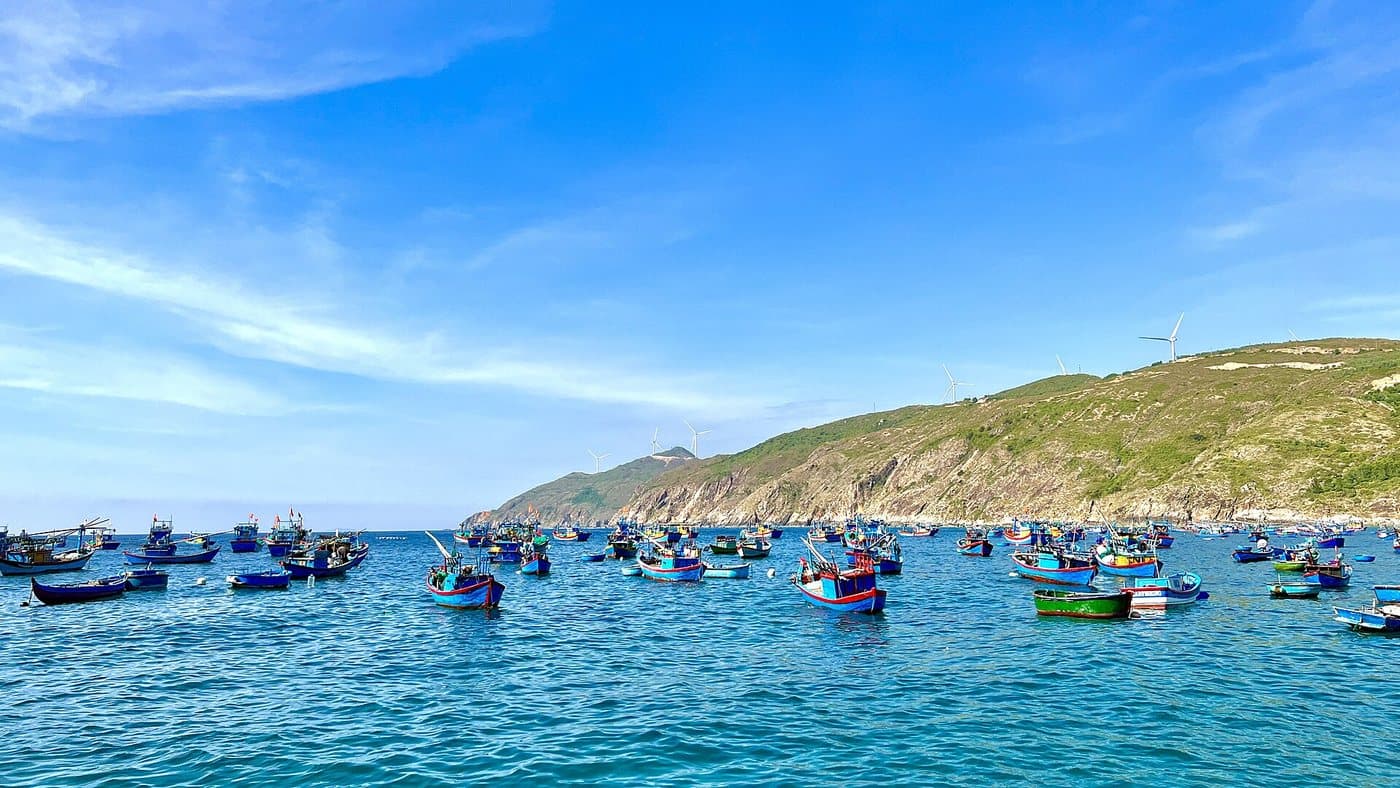
Three places around Quy Nhon are described as lighthouses. One is a working 19th-century tower on an island, one is a working tower on the mainland cape, and one is a glamping site that borrowed the word and has no lighthouse at all. Worth knowing which is which before you ride 30 km.
Cu Lao Xanh lighthouse, French, 1890
Cù Lao Xanh, the Green Island, also known as Vân Phi, lies 24 km off the Quy Nhon coast. On its highest point, 119 metres above sea level, French engineers put up a lighthouse in 1890. It still works and is listed among Vietnam's historic lighthouses.
The construction is standard French colonial: a round stone tower with a spiral stair inside and a lamp platform on top. The lamp burned kerosene first, then acetylene, then electricity from the 1960s.
Climbing it is free, arranged with the keeper on the day rather than booked — there are no published visiting hours, and every account of the climb describes it as informal permission rather than a ticketed attraction. Inside is a narrow cast-iron spiral stair. From the top the view runs 360 degrees: the mainland on one side, the open South China Sea on the other, fishing boats and green slopes below.
Getting to the island:
| Crossing | Price | Time |
|---|---|---|
| Wooden ferry from Ham Tu pier | 70,000 VND (~$2.70) per person, one way | 1–1.5 h |
| Passenger ferry Ham Tu → Nhon Chau | departures 08:00 and 13:00 | ~1.5 h |
| Canoe / speedboat | ~300,000 VND (~$11.50) return | 45 min |
Phuoc Mai: the working tower across from the port
Hải đăng Phước Mai stands on the southern tip of the Phuong Mai peninsula, across the bay from Quy Nhon port. Nhon Ly, Ky Co and Eo Gio are on the same peninsula, but 10–15 km further north.
It is a working lighthouse, not a museum, so there is no tour. Visitors climb the adjacent hill, take the view, and leave. From up there you look across the bay to the city.
It is not on the way to Ky Co or Eo Gio. Do not ride out for the lighthouse alone.
Trung Luong: glamping on the slope above the sea
The Trung Lương area, 30 km north of Quy Nhon. There is no lighthouse here at all, despite plenty of guides filing it under "Trung Luong lighthouse area".
What it actually is: Trung Lương Camp, a glamping site with tents and bungalows on a grassy slope above the sea, terrace restaurants, a pool, and a set of photo installations. Entry to the zone is 50,000 VND (~$1.90), open 06:30–18:00. A tent runs 600,000–1,200,000 VND (~$23–46) a night.
Nobody comes here for a sight. They come for a terrace, a coffee, a view of the sea and a photograph on a swing over the drop. Judged as a lighthouse it will disappoint you. Judged as somewhere to sleep in a beautiful spot, it is a good call.
Pagodas and temples
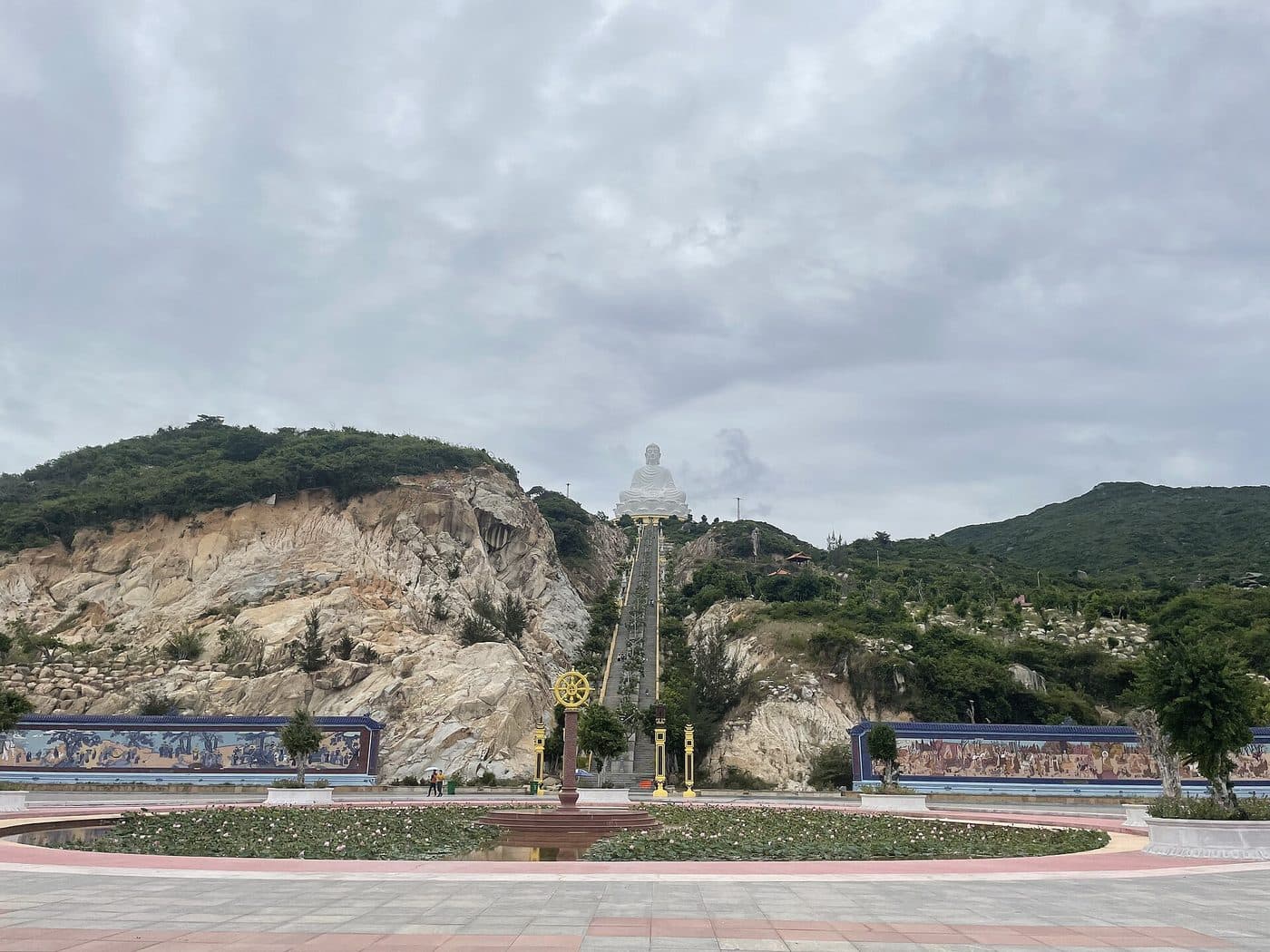
Quy Nhon is not a temple city the way Hue or Hoi An are. Three pagodas still earn a visit: one downtown, two out of town, each with a distinct character.
Long Khanh pagoda: a 17-metre Buddha downtown
Chùa Long Khánh at 141 Trần Cao Vân is the oldest Buddhist temple in Quy Nhon, founded in 1715 by a Chinese monk, Đức Sơn, who arrived with merchants from Guangdong. Free entry, open 05:00–20:00.
The centrepiece is a bronze Amitabha Buddha in the courtyard, about 17 metres tall. It is visible from the street, and drivers regularly pull over for a minute to look at it.
Inside the main hall there is a bronze bell cast in 1805 and a copper censer with 17th-century inscriptions. The atmosphere is working rather than touristic: monks live here, hold services, feed people who have nowhere else to eat. There is a communal prayer at 18:00 and you are welcome to stand at the back.
Etiquette: shoes off at the hall entrance, shoulders and knees covered, keep your voice down, no flash. Photographing the courtyard Buddha is unrestricted.
Thap Thap pagoda: the oldest Zen monastery in the region
Chùa Thập Tháp, "Ten Towers," sits about 27 km from the centre in what is now An Nhon ward. Founded in 1665 by the monk Nguyên Thiều of the Lam Te school (Linji Zen), it is the oldest Zen monastery in the old Binh Dinh region. Free entry.
The name refers to ten Cham towers that stood on this hill before the monks arrived. The towers were demolished and their brick went into the first pagoda. Nothing Cham remains standing, but carved stone fragments still surface in the monastery garden.
The architecture is classic Vietnamese: two-tier roofs with upturned corners, wooden columns, statues in the main hall, all of it around a garden of ponds and bonsai, with a library of Buddhist sutras in classical Chinese.
Thap Thap rewards an interest in Vietnamese Buddhist history and not much else. Without that interest, see Long Khanh downtown and give this one a miss. The country's more spectacular temples are gathered in our guide to Vietnam's temples and pagodas.
Ong Nui pagoda: the giant Buddha on Ba mountain
Chùa Linh Phong, usually called Chùa Ông Núi or the "Mountain Hermit's Pagoda," lies 30 km north of Quy Nhon on the slope of Bà mountain. Free entry.
The draw is a seated Buddha 69 metres high, 108 with its lotus pedestal. It sits on a platform on the mountainside and is visible from the highway several kilometres out.
Getting up to it means 600 steps. Not technically hard, but punishing in the heat: carry water and take breaks. There is a viewing platform halfway with rice fields below and the sea beyond. At the top, temple buildings and monks' cells.
Below the mountain is the cave where, by legend, a 17th-century hermit called Ông Núi, "Mister Mountain," lived, fed tigers and spoke with spirits. It is small, accessible, and you will not need a torch.
The practical value of Ong Nui is its position: the pagoda and Phu Cat airport (UIH) are both north of the city, so it can be folded into an airport run. Ask the driver how long the detour takes, and agree the fare and the wait in advance.
Han Mac Tu and Ghenh Rang: a poet's cape
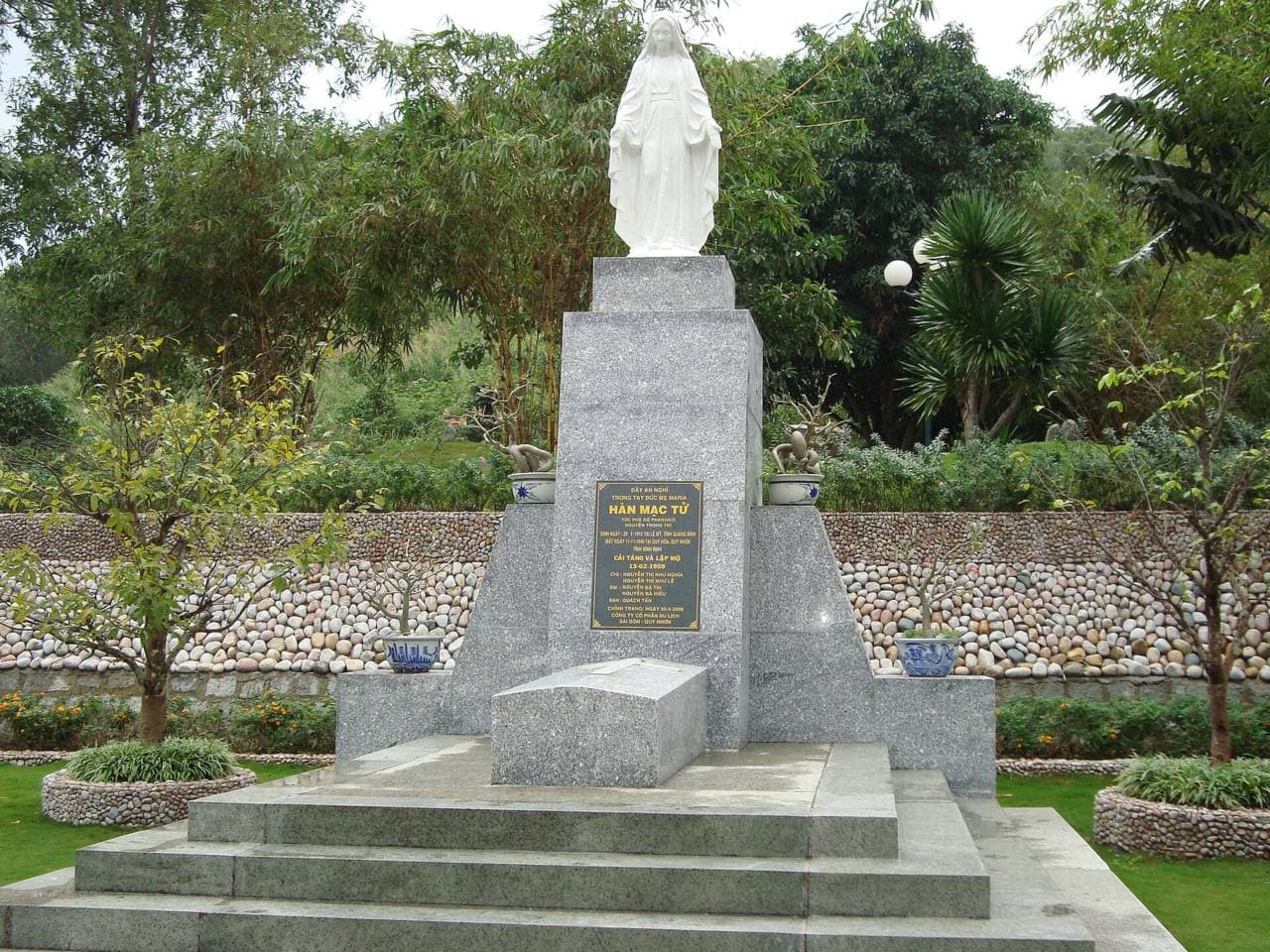
Hàn Mặc Tử (1912–1940) is a canonical figure of 20th-century Vietnamese poetry, one of the leaders of Thơ Mới, the "New Poetry" movement that brought the imagery, metre and preoccupations of French symbolism into Vietnamese literature in the 1930s. He lived 28 years and died of leprosy at the Quy Hòa sanatorium here. His poems, about love, the moon, blood and the approach of death, are still taught in schools and still set to music.
The Ghềnh Ráng cape, 3 km from the centre, is where he liked to walk. In 1959 his friends and family moved his grave here. It is now a memorial complex: the grave on the hillside, a museum with copies of manuscripts and photographs, and a park of themed installations. Entry is 25,000 VND (~$1).
A long staircase climbs to the grave through pines. At the top is a stone monument and, beside it, a stele carrying his last poem. The view takes in Quy Nhon bay and Queen's Beach below.
The museum is modest: photographs, editions published in his lifetime, a few personal effects. He died young and poor. Every label is in Vietnamese, so for a foreign visitor this lands as an atmosphere rather than an education. That is not a complaint. Walk the pine park, look at the sea, pull up a translation of the poems on your phone and read a couple where he wrote them.
Ghenh Rang works as one zone with three stops: the grave, the stone beach below, and the viewpoint over the bay. Ninety minutes to two hours passes easily here — up to the grave, down to the egg-stones, then a bench facing the water.
VietnamSpot on InstagramTips, lifehacks and news for living in VietnamFollow

Tay Son: the Quang Trung monument and museum
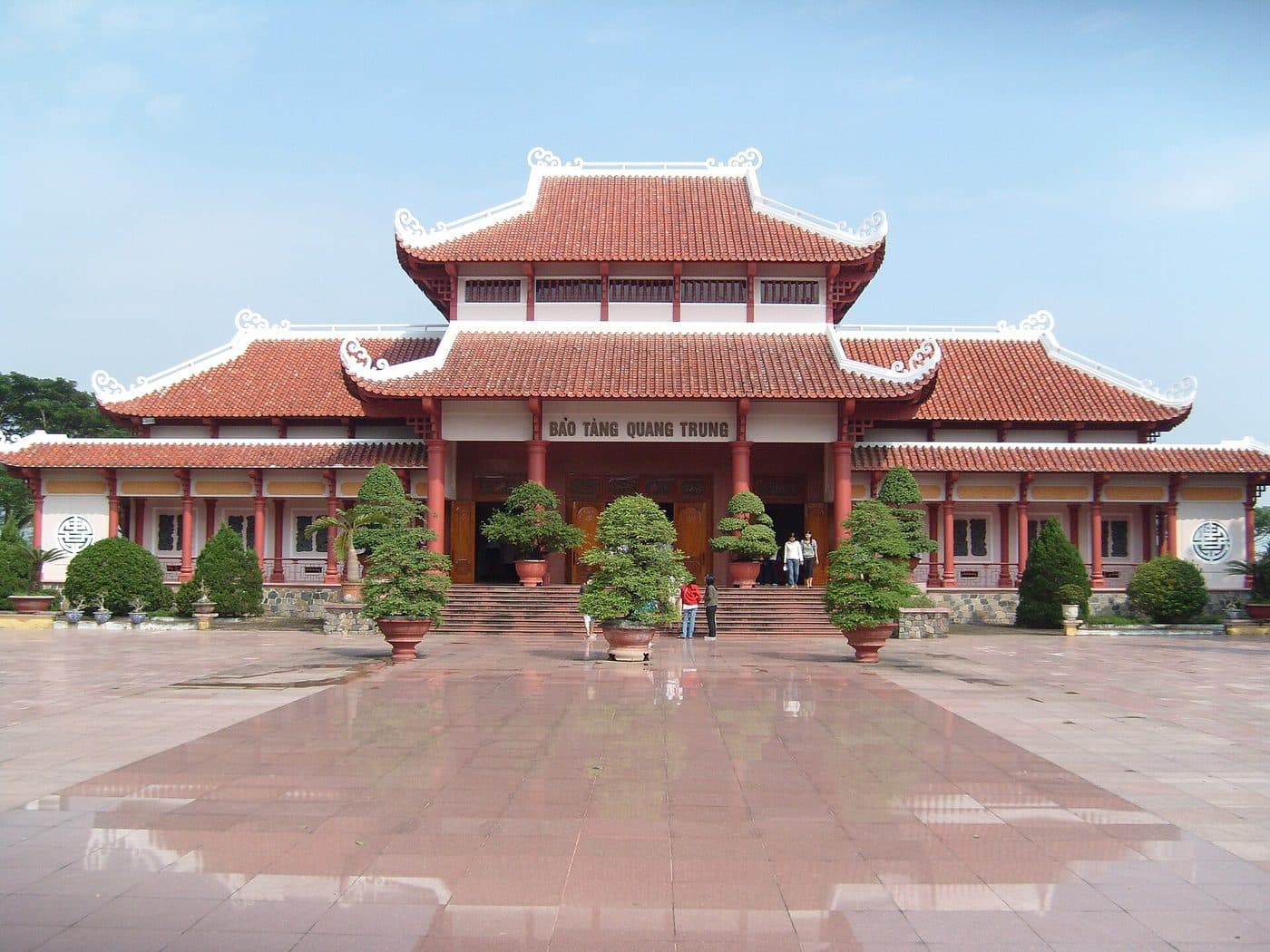
Forty-five kilometres northwest of Quy Nhon, in Tay Son commune, three brothers were born who upended Vietnamese history in the 18th century: Nguyen Nhac, Nguyen Hue and Nguyen Lu. In 1771 they raised a revolt against the feudal rulers of both north and south, and within twenty years they held almost the entire country.
The middle brother, Nguyễn Huệ (1753–1792), is better known by his imperial name, Quang Trung. In 1789, on the fifth day of the lunar new year, his army destroyed a 200,000-strong Qing Chinese force, having marched from Hue to Hanoi in forty days, at Ngọc Hồi — Đống Đa. It is remembered as one of the most brilliant victories in Vietnamese military history. Quang Trung is a national hero.
The complex in the old Phu Phong township pairs an equestrian statue with the Tay Son Brothers Museum. Museum entry is 50,000 VND (~$1.90) for adults, 25,000 for children, open 07:00–17:00. A traditional martial arts performance can be booked separately at around 400,000 VND for the group — Binh Dinh is the historical home of Vietnamese martial arts, and this is the one place set up to show it.
The museum stands on the Nguyen family's ancestral plot, beside a well and a tamarind tree that the brothers are said to have planted themselves. The collection: 18th-century weapons (swords, spears, early firearms), battle dioramas, copies of imperial edicts, a handful of personal objects. Labels are Vietnamese only, though the video screens cycle to English roughly once an hour, which is worth timing if you care.
If Tay Son is too far, there is Quang Trung Square in Quy Nhon itself on Nguyễn Tất Thành street: a roundabout with the equestrian statue at its centre, free, floodlit at night. Not a museum, but a fine stop on an evening walk, and it makes clear who this region honours above everyone else.
Pair Tay Son with the Duong Long towers — they are 10 km apart. That makes one long day: leave in the morning, do the towers, eat in Phu Phong, spend an hour in the museum, back in Quy Nhon by evening. Transport is a taxi for the day at 1,200,000–1,500,000 VND (~$46–58) or a rented car with driver.
Fast Track — no queue at the border
5–10 minutes instead of an hour in the immigration queue
from$11per passenger
Cu Lao Xanh: the island trip
Cù Lao Xanh, the Green Island, sits 24 km offshore. It covers 365 hectares and holds about 2,300 people in three fishing hamlets along the coast, with farmland in the middle. Mobile data is patchy and slow.
People come for a day or stay a night. For a day trip the morning ferry is enough: it leaves Ham Tu at 08:00 and the return sails at 15:00. With a night, you get two unhurried days, sunrise on the eastern shore, and a night sky with no light pollution anywhere in it.
What there is to do:
- Climb to the 1890 lighthouse and take the view from the platform
- Snorkel the northwestern reef, 8–12 metres of visibility in the dry season
- Walk through Nhơn Châu village: houses built from coral stone, basket boats on the shore, racks of drying fish
- Order seafood straight from the fishermen — spiny lobster around 600,000 VND/kg (~$23), mussels 80,000 VND/kg (~$3)
- Take the west shore in the evening for sunset over open water
- Take the east shore at dawn
Where to sleep. There are no hotels, only homestays — rooms in local houses at 200,000–400,000 VND (~$8–15) a night with breakfast. Book ahead through Booking or directly; the boatmen have the contacts. Shared shower, indoor toilet, basic but clean.
Cash. There is no ATM on the island. Bring enough dong for the boat, the room and food, in small notes. Nobody takes cards.
Connectivity. Viettel and Vinaphone work in patches, mostly around the coastal settlements. Download offline maps and anything you need before you sail — the operator comparison is in our SIM and mobile data guide.
Cu Lao Xanh is for people who want a version of Vietnam with no hotels, no restaurants and no tourist infrastructure at all. If you need a four-star bed and a hot shower, do not go. If you want a lighthouse at sunset and a sunrise over open sea, this is the place. What it shares with the rest of Vietnam's islands is the water, and nothing else.
Three ready-made Quy Nhon routes
Quy Nhon is easy to plan because the sights cluster into geographic zones and each zone is a day. Three tested routes follow. Prices are for two people unless stated otherwise, converted at ~26,000 VND to the dollar.
Day 1: Cham heritage
For anyone interested in Champa. Best done on a scooter: the parking is easy and the roads are decent.
Schedule:
- 07:00 — leave the hotel, ride to Thap Doi in the centre (5 min)
- 07:30 — Thap Doi, 30 minutes to look and photograph
- 08:30 — head north on QL1A
- 09:30 — Banh It towers, 1.5–2 hours including the climb
- 11:30 — lunch in Tuy Phuoc (bánh hỏi, the local speciality, around 50,000 VND a head)
- 13:30 — Canh Tien tower and the Cha Ban citadel, 1 hour
- 15:30 — back to Quy Nhon, roadside coffee on the way
- 17:00 — at the hotel
| Item | VND | ~USD |
|---|---|---|
| Scooter rental, one day | 150,000 | $6 |
| Fuel | 80,000 | $3 |
| Entry (Thap Doi 30k + Banh It 20k, ×2) | 100,000 | $4 |
| Lunch for two | 200,000 | $8 |
| Coffee and water | 60,000 | $2 |
| Total for two | 590,000 | ~$23 |
Solo, the scooter and fuel do not split, so budget around 410,000 VND (~$16).
Day 2: coves and islands
The most spectacular of the three: sea landscapes and snorkelling. Do it in the dry season, January to August, when the boats run reliably.
Schedule:
- 06:30 — leave the hotel
- 07:00 — Nhon Hai pier, 16 km from the centre
- 07:30 — boat to Hon Kho, two hours of snorkelling
- 09:30 — transfer by boat toward Ky Co (15 min)
- 10:00 — Ky Co, swim, lunch at a beach cafe
- 13:30 — back to the mainland, scooter to Eo Gio (15 min)
- 14:30 — Eo Gio, walk the clifftop path
- 17:30 — Trung Luong, dinner on the terrace, sunset
- 19:00 — at the hotel
| Item | VND | ~USD |
|---|---|---|
| Scooter and fuel | 230,000 | $9 |
| Hon Kho boat, return | 300,000 | $12 |
| Hon Kho entry (×2) | 120,000 | $5 |
| Boat Hon Kho → Ky Co | 200,000 | $8 |
| Ky Co gate + transfer (×2) | 460,000 | $18 |
| Mask rental (×2) | 100,000 | $4 |
| Lunch at Ky Co | 350,000 | $13 |
| Eo Gio entry (×2) | 80,000 | $3 |
| Trung Luong entry (×2) | 100,000 | $4 |
| Dinner at Trung Luong | 400,000 | $15 |
| Total for two | 2,340,000 | ~$90 |
This is the expensive day, and most of the cost is boats and gates rather than food. If the budget matters more than the coverage, drop Trung Luong and eat in Nhon Ly instead. Country-wide benchmarks are in the Vietnam prices guide.
Half a day: poets and pagodas
A slow route for a quiet afternoon: history, few stops, no rushing.
Schedule (afternoon):
- 14:00 — Long Khanh pagoda in the centre, 1 hour
- 15:30 — Ghenh Rang: Han Mac Tu's grave, the museum, Queen's Beach, 1.5–2 hours
- 17:30 — evening view over the bay from the viewpoint above Queen's Beach
- 18:00 — back to the centre
| Item | VND | ~USD |
|---|---|---|
| Grab, centre to Ghenh Rang and back | 200,000 | $8 |
| Ghenh Rang entry (×2) | 50,000 | $2 |
| Coffee along the way | 60,000 | $2 |
| Total for two | 310,000 | ~$12 |
Day 3: the combined plan
If you have exactly three days for the sights, this is the arrangement that works:
| Day | Route |
|---|---|
| Day 1 | Cham heritage (above) |
| Day 2 | Coves and islands (above) |
| Day 3 | Morning: Tay Son — the Quang Trung monument and museum, with Duong Long towers on the way. Afternoon: poets and pagodas — Long Khanh, Ghenh Rang, Queen's Beach |
Day 3 is the heaviest and needs a car with a driver, 1,200,000–1,500,000 VND (~$46–58) for the day. On a scooter the distances do not fit into daylight. If you have a fourth day, spend it on Cu Lao Xanh with a night on the island rather than adding more towers.
Practical notes for visiting Quy Nhon
When to go, by type of site
| Month | Towers | Coves and islands | Pagodas | Note |
|---|---|---|---|---|
| Jan–Mar | The best window: dry, around 25°C | |||
| Apr–May | Around 30°C, no rain | |||
| Jun–Aug | brutal at midday | humid | Around 33°C, start at 06:00 | |
| Sep–Oct | boats cancelled | Typhoons and rain | ||
| Nov | Up to 300 mm of rain in the month | |||
| Dec | Rain easing off |
More on the climate in the full Quy Nhon guide, and country-wide patterns in the Vietnam weather guide.
Getting here and getting around
Phu Cat airport (UIH) is 30–35 km from the centre, about 40 minutes by road. It was designated an international airport in 2020, but scheduled service is domestic in practice — Hanoi and Ho Chi Minh City only. Every foreign visitor connects through one of those two. An airport shuttle bus runs to 1 Nguyễn Tất Thành in the centre for about 50,000 VND (~$2); taxis wait outside the terminal.
Grab works in the city and is the sane default for Thap Doi, Long Khanh and Ghenh Rang — fixed fare in the app, no negotiation, English interface. Coverage falls apart on the Phuong Mai peninsula and towards Tay Son. Riding out with Grab and expecting to catch one back is how people end up walking. Full ground rules in the Grab and taxis guide.
Visas work by passport, not by destination. Twenty-four nationalities get 45 days visa-free: the UK, France, Germany, Italy, Spain, Japan, South Korea, and twelve more European countries added in August 2025. US, Canadian, Australian, New Zealand and Indian passport holders use the 90-day e-visa: $25 single entry, $50 multiple, roughly three working days, applied for on the government portal rather than the agency sites that outrank it in ads. Details in the Vietnam visa guide and the visa-free entry rules.
A SIM before you need it. Buy an eSIM before you board, or a physical SIM at the airport — a passport is required for a local SIM. Viettel has the widest coverage on the peninsula. See the SIM and mobile data guide.
Renting a scooter
Most of these sights are outside town and a taxi for every day gets expensive fast. Scooters, usually a Honda Wave 110 or a Yamaha Sirius, rent from almost every hotel and guesthouse at 150,000–200,000 VND a day (~$6–8). What they will ask for:
- A deposit of 1,000,000–2,000,000 VND, or your passport. Hand over a photocopy, never the original. A passport sitting in a rental shop's drawer is a visa problem, not an inconvenience.
- A licence. Legally you need an International Driving Permit issued under the 1968 Vienna Convention plus your home licence. Enforcement is patchy and most tourists are never stopped, but a traffic fine runs 2–4 million VND — and, far more expensively, riding without a valid licence voids the medical cover on nearly every travel insurance policy. That is the real cost, not the fine.
Check the brakes, lights, indicators and tyre pressure before you ride off. Fuel at any Petrolimex or Saigon Petro station, around 25,000 VND a litre; a four-litre tank covers 100 km and more. Longer version in the motorbike rental guide.
Money on the road
Expect to pay cash at nearly every entrance booth in this article: the towers, the pagodas, Ghenh Rang, Eo Gio and the piers. Keep 20,000 and 50,000 notes: booths and boatmen frequently cannot break a 500,000. There are ATMs in the city centre and at the airport, none on Cu Lao Xanh, and nothing you should rely on at the Nhon Hai or Nhon Ly piers. Country-wide cost benchmarks are in the Vietnam prices guide.
What to bring
- Water, at least a litre per person per outing
- Sun protection: hat, SPF 50+, sunglasses
- Closed shoes for the pagodas and the stone beaches
- A light jacket for boat trips, because it gets cold on the water even at 30°C
- A torch for the early climb at Ong Nui and for the cave
- Small notes for entrance fees
- A rain shell in April and May, when downpours arrive without warning
Pagoda etiquette
- Shoulders and knees covered; no low necklines. Larger temples lend wrap skirts at the entrance.
- Shoes off at the hall entrance. Socks are fine.
- No loud talking, no laughing, no eating on the grounds.
- Photography outside is fine. Inside is usually not, so look for the signs. No flash either way.
- If a service is under way, stand to the side and do not cross in front of the monks.
- Donations are voluntary and nobody will ask. If you want to, 10,000–20,000 VND in the box.
Where to eat along the routes
| Route | Where | Cost for two |
|---|---|---|
| Toward Banh It (Tuy Phuoc) | Street cafes, bánh hỏi | 100,000–150,000 VND (~$4–6) |
| At Ky Co | Beach cafes, seafood | 350,000–500,000 VND (~$13–19) |
| Near Eo Gio (Nhon Ly village) | Family-run fish restaurants | 250,000–400,000 VND (~$10–15) |
| Toward Tay Son (Phu Phong) | Quán Cô Hoa, Quán Bà Tư — local places | 150,000–250,000 VND (~$6–10) |
| Trung Luong, for dinner | Terrace restaurant — views, higher prices | 600,000–900,000 VND (~$23–35) |
Mistakes people make
- Taking the afternoon ferry to Cu Lao Xanh without a bed booked. The last return sails at 15:00, and in bad weather the boats do not sail at all.
- Climbing the Banh It hill at midday. No shade, 35°C, real heatstroke risk. Morning or after 16:00.
- Combining the towers and Ky Co in one day. They are on opposite sides of the city. You will spend the day on the road.
- Turning up at a pagoda in shorts. You may be turned away, or handed a wrap skirt you then have to walk around in.
- Assuming a card will work at the gate. Nearly every gate in this guide wants cash.
- Trusting a pre-2025 address. Blogs and listings still name districts that no longer exist. Navigate by the place name and coordinates, not the administrative label.
FAQ
Worth it if you like history, want Cham architecture without crowds, and are comfortable on a scooter. Not worth it if you want resort infrastructure, because Quy Nhon does not have it yet. Lonely Planet put it in the 25 Best Cities for 2026. That recognition is also why the window is closing.
Three, minimum. Day one for the Cham towers, day two for the coves and snorkelling, day three for the pagodas and Ghenh Rang. Add two more if you want Cu Lao Xanh: the morning ferry allows a day trip with about five hours on the island, but the lighthouse at sunset and the sunrise need a night there. The Tay Son complex either takes a separate day or gets combined with the Duong Long towers on day three.
Gia Lai. Binh Dinh province was merged into Gia Lai on 1 July 2025, the merged province kept the name Gia Lai, and Quy Nhon is its capital. Districts were abolished nationwide in the same reform. Maps, booking sites and most blogs still say "Binh Dinh Province" — searching that way still works, and the region's cultural identity is unchanged.
On your own is fine. Banh It and Thap Doi have bilingual Vietnamese-English signage and site maps; audio guides in English are sometimes available for around 30,000 VND. A half-day guide at 300,000–500,000 VND (~$12–19) adds historical context and translates inscriptions. Take one for the Cha Ban citadel and Duong Long, where the interpretive signage thins out badly.
Ky Co is prettier, easier to reach and has cafes, loungers and showers, plus the crowds that come with them. Hon Kho is wild, has nothing at all, and has the better reef. Come for swimming and photographs, pick Ky Co. Come for snorkelling and quiet, pick Hon Kho. The best answer is both, on one morning, by boat from Nhon Hai.
Legally yes: an International Driving Permit issued under the 1968 Vienna Convention plus your home licence. Enforcement is patchy and most tourists are never stopped, but a traffic fine runs 2–4 million VND, and riding without a valid licence voids the medical cover on nearly every travel insurance policy. That second cost is the one that matters.
Mostly no. Nearly every ticket booth in this guide is cash only: the towers, the pagodas, Ghenh Rang, Eo Gio and the piers. Keep 20,000 and 50,000 notes, because booths and boatmen frequently cannot break a 500,000. There are ATMs in the city centre and at the airport, none on Cu Lao Xanh, and nothing to rely on at the Nhon Hai or Nhon Ly piers.
Open, and Tet in late January or early February is the busiest time of the year for them. Vietnamese families come to pray for a good year and the courtyards fill up. It is atmospheric and it is crowded, especially at Long Khanh and Ong Nui. For quiet, come on any ordinary weekday.
The wooden boats around Quy Nhon have been working these waters for decades and the boatmen know them. Ask for life jackets, because they exist but are not always handed over. From September to November crossings are cancelled when the swell tops a metre; that is a captain doing his job, not an obstacle to negotiate. Check that your travel insurance covers boat travel and water activities.
The verdict
Quy Nhon rewards independent travellers who will rent a scooter and do not need a package. The Banh It towers, the water at Ky Co, a French lighthouse on an island two hours offshore, Buddhas of 17 and 69 metres, and a poet's grave on a cape above the sea, all inside a 50-kilometre radius, and none of it carrying the crowds that Nha Trang and Da Nang now take for granted.
Lonely Planet named it one of the 25 Best Cities for 2026 and tagged "best for coastal adventures and seafood delights." Two or three years from now the place will have been found: the coaches will come, the prices will rise, and the Eo Gio ticket fight of June 2026 will read as an early symptom rather than a curiosity. The window is open now.
Planning a route through central Vietnam? Quy Nhon slots naturally between Hoi An and Nha Trang. Three or four days on the sights, with beach time in between to recover from the riding. For hotels, food and costs in the city, see the full Quy Nhon guide; for context on how it compares nationally, the roundups of Vietnam's beaches and Vietnam's top attractions.
- Guide
Quy Nhon Beaches 2026: Best Coves, Prices, Seasons, Map
All 12 Quy Nhon beaches and coves: Ky Co, Bai Xep, Queen's Beach, the city beach. 2026 entry fees in VND and USD, swimming season, rip currents, map.Quy Nhon Beaches 2026: Best Coves, Prices, Seasons, Map - Guide
Quy Nhon Tours 2026: Islands, Phu Yen, Real Prices
Every day tour from Quy Nhon in 2026 — Ky Co and Hon Kho islands, the Phu Yen day trip, Cham towers. Verified prices in VND and USD, operators, what to skip.Quy Nhon Tours 2026: Islands, Phu Yen, Real Prices - Guide
Quy Nhon 2026: Vietnam's Quiet Beach Town Guide
Quy Nhon guide: quiet beaches like Ky Co and Eo Gio, Cham towers, seafood, how to get there and why this town is still off the trail.Quy Nhon 2026: Vietnam's Quiet Beach Town Guide