Vietnam attractions: the top 30 places for 2026
Vietnam packs nine UNESCO sites, the largest cave on Earth and rice terraces that stop you mid-step. Here are the 30 headline attractions with 2026 prices in dollars, how to reach each one, and honest advice on what is worth your time.
Việt Nam stretches 1,650 km down the coast, and each region is its own world. Up north are the karst towers of Ha Long and the rice terraces of Sapa. In the centre, the imperial palaces of Hue and the lantern lanes of Hoi An. Down south, the underground maze of Cu Chi and the tropical channels of the Mekong Delta. Entry tickets run from free to about $42, and in one week you can realistically see 8–10 top sites.
Prices current as of July 2026. Conversion at roughly 26,000 VND = $1.
- Ha Long Bay (Vịnh Hạ Long): UNESCO, cruises from ~$32 — 1–2 days
- Sapa & Fansipan (Sa Pa): Rice terraces, 3,143 m — 2–3 days
- Ninh Binh — Trang An (Tràng An): UNESCO, boat tour ~$10 — 1 day
- Hoan Kiem Lake (Hồ Hoàn Kiếm): Free, central Hanoi — 1–2 hours
- Thang Long Citadel (Hoàng thành Thăng Long): UNESCO, entry ~$3.85 — 1–2 hours
- Ho Chi Minh Mausoleum (Lăng Chủ tịch): Free, central Hanoi — 1 hour
- Hang Mua viewpoint (Hang Múa): Entry ~$4, 500 steps — 2–3 hours
- Hue Imperial Citadel (Kinh thành Huế): UNESCO, entry ~$8 — 3+ hours
- Hoi An Old Town (Hội An): UNESCO, entry ~$5 — 1–2 days
- Phong Nha-Ke Bang caves (Phong Nha-Kẻ Bàng): UNESCO, from ~$6 — 2–4 days
- Golden Bridge — Ba Na Hills (Bà Nà Hills): Entry ~$37 — full day
- My Son Sanctuary (Mỹ Sơn): UNESCO, entry ~$6 — 3–4 hours
- Hai Van Pass (Đèo Hải Vân): Free — 1–2 hours
- Da Lat — Crazy House (Đà Lạt): Waterfalls, eternal spring — 2–3 days
- Datanla Waterfall (Thác Datanla): Entry ~$1.90, alpine coaster — 5 km from central Da Lat
- Prenn Waterfall (Thác Prenn): Entry ~$2, path behind the falls — 10 km from central Da Lat
- Pongour Waterfall (Thác Pongour): Entry ~$0.80, 7 tiers — 50 km from central Da Lat
- Trúc Lâm Pagoda (Thiền viện Trúc Lâm): Cable car ~$3 return — Working Zen monastery, 2–3 hours
- Linh Phuoc Pagoda (Chùa Linh Phước): Free, walls set with porcelain shards — 7 km from central Da Lat
- Cu Chi Tunnels (Địa đạo Củ Chi): 250 km of tunnels, entry ~$4.20 — 3–4 hours
- Mekong Delta (Đồng bằng sông Cửu Long): Day tour from ~$13 — 1–2 days
- Notre-Dame Cathedral (Nhà thờ Đức Bà): Free, District 1 — 30 min
- Reunification Palace (Dinh Độc Lập): Entry ~$3.10 — 1–2 hours
- VinWonders Nha Trang (Hòn Tre): Entry ~$40 — full day
- VinWonders Phu Quoc (Phú Quốc): Entry ~$37 — full day
Top 30 Vietnam attractions — the quick table
Vietnam's main attractions span every region, from the northern peaks to the tropical islands of the south. Start with the eight you simply cannot skip:
- Ha Long Bay — around 1,600 islands, cruises from ~$31
- Hue Imperial Citadel — Nguyen dynasty palaces, entry ~$8
- Hoi An Old Town — UNESCO, lanterns and tailor shops
- Son Doong Cave — the largest on Earth, ~$3,000 per tour
- Sapa & Fansipan — the roof of Indochina, 3,143 m
- Golden Bridge at Ba Na Hills — the giant stone hands, entry ~$37
- Cu Chi Tunnels — 250 km of underground passages, entry ~$4
- Da Lat — waterfalls, the Crazy House and eternal spring
| # | Place | Region | Price (~$) | Time | Getting there |
|---|---|---|---|---|---|
| 1 | Ha Long Bay | North | from ~$31 | 1–2 days | Hanoi → bus 3.5 h |
| 2 | Hue Citadel | Centre | ~$8 | 3+ hours | Da Nang → train 2.5 h |
| 3 | Hoi An Old Town | Centre | ~$5 | 1–2 days | Da Nang → taxi 30 min |
| 4 | Son Doong Cave | Centre | ~$3,000 | 6 days | Phong Nha-Ke Bang park |
| 5 | Phong Nha Cave | Centre | ~$6 | 2–3 hours | Dong Hoi → 50 km |
| 6 | Paradise Cave | Centre | ~$10 | 2 hours | Phong Nha-Ke Bang park |
| 7 | Sapa (trekking) | North | from ~$15 | 2–3 days | Hanoi → bus 6.5 h |
| 8 | Fansipan (cable car) | North | ~$33 | 3–5 hours | Sapa → 15 min |
| 9 | Ninh Binh — Trang An | North | ~$10 | 1 day | Hanoi → bus 2.5 h |
| 10 | Hang Mua viewpoint | North | ~$4 | 2–3 hours | Ninh Binh → 5 km |
| 11 | Golden Bridge (Ba Na Hills) | Centre | ~$37 | full day | Da Nang → taxi 30 km |
| 12 | My Son Sanctuary | Centre | ~$6 | 3–4 hours | Da Nang → 80 km |
| 13 | Hai Van Pass | Centre | free | 1–2 hours | Da Nang → 30 km |
| 14 | Crazy House | Highlands | ~$3 | 1–2 hours | Da Lat centre |
| 15 | Datanla Waterfall | Highlands | ~$1.90 | 1–2 hours | Da Lat → 5 km |
| 16 | Prenn Waterfall | Highlands | ~$2 | 1–2 hours | Da Lat → 10 km |
| 17 | Trúc Lâm Pagoda | Highlands | ~$3 | 2–3 hours | Da Lat → 3 km |
| 18 | Cu Chi Tunnels | South | ~$4 | 3–4 hours | HCMC → 45 km |
| 19 | Mekong Delta | South | from ~$13 | 1–2 days | HCMC → My Tho 2 h |
| 20 | Notre-Dame Cathedral | South | free | 30 min | HCMC centre |
| 21 | HCMC Central Post Office | South | free | 30 min | District 1 |
| 22 | Hoan Kiem Lake | North | free | 1–2 hours | Hanoi centre |
| 23 | Thang Long Citadel | North | ~$3.85 | 1–2 hours | Hanoi centre |
| 24 | Hue combo ticket | Centre | ~$16 | full day | Hue |
| 25 | VinWonders Nha Trang | South | ~$40 | full day | Cable car from the seafront |
| 26 | VinWonders Phu Quoc | South | ~$37 | full day | North of the island |
| 27 | Pongour Waterfall | Highlands | ~$0.80 | 1–2 hours | Da Lat → 50 km |
| 28 | Linh Phuoc Pagoda | Highlands | free | 1 hour | Da Lat → 7 km |
| 29 | Ho Chi Minh Mausoleum | North | free | 1 hour | Hanoi centre |
| 30 | Reunification Palace | South | ~$3.10 | 1–2 hours | District 1 |
Ha Long Bay — a natural wonder on the UNESCO list
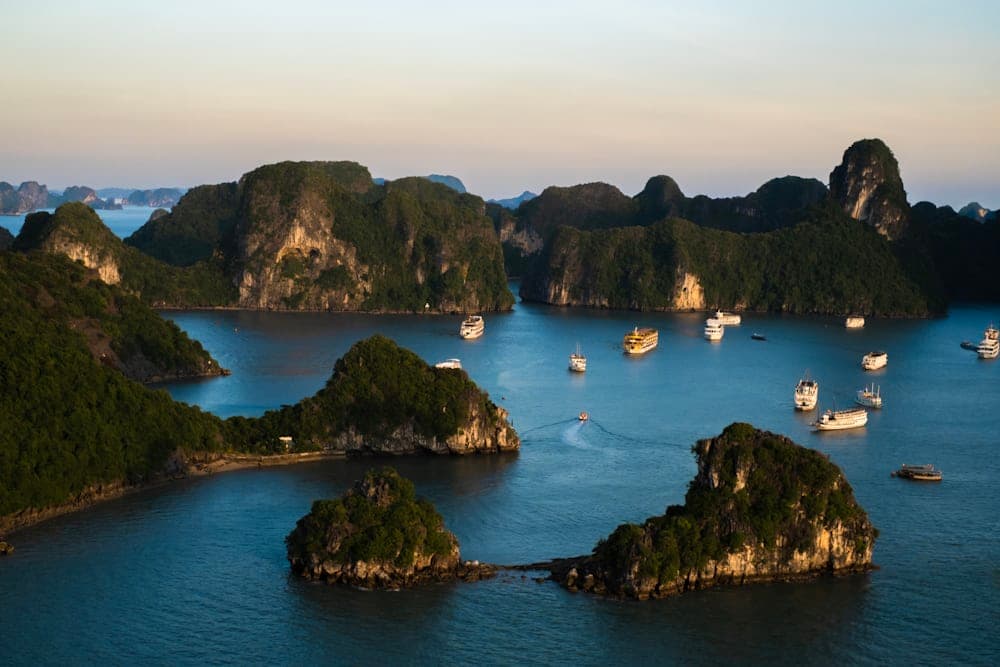
Vịnh Hạ Long is 1,553 km² of turquoise water from which around 1,600 limestone islands and pillars rise. It has been on the UNESCO World Heritage list since 1994, and in 2023 the zone was extended to include the Cat Ba archipelago — now a single site, "Ha Long Bay – Cat Ba Archipelago." People come for the cruises — from a day trip on a boat to a three-day journey sleeping on board.
A day cruise starts at 800,000 VND (~$31). That buys you 4–6 hours on the water, a cave stop and lunch. Honestly, it is not enough. A two-day tour with a night on a junk runs from 2,500,000 VND (~$96) — you get the sunset and sunrise among the karsts, kayaking and a floating village. Three-day options start at 3,800,000 VND (~$146).
Getting there. From Hanoi, a bus to Tuan Chau harbour is 160 km, 3.5 hours, 250,000–300,000 VND (~$10–12). Most operators pick you up from your hotel. A shuttle minivan with an Old Quarter pickup runs around the same.
Best time. October to April (the dry season). From May to September typhoons can cancel trips. The clearest days fall between October and December. For hotels, ports and cruise operators, see the full Ha Long guide.
The Hanoi guide is the easiest place to plan a Ha Long side trip — most cruises depart from there.
Hue — the Imperial Citadel and royal tombs

Huế is Vietnam's former capital and its first UNESCO site (1993). The Imperial Citadel is a Nguyen dynasty palace complex: two-metre-thick walls, the Ngo Mon gate, the Hall of Supreme Harmony and the ruins of the Forbidden Purple City. Entry is 200,000 VND (~$8) for adults and 40,000 VND (~$1.50) for children aged 7–12.
The combo ticket at 420,000 VND (~$16) covers the citadel plus the tombs of Minh Mang and Khai Dinh. Each tomb is its own architectural world: Minh Mang sits among gardens and lakes; Khai Dinh dazzles with mosaics of porcelain and glass.
Give the citadel itself at least three hours. Plenty of visitors regret rushing — there are dozens of pavilions, temples and courtyards inside. With the combo ticket, plan a full day.
Getting there. From Da Nang, the train takes 2.5 hours, from 75,000 VND (~$3). The bus is a bit cheaper and takes three hours. If you are based in Da Nang, do Hue as a day trip or an overnight. The full list of the city's sights is in the Hue attractions guide.
Hoi An — the Old Town of lanterns
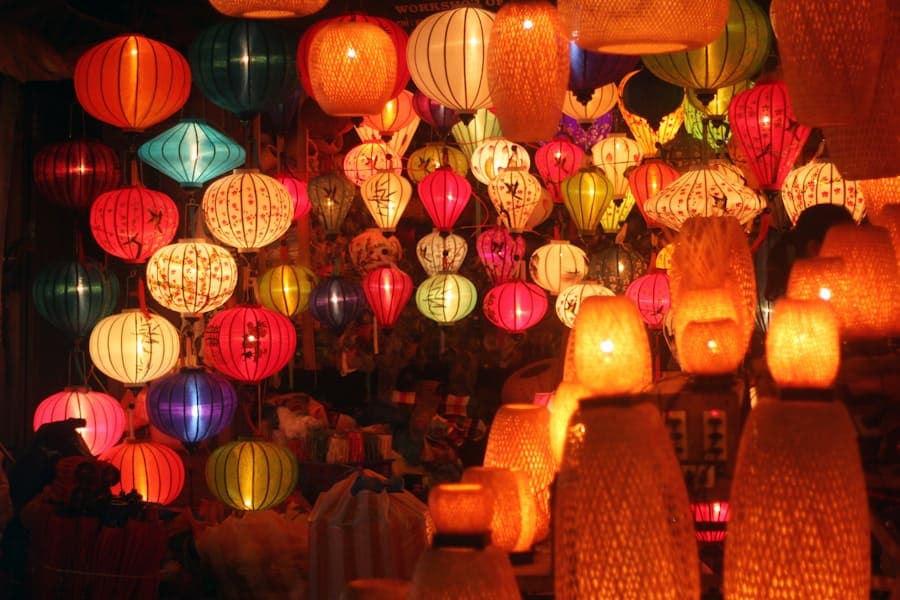
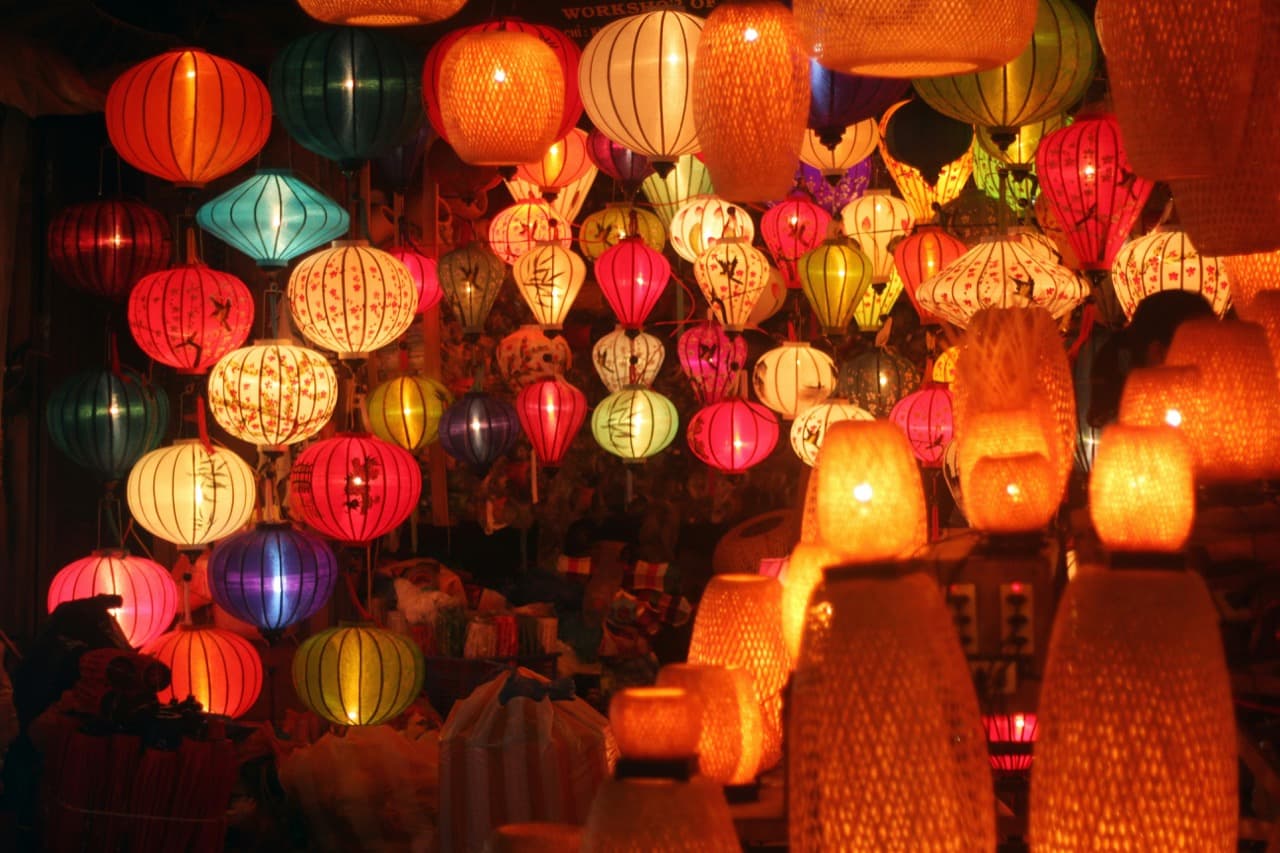
Hội An is one of the most photogenic towns in Southeast Asia. A trading port from the 15th to 19th centuries, its 30-hectare historic centre has been UNESCO-listed since 1999. The Japanese Bridge is the town symbol. In the evenings the narrow lanes glow with hundreds of paper lanterns.
The Old Town ticket is 120,000 VND (~$5). It admits you to five of the listed sites: temples, old houses, workshops, and it is valid for 24 hours. In practice you can wander the streets for free — the ticket only covers entry to specific buildings.
Once a month, on the 14th day of the lunar calendar, the town holds a lantern festival: the electric lights go off, candles and paper lanterns come on, and floats drift down the river. It is worth timing your visit around it.
Dress code. Temples and pagodas require covered shoulders and knees. Carry a scarf or a light shirt.
Hoi An is 30 km from Da Nang — a taxi is about $10 and the trip takes roughly 30 minutes. The Da Nang guide helps you plan both towns over 3–4 days, and everything about Hoi An itself — food to lodging — is in the full Hoi An guide. The list of local sights is in the what to see in Hoi An guide.
Fast Track — no queue at the border
5–10 minutes instead of an hour in the immigration queue
from$11per passenger
Phong Nha-Ke Bang caves — the underground kingdom
Phong Nha-Kẻ Bàng is a national park and UNESCO site in Quang Tri province (formerly Quang Binh). It holds more than 300 caves, and this is where Sơn Đoòng — Son Doong, the largest cave on Earth — is found. The chambers reach 200 m high and 150 m wide, running about 9 km, with their own climate, jungle and underground river inside.
Getting into Son Doong is a story of its own. Only one operator runs the tours — Oxalis Adventure — at $3,000 (80,000,000 VND, as of 2026) for six days and five nights. Places are few, so people book six months or more ahead. Season: January to August, with no expeditions from September to December.
For everyone else there are easier, cheaper caves:
| Cave | Entry | Time | Highlight |
|---|---|---|---|
| Phong Nha | 150,000 VND (~$6) | 1.5–2 hours | Underground river, boat trip |
| Paradise (Thiên Đường) | 250,000 VND (~$10) | 1.5 hours | Stalactites, lit, dry walkway |
| Dark Cave | 450,000 VND (~$17) | 2–3 hours | Zipline, mud baths, swimming |
Getting there. The nearest town is Dong Hoi. From there it is 50 km to the park by taxi or motorbike. The overnight train from Hanoi takes 10 hours, from 350,000 VND (~$13).
Sapa and Fansipan — mountains and rice terraces
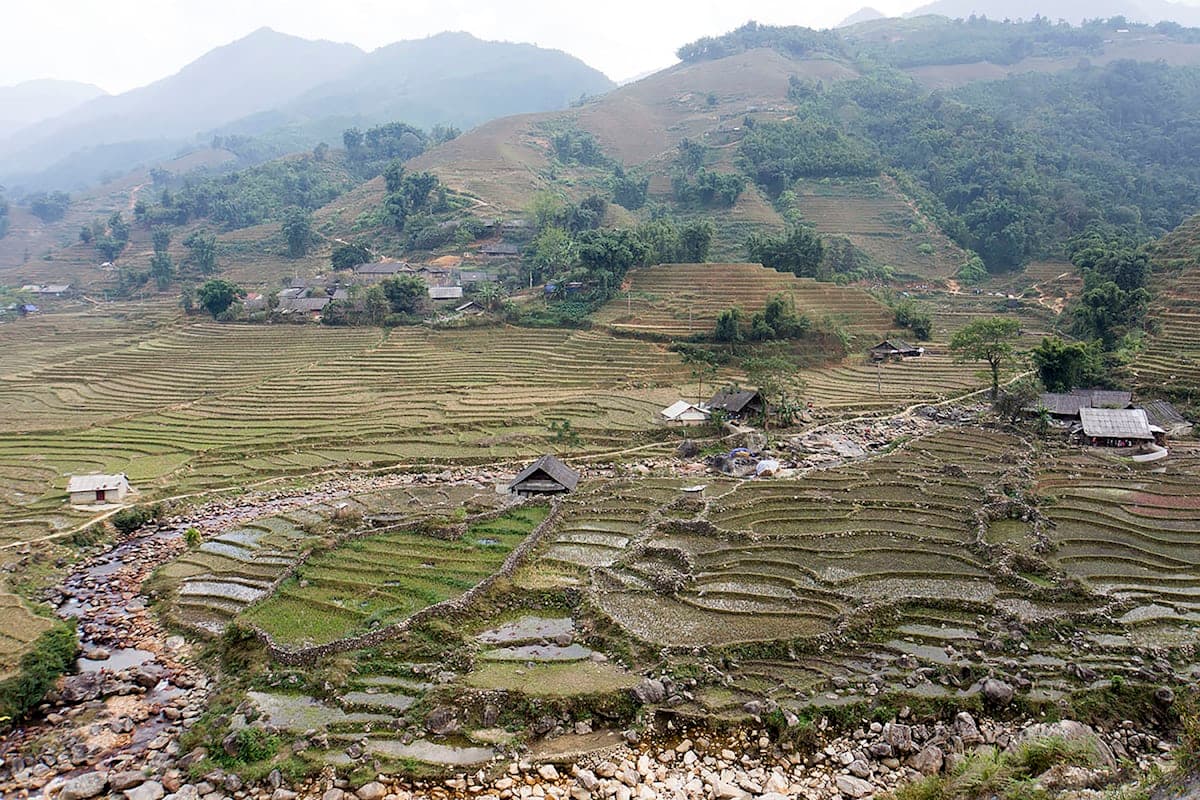
Sa Pa is a mountain town at 1,600 m with views over terraced rice fields. In September and October the terraces turn gold — the most photogenic window. In spring they are flooded and shine like mirrors. This is home to ethnic minorities, the H'mong and Red Dao. Treks through the villages with a local guide run from $15–20 a day.
Fansipan is 3,143 m, the highest point in Indochina. There are two ways up. The cable car — a ~850,000 VND ticket (~$33) buys 15 minutes flying above the clouds. Or hike it: a two-day trek with a night in a tent, $60–100 with a guide.
At the summit is a Buddhist complex with a huge bronze Buddha. It stays cool even on a sunny day — bring a warm layer.
In late February our main problem was rain and fog in which you couldn't see anything beyond three metres. In Sapa and in Ha Long alike. And it wasn't particularly coldextremallka, forum.awd.ru, 2018, translated by VietnamSpot
Getting there from Hanoi:
- Bus — 6.5 hours, from $15. Comfortable sleeper buses with reclining berths.
- Train — 10 hours (overnight), from $20–35. Romantic, but slow.
Travelling up from the capital? The Hanoi guide has the transport and logistics. For the full Sapa picture — homestays, trails and seasons — see the Sapa guide. For even bigger scenery in the north-east, there is Ban Gioc waterfall on the border with China.
Ninh Binh and Trang An — "Ha Long on land"
Ninh Bình and the Tràng An complex are karst mountains, rice fields and rivers on which a rower takes you through caves by boat. UNESCO listed Trang An in 2014 as a mixed site — for the landscape and the history (a 10th-century temple complex).
The Trang An boat ride is about 250,000 VND (~$10) and lasts 2–3 hours. The rowers work the oars with their feet — yes, their feet. It is a local trademark.
Nearby is Tam Cốc, a similar route but more intimate. And do climb Hang Múa — 500 steps to a viewpoint, entry 100,000 VND (~$4). The view is a postcard: the river curling among green cliffs.
Getting there. 100 km from Hanoi, a 2–2.5 hour bus from 80,000 VND (~$3). Many rent a motorbike — the roads are good and it is easier to move between the sites on your own wheels. For the full picture, see the Ninh Binh guide.
Best time. May and June, when the rice fields turn gold. It is lovely the rest of the year too, just without the postcard effect.
The Golden Bridge and Ba Na Hills
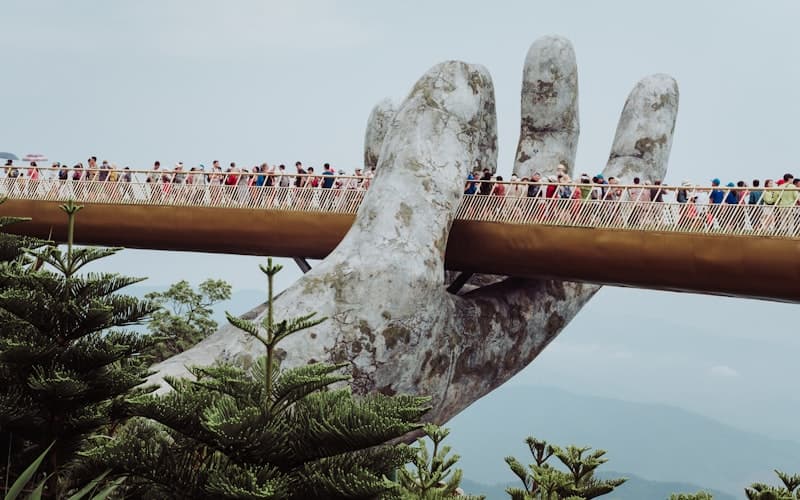
Cầu Vàng — the famous Golden Bridge — sits at 1,400 m in the Ba Na Hills resort complex. Two giant stone "hands," as if growing out of the mountain, hold up a walkway. The bridge became Da Nang's calling card after it opened in 2018 and its photos travelled the world.
Entry to Ba Na Hills (with the cable car) is about 950,000 VND (~$37) for adults; prices and discounts change, so check the Sun World website. The cable car climbs to the top in 20 minutes and is an attraction in itself — the elevation gain is dramatic.
Besides the bridge you get Fantasy Park with rides, a French Village styled like Provence, gardens and restaurants. It fills a full day.
Getting there. 30 km from central Da Nang. A taxi is $14–20 one way, 40 minutes, or book a transfer through your hotel. For transport and logistics, see the Da Nang guide. All the city's sights are in the what to see in Da Nang guide.

My Son Sanctuary — the Champa heritage
Mỹ Sơn is a temple complex built from the 4th to the 13th century. It is the legacy of the Champa empire, and it is often compared to Angkor in Cambodia — smaller in scale, though. UNESCO listed My Son in 1999.
Entry is 150,000 VND (~$6), including the buggy ride and a Champa dance show. Open 6:30–16:00. The dance shows run every morning, at 9:15 and 10:15.
The visit itself takes 1.5–2 hours, but with travel budget 5–6 hours. Half-day tours from Hoi An or Da Nang go for around $20 including transfer and guide. On your own you can reach it by motorbike in 50 minutes from Hoi An.
Half the temples are ruins after wartime bombing, but the atmosphere lands. Morning light through the trees and the quiet — that is the reason to come early.
Da Lat — the city of eternal spring and waterfalls
Đà Lạt sits at 1,475 m, and daytime temperatures hold between 18 and 25 °C all year, with noticeably cooler nights. French colonists founded it as a hill station to escape the heat, and Vietnamese travellers still come to pull on a jacket and drink hot coffee.
The Crazy House (Hang Nga Guesthouse) is an architectural attraction designed by the daughter of Vietnam's second president — a tree-shaped building with not a single straight angle. Entry is 80,000 VND (~$3).
The waterfalls are Da Lat's main natural draw:
| Waterfall | Entry | Distance from centre | Highlight |
|---|---|---|---|
| Datanla | 50,000 VND (~$1.90) | 5 km | Alpine coaster, rides |
| Prenn | 50,000 VND (~$2) | 10 km | You can walk behind the falls |
| Pongour | 20,000 VND (~$0.80) | 50 km | Most powerful, 7 tiers, few tourists |
The cable car to Trúc Lâm Pagoda is 80,000 VND (~$3) return, with a panorama of the lake and pine forests. The pagoda is a working Zen Buddhist monastery.
Also worth a look is Linh Phuoc Pagoda — one of Da Lat's most unusual, its walls set with fragments of porcelain and glass bottles. Free entry, 7 km from the centre.
Da Lat is where you exhale after the hot coast. It is cold at night, smells of pine, and strawberry farms surround it. For the full picture, see the Da Lat guide. Getting here from Ho Chi Minh City means an overnight bus of 6–7 hours or a 50-minute flight (from 1,000,000 VND / ~$38).
Cu Chi Tunnels — the underground history of the war
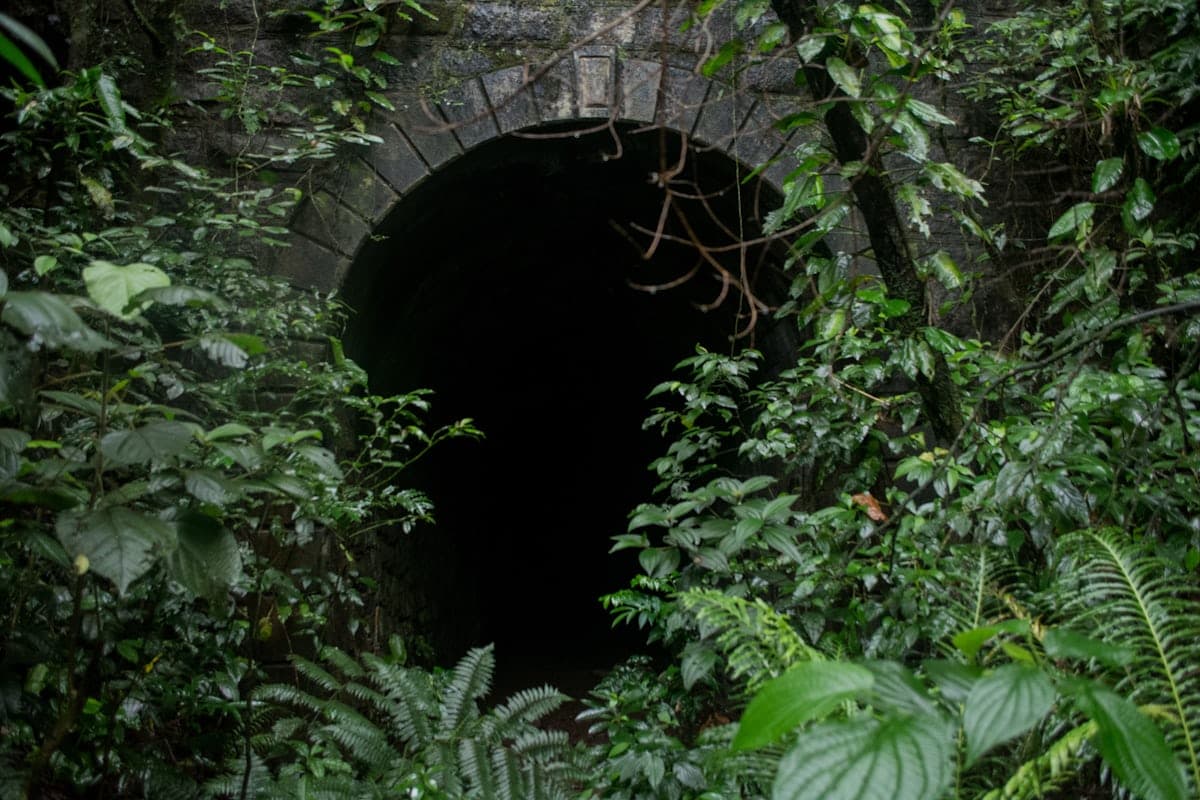
Địa đạo Củ Chi is a network of tunnels about 250 km long, dug during the Vietnam War. Several levels reach 12 m deep: bedrooms, kitchens, hospitals, weapons stores. During the war thousands lived here, sometimes for months without surfacing.
There are two visitor sites: Ben Dinh (closer to the city, more touristy) and Ben Duoc (further out, quieter, more authentic). Entry to both is 110,000 VND (~$4.20, guide, film and museum included).
The passages have been widened for visitors, but they are still tight — anyone claustrophobic will find it hard. On site you can fire genuine wartime weapons for a fee (~60,000 VND for 10 rounds).
Getting there. 45 km from central Ho Chi Minh City. Public bus with a change is cheap but confusing. Easier to take a tour at $13–20 with a transfer from District 1, or a taxi at about 500,000 VND (~$20) one way.
The visit runs 3–4 hours. Many pair Cu Chi with the Cao Dai Temple for a full day. The other war-history sites are covered in our guide to Vietnam's war museums.
Mekong Delta — floating markets and the tropics
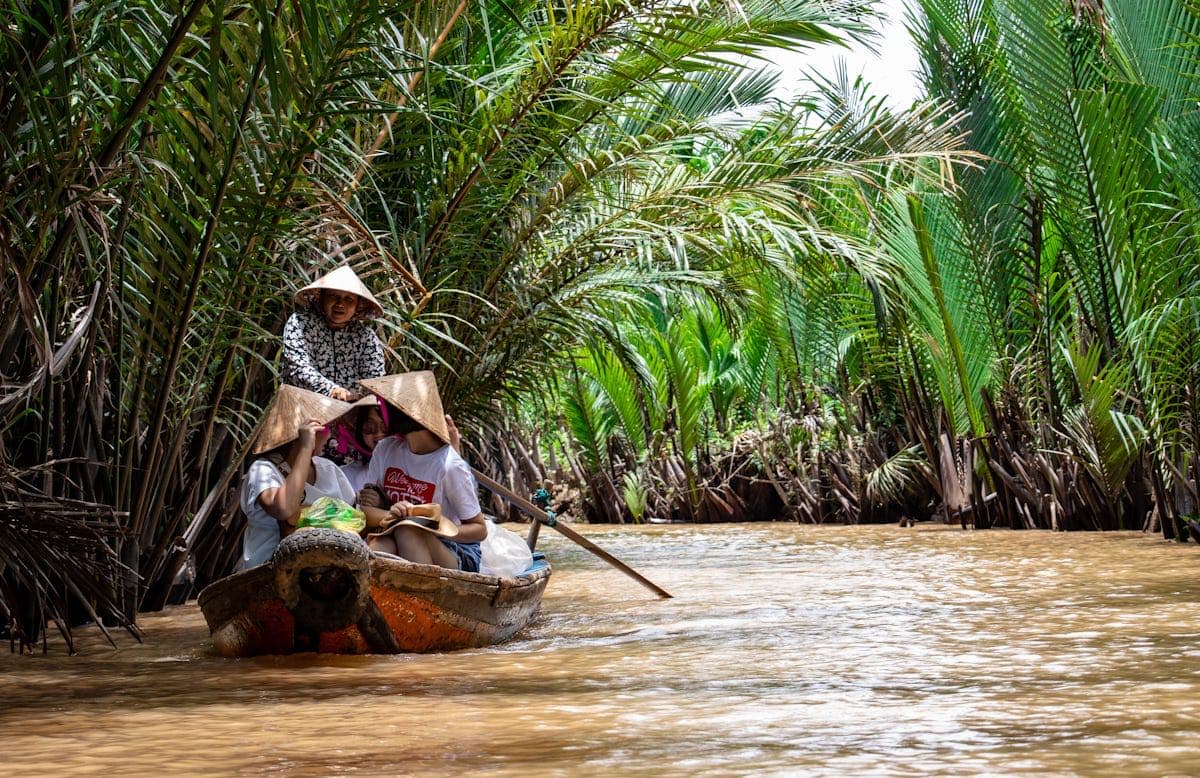
Đồng bằng sông Cửu Long is a vast river delta, Vietnam's rice basket. Here the Mekong spreads into nine branches (locals call it the "river of nine dragons") and life revolves around the water: floating markets, coconut plantations, honey farms and canals where sampans dart back and forth.
A day tour from Ho Chi Minh City runs from $13–30 for a group trip. Private tours start at $100–240. The price usually covers transfer, boat, lunch and a stop at craft workshops.
Two main directions:
- My Tho — closer (2 hours from the city), good for a day trip. Islands with fruit orchards, honey and coconut-candy tastings.
- Can Tho — further (3–4 hours), but this is where the real Cai Rang floating markets are. Better with an overnight.
Arrive at the floating markets early — by 5–6 a.m. By 9:00 trading fizzles out. In the pre-dawn mist, though, the boats piled with fruit look genuinely magical.
Be sure to try hủ tiếu — the local rice noodle with shrimp, made only in the delta. And the coconut candy, made in front of you at the Ben Tre factories.
The delta is a great add-on to a stay in Ho Chi Minh City — see the Ho Chi Minh City guide. Many set aside 1–2 days for it at the end of a trip.
Attractions in Hanoi and Ho Chi Minh City
Hanoi — temples, lakes and street food
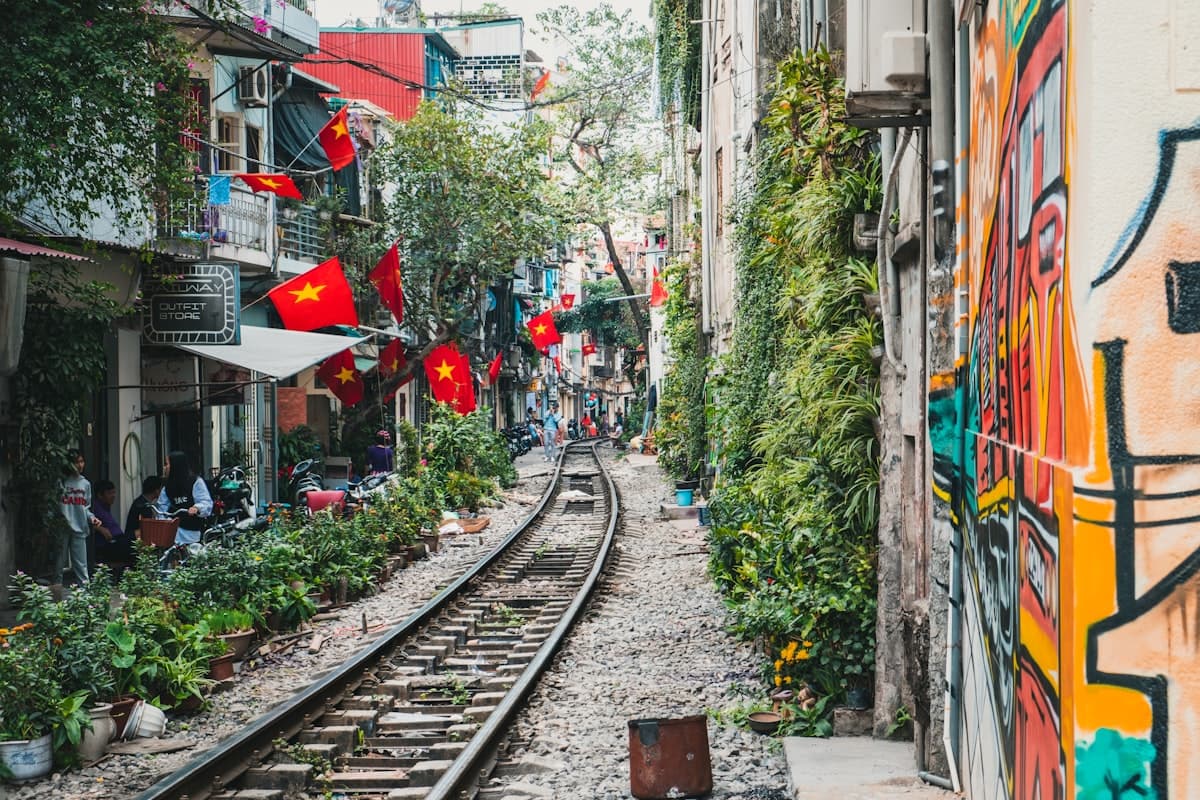
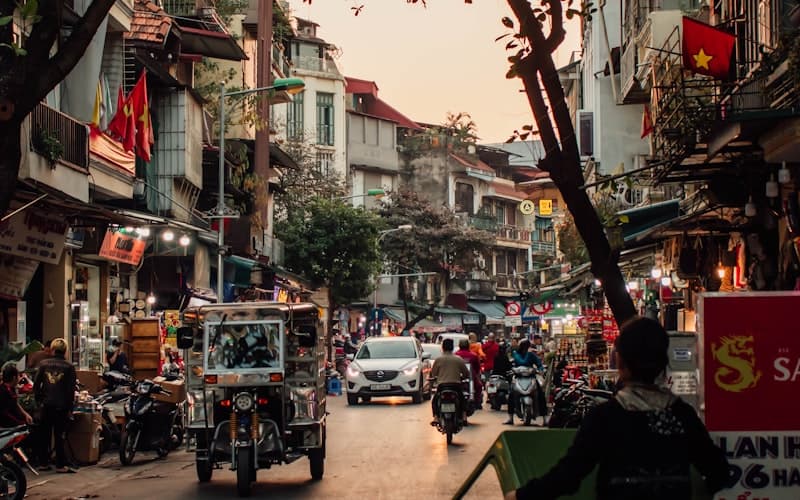
Vietnam's capital is a city of a thousand years of history, where the chaos of motorbikes coexists with quiet lakes and Confucian temples. The main stops:
- Hoan Kiem Lake (Hồ Hoàn Kiếm) — the heart of the city. Free. Mornings bring tai chi, evenings bring strolling couples. On the island is the Temple of the Jade Mountain (30,000 VND / ~$1.20).
- Thang Long Citadel — a UNESCO site (2010), remains of the 10th-century imperial palace. Entry 100,000 VND (~$3.85).
- Ho Chi Minh Mausoleum — free, but a strict dress code. It closes on some days and for maintenance periods — check the schedule before you go.
- The Old Quarter — 36 streets, each historically dedicated to one trade. This is a place to just wander, eat street food and haggle.
The whole city is in the full Hanoi guide.
Ho Chi Minh City — colonial architecture and nightlife
Former Saigon is the country's economic capital: 10 million people and an endless stream of motorbikes. Here 19th-century colonial architecture stands beside skyscrapers.
- Notre-Dame Cathedral (Nhà thờ Đức Bà) — a neo-Gothic cathedral from 1883 built of red brick shipped from Marseille. Free, but under restoration, and the end date has already slipped — exterior views only.
- Central Post Office — a working 1891 building in the Gustave Eiffel style. Free. You can send a postcard from inside.
- Reunification Palace — 80,000 VND (~$3.10). This is where the war ended: on 30 April 1975 a tank crashed through the gates.
Beyond the architecture there is Ben Thanh market for souvenirs, and the nightlife is concentrated on Bùi Viện Walking Street. The detailed guide is in the Ho Chi Minh City article, and the landmark sights are in the what to see in Ho Chi Minh City guide.
VinWonders and theme parks
VinWonders (formerly Vinpearl Land) is a chain of theme parks from the Vietnamese conglomerate Vingroup. The two flagship parks are in Nha Trang and on Phu Quoc, on a par with the big Asian parks in scale and number of rides. All of Nha Trang's main sights, including the Cham towers and the bay islands, are in the Nha Trang attractions guide.
VinWonders Nha Trang. Entry is 1,050,000 VND (~$40) for adults and 800,000 VND (~$31) for children (100–140 cm) and seniors (60+). It includes the cable car across the bay (one of the longest over water), all the rides, the water park, the aquarium and two free VinBus shuttles. After 16:00 an evening ticket is 550,000–700,000 VND (~$21–27). For the full picture, see the Nha Trang guide.
VinWonders Phu Quoc. An adult ticket is ~950,000 VND (~$37). The park sits in the north of the island, 30 km from Duong Dong. Besides the rides there is a fountain show and an evening programme.
Both parks are full-day affairs. Arrive at opening time (the Nha Trang park opens at 8:30) to fit it all in. Planning Phu Quoc? See the Phu Quoc guide and the Phu Quoc attractions list of the island's landmarks.
UNESCO sites in Vietnam — the full list
Vietnam shares second place in Southeast Asia with Thailand by number of UNESCO World Heritage sites — nine each, behind only Indonesia (10). The Yen Tu-Vinh Nghiem-Con Son, Kiep Bac complex joined the list in July 2025. Six cultural, two natural and one mixed.
| # | Site | Type | Year | Region |
|---|---|---|---|---|
| 1 | Ha Long Bay-Cat Ba | Natural | 1994 (2023) | North |
| 2 | Complex of Hue Monuments | Cultural | 1993 | Centre |
| 3 | Hoi An Old Town | Cultural | 1999 | Centre |
| 4 | My Son Sanctuary | Cultural | 1999 | Centre |
| 5 | Phong Nha-Ke Bang | Natural | 2003 (2015, 2025) | Centre |
| 6 | Thang Long Citadel | Cultural | 2010 | Hanoi |
| 7 | Citadel of the Ho Dynasty | Cultural | 2011 | Centre |
| 8 | Trang An (Ninh Binh) | Mixed | 2014 | North |
| 9 | Yen Tu-Vinh Nghiem-Con Son, Kiep Bac | Cultural | 2025 | North |
According to UNESCO, Vietnam keeps nominating new sites — the tentative list holds 8 more candidates, including the Cu Chi Tunnels, added in 2026.
Most of the sites cluster in central Vietnam (Hue, Hoi An, My Son, Phong Nha) — you can realistically loop them all in a single 5–7 day trip.
What the attractions cost — a price summary
Entry to Vietnam's main attractions ranges from free to about $40. The exceptions are Son Doong Cave ($3,000) and the VinWonders parks (~$40). Here is the full breakdown.
| Site | Price (VND) | Price (~$) | Note |
|---|---|---|---|
| Hoan Kiem Lake | free | $0 | Island temple — 30,000 VND |
| Ho Chi Minh Mausoleum | free | $0 | Strict dress code |
| Notre-Dame Cathedral | free | $0 | Under restoration |
| Pongour Waterfall | 20,000 | ~$0.80 | Da Lat, 50 km out |
| Thang Long Citadel | 100,000 | ~$3.85 | Hanoi, UNESCO |
| Crazy House | 80,000 | ~$3 | Da Lat |
| My Son Sanctuary | 150,000 | ~$6 | UNESCO, buggy + show included |
| Cu Chi Tunnels | 110,000 | ~$4.20 | 45 km from HCMC |
| Hoi An Old Town | 120,000 | ~$5 | 5 sites over 24 hours |
| Hue Citadel | 200,000 | ~$8 | UNESCO |
| Hue combo (3 sites) | 420,000 | ~$16 | Citadel + 2 tombs |
| Fansipan (cable car) | ~850,000 | ~$33 | Cable car |
| Ba Na Hills / Golden Bridge | ~950,000 | ~$37 | With the cable car |
| VinWonders | 1,050,000 | ~$40 | Nha Trang (Phu Quoc ~950,000) |
When to go and what to plan for
Vietnam runs 1,650 km from north to south, so there is no single "best season" — the weather depends on the region.
| Region | Best months | Notes |
|---|---|---|
| North (Hanoi, Ha Long, Sapa) | October — April | Winter 10–15 °C, summer hot and humid |
| Centre (Hue, Hoi An, Da Nang) | February — August | Typhoons in October — November |
| South (HCMC, Mekong, Phu Quoc) | November — April | Dry season, 28–35 °C |
| Highlands (Da Lat, Sapa) | September — November | Golden terraces in Sapa, Da Lat good all year |
How to build the route
The single biggest planning mistake is underestimating distances. Hanoi to Ho Chi Minh City is 1,700 km — you will not drive that on a whim. A practical shape for one trip:
- 1 week: pick one region. Centre works best — Hue, Hoi An, Da Nang, My Son and Ba Na Hills sit within a couple of hours of each other.
- 2 weeks: north + centre, or centre + south. Fly the long legs; internal flights start around $40 and save whole days.
- 3+ weeks: the full north-to-south run, ideally in January-February or March-April when every region is pleasant at once.
Common tourist mistakes
- Too little time for Hue. Everyone gives it one day and rushes. Plan at least two.
- Hoi An only at night. The lanterns are beautiful, but the old town is best explored in the morning, before the crowds.
- Son Doong without a booking. Tours sell out six months out — you cannot do it on impulse.
- Temple clothing. Hue, Hoi An and My Son need covered shoulders and knees. Carry a light cover-up.
- Underestimating distances. Vietnam is long — internal flights save days.
Drink bottled water, wear sunscreen (SPF 50+) and remember that haggling at markets is normal. A pre-departure eSIM keeps you online from the airport (see the Vietnam SIM & connectivity guide), and Grab handles taxis and food in English across every big city.
FAQ — frequently asked questions
Five places that define the country: Ha Long Bay (a cruise among around 1,600 islands), Hoi An Old Town (UNESCO, lanterns and tailor shops), the Imperial Citadel of Hue (the country's first UNESCO site), the Phong Nha-Ke Bang caves (an underground realm that includes the largest cave on Earth) and the Golden Bridge at Ba Na Hills. Add Sapa with its rice terraces and the Cu Chi Tunnels, and you will have seen the country from the peaks to the underground.
- Most sites100,000–300,000 VND~$4–12run to
- The free ones are Hoan Kiem Lake in Hanoi, Notre-Dame Cathedral and the Central Post Office in Ho Chi Minh City
- The pricey ones are VinWonders~$40
- Ba Na Hills~$37
- The Fansipan cable car~$33
- The ten headline sites$60–110budget roughly in entry tickets, plus transport and tours
Almost. Hoi An, Hue, Da Lat, Ninh Binh, Hanoi and Ho Chi Minh City are easy to do on your own. Take a tour for Ha Long Bay (an overnight cruise), the Mekong Delta (you need a boat), the Phong Nha caves (organised trips) and the Cu Chi Tunnels (transfer plus guide).
Nine World Heritage sites: Ha Long Bay-Cat Ba, the Imperial Citadel of Hue, Hoi An Old Town, My Son Sanctuary, Phong Nha-Ke Bang National Park, the Thang Long Citadel (Hanoi), the Citadel of the Ho Dynasty, Trang An (Ninh Binh), and the Yen Tu-Vinh Nghiem-Con Son, Kiep Bac complex added in 2025. Vietnam shares second place in Southeast Asia with Thailand, after Indonesia. Most cluster in the centre.
There is no universal answer — Vietnam is long. The north (Hanoi, Ha Long, Sapa) is best from October to April. The centre (Hue, Hoi An, Da Nang) from February to August, avoiding the October-November typhoons. The south (HCMC, Mekong, Phu Quoc) from November to April. For the whole country, aim for January-February or March-April.
Vietnam is one of the safest countries in Southeast Asia for travellers. Violent crime is very rare. The main risks are petty theft in crowds, taxi scams (use Grab) and the traffic. Carry a copy of your passport, drink bottled water and agree taxi fares in advance. The tourist infrastructure is well developed across the country.
It depends on your passport. Many nationalities (the UK, most of the EU, Japan, South Korea and others) get 45 days visa-free; others, including the US, Australia and Canada, need a visa in advance. Everyone can apply for the 90-day e-visa online at evisa.gov.vn — it is valid for all nationalities. Always confirm the current rules for your passport before you fly.
- Guide
Mekong Delta Private Tour 2026: Local Guide from Saigon
Full-day private Mekong Delta tour from Saigon with local guide Denny: wild honey, canal boat, coconut candy, lunch and a pagoda. Book via VietnamSpot.Mekong Delta Private Tour 2026: Local Guide from Saigon - Guide
Da Nang 2026: Vietnam's Nomad-Favourite Coastal City
Da Nang guide: beaches, Dragon Bridge, where to stay, getting around and day trips — the most liveable coastal city in Vietnam for travellers and nomads.Da Nang 2026: Vietnam's Nomad-Favourite Coastal City - Guide
Hanoi Tips & FAQ: Scams, Etiquette & Safety 2026
Practical Hanoi tips: common scams, etiquette, crossing the road, safety, apps and visas — the things first-time visitors need to know.Hanoi Tips & FAQ: Scams, Etiquette & Safety 2026