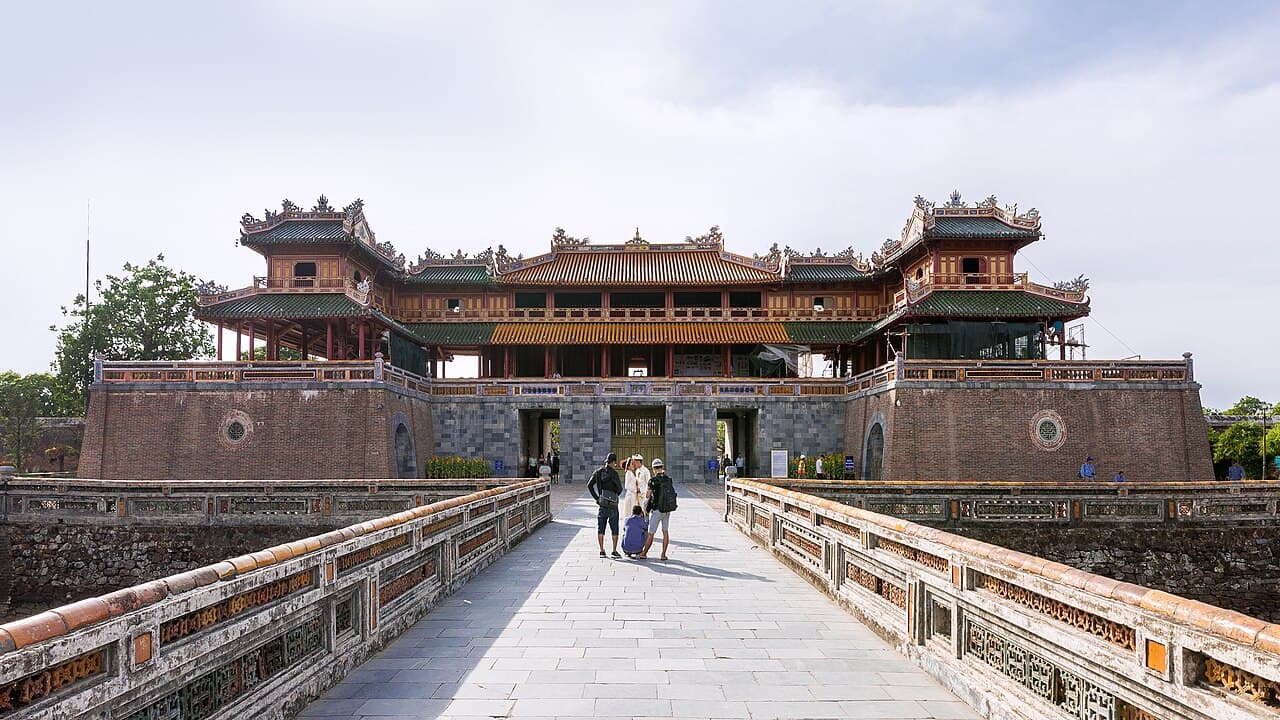
Is Hue worth visiting in 2026? The honest verdict
Our verdict is 8 out of 10. Half the visitors leave calling Hue the best cultural stop in Vietnam; the other half say half a day was plenty. Both camps are describing the same city — they just arrived with different plans. Here is what the Citadel, the tombs and the food actually deliver, and what the rain, the ruins and the dead nights cost you.
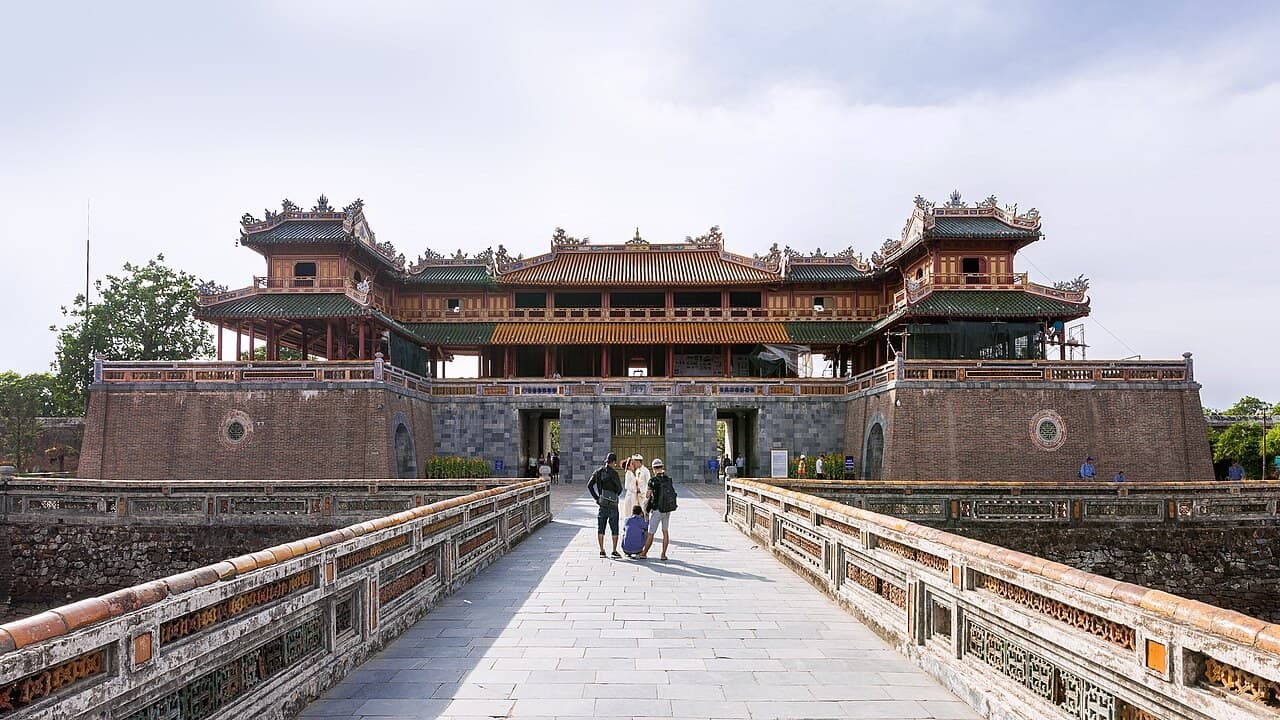
Whether Hue is worth visiting splits travellers almost down the middle. Thirteen emperors of the Nguyen dynasty ruled Vietnam from here between 1802 and 1945, and what survives is a walled Imperial City, seven tombs scattered through the hills outside town, and a bowl of bún bò Huế that nobody else in the country gets quite right. Half the visitors leave calling it the best cultural stop in Vietnam. The other half say half a day was plenty.
Both camps are describing the same city. They just arrived with different plans.
The verdict: is Hue worth visiting?
8 out of 10. Hue is not a resort and it is not Hoi An with lanterns. It is a heritage city with the best regional cooking in Vietnam and the worst autumn weather.
| Criterion | Score | Why |
|---|---|---|
| History and architecture | 10/10 | UNESCO-listed since 1993, 300+ monuments, a walled and moated imperial Citadel |
| Food | 10/10 | Home of bun bo Hue and Nguyen court cuisine |
| Atmosphere | 8/10 | Calmer than Hanoi or Saigon, almost no resort gloss |
| Value | 9/10 | Cheaper than Da Nang or Nha Trang — except the entrance tickets |
| Safety | 9/10 | One of Vietnam's quietest cities, centre is walkable |
| Infrastructure | 7/10 | Phú Bài airport 15 km out, Grab works, scooters everywhere |
| Beaches | 4/10 | Thuan An is 15 km away and barely developed |
| Nightlife | 4/10 | The city goes to sleep at 22:00 |
| Weather | 5/10 | About 770 mm of rain in October, +18–23 °C in winter |
TripAdvisor reviewers rate the Imperial City and Thien Mu Pagoda highly overall. The English-language travel blogs land in the same place from a different direction: worth it, on the condition that you give it enough time.
"Hue is 100% worth visiting if you can spend at least two full days in the city." — Anthony Giarratano, ahoyvietnam.com, January 2026
What travellers praise: seven reasons to go
1. The Imperial City
Hoàng Thành Huế, the reason the city is on anyone's itinerary, is a whole walled city of gates, courtyards and pavilions where the Nguyen emperors lived for 143 years. UNESCO listed the complex in 1993.
Adult entry is 200,000 VND (~$7.70), children aged 7–12 pay 40,000 VND (~$1.50), under-sevens go free. A Citadel-plus-two-tombs combo costs 420,000 VND (~$16); the four-site combo (Citadel plus Minh Mang, Tu Duc and Khai Dinh) runs 530,000 VND (~$20) and stays valid for two days. Ticket offices take cash only. Foreigners and Vietnamese pay the same price, which is unusual here.
Budget three hours minimum. The set pieces are the Ngo Mon gate, the Thai Hoa throne hall, the museum of court objects and the rebuilt Royal Theatre. You can rent a court costume and be photographed on a replica throne for 100,000 VND (~$4), which is either the highlight or the low point depending on your tolerance for that sort of thing. Details on the rest of the city's sights sit in our guide to things to do in Hue.
2. The royal tombs
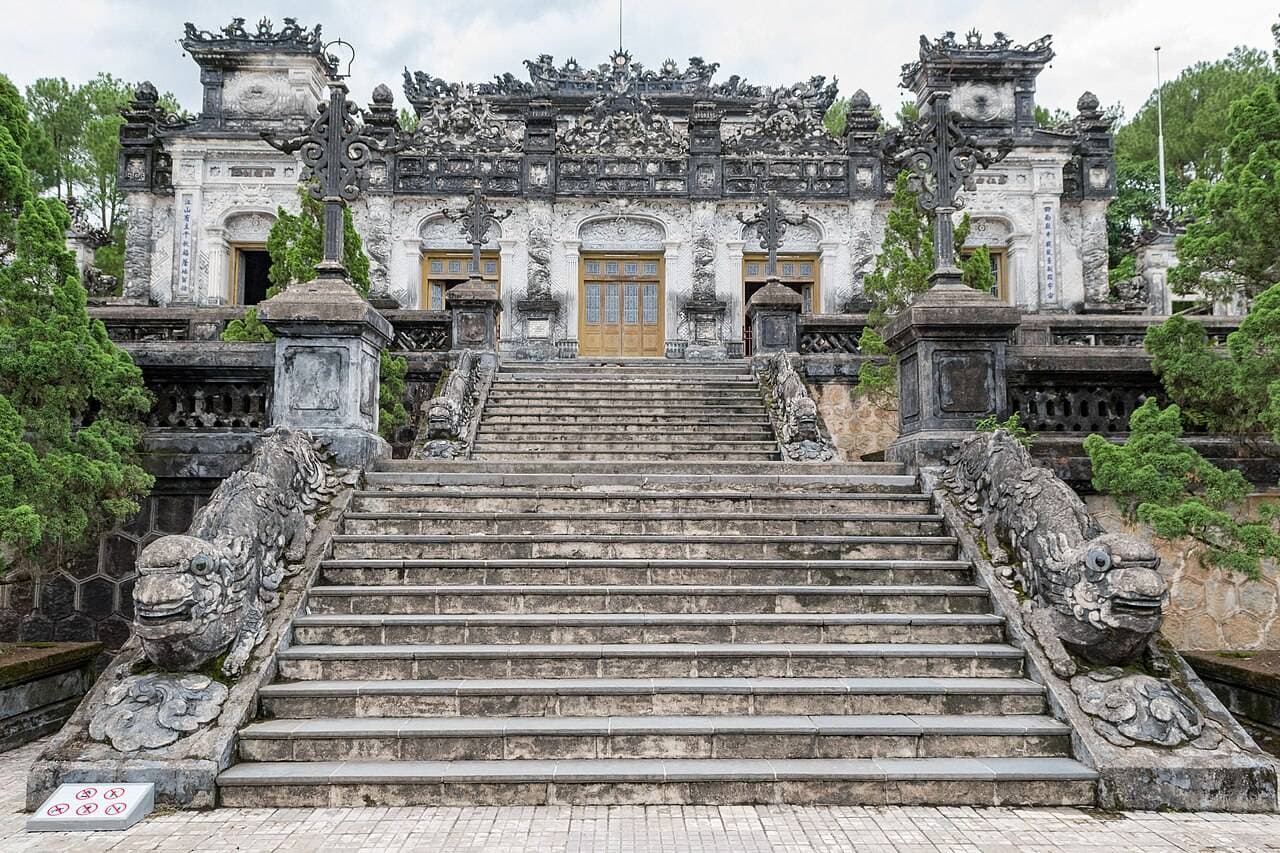
Seven imperial tombs ring the city, each built to a different emperor's taste. Nobody keeps calling them graveyards once they have seen one: these are landscaped estates with lakes, pavilions and, at Minh Mang, peacocks.
- Minh Mang (12 km out) — Chinese-influenced, rigidly symmetrical, the one most people call the most beautiful
- Khai Dinh (10 km) — a European-Vietnamese hybrid, interiors mosaicked in broken porcelain, home of the dragon staircase you have already seen on Instagram
- Tu Duc (7 km) — the poetic one, built around a lake with a pavilion where the emperor wrote verse
Allow an hour to ninety minutes each. Two in a day is a full day. Three blur together, which is the single most common complaint from people who tried it.
The routine that works: Khai Dinh in the morning, because it is compact and photogenic; Minh Mang after, because it needs walking room; Tu Duc the next day at a slower pace. Getting there is a scooter (100,000–150,000 VND / ~$4–6 a day), a Grab car, or a guided day tour at 450,000–600,000 VND (~$17–23). Note the geography before you book anything: the tombs sit 15–40 minutes apart by car, not next door to each other.
3. Thien Mu Pagoda
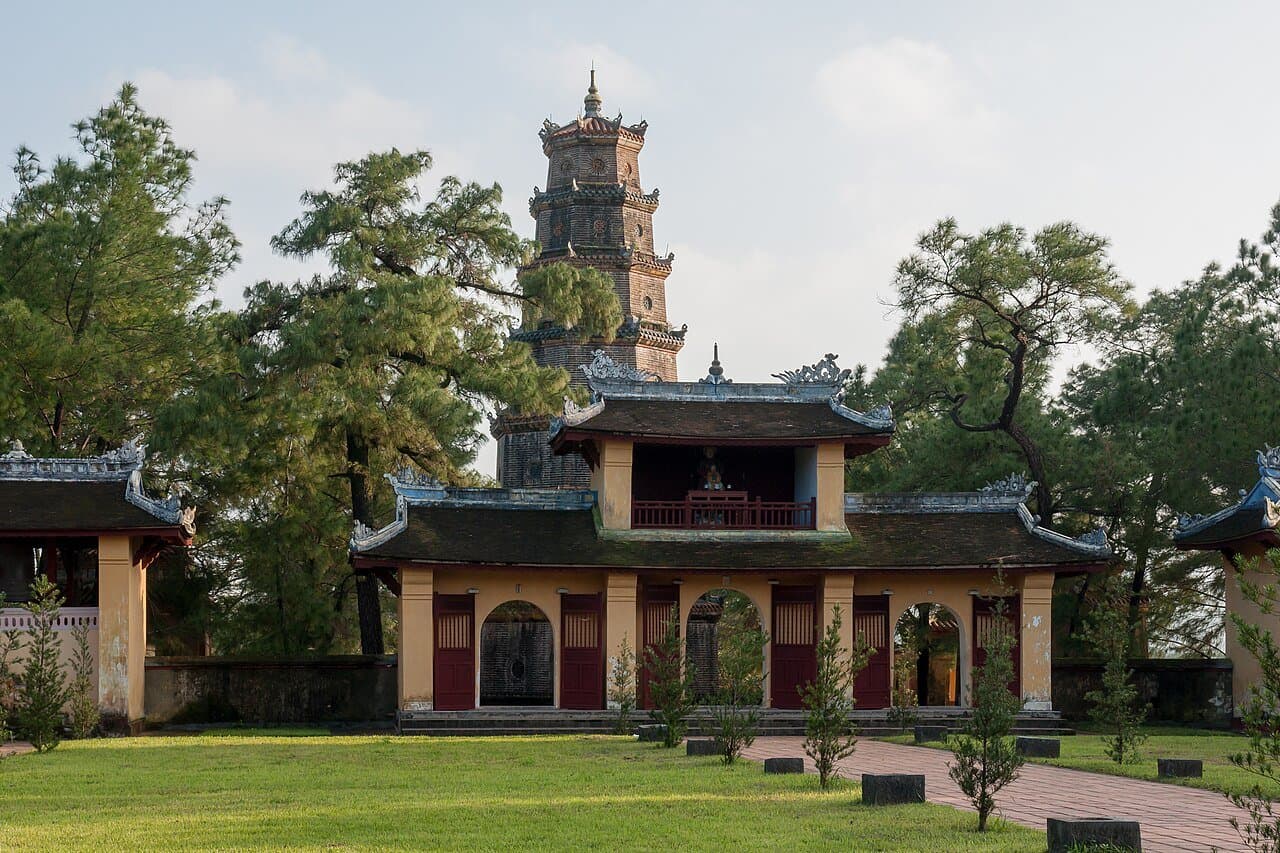
Chùa Thiên Mụ is the city's emblem, a seven-tier tower on a bluff above the Perfume River, founded in 1601. Free to enter. Reviewers consistently find it quieter than the Citadel and better at sunset. Rabbits live in the shrubbery, which turns up in TripAdvisor reviews far more often than you would expect.
One heavy detail sits in the courtyard: a pale blue Austin sedan. In 1963 the monk Thich Quang Duc was driven in it to a Saigon intersection, where he burned himself alive in protest against the Diem government. Malcolm Browne's photograph was named World Press Photo of the Year and changed how the world read the war. Nobody puts a sign up telling you to stop. Most people do anyway.
4. Bun bo Hue, at the source
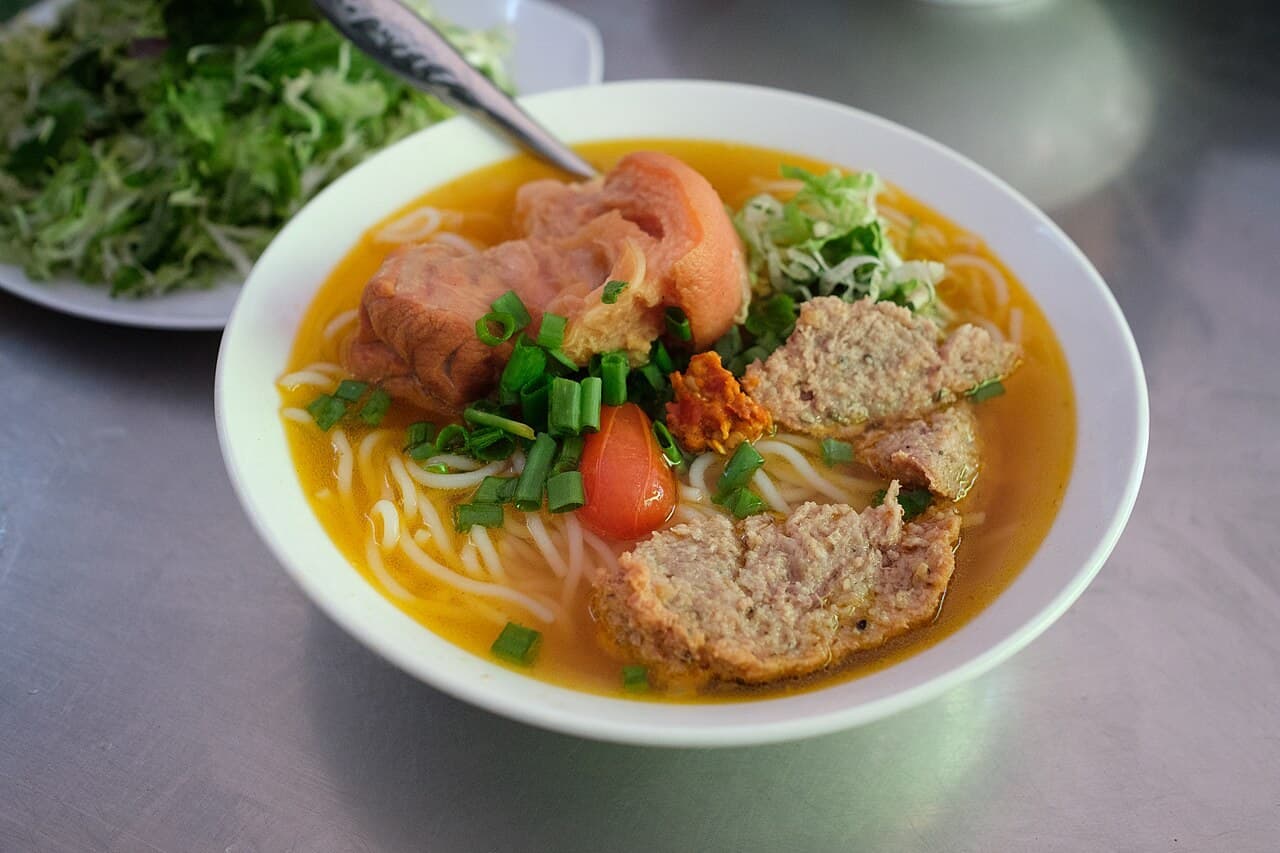
Bún bò Huế is local pride in a bowl: beef and pork-knuckle broth stained red-orange with chilli oil and annatto, thick round rice noodles, pork blood cake, banana blossom, lime, herbs. Every province cooks a version. Hue cooks the reference version.
A street bowl runs 30,000–50,000 VND (~$1.20–2). The same dish inside a tourist restaurant is 70,000–120,000 VND (~$2.70–4.60). You are paying for the chairs, not the broth. Often the street bowl tastes better.
Places locals and visitors both rate:
- Bún Bò Bà Tuyết, 47 Nguyễn Công Trứ — generous bowls, deep broth
- Quán Cẩm, 45 Lê Lợi — the breakfast standard, queue from 07:00
- Bún Bò O Phụng, 24 Nguyễn Khuyến — the spiciest, and the one purists point to
Our full write-up of the dish, including how to order it without the blood cake, is in the bun bo Hue guide.
5. Court cuisine
Beyond the noodles sit dozens of dishes developed for the Nguyen court: small portions, careful plating, a lot of flavours on one tray.
- nem lụi — lemongrass pork grilled on bamboo skewers
- bánh khoái — a crisp folded pancake with prawns
- bánh bèo — steamed rice cakes topped with dried shrimp
- chè cung đình — royal sweet soups served in ceramic
A set menu at a royal-cuisine restaurant costs 250,000–400,000 VND (~$10–15), which for the format is close to absurd. The names that come up repeatedly are Ancient Hue, Y Thao Garden and Tha Om Garden House. All three sit in old garden houses and all three trade on the idea that you are eating at a mandarin's place. Book a day or two ahead in the February–April season.
6. The Perfume River
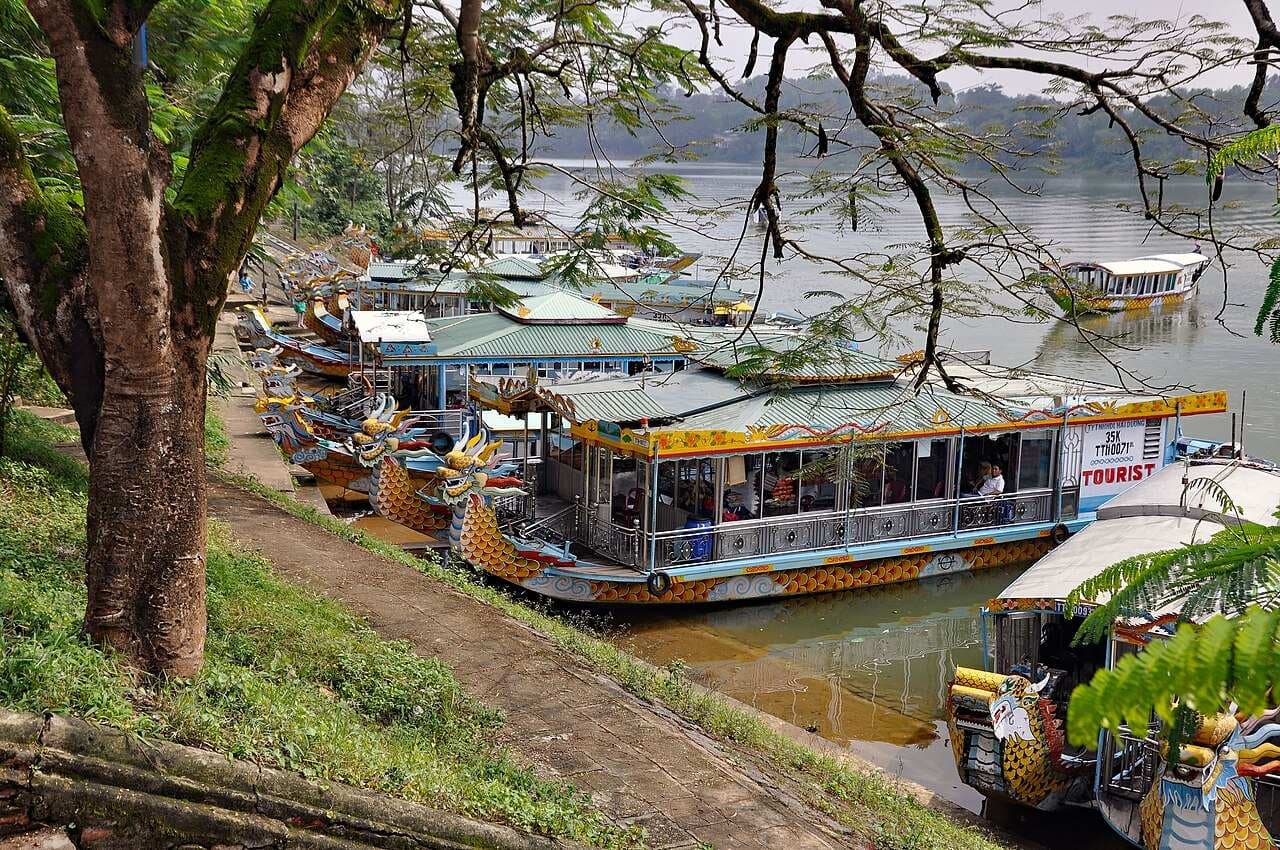
Sông Hương runs straight through the middle of town. An hour on a dragon boat costs 150,000–300,000 VND (~$6–11.50) and is worth doing at sunset. The catch is standard: boatmen add extras once you are on the water — music, a stop at the pagoda, a photo set.
In the evening people float candles and paper lanterns downstream. It is quieter than the same ritual in Hoi An, mostly because there are a tenth as many people doing it. At weekends local families take over the riverbank and live music starts up in the cafes. This is where Hue stops being a monument and starts being a town.
7. It is cheap, with one exception
Hue undercuts Nha Trang, Phu Quoc and Da Nang on almost everything. A clean 3-star room is 600,000–900,000 VND (~$23–35). A hostel bed starts at 200,000 VND (~$8). Lunch in a cafe is 80,000–150,000 VND (~$3–6). A scooter is 100,000–150,000 VND (~$4–6) a day. Specific properties are compared in our Hue hotels guide.
Then the tickets. The monument fees are among the highest in Vietnam, and the four-site combo alone is ~$20 a head. Vietnam Backpacker Hostels puts a backpacker day here at $25–35 including bed, food and sights, which is roughly half what the same day costs in Ho Chi Minh City.
Fast Track — no queue at the border
5–10 minutes instead of an hour in the immigration queue
from$11per passenger
What travellers criticise: the honest list
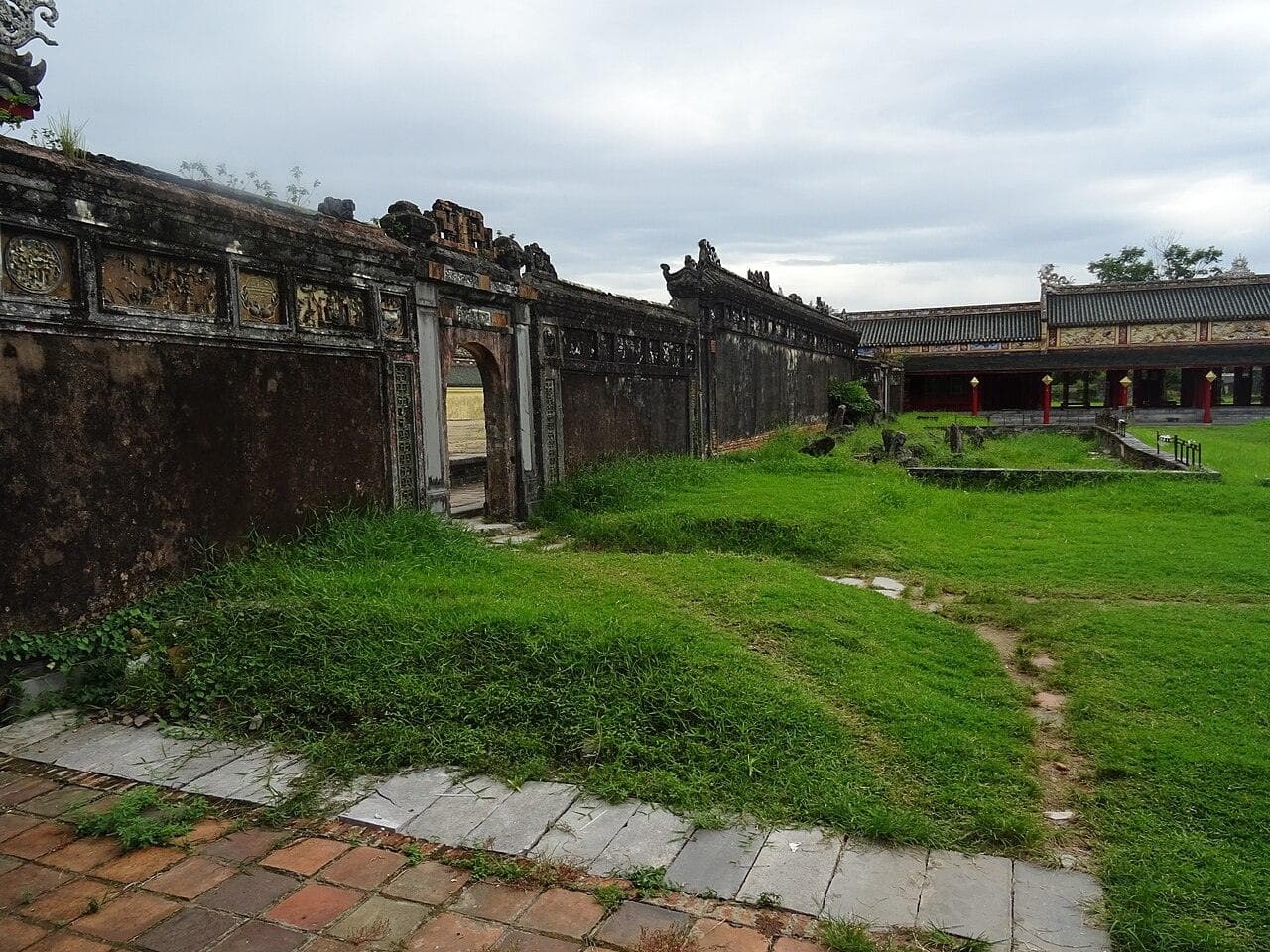
The Purple Forbidden City is a field of foundations
Tử Cấm Thành, the emperor's private inner enclosure, is mostly gone, and it is the disappointment that turns up in review after review. A 1947 fire started the job and the 1968 Battle of Hue finished it. Across the whole Citadel, of roughly 160 original structures about ten came through the fighting intact; restoration since the 1990s has rebuilt or stabilised dozens more, and it is slow work.
The comparison with Beijing is unfair and also accurate. If you arrive expecting Beijing, you will be annoyed within twenty minutes. Arrive expecting a partially reconstructed imperial capital that a war went through, and the empty foundations start reading as the point rather than the failure.
One of the wettest cities in Vietnam, and 2025 proved it
Hue is one of the wettest places in the country. October averages about 770 mm; Nha Trang gets about 1,400 mm across an entire year.
Late October 2025 went past average into something else. The Bach Ma station logged 1,739.6 mm in the 24 hours from 19:00 on 26 October. That is close to Vietnam's whole annual average, and the second-highest 24-hour total recorded anywhere.
Every monument inside the Citadel closed from 27 to 30 October, reopened on the 31st, then closed again from 10:00 on 3 November when the water came back. Parts of the Imperial Palace stood under 0.3–0.5 m of water and a section of the Citadel wall came down. The Bo River at Phu Oc set a new record three separate times inside eight days.
Winter is colder than the map suggests
December to February sits at +18–23 °C. That sounds mild until you add 90% humidity and wind off the river. The recurring line in reviews is some version of: we packed for Southeast Asia and bought a sweater at the market on day two.
Most hotels have no heating. The regional assumption is still that air conditioning is enough, and plenty of units are cooling-only. If you are coming in January, check the listing for a heat function on the AC before booking. It is a two-minute check that decides whether your evenings are pleasant.
Summer is brutal in the middle of the day
May to August reaches +38 °C at 80%+ humidity. The Citadel has almost no shade and a lot of stone that holds heat. The workable hours are 06:00–09:00 and 16:00–18:00, and that is not a preference, it is the difference between a good visit and a miserable one.
I can confirm it: the grounds look deserted, only some of the buildings have been restored. If not for the cursed heat, you could stroll for a long time, but as it was we were done in just over an hourbezal, Vinsky Forum, 2025, translated by VietnamSpot
Two days covers it
This is the sceptics' strongest card, and it is largely true. The efficient version:
- Day 1: Citadel, Perfume River, bun bo
- Day 2: two or three tombs plus Thien Mu
Day three is either a repeat or a trip out of town. Backpackers routinely write some version of "booked four nights, spent the third one in a cafe on my phone".
If you are staying three or four days, the fix is to leave the imperial circuit: Bach Ma National Park (45–50 km, waterfalls and trails), the pomelo gardens of Thuỷ Biều, or Tam Giang lagoon, the largest in Southeast Asia, with fishing villages along it. These break the pattern and stop the déjà vu.
The beach is an afterthought
Thuan An is 15 km from the centre. There is sand, a couple of cafes and a few loungers, and that is it. No bars, no shops, nothing to fill an afternoon with. Against Hoi An's beaches or My Khe in Da Nang it does not compete.
Lang Co, 60 km south toward Da Nang, is the better strip: long white sand, real infrastructure, hotels from Banyan Tree down to cheap guesthouses. But that is a stop on the road, not a Hue beach. Go for a day if you like. If the sea is what you came for, base yourself in Da Nang instead.
Nightlife barely exists
After 22:00 the city shuts. There is a walking street with a handful of bars and souvenir stalls and that is the whole inventory. No clubs, no live music. Da Nang has ten times more of everything on this list, and it is 2.5 hours away.
Boatmen and cyclo drivers will work you
Standard central Vietnam. Walk the riverfront and five people will offer you a boat. Fix the price on land, and fix what it includes: the hour, the music, the landing at the pagoda. Otherwise the additions arrive mid-river, where your negotiating position is poor.
The sites are hard on your legs
Worth stating plainly, because the English-language guides usually do not: the UNESCO sites are not wheelchair accessible, the ground is uneven stone throughout, and a normal Hue day runs past 10,000 steps. If mobility is a factor, a car with a driver between the tombs turns an exhausting day into a manageable one.
Mistakes people keep making
Five, in rough order of how often they show up in reviews:
- Booking one night. You cannot see the Citadel properly and go anywhere else in a day. Two nights minimum.
- Coming in October. Typhoon and flood season. See above for what that actually looked like in 2025.
- Buying the four-site combo and managing two. Tickets are single-use and non-refundable. Be honest about your pace.
- Walking into the Citadel at noon in July. No shade, hot stone. Go at 07:00 or after 16:00.
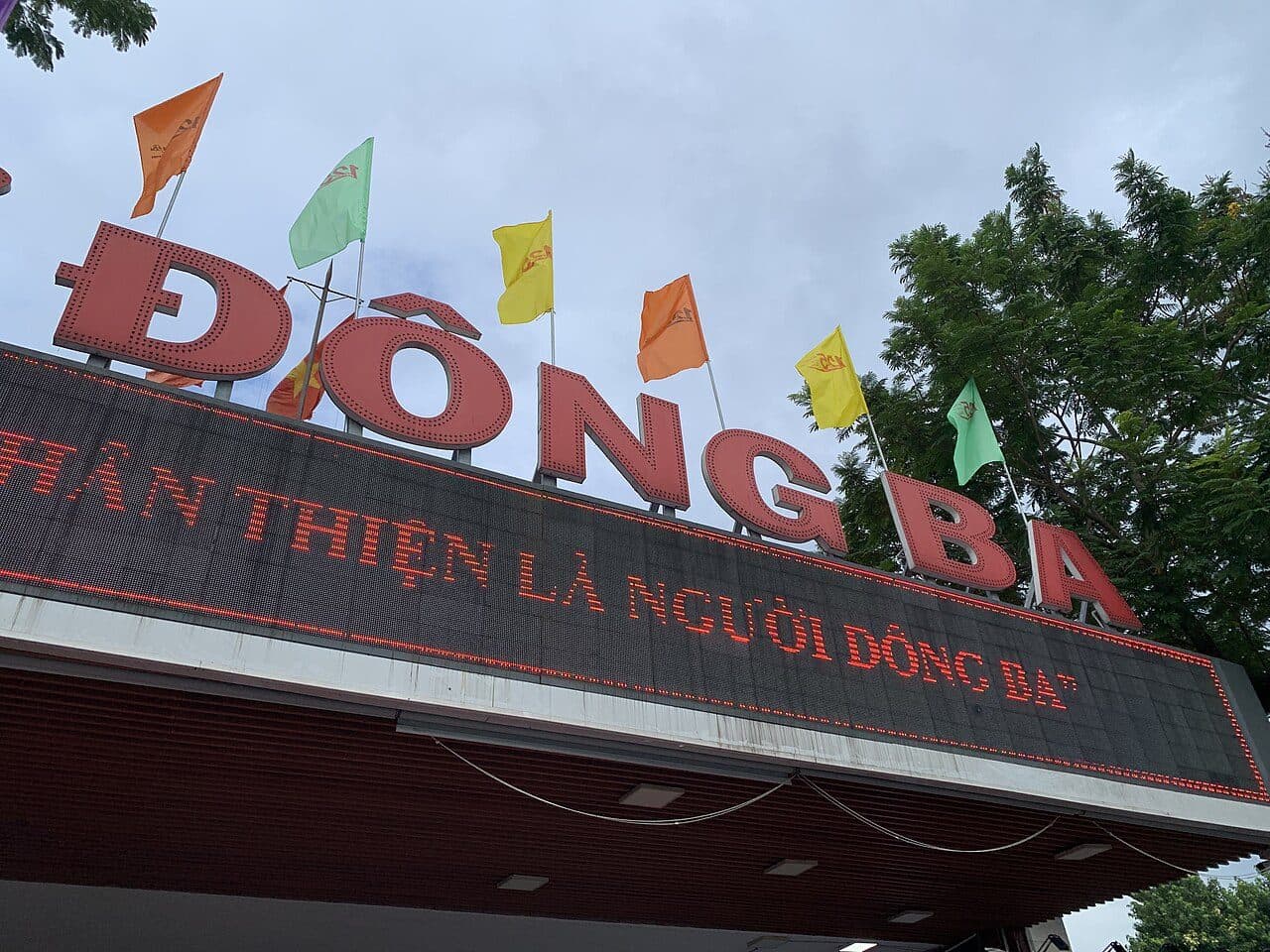
- Eating bun bo only in restaurants. The tourist places in the centre are consistently the weaker version. Head for Lê Lợi, Nguyễn Du, or the streets around Đông Ba market.
Hue vs Hoi An, in detail
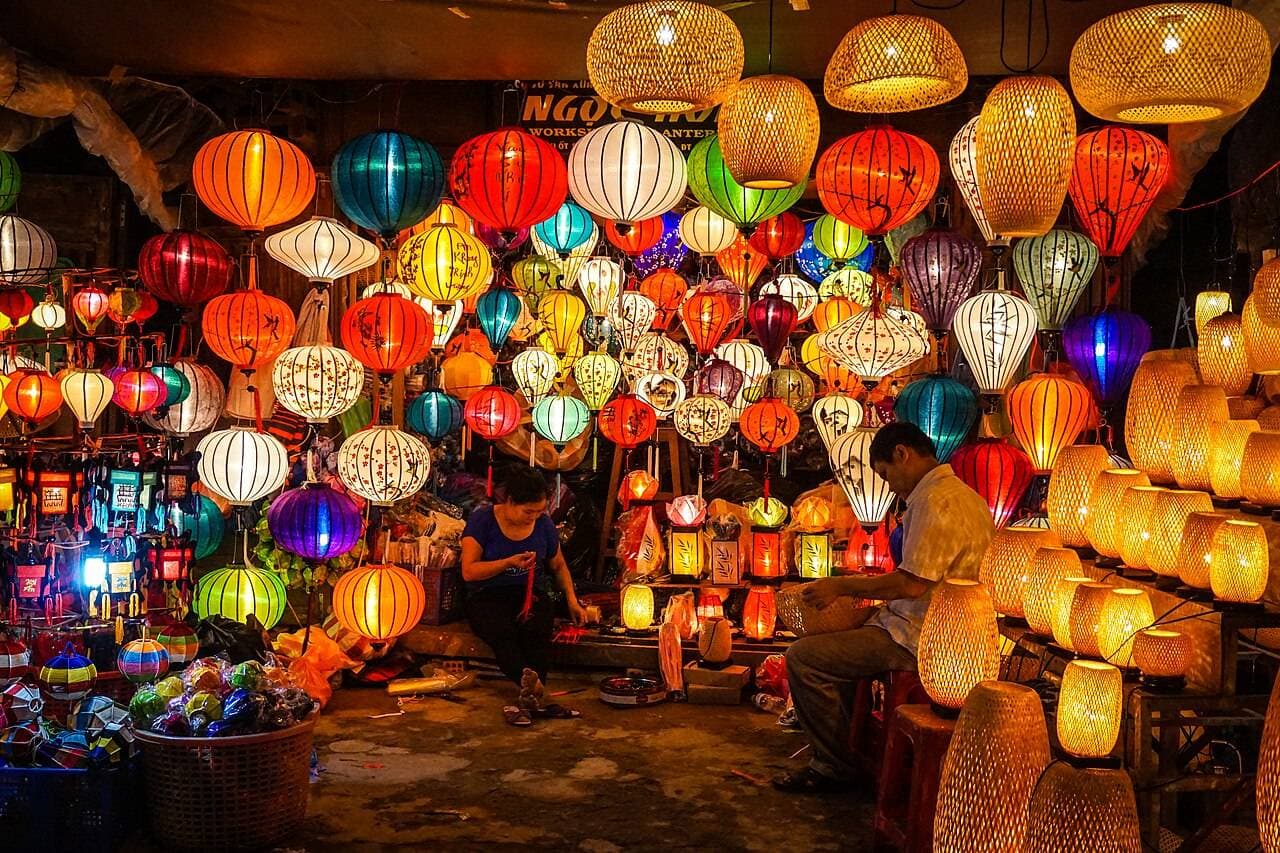
They sit close together on the map and share a UNESCO listing, and that is where the similarity stops. A Hoi An day is built around lanterns, tailors, a cooking class and An Bang beach. A Hue day starts with noodles at a plastic table and ends walking through a walled complex where peacocks wander and cats sleep on the stones. Hoi An photographs better. Hue makes more sense afterwards.
The other difference is density. In high season you queue for the Japanese Bridge and shuffle through the old houses. In Hue you can find empty halls inside the Citadel, especially when it rains. A lot of travellers say that is precisely what they were after: no tour group in the frame, nobody's elbow in the shot.
Expectations vs reality
The five ideas people arrive with, and what they actually find:
| Expectation | Reality |
|---|---|
| "A Forbidden City like Beijing's" | Much of it is foundations and lawn. Of roughly 160 structures, about ten survived 1968 |
| "A small open-air museum" | The Citadel is a walled city in itself; the tombs are separate estates 7–17 km out |
| "Half a day is enough" | Two full days minimum. One is a rush, four is one too many |
| "A resort town" | No. It is a heritage city, and the beaches are weak |
| "Hoi An, but historical" | A different thing entirely: bigger, rougher, no lanterns, far fewer crowds |
| "Hot and sunny" | +18–23 °C and drizzle in winter, typhoons in autumn |
| "Cheap, like the rest of Vietnam" | Rooms and food yes. Monument tickets are among the country's most expensive |
If you are arriving from Hoi An, do not expect the sequel. Different film.
Who Hue is for, and who should skip it
- ✓ History and architecture are your reason to travel — UNESCO, the Nguyen dynasty, 300+ monuments
- ✓ You travel for food; this is the best regional cooking in the country
- ✓ You want a Vietnam with no resort gloss on it
- ✓ You are a photographer — the tombs give frames you will not get anywhere else
- ✓ You are working the Hanoi → Da Nang → Ho Chi Minh City route
- ✗ Your trip is built around a beach
- ✗ You want nightlife
- ✗ Museums and ruins bore you
- ✗ You are travelling with small children — the Citadel wears them out fast
- ✗ You have one night; you will spend the whole time feeling behind
- ✗ You are coming December to February and damp cold does not appeal
One pattern shows up among people who have been to Vietnam more than once: Hue tends to land on the second or third trip. First-timers want beaches and motion, and Hue reads as the wrong city. Come back specifically for the history and it opens up. It is a destination for travellers who have already worked out that Vietnam is not Nha Trang.
"While it has several UNESCO sites and plenty of tourists visiting them, the overall city doesn't feel very touristy at all." — ahoyvietnam.com, January 2026
Hue against the other options
If you are choosing between central and southern Vietnam, this is the short version:
| Criterion | Hue | Hoi An | Da Nang | Ho Chi Minh City |
|---|---|---|---|---|
| Main draw | Imperial history | Atmosphere, lanterns | Modern beach city | Megacity, contrasts |
| Days needed | 2–3 | 3–4 | 2–3 | 3–5 |
| Beach | Weak (4/10) | Good (8/10) | Excellent (8/10) | None |
| Food | Unique (10/10) | Unique (9/10) | Very good (8/10) | Broadest (9/10) |
| Room prices | Low | Low | Mid | Mid |
| Nightlife | Weak | Weak | Real | Serious |
| UNESCO | Yes | Yes | No | No |
| Best months | Feb–Apr | Feb–Apr | Mar–Aug | Dec–Apr |
The short answers: history and authenticity, Hue. Atmosphere and good evenings, Hoi An. Beach plus city, Da Nang. Restaurants, shopping and noise, Saigon.
Most people do not choose. Two nights in Hue and three in Hoi An, with the train over the Hai Van Pass in between, is one of the better short routes in Southeast Asia.
The other option is basing in Da Nang and taking a day tour up (from 800,000 VND / ~$31 per person, covering the Citadel, one or two tombs and lunch). Reviews are consistent that this loses to doing it yourself: everything at a jog, no Thien Mu, no time to eat properly. But if your Vietnam itinerary gives Hue exactly one day, it works.
When to go
The comfortable window is narrower than for anywhere else on this coast.
| Month | Air | Rain | Verdict |
|---|---|---|---|
| January | +18–22 °C | 130 mm | Cool and wet. Not the pick |
| February | +19–24 °C | 65 mm | Good: quiet, mostly dry |
| March | +22–27 °C | 50 mm | The best month |
| April | +25–30 °C | 60 mm | Excellent: warm, sunny, little rain |
| May | +27–33 °C | 110 mm | Hot but workable |
| June–August | +28–38 °C | ~100 mm | Peak heat, early and late only |
| September | +26–32 °C | 410 mm | Typhoons. Avoid |
| October | +24–28 °C | 770 mm | Worst month: flooding |
| November | +22–25 °C | 640 mm | Wet season at full strength |
| December | +19–22 °C | 350 mm | Cold and damp |
Best windows: February to April, and May if you handle heat well. Worst: September to November. Booking October because rooms are cheap is a bad trade. After 2025 the realistic downside is not drizzle but half a trip spent indoors while the sites are shut. How the wet season works nationwide is in our Vietnam weather guide.
Getting there and where to stay
Transport
Phú Bài airport (HUI) is 15 km from the centre and domestic-only: Vietnam Airlines and VietJet, to Hanoi and Ho Chi Minh City. Every international arrival connects through one of those two. One-way domestic fares run 800,000–1,500,000 VND (~$31–58).
From Da Nang and Hoi An, take the train. It is 103 km over the Hai Van Pass in 2.5–4 hours, standard Reunification Express seats from 83,000 VND (~$3), and the tourist Heritage train at 180,000 VND (~$7) on weekdays or 210,000 VND (~$8) at weekends. It is one of the best rail hours in Southeast Asia and it costs less than a coffee at the airport. Buses are cheaper and see none of it.
Taxis from the airport into town are 250,000–350,000 VND (~$10–13.50). Grab operates but the driver pool is thin, so 10 to 15 minute waits are normal.
Grab also wants a working Vietnamese number for its SMS code, which is the practical argument for sorting out an eSIM before you fly rather than queueing at a counter. Everything else about moving around is in our guide to getting around Hue.
Where to stay
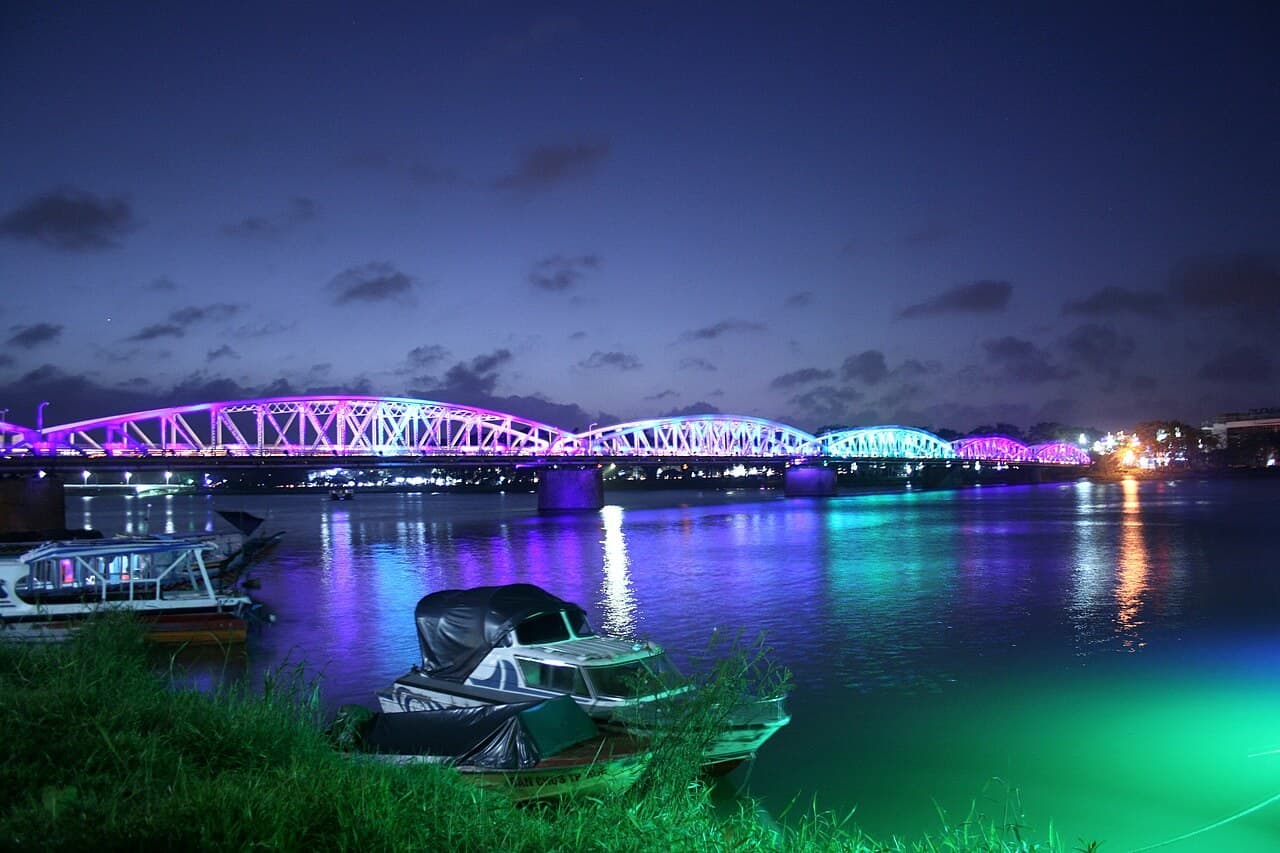
The area that works is the stretch between the Citadel and the river, within a kilometre of the Truong Tien bridge. That is where the cafes, the hotels and the street food are. Hostels and guesthouses start at 200,000 VND (~$8), 3-star runs 600,000–900,000 VND (~$23–35), 4-star from 1,200,000 VND (~$46).
Avoid the outskirts across the river, the airport road and the industrial edge. They are 20–30% cheaper and cost you half an hour in a taxi every time you want a bowl of noodles. Specific properties are compared in our Hue hotels guide.
FAQ — visiting Hue
Yes, if you care about history, architecture or food. Hue is the most Vietnamese-feeling destination in the country: no resort strip, no tourist-menu English everywhere, an imperial complex and the best noodles in Vietnam. Come expecting an open-air museum rather than a holiday, and it delivers. Come for a beach and you have picked wrong.
Two full days is the minimum: one for the Citadel and the centre, one for two or three tombs plus Thien Mu Pagoda. Three nights is the comfortable version, leaving room for the river and an unhurried royal-cuisine dinner. One day gets you a fast walk past the highlights and not much else.
Different trips. Hue is imperial history, tombs and food. Hoi An is atmosphere, lanterns and a beach. With five to seven days, do not choose. Take both, with the train over the Hai Van Pass between them: 2.5 to 4 hours, and the scenery does all the work.
February to April: driest, most comfortable. May to August is hot, with only occasional rain. September to November is a hard no: typhoon season, about 770 mm of rain in October, and in 2025 the monuments closed twice inside eight days. December and January are cool by local standards, +18–23 °C and damp.
Yes. It is one of the calmest cities in central Vietnam. Petty crime is rare, the centre is walkable, and solo women report walking at night without issues. The real risk here is weather, not people. Autumn flooding closes roads and sites, so watch forecasts if you travel between September and November.
If you tick sights off a list at speed, it can feel repetitive by day three. Slow down and it does not: an afternoon in a riverside cafe, a court-cuisine dinner, the walk out to Thien Mu. The people who report being bored are almost always the ones who booked one night and tried to compress everything into it.
- Budget a head for a hostel bed, street food and a scooter600,000 VND~$23
- Mid-range for a 3-star room, cafes and taxis1,200,000–1,800,000 VND~$46–69with monument tickets on top
- ATMs dispense a go2,000,000–3,000,000 VND~$77–115fee around 50,000 VND (~$2)
Cards work at 3-star hotels and larger restaurants; street stalls, Dong Ba market and every ticket office take cash only
Depends on your passport. Twelve countries including the UK, Germany, France, Italy, Spain, Japan and South Korea get 45 days visa-free, and twelve more European countries have the same until August 2028 under a tourism scheme. Everyone else applies online for the e-visa: up to 90 days, $25 single entry or $50 multiple entry. Current lists and the application walkthrough are in our visa-free entry guide.
Read next: Hue travel guide · Things to do in Hue · Day trips from Hue · Is Hoi An worth visiting
VietnamSpot on InstagramTips, lifehacks and news for living in VietnamFollow

- Guide
Hue Festival 2026: Dates, Program, Tickets & Tips
Hue Festival 2026 guide — four-season program, June 13–18 arts week recap, autumn events, ticket prices in VND and USD, and how to plan your visit.Hue Festival 2026: Dates, Program, Tickets & Tips - Guide
Hue Attractions 2026: Citadel, Tombs & Pagodas
Hue attractions: the imperial Citadel, the royal tombs, Thien Mu Pagoda, the Perfume River and Dong Ba Market — tickets, routes and tips.Hue Attractions 2026: Citadel, Tombs & Pagodas - Guide
Hue Tours 2026: Tombs, DMZ & Day Trips
Hue tours guide: imperial tombs, Bach Ma, the DMZ, a Perfume River boat and the Hai Van Pass to Hoi An — how to book and 2026 prices.Hue Tours 2026: Tombs, DMZ & Day Trips