Pu Luong Nature Reserve 2026: Rice Terraces & Homestays
Pu Luong Nature Reserve covers 17,662 hectares of rice terraces, limestone peaks and about 24 Thai and Muong villages, 160 km southwest of Hanoi. The valley gets two golden rice harvests a year, in late May and again from late September into early October, which is unusual for the northern mountains. People come for the quiet, the trekking and a night in a stilt house, where a homestay bed with dinner can cost as little as 100 000 VND (~$4).
We put this guide together from local operators’ price lists, Vietnam Coracle’s reporting and traveller reviews from 2026. It covers four ready-made itineraries, prices in VND and US dollars (at $1 ≈ 26 000 VND), a map of nine key spots and a straight comparison with Sapa and Mai Chau. If this is your first trip, the sections on when to go and how to get there answer most questions.
What Pu Luong Nature Reserve is
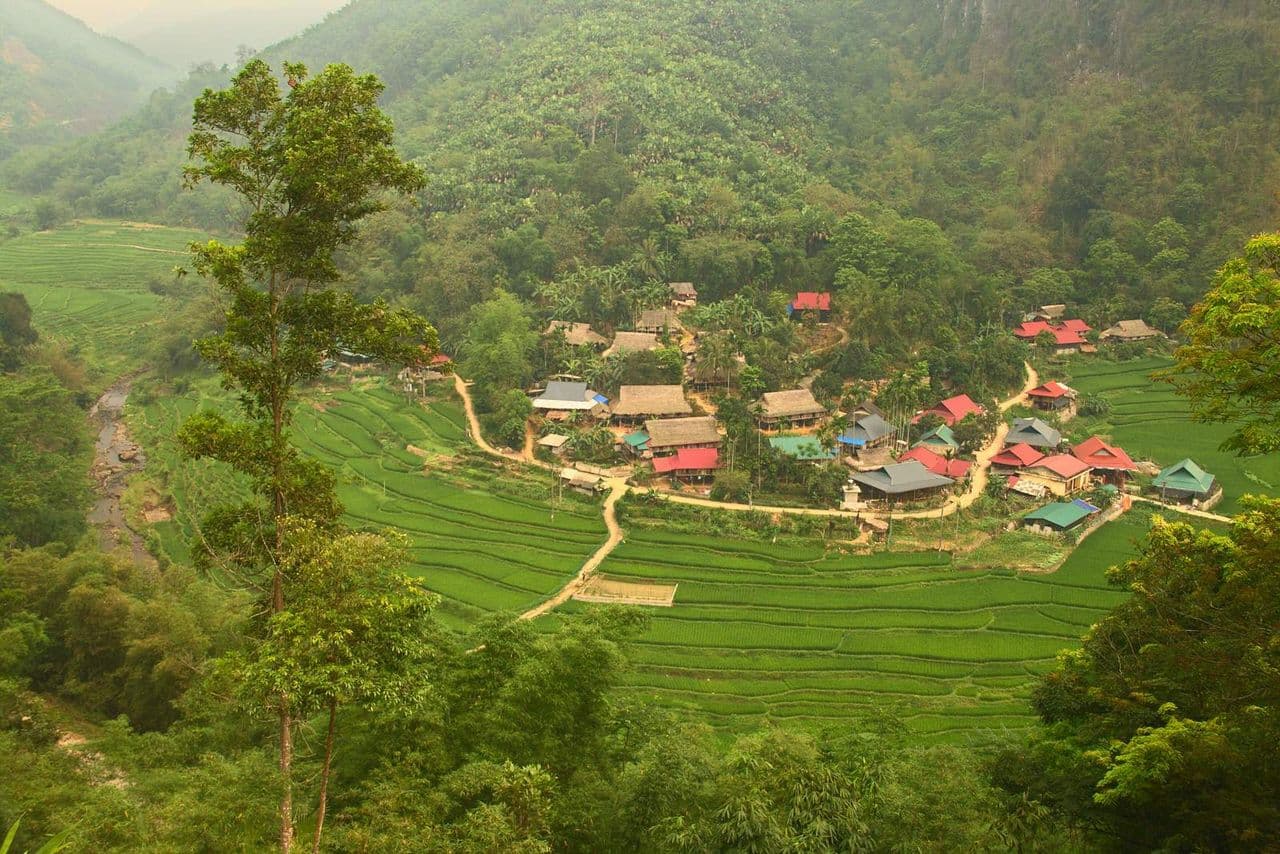
Pu Luong (Pù Luông) is a protected area in the west of Thanh Hoa province. It was set up in 1999, covers 17,662 ha and runs from 60 m to about 1,700 m above sea level. Around 95% of the people living inside are Thai and Muong, who build their houses on stilts and have farmed the terraced slopes for centuries.
Most English guides still list the address as Ba Thuoc and Quan Hoa districts. Vietnam abolished the district level on 1 July 2025, so the core of the reserve now sits in two communes: Pu Luong (xã Pù Luông, with Don and Kho Muong villages) and Co Lung (xã Cổ Lũng, with Ban Hieu and Pho Doan). Nothing changes for bookings or transfers, but it helps when an address on a map app looks unfamiliar.
| Field | Details |
|---|---|
| Name | Pu Luong Nature Reserve |
| Vietnamese | Khu bảo tồn thiên nhiên Pù Luông |
| Location | Thanh Hoa province, Pu Luong and Co Lung communes (Ba Thuoc and Quan Hoa districts until 07/2025) |
| Centre coordinates | 20.4642, 105.1294 |
| From Hanoi | 150–170 km (4.5 h by road) |
| From Mai Chau | 65–75 km (1.5–2 h) |
| From Ninh Binh | ~100 km (2.5 h) |
| Area | 17,662 ha |
| Highest peak | 1,700 m |
| Ethnic groups | Thai and Muong (~95% of residents) |
| Villages | about 24 |
| Entry fee | reserve is free; Hang Doi cave 10 000 VND (~$0.40), motorbike parking 10 000 VND |
| Status | nature reserve since 1999 |
Pu Luong often gets called "Sapa’s little brother". It’s a flattering comparison, and a misleading one. Sapa is a high mountain resort town with a cable car and traffic jams at the base of Fansipan. Pu Luong is a low-key valley where the dirt track between villages runs through the paddies, and in the evening your host pours rice wine from a bamboo tube and serves pork steamed in banana leaf. There are far fewer visitors here. On a weekday on the trail from Ban Hieu to the waterfall, you’re more likely to meet a water buffalo than a tour group.
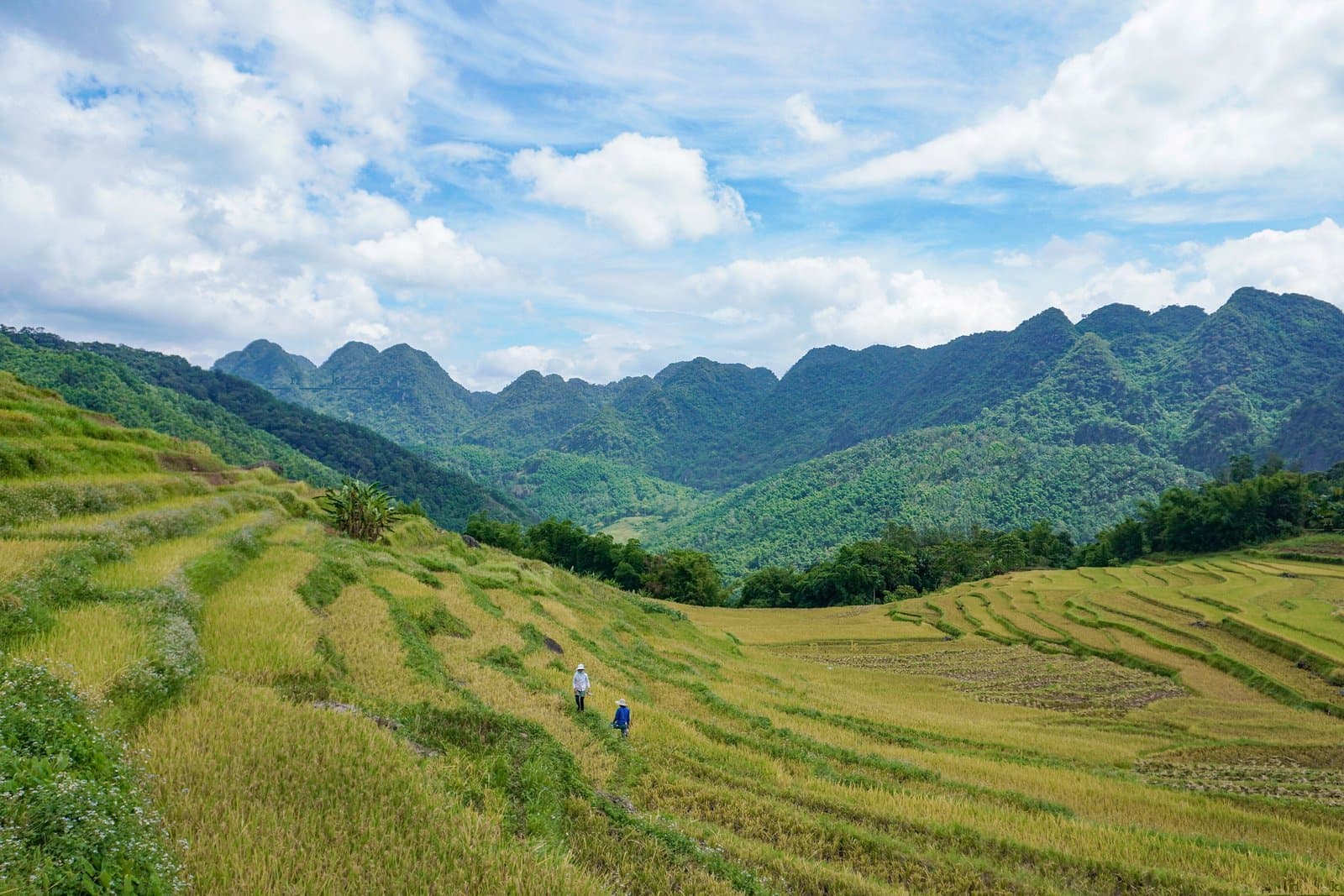
The two harvests are the main natural draw. Sapa and Mu Cang Chai get one (September). The Thai and Muong farmers here grow two crops: the first is cut in late May and early June, the second from mid-September to early October. That gives you two chances a year to see the terraces turn gold, not one.
- Ban Hieu village (Bản Hiêu): Thai stilt houses, waterfall 15 min walk — Starting point for most treks
- Hieu waterfall (Thác Hiêu): 800 m of cascades and pools, swimming allowed — Free or a local fee up to 20 000 VND
- Don village (Bản Đôn): The classic view, terraces down to the Cham river — Next to Pu Luong Retreat
- Kho Muong village (Bản Kho Mường): Remote village near the bat cave — 4–5 h hike from Ban Hieu
- Hang Doi bat cave (Hang Dơi): Five bat species — Entry 10 000 VND (~$0.40)
- Pho Doan market (Chợ Phố Đoàn): Main local market — Thursday and Sunday, 6:00–11:00
- Pu Luong Retreat (Pù Luông Retreat): Infinity pool over the valley — From 1 400 000 VND (~$54) a night
- Ebino Pu Luong Resort (Ebino Pù Luông Resort): 4-star, 41 rooms, spa — From 1 800 000 VND (~$69) a night
- Ban Cong village (Bản Công): Thai weavers, water wheels — Craft lessons
How to get to Pu Luong from Hanoi
A limousine van from Hanoi’s Old Quarter is the quickest and easiest way to get to Pu Luong. It takes about 4.5 hours and costs 250 000–350 000 VND (~$10–13) per seat. Your homestay or a local operator books it a day ahead; vans usually leave around 7:00 and 13:00 and pick up from hotels in Hoan Kiem. In high season (May to June, September to October) book one or two days in advance.
The budget option is a sleeper bus to Cam Thuy (a former district town, now a commune) plus a taxi to Ban Hieu or Don. Buses leave Giap Bat, Hanoi’s southern bus station, every one to two hours between 6:00 and 20:00 for about 150 000 VND (~$6). The 30 km taxi ride from Cam Thuy adds another 300 000 VND (~$12). It works out cheaper than the limousine, but it’s one and a half to two hours slower and more hassle with luggage.
Transport options compared
| Option | Time | Price | Best for |
|---|---|---|---|
| Limousine van | 4.5 h | 250 000–350 000 VND (~$10–13) | most travellers |
| Sleeper bus + taxi | 6 h | 150 000 + 300 000 VND (~$6 + $12) | budget, experienced travellers |
| Private car (up to 4) | 4 h | 2 500 000–3 500 000 VND (~$95–135) per car | families, groups of 3–4 |
| Motorbike | 5–6 h | 100 000–150 000 VND (~$4–6) a day + fuel | experienced riders |
| 2-day/1-night guided tour | n/a | ~$125–175 per person | first-timers who want zero logistics |
| 3-day/2-night tour | n/a | ~$185–250 per person | the most popular format |
Grab doesn’t operate in the valley. Once you’re there, taxis and drivers are arranged through your homestay, and most owners reply on WhatsApp or Zalo.
Riding a motorbike
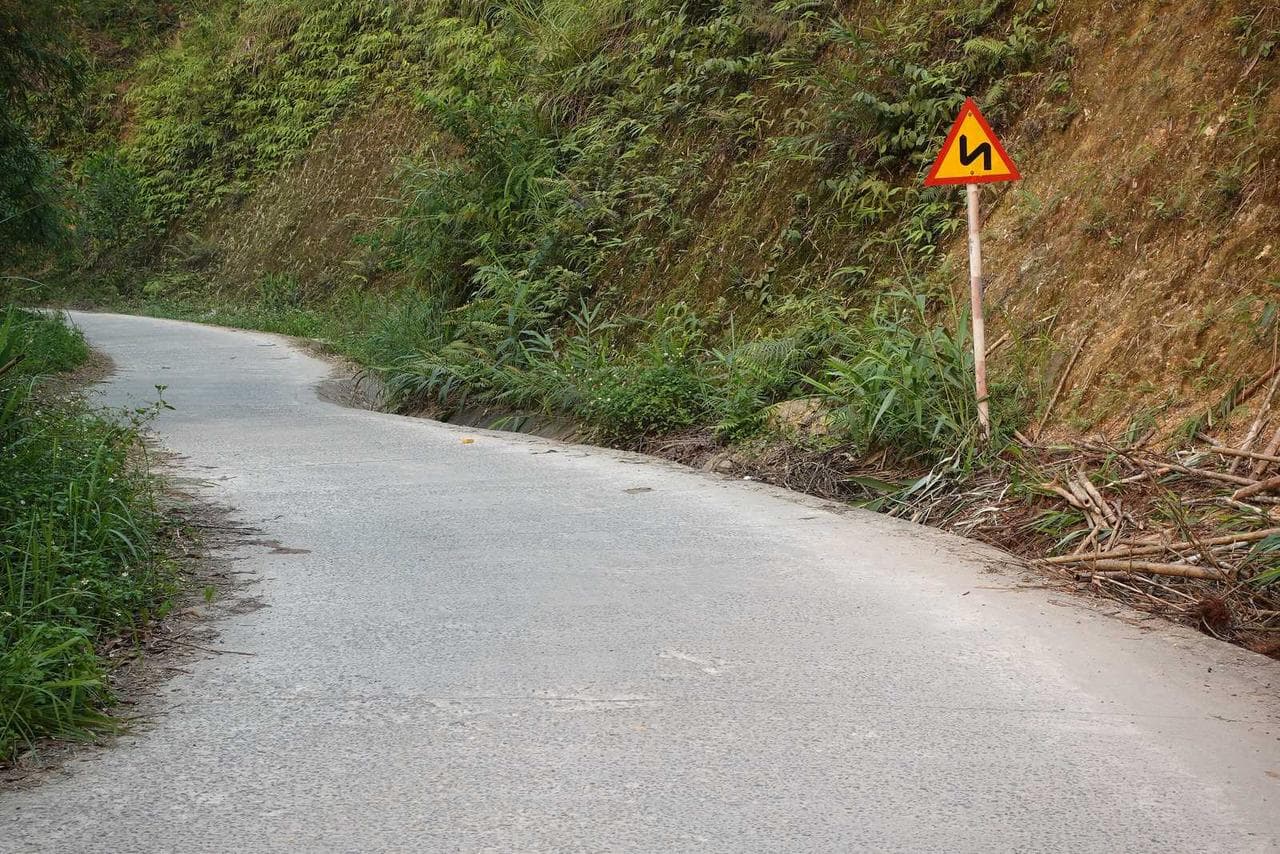
The ride from Hanoi is about 160 km, and the last 50 km is mountain switchbacks. It’s not a route for beginners. Vietnam Coracle warns about buffalo, trucks and landslide debris on the bends in the rainy season. If you do ride, leave Hanoi at 7:00, stop for lunch in Mai Chau and reach Ban Hieu before dark. Rentals in the Old Quarter cost 100 000–150 000 VND (~$4–6) a day, with your passport or a 5 000 000 VND (~$190) deposit as security. Check that your licence and insurance actually cover you before you set off.
From Mai Chau and Ninh Binh
From Mai Chau it’s 65 km and about two hours to Ban Hieu. A taxi arranged locally costs 500 000–750 000 VND (~$19–29), a motorbike about 150 000 VND (~$6) a day, and a day tour from Mai Chau starts around 2 000 000 VND (~$77) per person. The Mai Chau to Pu Luong run is a classic of the northwest, and a 3-day, 2-night tour covers both. Our Mai Chau valley guide has the details on that side.
From Ninh Binh and Tam Coc it’s 100 km, about 2.5 hours. A loop that works well is Tam Coc, then Pu Luong, then Mai Chau, then back to Hanoi. See our Ninh Binh guide for that end of the trip and the Hanoi guide if you’re using the capital as your base.
When to visit: seasons and the two rice harvests
The best months for Pu Luong are late May, early October and November. In those windows you get golden terraces or dry weather (sometimes both) and daytime temperatures of 22–28°C. Local guides generally agree that October is the prettiest month.
Green terraces (March to April)
The young rice has just gone in and the fields are a bright, almost neon green. Mist settles in the valley in the mornings, which photographers love. Days are 23–30°C, nights 16–22°C. Rain is rare and the trails are dry. The catch is that there’s no gold yet, so for the classic postcard shot you need May or October.
First harvest (late May to early June)
This is the first harvest of the year. Thai and Muong farmers are out on the terraces with sickles, and the valley smells of ripe rice. Morning fog over the fields is normal. The downside is that the rainy season has started: afternoon downpours, 28–34°C and humidity above 80%. Pack a rain jacket and waterproof shoes.
Second harvest (mid-September to early October)
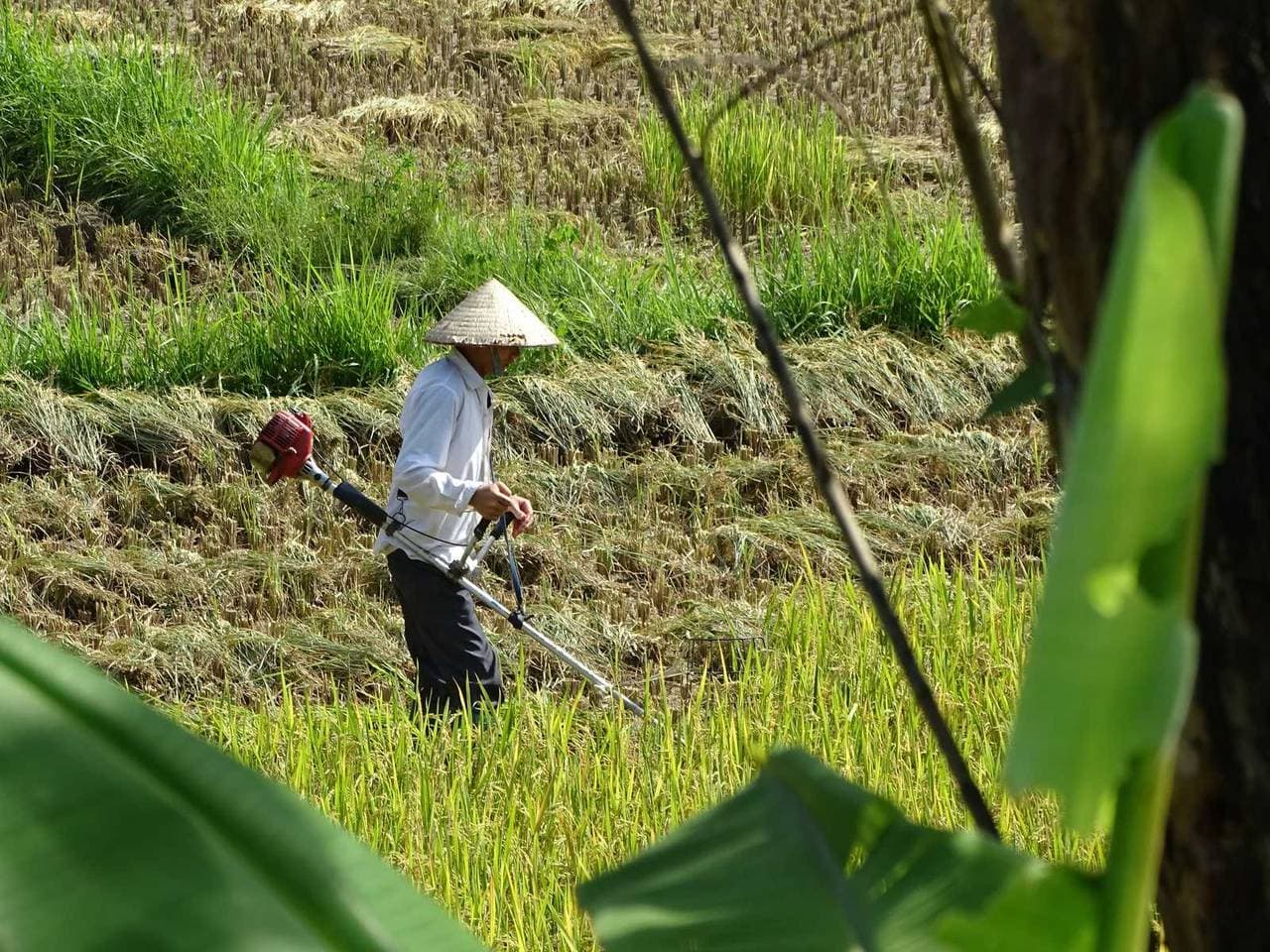
The second harvest is the stronger visual of the two, with gold fields set against dark green forest. There’s less rain by now and daytime temperatures drop to 25–31°C. Travellers who’ve been in both windows tend to rate the September mornings best for photos: fog between the terraces, farmers in conical hats, soft light.
Photos or trekking?
For trekking, go in October or November, when it’s dry, cool and the trails aren’t slippery. For golden terraces, aim for late May or late September. For the greenest landscape, March. Skip June to August if you can: the rain makes the mountain road risky, trails turn to mud and the Cham river runs brown.
| Month | Day °C | Night °C | Rain, mm | In the valley | Verdict |
|---|---|---|---|---|---|
| January | 18–22 | 10–14 | 30–40 | bare fields | dry, cool, few visitors |
| February | 20–24 | 12–16 | 30–50 | preparing to plant | dry, clear |
| March | 23–27 | 16–19 | 50–80 | green terraces | excellent |
| April | 26–30 | 19–22 | 80–120 | green terraces | excellent |
| May | 28–32 | 22–24 | 200–280 | first harvest | peak beauty, afternoon rain |
| June | 30–34 | 23–25 | 280–350 | end of harvest, planting | rainy, humid |
| July | 30–34 | 24–25 | 300–380 | planting, green | heavy rain, not ideal |
| August | 29–33 | 24–25 | 280–340 | green fields | rainy, take care |
| September | 27–31 | 22–24 | 200–270 | second harvest starts | peak beauty |
| October | 25–29 | 19–22 | 100–150 | second harvest peak | best month |
| November | 22–26 | 15–18 | 50–80 | dry fields | excellent for trekking |
| December | 18–22 | 11–14 | 30–50 | dry, clear | cool, good visibility |
Weather data checked in June 2026. Look at the forecast before you go.
The villages: Thai, Muong and stilt houses
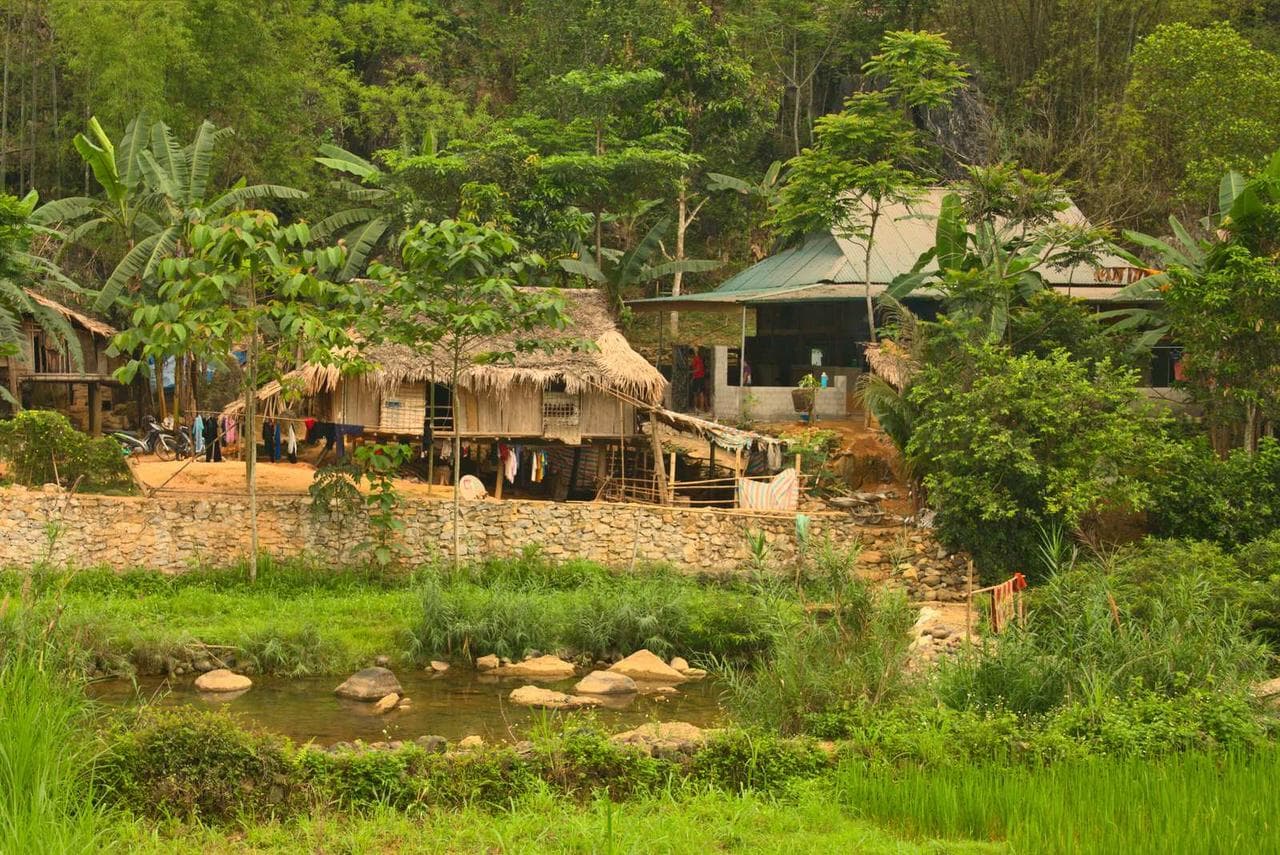
There are about 24 villages inside the reserve. Six of them have homestays and are set up for visitors. The rest are working farming communities, and walking in without a local guide is considered rude. The Thai and Muong are separate ethnic groups with similar lives: bamboo stilt houses with thatched roofs, rice farming, weaving and rice wine.
Ban Hieu (Bản Hiêu): the waterfall village
Most treks start here. The village sits beside Hieu waterfall, an 800 m run of natural pools down a gentle slope. The Thai stilt houses are in good condition and many now take guests, from 100 000 to 700 000 VND (~$4–27) a night. The classic loop from Ban Hieu to Don through the paddies starts here, and the waterfall is a 15-minute walk from the village centre.
Don (Bản Đôn): the postcard view
The photo most people know from Pu Luong is the view over Don. The village lies in a wide valley with terraces stepping down to the Cham river and limestone peaks behind. The best-known resort in the valley, Pu Luong Retreat, is here too, with its infinity pool on the edge of the slope. If you only get one evening in Pu Luong, spend it watching the sun go down over the Don terraces.
Kho Muong (Bản Kho Mường): the bat cave village
This is the most remote of the tourist villages, a 4–5 hour hike from Ban Hieu over a pass. Locals will offer to guide you for about 400 000 VND (~$15). The main sight is Hang Doi cave (Hang Dơi), roughly 200 m long and home to five species of bats. Entry is 10 000 VND (~$0.40). Afterwards you can stay for dinner with a Thai family: rice wine from bamboo and fermented pork (mắm nem) with vegetables from the garden.
Ban Cong (Bản Công): weavers and water wheels
Ban Cong, on the way from Hieu to Don, is the centre of Thai weaving in Pu Luong. Weavers run hour-long lessons for 150 000–300 000 VND (~$6–12), and you leave with a strip of fabric in a traditional pattern that you made yourself. Nearby are 5-metre water wheels that have been lifting water into the fields since the 19th century. Good spot for photos.
Pho Doan (Phố Đoàn): the market town
Pho Doan isn’t an ethnic village so much as a trading post at the edge of the reserve. The reason to go is the market, held on Thursday and Sunday from 6:00 to 11:00. People from all 24 villages come to buy vegetables, spices, fabric and bamboo tools. If you want everyday rural Vietnam with no staging, get there by 7:00 on a Thursday. Regulars say most stalls have sold out by 9:00.
Ban Lac and Ban Pom (the Mai Chau side)
Strictly speaking these two are in the Mai Chau valley, but plenty of Pu Luong tours spend their first night here. Ban Lac is a White Thai village with lots of homestays, evening dance shows and bike rental. It’s touristy, which is the downside. The upside is that it’s an easy first stop before you head deeper into Pu Luong.
Things to do: trekking, rafting and waterfalls
Pu Luong offers four main things: village treks, swimming at the waterfalls, bamboo rafting on the Cham river and cycling along the terraces. Two days is enough for a first visit: one for the Ban Hieu, waterfall and Don loop, one for the cave and the raft. With three to five days you can add Kho Muong and the trek up Pu Luong peak (1,700 m).
Hieu waterfall
This is the main natural sight. From Ban Hieu it’s a 15-minute walk uphill through rice fields to the first pools. Hieu isn’t one big drop but a gentle 800 m series of cascades with plenty of pools. The bottom is sandy, the water is waist-deep and there aren’t many slippery rocks. Swimming is allowed. Entry is free, although locals sometimes charge up to 20 000 VND (under $1), plus 10 000 VND to park a motorbike. The water is clearest from October to March. In the rainy months (June to August) it turns muddy and swimming isn’t much fun.
Hang Doi bat cave
From Kho Muong it’s an hour’s uphill walk to the cave entrance. Entry costs 10 000 VND (~$0.40); bring a torch and shoes you don’t mind getting dusty. It’s a limestone cave about 200 m long, with five bat species and several thousand bats in total. Going in with a local guide is the better option, and you can agree one in Kho Muong for about 100 000 VND (~$4).
Bamboo rafting on the Cham river
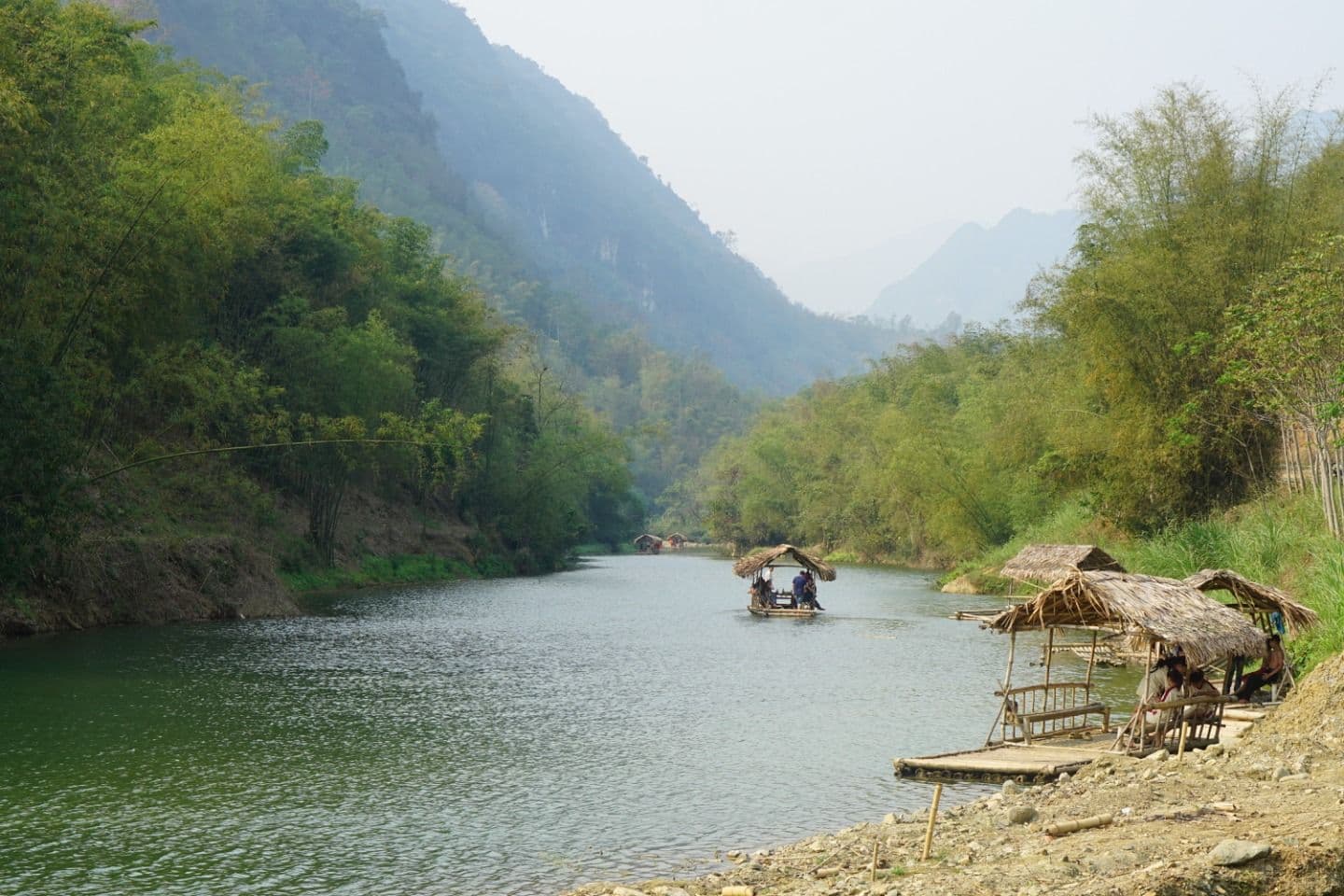
Thai families have been poling rafts of six to eight bamboo trunks down the Cham for generations, first for fishing and now for visitors as well. A ride costs 50 000–100 000 VND (~$2–4) per person and lasts 30–60 minutes. August and September are best, when the water level is right and the river is clear. In the dry season the river gets shallow and the raft scrapes over rocks.
Cycling: a 15 km loop
Cycling is the most relaxed way to see the valley. The loop runs from Don to Ban Cong and the water wheels, then back along the Cham: 15 km of dirt road, about three hours with stops. Any homestay or resort rents bikes for 80 000–150 000 VND (~$3–6) a day. You don’t need a map because there’s only one road.
Four ready-made treks
| Route | Distance | Difficulty | Time | What you see |
|---|---|---|---|---|
| Ban Hieu to the waterfall and rice fields | 4 km | easy | 2–3 h | waterfall, terraces, Thai village |
| Don to Pho Doan to Hieu | 12 km | moderate | 5–6 h | terraces, market, waterfall |
| Kho Muong and Hang Doi cave | 8 km | moderate | 4–5 h | remote village, bat cave |
| Full Pu Luong loop | 20 km | hard | 7–8 h | the whole reserve, a mountain pass |
Weaving, cooking and rice wine
Most homestays offer extras: a weaving lesson (150 000–300 000 VND, ~$6–12), a cooking class where you make dinner in bamboo (250 000–400 000 VND, ~$10–15) and a rice wine tasting with your host. These aren’t staged attractions; for Thai and Muong families they’re a real part of the household income. Say yes to dinner with your hosts almost every time. It’s the best food in the valley.
Vietnam’s national parks · Ha Giang loop · Trekking in Sapa
Fast Track — no queue at the border
5–10 minutes instead of an hour in the immigration queue
from$11per passenger
Where to stay: homestays and resorts
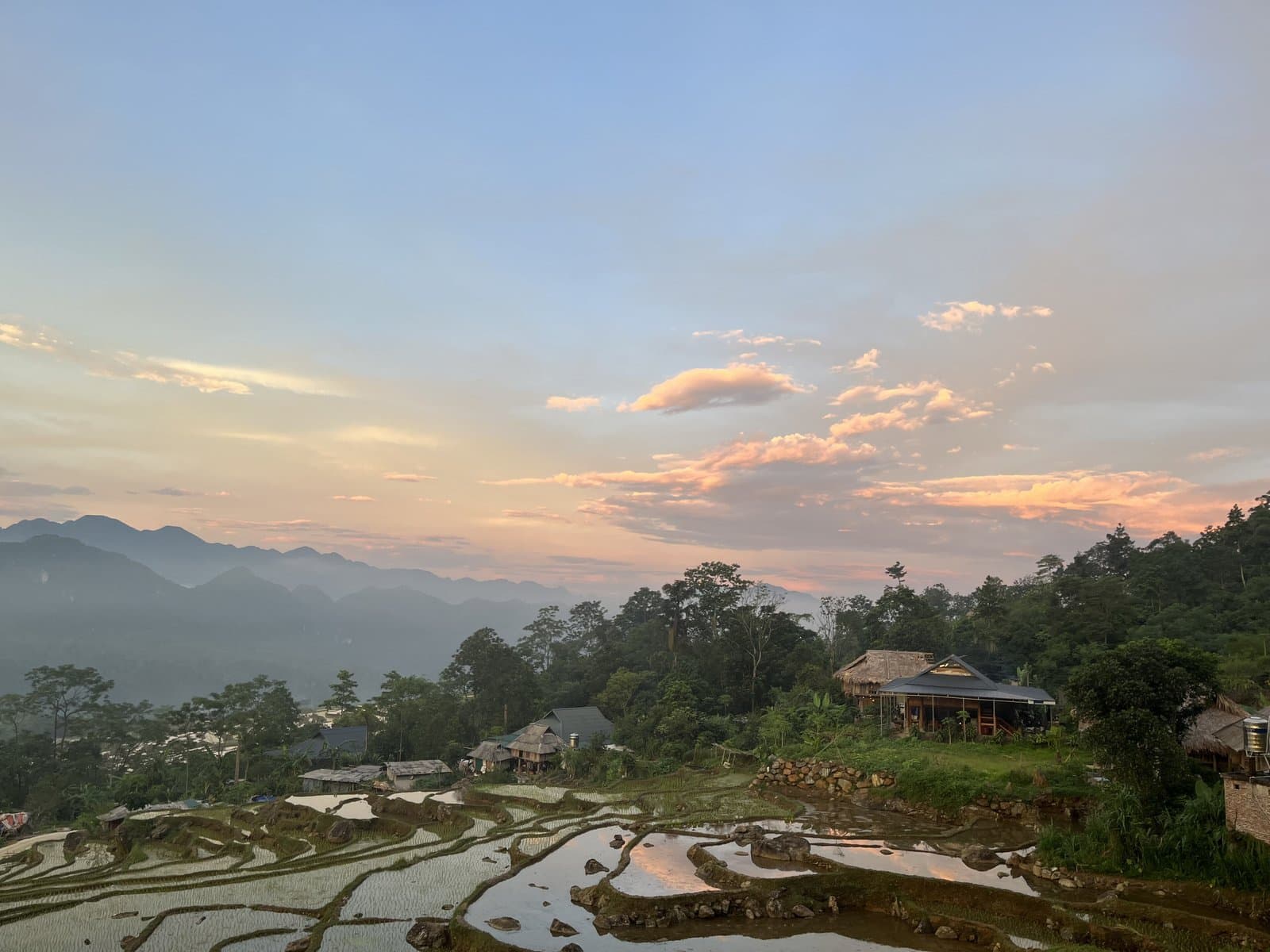
Accommodation in Pu Luong comes in three price bands: a basic Thai homestay from about $4 per person, mid-range rooms at $15–35 and resorts from about $48 a night. Each gives you a different trip, so pick by what matters most: living with a family, comfort, or the infinity pool view.
Basic Thai homestays ($4–10)
Expect a stilt house with a shared sleeping hall of six to ten mattresses, a shared bathroom with cold water and simple food. Prices run 100 000–250 000 VND (~$4–10) per person. You’ll find them in Kho Muong, Hieu and Don. The big plus is that you live the way the family does: dinner cooked over a fire, a rooster for an alarm. The big minus is zero privacy and very little in the way of facilities.
Mid-range ($15–35)
This is the best value for money.
- Pu Luong Home: stilt houses converted into private rooms, breakfast included. From 400 000 VND (~$15).
- Pu Luong Rice Road Homestay: terrace views, dinner with the hosts. From 550 000 VND (~$21).
- Ban Hieu Garden Lodge: bungalows by the waterfall, with a pool. From 850 000 VND (~$33).
For most people this level works best. You get a private bathroom and decent food, and you’re still in the village.
Resorts ($48–125)
- Pu Luong Retreat: the famous infinity pool looking over the Don valley. 1 400 000–2 200 000 VND (~$54–85). The pool shot is guaranteed, and it’s a good place to stay even if you leave the camera in your bag.
- Pu Luong Eco Garden: 24 rooms, eco-style buildings, windows onto the mountains and terraces. 1 250 000–2 000 000 VND (~$48–77).
- Ebino Pu Luong Resort & Spa: the only 4-star in the valley, 41 rooms, spa and steam room. 1 800 000–3 200 000 VND (~$69–123). Close to Hieu waterfall.
Summary table
| Place | VND a night | ~USD | Location | Notes |
|---|---|---|---|---|
| Basic homestay | 100 000–250 000 | $4–10 | any village | mattress, shared bathroom |
| Pu Luong Home | from 400 000 | $15 | Ban Hieu | stilt house, private room |
| Rice Road Homestay | from 550 000 | $21 | by the terraces | views, dinner |
| Ban Hieu Garden Lodge | from 850 000 | $33 | Ban Hieu | pool, by the waterfall |
| Pu Luong Eco Garden | from 1 250 000 | $48 | hillside | eco design, views |
| Pu Luong Retreat | from 1 400 000 | $54 | Don | infinity pool |
| Ebino Pu Luong Resort | from 1 800 000 | $69 | near Hieu waterfall | 4-star, spa |
Currency converter
Guests at the basic homestays tend to say the same thing: you sleep on a mattress in a shared room, but dinner with the family and the morning mist over the terraces make up for it.
For what a typical day costs elsewhere in the country, see our guide to prices in Vietnam.
Pu Luong vs Sapa vs Mai Chau: which one to pick
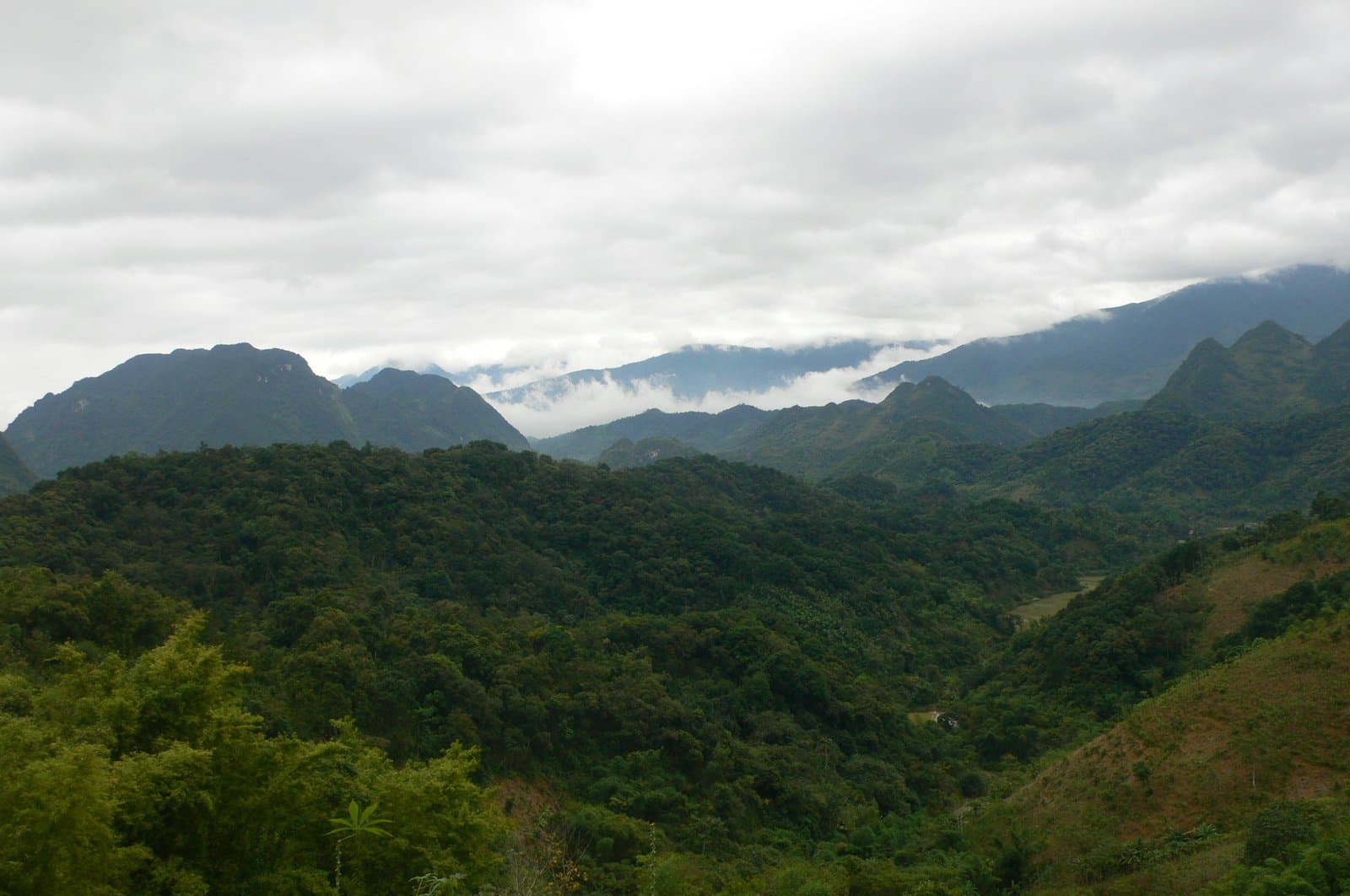
Pu Luong is for quiet and a less touristy experience, Sapa for big mountains, views and infrastructure, and Mai Chau for an easy first look at Thai village life. All three are in the northwest, but each makes a different kind of trip.
| Factor | Pu Luong | Sapa | Mai Chau |
|---|---|---|---|
| From Hanoi | 160 km, 4.5 h | 320 km, 5.5 h (train or bus + road) | 130 km, 3.5 h |
| Altitude | 60–1,700 m | 1,500–3,100 m | 200–500 m |
| Harvests a year | 2 (May and September) | 1 (September) | 2 |
| Tourist numbers | low | high | medium |
| Ethnic groups | Thai, Muong | Hmong, Dao, Thai | White Thai |
| Accommodation | 100 000–3 200 000 VND ($4–125) | 150 000–5 000 000 VND ($6–190) | 100 000–2 500 000 VND ($4–95) |
| Best for | trekking, quiet | mountains, views, photography | a first visit |
| Harvest scene | two golden waves | one big harvest | two, less dramatic |
| Cable car | no | yes (Fansipan) | no |
If you only have room for one northwestern stop, choose by budget and interests. With kids or without much hiking experience, go for Mai Chau, or Sapa with its cable car. Solo travellers and couples who like to hike will get more from Pu Luong. Photographers should choose by season: Sapa’s golden harvest is in September, while Pu Luong has two peaks, May and October.
A combo that works well is Hanoi, then Mai Chau (one day), then Pu Luong (two days) and back to Hanoi. You see both ethnic valleys and drive through both landscapes. For the capital itself, see our Hanoi guide and the list of things to do in Hanoi. For the mountain alternative, read the Sapa guide. And if you want the sea after the hills, Ha Long Bay is the obvious next leg.
Itineraries and budget
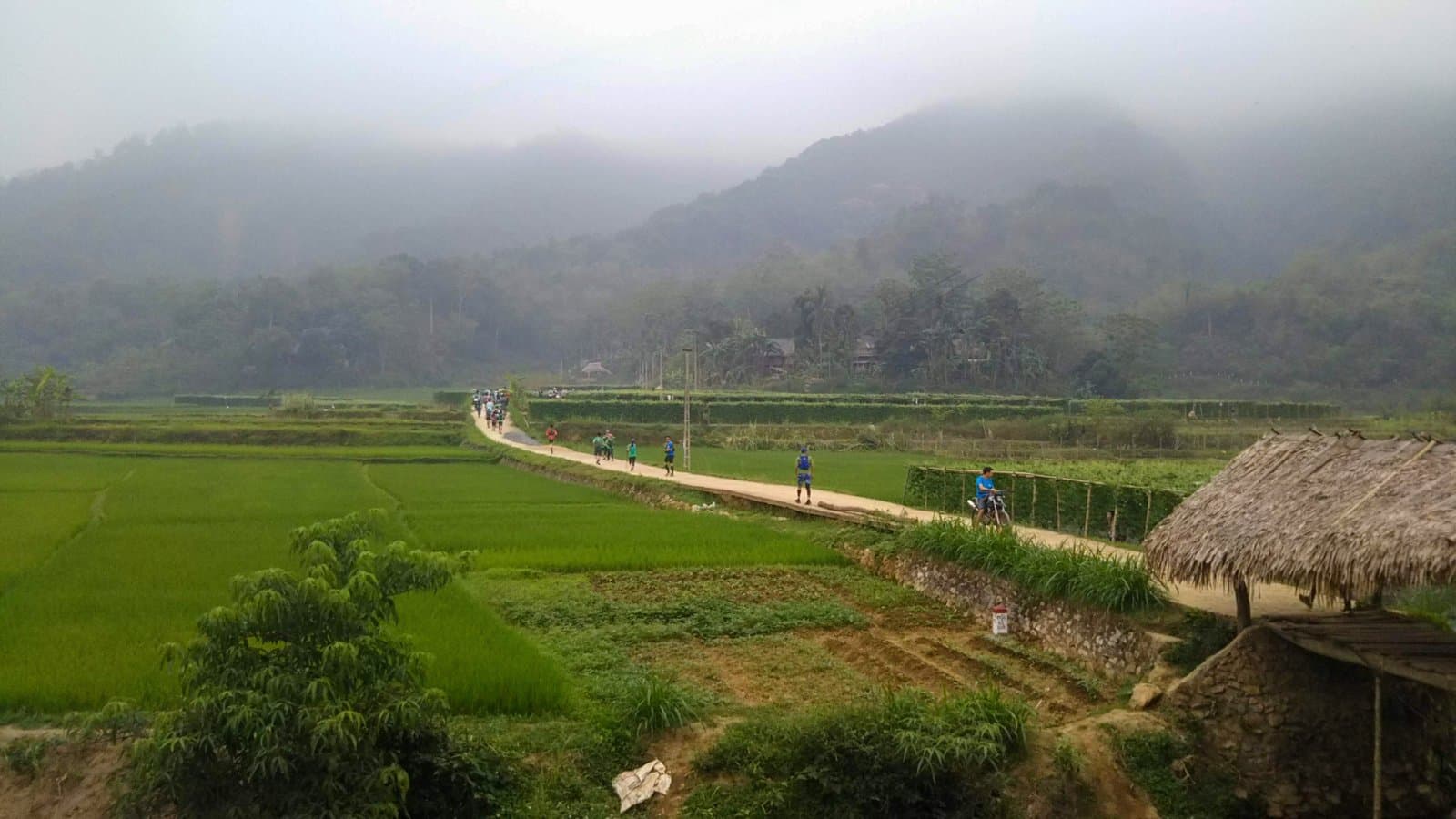
All budgets are per person and include transport from Hanoi.
2 days, 1 night: the short version
Day 1: Hanoi to Ban Hieu (limousine at 7:00, arriving around 12:00). Lunch, walk up to Hieu waterfall, swim. Dinner at the homestay.
Day 2: Morning walk through the rice fields to Don (12 km, about 5 hours with stops). Lunch in Don. Limousine back to Hanoi at 14:00.
Budget: return limousine about $19, mid-range homestay $21, food $13, optional guide $16. Total: about $70–75.
3 days, 2 nights: the sweet spot
Day 1: Hanoi to Ban Hieu, waterfall, dinner.
Day 2: Walk to Don, cycle to Ban Cong, weaving class, night at Pu Luong Retreat or Eco Garden.
Day 3: Bamboo raft on the Cham river, Pho Doan market, back to Hanoi.
Budget: transport $19, two resort nights at about $54 each, food $26, activities $16, guide $16. Total: about $185, or around $125 if you stay in mid-range homestays.
5 days: the full trip
Add Kho Muong and the bat cave on day 3, the climb to Pu Luong peak (1,700 m) with a guide and tent on day 4, and finish with a last day in Don, sunset at the infinity pool, then the ride back. Budget: about $270–375 per person.
With Mai Chau (4 days, 3 nights)
Hanoi to Mai Chau (one night, cycling around Ban Lac), then on to Pu Luong (two nights) and back to Hanoi. The best balance of the four. Budget: about $190–235.
Mai Chau valley · Ninh Binh · Hanoi day trips
Frequently asked questions
- Minimum2 days, 1 nightHieu waterfall and the Ban Hieu to Don loop
- Sweet spot3 days, 2 nightsadds cycling, the bamboo raft and a slow evening at a resort
- The deep version5 daysKho Muong, the bat cave and Pu Luong peak
A day trip from Hanoi is technically possible, but that’s nine hours on the road for four in the valley
Yes, especially from about age six. The easy trail from Ban Hieu to the waterfall (4 km) is fine for younger walkers, and the pools at Hieu are safe for swimming. Pu Luong Retreat and Eco Garden work well for families, with pools, restaurants and no age limits. The bamboo raft is fine for children too. With babies and strollers it’s a no: the roads are dirt and the trails get slippery
Yes. Theft and violent crime are rare. The real risks are the road (switchbacks in the rain, buffalo on the tarmac) and the weather (heatstroke in May and June, slippery trails in the wet season). Viettel has signal almost everywhere, and resorts have Wi-Fi. Pho Doan has basic medical care; anything serious means a transfer to Thanh Hoa (3 hours) or Hanoi (4.5 hours), so make sure your insurance covers evacuation
Mu Cang Chai is more dramatic, with terraces carved into steep slopes in long curving patterns. Pu Luong is softer: a wide valley of terraces and stilt houses. Pu Luong is also closer to Hanoi (160 km against about 300 km), cheaper and easier to reach. Go to Mu Cang Chai for one big photo, and to Pu Luong for a three-day stay where you actually spend time in the villages
No. The villages have no card terminals, ATMs or money changers. Take cash from Hanoi: at least 3 000 000 VND (~$115) for two people for three days. The bigger resorts (Ebino, Pu Luong Retreat) may take Visa and Mastercard, but check before you arrive. Withdraw in one go in Hanoi, since Vietnamese ATMs cap single withdrawals and foreign cards pay a fee each time
The terraces turn gold twice a year: late May to early June, and mid-September to early October. They’re green in March and April, after the first planting, and again in July and August, after the second. Between harvest and replanting the fields can look brown for a few weeks. For the postcard shot, aim for one of the golden windows, and ideally a foggy September morning
Common mistakes and practical tips
Don’t count on your card. There are no card machines, money changers or ATMs in the villages. Withdraw VND in Hanoi: at least 3 000 000 VND (~$115) for two people for three days.
Don’t do it as a day trip. Nine hours on the road for four hours in the valley is a waste of time and money. Stay at least one night, ideally two.
Don’t ride at night. The last 50 km of switchbacks has buffalo, trucks and no street lights. Leave Hanoi at 7:00 so you reach Ban Hieu before dark.
Bring waterproof shoes. Even in the dry season the trails by the waterfall are damp, and in the wet season there’s 5–10 cm of mud. Trainers and canvas shoes are soaked within ten minutes.
Eat with your hosts. The best food in the valley is home cooking. Dinner costs 100 000–150 000 VND (~$4–6) per person, made with vegetables from the family garden and served with rice wine.
Pack a fleece for the mornings. In January it drops to around 12°C at Hieu waterfall in the early morning, and to 16°C in March. After the heat of Hanoi or Saigon, that’s a shock.
Use insect repellent. Mosquitoes are out from May to October, especially near water. You can buy repellent in Pho Doan, but it’s cheaper in Hanoi.
Respect local etiquette. Don’t walk into a stilt house without being invited. Ask before you photograph people (a smile and a nod at the camera works). Don’t touch anything on the family altar, usually in a corner of the house.
Sort the visa first. Pu Luong needs no special permit, but your entry rules depend on your passport. Check our Vietnam visa guide and apply for an e-visa only through the official portal, evisa.gov.vn. For data, see our guide to SIM cards and eSIMs in Vietnam.
Read next: Vietnam’s rice terraces · Mai Chau valley · Sapa · Ninh Binh



- Guide
Things to Do in Ninh Binh 2026: 10 Sights, Prices in USD
Ninh Binh attractions for 2026: Trang An, Tam Coc, Mua Cave, Hoa Lu, Bai Dinh, Phat Diem. New ticket prices in VND and USD, a map and 1–3 day itineraries.Things to Do in Ninh Binh 2026: 10 Sights, Prices in USD - Guide
Quy Nhon Attractions 2026: Cham Towers, Coves, Lighthouses
What to see in Quy Nhon in 2026 — 11th-century Cham towers, Ky Co cove, an 1890 French lighthouse, pagodas. Verified fees in VND and USD, day routes, map.Quy Nhon Attractions 2026: Cham Towers, Coves, Lighthouses - Guide
Hoi An Reviews 2026: Is the Old Town Worth Visiting?
Honest Hoi An reviews: what travellers love and criticise, how many days you need and who it suits — with real quotes and a clear verdict.Hoi An Reviews 2026: Is the Old Town Worth Visiting?