Vietnamese spring rolls: nem, cha gio and goi cuon explained
"Spring roll" does not appear on a single Vietnamese menu written for Vietnamese people. The phrase covers at least four different dishes, and ordering one portion of nem in Hanoi, Nha Trang and Thanh Hoa will get you three unrelated plates. Below: what's what, recipes for both rolls, which rice paper to buy, and what a portion actually costs in Vietnam.
"Spring roll" does not appear on a single Vietnamese menu written for Vietnamese people. The phrase covers at least four different dishes, and ordering "one portion of nem" in Hanoi, Nha Trang and Thanh Hoa will get you three unrelated plates. Below: what's what, recipes for both rolls, and what a portion actually costs in Vietnam.
If you're still building a food list, start with the Vietnamese cuisine overview and the street food guide. This page goes deep on one family of dishes.
One word, four different dishes
English makes this harder than it needs to be, because it invented several names for the same thing and then reused one of them for something else entirely.
| Name | Vietnamese | What it is | Where it's said |
|---|---|---|---|
| Nem ran | nem rán | Deep-fried roll | North, Hanoi |
| Cha gio | chả giò | The same fried roll, southern version | South, Saigon, Mekong Delta |
| Goi cuon | gỏi cuốn | Fresh, unfried roll | South |
| Nem cuon | nem cuốn | The same fresh roll | North |
| Banh trang | bánh tráng | The rice paper itself | South and nationwide |
| Banh da nem | bánh đa nem | Rice paper made specifically for frying | North |
| Nem chua | nem chua | Fermented raw pork, not a roll at all | Nationwide |
| Nem nuong | nem nướng | Grilled pork sausage on a skewer | Ninh Hoa and Nha Trang |
A northerner saying "nem" means the fried roll. A southerner says chả giò for that and reserves nem for the fermented pork.
The English naming layer
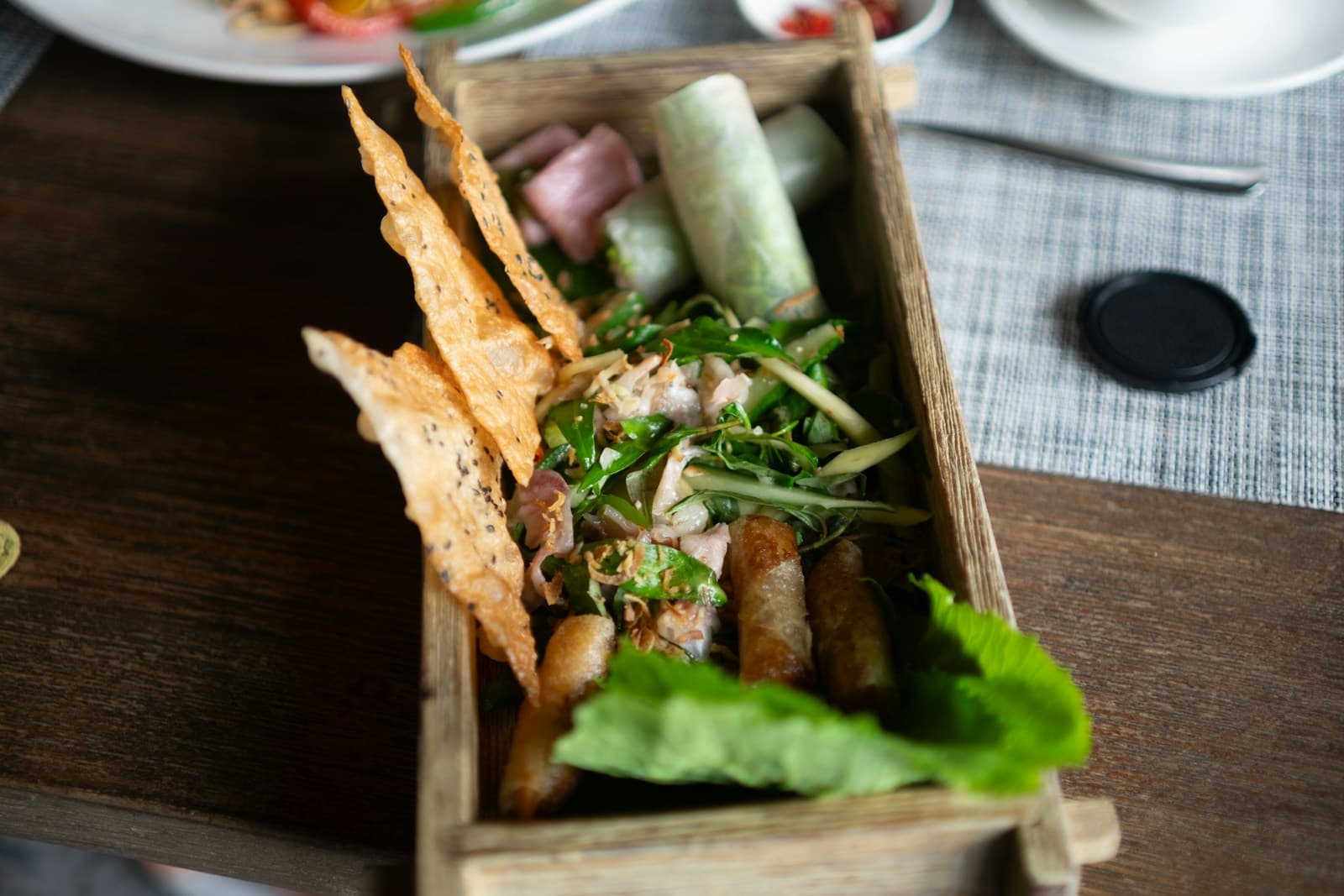
On top of the Vietnamese split, English adds four words for the fresh roll alone:
- Summer roll — American restaurant coinage, invented to stop people expecting something fried
- Rice paper roll — the standard term in Australia and New Zealand
- Salad roll — Canada and parts of the US
- Spring roll — ambiguous, could be either version
And the fried version competes with the Chinese-American spring roll, which is a genuinely different food: wheat wrapper, not rice paper. If a menu offers "spring rolls" with no further detail, that wrapper question is the one to ask.
Three traps with the word "nem"
Nha Trang. Here "nem" almost certainly means nem nướng: grilled pork sausages that arrive with a mountain of herbs, a stack of rice paper and instructions to roll them yourself. The dish comes from Ninh Hoa, 34 km up the coast, and moved into Nha Trang with restaurants catering to visitors. Nothing to do with fried rolls. More in the Nha Trang food guide.
Nem chua. Pink batons wrapped in banana leaf and tied with string: raw pork fermented for a couple of days with rice, garlic and chilli. Sour, salty, sharp, excellent with beer, and eaten with no cooking whatsoever. Approach with an informed stomach. Hanoi also does a fried version, nem chua rán, which is closer to our topic by method but not by substance.
Lookalike names. Bánh cuốn is not gỏi cuốn. The first is a steamed rice roll eaten for breakfast — we covered it in the banh cuon guide. All they share is the word cuốn, "rolled".
Fried rolls: nem rán up north, chả giò down south
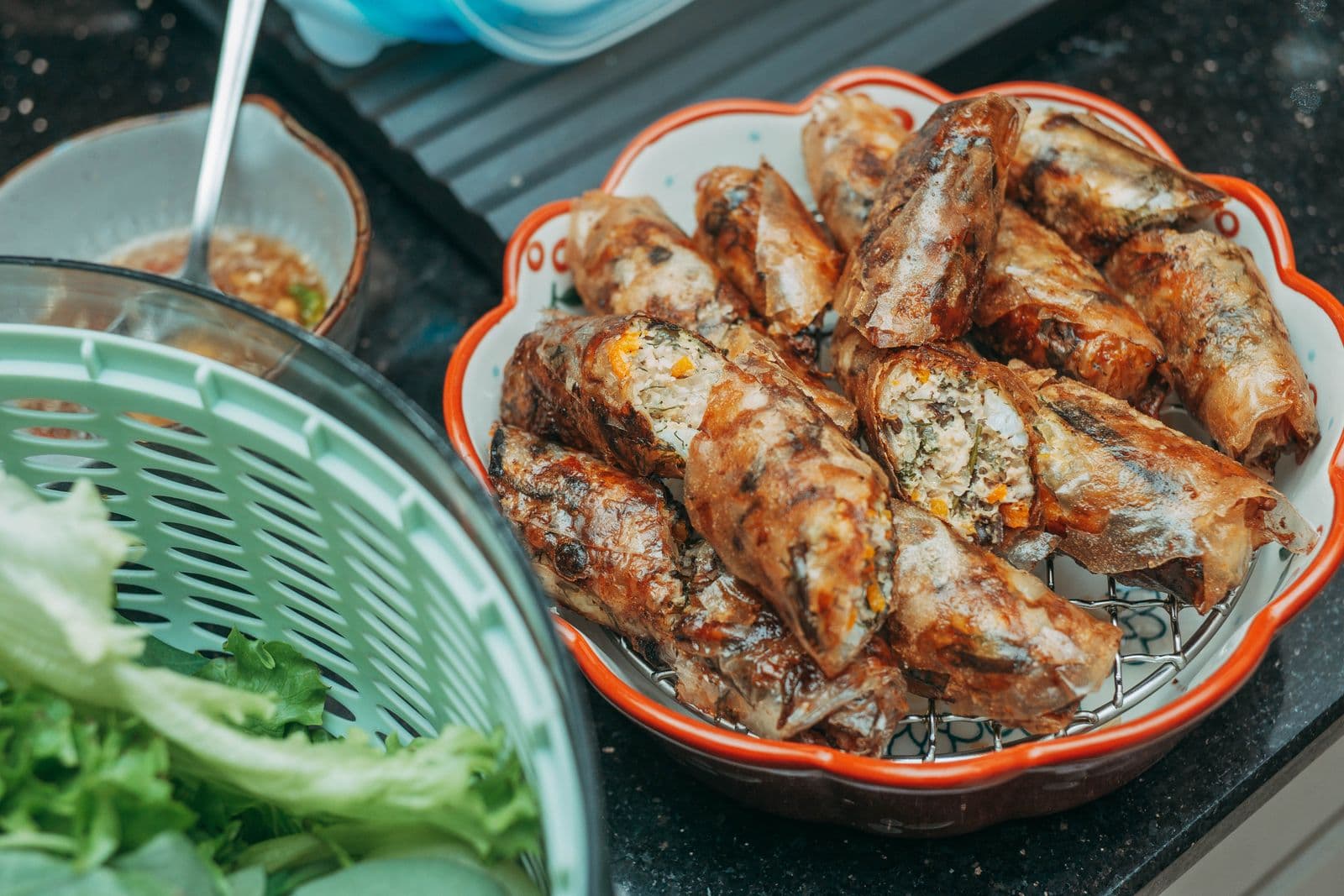
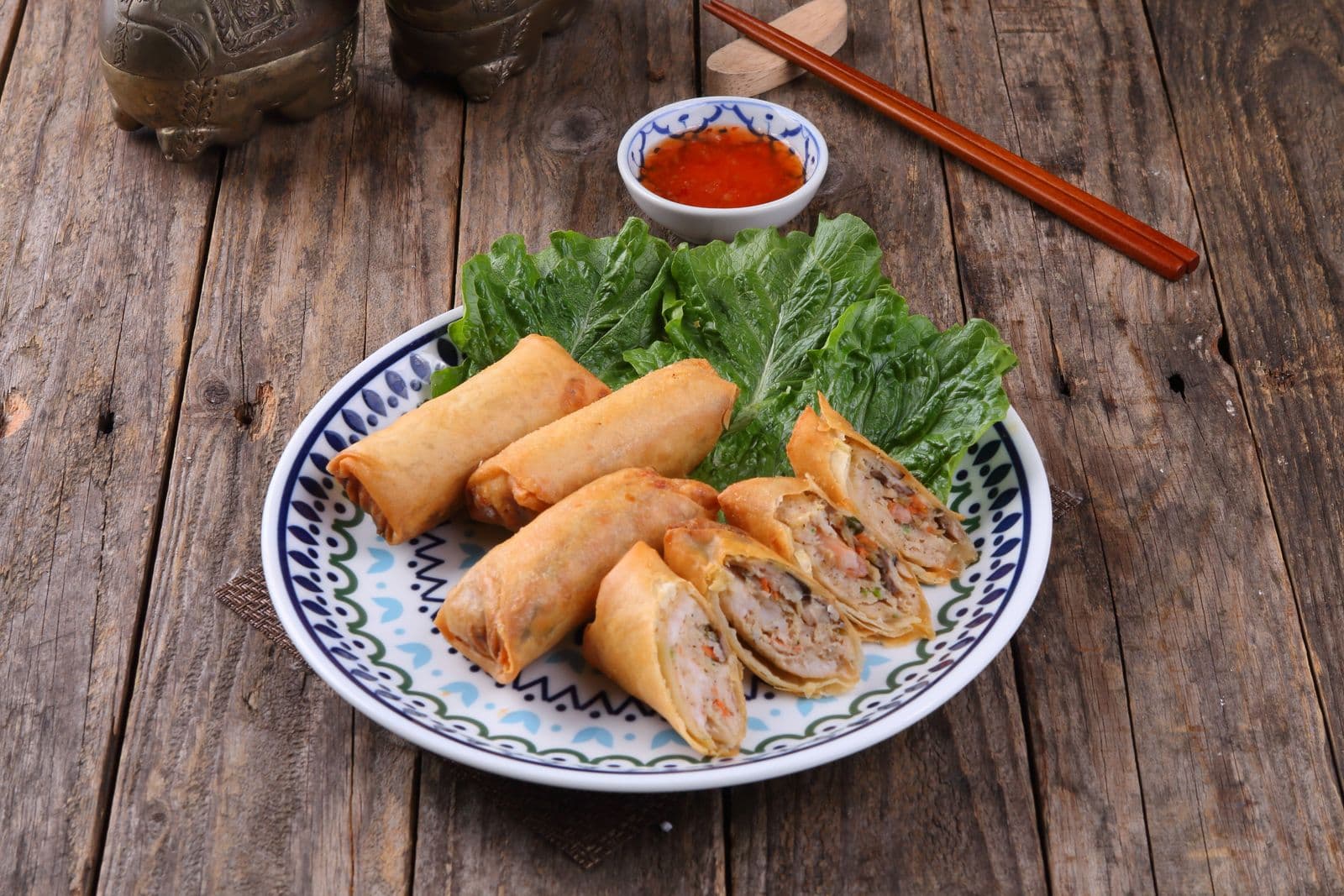
A fried roll is ground pork with wood-ear mushrooms and glass noodles, wrapped in rice paper and deep-fried until golden. Soft inside, loud outside. You eat it with your hands, wrapped in a lettuce leaf with herbs, dipped in a sweet and sour fish sauce.
That's where north and south stop agreeing.
| What | North: nem rán | South: chả giò |
|---|---|---|
| Wrapper | Almost always bánh đa nem, pure rice | Rice paper or a wheat wrapper |
| Size | Smaller, thinner | Larger, denser |
| Texture when fried | Glassy snap | Firmer, slightly chewy |
| Filling base | Pork, wood-ear, glass noodles, carrot | Same, plus a sweet root vegetable |
| Signature addition | Kohlrabi; crab in coastal versions | Taro, jicama (củ đậu), sweet potato |
| Served with | Bun cha, rice, beer | Grilled-pork vermicelli, or on its own |
The southern version comes out noticeably sweeter: taro and jicama bring a sugary wetness the northern filling doesn't have. The northern one is drier and sharper, partly from more pepper, partly because the pork is leaner.
There's a third reason, and it's purely technical. Real northern bánh đa nem is rice flour, water and salt with no tapioca starch. Thinner, tears more easily, and that's exactly why the crust shatters instead of bending. The most famous sheets come from Thổ Hà village in Bac Ninh province. Southern bánh tráng is sturdier, keeps longer, crisps less.
A holiday dish
Fried rolls aren't everyday food in a Vietnamese household — they're a fixture of the festive table. At Tet, the lunar new year, families roll them by the dozen as a group activity: someone mixes the filling, someone wets the sheets, someone mans the oil. If you're in Vietnam in late January or February you'll see it in every courtyard.
Fast Track — no queue at the border
5–10 minutes instead of an hour in the immigration queue
from$11per passenger
How to make fried nem, step by step
This makes 16–18 rolls: a starter for four or a main for two. Budget an hour, forty minutes of which is rolling. There's no shortcut, so it's worth making a double batch and freezing half.
Ingredients
| Ingredient | Amount | Why it's there |
|---|---|---|
| Ground pork, not lean | 300 g | The base; fat keeps it juicy |
| Shrimp, chopped | 250–270 g | Sweetness and bite |
| Glass noodles, dry | 50 g | Binds the filling and adds bulk |
| Wood-ear mushrooms, dry | 15 g | Crunch inside a soft filling |
| Carrot, julienned | 30 g | Colour and sweetness |
| Bean sprouts | 100 g | Lightness |
| Shallot or onion, minced | 2–3 tbsp | Aroma |
| Egg | 2 | Holds the mince together |
| Fish sauce nước mắm | 1 tsp | Umami; without it the filling is flat |
| Salt, black pepper | 0.5 tsp and 1.5 tsp | Northern nem are properly peppery |
| Rice paper | 16–18 sheets | See the wrapper section below |
| Rice vinegar | a few drops | Goes in the dipping water |
| Frying oil | 700–900 ml | At least 3 cm deep |
Pork-to-shrimp ratio is a matter of taste. Vietnamese home recipes sit between 50:50 and 60:40 in favour of pork. Less shrimp gives a drier, simpler filling; more makes it sweeter and pricier.
Substitutions. Wood-ear mushrooms aren't everywhere; button mushrooms change the flavour and give no crunch, but the filling still holds. Bean sprouts can be skipped. Glass noodles cannot — they're what swells during frying and gives the roll its structure.
Eight steps
- Soak the mushrooms and noodles. Wood-ear in warm water for 15–20 minutes, then rinse and squeeze dry. Glass noodles for 10 minutes, soft but not mushy. Squeeze both. Wet filling is the number one cause of burst rolls.
- Chop. Cut the noodles into 5 cm lengths — long strands make a lumpy cylinder. Mushrooms, carrot and onion go fine. A thick carrot baton will spear the wrapper from inside.
- Mix. Pork, shrimp, mushrooms, noodles, carrot, sprouts, onion, eggs, fish sauce, salt, pepper. Mix by hand until even, and don't be shy with pepper. Rest it 10 minutes.
- Prepare the dipping water. Warm water in a wide shallow bowl plus a few drops of rice vinegar, roughly 1/8 tsp per cup. The vinegar raises tiny bubbles on the sheet, and the fried crust comes out blistered rather than flat.
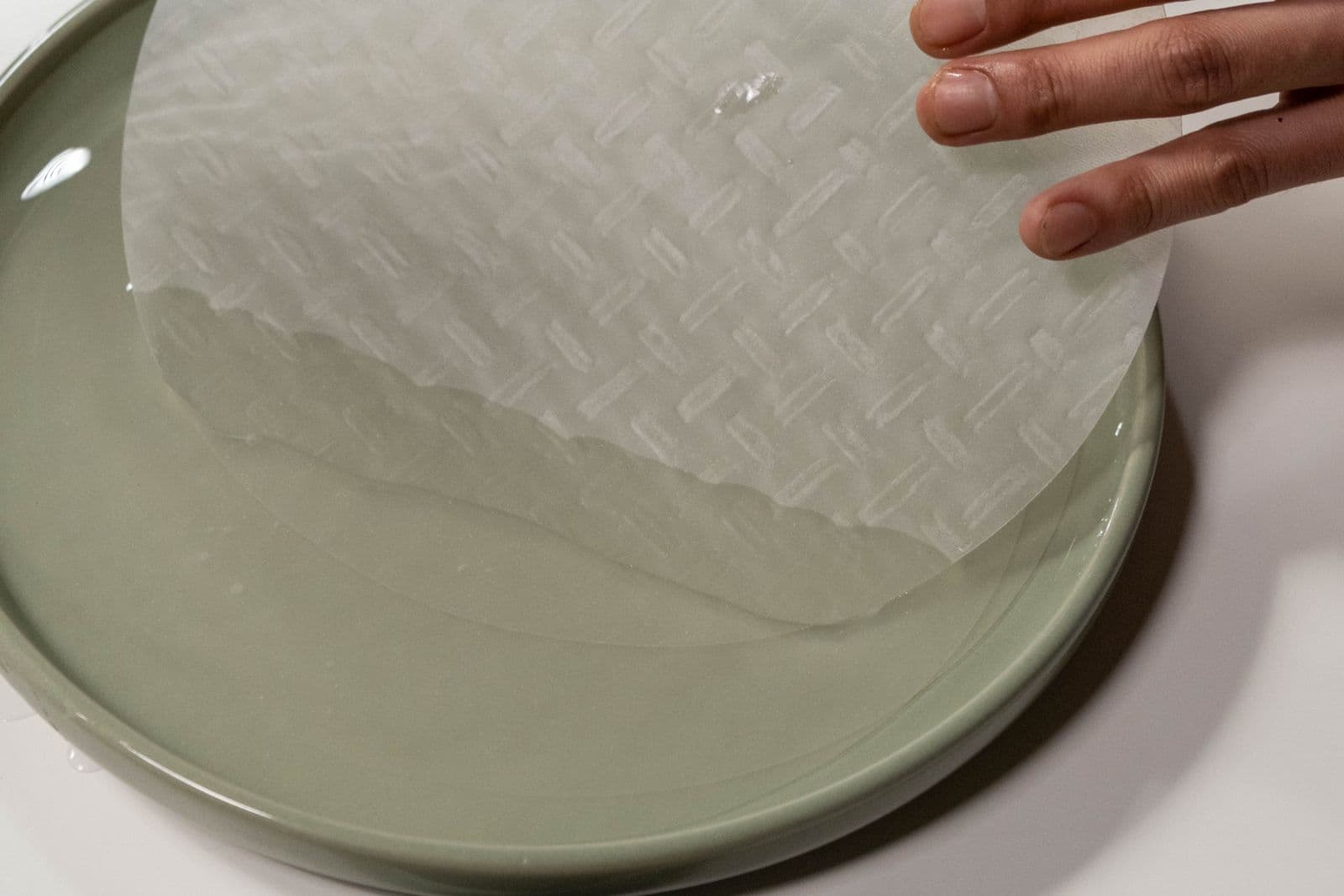
- Wet a sheet. Two seconds in the water, then straight onto a damp towel. It finishes softening on its own over the next half minute. A sheet left in the bowl turns to paste and tears at the first fold.
- Roll loosely. One tablespoon of filling on the lower third, fold the near edge over, tuck the sides, roll it up. Loosely is the operative word: the noodles swell and a tight roll splits in the oil.
- First fry. Oil at 160–175 °C, medium heat, 4–5 minutes to pale gold. Single layer, with gaps. Crowd the pan and the oil temperature drops, so the rolls soak up fat instead of sealing.
- Second fry. Turn the heat up and return them for 2–3 minutes, to deep gold. The first fry cooks the inside, the second builds the crust. Skip it and you get a pale, chewy tube that no wrapper can rescue.
Freezing a half-batch
After the first fry, cool the rolls, spread them in a single layer on a board, freeze, then bag them. They keep for a month. Thaw slightly and finish-fry before serving: two or three minutes on the stove, or in an air fryer.
The same logic applies to supermarket frozen rolls. They're usually fried once at the factory, so what they need at home is a short blast of high heat, not twenty patient minutes in the oven.
What a batch costs
Roughly, using Western grocery prices: rice paper $2–5, ground pork $3–5, shrimp $6–10, glass noodles and dried mushrooms $2–3, vegetables and eggs $3, fish sauce and oil amortised at $2. Call it $18–28 for 16–18 rolls, or about $1–1.60 each.
At a Vietnamese street stall the same roll costs $0.20–0.40. The gap is entirely about where shrimp and rice paper are local and where they're imported. On the other hand, a batch that feeds four still beats one restaurant order in London or Los Angeles.
Fresh rolls gỏi cuốn — recipe and assembly
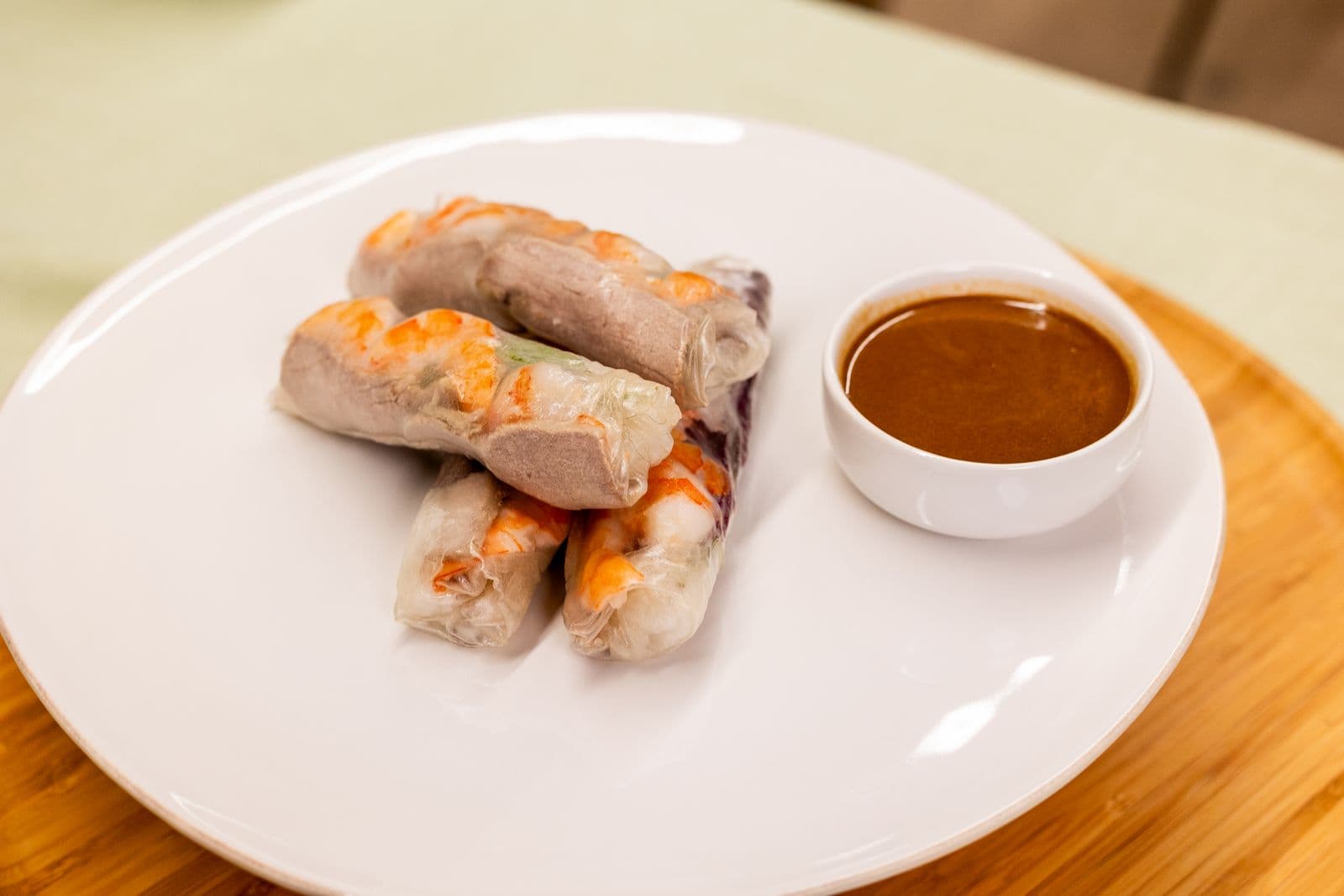
Fresh rolls aren't cooked, they're assembled. Everything inside is already done: shrimp boiled, pork boiled and sliced, vermicelli soaked, herbs washed. You wet the rice paper, lay out the filling and roll. No heat is involved at any point, which is why one roll comes in at 50–80 calories.
In 2011 CNN Go put gỏi cuốn at No. 30 on its list of the world's 50 most delicious foods. It got there for balance rather than novelty: sweet shrimp, lean pork, neutral vermicelli and aggressive fresh herbs in one bite.
What goes in
- Rice paper — 22 cm, the standard sheet sold everywhere
- Shrimp — boiled, halved lengthwise
- Pork — boiled belly, thinly sliced
- Bún — thin rice vermicelli, cooked and cooled
- Lettuce — soft leaf, no tough ribs
- Herbs — mint, coriander, Thai basil; the north adds perilla (tía tô) and fish mint (diếp cá), the south uses rau răm
North and south diverge here too. Southern rolls are sweeter and more filling: more vermicelli, gentler herbs. Northern ones are leaner and sharper. Fish mint in particular tends to stop first-timers cold — it has a distinct metallic edge.
How to roll one
- Dip the sheet in warm water for two seconds and lay it on a board, rough side up.
- Place two or three shrimp halves cut side down across the upper third, so they show through the wrapper in the finished roll. That's the only reason shrimp goes in separately.
- On the lower third: lettuce, vermicelli, pork, herbs. Keep it as a compact log.
- Fold the near edge over the filling, press, tuck the sides, and roll up to the shrimp.
Gluten-free and vegetarian, by default
Rice paper is rice flour and water, so both versions of the roll are naturally gluten-free. The catch is in the dip: hoisin sauce frequently contains wheat, and some brands of fish sauce add wheat-derived ingredients. If gluten matters, the fried roll with plain nước chấm is the safer order, and worth confirming with the cook.
The vegetarian version is genuinely Vietnamese rather than an accommodation. Buddhist observance means gỏi cuốn chay with fried tofu, mushrooms and carrot is on menus across the country. Say chay and you'll be understood. Dips may still be fish sauce based unless you ask.
What Vietnam doesn't put in them
Mango, avocado, crab sticks, cream cheese, salmon — all common in Western recipes, none of them street food in Vietnam. No harm done, they taste fine; they're just rice paper rolls in the spirit of gỏi cuốn rather than the thing itself. Mango in Vietnam is eaten on its own or in salads, and we have a guide to local fruit for that.
Fillings: the canon and the improvisations
The filling is the one place where these rolls tolerate improvisation. The wrapper, the soaking time and the oil temperature don't forgive much; what goes inside forgives nearly everything.
| Filling | Which roll | Authenticity | Watch out for |
|---|---|---|---|
| Pork + shrimp + wood-ear + glass noodles | Fried | Northern canon | The benchmark everything else is measured against |
| Pork + taro or jicama | Fried | Southern canon | Sweet and wet, squeeze the root vegetable |
| Chicken instead of pork | Fried | Exists as nem gà | Drier than pork, add a spoon of oil |
| Shrimp + vermicelli + herbs | Fresh | Southern canon | Shrimp cut side down so it shows |
| Tofu + mushrooms + carrot | Either | Buddhist vegetarian | Fry the tofu first or the filling weeps |
| Crab sticks | Fresh | Home invention | Works, but the flavour drifts toward salad |
| Cream cheese, salmon | Fresh | Not Vietnamese | Closer to Japanese plating than to Vietnam |
| Mango, avocado | Fresh | Not Vietnamese | Mango leaks; the roll gets soggy fast |
| Banana and condensed milk | Fried, sweet | Southeast Asian street dessert | Fry fast, sugar burns |
Three constraints hold whatever you improvise.
Dryness beats flavour. Anything going inside a fried roll must be squeezed. Cheese and juicy fruit release water under heat and split the wrapper from within — no rolling technique fixes that.
Cut small. A cube bigger than a centimetre will pierce the sheet as you roll. It matters even more for fresh rolls, where the wrapper never firms up and stays an elastic film.
One loud flavour. Vietnamese fillings are built on neutral components plus a single accent — the shrimp, or the pepper. Put cheese, chilli and mango in the same roll and nothing reads.
Sweet rolls are a real thing, incidentally: across Southeast Asia rice paper gets fried with banana and served with condensed milk. In Vietnam that usually turns into bánh tráng nướng with a sweet topping instead. For the rest of the local sweets, see our Vietnamese dessert guide.
Rice paper: which one, and where to buy it
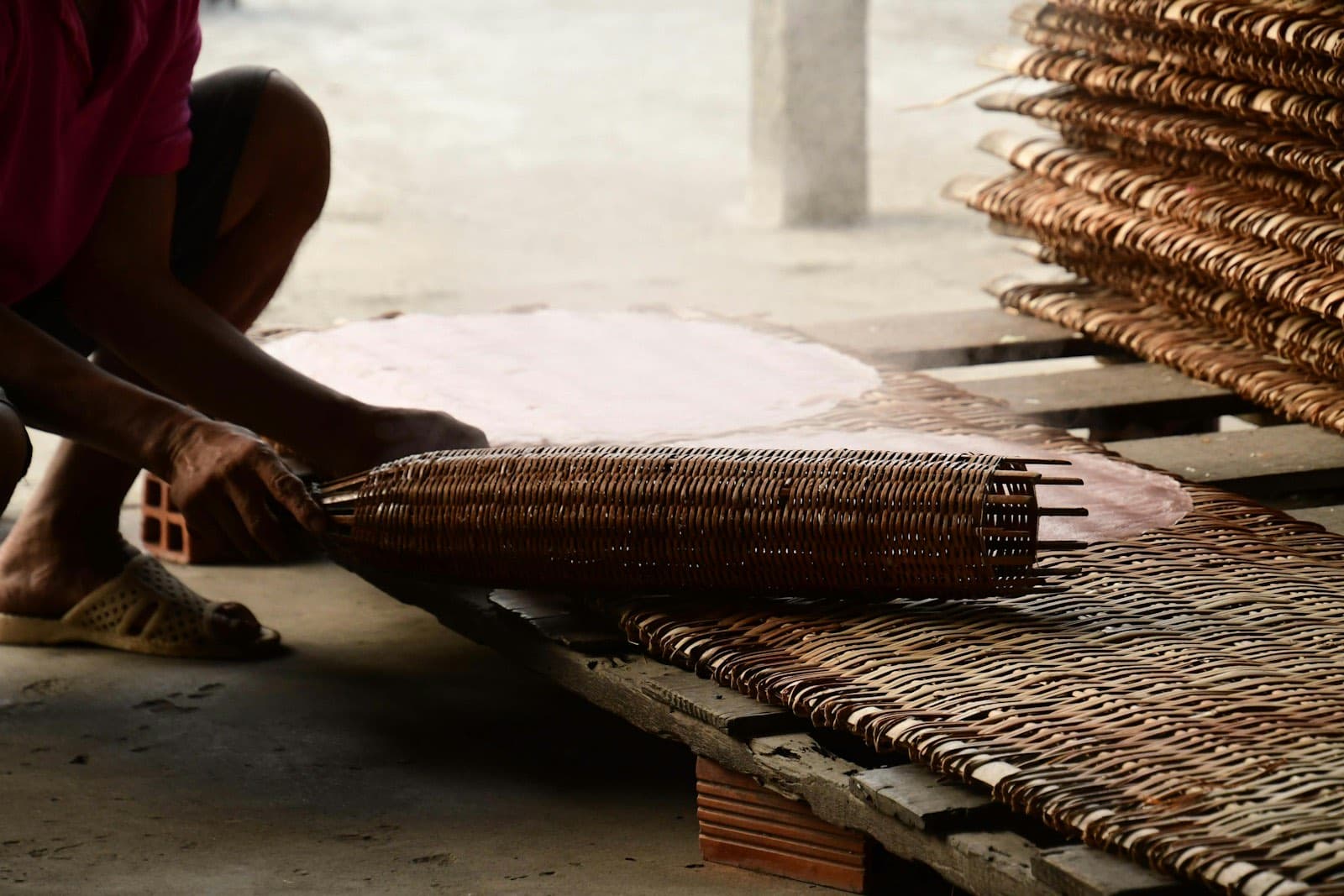
This section answers the question everyone who has fried rolls at home eventually asks: why is the crust rubbery instead of crisp?
Tapioca. Rice paper sold outside Vietnam almost always contains tapioca starch, which makes the sheet stronger and lets it sit in a cupboard for years. The price you pay is texture after frying: slightly chewy, slightly stretchy, never glassy. For fried rolls Vietnamese cooks reach for a different sheet, bánh đa nem, made of rice flour, water and salt only. It's thinner, more delicate, and not on a mainstream supermarket shelf.
| Type | Composition and thickness | Use for |
|---|---|---|
| Bánh tráng, 22 cm | Rice + tapioca, medium | Fresh rolls; the all-purpose sheet |
| Bánh đa nem, 16 cm | Pure rice, thin | Fried rolls; maximum crunch |
| Bánh tráng phơi sương | "Dew-dried", soft | Wrapping grilled meat with no soaking |
Where to buy it
| Where | What you'll find | Price |
|---|---|---|
| H Mart and similar Asian chains, US | Full Vietnamese aisle, several brands and diameters | $3–10 per pack |
| Safeway and mainstream US grocers | Rose brand, 12 oz, in the Asian specialty aisle | Supermarket pricing |
| UK Asian grocers and online: Longdan, Hello Oriental, Tuk Tuk Mart | Wide choice, 400 g packs | Roughly £2–4 |
| UK mainstream supermarkets | Stocked, but one brand and one size | Supermarket pricing |
| Any Vietnamese grocery | Ask for bánh đa nem by name | Cheapest, best selection |
Prices checked September 2026. Verify locally before you shop.
The practical rule: mainstream retail sells the 22 cm tapioca blend meant for fresh rolls. If you're frying, you want the thinner pure-rice sheet, and that means a Vietnamese or pan-Asian grocer rather than the supermarket.
If you can't find it
| Substitute | What you get | Honestly |
|---|---|---|
| Thin flatbread or lavash | Fries, crisps, holds together | Not authentic, but the best available stand-in |
| Crêpes | A Western adaptation | No crunch at all |
| Filo pastry | Crisper than the original | Shatters and flakes; the roll falls apart in your hand |
| Iceberg lettuce leaves | A low-carb take on fresh rolls | Slides apart; fork-and-plate only |
Storage. Keep the pack flat with nothing on top. A cracked sheet can't be repaired — it can only go into bánh tráng trộn, which we get to below.



Sauces: nước chấm for fried, peanut for fresh
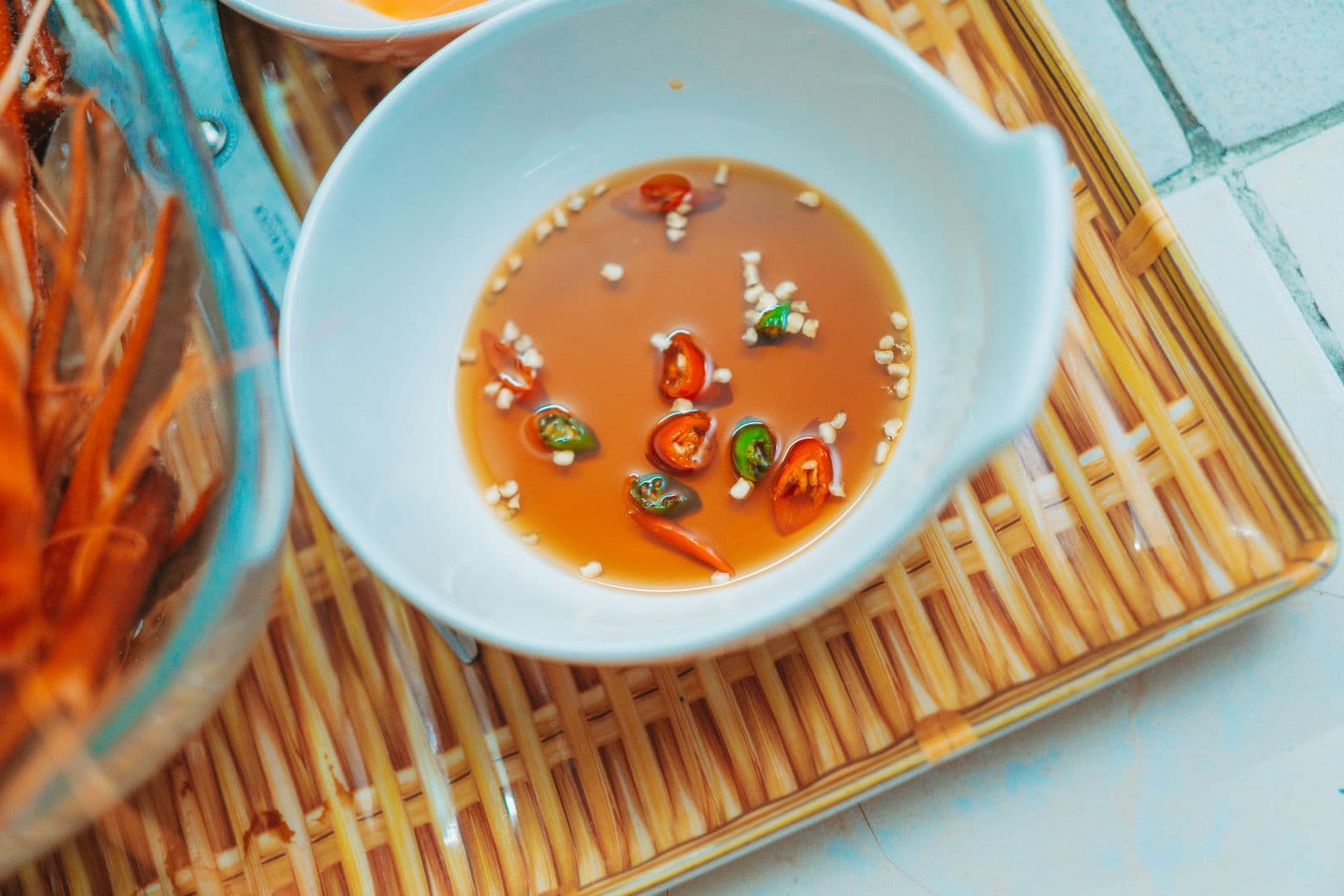
The rule is simple and non-negotiable: fried rolls take the fish sauce dip nước chấm, fresh rolls take the peanut-hoisin tương xay. Swap them and the whole thing falls out of balance.
Nước chấm for the fried version
The ratio Vietnamese cooks quote is 1:1:5 — fish sauce, sugar, water. In practice, for one small bowl:
- 2 tbsp fish sauce nước mắm
- 2 tbsp sugar
- 6 tbsp warm water
- 1.5 tbsp lime juice
- 2 cloves garlic, finely minced
- Chilli to taste, sliced or minced
Dissolve the sugar in warm water, add fish sauce and lime, then garlic and chilli last so they float. Street versions often throw in shredded carrot and green papaya, which pickle slightly and end up being a snack in their own right.
Treat the ratio as a starting point. Too strong? More water. Flat? More lime. Bland? More fish sauce.
Tương xay for the fresh version
Thick, sweet, peanut-based. Two routes:
On the stove. Fry 2 tbsp minced garlic in 2 tbsp oil until fragrant, add 8 tbsp hoisin, 2–3 tbsp peanut butter and 120 ml water, and warm through. Top with crushed roasted peanuts.
In a blender. Same ingredients without the frying, plus a splash of vinegar and sriracha to taste, blitzed smooth.
What usually doesn't come with Vietnamese rolls is soy sauce. It's Chinese and Japanese; here the salty backbone is fish sauce. Where to buy the good stuff without overpaying is in our guide to Vietnamese markets and haggling.
Five reasons rolls fall apart
Almost every failure comes down to five things, and none of them is talent.
- The sheet sat in the water too long. Two seconds is the limit. It feels too short — it isn't; the softening continues on the board. Soak it until it's fully pliable in the bowl and you get a sticky film that tears on contact.
- Wrong wrapper. A thick tapioca sheet gives a chewy fried crust; a thin rice sheet under a fresh roll tears from the weight. Diameter matters too: a 22 cm sheet holds more filling than its seam can survive.
- Overfilled and rolled tight. Glass noodles swell with heat and a tight roll splits in the oil. One tablespoon per sheet is the ceiling, and roll firmly without tension.
- Crowded pan. Six rolls instead of three drops the oil temperature by tens of degrees; the crust never sets and the wrapper starts drinking fat. They stick together and tear when you separate them.
- Filling wasn't squeezed. Water from mushrooms, noodles and sprouts turns to steam and bursts the wrapper from inside. Squeeze everything wet, by hand, not by shaking a colander.
One more thing that isn't a mistake but catches people out: fresh rolls need to be eaten within the hour. The wrapper dries, tightens and goes leathery. You can hold them in the fridge under cling film, but it's a compromise.
Air fryer, oven and the alternatives
Deep frying isn't the only option, though it is the best one. Here's the honest picture.
| Method | Setting | Result |
|---|---|---|
| Deep fry | 160–175 °C, then high heat | The benchmark: even, blistered crust |
| Shallow fry, 1.5–2 cm oil | Medium heat, turning | About 90% of the result, half the oil |
| Air fryer | 180–190 °C, 10–12 min, brushed with oil | Drier and paler, but it does crisp |
| Oven | 200 °C, 20–25 min | Worst option: the sheet dries before it browns |
The air fryer has one condition attached: brush every roll with oil on all sides or the wrapper won't colour, it'll just shrivel into parchment. Single layer, with air moving between them.
Use the oven only if frying is off the table for you. What comes out is dry rather than crisp, and the difference is not subtle.
Bánh tráng — when the rice paper is the dish
The fourth face of this topic: in Vietnam rice paper works as a wrapper and as a product in its own right. Several street dishes are built from it.
| Dish | What it is | Where to find it | Price |
|---|---|---|---|
| Bánh tráng nướng | "Vietnamese pizza": a sheet over charcoal with quail egg, spring onion, dried shrimp, mayo and chilli | Da Lat, Saigon | 15,000–30,000 ₫ ($0.60–1.20) |
| Bánh tráng trộn | Shredded rice paper tossed with dried beef, green mango, peanuts, quail eggs and satay sauce | Saigon | 15,000–25,000 ₫ ($0.60–1.00) |
| Bánh tráng phơi sương | "Dew-dried" soft sheets used to wrap grilled meat without soaking | Trang Bang, Tay Ninh province | Comes with the meat set |
Banh trang nuong is cooked on a small charcoal brazier, held on a grate and cut with scissors straight into a paper cone. Da Lat in the evening smells of exactly this: charcoal, egg, chilli. Banh trang tron is sold from a cart in a plastic cup, and it is the most teenage food in Vietnam — sweet, sour, hot and crunchy at once.
Both live on evening streets, which we mapped in the night markets guide.
What to order in Vietnam and what it costs
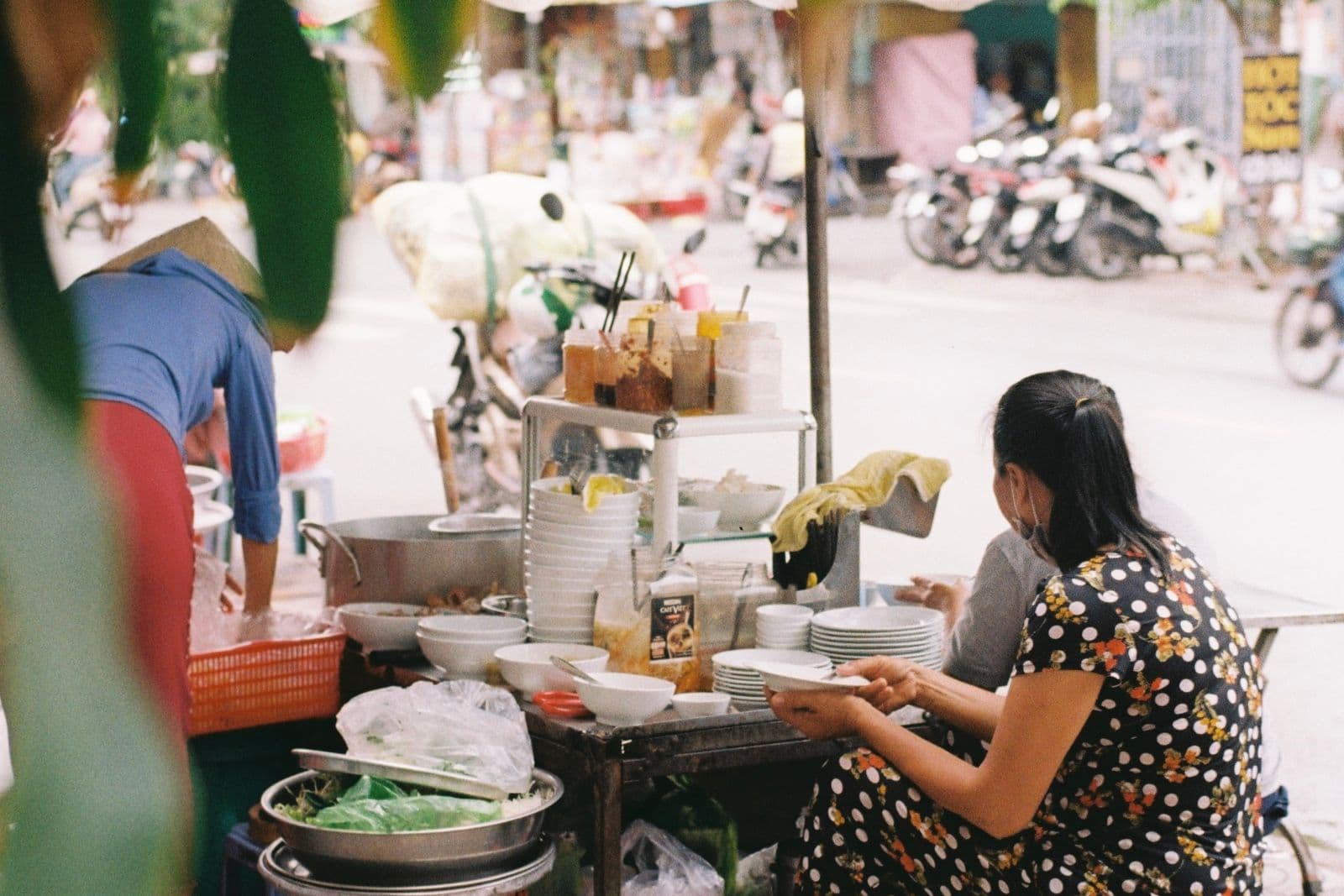
Rolls are among the cheapest things on a Vietnamese street. One fresh roll at a stall runs 5,000–10,000 ₫, about $0.20–0.40. A plate of three or four costs 15,000–40,000 ₫. In Hanoi, five or six will be 50,000–70,000 ₫.
| Item | ₫ | ~$ |
|---|---|---|
| Single fresh roll | 5,000–10,000 | 0.20–0.40 |
| Portion of 3–4 fresh rolls | 15,000–40,000 | 0.60–1.60 |
| Portion of 5–6 rolls, Hanoi | 50,000–70,000 | 2.00–2.80 |
| Fried nem, one portion | 25,000–50,000 | 1.00–2.00 |
| Bánh tráng nướng | 15,000–30,000 | 0.60–1.20 |
| Bánh tráng trộn | 15,000–25,000 | 0.60–1.00 |
| Same items in a tourist quarter | +20–30% | — |
Accurate as of September 2026. Rate used: 1 USD ≈ 26,000 ₫. Live conversion is on our Vietnam prices page.
The gap between tourist and residential streets is wider than you'd guess. In Phạm Ngũ Lão, Saigon's backpacker strip, a plate of rolls goes for $3–5; at neighbourhood markets the same plate is $1.50–3. Hanoi's Old Quarter carries a 20–30% premium over residential streets. The rule holds nationwide: walk two blocks away from the English signage.
Bring small notes. Street stalls are cash-only, and a 500,000 ₫ note at a roll cart is a problem rather than a payment.
Where to find what
| City | What to order | What arrives |
|---|---|---|
| Hanoi | nem rán, usually alongside bun cha | Small crisp rolls, shared bowl of sauce |
| Saigon | chả giò, gỏi cuốn, bánh tráng trộn | Larger fried rolls, fresh shrimp rolls, rice paper salad |
| Nha Trang | nem nướng | Not rolls: grilled sausages you wrap yourself |
| Da Lat | bánh tráng nướng | Charcoal-grilled sheet with egg, eaten standing up |
How they're eaten
A fried roll is picked up with chopsticks, laid on a lettuce leaf with mint or coriander, wrapped and eaten whole after a dip. Cutting it with a knife isn't a thing, and street places won't have one anyway. Fresh rolls are eaten by hand, dipping one end in the peanut sauce.
A shared bowl of sauce on the table is normal. You get your own only if you ask.
Is street food here safe?
Fried rolls: yes, with almost no caveat. They come out of hot oil and reach your plate within a minute. Just look at the oil itself — dark and murky, with a pile of rolls sitting under a lamp for an hour, means walk on and find a stall frying to order.
Fresh rolls are a finer judgement. Nothing has been heated, so it comes down to how the herbs and vermicelli were washed. High-turnover stalls are safer because nothing sits. Pre-made rolls under cling film in the sun since morning are a bad bet anywhere on earth.
General rules for picking a stall, plus ice, water and what to do if it does go wrong, are in the Vietnamese street food guide.
Our pick
If you only have room for three, these cover the whole topic:
- Fried nem rán in Hanoi, served with bun cha. The northern benchmark, and the thing to measure your home attempts against
- Gỏi cuốn from a Saigon street cart. $0.60–1.60 a plate, and the most honest version of the fresh roll you'll get
- Bánh tráng nướng in Da Lat after dark. Not a roll at all, but it's the dish that makes you understand rice paper as an ingredient rather than packaging
Ordering phrases
| What you want | Vietnamese | Roughly |
|---|---|---|
| One portion of fried nem | Một suất nem rán | mot swat nem zan |
| Fresh rolls | Gỏi cuốn | goy kwon |
| Vegetarian, no meat | Chay | chai |
| Not spicy | Không cay | khong kai |
| No peanuts | Không đậu phộng | khong dow fong |
| The bill, please | Tính tiền | ting tien |
Calories and lighter versions
The fresh roll is one of the rare cases where "healthy" and "good" don't need a caveat.
| Version | Calories each | Where they come from |
|---|---|---|
| Fresh, with shrimp | 50–80 | Rice paper and vermicelli |
| Fresh, vegetarian with tofu | 45–70 | Same, minus the animal protein |
| Fried | Substantially higher | Absorbed oil |
| Plate of 2–3 fresh rolls | 150–200 | — |
No honest number exists for the fried roll: it depends entirely on how much oil the wrapper took up, which in turn depends on frying temperature. That's the other argument for double frying — a crust that sets fast acts as a barrier.
Lighter variations that actually work:
- Fresh rolls with shrimp only, no pork, heavier on vegetables and herbs
- More vegetables and less vermicelli in the filling
- Tofu instead of meat, with the peanut sauce thinned with extra water
- Iceberg lettuce instead of rice paper — no longer a roll, but close in spirit
Baking instead of frying and expecting the same dish does not work. You get something else, with a different texture.
Where to eat them outside Vietnam
Vietnamese restaurants in most Western cities carry both versions, usually listed as "spring rolls" and "summer rolls" or "rice paper rolls". Two things worth knowing before you order.
First, the fresh roll on a Western menu is often much larger and heavier on vermicelli than its Vietnamese original — closer to a salad in a wrapper. Second, the fried roll is sometimes made with a wheat wrapper, which is the Chinese-American version. If the crust looks bubbled and glassy it's rice paper; if it's smooth and pastry-like it isn't.
Supermarket frozen rolls are a compromise, and they're usually factory-fried once. Give them a short blast of high heat at home rather than twenty minutes in the oven, and they'll be respectable. The same logic as pho bo: the version abroad costs more and tastes less, because everything in it travelled.
FAQ
No. The wrapper is the tell: Vietnamese rolls use rice paper, Chinese ones use a wheat wrapper. The term itself is Chinese in origin — 春卷, "spring rolls" made for the spring festival — but the dish most Western menus serve under that name is Vietnamese. Vietnamese menus don't use the phrase at all; they write nem rán, chả giò or gỏi cuốn.
"Summer roll" is an American restaurant coinage for the fresh, unfried version — gỏi cuốn — invented precisely because "spring roll" had come to mean the deep-fried one. Australians call the same thing a rice paper roll, Canadians often a salad roll. In Vietnamese there's no such split: the north says nem cuốn and the south gỏi cuốn.
The thin, pure-rice sheet with no tapioca starch, called bánh đa nem in Vietnam, usually 16 cm across. Standard supermarket rice paper nearly always contains tapioca: sturdier and longer-lasting, but it fries to a chewy crust rather than a crisp one. Look for the thin version at Vietnamese or pan-Asian grocers rather than a mainstream supermarket.
Usually it soaked too long — two seconds is the limit, after which the sheet turns to film. The second cause is wet filling: unsqueezed mushrooms, noodles and sprouts release water that softens the wrapper from inside. The third is coarse chopping; a thick carrot baton or a long noodle strand will spear the sheet as you roll. Wet it, lay it on a damp towel and let it finish softening while you gather the filling.
Rice paper is rice flour and water, so the wrapper is. The risk sits in the sauces: hoisin, the base of the peanut dip for fresh rolls, frequently contains wheat, and some fish sauce brands add wheat derivatives. If you're coeliac, the safer order is the fried roll with plain nước chấm, and it's still worth confirming with the kitchen.
Fried rolls take nước chấm: fish sauce, sugar and water at 1:1:5, plus lime, garlic and chilli. Fresh rolls take tương xay, built on hoisin and peanut butter, topped with crushed peanuts. Soy sauce usually doesn't come with Vietnamese rolls — that's a Chinese and Japanese habit. If you have a peanut allergy, order the fried version.
A fresh shrimp roll is 50–80 calories depending on the filling, and a plate of two or three lands at 150–200. The tofu version comes in slightly lighter at 45–70. Fried rolls are substantially higher and cannot be pinned to a number, because it all depends on how much oil the wrapper absorbed. Double frying at the right temperature reduces that absorption.
It depends on the city. In Hanoi you'll get fried rolls. In Nha Trang it's almost certainly nem nướng, grilled pork sausages you wrap yourself. In Thanh Hoa or Lai Vung it means nem chua, fermented raw pork eaten with no cooking at all. If you're unsure, ask "nem rán?" and mime frying. That works anywhere in the country.
Read next: Pho bo · Banh mi · Banh xeo · Bun cha
Accurate as of September 2026. Prices and conditions change — check official sources before you travel.
- Food
Saigon Food Tour 2026 with a Private Local Guide
Saigon food tour 2026 with local guide Denny: 11 or 8 tastings from ~$39. Book a vetted English-speaking private guide through VietnamSpot.Saigon Food Tour 2026 with a Private Local Guide - Food
Mi Quang 2026: Da Nang and Hoi An Noodles, Where to Eat
Mi Quang, central Vietnam's turmeric noodles: what goes in the bowl, how to eat it, 12 places in Da Nang and Hoi An with 2026 prices in VND and USD.Mi Quang 2026: Da Nang and Hoi An Noodles, Where to Eat - Food
Vung Tau Food Guide 2026: Seafood, Banh Khot, Prices
What to eat in Vung Tau: banh khot, Long Son oysters, stingray hotpot. Seven restaurants, the Xom Luoi fish market, prices in USD, one-day route.Vung Tau Food Guide 2026: Seafood, Banh Khot, Prices